- Base Value(2025): 9.8 Bn
- Estimated Value(2026): 11.6 Bn
- Forecast Value (2036): 52.4 Bn
- CAGR (2026 - 2036): 16.2%
Battery Management System Control Unit Platforms Market Forecast and Outlook By Fact.MR
- In 2025, the battery management system control unit platforms market was valued at USD 9.8 billion.
- Based on Fact.MR analysis, demand for BMS control unit platforms is estimated to grow to USD 11.6 billion in 2026 and USD 52.4 billion by 2036.
- FACT.MR projects a CAGR of 16.2% during the forecast period.
.webp "Image (5)")
Image (5) | Source: Fact.MR
| Metric | Value |
|---|---|
| Estimated Value in 2026 | USD 11.6 billion |
| Forecast Value in 2036 | USD 52.4 billion |
| Forecast CAGR (2026 to 2036) | 16.2% |
Source: Fact.MR analysis. Updated May 9, 2026
Summary of Battery Management System Control Unit Platforms Market
- Market Definition
- Market covers electronic BMS hardware and embedded software platforms that monitor, control, and protect battery packs across EV, energy storage, and industrial applications globally.
- Demand Drivers
- Global electric vehicle production expansion is increasing BMS platform demand. OEM electrification commitments across Europe, China, and North America are accelerating centralized BMS adoption.
- ISO 26262 and IEC 62619 functional safety mandates are driving BMS hardware upgrades. Compliance requirements are increasing embedded software content per platform.
- Grid-scale BESS deployment is expanding industrial BMS demand. Renewable integration targets in China, the U.S., and Europe are creating sustained procurement volumes.
- Key Segments Analyzed
- By Platform Type: Centralized BMS control units lead with approximately 40% share in 2026. OEM standardization and cost efficiency support this position.
- By Component: Hardware control units (MCU + sensing ICs) lead with approximately 45% share in 2026. High integration complexity and safety certification requirements drive value concentration.
- By Battery Type: Lithium-ion battery systems hold approximately 75% share in 2026. LFP and solid-state systems are emerging segments gaining share.
- Analyst Opinion at FACT.MR
- Shambhu Nath Jha, Principal Consultant at Fact.MR, opines, ‘CXOs will find that platform-level consolidation is the defining competitive dynamic. Vendors combining certified hardware with proprietary algorithms are capturing a disproportionate share of OEM programme awards.’
- Strategic Implications
- Invest in ISO 26262 ASIL-D certified BMS hardware development. Compliance is a prerequisite for Tier-1 OEM qualification in Europe and North America.
- Expand modular BMS platform offerings targeting second-life and stationary storage. This unlocks post-automotive demand from grid operators and industrial users.
- Develop embedded software and algorithm layers as proprietary differentiators. Hardware commoditisation is accelerating; software-defined BMS features command higher margins.
- Methodology
- Market sizing is based on OEM BMS procurement volumes and semiconductor shipment data. Validated using EV production schedules and energy storage project pipelines.
- Incorporates IEA EV Outlook, USABC technical data, and national EV policy databases. Includes subsidy programme analysis across China, USA, Germany, and India.
- Forecasts consider OEM electrification timelines and safety certification adoption rates. Supported by expert inputs from embedded systems and power electronics specialists.
Between 2026 and 2036, the market is projected to generate an absolute opportunity of USD 40.8 billion. Growth is structurally anchored in EV production scale-up, grid-scale energy storage deployment, and tightening ISO 26262 and IEC 62619 functional safety mandates. Adoption is fastest in markets with consolidated EV supply chains, while industrial and stationary storage applications offer incremental but stable volume.
Regionally, China is projected to record the fastest CAGR of 17.8% through 2036, underpinned by CATL and BYD domestic ecosystem dominance. India follows at 17.2%, accelerated by PLI scheme-linked EV manufacturing investment. South Korea grows at 16.7%, driven by LG Energy Solution and Samsung SDI integrated BMS supply chains. The United States records 15.9%, supported by IRA battery manufacturing credits and OEM-semiconductor co-development. Germany grows at 15.4%, shaped by premium OEM electrification and UNECE R100 compliance. Japan records 14.8%, driven by a structured hybrid-to-BEV transition and established power electronics ecosystems.
Segmental Analysis
Battery Management System Control Unit Platforms Market Analysis by Platform Type
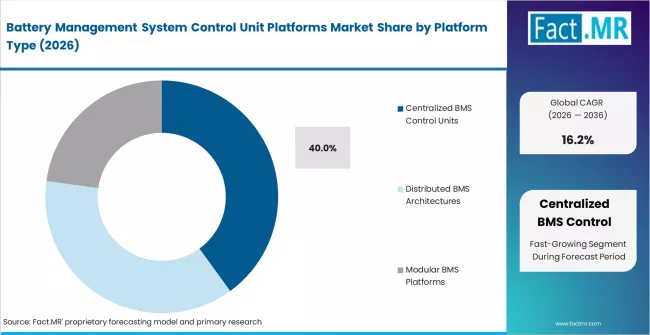
Battery Management System Control Unit Platforms Market Analysis By Platform Type | Source: Fact.MR
Based on FACT.MR analysis, centralized BMS control units hold approximately 40% share in 2026. They lead due to lower per-unit cost and compatibility with established OEM electrical architectures. Automotive-grade integration and single ECU simplicity support adoption across mass-market EV programmes.
- Bosch BMS Platform Investment: Robert Bosch GmbH disclosed a EUR 250 million investment in BMS hardware production capacity in Reutlingen, Germany in Q2 2024. The expansion targets centralized BMS units for European OEM programmes compliant with ISO 26262 ASIL-D requirements [4].
- Continental Distributed Architecture Development: Continental AG launched a new distributed BMS architecture in Q4 2024 targeting large-format truck and bus battery packs. The platform supports cell-level monitoring across 400V and 800V architectures and integrates with V2G communication protocols [5].
- Modular BMS Adoption in BESS: Infineon Technologies reported a 28% year-over-year increase in BMS IC shipments for stationary storage applications in FY2024. Growth is concentrated in modular rack-scale BESS units for commercial and utility-scale deployments across Europe and the U.S. [6].
Battery Management System Control Unit Platforms Market Analysis by Component
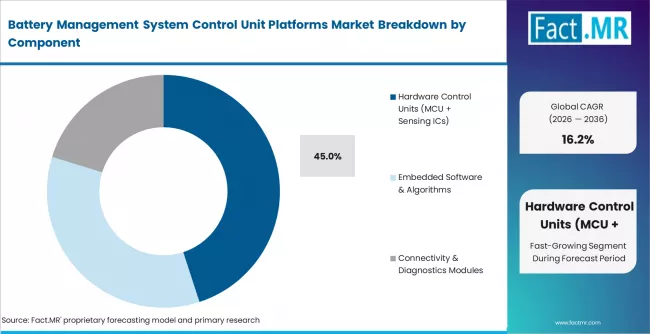
Battery Management System Control Unit Platforms Market Analysis By Component | Source: Fact.MR
Based on FACT.MR analysis, hardware control units (MCU + sensing ICs) hold approximately 45% share in 2026. High integration complexity, automotive-grade certification, and ASIL compliance requirements concentrate value in hardware. Embedded software and diagnostics modules are growing faster as OEMs demand over-the-air update capability and predictive state-of-health algorithms.
- NXP Automotive BMS IC Launch: NXP Semiconductors launched the MC33775A battery cell controller IC in Q1 2025 targeting automotive BMS designs. The IC supports ISO 26262 ASIL-D compliance, 14-cell measurement, and daisy-chain communication for high-voltage EV pack architectures [1].
- Texas Instruments Software Algorithm Expansion: Texas Instruments released an updated BMS algorithm library for state-of-charge and state-of-health estimation in January 2025. The library supports Kalman filter-based SOC estimation for LFP and NMC chemistries across automotive and industrial applications [2].
- Connectivity Module Demand Trend: Denso Corporation disclosed expanded BMS connectivity module production in Q3 2024, including CAN FD and LIN bus integration for hybrid and BEV platforms. Shipment volumes grew 19% year-over-year driven by Toyota and Daihatsu electrification programmes [7].
Drivers, Restraints, and Opportunities
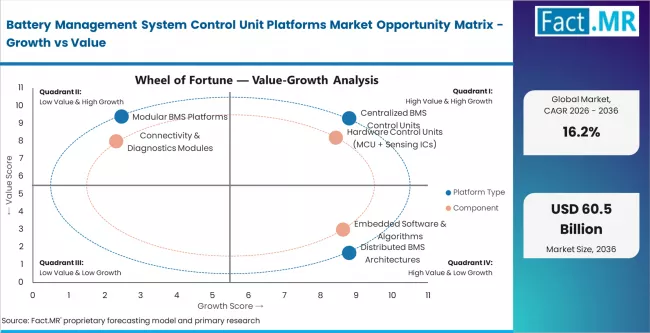
Battery Management System Control Unit Platforms Market Opportunity Matrix Growth Vs Value | Source: Fact.MR
FACT.MR analysis indicates that the BMS control unit platforms market is structurally tied to EV production volumes and energy storage capacity additions. Demand is no longer a niche industrial requirement. It is an embedded requirement within EV powertrain architectures, mandated by both OEM specifications and regulatory safety standards.
Centralized BMS architectures are the current dominant design, though distributed and modular platforms are gaining share in high-cell-count applications. Standard platforms are under pricing pressure from semiconductor integration. Value is migrating toward embedded software, algorithm libraries, and cloud-connected diagnostics. Companies offering hardware-software integrated stacks are commanding higher margins.
- EV Safety Regulation Mandate: UNECE Regulation No. 100 (Rev. 3, 2024) and EU Battery Regulation (2023/1542) require real-time cell monitoring and thermal runaway detection. These mandates are directly expanding BMS hardware and software content per vehicle. NXP Semiconductors expanded its automotive-grade BMS IC portfolio in Q3 2024 to address compliance requirements across European OEM programmes.
- IRA Battery Manufacturing Credit: The U.S. Inflation Reduction Act Section 45X provides up to USD 35 per kWh for domestically produced battery components including BMS modules. Texas Instruments announced expanded Austin, Texas BMS microcontroller production in January 2025 to serve IRA-eligible domestic OEM programmes
- China NEV Supply Chain Integration: China's NEV industry plan mandates domestic BMS content thresholds for subsidy eligibility. CATL's 2024 annual report disclosed proprietary BMS chip development, shifting from third-party MCU sourcing toward vertically integrated BMS silicon. This is reshaping competitive dynamics for international BMS component suppliers [3].
Regional Analysis
The BMS control unit platforms market is assessed across Asia Pacific, North America, Europe, Latin America, and Middle East and Africa, covering 40+ countries with distinct demand profiles shaped by EV production mandates, semiconductor supply chains, and energy storage investment programmes. The full report offers market attractiveness analysis by region and country.
.webp "Top Country Growth Comparison Battery Management System Control Unit Platforms Market Cagr (2026 2036)")
Top Country Growth Comparison Battery Management System Control Unit Platforms Market Cagr (2026 2036) | Source: Fact.MR
| Country | CAGR (2026 to 2036) |
|---|---|
| China | 17.8% |
| India | 17.2% |
| South Korea | 16.7% |
| United States | 15.9% |
| Germany | 15.4% |
| Japan | 14.8% |
Source: Fact.MR analysis. Updated May 9, 2026
Source: Fact.MR (FACT.MR) analysis, based on proprietary forecasting model and primary research
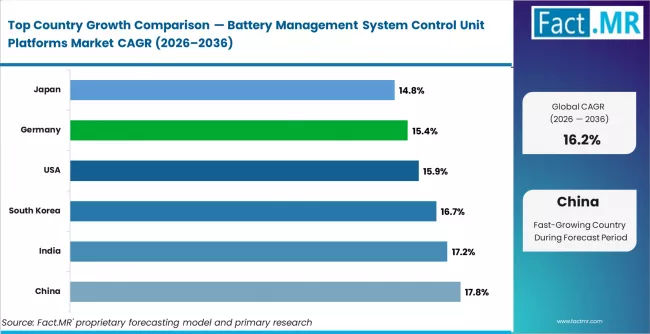
Battery Management System Control Unit Platforms Market Cagr Analysis By Country | Source: Fact.MR
North America Battery Management System Control Unit Platforms Market Analysis
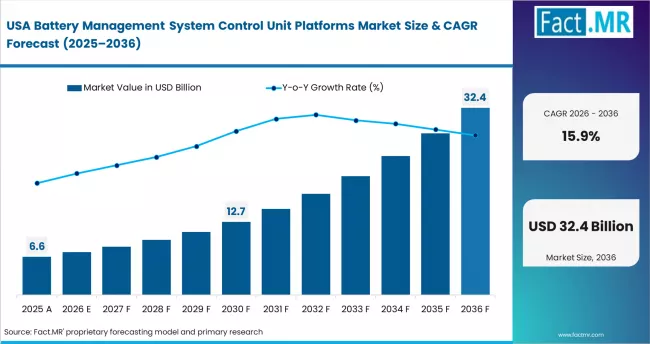
Battery Management System Control Unit Platforms Market Country Value Analysis | Source: Fact.MR
North America is an investment-led BMS innovation hub. IRA incentives are restructuring domestic supply chains. Demand is concentrated in United States and expanding in Canada. Texas Instruments and NXP Semiconductors maintain strong semiconductor positioning. OEM electrification pipelines are directly shaping BMS platform procurement.
- United States: Policy-backed manufacturing and OEM electrification support 15.9% CAGR through 2036. IRA Section 45X is accelerating domestic BMS production localisation. Texas Instruments expanded MCU output in Austin to align with IRA-compliant programmes. General Motors mandates ASIL-D BMS under its Ultium platform. Qualification cycles are tightening as safety and OTA readiness become baseline requirements. Software-enabled BMS features are also beginning to influence procurement decisions.
FACT.MR covers United States, Canada, and Mexico. It includes IRA credit impacts, OEM platform pipelines, and semiconductor sourcing trends.
Asia Pacific Battery Management System Control Unit Platforms Market Analysis
Asia Pacific anchors global BMS production and technology integration. China and South Korea lead vertically integrated ecosystems. India is emerging as a localisation-driven growth market. The region combines captive OEM BMS systems with independent platform vendors.
- China: Policy-driven scale and vertical integration support 17.8% CAGR through 2036. CATL is integrating proprietary BMS chips and algorithms, reducing reliance on imported semiconductors. Ministry of Industry and Information Technology mandated real-time monitoring and fault isolation in 2024. This is driving both new platform demand and retrofit upgrades. Domestic OEM ecosystems provide predictable, high-volume procurement pipelines.
- South Korea: Integrated battery-to-BMS ecosystem supports 16.7% CAGR through 2036. LG Energy Solution is investing heavily in algorithm-led BMS platforms. Samsung SDI is advancing solid-state battery monitoring capabilities. Tight integration across cell, pack, and BMS layers reduces time-to-market and improves performance consistency.
- India: Localisation-led growth supports 17.2% CAGR through 2036. Government PLI schemes include BMS hardware localisation incentives. Tata Motors and Mahindra & Mahindra are expanding domestic supplier qualification. State EV policies reinforce local sourcing advantages. Cost-optimised BMS design is emerging as a key differentiator in this market.
- Japan: Technology-transition-driven growth supports 14.8% CAGR through 2036. Toyota is advancing solid-state battery programmes requiring next-generation BMS platforms. Denso Corporation is expanding BMS module and connectivity production. Transition from hybrid dominance to BEV architectures is increasing system complexity and redesign demand.
FACT.MR covers China, India, Japan, South Korea, ASEAN, and Australia. It includes OEM procurement patterns, localisation trends, and semiconductor shipment data.
Europe Battery Management System Control Unit Platforms Market Analysis
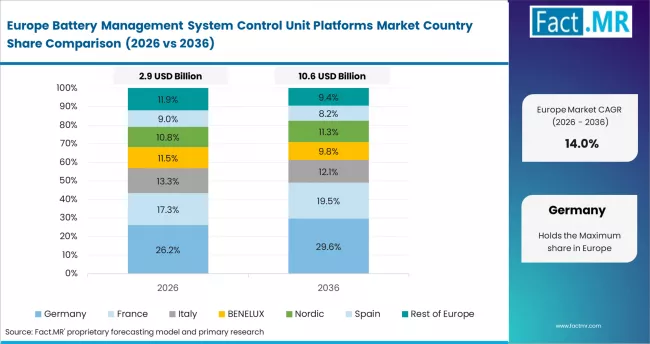
Battery Management System Control Unit Platforms Market Europe Country Market Share Analysis, 2026 & 2036 | Source: Fact.MR
Europe is the regulatory benchmark shaping global BMS standards. EU Battery Regulation and UNECE R100 create strict compliance requirements. Robert Bosch and Continental AG lead through deep OEM integration. Premium OEM electrification is increasing per-vehicle BMS value.
- Germany: Regulation-driven adoption supports 15.4% CAGR through 2036. EU Battery Regulation mandates battery data transparency and state-of-health tracking. Robert Bosch expanded production capacity in 2024. Volkswagen Group SSP platform mandates advanced ASIL-D BMS systems. Compliance requirements are increasing software and diagnostics content per unit.
FACT.MR covers Germany, United Kingdom, France, Italy, Spain, and Nordic countries. It includes compliance timelines and OEM procurement pipelines.
Latin America Battery Management System Control Unit Platforms Market Analysis
Latin America is an early-stage but policy-supported market. Brazil leads due to EV assembly investments and localisation mandates. Demand is linked to global OEM platform expansion into the region.
- Brazil: Incentive-backed adoption supports gradual growth through 2036. Mover Programme mandates local BMS integration. Volkswagen Group and Stellantis confirmed EV assembly programmes. Procurement pipelines are aligned with 2026 production timelines. Market growth is tied to localisation and OEM rollout schedules.
FACT.MR covers Brazil, Argentina, Chile, Mexico, and Rest of Latin America. It includes policy incentives and OEM localisation strategies.
Middle East and Africa Battery Management System Control Unit Platforms Market Analysis
Middle East and Africa is an infrastructure-led adoption region. Grid-scale energy storage and pilot EV programmes are the primary drivers. South Africa anchors automotive-linked demand.
- South Africa: Dual automotive and energy demand supports gradual growth through 2036. BMW and Ford maintain assembly operations with electrification plans. REIPPP projects are driving industrial BMS deployment. The market combines vehicle and stationary storage demand, creating a hybrid growth model.
FACT.MR covers Saudi Arabia, Israel, South Africa, Turkey, GCC, and Rest of MEA. It includes infrastructure investment trends and electrification timelines.
Competitive Aligners for Market Players
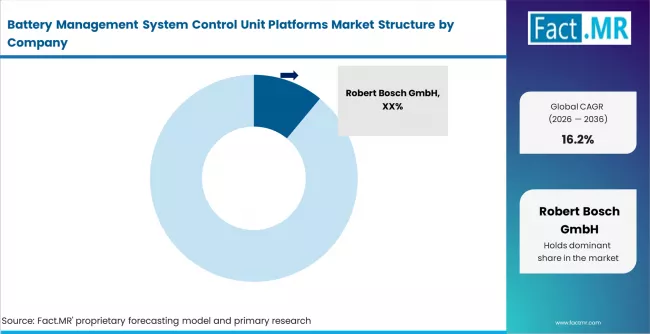
Battery Management System Control Unit Platforms Market Analysis By Company | Source: Fact.MR
Competitive aligners in the battery management system control unit platforms market are increasingly centered on platform integration, safety certification, and algorithm ownership. Vendors are no longer competing on basic cell monitoring hardware. The market is shifting toward full-stack solutions that combine hardware, embedded software, and predictive analytics within a unified platform.
A key competitive factor is early alignment with OEM electrification roadmaps. Suppliers that secure design wins at the platform development stage gain long-term revenue visibility. Companies such as Robert Bosch and Continental AG benefit from deep OEM integration and established validation pipelines. These relationships create high switching barriers once a BMS platform is locked into a vehicle architecture.
Functional safety and compliance capability are also critical differentiators. ISO 26262 ASIL-D certification is becoming a baseline requirement. Vendors that can deliver pre-certified platforms reduce OEM validation timelines and improve procurement success rates. Semiconductor partnerships with players like NXP Semiconductors and Texas Instruments further strengthen platform credibility and performance.
Software capability is emerging as the primary value layer. Advanced algorithms for state-of-charge, state-of-health, and predictive diagnostics are enabling higher battery efficiency and longer lifecycle performance. This is particularly important as second-life battery applications gain traction. Vendors with proprietary software stacks are capturing higher-margin contracts and recurring revenue opportunities. Geographic localisation is another important lever. Suppliers investing in local manufacturing and engineering in China and India are improving access to fast-growing OEM programmes. The market favours vendors that combine certified hardware, advanced software, and early OEM integration into scalable platform offerings.
Key Players
- Robert Bosch GmbH
- Continental AG
- Denso Corporation
- LG Energy Solution
- CATL (Contemporary Amperex Technology Co. Limited)
- NXP Semiconductors N.V.
- Texas Instruments Incorporated
- Infineon Technologies AG
Bibliography
- [1] NXP Semiconductors N.V. (Q1 2025). Product Launch: MC33775A Automotive Battery Cell Controller IC for ISO 26262 ASIL-D Compliant BMS Designs in High-Voltage EV Pack Architectures. nxp.com/products/battery-management
- [2] Texas Instruments Incorporated. (January 2025). Manufacturing Announcement: Expanded BMS Microcontroller Production at Austin, Texas Facility for IRA Section 45X Eligible Domestic OEM Supply Programmes. ti.com/about/newsroom
- [3] CATL (Contemporary Amperex Technology Co. Limited). (2024). Annual Report 2024: Proprietary BMS Chip Development, Algorithm Integration, and Domestic Semiconductor Sourcing Strategy for NEV Battery Platforms. catl.com/investor-relations
- [4] Robert Bosch GmbH. (Q2 2024). Press Release: EUR 250 Million Investment in BMS Hardware Production Capacity Expansion in Reutlingen, Germany for ISO 26262 ASIL-D Certified Centralized BMS Units Targeting European Premium OEM Programmes. bosch.com/news
- [5] Continental AG. (Q4 2024). Product Announcement: Distributed BMS Architecture for Commercial Vehicle High-Voltage Battery Packs Supporting 400V and 800V Systems with Integrated V2G Communication Protocol Compliance. continental.com/press
- [6] Infineon Technologies AG. (FY2024). Annual Report 2024: BMS IC Shipment Volume Growth of 28% Year-over-Year for Stationary Energy Storage Applications Including Commercial and Utility-Scale BESS Deployments in Europe and North America. infineon.com/investors
- [7] Denso Corporation. (Q3 2024). Investor Presentation: Expanded BMS Connectivity Module Production Including CAN FD and LIN Bus Integration for Hybrid and BEV Platforms Across Toyota and Daihatsu Electrification Programmes. denso.com/global/en/investors
This Report Addresses
- Strategic intelligence on BMS control unit platform demand across centralized, distributed, and modular architectures for EV, BESS, and industrial applications globally.
- Market forecast from USD 11.6 billion in 2026 to USD 52.4 billion by 2036, at a CAGR of 16.2%.
- Opportunity mapping across China NEV supply chain integration, India PLI-linked localisation, U.S. IRA manufacturing credits, South Korea integrated BMS ecosystem, Germany premium OEM compliance, and Japan solid-state transition.
- Segment analysis by platform type (centralized, distributed, modular), component (hardware, software, diagnostics), and battery type (Li-ion, LFP, solid-state) across global and regional markets.
- Regional outlook covering Asia Pacific OEM integration volume, North America IRA-driven domestic production, Europe functional safety compliance pipeline, and Latin America Mover Programme-linked localisation demand.
- Competitive landscape of Robert Bosch, Continental AG, NXP Semiconductors, Texas Instruments, Infineon Technologies, CATL, LG Energy Solution, and Denso covering certification depth, algorithm proprietary content, and OEM programme share.
- Regulatory analysis covering EU Battery Regulation (2023/1542), UNECE R100 Rev. 3, ISO 26262, IEC 62619, China NEV BMS safety standards, and U.S. IRA Section 45X battery component credits.
- Report delivered in PDF, Excel, and presentation formats supported by validated OEM procurement data, semiconductor shipment volumes, and industry expert inputs.
Battery Management System Control Unit Platforms Market Definition
The BMS control unit platforms market covers electronic hardware and embedded software systems that monitor, control, and protect battery packs. These platforms manage state of charge, state of health, cell balancing, thermal management, and fault diagnostics.
Battery Management System Control Unit Platforms Market Inclusions
Covers global and regional forecasts from 2026 to 2036. Segmentation includes platform type, component, and battery type. Includes centralized, distributed, and modular BMS architectures. Hardware control units, embedded software, and connectivity and diagnostics modules are included across all covered end-use systems.
Battery Management System Control Unit Platforms Market Exclusions
Excludes conventional lead-acid battery charger controllers and standalone cell monitors without integrated control logic. Omits downstream battery packs and finished EV powertrains. Excludes BMS application software tools and fleet telematics platforms unless integrated at the hardware control unit level.
Battery Management System Control Unit Platforms Market Research Methodology
- Primary Research:Includes interviews with BMS hardware engineers and embedded software developers. Covers OEM procurement managers, EV battery system integrators, and power semiconductor sales leads across key markets.
- Desk Research:Includes analysis of company filings from Robert Bosch, Continental AG, NXP Semiconductors, and Infineon Technologies. Incorporates IEA, USABC, and national EV policy data.
- Market-Sizing and Forecasting:Uses a hybrid approach. Combines OEM procurement volumes, BMS unit shipment data, and average selling prices by platform type and battery chemistry across EV and stationary storage segments.
- Data Validation and Update Cycle:Validated using OEM production schedules and semiconductor shipment volumes. Includes functional safety certification databases and government EV subsidy records. Updated through expert interviews.
Segmentation
Scope of Report
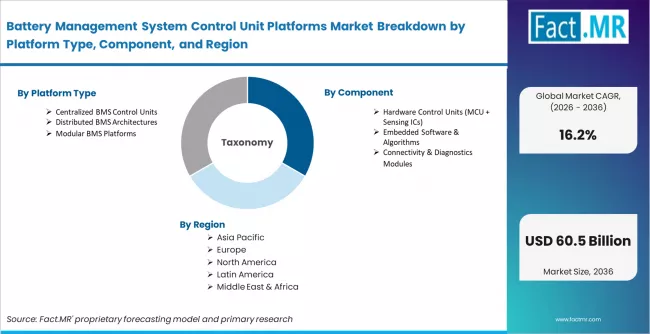
Battery Management System Control Unit Platforms Market Breakdown By Platform Type, Component, And Region | Source: Fact.MR
| Attribute | Details |
|---|---|
| Quantitative Units | USD 11.6 billion (2026) to USD 52.4 billion (2036), at a CAGR of 16.2% |
| Market Definition | Electronic hardware and embedded software platforms that monitor, control, and protect battery packs in EVs, industrial systems, and energy storage applications. |
| Platform Type Segmentation | Centralized BMS Control Units, Distributed BMS Architectures, Modular BMS Platforms |
| Component Segmentation | Hardware Control Units (MCU + Sensing ICs), Embedded Software & Algorithms, Connectivity & Diagnostics Modules |
| Battery Type Segmentation | Lithium-Ion Battery Systems, LFP / Solid-State Emerging, Others |
| Application Coverage | Battery monitoring and cell balancing in EVs, grid-scale energy storage, industrial UPS, and consumer electronics. |
| Regions Covered | North America, Europe, Asia Pacific, Latin America, Middle East and Africa |
| Countries Covered | USA, Canada, Mexico, Germany, UK, France, Italy, Spain, Nordic, BENELUX, China, Japan, South Korea, India, ASEAN, Australia and New Zealand, Brazil, Argentina, Chile, Saudi Arabia, GCC, Turkey, South Africa, Rest of MEA |
| Key Companies Profiled | Robert Bosch GmbH, Continental AG, Denso Corporation, LG Energy Solution, CATL, NXP Semiconductors, Texas Instruments, Infineon Technologies |
| Forecast Period | 2026 to 2036 |
| Approach | Hybrid top-down and bottom-up model using OEM procurement data, semiconductor revenues, BMS shipment volumes, average selling prices by platform type, regulatory data, and primary interviews with EV engineers and BMS developers. |
Source: Fact.MR analysis. Updated May 9, 2026
Battery Management System Control Unit Platforms Market by Segments
-
By Platform Type:
- Centralized BMS Control Units
- Distributed BMS Architectures
- Modular BMS Platforms
-
By Component:
- Hardware Control Units (MCU + Sensing ICs)
- Embedded Software & Algorithms
- Connectivity & Diagnostics Modules
-
By Battery Type:
- Lithium-Ion Battery Systems
- LFP / Solid-State Emerging
- Others
-
By Region:
- North America
- United States
- Canada
- Mexico
- Latin America
- Brazil
- Argentina
- Chile
- Rest of Latin America
- Western Europe
- Germany
- United Kingdom
- France
- Italy
- Spain
- Nordic Countries
- BENELUX
- Rest of Western Europe
- East Asia
- China
- Japan
- South Korea
- South Asia and Pacific
- India
- ASEAN
- Australia and New Zealand
- Rest of South Asia and Pacific
- Middle East and Africa
- Kingdom of Saudi Arabia
- Israel
- Other GCC Countries
- Turkey
- South Africa
- Rest of Middle East and Africa
- North America
Frequently Asked Questions
How large is the global BMS control unit platforms market in 2025?
What will the market size be in 2026?
What is the projected market size by 2036?
What is the expected CAGR from 2026 to 2036?
Which platform type is poised to lead the market?
Which component holds the largest share?
Which country shows the fastest growth in the market?
What are the primary applications of BMS control unit platforms?
What drives demand in this market?
Who are the key players in the market?
Who worked on this report


Preview the report firsthand - request a free sample
Free SampleGet the brochure for pricing and purchase details
Download PDF