- Base Value(2025): 2.86 Bn
- Estimated Value(2026): 3.18 Bn
- Forecast Value (2036): 8.67 Bn
- CAGR (2026 - 2036): 10.6%
Battery Pack End-of-Line Test Bench Systems Market Forecast and Outlook By Fact.MR
- The battery pack end-of-line test bench systems market was valued at USD 2.86 billion in 2025.
- According to Fact.MR, demand is projected to reach USD 3.18 billion in 2026 and expand to USD 8.67 billion by 2036, reflecting a CAGR of 10.6% during the forecast period.
- The market is expected to generate an absolute opportunity of USD 5.49 billion between 2026 and 2036, supported by the parallel expansion of battery manufacturing capacity and increasing validation requirements.
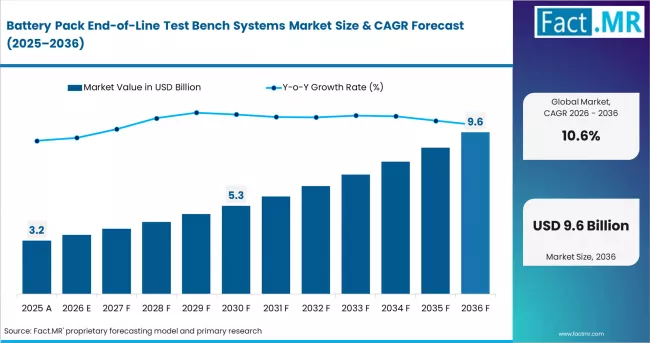
Battery Pack End Of Line Test Bench Systems Market Market Value Analysis | Source: Fact.MR
| Metric | Details |
|---|---|
| Industry Size (2026) | USD 3.18 billion |
| Industry Value (2036) | USD 8.67 billion |
| CAGR (2026 to 2036) | 10.6% |
Source: Fact.MR analysis. Updated May 9, 2026
Summary of Battery Pack End-of-Line Test Bench Systems Market
- Market Definition
- The market includes the test bench systems used at the final stage of battery pack production to verify safety, function, and quality before the battery is released for integration or delivery.
- Demand Drivers
- Global EV sales and battery manufacturing growth are expanding the installed base of pack assembly lines that require validated end-of-line testing.
- Manufacturers increasingly need test benches that combine electrical, leak, communication, and functional checks in one scalable production workflow.
- End-of-line testing is being treated as a critical quality gate because battery packs must meet defined safety and performance requirements before shipment.
- Key Segments Analyzed
- By Test Type: Electrical Safety Testing is expected to hold 27.6% share in 2026, supported by the central role of insulation, continuity, and safety verification before release.
- By Battery Type: Lithium-ion NMC Packs are projected to account for 33.8% share in 2026 because of continued use in higher-performance EV battery applications and broad installed production capacity.
- By Automation Level: Fully Automated Benches are likely to capture 35.4% share in 2026 as manufacturers look for higher throughput, better traceability, and lower manual interface burden.
- By Geography: China is expected to be the fastest-growing country in this study at 11.5% CAGR through 2036, supported by battery manufacturing scale and EV production leadership.
- Analyst Opinion at Fact.MR
- Shambhu Nath Jha, Senior Analyst at Fact.MR, opines that this market is no longer about whether battery packs are tested at the end of the line. That is already established. The competitive shift is now about how much testing can be consolidated into one repeatable, production-grade bench without slowing throughput or increasing interface complexity. The strongest systems reduce rework risk, improve data traceability, and make final validation less dependent on manual interpretation. [3]
- Strategic Implications
- Test bench suppliers should expand modular coverage across electrical, leak, and BMS validation instead of competing on one narrow test function.
- Battery manufacturers need to prioritize scalable automation and report-linked traceability before expanding line output.
- Providers that combine power electronics, automation software, and fixture integration are better positioned than vendors selling isolated test cabinets.
- Methodology
- Market sizing uses EV battery manufacturing expansion, test intensity per pack line, and bench-system value layering across hardware and software.
- Analysis includes IEA electric vehicle data and industrial references describing end-of-line test content and production-line integration.
- Forecasts account for growth in EV pack output, rising test complexity, and the shift toward modular and automated production validation.
The Growth is tied to both volume and complexity. Battery production lines are scaling rapidly, while validation standards are becoming more stringent to ensure safety, performance, and regulatory compliance. Data from the International Energy Agency indicates that global electric car sales exceeded 17 million in 2024, accounting for more than 20% of total car sales. This scale is driving continued investment in battery production infrastructure and associated testing systems. End-of-line testing has become a critical manufacturing step rather than a secondary validation process. It is used to detect defects, verify electrical performance, and confirm compliance with safety benchmarks before battery packs move downstream. Manufacturers are increasingly standardizing these processes to improve throughput and reduce variability across production lines.
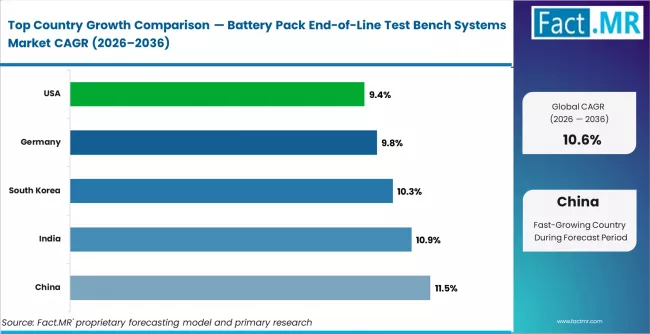
China leads with a projected CAGR of 11.5% through 2036, driven by large-scale battery manufacturing capacity and continued expansion of EV production lines requiring integrated end-of-line validation systems. India follows at 10.9%, supported by growing battery manufacturing investments and increasing localization of EV assembly and pack validation infrastructure. South Korea grows at 10.3%, underpinned by advanced battery production capabilities and strong demand for high-throughput automated test systems. Germany records 9.8%, with growth anchored in engineering-driven manufacturing environments and emphasis on quality-focused validation processes. The United States grows at 9.4%, driven by expanding domestic battery production and rising need for scalable production-grade testing solutions.
Segmental Analysis
Battery Pack End-of-Line Test Bench Systems Market Analysis by Test Type
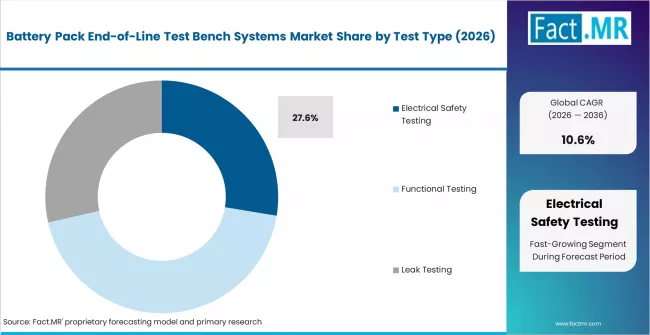
Battery Pack End Of Line Test Bench Systems Market Analysis By Test Type | Source: Fact.MR
Electrical safety testing is projected to represent 27.6% share in 2026 due to its role as the first validation layer in battery pack production. Every pack must pass core electrical checks before progressing through the rest of the end-of-line process. These checks confirm whether the system meets baseline safety and performance requirements. Testing procedures focus on insulation resistance, bond integrity, continuity, and DC voltage verification. These parameters determine whether the battery pack is electrically sound and safe for further evaluation. Failure at this stage prevents downstream functional or communication testing. Suppliers such as Keysight Technologies, Digatron, and Asterisco with National Instruments continue to emphasize electrical validation as a central component of EOL systems.
- Release gate: Electrical safety checks remain the most direct pass-fail barrier before a pack can leave production.
- Benchmark role: Insulation, continuity, and bond validation are among the most repeatable and standardized steps in pack EOL flow.
- System dependency: Later functional or communication checks matter less if the pack does not first pass its electrical safety baseline. [4]
Battery Pack End-of-Line Test Bench Systems Market Analysis by Battery Type
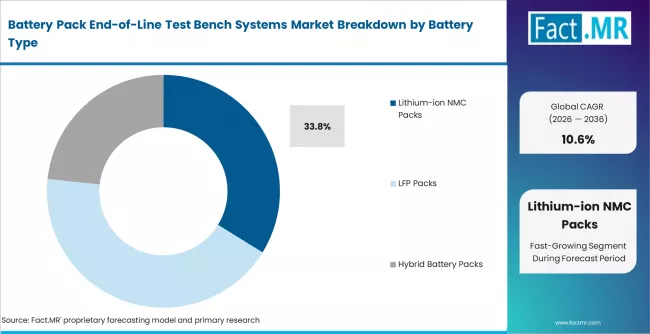
Battery Pack End Of Line Test Bench Systems Market Analysis By Battery Type | Source: Fact.MR
Lithium-ion NMC packs are projected to account for 33.8% share in 2026, supported by their continued use in higher-performance electric vehicle platforms. These battery systems remain widely deployed across automotive manufacturing lines due to their energy density and performance characteristics. Data from the International Energy Agency highlights ongoing growth in electric vehicle production, reinforcing the relevance of established lithium-ion chemistries such as NMC. End-of-line test bench demand closely follows production trends. Where NMC battery lines operate at scale, manufacturers require consistent validation across electrical performance, communication interfaces, and safety parameters. This ensures that each pack meets required standards before integration into vehicles. Despite increasing investment in alternative chemistries such as LFP, NMC remains a major contributor to current production volumes. This sustained presence supports continued demand for testing systems tailored to NMC pack validation.
- Installed-base pull: Existing automotive battery production capacity still supports large volumes of NMC-linked final test demand.
- Performance sensitivity: Higher-performance pack applications require tightly controlled end-of-line validation.
- Production continuity: Test bench procurement often follows the chemistry mix already embedded in current line investments.
Battery Pack End-of-Line Test Bench Systems Market Analysis by Automation Level
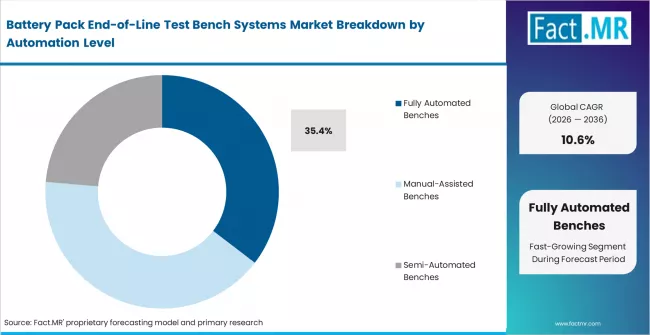
Battery Pack End Of Line Test Bench Systems Market Analysis By Automation Level | Source: Fact.MR
Fully automated benches are gaining traction as battery pack testing becomes more data-intensive and operationally complex. Manufacturers are moving away from fragmented manual stations toward integrated systems that can manage higher test volumes with greater consistency. Fully Automated Benches are expected to account for 35.4% share in 2026. This shift is driven by the need to reduce manual intervention, improve repeatability, and maintain stable cycle times across expanding production lines. Solutions from Festo highlight modular and scalable architectures that reduce interface complexity while improving system reliability. Keysight Technologies positions its latest platforms around unified and scalable EV production testing, reinforcing the move toward integrated validation environments.
- Throughput logic: Automation supports higher line speed without expanding manual validation labor at the same rate.
- Traceability gain: Automated benches create more consistent report generation and data capture across each tested pack.
- Interface reduction: Consolidated automated stations lower the operational friction created by multiple disconnected checks.
Drivers, Restraints, and Opportunities
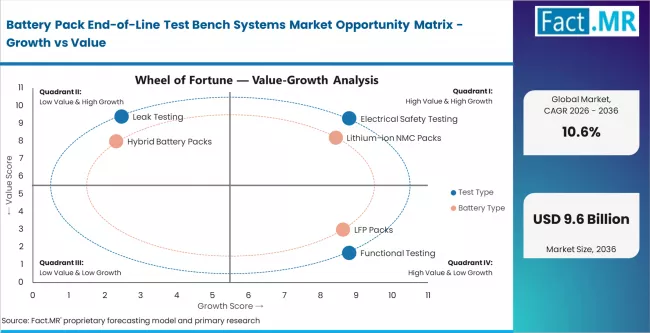
Battery Pack End Of Line Test Bench Systems Market Opportunity Matrix Growth Vs Value | Source: Fact.MR
Fact.MR analysts observe that the battery pack end-of-line test bench systems market is strongly linked to the expansion of EV battery manufacturing and the need to keep pack output aligned with safety and quality expectations. Structural demand is anchored by the rise in global EV sales, the growing number of battery pack lines, and the increasing complexity of final pack validation. The market’s size reflects the fact that end-of-line testing is treated by industrial sources as a fundamental production gate rather than a discretionary quality add-on.
A key restraint remains line complexity. Manufacturers want faster throughput, but battery EOL systems increasingly need to cover more functions, more communication checks, and more reporting expectations without becoming bottlenecks. This creates integration pressure during commissioning and line expansion. Festo’s case material directly points to lower interface effort as a benefit, which implies that interface burden is already a meaningful operational problem in this market.
- Production expansion: Rising EV output and battery manufacturing scale continue to drive new demand for pack-level final test infrastructure.
- Coverage complexity: Bench systems must increasingly combine electrical, leak, communication, and performance checks without disrupting line speed.
- Commissioning pressure: More complex validation content can increase integration burden unless systems are modular and software-linked.
Regional Analysis
The battery pack end-of-line test bench systems market is assessed across Asia Pacific, North America, Europe, Latin America, and Middle East & Africa, covering 40+ countries with demand profiles shaped by EV battery manufacturing scale, battery trade, line automation intensity, and battery production expansion. The full report provides market attractiveness analysis by region and country.
.webp "Top Country Growth Comparison Battery Pack End Of Line Test Bench Systems Market Cagr (2026 2036)")
Top Country Growth Comparison Battery Pack End Of Line Test Bench Systems Market Cagr (2026 2036) | Source: Fact.MR
| Country | CAGR (2026 to 2036) |
|---|---|
| China | 11.5% |
| India | 10.9% |
| South Korea | 10.3% |
| Germany | 9.8% |
| United States | 9.4% |
Source: Fact.MR analysis. Updated May 9, 2026
Source: Fact.MR analysis, based on proprietary forecasting model and primary research.
Battery Pack End Of Line Test Bench Systems Market Cagr Analysis By Country | Source: Fact.MR
Asia Pacific Battery Pack End-of-Line Test Bench Systems Market Analysis
Asia Pacific is the primary demand growth region. EV production, battery manufacturing capacity, and supply-chain concentration in China, South Korea, Japan, and increasingly India anchor regional demand. China and South Korea together dominate much of the current large-scale battery and EV manufacturing landscape, while India is gaining relevance as EV and battery investment broadens. The IEA’s 2025 outlook highlights China’s scale in EV and battery manufacturing and points to continuing diversification in production and trade, which supports continued investment in end-of-line validation equipment. The region supports both high-volume passenger EV pack manufacturing and rising contract manufacturing needs for modules and packs.
- China: China continues to dominate global battery production, creating strong demand for EOL testing systems integrated into high-speed manufacturing lines. With a CAGR of 11.5%, the market reflects sustained investment in automation and quality control. Large EV output and ongoing capacity expansion require scalable and precise validation infrastructure to support production efficiency and compliance.
- India: India is emerging as a fast-growing market as battery manufacturing and EV assembly scale from a relatively lower base. Demand is supported by new investments in battery plants and localization efforts. Growth is expected to reach a CAGR of 10.9%, reflecting increasing adoption of automated testing systems to support quality assurance and production consistency.
- South Korea: South Korea remains a high-value contributor, supported by advanced battery technology and export-oriented manufacturing. The market is projected to expand steadily, with growth around 10.3% CAGR, as manufacturers invest in sophisticated EOL testing systems to maintain global quality standards. Strong emphasis on precision and performance drives demand for high-end validation equipment.
Across Asia Pacific, demand is driven by both production scale and increasing technical requirements, ensuring continued investment in advanced EOL testing solutions.
North America Battery Pack End-of-Line Test Bench Systems Market Analysis
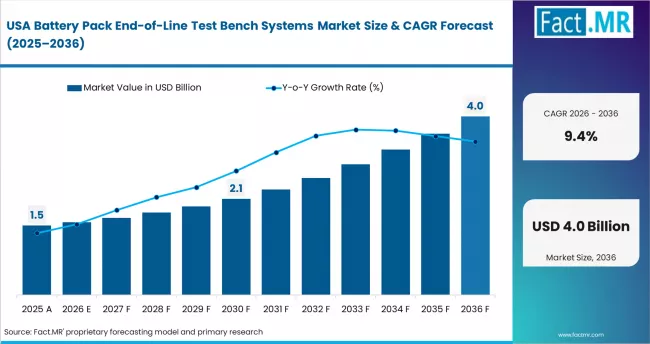
Battery Pack End Of Line Test Bench Systems Market Country Value Analysis | Source: Fact.MR
North America represents a high-value and expanding market, where demand is closely linked to domestic battery manufacturing growth and EV production localization. Investments in gigafactories and battery assembly lines are increasing the need for scalable and efficient validation systems.
- United States: The U.S. market continues to grow as battery manufacturing capacity expands and EV production scales. Growth is projected near a 9.4% CAGR, supported by increasing focus on production-grade validation and quality control. Manufacturers are investing in flexible EOL testing systems that can handle multiple battery formats and evolving technologies.
Demand in North America is driven by a combination of automation, compliance requirements, and the need to support large-scale production while maintaining performance standards.
Europe Battery Pack End-of-Line Test Bench Systems Market Analysis
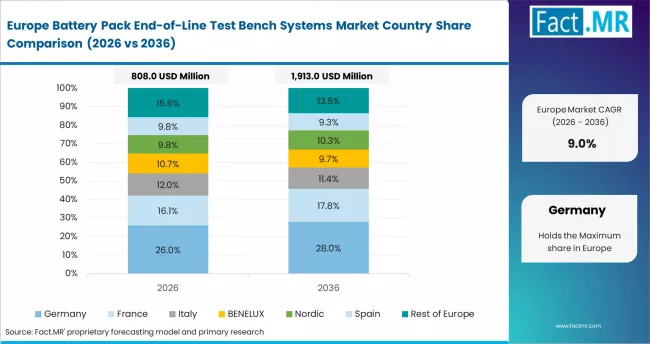
Battery Pack End Of Line Test Bench Systems Market Europe Country Market Share Analysis, 2026 & 2036 | Source: Fact.MR
Europe operates as an engineering-intensive and quality-driven market, where emphasis is placed on precision, traceability, and compliance with automotive-grade standards. While overall battery production volume is smaller compared to Asia Pacific, the region prioritizes high-quality manufacturing and integrated validation processes.
- Germany: Germany remains the leading market in Europe, supported by strong automotive manufacturing and ongoing battery production investments. The market is expected to grow at a 9.8% CAGR, reflecting demand for advanced EOL testing systems that ensure product reliability and regulatory compliance. Manufacturers are focusing on automation, data integration, and process control to maintain high standards.
European demand is shaped less by scale and more by the need for robust validation systems that support consistent quality and traceability across battery production lines.
Competitive Aligners for Market Players
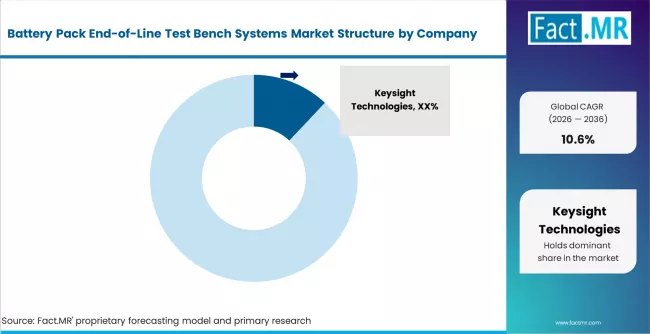
Battery Pack End Of Line Test Bench Systems Market Analysis By Company | Source: Fact.MR
The battery pack end-of-line test bench systems market is moderately concentrated, with specialized automation and test-equipment providers controlling much of the higher-function end of the category. Key players include FFT, Keysight Technologies, Digatron, Festo-linked integration partners, and modular battery-test system suppliers tied to NI-oriented architectures. These companies benefit from system-integration depth, electrical test capability, and the ability to combine software, automation, and validation logic into production-ready platforms. [5]
Competitive advantage is defined by modularity, interface control, and validation breadth. Manufacturers increasingly prefer test bench suppliers that can combine electrical, mechanical, leak, and BMS-related checks with clean reporting and faster commissioning. This creates a structural advantage for providers that can package EOL testing as a scalable production system rather than as a customized test island. Strategically, market participants are investing in unified functional test platforms, modular stand architectures, and software-linked reporting. Competitive intensity is rising as battery line expansion continues, though integration credibility remains a meaningful barrier to entry.
Key Players
- Keysight Technologies
- FFT Produktionssysteme
- Digatron
- Festo
- Asterisco Tech
- Unico
- CustoM
Bibliography
- [1] International Energy Agency. (2025). Global EV outlook 2025. International Energy Agency.
- [2] FFT Produktionssysteme. (n.d.). Battery end-of-line testing. FFT Produktionssysteme.
- [3] Festo. (n.d.). Automated end-of-line testing for battery systems. Festo.
- [4] Keysight Technologies. (2025, October 2). Keysight expands end-of-line test portfolio to power the future of electric mobility. Keysight Technologies.
- [5] FFT Produktionssysteme. (n.d.). Battery testing: Service, engineering, production. FFT Produktionssysteme.
This Report Addresses
- Strategic intelligence on battery pack end-of-line test bench systems demand across EV battery production, contract manufacturing, and energy storage pack assembly.
- Market forecast from USD 3.18 billion in 2026 to USD 8.67 billion by 2036 at a CAGR of 10.6%.
- Growth opportunity mapping across automated battery pack production lines, electrical safety validation, BMS communication testing, and integrated leak or mechanical test workflows.
- Segment analysis by test type, battery type, automation level, end use, and application.
- Regional outlook covering Asia Pacific battery manufacturing scale, North American localized EV production, and Europe’s engineering-led validation environment.
- Competitive analysis of Keysight, FFT, Digatron, Festo-linked systems, and other modular battery test bench providers.
- The role of EV manufacturing growth, modular automation, and validation traceability in driving end-of-line bench demand.
- Why the category is shifting from fragmented quality checks toward integrated production-grade battery validation systems.
attery Pack End-of-Line Test Bench Systems Market Definition
The market covers production-line test bench systems used to validate battery packs and related battery assemblies at the end of manufacturing before shipment or integration into vehicles or energy storage systems. These benches are designed to check whether packs meet defined electrical, functional, safety, communication, and quality specifications under controlled production conditions. End-of-line testing is described by industrial and manufacturing sources as the final testing stage used to ensure that each battery system complies with required quality, safety, and performance targets. [2]
Battery Pack End-of-Line Test Bench Systems Market Inclusions
Market scope includes pack and module EOL test stands, automated battery test benches, insulation and leakage test stations, BMS communication validation systems, charge-discharge validation benches, report-generation software, and integrated handling or fixture systems used specifically for production-stage final validation. It also includes modular and scalable end-of-line platforms where electrical, leak, optical, and communication checks are combined for production use.
Battery Pack End-of-Line Test Bench Systems Market Exclusions
The scope excludes laboratory R&D battery cyclers used purely for early-stage chemistry or cell development, field-service battery testers used outside production lines, and second-life or end-of-life battery evaluation systems not positioned around manufacturing-line final validation. It also excludes cell formation systems unless they are marketed as part of a pack or module end-of-line production bench.
Battery Pack End-of-Line Test Bench Systems Market Research Methodology
- Primary Research:Interviews with battery manufacturing engineers, EV pack line integrators, commissioning managers, quality-control specialists, and battery test-equipment distributors.
- Desk Research:Review of IEA electric vehicle outlook data, official end-of-line test-system materials from Keysight, Festo, FFT, Digatron, and production-bench references from NI-linked partners.
- Market-Sizing and Forecasting:Hybrid model based on battery pack manufacturing expansion, end-of-line validation intensity per line, and combined hardware-software value across modular bench systems.
- Data Validation and Update Cycle:Validation against current supplier positioning, battery production testing workflows, and evidence that EOL testing is becoming more automated, modular, and production-linked.
Segmentation
Scope of Report
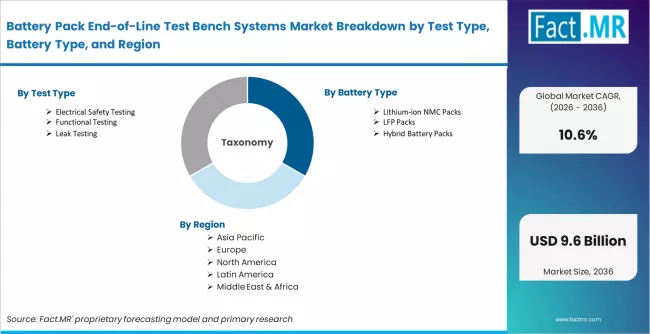
Battery Pack End Of Line Test Bench Systems Market Breakdown By Test Type, Battery Type, And Region | Source: Fact.MR
| Attribute | Details |
|---|---|
| Quantitative Units | USD 3.1 billion (2026) to USD 8.6 billion (2036), at a CAGR of 10.6% |
| Market Definition | Battery pack and module end-of-line test bench systems used for final production validation of safety, function, communication, and quality before shipment or integration |
| Test Type Segmentation | Electrical Safety Testing, Functional Testing, Leak Testing, Communication & BMS Validation, Charge-Discharge Validation |
| Battery Type Segmentation | Lithium-ion NMC Packs, LFP Packs, Solid-State-Ready Pack Platforms, Hybrid Battery Packs |
| Automation Level Segmentation | Manual-Assisted Benches, Semi-Automated Benches, Fully Automated Benches |
| End Use Segmentation | Passenger EV Battery Production, Commercial EV Battery Production, Energy Storage Battery Assembly, Battery Module & Pack Contract Manufacturing |
| Application Segmentation | Battery Pack Testing, Battery Module Testing, Pack-Plus-BMS End-of-Line Validation |
| Regions Covered | Asia Pacific, North America, Europe, Latin America, Middle East & Africa |
| Countries Covered | China, India, South Korea, Germany, United States, Japan, Brazil, and 40+ countries |
| Key Companies Profiled | Keysight Technologies, FFT Produktionssysteme, Digatron, Festo, Asterisco Tech, Unico, CustoM |
| Forecast Period | 2026 to 2036 |
| Approach | Hybrid top-down and bottom-up model using EV and battery manufacturing expansion, end-of-line validation intensity, and modular test-bench value layering |
Source: Fact.MR analysis. Updated May 9, 2026
Battery Pack End-of-Line Test Bench Systems Market by Segments
-
By Test Type:
- Electrical Safety Testing
- Functinal Testing
- Leak Testing
- Cmmunicatin & BMS Validatin
- Charge-Discharge Validatin
-
By Battery Type:
- Lithium-in NMC Packs
- LFP Packs
- Slid-State-Ready Pack Platfrms
- Hybrid Battery Packs
-
By Autmatin Level:
- Manual-Assisted Benches
- Semi-Autmated Benches
- Fully Autmated Benches
-
By Regin:
- Asia Pacific
- China
- India
- Suth Krea
- Japan
- Rest f Asia Pacific
- North America
- United States
- Canada
- Mexic
- Eurpe
- Germany
- France
- United Kingdm
- Italy
- Spain
- Rest f Eurpe
- Latin America
- Brazil
- Argentina
- Rest f Latin America
- Middle East & Africa
- GCC Cuntries
- Suth Africa
- Turkey
- Rest of Middle East & Africa
- Asia Pacific
Frequently Asked Questions
How large is the global battery pack end-of-line test bench systems market in 2025?
What will the market size be in 2026?
What is the projected market size by 2036?
What is the expected CAGR from 2026 to 2036?
Which test type segment is poised to lead the market?
Which country shows the fastest growth?
What is driving demand for battery pack end-of-line test bench systems?
What is the key challenge in this market?
Who worked on this report


Preview the report firsthand - request a free sample
Free SampleGet the brochure for pricing and purchase details
Download PDF