- Base Value(2026): 35.6 Bn
- Estimated Value(2026): 37.1 Bn
- Forecast Value (2036): 56.1 Bn
- CAGR (2026 - 2036): 4.2%
Beach Hotels Market Size, Market Forecast and Outlook By Fact.MR
Valuation of the beach hotels market stood at USD 35.6 billion in 2025. According to Fact MR, demand for beach hotels is expected to reach USD 37.1 billion in 2026 and USD 56.1 billion by 2036. A CAGR of 4.2% is projected for the forecast timeline.
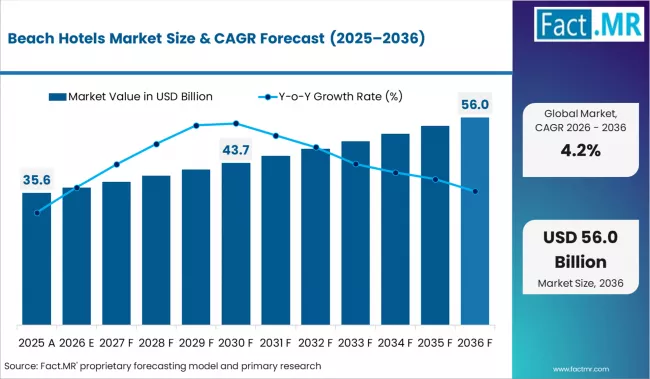
Beach Hotels Market Market Value Analysis | Source: Fact.MR
Summary of the Beach Hotels Market
- Market Definition
- The market includes hospitality establishments located in coastal destinations offering accommodation, recreation, and tourism services linked to seaside environments. Beach hotels provide lodging facilities supported by amenities such as dining, leisure activities, and wellness services designed to meet seasonal and leisure travel demand across domestic and international tourism markets.
- Demand Drivers
- Recovery in leisure travel supporting occupancy rates across coastal tourism destinations
- Expansion of domestic tourism contributing to stable booking demand for short distance travel
- Growth in online booking platforms improving access to accommodation comparison and reservation systems
- Development of resort style properties offering integrated leisure, wellness, and recreation services
- Key Segments Analyzed
- Nationality: Domestic travelers lead with approximately 65% share supported by regional tourism activity
- Booking Channel: Online booking accounts for nearly 60% share due to digital reservation platform adoption
- Application Scope: Leisure travel remains the primary demand segment across coastal hospitality infrastructure
- Geography: Asia Pacific demonstrates relatively higher growth due to expansion of coastal tourism infrastructure
- Analyst Opinion at Fact MR
- Shambhu Nath Jha, Principal Consultant, Fact MR, opines, "In this updated edition of the Beach Hotels Market report, industry participants will observe stable demand linked to leisure travel patterns and coastal tourism infrastructure development. Beach hotels continue to benefit from steady domestic tourism activity and digital booking integration across reservation platforms. Companies that strengthen service quality, property location positioning, and booking channel optimization are expected to maintain competitive positioning through 2036."
- Strategic Implications/Executive Takeaways
- Strengthen digital reservation capabilities across online booking platforms and mobile applications
- Focus on service differentiation through recreational and wellness offerings aligned with leisure travel demand
- Optimize pricing strategies based on seasonal occupancy variability across coastal destinations
- Expand partnerships with travel agencies and online distribution platforms supporting booking visibility
- Methodology
- Primary interviews conducted with hotel operators, tourism consultants, and travel service providers
- Desk research based on tourism industry publications, government travel statistics, company reports, and hospitality datasets
- Market sizing derived using a hybrid approach combining bottom up revenue assessment with top down tourism demand analysis
- Data validation performed through cross verification with tourism datasets and internal peer review aligned with Fact MR standards
Beach Hotels Market
| Metric | Details |
|---|---|
| Industry Size (2026E) | USD 37.1 billion |
| Industry Value (2036F) | USD 56.1 billion |
| CAGR (2026 to 2036) | 4.2% |
Source: Fact.MR analysis. Updated Mar 27, 2026
A CAGR of 4.2% indicates incremental expansion, suggesting demand progression aligned with gradual recovery in leisure travel and stable occupancy trends in coastal destinations. Growth momentum remains supported by international tourism flows and premium resort upgrades, while structural limits persist due to seasonality exposure, high operating costs in coastal locations, and sensitivity to macroeconomic travel spending patterns.
India leads with a projected CAGR of 5.1%, supported by expansion of domestic coastal tourism and increasing development of resort infrastructure. China follows with a CAGR of 4.8%, driven by rising outbound and domestic leisure travel to coastal destinations. Germany records a CAGR of 4.1%, reflecting steady participation in international beach tourism across Mediterranean destinations. The United Kingdom shows a CAGR of 4.0%, supported by consistent demand for seasonal coastal travel packages and resort stays. The United States records the slowest growth at 3.9%, reflecting a mature market where demand is largely tied to replacement travel cycles within established beach destinations. Mature markets generate a significant share of replacement demand as growth remains linked to repeat travel patterns and limited expansion of new coastal hospitality infrastructure.
Segmental Analysis of Beach Hotels Market
Beach Hotels Market Analysis by Nationality
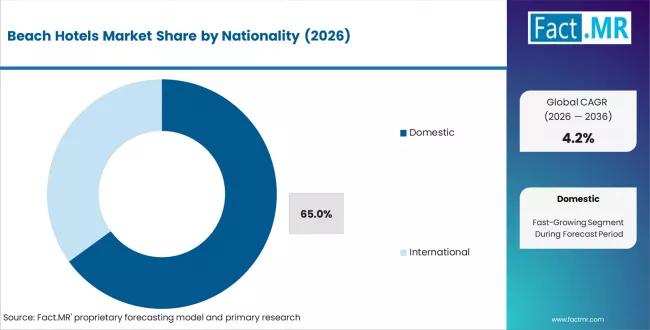
Beach Hotels Market Analysis By Nationality | Source: Fact.MR
- Market Overview: Based on Fact MR assessment, domestic travelers are projected to account for 65% share of the beach hotels market in 2026. Demand concentration is supported by shorter travel planning cycles, lower transportation cost exposure, and increased preference for regional leisure destinations. Domestic tourism demand is influenced by seasonal holiday patterns, long weekend travel frequency, and increased utilization of coastal hospitality infrastructure located within driving distance of major metropolitan areas. Beach hotel operators align pricing strategies and room inventory allocation with domestic booking demand variability observed across peak holiday and festive travel periods.
- Demand Drivers:
- Short-Haul Travel Preference: Domestic travelers demonstrate higher booking frequency for coastal destinations accessible through road and short-duration air travel networks.
- Seasonal Occupancy Stability: National holiday calendars and school vacation periods generate predictable occupancy demand across beachfront hospitality assets.
- Pricing Sensitivity Factors: Domestic booking patterns reflect higher response to promotional room tariffs, bundled accommodation packages, and flexible cancellation policies.
Beach Hotels Market Analysis by Booking Channel
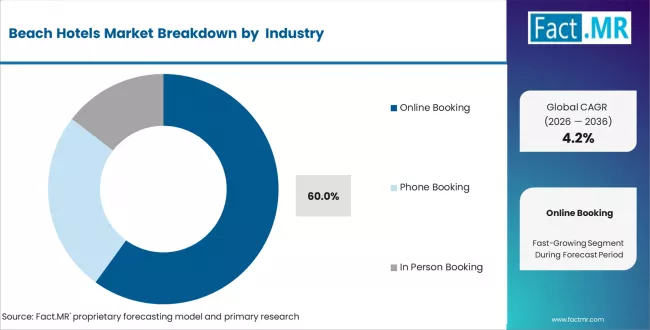
Beach Hotels Market Analysis By Booking Channel | Source: Fact.MR
- Market Overview: Online booking channels are estimated to hold 60% share of the beach hotels market in 2026, supported by increased utilization of digital reservation platforms across leisure travel planning workflows. Hotel inventory distribution is integrated across online travel agencies, direct hotel websites, and mobile booking applications enabling real-time room availability visibility. Online reservation systems enable dynamic pricing adjustments aligned with seasonal demand fluctuations and occupancy optimization strategies applied by coastal hospitality operators.
- Demand Drivers:
- Digital Reservation Adoption: Online booking platforms enable comparison of room tariffs, property ratings, and location attributes influencing consumer accommodation selection behavior.
- Inventory Distribution Integration: Beach hotel operators utilize centralized booking management systems allowing synchronization of room availability across multiple online reservation platforms.
- Mobile Booking Penetration: Smartphone-based reservation applications support last-minute booking activity associated with short-duration leisure travel planning patterns.
Key Dynamics of Beach Hotels Market
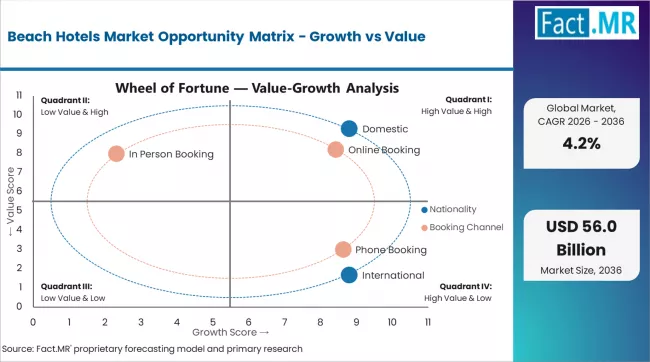
Beach Hotels Market Opportunity Matrix Growth Vs Value | Source: Fact.MR
Beach Hotels Market Drivers, Restraints, and Opportunities
Fact MR analysis indicates that the beach hotels market developed from leisure travel demand concentrated in coastal regions offering recreational and seasonal tourism experiences. Early development of beach hotels was driven by international tourism growth, improved air connectivity, and expansion of hospitality infrastructure in coastal destinations. The current market valuation reflects the integration of resort-style amenities, destination-based travel packages, and seasonal occupancy models across major coastal tourism markets. Demand persists because beach hotels provide location-based hospitality experiences linked with vacation travel patterns and international tourism flows.
A structural shift is occurring as traditional seasonal tourism models transition toward experience-oriented hospitality offerings that emphasize wellness, recreation, and destination-specific services. Conventional beach hotels remain widely used in price-sensitive tourism segments where standardized accommodation services remain sufficient. Premium beachfront resorts incorporate spa services, curated activities, and integrated travel experiences that increase service pricing relative to standard accommodation formats. These higher-value service offerings support revenue growth even when occupancy rates fluctuate due to seasonality and economic cycles.
- Experience Based Hospitality: Hotel operators increasingly provide wellness services, recreational activities, and curated travel experiences linked to coastal destinations.
- Tourism Regulation Frameworks: Policies such as coastal zoning laws and environmental tourism regulations influence hotel development and operational compliance in beachfront locations.
- Asia Pacific Tourism Growth: Thailand, Indonesia, and India maintain expanding coastal tourism infrastructure supported by domestic and international travel demand.
Regional Analysis
The beach hotels market is assessed across North America, Europe, Asia Pacific, Latin America, and Middle East & Africa, segmented by country-level coastal tourism demand, hospitality infrastructure, and travel patterns. Regional performance reflects international arrivals, domestic tourism trends, and premium leisure accommodation development. The full report offers market attractiveness analysis.
.webp "Top Country Growth Comparison Beach Hotels Market Cagr (2026 2036)")
Top Country Growth Comparison Beach Hotels Market Cagr (2026 2036) | Source: Fact.MR
| Country | CAGR (2026-2036) |
|---|---|
| China | 4.8% |
| India | 5.1% |
| USA | 3.9% |
| UK | 4% |
| Germany | 4.1% |
Source: Fact.MR analysis. Updated Mar 27, 2026
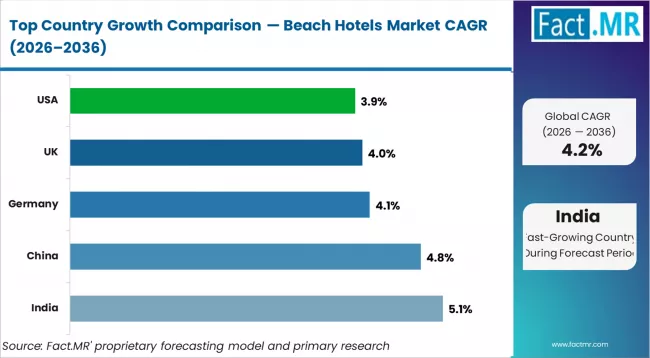
Beach Hotels Market Cagr Analysis By Country | Source: Fact.MR
Source: Fact MR analysis, based on proprietary forecasting model and primary research
North America
North America functions as the premium leisure travel and coastal hospitality development hub, supported by established tourism infrastructure and diversified accommodation offerings. Marriott International, Inc. maintains leadership in resort portfolio expansion. Hilton Worldwide Holdings Inc. strengthens presence in beachfront properties. Hyatt Hotels Corporation expands upscale coastal resort offerings.
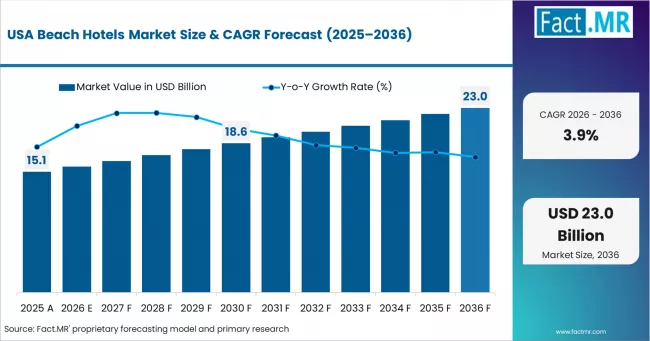
Beach Hotels Market Country Value Analysis | Source: Fact.MR
- USA: Demand for beach hotels in USA is projected to rise at 3.9% CAGR through 2036. Growth is supported by National Travel and Tourism Strategy updates (U.S. Department of Commerce, 2022), promoting coastal tourism. Marriott International, Inc. expanded beachfront resort portfolio (March 2023), supporting market growth.
Europe
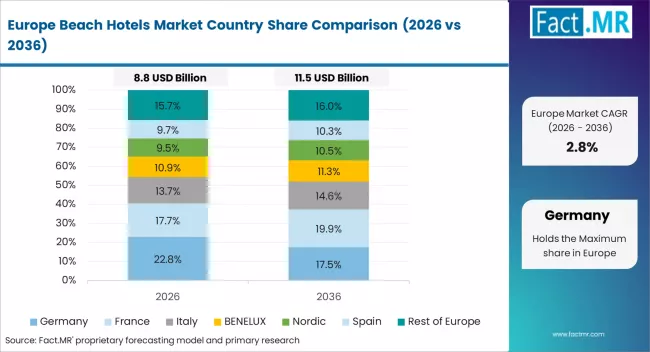
Beach Hotels Market Europe Country Market Share Analysis, 2026 & 2036 | Source: Fact.MR
Europe operates as the coastal tourism diversification and premium travel accommodation base, shaped by strong intra-regional travel demand and hospitality standards. Accor S.A. leads in coastal resort expansion. InterContinental Hotels Group PLC strengthens leisure property portfolio. TUI Group supports integrated holiday accommodation services.
- UK: Demand for beach hotels in UK is projected to rise at 4% CAGR through 2036. The UK Tourism Recovery Plan (Department for Digital, Culture, Media and Sport, updated 2022) supports domestic travel demand. InterContinental Hotels Group PLC expanded coastal hotel offerings (February 2023), supporting growth.
- Germany: Demand for beach hotels in Germany is projected to rise at 4.1% CAGR through 2036. The German National Tourism Strategy (Federal Ministry for Economic Affairs and Climate Action, updated 2022) supports leisure travel expansion. TUI Group expanded beach resort packages (January 2023), supporting market demand.
Asia Pacific
Asia Pacific serves as the high-growth coastal tourism and resort infrastructure market, supported by expanding middle-class travel demand and hospitality investment. Shangri-La Group strengthens beachfront luxury accommodation presence. Taj Hotels (Indian Hotels Company Limited) expands coastal resort portfolio. Huazhu Group Limited supports regional hotel development.
- China: Demand for beach hotels in China is projected to rise at 4.8% CAGR through 2036. The Tourism Development Plan (Ministry of Culture and Tourism, updated 2021) supports coastal tourism infrastructure. Huazhu Group Limited expanded resort accommodation offerings (April 2023), supporting growth.
- India: Demand for beach hotels in India is projected to rise at 5.1% CAGR through 2036. The Swadesh Darshan Scheme (Ministry of Tourism, ongoing) supports coastal tourism development. Taj Hotels (Indian Hotels Company Limited) expanded beach resort properties (May 2023), supporting domestic travel demand.
Fact MR's analysis of beach hotels market in global regions consists of country-wise assessment that includes China, India, USA, UK, and Germany. Readers can find tourism trends, hospitality expansion patterns, travel demand shifts, and competitive positioning across key markets.
Competitive Landscape of Beach Hotels Market
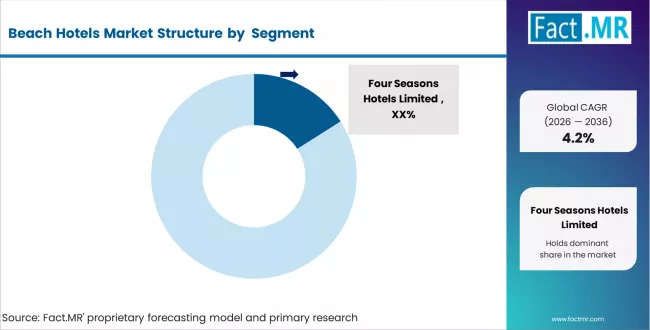
Beach Hotels Market Analysis By Company | Source: Fact.MR
Competitive Structure and Buyer Dynamics in the Beach Hotels Market
The competitive structure of the Beach Hotels Market is moderately fragmented, with global hospitality chains and regional resort operators competing across premium, luxury, and all inclusive segments. Companies such as Marriott International, Inc., Hilton Worldwide Holdings Inc., Accor S.A., and Four Seasons Hotels Limited maintain strong positions through established global brands and extensive resort portfolios located in major coastal destinations. All inclusive resort specialists including Sandals Resorts International Ltd., Iberostar Group, Bahia Principe Hotels & Resorts, and Grupo Vidanta compete through destination focused offerings and bundled service packages. Additional participants including LUX* Resorts & Hotels and Montage International operate in the luxury resort segment with differentiated guest experience positioning. Competition is primarily influenced by location quality, service standards, brand recognition, pricing structures, and distribution through online travel platforms.
Several companies maintain structural advantages through established brand equity, global reservation systems, and long term property management expertise. Firms such as Marriott International, Inc., Hilton Worldwide Holdings Inc., and Accor S.A. benefit from loyalty programs and global distribution networks that support consistent occupancy levels. Sandals Resorts International Ltd. and Iberostar Group maintain advantages through vertically integrated resort operations and bundled travel packages. Luxury operators such as Four Seasons Hotels Limited and Montage International maintain strong positioning through premium service standards and exclusive resort locations. Travelers typically compare multiple hotel brands and booking platforms before selecting accommodations, reducing dependency on a single provider. Competitive pricing strategies and promotional packages moderate supplier pricing leverage, while companies with strong brand recognition and premium locations retain stronger negotiating influence.
Key Players of the Beach Hotels Market
- Four Seasons Hotels Limited
- Iberostar Group
- Sandals Resorts International Ltd.
- Hilton Worldwide Holdings Inc.
- Marriott International, Inc.
- LUX* Resorts & Hotels
- Grupo Vidanta
- Montage International
- Bahia Principe Hotels & Resorts
- Accor S.A.
Bibliographies
- [1] World Travel and Tourism Council (WTTC). (2023). Travel and Tourism: Global beach tourism economic contribution and coastal destination trends. WTTC. Retrieved March 23, 2026.
- [2] United Nations World Tourism Organization (UNWTO). (2023). International tourism and coastal destinations: Trends in arrivals and expenditure, 2023 edition. UNWTO. Retrieved March 23, 2026.
- [3] D-EDGE Hospitality Solutions. (2023). Hotel online distribution trends report: Europe and Asia (2019–2022). Hospitality Net. Retrieved March 23, 2026.
- [4] International Trade Administration / U.S. Department of Commerce. (2023, February 13). Travel and tourism: National Travel and Tourism Strategy overview – coastal tourism focus. U.S. ITA. Retrieved March 23, 2026.
- [5] International Hotel and Tourism Association (IHTA). (2024, July 13). Wellness-focused hospitality experiences in coastal hotels. Hotel and Tourism Association Insights. Retrieved March 23, 2026.
This Report Addresses
- Market size estimation and revenue forecasts for the Beach Hotels Market from 2026 to 2036, supported by coastal tourism demand trends and hospitality occupancy benchmarks across leisure travel destinations.
- Growth opportunity mapping across domestic and international traveler segments and online booking channels, reflecting demand for digital reservation platforms and short haul leisure travel.
- Segment and regional revenue forecasts covering age groups, demographics, booking channels, nationality segments, and key markets including India, China, Germany, United Kingdom, and United States.
- Competition strategy assessment of leading companies such as Marriott International, Inc., Hilton Worldwide Holdings Inc., Accor S.A., Four Seasons Hotels Limited, and Iberostar Group, including brand positioning and distribution capability benchmarking.
- Regulatory impact analysis covering coastal zoning regulations, tourism development policies, and hospitality compliance standards influencing resort development and operational expansion.
- Market report delivery in PDF, Excel, PPT, and interactive dashboard formats designed for tourism investment evaluation, occupancy planning, and hospitality strategy development.
- Supply chain vulnerability assessments examining seasonality exposure, macroeconomic travel spending sensitivity, and high operating costs in coastal locations impacting revenue stability.
Beach Hotels Market Definition
The Beach Hotels Market includes hospitality establishments located near coastal areas that provide accommodation services with direct or nearby access to beaches. These hotels offer lodging facilities along with amenities such as dining services, recreational activities, and leisure experiences associated with seaside environments. Beach hotels cater to leisure travelers, vacation tourists, and business visitors seeking coastal stays. Properties range from budget accommodations to premium resorts, often including facilities such as swimming pools, spa services, and event spaces. The primary function of beach hotels is to provide lodging and hospitality services in coastal destinations focused on tourism and recreation.
Beach Hotels Market Inclusions
This report covers global and regional market sizes for beach hotels with forecast analysis for the study period. The market is segmented by hotel category including budget, mid range, and luxury properties. Application segmentation includes leisure travel, business travel, and group bookings. End users include domestic tourists, international travelers, travel agencies, and corporate booking services. The report also evaluates pricing trends, occupancy patterns, and selected trade flow analysis across major coastal tourism markets.
Beach Hotels Market Exclusions
The report excludes inland hotels, city hotels, and mountain resorts that are not located in coastal environments. Short term rental properties such as private vacation homes and apartments are not included. The scope also excludes cruise tourism accommodations and maritime travel services. Hospitality services unrelated to accommodation, such as restaurants or travel agencies operating independently of hotel properties, are outside the defined market scope.
Beach Hotels Market Research Methodology
- Primary Research: Interviews were conducted with hotel operators, hospitality managers, tourism consultants, and travel service providers.
- Desk Research: Public information was collected from tourism industry publications, company reports, government tourism statistics, and travel databases.
- Market-Sizing and Forecasting: A hybrid model combining bottom up revenue analysis with top down tourism demand assessment across coastal travel destinations was applied.
- Data Validation and Update Cycle: Findings were cross verified using multiple tourism industry data sources and expert inputs, with periodic updates conducted as new travel market information becomes available.
Segmentation
Report Scope of Beach Hotels Market
| Metric | Value |
|---|---|
| Quantitative Units | USD 37.1 billion (2026) to USD 56.1 billion (2036), at a CAGR of 4.2% |
| Market Definition | The beach hotels market includes hospitality establishments located in coastal destinations offering accommodation, leisure, and tourism services for travelers seeking seaside experiences, including resort facilities, recreational activities, and vacation services across domestic and international tourism segments. |
| Age Segmentation | Under 15, 16–25, 26–35, 36–45, 46–55, Over 55 |
| Demographic Segmentation | Male, Female, Kid |
| Nationality Segmentation | Domestic, International |
| Booking Channel Segmentation | Phone Booking, Online Booking, In Person Booking |
| Regions Covered | North America, Latin America, Europe, East Asia, South Asia, Oceania, Middle East and Africa |
| Countries Covered | United States, Canada, Mexico, Brazil, Spain, Italy, Greece, Thailand, Indonesia, Australia, United Arab Emirates, India, Maldives, and 40+ countries |
| Key Companies Profiled | Four Seasons Hotels Limited, Iberostar Group, Sandals Resorts International Ltd., Hilton Worldwide Holdings Inc., Marriott International, Inc., LUX* Resorts and Hotels, Grupo Vidanta, Montage International, Bahia Principe Hotels and Resorts, Accor S.A. |
| Forecast Period | 2026 to 2036 |
| Approach | Hybrid top-down and bottom-up market modeling supported by tourism demand analysis, hotel occupancy rate assessment, travel spending trends, and validation through interviews with hospitality operators, travel service providers, and tourism industry stakeholders. |
Source: Fact.MR analysis. Updated Mar 27, 2026
Beach Hotels Market Key Segments
-
By Age :
- Under 15
- 16 to 25
- 26 to 35
- 36 to 45
- 46 to 55
- Over 55
-
By Demographic :
- Male
- Female
- Kid
-
By Nationality :
- Domestic
- International
-
By Booking Channel :
- Phone Booking
- Online Booking
- In Person Booking
-
Region :
- North America
- USA
- Canada
- Mexico
- Europe
- Germany
- UK
- France
- Italy
- Spain
- Nordic Countries
- BENELUX
- Rest of Europe
- Asia Pacific
- China
- Japan
- South Korea
- India
- Australia
- Rest of Asia Pacific
- Latin America
- Brazil
- Argentina
- Rest of Latin America
- Middle East and Africa
- Kingdom of Saudi Arabia
- United Arab Emirates
- South Africa
- Rest of Middle East and Africa
- Other Regions
- Oceania
- Central Asia
- Other Markets
- North America
Frequently Asked Questions
How large is the demand for Beach Hotels in the global market in 2026?
What will be the market size of Beach Hotels in the global market by 2036?
What is the expected demand growth for Beach Hotels in the global market between 2026 and 2036?
Which Nationality Segment is poised to lead global demand by 2026?
Which Company is Identified as a Leading Participant in the Beach Hotels Market?
What is Driving Beach Hotels Demand in the United States?
What is the United States Growth Outlook in this Report?
Why is China an Important Market for Beach Hotels?
What is the China Growth Outlook in this Report?
What Factors Support Beach Hotels Demand in India?
What is the India Growth Outlook in this Report?
What Factors Support Beach Hotels Adoption in the United Kingdom?
What is the United Kingdom Growth Outlook in this Report?
Why is Germany Considered an Important Market for Beach Hotels in Europe?
What is the Germany Growth Outlook in this Report?
What are Beach Hotels and What are They Mainly Used For?
What does Beach Hotels Market Mean in this Report?
What is Included in the Scope of this Beach Hotels Market Report?
What is Excluded from the Scope of this Report?
What does Market Forecast Mean on this Page?
How is the Beach Hotels Market Forecast Developed in this Report?
Who worked on this report


Preview the report firsthand - request a free sample
Free SampleGet the brochure for pricing and purchase details
Download PDF