Capsule Hotels Market (2026 - 2036)

Capsule Hotels Market is segmented by Traveler Type (Solo, Group), Age Group (25-39 Years, 18-24 Years, 40-54 Years, 55+ Years), Booking Mode (Online, Offline), and Region. Forecast for 2026 to 2036.

Core Findings

    Capsule Hotels Market Forecast 2026 to 2036

    In 2025, the capsule hotels market was valued at USD 251.5 million. Based on Fact MR's analysis, demand for capsule hotels is estimated to grow to USD 271.4 million in 2026 and USD 539.4 million by 2036. FMR projects a CAGR of 7.9% during the forecast period.

    The absolute dollar growth from 2026 to 2036 is USD 268 million. This growth is driven by the increasing demand for budget-friendly, efficient, and space-saving accommodations, particularly in densely populated urban areas and high-traffic locations such as airports and city centers. The rise in solo and short-term travelers, along with the growing popularity of minimalistic travel experiences, is also supporting the market. However, challenges such as the relatively niche nature of capsule hotels and cultural preferences in certain regions may limit adoption in some markets.

    China leads with a CAGR of 10.7%, driven by the rapid urbanization, tourism growth, and increasing demand for budget accommodations. India follows with 9.9%, supported by growing domestic travel and the increasing demand for affordable and innovative accommodation options. Germany grows at 9.1%, benefiting from the increasing popularity of capsule hotels in major tourist and business hubs. France shows growth at 8.3%, reflecting growing adoption in cities with high tourist traffic. The UK grows at 7.5%, driven by the expanding budget accommodation market and increased international tourism.
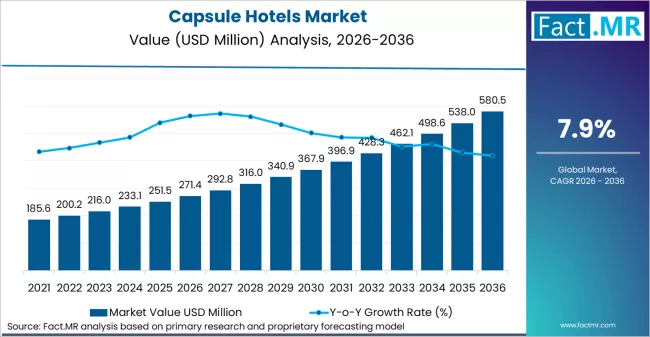
    Capsule Hotels Market Market Value Analysis

    Capsule Hotels Market

    Metric Value
    Estimated Value in (2026E) USD 271.4 million
    Forecast Value in (2036F) USD 539.4 million
    Forecast CAGR (2026 to 2036) 7.9%

    Capsule Hotels Market Definition

    The Capsule Hotels Market involves the development, operation, and sale of compact, pod‑style accommodations that provide budget‑friendly, space‑efficient lodging with basic amenities for short stays.

    Market Inclusions

    This report covers global and regional market sizes for capsule hotels over a defined forecast period, including service formats (economy, premium, airport‑linked pods), application segments (leisure, business travel), and distribution channels (online travel agencies, direct bookings).

    Market Exclusions

    The scope excludes traditional hotels, hostels without capsule concepts, and other short‑stay lodging formats (serviced apartments, guesthouses) not using the pod‑style accommodation model.

    Research Methodology

    • Primary Research: Interviews were conducted with hotel operators, travel platform executives, and hospitality analysts.
    • Desk Research: Data was sourced from tourism reports, industry publications, and trade association statistics.
    • Market‑Sizing and Forecasting: A hybrid model combining top‑down hospitality demand forecasts with bottom‑up property and revenue data was used.
    • Data Validation and Update Cycle: Findings were validated through expert review and aligned with recent occupancy and revenue statistics.

    Summary of the Breathable Membrane Market

    • Market Definition
      • The breathable membrane market involves the production and sale of semi-permeable materials that allow moisture vapor to pass through while blocking liquid water. These membranes are used to enhance comfort, durability, and moisture control in various products across industries such as construction, hygiene, healthcare, textiles, and food packaging.
    • Demand Drivers
      • Growing Adoption in Sustainable Building Materials: The increasing demand for energy-efficient and sustainable building materials is driving the adoption of breathable membranes, particularly in construction applications where moisture control is critical.
      • Rising Consumer Demand for Comfort and Hygiene: The growing awareness around personal hygiene and the increasing need for comfort in everyday products, such as medical garments, hygiene products, and protective clothing, are boosting the demand for breathable membranes.
      • Technological Advancements: Ongoing innovations in breathable membrane technologies, offering enhanced performance and durability, are supporting market growth.
    • Key Segments Analyzed
      • Material Type: Polyethylene is expected to dominate, accounting for 45% of the market share by 2026. Polyethylene-based breathable membranes are popular in applications requiring moisture management, such as hygiene products, textiles, and medical applications, due to their excellent moisture-wicking properties and versatility.
      • Application: Hygiene is projected to capture 30% of the market share by 2026. The hygiene sector, including products like diapers, sanitary pads, and adult incontinence products, represents a significant portion of the market due to the demand for breathable materials that provide comfort, breathability, and moisture control.
      • Geography: China leads with a CAGR of 8.2%, driven by the rapid growth of the construction sector and the increasing focus on energy-efficient and sustainable building practices. India follows with a 7.8% CAGR, fueled by the growing demand for high-performance materials in the construction and textile sectors.
    • Analyst Opinion at Fact MR
      • Shambhu Nath Jha, Principal Consultant at Fact MR, highlighted, "The growing focus on sustainability, especially in the construction and textile sectors, is expected to continue fueling the demand for breathable membranes, particularly those made from polyethylene, which offer superior moisture control and breathability."
    • Strategic Implications/Executive Takeaways
      • Emphasis on Innovation and Sustainability: Companies should focus on developing innovative breathable membrane solutions that meet the growing demand for energy-efficient buildings and sustainable textiles, with a focus on durability and moisture management.
      • Targeting Emerging Markets: Expanding market presence in rapidly developing regions like Asia Pacific, where urbanization and infrastructure growth are driving demand for construction materials, will be key to tapping into the growing need for breathable membranes.
      • Collaboration with Industry Players: Strategic partnerships with construction companies and textile manufacturers can help ensure product adoption and meet the increasing demand for high-performance breathable membranes.
    • Methodology
      • Primary Research: Interviews were conducted with material scientists, manufacturers, and end-user product designers.
      • Desk Research: Data was sourced from industry reports, standards publications, and trade association statistics.
      • Market Sizing & Forecasting: A hybrid model combining top-down demand forecasts with bottom-up shipment and revenue data was used to project market growth.

    Segmental Analysis

    Capsule Hotels Market Analysis by Booking Mode
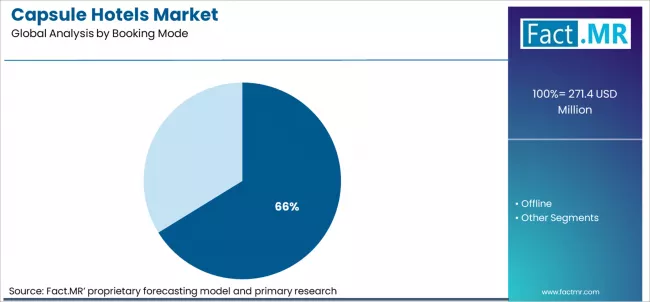
    Capsule Hotels Market Analysis By Booking Mode

    • Market Overview: Online booking is expected to capture 66.2% of the capsule hotels market by 2026. The convenience of online booking platforms is driving this trend, as travelers increasingly prefer to book accommodations through mobile apps and websites.
    • Demand Drivers:
      • Ease of Access and Convenience: Online platforms provide an easy and efficient way to book capsule hotels, especially for travelers seeking quick, budget-friendly options. This convenience appeals to both domestic and international travelers who can compare prices, check availability, and make bookings on the go.
      • Growth of Travel Apps and Online Platforms: The rise of travel apps and online booking sites like Booking.com, Airbnb, and others has significantly increased the adoption of online booking in the hospitality industry. Capsule hotels, which cater to budget-conscious travelers, are leveraging these platforms to reach a larger audience.
      • Preference for Mobile and Digital Booking: With more travelers relying on mobile devices for all aspects of travel planning, including accommodation booking, the demand for online booking options for capsule hotels continues to rise, especially among younger, tech-savvy demographics.

    Capsule Hotels Market Analysis by Traveler Type
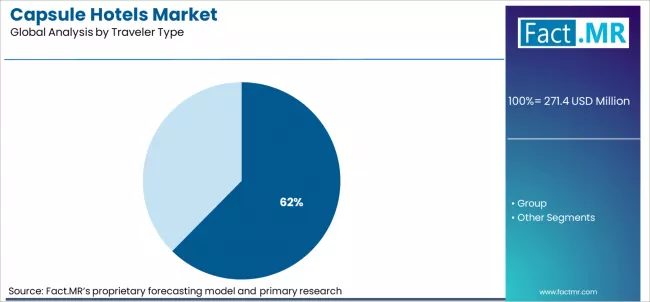
    Capsule Hotels Market Analysis By Traveler Type

    • Market Overview: Solo travelers are projected to account for 62.4% of the market share by 2026. Capsule hotels are particularly popular with solo travelers due to their compact design, affordability, and suitability for short stays, making them an ideal option for individuals traveling alone.
    • Demand Drivers:
      • Affordability and Privacy for Solo Travelers: Capsule hotels provide a cost-effective, private, and secure place to stay, which is especially appealing to solo travelers who may be on a budget or prefer a minimalist, independent experience. The compact nature of capsule hotels makes them an ideal choice for solo travelers seeking practicality and privacy without paying for expensive traditional hotel rooms.
      • Increased Solo Travel Trends: The rise in solo travel, driven by younger generations and solo adventurers, is contributing to the growth of capsule hotels. Solo travelers value the convenience, affordability, and simplicity offered by capsule hotels, which cater to their specific needs for temporary, low-cost accommodation.
      • Social and Safe Environment: Many solo travelers are attracted to capsule hotels due to the social, yet private, environment they offer. The shared spaces in capsule hotels provide opportunities to meet other like-minded travelers, making them an attractive option for solo adventurers.

    Capsule Hotels Market Drivers, Restraints, and Opportunities

    FMR analysts observe that the capsule hotels market is a growth‑aligned, urban hospitality segment driven by increasing demand for affordable, space‑efficient accommodations in dense city centers and travel hubs. Historically, traditional hotels dominated overnight stays; as budget‑conscious travelers, digital nomads, and short‑stay business guests seek low‑cost, convenient lodging, structural demand has emerged for compact, pod‑style rooms that maximize occupancy while minimizing space and cost. The 2026 valuation reflects this shift, with adoption tied to rising urban tourism, airport transit stays, and evolving preferences for minimalist yet functional accommodations.

    While conventional hotels remain dominant in volume, capsule hotels are gaining share in markets where cost, location, and convenience outweigh full‑service amenities. These compact units often command higher per‑square‑foot revenue through optimized pricing models, contributing to net market value growth even as unit expansion grows moderately. The market exists because urban density and travel behavior align with capsule concepts that balance basic comfort, privacy, and price.

    • Urban & Transit Demand: Budget travelers and transit passengers adopt capsule hotels for convenient, low‑cost stays near transport hubs and city centers.
    • Hospitality Standards & Space Efficiency: Design and safety standards for compact lodging push adoption of certified capsule hotel solutions that meet building and guest safety criteria.
    • Regional Travel Dynamics: In Asia‑Pacific and Europe, strong urban tourism and business travel accelerate capsule hotel adoption compared with regions where traditional hotels remain more prevalent.

    Regional Analysis

    The market analysis covers key global regions, including East Asia, South Asia, Western Europe, and North America. It is segmented geographically, with specific market dynamics for each region. The full report provides a detailed market attractiveness analysis.
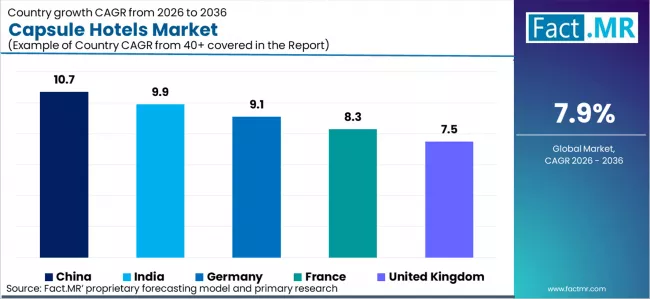
    Capsule Hotels Market Cagr Analysis By Country

    Country CAGR (2026-2036)
    China 10.7%
    India 9.9%
    Germany 9.1%
    France 8.3%
    United Kingdom 7.5%

    Source: Fact MR (FMR) analysis, based on proprietary forecasting model and primary research.

    East Asia:
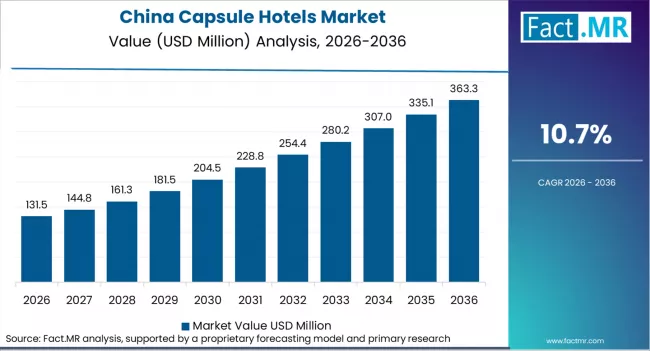
    Capsule Hotels Market Country Value Analysis

    In East Asia, China leads the demand for capsule hotels, driven by rapid urbanization, increasing travel demand, and the rise in affordable and efficient accommodation options for both domestic and international tourists.

    • China: Demand for capsule hotels in China is projected to rise at 10.7% CAGR through 2036. China’s growing tourism sector, rapid urbanization, and demand for affordable, efficient accommodations continue to drive market growth.

    South Asia:

    In South Asia, India is a growing market for capsule hotels, supported by the rise in domestic tourism, increasing adoption of budget accommodation options, and growing interest in unique and space-efficient lodging alternatives.

    • India: Demand for capsule hotels in India is projected to rise at 9.9% CAGR through 2036. India’s expanding travel industry, increased tourism in major cities, and rising demand for budget-friendly accommodations contribute to steady market growth.

    Western Europe:

    In Western Europe, Germany and France are significant markets for capsule hotels, driven by increasing urban tourism, growing demand for innovative and affordable accommodation, and rising interest in unique lodging experiences.

    • Germany: Demand for capsule hotels in Germany is projected to rise at 9.1% CAGR through 2036. Germany’s strong tourism industry, growing demand for budget travel, and rising interest in capsule hotel concepts continue to fuel market expansion.
    • France: Demand for capsule hotels in France is projected to rise at 8.3% CAGR through 2036. France’s increasing number of international tourists and growing demand for affordable, space-efficient accommodations contribute to market growth.
    • United Kingdom: Demand for capsule hotels in the UK is projected to rise at 7.5% CAGR through 2036. The UK’s increasing demand for unique and budget-friendly accommodation and growth in urban tourism continue to drive market growth.

    Fact MR's analysis of the Capsule Hotels Market in East Asia, South Asia, Western Europe consists of country-wise assessments that include China, India, Germany, France, and the United Kingdom. Readers can find detailed trends, regulatory updates, and company-specific investments shaping the market’s growth in these countries.

    What is the Competitive Structure and Buyer Behavior in the Capsule Hotels Market?
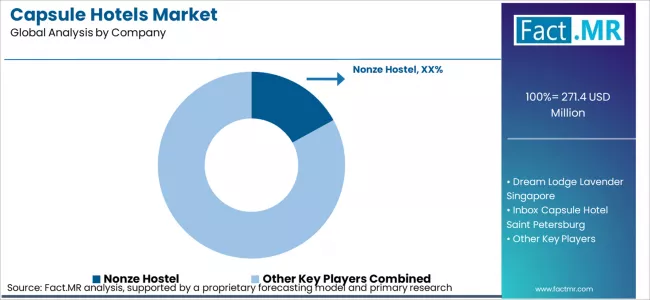
    Capsule Hotels Market Analysis By Company

    The capsule hotels market remains moderately fragmented, with a wide array of independent operators such as Nonze Hostel, Dream Lodge @ Tyrwhitt, inBox Capsule Hotel, The Pod Sydney, and distinctive concepts such as Tubohotel coexisting with guest‑focused properties like Koyasan Guest House Kokuu. Large international capsule hotel chains and branded pod operators also compete, yet no single firm dominates global share, and localized operators frequently outperform global brands in specific urban or tourist hubs. The primary competitive variables are traveler experience, location convenience, price, and added amenities that appeal to budget and solo travelers, digital nomads, and transit passengers. Operators with strong digital booking integration, proximity to transport nodes or city centers, and differentiated service offerings hold structural advantages, as these factors enhance occupancy levels and guest loyalty in a market where overall scale is limited compared to traditional hotels. Large travel platforms and OTAs give buyers leverage, enabling them to compare prices and reviews easily and negotiate visibility and rates; this customer behavior limits individual operators’ pricing power and shifts competition toward experiential value and service reliability rather than pricing alone.

    Recent Industry Developments

    • 2026 Expansion: TARKA Edinburgh Opening: In Summer 2026, the UK market will see a significant shift with the opening of TARKA Edinburgh. This 242-bed facility, housed in a repurposed vacant building, represents the "Japanese-inspired lifestyle" trend, featuring high-design pods and a rooftop Japanese restaurant to bridge the gap between budget hostels and boutique hotels.
    • Transition to AI-Driven "Operational Nerve Centres": As of early 2026, the "smart capsule" has moved beyond basic Wi-Fi to fully integrated IoT ecosystems. Modern facilities are using AI to form "Intelligent Guest Profiles" (IGPs), where a guest's preferred lighting, temperature, and even "midnight snack" preferences are automatically synced to the pod upon mobile check-in.
    • Rise of the "Micro-Nightclub" Hospitality Concept: In March 2026, Singapore’s Club 666 debuted the city’s first "micro-nightclub" concept, integrating capsule-style private rooms into the nightlife experience. This trend reflects the broader 2026 movement of using capsule architecture to provide "intimate pockets" for groups within larger, high-density hospitality venues

    Key Players of the Capsule Hotels Market

    • Nonze Hostel
    • Dream Lodge Lavender Singapore
    • Inbox Capsule Hotel Saint Petersburg
    • The Pod Sydney
    • Anshin Oyado (Capsule Hotel)
    • Bloc Hotels
    • Tubohotel
    • Koyasan Guesthouse

    Report Scope

    Metric Value
    Quantitative Units USD 271.4 million (2026) to USD 539.4 million (2036), at a CAGR of 7.9%
    Market Definition The Capsule Hotels Market includes the business of compact, cost-effective accommodations that feature capsule-style rooms, targeted at solo and group travelers of various age groups.
    By Traveler Type Solo, Group
    By Age Group 25-39 Years, 18-24 Years, 40-54 Years, 55+ Years
    By Booking Mode Online, Offline
    Regions Covered North America, Latin America, Europe, East Asia, South Asia, Oceania, Middle East and Africa
    Countries Covered United States, Canada, Mexico, Brazil, Argentina, Germany, France, United Kingdom, Italy, Spain, China, India, Japan, South Korea, Indonesia, Australia, and 40+ countries
    Key Companies Profiled Nonze Hostel, Dream Lodge Lavender Singapore, Inbox Capsule Hotel Saint Petersburg, The Pod Sydney, Anshin Oyado (Capsule Hotel), Bloc Hotels, Tubohotel, Koyasan Guesthouse
    Forecast Period 2026 to 2036
    Approach Hybrid top-down and bottom-up market modeling validated through primary interviews with manufacturers and supported by trade data benchmarking and market research.

    Capsule Hotels Market Key Segments

    • Traveler Type

      • Solo
      • Group
    • Age Group

      • 25-39 Years
      • 18-24 Years
      • 40-54 Years
      • 55+ Years
    • Booking Mode

      • Online
      • Offline
    • Region

      • North America
        • USA
        • Canada
        • Mexico
      • Europe
        • Germany
        • UK
        • France
        • Italy
        • Spain
        • Nordic Countries
        • BENELUX
        • Rest of Europe
      • Asia Pacific
        • China
        • Japan
        • South Korea
        • India
        • Australia
        • Rest of Asia Pacific
      • Latin America
        • Brazil
        • Argentina
        • Rest of Latin America
      • Middle East and Africa
        • Kingdom of Saudi Arabia
        • United Arab Emirates
        • South Africa
        • Rest of Middle East and Africa
      • Other Regions
        • Oceania
        • Central Asia
        • Other Markets

    Bibliographies

    • Bloc Hotels. (2023). Affordable capsule-style accommodations for urban travelers. Bloc Hotels.
    • Dream Lodge Lavender Singapore. (2023). Compact and functional capsule hotel rooms for budget-conscious travelers. Dream Lodge Lavender Singapore.
    • Nonze Hostel. (2023). Affordable and efficient capsule hotel solutions for solo travelers. Nonze Hostel.
    • The Pod Sydney. (2023). Innovative capsule hotel experiences in the heart of Sydney. The Pod Sydney.
    • Boutique Hotelier. (2025, May). TARKA Edinburgh, new capsule hotel, to open in summer 2026 [Industry update]. Boutique Hotelier.
    • FCS Solutions. (2026, February). Top Hotel Industry Trends for 2026: AI, Tech & Profitability [Industry report]. FCS Solutions.
    • Vietnam Investment Review. (2026, March 3). Club 666 to open Singapore’s first micro nightclub concept [Hospitality trend]. Vietnam Investment Review.

    This report addresses:

    • Market intelligence enabling comprehensive assessment of leading countries and product segments across the Capsule Hotels Market globally.
    • Market volume (sales units) estimates and 10-year revenue forecasts from 2026 to 2036, validated through manufacturer shipment data, channel partner surveys, and country-level demand modeling.
    • Growth opportunity mapping across traveler types (Solo, Group), age groups (25-39 Years, 18-24 Years, 40-54 Years, 55+ Years), and booking modes (Online, Offline).
    • Segment and regional revenue forecasts by traveler type, age group, booking mode, and geography across 40+ countries.
    • Competition strategy analysis covering dealer network structure, recent developments, product portfolio, USPs, and market share analysis.
    • Product and regulatory compliance tracking aligned with hospitality standards, tourism industry regulations, and space-efficient accommodation guidelines.
    • Regulatory impact analysis addressing environmental regulations, tourism standards, and hospitality certifications across key markets.
    • Report delivery in PDF, Excel, PowerPoint, and interactive dashboard formats for executive, procurement, and operational planning use.

    Table of Content

    1. Executive Summary
      • Global Market Outlook
      • Demand to side Trends
      • Supply to side Trends
      • Technology Roadmap Analysis
      • Analysis and Recommendations
    2. Market Overview
      • Market Coverage / Taxonomy
      • Market Definition / Scope / Limitations
    3. Research Methodology
      • Chapter Orientation
      • Analytical Lens and Working Hypotheses
        • Market Structure, Signals, and Trend Drivers
        • Benchmarking and Cross-market Comparability
        • Market Sizing, Forecasting, and Opportunity Mapping
      • Research Design and Evidence Framework
        • Desk Research Programme (Secondary Evidence)
          • Company Annual and Sustainability Reports
          • Peer-reviewed Journals and Academic Literature
          • Corporate Websites, Product Literature, and Technical Notes
          • Earnings Decks and Investor Briefings
          • Statutory Filings and Regulatory Disclosures
          • Technical White Papers and Standards Notes
          • Trade Journals, Industry Magazines, and Analyst Briefs
          • Conference Proceedings, Webinars, and Seminar Materials
          • Government Statistics Portals and Public Data Releases
          • Press Releases and Reputable Media Coverage
          • Specialist Newsletters and Curated Briefings
          • Sector Databases and Reference Repositories
          • FMR Internal Proprietary Databases and Historical Market Datasets
          • Subscription Datasets and Paid Sources
          • Social Channels, Communities, and Digital Listening Inputs
          • Additional Desk Sources
        • Expert Input and Fieldwork (Primary Evidence)
          • Primary Modes
            • Qualitative Interviews and Expert Elicitation
            • Quantitative Surveys and Structured Data Capture
            • Blended Approach
          • Why Primary Evidence is Used
          • Field Techniques
            • Interviews
            • Surveys
            • Focus Groups
            • Observational and In-context Research
            • Social and Community Interactions
          • Stakeholder Universe Engaged
            • C-suite Leaders
            • Board Members
            • Presidents and Vice Presidents
            • R&D and Innovation Heads
            • Technical Specialists
            • Domain Subject-matter Experts
            • Scientists
            • Physicians and Other Healthcare Professionals
          • Governance, Ethics, and Data Stewardship
            • Research Ethics
            • Data Integrity and Handling
        • Tooling, Models, and Reference Databases
      • Data Engineering and Model Build
        • Data Acquisition and Ingestion
        • Cleaning, Normalisation, and Verification
        • Synthesis, Triangulation, and Analysis
      • Quality Assurance and Audit Trail
    4. Market Background
      • Market Dynamics
        • Drivers
        • Restraints
        • Opportunity
        • Trends
      • Scenario Forecast
        • Demand in Optimistic Scenario
        • Demand in Likely Scenario
        • Demand in Conservative Scenario
      • Opportunity Map Analysis
      • Product Life Cycle Analysis
      • Supply Chain Analysis
      • Investment Feasibility Matrix
      • Value Chain Analysis
      • PESTLE and Porter’s Analysis
      • Regulatory Landscape
      • Regional Parent Market Outlook
      • Production and Consumption Statistics
      • Import and Export Statistics
    5. Global Market Analysis 2021 to 2025 and Forecast, 2026 to 2036
      • Historical Market Size Value (USD Million) Analysis, 2021 to 2025
      • Current and Future Market Size Value (USD Million) Projections, 2026 to 2036
        • Y to o to Y Growth Trend Analysis
        • Absolute $ Opportunity Analysis
    6. Global Market Pricing Analysis 2021 to 2025 and Forecast 2026 to 2036
    7. Global Market Analysis 2021 to 2025 and Forecast 2026 to 2036, By Booking Mode
      • Introduction / Key Findings
      • Historical Market Size Value (USD Million) Analysis By Booking Mode , 2021 to 2025
      • Current and Future Market Size Value (USD Million) Analysis and Forecast By Booking Mode , 2026 to 2036
        • Online
        • Offline
      • Y to o to Y Growth Trend Analysis By Booking Mode , 2021 to 2025
      • Absolute $ Opportunity Analysis By Booking Mode , 2026 to 2036
    8. Global Market Analysis 2021 to 2025 and Forecast 2026 to 2036, By Traveler Type
      • Introduction / Key Findings
      • Historical Market Size Value (USD Million) Analysis By Traveler Type, 2021 to 2025
      • Current and Future Market Size Value (USD Million) Analysis and Forecast By Traveler Type, 2026 to 2036
        • Solo
        • Group
      • Y to o to Y Growth Trend Analysis By Traveler Type, 2021 to 2025
      • Absolute $ Opportunity Analysis By Traveler Type, 2026 to 2036
    9. Global Market Analysis 2021 to 2025 and Forecast 2026 to 2036, By Region
      • Introduction
      • Historical Market Size Value (USD Million) Analysis By Region, 2021 to 2025
      • Current Market Size Value (USD Million) Analysis and Forecast By Region, 2026 to 2036
        • North America
        • Latin America
        • Western Europe
        • Eastern Europe
        • East Asia
        • South Asia and Pacific
        • Middle East & Africa
      • Market Attractiveness Analysis By Region
    10. North America Market Analysis 2021 to 2025 and Forecast 2026 to 2036, By Country
      • Historical Market Size Value (USD Million) Trend Analysis By Market Taxonomy, 2021 to 2025
      • Market Size Value (USD Million) Forecast By Market Taxonomy, 2026 to 2036
        • By Country
          • USA
          • Canada
          • Mexico
        • By Booking Mode
        • By Traveler Type
      • Market Attractiveness Analysis
        • By Country
        • By Booking Mode
        • By Traveler Type
      • Key Takeaways
    11. Latin America Market Analysis 2021 to 2025 and Forecast 2026 to 2036, By Country
      • Historical Market Size Value (USD Million) Trend Analysis By Market Taxonomy, 2021 to 2025
      • Market Size Value (USD Million) Forecast By Market Taxonomy, 2026 to 2036
        • By Country
          • Brazil
          • Chile
          • Rest of Latin America
        • By Booking Mode
        • By Traveler Type
      • Market Attractiveness Analysis
        • By Country
        • By Booking Mode
        • By Traveler Type
      • Key Takeaways
    12. Western Europe Market Analysis 2021 to 2025 and Forecast 2026 to 2036, By Country
      • Historical Market Size Value (USD Million) Trend Analysis By Market Taxonomy, 2021 to 2025
      • Market Size Value (USD Million) Forecast By Market Taxonomy, 2026 to 2036
        • By Country
          • Germany
          • UK
          • Italy
          • Spain
          • France
          • Nordic
          • BENELUX
          • Rest of Western Europe
        • By Booking Mode
        • By Traveler Type
      • Market Attractiveness Analysis
        • By Country
        • By Booking Mode
        • By Traveler Type
      • Key Takeaways
    13. Eastern Europe Market Analysis 2021 to 2025 and Forecast 2026 to 2036, By Country
      • Historical Market Size Value (USD Million) Trend Analysis By Market Taxonomy, 2021 to 2025
      • Market Size Value (USD Million) Forecast By Market Taxonomy, 2026 to 2036
        • By Country
          • Russia
          • Poland
          • Hungary
          • Balkan & Baltic
          • Rest of Eastern Europe
        • By Booking Mode
        • By Traveler Type
      • Market Attractiveness Analysis
        • By Country
        • By Booking Mode
        • By Traveler Type
      • Key Takeaways
    14. East Asia Market Analysis 2021 to 2025 and Forecast 2026 to 2036, By Country
      • Historical Market Size Value (USD Million) Trend Analysis By Market Taxonomy, 2021 to 2025
      • Market Size Value (USD Million) Forecast By Market Taxonomy, 2026 to 2036
        • By Country
          • China
          • Japan
          • South Korea
        • By Booking Mode
        • By Traveler Type
      • Market Attractiveness Analysis
        • By Country
        • By Booking Mode
        • By Traveler Type
      • Key Takeaways
    15. South Asia and Pacific Market Analysis 2021 to 2025 and Forecast 2026 to 2036, By Country
      • Historical Market Size Value (USD Million) Trend Analysis By Market Taxonomy, 2021 to 2025
      • Market Size Value (USD Million) Forecast By Market Taxonomy, 2026 to 2036
        • By Country
          • India
          • ASEAN
          • Australia & New Zealand
          • Rest of South Asia and Pacific
        • By Booking Mode
        • By Traveler Type
      • Market Attractiveness Analysis
        • By Country
        • By Booking Mode
        • By Traveler Type
      • Key Takeaways
    16. Middle East & Africa Market Analysis 2021 to 2025 and Forecast 2026 to 2036, By Country
      • Historical Market Size Value (USD Million) Trend Analysis By Market Taxonomy, 2021 to 2025
      • Market Size Value (USD Million) Forecast By Market Taxonomy, 2026 to 2036
        • By Country
          • Kingdom of Saudi Arabia
          • Other GCC Countries
          • Turkiye
          • South Africa
          • Other African Union
          • Rest of Middle East & Africa
        • By Booking Mode
        • By Traveler Type
      • Market Attractiveness Analysis
        • By Country
        • By Booking Mode
        • By Traveler Type
      • Key Takeaways
    17. Key Countries Market Analysis
      • USA
        • Pricing Analysis
        • Market Share Analysis, 2025
          • By Booking Mode
          • By Traveler Type
      • Canada
        • Pricing Analysis
        • Market Share Analysis, 2025
          • By Booking Mode
          • By Traveler Type
      • Mexico
        • Pricing Analysis
        • Market Share Analysis, 2025
          • By Booking Mode
          • By Traveler Type
      • Brazil
        • Pricing Analysis
        • Market Share Analysis, 2025
          • By Booking Mode
          • By Traveler Type
      • Chile
        • Pricing Analysis
        • Market Share Analysis, 2025
          • By Booking Mode
          • By Traveler Type
      • Germany
        • Pricing Analysis
        • Market Share Analysis, 2025
          • By Booking Mode
          • By Traveler Type
      • UK
        • Pricing Analysis
        • Market Share Analysis, 2025
          • By Booking Mode
          • By Traveler Type
      • Italy
        • Pricing Analysis
        • Market Share Analysis, 2025
          • By Booking Mode
          • By Traveler Type
      • Spain
        • Pricing Analysis
        • Market Share Analysis, 2025
          • By Booking Mode
          • By Traveler Type
      • France
        • Pricing Analysis
        • Market Share Analysis, 2025
          • By Booking Mode
          • By Traveler Type
      • India
        • Pricing Analysis
        • Market Share Analysis, 2025
          • By Booking Mode
          • By Traveler Type
      • ASEAN
        • Pricing Analysis
        • Market Share Analysis, 2025
          • By Booking Mode
          • By Traveler Type
      • Australia & New Zealand
        • Pricing Analysis
        • Market Share Analysis, 2025
          • By Booking Mode
          • By Traveler Type
      • China
        • Pricing Analysis
        • Market Share Analysis, 2025
          • By Booking Mode
          • By Traveler Type
      • Japan
        • Pricing Analysis
        • Market Share Analysis, 2025
          • By Booking Mode
          • By Traveler Type
      • South Korea
        • Pricing Analysis
        • Market Share Analysis, 2025
          • By Booking Mode
          • By Traveler Type
      • Russia
        • Pricing Analysis
        • Market Share Analysis, 2025
          • By Booking Mode
          • By Traveler Type
      • Poland
        • Pricing Analysis
        • Market Share Analysis, 2025
          • By Booking Mode
          • By Traveler Type
      • Hungary
        • Pricing Analysis
        • Market Share Analysis, 2025
          • By Booking Mode
          • By Traveler Type
      • Kingdom of Saudi Arabia
        • Pricing Analysis
        • Market Share Analysis, 2025
          • By Booking Mode
          • By Traveler Type
      • Turkiye
        • Pricing Analysis
        • Market Share Analysis, 2025
          • By Booking Mode
          • By Traveler Type
      • South Africa
        • Pricing Analysis
        • Market Share Analysis, 2025
          • By Booking Mode
          • By Traveler Type
    18. Market Structure Analysis
      • Competition Dashboard
      • Competition Benchmarking
      • Market Share Analysis of Top Players
        • By Regional
        • By Booking Mode
        • By Traveler Type
    19. Competition Analysis
      • Competition Deep Dive
        • Nonze Hostel
          • Overview
          • Product Portfolio
          • Profitability by Market Segments (Product/Age /Sales Channel/Region)
          • Sales Footprint
          • Strategy Overview
            • Marketing Strategy
            • Product Strategy
            • Channel Strategy
        • Dream Lodge Lavender Singapore
        • Inbox Capsule Hotel Saint Petersburg
        • The Pod Sydney
        • Anshin Oyado (Capsule Hotel)
        • Bloc Hotels
        • Tubohotel
        • Koyasan Guesthouse
    20. Assumptions & Acronyms Used

    List Of Table

    • Table 1: Global Market Value (USD Million) Forecast by Region, 2021 to 2036
    • Table 2: Global Market Value (USD Million) Forecast by Booking Mode , 2021 to 2036
    • Table 3: Global Market Value (USD Million) Forecast by Traveler Type, 2021 to 2036
    • Table 4: North America Market Value (USD Million) Forecast by Country, 2021 to 2036
    • Table 5: North America Market Value (USD Million) Forecast by Booking Mode , 2021 to 2036
    • Table 6: North America Market Value (USD Million) Forecast by Traveler Type, 2021 to 2036
    • Table 7: Latin America Market Value (USD Million) Forecast by Country, 2021 to 2036
    • Table 8: Latin America Market Value (USD Million) Forecast by Booking Mode , 2021 to 2036
    • Table 9: Latin America Market Value (USD Million) Forecast by Traveler Type, 2021 to 2036
    • Table 10: Western Europe Market Value (USD Million) Forecast by Country, 2021 to 2036
    • Table 11: Western Europe Market Value (USD Million) Forecast by Booking Mode , 2021 to 2036
    • Table 12: Western Europe Market Value (USD Million) Forecast by Traveler Type, 2021 to 2036
    • Table 13: Eastern Europe Market Value (USD Million) Forecast by Country, 2021 to 2036
    • Table 14: Eastern Europe Market Value (USD Million) Forecast by Booking Mode , 2021 to 2036
    • Table 15: Eastern Europe Market Value (USD Million) Forecast by Traveler Type, 2021 to 2036
    • Table 16: East Asia Market Value (USD Million) Forecast by Country, 2021 to 2036
    • Table 17: East Asia Market Value (USD Million) Forecast by Booking Mode , 2021 to 2036
    • Table 18: East Asia Market Value (USD Million) Forecast by Traveler Type, 2021 to 2036
    • Table 19: South Asia and Pacific Market Value (USD Million) Forecast by Country, 2021 to 2036
    • Table 20: South Asia and Pacific Market Value (USD Million) Forecast by Booking Mode , 2021 to 2036
    • Table 21: South Asia and Pacific Market Value (USD Million) Forecast by Traveler Type, 2021 to 2036
    • Table 22: Middle East & Africa Market Value (USD Million) Forecast by Country, 2021 to 2036
    • Table 23: Middle East & Africa Market Value (USD Million) Forecast by Booking Mode , 2021 to 2036
    • Table 24: Middle East & Africa Market Value (USD Million) Forecast by Traveler Type, 2021 to 2036

    List Of Figures

    • Figure 1: Global Market Pricing Analysis
    • Figure 2: Global Market Value (USD Million) Forecast 2021 to 2036
    • Figure 3: Global Market Value Share and BPS Analysis by Booking Mode , 2026 and 2036
    • Figure 4: Global Market Y to o to Y Growth Comparison by Booking Mode , 2026 to 2036
    • Figure 5: Global Market Attractiveness Analysis by Booking Mode
    • Figure 6: Global Market Value Share and BPS Analysis by Traveler Type, 2026 and 2036
    • Figure 7: Global Market Y to o to Y Growth Comparison by Traveler Type, 2026 to 2036
    • Figure 8: Global Market Attractiveness Analysis by Traveler Type
    • Figure 9: Global Market Value (USD Million) Share and BPS Analysis by Region, 2026 and 2036
    • Figure 10: Global Market Y to o to Y Growth Comparison by Region, 2026 to 2036
    • Figure 11: Global Market Attractiveness Analysis by Region
    • Figure 12: North America Market Incremental Dollar Opportunity, 2026 to 2036
    • Figure 13: Latin America Market Incremental Dollar Opportunity, 2026 to 2036
    • Figure 14: Western Europe Market Incremental Dollar Opportunity, 2026 to 2036
    • Figure 15: Eastern Europe Market Incremental Dollar Opportunity, 2026 to 2036
    • Figure 16: East Asia Market Incremental Dollar Opportunity, 2026 to 2036
    • Figure 17: South Asia and Pacific Market Incremental Dollar Opportunity, 2026 to 2036
    • Figure 18: Middle East & Africa Market Incremental Dollar Opportunity, 2026 to 2036
    • Figure 19: North America Market Value Share and BPS Analysis by Country, 2026 and 2036
    • Figure 20: North America Market Value Share and BPS Analysis by Booking Mode , 2026 and 2036
    • Figure 21: North America Market Y to o to Y Growth Comparison by Booking Mode , 2026 to 2036
    • Figure 22: North America Market Attractiveness Analysis by Booking Mode
    • Figure 23: North America Market Value Share and BPS Analysis by Traveler Type, 2026 and 2036
    • Figure 24: North America Market Y to o to Y Growth Comparison by Traveler Type, 2026 to 2036
    • Figure 25: North America Market Attractiveness Analysis by Traveler Type
    • Figure 26: Latin America Market Value Share and BPS Analysis by Country, 2026 and 2036
    • Figure 27: Latin America Market Value Share and BPS Analysis by Booking Mode , 2026 and 2036
    • Figure 28: Latin America Market Y to o to Y Growth Comparison by Booking Mode , 2026 to 2036
    • Figure 29: Latin America Market Attractiveness Analysis by Booking Mode
    • Figure 30: Latin America Market Value Share and BPS Analysis by Traveler Type, 2026 and 2036
    • Figure 31: Latin America Market Y to o to Y Growth Comparison by Traveler Type, 2026 to 2036
    • Figure 32: Latin America Market Attractiveness Analysis by Traveler Type
    • Figure 33: Western Europe Market Value Share and BPS Analysis by Country, 2026 and 2036
    • Figure 34: Western Europe Market Value Share and BPS Analysis by Booking Mode , 2026 and 2036
    • Figure 35: Western Europe Market Y to o to Y Growth Comparison by Booking Mode , 2026 to 2036
    • Figure 36: Western Europe Market Attractiveness Analysis by Booking Mode
    • Figure 37: Western Europe Market Value Share and BPS Analysis by Traveler Type, 2026 and 2036
    • Figure 38: Western Europe Market Y to o to Y Growth Comparison by Traveler Type, 2026 to 2036
    • Figure 39: Western Europe Market Attractiveness Analysis by Traveler Type
    • Figure 40: Eastern Europe Market Value Share and BPS Analysis by Country, 2026 and 2036
    • Figure 41: Eastern Europe Market Value Share and BPS Analysis by Booking Mode , 2026 and 2036
    • Figure 42: Eastern Europe Market Y to o to Y Growth Comparison by Booking Mode , 2026 to 2036
    • Figure 43: Eastern Europe Market Attractiveness Analysis by Booking Mode
    • Figure 44: Eastern Europe Market Value Share and BPS Analysis by Traveler Type, 2026 and 2036
    • Figure 45: Eastern Europe Market Y to o to Y Growth Comparison by Traveler Type, 2026 to 2036
    • Figure 46: Eastern Europe Market Attractiveness Analysis by Traveler Type
    • Figure 47: East Asia Market Value Share and BPS Analysis by Country, 2026 and 2036
    • Figure 48: East Asia Market Value Share and BPS Analysis by Booking Mode , 2026 and 2036
    • Figure 49: East Asia Market Y to o to Y Growth Comparison by Booking Mode , 2026 to 2036
    • Figure 50: East Asia Market Attractiveness Analysis by Booking Mode
    • Figure 51: East Asia Market Value Share and BPS Analysis by Traveler Type, 2026 and 2036
    • Figure 52: East Asia Market Y to o to Y Growth Comparison by Traveler Type, 2026 to 2036
    • Figure 53: East Asia Market Attractiveness Analysis by Traveler Type
    • Figure 54: South Asia and Pacific Market Value Share and BPS Analysis by Country, 2026 and 2036
    • Figure 55: South Asia and Pacific Market Value Share and BPS Analysis by Booking Mode , 2026 and 2036
    • Figure 56: South Asia and Pacific Market Y to o to Y Growth Comparison by Booking Mode , 2026 to 2036
    • Figure 57: South Asia and Pacific Market Attractiveness Analysis by Booking Mode
    • Figure 58: South Asia and Pacific Market Value Share and BPS Analysis by Traveler Type, 2026 and 2036
    • Figure 59: South Asia and Pacific Market Y to o to Y Growth Comparison by Traveler Type, 2026 to 2036
    • Figure 60: South Asia and Pacific Market Attractiveness Analysis by Traveler Type
    • Figure 61: Middle East & Africa Market Value Share and BPS Analysis by Country, 2026 and 2036
    • Figure 62: Middle East & Africa Market Value Share and BPS Analysis by Booking Mode , 2026 and 2036
    • Figure 63: Middle East & Africa Market Y to o to Y Growth Comparison by Booking Mode , 2026 to 2036
    • Figure 64: Middle East & Africa Market Attractiveness Analysis by Booking Mode
    • Figure 65: Middle East & Africa Market Value Share and BPS Analysis by Traveler Type, 2026 and 2036
    • Figure 66: Middle East & Africa Market Y to o to Y Growth Comparison by Traveler Type, 2026 to 2036
    • Figure 67: Middle East & Africa Market Attractiveness Analysis by Traveler Type
    • Figure 68: Global Market - Tier Structure Analysis
    • Figure 69: Global Market - Company Share Analysis

    - FAQs -

    How large is the demand for Capsule Hotels in the global market in 2026?

    Demand for Capsule Hotels in the global market is estimated to be valued at USD 271.4 million in 2026.

    What will be the market size of Capsule Hotels in the global market by 2036?

    The market size for Capsule Hotels is projected to reach USD 539.4 million by 2036.

    What is the expected demand growth for Capsule Hotels in the global market between 2026 and 2036?

    Demand for Capsule Hotels in the global market is expected to grow at a CAGR of 7.9% between 2026 and 2036.

    Which booking mode is expected to dominate the market?

    Online booking is expected to dominate the market, accounting for 66.2% of the market share in 2026, driven by the increasing use of digital platforms for travel reservations and the growing popularity of capsule hotels among budget-conscious travelers.

    Which region is expected to show the highest growth rate for Capsule Hotels?

    China is projected to show the highest regional CAGR at 10.7% during the forecast period, driven by the rising number of travelers, the expansion of the tourism and hospitality industry, and the growing demand for affordable accommodation options.

    How significant is the growth outlook for India in this market?

    India is expected to grow at a CAGR of 9.9%, reflecting increasing domestic and international tourism, a growing young population, and a rising demand for affordable and compact lodging solutions in urban areas.

    What is the growth outlook for Germany in the Capsule Hotels market?

    Germany is expected to grow at a CAGR of 9.1%, supported by the increasing popularity of capsule hotels among backpackers and budget travelers, as well as the growth in international tourism and the need for cost-effective accommodation.

    What is the growth forecast for France in the Capsule Hotels market?

    France is expected to grow at a CAGR of 8.3%, driven by the country's strong tourism industry, increasing demand for budget-friendly accommodations, and the growing popularity of capsule hotels, especially among young travelers and tourists.

    What is the growth forecast for the United Kingdom in the Capsule Hotels market?

    The United Kingdom is expected to grow at a CAGR of 7.5%, supported by the increasing demand for budget accommodations, especially in major cities, and the growing trend of capsule hotels among travelers seeking affordable and compact lodging solutions.

    Which company is identified as a leading player in the Capsule Hotels market?

    Nonze Hostel is recognized as a leading player in this market, offering a range of capsule hotel services with modern amenities, targeting budget-conscious travelers seeking affordable and efficient accommodations.

    What are Capsule Hotels used for?

    Capsule Hotels are a type of budget accommodation where guests stay in small, self-contained pods or capsules. They are designed to maximize space and provide basic amenities, offering a cost-effective solution for travelers seeking short-term, affordable lodging.

    What does the Capsule Hotels market include in this report?

    The market scope includes the global demand for capsule hotels, focusing on the growing popularity of online bookings for these compact, budget-friendly accommodations that cater to travelers looking for short-term, affordable lodging options.

    How is the market forecast developed in this report?

    The forecast is developed using historical data on travel trends, increasing demand for affordable accommodations, the growth of the tourism and hospitality sectors, and insights from key industry players in the capsule hotel and budget accommodation sectors.

    What is meant by the Capsule Hotels market in this report?

    The market refers to the global production, trade, and consumption of capsule hotels, with a focus on online bookings and the increasing demand for space-efficient, affordable lodging solutions that cater to modern travelers.

    Capsule Hotels Market