- Market Value (2025): USD 2.96 Bn
- Estimated Value (2026): USD 3.08 Bn
- Forecast Value (2036): USD 4.63 Bn
- CAGR (2026-2036): 4.2%
Bench Seats Market Forecast and Outlook 2026 to 2036
According to the Fact.MR analysis, the bench seats market is projected to grow from USD 3.08 billion in 2026 to USD 4.63 billion by 2036. Demand for bench seats is likely to grow at a CAGR of 4.2% over the forecast period.
Demand for bench seats is rising as pickup trucks, buses, rail cars, boats and public spaces use continuous seating that fits more occupants in less floor space. Company players of bench seats are offering fold-flat, modular and easy-clean designs. For example, Ford's F-Series remained the best-selling vehicle line in the United States in 2024, and many regular-cab and work trims use front bench seats. Similar work-truck demand is projected to drive sales of bench seats through 2036.
Key Takeaways from the Bench Seats Market
- Sales of bench seats stood at USD 2.96 billion in 2025
- Bench Seats Market Value (2026): USD 3.08 billion
- Bench Seats Market Forecast Value (2036): USD 4.63 billion
- Bench Seats Market Forecast CAGR (2026-2036): 4.2%
- Leading Material Type: Fabric (38.4%)
- Key Market Participants: Steelcase Inc., MillerKnoll Inc., Haworth Inc., HNI Corporation, Teknion Corporation, Vitra International AG
- Key Growth Regions: United States, Brazil, Japan, United Kingdom, Germany
In 2025, HNI agreed to acquire Steelcase, combining two of the largest US commercial furniture makers whose ranges include lounge and bench seating for offices and public spaces. Demand for bench seats is growing as workplaces and transit hubs redesign shared areas. Company players of bench seats are consolidating to offer complete interior packages. Similar consolidation is projected to shape sales of bench seats in commercial settings.
Bench Seats Market
| Metric | Value |
|---|---|
| Estimated Value in (2026) | USD 3.08 billion |
| Forecast Value in (2036) | USD 4.63 billion |
| Forecast CAGR (2026 to 2036) | 4.2% |
Source: Fact.MR analysis. Updated Nov 23, 2026
Source: Fact.MR analysis. Updated 16 Nov 2026
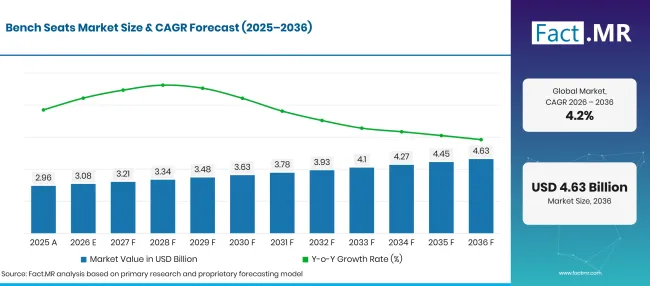
Bench Seats Market Forecast Global | Source: Fact.MR
Category
| Category | Segments |
|---|---|
| Material Type | Fabric, Leather, Vinyl, Others |
| Application | Automotive, Marine, Aviation, Others |
| Distribution Channel | OEMs, Aftermarket |
| End-User | Commercial, Residential |
| Region | United States; Brazil; Japan; United Kingdom; Germany |
Source: Fact.MR analysis. Updated Nov 23, 2026
Source: Fact.MR analysis. Updated 16 Nov 2026
Segmental Analysis
What makes fabric the preferred material for bench seat manufacturers?
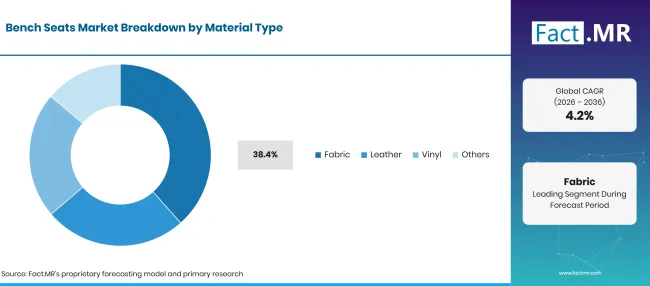
Bench Seats Market Breakdown Material Type | Source: Fact.MR
Demand for Fabric accounts for 38.4% of revenue in 2026, about USD 1.2 billion, as woven and knitted textiles are comfortable, breathable and cheaper than leather for vehicle and commercial seating. Leather and vinyl serve premium and wipe-clean uses. Company players are offering stain-resistant and recycled fabrics. Similar cost and comfort needs are projected to keep fabric in the lead. Manufacturers can also offer stain-resistant, abrasion-resistant and recycled textile options without the higher material costs associated with leather. Vinyl remains relevant for moisture-resistant and easy-clean seating. Continued demand for economical upholstery and high-volume seating production is expected to sustain fabric's leading position.
Which vehicle applications generate the strongest demand for bench seats?
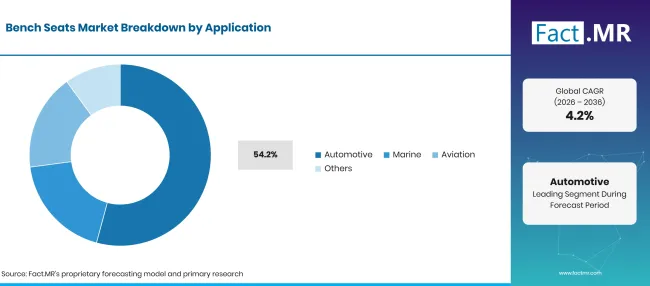
Bench Seats Market Breakdown Application | Source: Fact.MR
Automotive accounts for 54.2% of revenue in 2026, about USD 1.7 billion, as rear benches are standard in most cars and front benches remain in work trucks and vans. Marine and aviation uses follow. Company players are designing benches with integrated seat belts and child-seat anchors. Similar vehicle production is projected to keep automotive the leading application. The Federal Transit Administration announced nearly USD 390 million in February 2026 for 34 transit projects across 19 states and Puerto Rico, supporting nearly 200 new buses and approximately 11 bus maintenance facilities.
How does factory-installed seating strengthen OEM distribution sales?
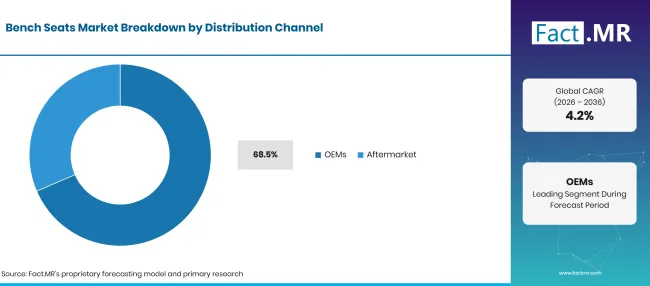
Bench Seats Market Breakdown Distribution Channel | Source: Fact.MR
Sales through OEMs account for 68.5% of revenue in 2026, about USD 2.1 billion, as seats are installed at the factory under long-term supply programs. Aftermarket sales cover replacements and custom upholstery. Company players are working with vehicle and furniture OEMs. Similar factory fitment is projected to keep OEMs in the lead. The FTA's FY2026 funding announcement made approximately USD 610 million available for bus and bus-facility programs, including vehicle purchases and fleet modernization. Such procurement programs create opportunities for seating suppliers that qualify for original-equipment contracts.
What purchasing requirements are driving commercial end-user demand?
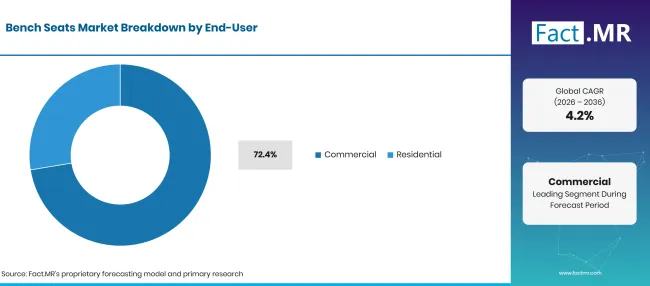
Bench Seats Market Breakdown End User | Source: Fact.MR
Demand from commercial users account for 72.4% of revenue in 2026, about USD 2.2 billion, including fleets, transit agencies, offices and public venues. Residential buyers purchase home benches and personal vehicles. Company players are offering durable commercial grades. Similar fleet and facility purchases are projected to keep commercial users in the lead. The U.S. Bureau of Labor Statistics reported approximately 497,600 employees in transit and ground passenger transportation in October 2026, indicating the scale of the operating sector that supports commercial transportation infrastructure. Fleet replacement and public-facility procurement are expected to sustain commercial seating demand.
Bench Seats Market-Drivers, Restraints & Trends
Drivers: Public Transportation Fleet Replacement
Transit agencies are investing in new buses and upgrading existing fleets, creating procurement opportunities for passenger seating manufacturers. In February 2026, the U.S. Federal Transit Administration (FTA) announced nearly USD 390 million for 34 transit projects across 19 states and Puerto Rico. The funding is expected to support nearly 200 new buses and approximately 11 bus maintenance facilities. Additionally, the FTA reported that its FY2025 and FY2026 allocations across the Grants for Buses and Bus Facilities and Low or No Emission programs totaled USD 2.4 billion across 199 projects. These investments are expected to support demand for durable, vandal-resistant and easy-to-maintain bench seating.
Restraints: Changing Automotive Seating Preferences
Growing SUV production and the preference for individually configured seating systems are limiting opportunities for traditional bench installations, particularly in front passenger compartments. According to the U.S. Environmental Protection Agency's February 2026 Automotive Trends Report, trucks represented 66% of new vehicle production in model year 2024, while cars accounted for 34%. Truck SUVs alone represented approximately half of new vehicle production. This changing production mix requires bench seat manufacturers to adapt their product portfolios to different vehicle configurations, passenger requirements and safety specifications. Company players may need to concentrate on rear seating systems, pickup trucks, commercial vans and transit applications to maintain sales as conventional front bench installations face competitive pressure.
Opportunity: Modular and Reconfigurable Bench Systems
Demand is developing for foldable, sliding and removable seating systems that allow commercial vehicle operators to switch between passenger transportation and cargo operations. The U.S. Energy Information Administration reported that hybrid, battery-electric and plug-in hybrid vehicles collectively represented 24% of new light-duty vehicle sales in the second quarter of 2026, compared with 22% in the same quarter of 2025. Hybrid vehicles accounted for 16% of sales, demonstrating the growing presence of electrified powertrains.
Trend: Sustainable Materials Recycled and Sustainable Upholstery Materials
Automotive suppliers, commercial furniture manufacturers and institutional buyers are increasingly considering material recovery, product durability and environmental procurement requirements when selecting seating components. The U.S. Environmental Protection Agency's Comprehensive Procurement Guidelines recommend 100% total recovered material content for PET fabric used in designated furniture applications. The agency also recommends 25–30% recovered material content for steel furniture structures. These procurement benchmarks provide a reference for manufacturers developing recycled polyester upholstery and recycled-metal seat frames. Company players investing in recycled textiles, resource-efficient manufacturing and durable upholstery can strengthen their position in sustainability-focused commercial seating contracts.
Bench Seats Market by Analysis by Key Country
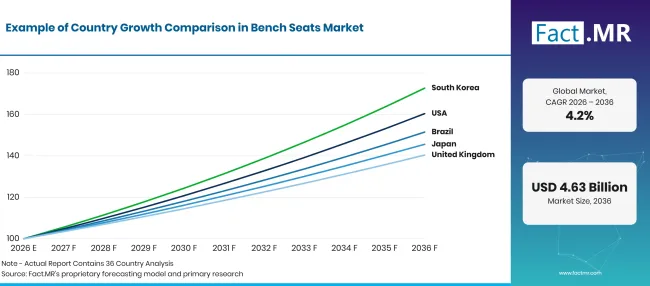
Bench Seats Market Growth Index | Source: Fact.MR
| Country | CAGR (2026-2036) |
|---|---|
| United States | 4.8% |
| Brazil | 4.2% |
| Japan | 3.8% |
| United Kingdom | 3.5% |
| Germany | 3.0% |
Source: Fact.MR analysis. Updated Nov 23, 2026
Source: Fact.MR analysis.
Why is the United States the fastest-growing market for bench seats?
Sales of bench seats in the United States are projected to grow at a 4.8% CAGR, the fastest among the five key countries, as pickup trucks, vans and transit buses use benches widely.
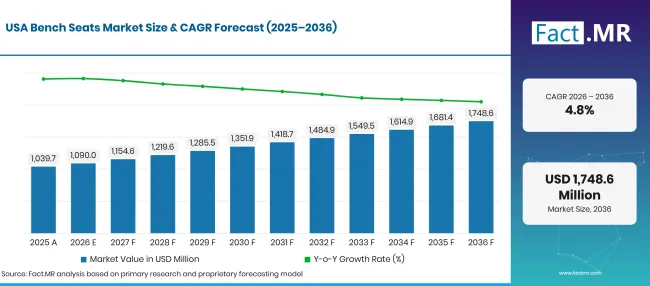
Bench Seats Market Forecast Usa | Source: Fact.MR
Office furniture makers such as Steelcase, MillerKnoll, Haworth and HNI are US-based. Similar vehicle and workplace demand is projected to drive sales in the United States. The U.S. Federal Transit Administration's November 2026 National Transit Summaries and Trends report recorded approximately 65,300 buses in the national transit fleet, indicating a substantial installed base requiring seating installations, refurbishment and replacement. Additionally, the U.S. Bureau of Economic Analysis reported on November 18, 2026, that outdoor recreation contributed USD 704.2 billion to the national economy in 2025, equivalent to 2.3% of GDP. These vehicle and recreational spending patterns create opportunities for manufacturers supplying durable bench seats for commercial vehicles, transit systems and outdoor applications.
What is supporting bench seat demand in Brazil?
Sales of bench seats in Brazil are estimated to increase at a 4.2% CAGR as bus makers such as Marcopolo build urban and intercity buses and light pickup demand grows.
Company players are serving local OEMs. Similar transport demand is projected to drive sales in Brazil. The Brazilian Ministry of Cities reported on November 17, 2026, that 29,038 buses operated across 96 participating municipalities under its 2026 National Urban Mobility Survey. These buses travelled nearly 2.4 billion kilometres, while municipal bus services transported more than 1.06 billion passengers during 2025. Continued bus utilization and fleet replacement requirements create procurement opportunities for manufacturers supplying passenger bench seating, particularly for urban and intercity buses. Marcopolo and other domestic bus manufacturers provide an established vehicle production base for seating suppliers.
What is shaping bench seat demand in Japan?
Demand for bench seats in Japan is anticipated to record a 3.8% CAGR as kei vans and commuter trains use bench seating. Okamura supplies office seating domestically.
Similar transport use is projected to support sales. The Ministry of Land, Infrastructure, Transport and Tourism's 2026 automotive statistics recorded 43,280 operating bus vehicles and approximately 229 million passenger journeys in the latest reported fiscal-year data for FY2024. Bus operations also accounted for approximately 902 million vehicle kilometres, highlighting the continuing utilization of public transportation fleets. These operating requirements support opportunities for replacement seating, passenger comfort improvements and new vehicle installations. Domestic furniture and seating suppliers, including Okamura, can address institutional and commercial seating requirements alongside automotive seating manufacturers.
What is shaping bench seat demand in the United Kingdom?
Demand in the United Kingdom is projected to grow at a 3.5% CAGR as rail operators refurbish trains and offices redesign shared spaces. Similar refurbishment is projected to support sales.
The Office of Rail and Road reported in October 2026 that Great Britain's railway recorded 461 million passenger journeys between April and June 2026, representing a 2% increase compared with the corresponding quarter in 2025. Annual passenger journeys also reached 1.83 billion between April 2025 and March 2026, the highest level since 1920. Rising passenger utilization creates opportunities for seating refurbishment, replacement and installation across railway coaches, stations and public transport facilities. Suppliers offering durable, space-efficient bench seating are positioned to benefit from continued investment in passenger transport infrastructure.
Which factors are limiting the pace of bench seat market expansion in Germany?
Demand in Germany is estimated to record a 3.0% CAGR, the slowest among the five key countries, as car production has fallen from pre-pandemic levels and office investment is weak.
Vitra and Kinnarps serve premium furniture. Similar conditions are projected to keep growth slower. The Federal Statistical Office (Destatis) reported in July 2026 that approximately 49.5 million passenger cars were registered in Germany as of January 1, 2026, representing a record vehicle base. However, new passenger car exports declined 4.0% year over year during January–July 2026, indicating softer activity in an important automotive production channel. These contrasting conditions create opportunities for replacement seating and commercial applications while limiting the pace of new vehicle-related demand. Manufacturers such as Vitra and Kinnarps continue to serve institutional and commercial furniture requirements.
Competitive Landscape for Bench Seats Market
Competition in the bench seats market is divided between commercial furniture groups and seating suppliers to vehicle makers. Steelcase, MillerKnoll, Haworth, HNI, Teknion, Vitra, Kinnarps, Global Furniture, Okamura and KI compete on design and contract furniture, while automotive seat suppliers compete for vehicle programs. Buyers select on durability, comfort, safety compliance and price.
From 2024 onward, competition shifted toward consolidation and sustainable materials. HNI's agreement to acquire Steelcase reshaped US contract furniture. Company players with modular designs and recycled materials are best placed to grow.
Recent Developments
- In 2025, HNI agreed to acquire Steelcase.
- In 2025, Ford reported the F-Series as the best-selling US vehicle line for 2024.
- On February 25, 2026, Haworth announced the acquisition of a majority shareholding in Canadian office furniture manufacturer Tayco. The acquisition expands Haworth's North American manufacturing capabilities and strengthens its portfolio across office furniture, workstations, storage, tables and seating. The transaction provides additional opportunities to serve commercial furniture customers through an expanded dealer network.
- On February 16, 2026, Heller Furniture joined Haworth through a strategic acquisition. The partnership expands Haworth's design-led furniture portfolio and strengthens its presence in indoor and outdoor furniture categories. Heller's established seating and furniture designs gain access to Haworth's international distribution network and commercial market reach.
- On April 28, 2026, Teknion introduced Blink, a multi-use chair developed in partnership with Formway. The chair combines ergonomic support, a flexible precision-molded shell and more than 1,000 perforations to improve breathability and seating comfort. Its design targets contemporary hybrid workplaces where users require adaptable seating with minimal manual adjustment.
- On June 3, 2026, KI introduced the Kiaura Collection, incorporating its Cognetic Technology. The new seating collection focuses on movement, physical comfort and cognitive engagement during extended sitting. The launch represents an expansion into human-performance seating, combining ergonomic design, advanced textiles and movement-oriented seating technology.
- On June 2, 2026, Herman Miller introduced updates to its Aeron Chair, including two new color options, Jasper and Nightfall, material improvements and a redesigned aluminum base. The updated design incorporates increased recycled and bio-based materials, with the company estimating a 12% reduction in the chair's global average embodied carbon footprint. The development strengthens MillerKnoll's premium seating portfolio.
- On June 17, 2026, Steelcase announced its debut at InfoComm 2026, showcasing integrated furniture and technology solutions for hybrid collaboration environments. The development focuses on creating adaptable workplace spaces that support communication, user comfort and technology integration. It represents an expansion of its workplace furniture solutions rather than a specific bench-seat launch.
Key Players in Bench Seats Market
Key companies operating in the market include Steelcase Inc., MillerKnoll Inc., Haworth Inc., HNI Corporation, Teknion Corporation, Vitra International AG, Kinnarps AB, Global Furniture Group, Okamura Corporation, and KI.
- Steelcase Inc.
- MillerKnoll Inc.
- Haworth Inc.
- HNI Corporation
- Teknion Corporation
- Vitra International AG
- Kinnarps AB
- Global Furniture Group
- Okamura Corporation
- KI
Bibliography
- Bureau of Economic Analysis. (2026, November 18). Outdoor recreation economic statistics, U.S. and states, 2025. U.S. Department of Commerce.
- Bureau of Labor Statistics. (2026, November). The employment situation—October 2026. U.S. Department of Labor.
- Destatis. (2026, September 21). Exports of new passenger cars down 4.0% year on year in the first seven months of 2026. Federal Statistical Office of Germany.
- Federal Transit Administration. (2026, February 20). Federal Transit Administration invests nearly $390 million to revitalize America's aging transit bus infrastructure. U.S. Department of Transportation.
- Federal Transit Administration. (2026). Grants for buses and bus facilities program. U.S. Department of Transportation.
- Federal Transit Administration. (2026). National transit summaries and trends: 2025 edition. U.S. Department of Transportation.
- Haworth. (2026, February 25). Haworth makes strategic investment in Canada with acquisition of Tayco.
- Haworth. (2026, February 16). Heller Furniture joins Haworth.
- HNI Corporation. (2025, August 4). HNI Corporation to acquire Steelcase Inc. Steelcase.
- International? Not required for this report's current source set.
- Japan Ministry of Land, Infrastructure, Transport and Tourism. (2026). White paper on transport policy: Trends in transportation and transport measures.
- KI. (2026, June 3). KI introduces the Kiaura Collection built with Cognetic Technology and defines human performance seating at Design Days.
- Ministério das Cidades. (2026, November 17). Ministério das Cidades divulga novos dados da Pesquisa Nacional de Mobilidade Urbana [Ministry of Cities releases new data from the National Urban Mobility Survey]. Governo Federal do Brasil.
- MillerKnoll. (2026, June 2). Herman Miller introduces Aeron Chair in color and advances its sustainable and inclusive design.
- Office of Rail and Road. (2026, October 1). Passenger rail usage, April to June 2026.
- Steelcase. (2025, December 10). HNI Corporation completes acquisition of Steelcase Inc.
- Steelcase. (2026, June 17). Steelcase debuts at InfoComm 2026 with hybrid collaboration solutions designed to build human connection.
- Teknion. (2026, April 28). Teknion unveils Blink: An elevated multi-use chair focused on intuitive comfort and sustainable design for the contemporary workplace.
- U.S. Environmental Protection Agency. (2026, February). The 2025 EPA automotive trends report: Fuel economy and technology since 1975—Executive summary.
- U.S. Energy Information Administration. (2026, July 27). Hybrid sales rise while battery electric sales remain lower after tax credit expiration.
Segmentation
Scope of Report
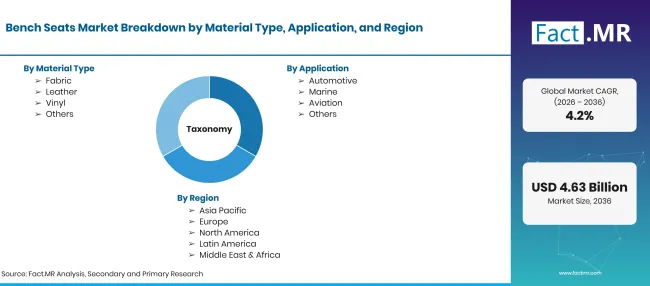
Bench Seats Market Taxonomy | Source: Fact.MR
| Items | Values |
|---|---|
| Quantitative Units (2026) | USD 3.08 Billion |
| Material Type | Fabric, Leather, Vinyl, Others |
| Application | Automotive, Marine, Aviation, Others |
| Distribution Channel | OEMs, Aftermarket |
| End-User | Commercial, Residential |
| Regions Covered | North America, Latin America, Europe, Asia Pacific, Middle East & Africa |
| Countries Covered | United States, Germany, Japan, United Kingdom, Brazil, and other countries |
| Key Companies Profiled | Steelcase Inc., MillerKnoll Inc., Haworth Inc., HNI Corporation, Teknion Corporation, Vitra International AG, Kinnarps AB, Global Furniture Group, Okamura Corporation, KI |
| Additional Attributes | Dollar revenue in the Bench Seats Market is segmented by material type (fabric, leather, vinyl); application (automotive, marine, aviation); distribution channel (OEMs, aftermarket); end-user (commercial, residential) and region. |
Source: Fact.MR analysis. Updated Nov 23, 2026
Source: Fact.MR analysis. Updated 16 Nov 2026
Bench Seats Market by Segments
-
Material Type
- Fabric
- Leather
- Vinyl
- Others
-
Application
- Automotive
- Marine
- Aviation
- Others
-
Distribution Channel
- OEMs
- Aftermarket
-
End-User
- Commercial
- Residential
-
Region:
- North America
- United States
- Canada
- Mexico
- Europe
- Germany
- United Kingdom
- France
- Italy
- Spain
- Rest of Europe
- Asia Pacific
- China
- India
- Japan
- South Korea
- Australia
- Rest of Asia Pacific
- Latin America
- Brazil
- Argentina
- Rest of Latin America
- Middle East & Africa
- GCC Countries
- South Africa
- Rest of Middle East & Africa
- North America
Frequently Asked Questions
How big is the global Bench Seats Market in 2026?
What will be the size of the Bench Seats Market by 2036?
How fast will the Bench Seats Market grow during the forecast period?
Which material type segment holds the largest share of the Bench Seats Market?
Who worked on this report


Preview the report firsthand - request a free sample
Free SampleGet the brochure for pricing and purchase details
Download PDF