- Market Value (2025): USD 97.3 Mn
- Estimated Value (2026): USD 110 Mn
- Forecast Value (2036): USD 373.4 Mn
- CAGR (2026-2036): 13.0%
What is the berthing approach sensors market forecast to be worth by 2036?
USD 110 million in 2026 to USD 373.4 million by 2036, at 13.00% CAGR.
- The berthing approach sensors market reached USD 97.3 million in 2025. Market value is projected to increase to USD 110 million in 2026 to USD 373.4 million by 2036.
- The market is forecast to expand at 13.0% CAGR during the forecast period as commercial ports continue investing in digital navigation and berth safety technologies.
- Berthing approach sensors measure vessel movement before docking by tracking distance, speed, angle and drift.
- The systems provide real time information that supports pilots, vessel traffic services and terminal operators during critical berthing operations. Accurate guidance also helps reduce infrastructure damage.
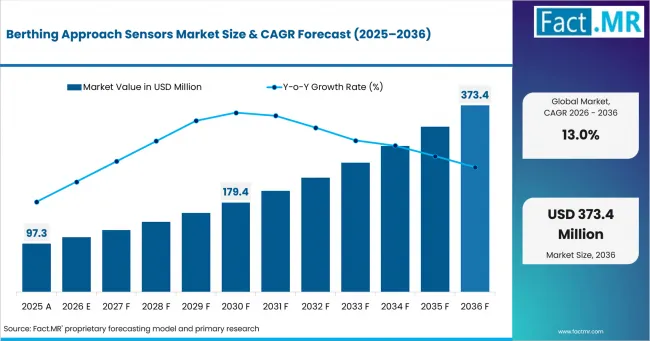
Berthing Approach Sensors Market Market Value Analysis | Source: Fact.MR
What are the defining numbers behind berthing approach sensors market growth?
USD 263.4 million absolute opportunity by 2036, supported by smart port investment and safer vessel navigation.
- Demand Drivers in the Market
- Ports continue upgrading navigation systems to improve berthing accuracy.
- Larger commercial vessels increase demand for precision guidance technology.
- Digital traffic management supports safer terminal operations.
- Real time vessel monitoring improves operational efficiency across busy ports.
- Key Segments Analyzed
- By Technology: Laser docking aids are expected to account for 35.0% share in 2026 because they provide accurate real time positioning during vessel approach.
- By Measured Output: Distance measurement is projected to hold 31.0% share in 2026 because it remains the primary reference for safe berthing.
- By Berth Type: Container terminals are forecast to represent 36.0% share in 2026 because they handle frequent vessel arrivals.
- By Buyer Type: Port authorities are expected to capture 34.0% share in 2026 because they continue leading investment in navigation infrastructure.
- By Geography: The United States is projected to record 13.6% CAGR through 2036 as digital port projects continue expanding.
- Analyst Opinion at Fact.MR
- Shambhu Nath Jha, Senior Analyst at Fact.MR, states, "Berthing approach sensors are becoming an essential part of modern port operations. Ports increasingly value systems that improve docking precision while strengthening operational safety under demanding marine conditions."
- Strategic Implications
- Technology providers should improve sensor accuracy for larger commercial vessels.
- Port authorities should integrate approach sensing into terminal modernization programs.
- Terminal operators should combine navigation data with berth management platforms.
- System developers should strengthen remote diagnostics and predictive monitoring capabilities.
Demand continues increasing because larger vessels require greater positioning accuracy during arrival. Ports are strengthening safety standards while introducing digital navigation systems that improve operational efficiency. Continuous monitoring also supports better decision making during difficult weather and high traffic conditions.
The United States is projected to record 13.6% CAGR through 2036 because smart port investment continues expanding. Singapore is expected to achieve 13.3% CAGR through advanced marine traffic management. Germany is likely to register 13.0% CAGR through terminal modernization. China is forecast to grow at 12.8% CAGR as port automation expands. India is anticipated to record 12.4% CAGR through infrastructure upgrades across major commercial ports.
How does the berthing approach sensors market break down by segment?
Laser docking aids lead at 35.0%. Distance measurement leads at 31.0%.
Which technology dominates?
Laser docking aids hold 35.0% share in 2026.
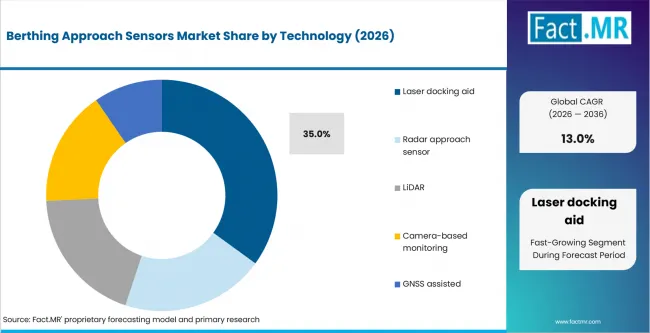
Berthing Approach Sensors Market Analysis By Technology | Source: Fact.MR
Laser docking aids are expected to account for 35.0% share in 2026 because they provide highly accurate vessel positioning during final approach. Ports value their reliability under demanding operating conditions. Radar approach sensors perform well in poor visibility. LiDAR improves object detection. Camera based monitoring strengthens visual verification. GNSS assisted systems improve navigation accuracy. Trelleborg Marine & Infrastructure launched SmartDAS, a next-generation berthing aid system that detects approaching vessels up to 200 m away and measures distance, approach speed, and berthing angle using advanced sensors. [1]
Which measured output dominates?
Distance measurement leads with 31.0% share in 2026.
Distance measurement is projected to capture 31.0% share in 2026 because pilots rely on precise separation data before berth contact. Accurate distance information reduces docking risk. Speed monitoring improves vessel control. Angle measurement supports proper alignment. Drift monitoring detects sideways movement. Alarm thresholds provide early warning during abnormal approach conditions. NYK Line began demonstration testing of the DynaMoor automated mooring system in Japan. The project uses vessel motion sensors to monitor approach and berthing behavior, improving docking safety and berth operations. [2]
Which berth type dominates?
Container terminals hold 36.0% share in 2026.
Container terminals remain the largest application because they manage frequent vessel arrivals throughout the day. The segment is expected to account for 36.0% share in 2026. LNG terminals require high precision navigation. Cruise ports emphasize passenger safety. Ferry terminals support regular docking schedules. Kawasaki Heavy Industries successfully completed verification tests of its automated berthing and unberthing system, demonstrating sensor-based vessel approach monitoring and automated docking control at sea. The verification confirmed the system's ability to support safer and more efficient port operations through precise vessel positioning, approach sensing, and automated berthing assistance technologies. [3]
Which installation dominates?
Fixed pier systems lead market demand.
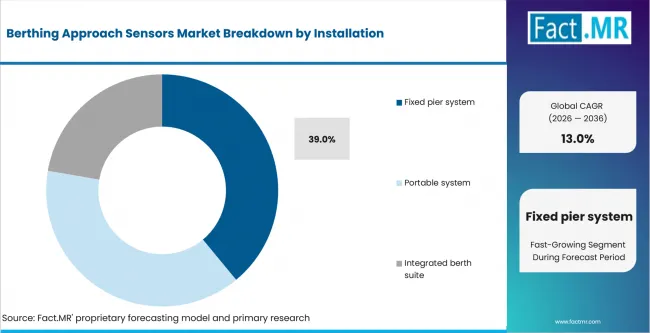
Berthing Approach Sensors Market Analysis By Installation | Source: Fact.MR
Fixed pier systems are expected to account for 39.0% share in 2026 because permanent installations provide continuous monitoring with stable operating performance. They also support integration with terminal systems. Portable systems improve deployment flexibility. Integrated berth suites combine multiple navigation technologies into one platform.
Which buyer type dominates?
Port authorities lead with 34.0% share in 2026.
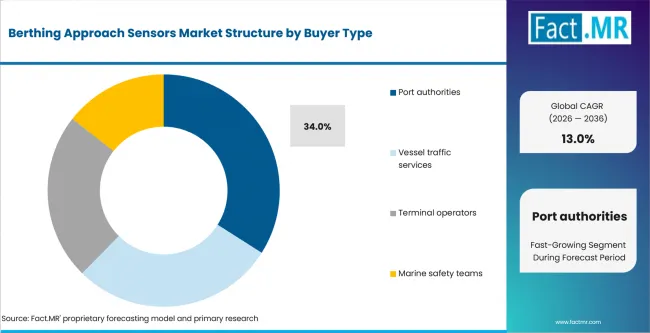
Berthing Approach Sensors Market Analysis By Buyer Type | Source: Fact.MR
Port authorities remain the largest customer group because they oversee navigation infrastructure and marine safety investment. The segment is expected to account for 34.0% share in 2026. Vessel traffic services strengthen operational coordination. Terminal operators improve docking efficiency. Marine safety teams support risk management across busy ports.
What is accelerating berthing approach sensor adoption, and what is holding it back?
Digital navigation investment supports growth while installation costs remain a challenge.
Drivers Impact Analysis
| DRIVER | (~) % IMPACT ON CAGR | GEOGRAPHIC RELEVANCE | IMPACT TIMELINE |
|---|---|---|---|
| Smart port development | +1.0% | Global | Medium term (2-4 years) |
| Growth of larger commercial vessels | +0.9% | Global | Medium term (2-4 years) |
| Rising demand for navigation safety | +0.8% | Europe, Asia Pacific | Long term (≥4 years) |
| Expansion of digital vessel traffic systems | +0.6% | North America, Europe | Medium term (2-4 years) |
| Stronger port automation investment | +0.5% | Global | Short term (≤2 years) |
Source: Fact.MR analysis. Updated Jul 4, 2026
Smart port development
Ports continue adopting connected technologies that improve vessel movement and operational visibility. Berthing sensors form an important part of this transition.
Larger commercial vessels
Bigger ships require greater positioning accuracy during docking. Advanced sensing systems improve navigation confidence.
Navigation safety
Port operators continue strengthening safety procedures during vessel approach. Accurate guidance reduces operational risk.
Digital vessel traffic systems
Modern traffic management platforms increasingly exchange information with berth approach sensors. Integrated data improves decision making.
Port automation investment
Automation projects continue expanding across major ports. Navigation sensors improve the performance of connected marine infrastructure.
Opportunity Impact Analysis
| OPPORTUNITY | (~) % IMPACT ON CAGR | GEOGRAPHIC RELEVANCE | IMPACT TIMELINE |
|---|---|---|---|
| AI assisted docking guidance | +0.8% | Global | Long term (≥4 years) |
| Retrofit of existing terminals | +0.7% | Global | Medium term (2-4 years) |
| Cloud based navigation platforms | +0.5% | Europe, North America | Medium term (2-4 years) |
| Autonomous vessel support | +0.4% | Asia Pacific | Long term (≥4 years) |
Source: Fact.MR analysis. Updated Jul 4, 2026
AI assisted docking guidance
Artificial intelligence improves interpretation of approach data. Better prediction supports safer vessel movement.
Retrofit of existing terminals
Older berths can gain advanced sensing capability without complete infrastructure replacement. This expands market opportunity.
Cloud based navigation platforms
Remote access improves equipment supervision across multiple terminals. Operators receive faster operational updates.
Autonomous vessel support
Future autonomous shipping will require highly accurate approach guidance. Advanced sensing systems are expected to support this transition.
Restraints Impact Analysis
| RESTRAINT | (~) % IMPACT ON CAGR | GEOGRAPHIC RELEVANCE | IMPACT TIMELINE |
|---|---|---|---|
| High installation costs | -0.7% | Global | Medium term (2-4 years) |
| Integration with legacy systems | -0.5% | Older ports | Medium term (2-4 years) |
| Technical maintenance needs | -0.3% | Global | Short term (≤2 years) |
| Limited digital infrastructure | -0.3% | Developing regions | Long term (≥4 years) |
Source: Fact.MR analysis. Updated Jul 4, 2026
High installation costs
Advanced sensing equipment requires investment in hardware, software and supporting communication networks. Budget limits may delay deployment.
Integration with legacy systems
Older navigation infrastructure may require engineering modifications before supporting modern sensor platforms. This extends implementation time.
Technical maintenance needs
High precision sensors require regular calibration to maintain measurement accuracy. Skilled maintenance teams remain important.
Limited digital infrastructure
Some ports continue operating with limited network capability. Additional upgrades are often required before advanced monitoring systems can be deployed.
Which countries are strengthening berthing approach sensor deployment?
United States 13.6%; Singapore 13.3%; Germany 13.0%; China 12.8%; India 12.4%.
Based on regional analysis, the berthing approach sensors market is segmented into North America, Europe, East Asia, South Asia, Middle East and Africa and Latin America.
| Country | CAGR |
|---|---|
| United States | 13.6% |
| Singapore | 13.3% |
| Germany | 13.0% |
| China | 12.8% |
| India | 12.4% |
Source: Fact.MR analysis. Updated Jul 4, 2026
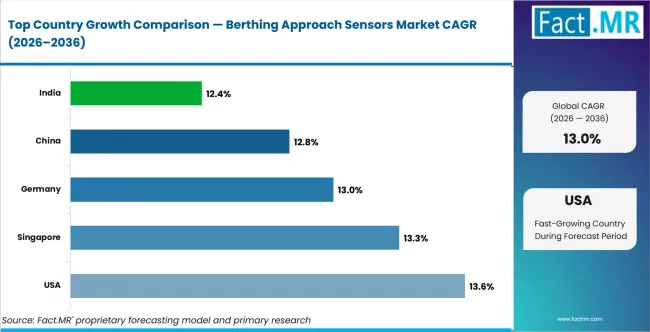
Berthing Approach Sensors Market Cagr Analysis By Country | Source: Fact.MR
What is supporting growth in the United States?
13.6% CAGR, driven by smart navigation and port modernization.
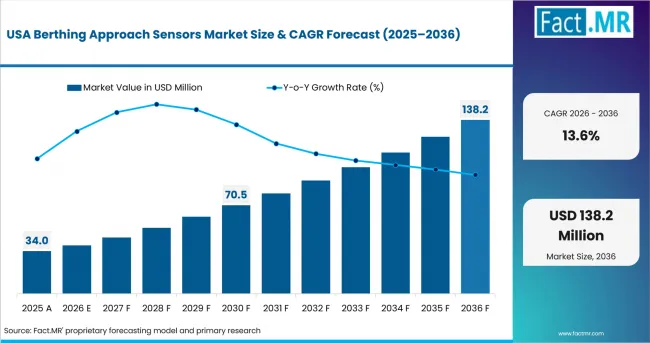
Berthing Approach Sensors Market Country Value Analysis | Source: Fact.MR
The United States is projected to record 13.6% CAGR from 2026 to 2036 as major ports continue improving digital navigation systems. Port authorities are investing in safer vessel movement through advanced sensing technology. Larger container ships also increase demand for accurate approach guidance across busy terminals.
Why is Singapore expanding steadily?
13.3% CAGR, backed by advanced traffic management.
Singapore is expected to achieve 13.3% CAGR by 2036 because one of the world's busiest ports continues strengthening intelligent vessel guidance. Real time navigation data improves docking efficiency while reducing operational risk. Smart port programs also encourage wider deployment of integrated sensing systems.
What supports Germany's market outlook?
13.0% CAGR, encouraged by engineering driven infrastructure upgrades.
Germany is likely to register 13.0% CAGR because commercial terminals continue improving navigation accuracy through modern sensing equipment. Terminal operators increasingly value systems that reduce berthing delays while supporting safe operations. Continuous infrastructure upgrades also strengthen equipment demand.
Why does China remain an important market?
12.8% CAGR, supported by large scale terminal expansion.
China is forecast to expand at 12.8% CAGR by 2036 as coastal ports continue modernizing navigation infrastructure across high traffic terminals. Greater investment in automation supports wider deployment of berthing approach sensors. Digital monitoring also improves operational efficiency.
How is India building future demand?
12.4% CAGR, driven by port infrastructure development.
India is expected to record 12.4% CAGR as commercial ports continue upgrading navigation systems across expanding cargo terminals. Greater attention to marine safety supports investment in precision sensing technology. Modern infrastructure projects are expected to strengthen long term demand.
Who leads the berthing approach sensors market?
Trelleborg Marine & Infrastructure, Prosertek; Straatman, Tidalis, Wärtsilä compete among each other
The market includes marine technology providers, port equipment manufacturers and navigation specialists. Trelleborg Marine & Infrastructure continues strengthening its position through intelligent berthing solutions that combine approach guidance with digital berth management. Tidalis contributes advanced vessel traffic management systems that improve navigation across high activity ports.
Prosertek develops integrated berthing technologies designed for commercial terminals and specialized marine facilities. Straatman supplies docking and mooring equipment that supports safer vessel handling. Mampaey expands its presence through marine safety solutions and modern berthing technology.
Competition increasingly depends on measurement accuracy and system integration. Customers seek solutions that improve operational visibility while reducing berthing risk. Companies delivering dependable sensing performance with long term technical support are expected to strengthen their market position.
Which companies are the key providers?
Trelleborg Marine & Infrastructure and Tidalis are leading providers. Prosertek remains established participant.
- Trelleborg Marine & Infrastructure
- Tidalis
- Prosertek
- Straatman
Bibliography
- Trelleborg Marine & Infrastructure. (2025, July 21). Trelleborg transforms port operations through data-driven decision making. Trelleborg Marine & Infrastructure.
- NYK Line. (2025, May 13). New DynaMoor mooring trial begins. NYK Line.
- Kawasaki Heavy Industries, Ltd. (2025, May 20). Kawasaki successfully completed verification of automated berthing and unberthing operations with Advanced Safety Berthing/Unberthing Assistance System — Safety and efficiency improvements for in-port vessel maneuvering, berthing, unberthing and mooring operations. Kawasaki Heavy Industries.
- Prosertek. (2026). BAS: Berthing aid system. Prosertek.
- Trelleborg Marine & Infrastructure. (2024, December 12). Trelleborg acquires Mampaey Offshore Industries. Trelleborg Marine & Infrastructure.
This Report Addresses
- Strategic assessment of berthing approach sensors across smart navigation and digital port operations.
- Segment evaluation covering Laser Docking Aids and Distance Measurement.
- Country outlook for the United States, Singapore, Germany, China and India.
- Competitive review of Trelleborg Marine & Infrastructure, Tidalis, Prosertek, Straatman and Mampaey.
- Technology review covering LiDAR, radar sensing, camera monitoring, GNSS assisted guidance and real time alarm systems.
- Operational assessment covering LNG terminals, container ports, tanker berths, cruise terminals, ferry facilities and offshore terminals.
- Market estimates supported by navigation technology analysis, port modernization tracking and primary industry interviews.
What does the berthing approach sensors market cover?
Navigation guidance systems developed for vessel berthing operations.
The market includes laser docking aids, radar approach sensors, LiDAR systems, camera based monitoring and GNSS assisted guidance systems. These technologies improve vessel positioning before final berth contact.
The assessment focuses on approach sensing equipment installed at marine terminals. Conventional navigation instruments carried onboard vessels remain outside the market definition.
What is included in the scope?
Digital sensing systems used for berth approach guidance.
The study covers measurement of distance, speed, angle, drift, alarm thresholds and approach history. It also includes fixed pier systems, portable systems and integrated berth monitoring suites.
Applications span LNG terminals, cruise ports, container terminals, ferry terminals, offshore facilities and tanker berths. The study evaluates products supplied to port authorities, vessel traffic services, terminal operators and marine safety teams.
What is excluded from the scope?
Marine navigation products without berth approach sensing are excluded.
The assessment excludes onboard radar systems, standard GPS receivers, electronic chart systems and conventional port communication equipment without dedicated berthing guidance capability. General surveillance cameras also remain outside the market scope.
How was the analysis built?
110+ sources, 41+ company portfolios, 30+ countries, 24+ interviews.
- Primary Research: Harbor pilots, terminal operators, marine engineers and navigation technology suppliers contributed operational and technical insights. Port safety specialists also supported market validation.
- Desk Research: The assessment reviewed company portfolios, smart port programs, navigation technology developments and maritime safety publications. Infrastructure investment announcements strengthened market analysis.
- Market Sizing and Forecasting: Estimates were prepared using port modernization spending, vessel traffic growth, navigation equipment deployment and terminal expansion across major maritime regions.
- Data Validation and Update Cycle: Forecasts were verified through supplier interviews, project monitoring and expert assessment. Procurement activity and installation trends supported the final market estimates.
Segmentation
What is the report's scope and coverage?
| Attribute | Details |
|---|---|
| Quantitative Units | USD million |
| Attribute | Details |
| Market Definition | Sensor systems designed to guide vessel approach during berthing operations |
| Technology | Laser docking aid; radar approach sensor; LiDAR; camera-based monitoring; GNSS assisted |
| Measured Output | Distance; speed; angle; drift; alarm threshold; approach history |
| Berth Type | LNG; cruise; container; ferry; offshore terminal; tanker berth |
| Installation | Fixed pier system; portable system; integrated berth suite |
| Buyer Type | Port authorities; vessel traffic services; terminal operators; marine safety teams |
| Regions Covered | North America; Europe; East Asia; South Asia; Middle East and Africa; Latin America |
| Countries Covered | United States; Singapore; Germany; China; India |
| Key Companies Profiled | Trelleborg Marine & Infrastructure; Prosertek; Straatman; Tidalis |
| Forecast Period | 2026 to 2036 |
| Approach | Hybrid top down and bottom up approach using smart port investment, navigation upgrades, vessel traffic growth and expert validation |
Source: Fact.MR analysis. Updated Jul 4, 2026
How is the market segmented?
-
By Technology:
- Laser docking aid
- Radar approach sensor
- LiDAR
- Camera-based monitoring
- GNSS assisted
-
By Measured Output:
- Distance
- Speed
- Angle
- Drift
- Alarm threshold
- Approach history
-
By Berth Type:
- LNG
- Cruise
- Container
- Ferry
- Offshore terminal
- Tanker berth
-
By Installation:
- Fixed pier system
- Portable system
- Integrated berth suite
-
By Buyer Type:
- Port authorities
- Vessel traffic services
- Terminal operators
- Marine safety teams
-
By Region:
- North America
- United States
- Canada
- Europe
- Germany
- United Kingdom
- France
- Italy
- Spain
- Asia Pacific
- China
- Japan
- South Korea
- India
- Singapore
- Latin America
- Brazil
- Argentina
- Mexico
- Middle East & Africa
- GCC Countries
- South Africa
- Israel
- North America
Frequently Asked Questions
Which technology leads the Berthing Approach Sensors Market?
Which measured output leads the Berthing Approach Sensors Market?
Which berth type leads the Berthing Approach Sensors Market?
Which installation leads the Berthing Approach Sensors Market?
Which buyer type leads the Berthing Approach Sensors Market?
Which region leads the Berthing Approach Sensors Market?
Who worked on this report


Preview the report firsthand - request a free sample
Free SampleGet the brochure for pricing and purchase details
Download PDF