- Market Value (2025): USD 1.02 Bn
- Estimated Value (2026): USD 1.09 Bn
- Forecast Value (2036): USD 2.03 Bn
- CAGR (2026-2036): 6.4%
What is the Beta-Sitosterol Market forecast to be worth by 2036?
USD 1.1 billion in 2026 to USD 2.0 billion by 2036 at a 6.4% CAGR.
- As per Fact.MR analysis, the beta-sitosterol market reached USD 1.02 billion in 2025.
- Demand will increase from USD 1.09 billion in 2026 to USD 2.03 billion by 2036.
- The beta-sitosterol market will record a 6.4% CAGR from 2026 to 2036.
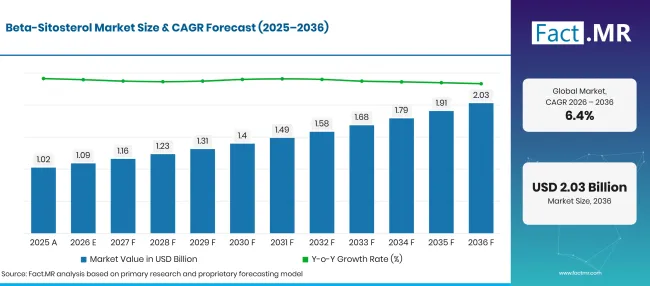
Factmr Beta Sitosterol Market Forecast Global | Source: Fact.MR
| Year | Basis | Market value (USD Billion) |
|---|---|---|
| 2025 | Actual | 1.02 |
| 2026 | Estimate | 1.09 |
| 2036 | Forecast | 2.03 |
| CAGR 2026 to 2036 | Forecast period | 6.4% |
Source: Fact.MR analysis. Updated Oct 15, 2026
What are the defining numbers behind Beta-Sitosterol Market growth?
An absolute opportunity of USD 0.9 billion will be created between 2026 and 2036.
- Demand Drivers in the Market
- Populations are ageing across major markets, with the World Health Organization projecting that one in six people worldwide will be aged 60 or over by 2030, and that this cohort will reach 2.1 billion by 2050 [1]. Older adults remain the core consumers of cholesterol-management and prostate-health products.
- Regulatory health claims are underpinning adoption in food and supplements. U.S. rules permit a claim that diets including plant sterol or stanol esters may reduce coronary heart disease risk, at an intake of 1.3 g or more per day of plant sterol esters [2], while EU rules authorize a claim that plant sterols and plant stanol esters lower blood cholesterol [3].
- Clinical evidence is reinforcing prostate-health positioning. A 2023 review found that beta-sitosterol improves lower urinary tract symptoms linked to benign prostatic hyperplasia, though to a lesser degree than prescription drugs, which supports supplement use among men with mild symptoms [4].
- Diversified sourcing and product formats are strengthening supply. Producers are supplying sterols from vegetable oil refining by-products and pine tall oil, in free and esterified forms [5], while fine-particle, granular, and ester grades are enabling formulators to integrate the ingredient into supplements, beverages, and spreads [6].
- Key Segments Analyzed
- By Source: Plant Oils are set to dominate with a 42.3% share in 2026, since vegetable oils and their refining streams provide the most consistent commercial supply.
- By Application: Dietary Supplements are poised to lead with a 42.3% share in 2026, owing to wide use in prostate-health and cholesterol-support products.
- By Form: Powder is slated to contribute a 51.2% share in 2026, supported by easy blending into tablets, capsules, and dry mixes.
- By End-User: Healthcare is forecast to command a 48.3% share in 2026, given demand from cardiovascular and prostate-health products.
- Analyst Opinion at Fact.MR
- Shambhu Nath Jha, Principal Consultant at Fact.MR, states, “Beta-sitosterol is now bought as a documented, standardized input in heart-health and prostate-health formulations. Buyers will favor suppliers that offer verified purity, stable sourcing, and regulatory support for health claims. Producers that pair high-assay powders with application support for supplement and pharmaceutical customers will gain the most from formulators and contract manufacturers.”
- Strategic Implications
- Ingredient suppliers should document assay, purity, and sterol profile for every grade, since pharmaceutical and supplement buyers compare suppliers on specification and batch consistency.
- Supplement and food brands should align dose and labeling with local health-claim rules, given that U.S. and EU claim conditions differ on intake levels and wording [2][3].
- Manufacturers should diversify raw material sources across plant oils, pine tall oil, and other botanical streams, so that price or supply swings in one feedstock do not disrupt output.
Germany is projected to lead at a 7.8% CAGR, as accelerated demographic ageing converges with EU-authorized plant sterol claims. Brazil is expected to follow at 7.1%, underpinned by rapid expansion of its older population. The United States is anticipated to record 6.5%, supported by a sizeable older cohort and an established FDA claim. The United Kingdom is forecast to post 5.8%, reflecting steady growth in its 65-and-over segment, while Japan is set to close at 5.1%, as a contracting total population offsets the most mature age profile among major economies.
How does the Beta-Sitosterol Market break down by segment?
Plant Oils will lead Source at 42.3%; Dietary Supplements will lead Application at 42.3%; Powder will lead Form at 51.2%; Healthcare will lead End-User at 48.3%.
Which Source dominates?
Plant Oils will hold 42.3% share in 2026.
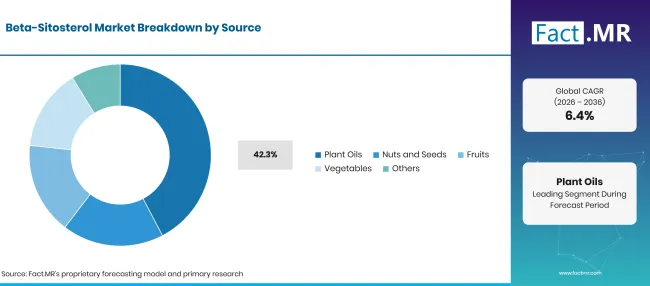
Factmr Beta Sitosterol Market Breakdown Source | Source: Fact.MR
| Source | Share (2026) |
|---|---|
| Plant Oils (Leading segment) | 42.3% |
| Other sources combined | 57.7% |
| Total | 100.0% |
Source: Fact.MR analysis. Updated Oct 15, 2026
Plant oils are set to lead because vegetable oils carry the highest phytosterol content among common foods, while their refining streams concentrate sterols for commercial extraction. A 2025 review in The Bioscan identifies beta-sitosterol as the most abundant and best-researched phytosterol, with vegetable oils ranking among the richest dietary sources [7]. Nuts and seeds, fruits, and vegetables are serving smaller, label-driven demand. The Others group includes pine tall oil, a wood-pulping by-product that suppliers such as Arboris are converting into pine-derived sterols [5].
What leads the Application segment?
Dietary Supplements will capture 42.3% share in 2026.
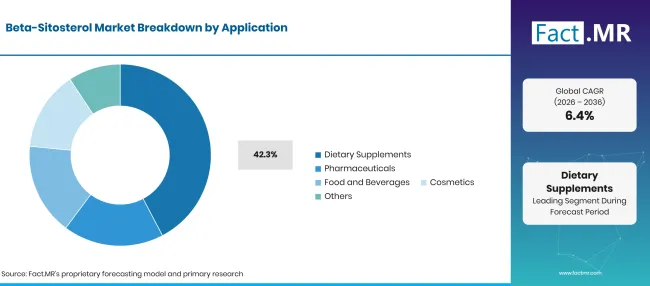
Factmr Beta Sitosterol Market Breakdown Application | Source: Fact.MR
| Application | Share (2026) |
|---|---|
| Dietary Supplements (Leading segment) | 42.3% |
| Other applications combined | 57.7% |
| Total | 100.0% |
Source: Fact.MR analysis. Updated Oct 15, 2026
Dietary supplements are set to lead because beta-sitosterol is being marketed directly for prostate and cholesterol support in tablet and capsule formats. A 2025 ConsumerLab review of saw palmetto and beta-sitosterol products concluded that the evidence base for beta-sitosterol remains fairly strong for benign prostatic hyperplasia [4]. Pharmaceutical manufacturers are deploying high-purity grades in clinical and formulation work. Food and beverage producers are incorporating sterols into spreads, dairy products, and juices where authorized health claims apply [3]. Cosmetics formulators are integrating phytosterols into skin-care products.
Which Form leads the market?
Powder will account for 51.2% share in 2026.
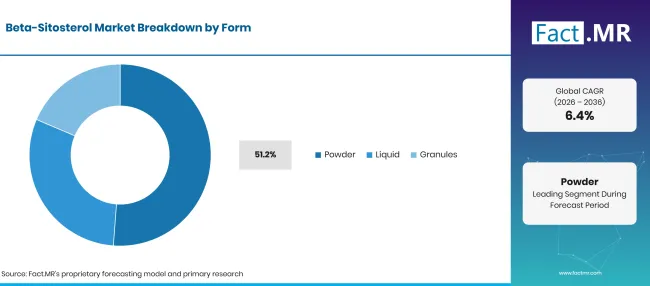
Factmr Beta Sitosterol Market Breakdown Form | Source: Fact.MR
| Form | Share (2026) |
|---|---|
| Powder (Leading segment) | 51.2% |
| Other forms combined (Liquid, Granules) | 48.8% |
| Total | 100.0% |
Source: Fact.MR analysis. Updated Oct 15, 2026
Powder is positioned to lead because it integrates seamlessly into tablets, capsules, and dry premixes while offering reliable storage stability. Cargill positions its powder grade as stable across wide temperature and pH ranges, suited to low-fat foods, dietary supplements, and beverages [8]. Liquid forms, including esterified sterols, are serving spreads, dressings, and beverages. Granules are streamlining handling in tableting and bulk blending [8].
How does End-User shape demand?
Healthcare will represent 48.3% share in 2026.
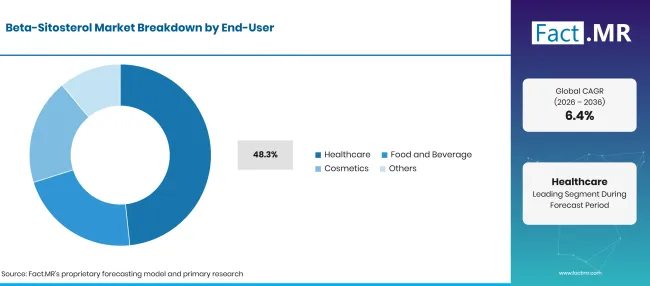
Factmr Beta Sitosterol Market Breakdown End User | Source: Fact.MR
| End-User | Share (2026) |
|---|---|
| Healthcare (Leading segment) | 48.3% |
| Other end-users combined | 51.7% |
| Total | 100.0% |
Source: Fact.MR analysis. Updated Oct 15, 2026
Healthcare is set to lead because beta-sitosterol is being positioned around cardiovascular and prostate health, where buyers require documented purity and identity. Pharmaceutical manufacturers and supplement brands serving cholesterol management and benign prostatic hyperplasia anchor this group. Food and beverage producers are incorporating sterols into fortified products under health-claim regulations. Cosmetic formulators are integrating them into skin-care lines, while other end users are procuring smaller volumes for specialty applications.
What is accelerating Beta-Sitosterol Market adoption, and what is holding it back?
Demand will rise through population ageing, health-claim support, and growing supplement use. Growth is held back by feedstock price swings and uneven regulation across countries.
Drivers Impact Analysis
| DRIVER | (~) % IMPACT ON CAGR | GEOGRAPHIC RELEVANCE | IMPACT TIMELINE |
|---|---|---|---|
| Demographic ageing is widening the buyer base for cholesterol-management and prostate-health products | +2.2% | Global | Medium term (2-4 years) |
| Authorized health claims in the U.S. and EU are underpinning adoption across food and supplements | +1.6% | North America, Western Europe | Short term (<= 2 years) |
| Growing clinical evidence is reinforcing prostate-health positioning | +1.1% | Global | Medium term (2-4 years) |
| Diversified feedstock and higher-purity grades are strengthening supply reliability | +0.7% | Global | Long term (>= 4 years) |
Source: Fact.MR analysis. Updated Oct 15, 2026
Opportunity Impact Analysis
| OPPORTUNITY | (~) % IMPACT ON CAGR | GEOGRAPHIC RELEVANCE | IMPACT TIMELINE |
|---|---|---|---|
| Pharmaceutical-grade, high-assay ingredients backed by documented purity | +1.1% | Western Europe, North America | Medium term (2-4 years) |
| Bioavailability-enhanced formats, including nanoemulsions and plant-based protein powders and bars | +0.8% | Global | Long term (>= 4 years) |
| Skin-care adoption for barrier-supporting formulations | +0.5% | Western Europe, East Asia | Medium term (2-4 years) |
| E-commerce-led health consumption | +0.3% | East Asia, South Asia & Pacific | Short term (<= 2 years) |
Source: Fact.MR analysis. Updated Oct 15, 2026
Restraints Impact Analysis
| RESTRAINT | (~) % IMPACT ON CAGR | GEOGRAPHIC RELEVANCE | IMPACT TIMELINE |
|---|---|---|---|
| High cost of extracting and purifying high-assay grades | -0.9% | Global | Short term (<= 2 years) |
| Price and supply swings in plant oil and pine tall oil feedstocks | -0.6% | Global | Medium term (2-4 years) |
| Modest efficacy relative to prescription drugs and differing claim rules across jurisdictions | -0.4% | North America, Western Europe | Long term (>= 4 years) |
Source: Fact.MR analysis. Updated Oct 15, 2026
Which countries are scaling the Beta-Sitosterol Market through 2036?
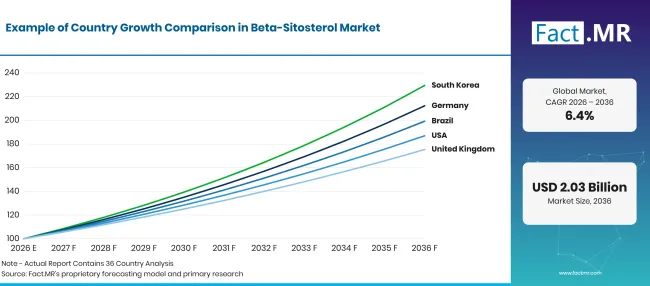
Factmr Beta Sitosterol Market Growth Index | Source: Fact.MR
| Country | CAGR (2026-2036) |
|---|---|
| Germany | 7.8% |
| Brazil | 7.1% |
| United States | 6.5% |
| United Kingdom | 5.8% |
| Japan | 5.1% |
Source: Fact.MR analysis. Updated Oct 15, 2026
What supports Germany adoption?
7.8% CAGR, supported by fast population ageing and EU-authorized plant sterol claims.
Germany is ageing quickly, with Destatis projecting that the share of people aged 67 and over will rise from 20% in 2024 to about one quarter by 2035 [9]. German food and supplement makers work under the EU claim that plant sterols and plant stanol esters lower blood cholesterol [3]. Demand will come from supplement makers and from producers of sterol-enriched foods, notably functional dairy and spreads, where established claim conditions are supporting wider product launches.
How is Brazil scaling demand?
7.1% CAGR, driven by rapid growth in the older population.
Brazil is recording swift growth in its older population, with IBGE reporting that 22.2 million people were aged 65 or over at the 2022 census, or 10.9% of the population, up from 7.4% in 2010 [10]. Its large oilseed processing base can offer a local feedstock for plant sterols, while supplement and pharmaceutical buyers will widen use as the older population grows, supporting domestic sourcing.
What supports United States adoption?
6.5% CAGR, supported by a large older population and an authorized FDA health claim.
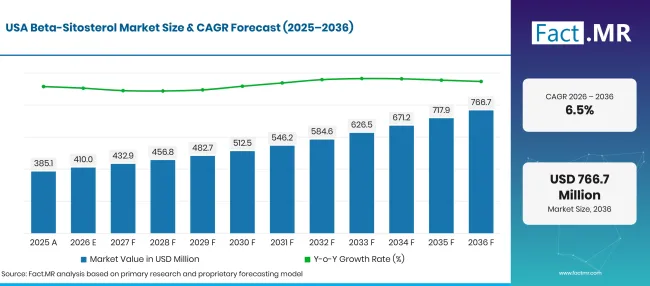
Factmr Beta Sitosterol Market Forecast Usa | Source: Fact.MR
The United States has 61.2 million people aged 65 and over, or 18.0% of the population, according to the U.S. Census Bureau for 2024 [11]. FDA rule 21 CFR 101.83 authorizes a heart-disease claim for plant sterol and stanol esters [2]. Supplement brands will pair this claim with prostate-health positioning to widen sales across retail and online channels.
How does the United Kingdom perform?
5.8% CAGR, shaped by steady growth in the older population.
The United Kingdom is registering steady growth in its older population, with the Office for National Statistics reporting that the number of people aged 65 and over rose 1.8% in England and 1.5% in Wales in the year to mid-2024 [12]. Growth in this group supports demand for heart-health and prostate-health products, while moderate annual gains limit the pace of volume growth and favor steady, repeat-purchase categories.
How is Japan developing demand?
5.1% CAGR, shaped by the oldest age profile among major countries and a shrinking population.
Japan has the oldest age profile among major countries, with its internal affairs ministry estimating that people aged 65 and over made up a record 29.6% of the population in September 2026 [13]. The 2025 census showed the total population down 2.5% from 2020 [14]. A large older group supports demand, but a falling customer base slows volume growth, which is steering suppliers toward premium, evidence-backed formulations.
Which companies are the key providers?
Key companies include BASF SE; Cargill, Incorporated; Archer Daniels Midland Company; Matrix Life Science Pvt. Ltd.; Wilmar International; International Flavors & Fragrances (IFF); Arboris LLC.
- BASF SE
- Cargill, Incorporated
- Archer Daniels Midland Company
- Matrix Life Science Pvt. Ltd.
- Wilmar International
- International Flavors & Fragrances (IFF)
- Arboris LLC
Bibliography
- [1] Federal Statistical Office of Germany. (2025, December 11). By 2035, one quarter of Germany’s population will be aged 67 or over.
- [2] Office for National Statistics. (2025, September 26). Population estimates for the UK, England, Wales, Scotland and Northern Ireland: Mid-2024.
- [3] Statistics Bureau of Japan. (2025, October 30). News bulletin No. 372: Conducting of the 2025 Census.
- [4] U.S. Census Bureau. (2025, June 26). Older adults outnumber children in 11 states and nearly half of U.S. counties.
- [5] U.S. Food and Drug Administration. (n.d.). Information on select dietary supplement ingredients and other substances.
- [6] Health claims: Plant sterol/stanol esters and risk of coronary heart disease (CHD), 21 C.F.R. § 101.83 (2026).
This Report Answers
- The report explains how beta-sitosterol is used by source, application, form, and end-user.
- Segment analysis identifies the sub-segment that leads each segment and the buyer needs behind its 2026 share.
- Country analysis compares the five listed countries through population ageing, health-claim rules, and supplement demand.
- Competitive analysis reviews integrated ingredient groups and specialist phytosterol producers.
- Regulatory analysis tracks health-claim rules for plant sterols in the United States and the European Union.
What does the Beta-Sitosterol Market cover?
The Beta-Sitosterol Market covers beta-sitosterol, one of the most abundant plant sterols, extracted from plant oils, nuts, seeds, fruits, vegetables, and other botanical sources. Its structure is similar to cholesterol, and it is used to support cholesterol management and prostate health.
The assessment tracks beta-sitosterol supplied as powder, liquid, and granules to dietary supplement, pharmaceutical, food and beverage, and cosmetic producers.
What is included in the scope?
The scope includes isolated beta-sitosterol and phytosterol mixtures in which beta-sitosterol is a principal component, in free and esterified forms. It covers standardized grades sold by purity and assay for supplements, pharmaceuticals, foods, and cosmetics.
Combination products are included when beta-sitosterol or plant sterols make up the active base. Products that pair plant sterols with other botanicals, such as saw palmetto, count only for their sterol value.
What is excluded from the scope?
The scope excludes whole foods that contain naturally occurring phytosterols, such as vegetable oils, nuts, and avocados sold as food commodities. Plant stanols sold without a sterol base, and animal-derived sterols such as cholesterol, are also excluded.
Botanical extracts sold without a standardized beta-sitosterol content are outside the revenue boundary. Vitamins, probiotics, and other ingredients sold in the same finished product are excluded.
How Was the Analysis Built?
The analysis draws on 120+ sources, 35+ company portfolios, 25+ countries, and more than 20 industry interviews.
- Primary Research: Primary research includes discussions with manufacturers, service providers, technology developers, distributors, end users, and subject-matter experts. These conversations examine purchasing priorities, product adoption, operational challenges, approval requirements, competitive positioning, and the factors that influence wider market acceptance.
- Desk Research: Desk research covers government statistics, regulatory publications, company filings, trade data, technical studies, industry associations, standards, public policy, and other authoritative sources. Every source used in the analysis is documented in the bibliography.
- Market Sizing and Forecasting: Market estimates combine historical performance, demand indicators, pricing and volume trends, segment shares, company participation, country-level growth, adoption patterns, investment activity, and barriers to market expansion.
- Data Validation and Update Cycle: Findings are validated by comparing primary interviews with public data, company activity, regulatory changes, trade patterns, and industry developments. Regular updates review new product launches, capacity changes, partnerships, approvals, and shifts in commercial adoption.
Who leads the Beta-Sitosterol Market?
Competition falls into two groups. Integrated ingredient groups compete on scale, grade range, and regulatory support: BASF markets Vegapure plant sterols and sterol esters [15], Cargill offers CoroWise fine-particle, granular, and ester grades [6], and ADM sells CardioAid sterols made from vegetable oils [16]. Wilmar International lists phytosterol in its FSSC 22000-certified food ingredient portfolio [17], while IFF promotes phytosterols for heart health [18].
Specialist producers compete on source, purity, and cost. Arboris produces pine-derived sterols from tall oil [5], Matrix Fine Sciences supplies phytosterols from non-GMO sunflower, soy, and rapeseed [19], K. Patel Phyto Extractions, a GMP-certified Mumbai extractor, serves buyers in over 30 countries [20], and Tianjin Jianfeng Natural Product adds herbal extract capacity in China [21]. Source stability, purity grades, and health-claim support will decide competition through 2036.
Segmentation
What is the report's scope and coverage?
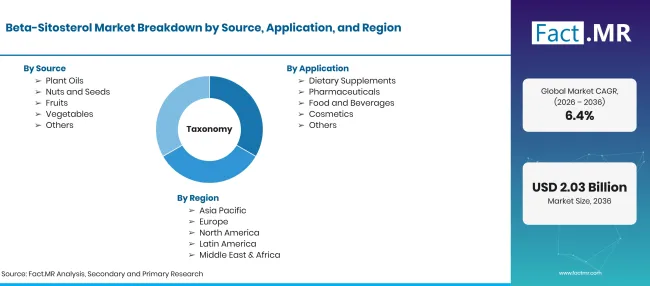
Factmr Beta Sitosterol Market Taxonomy | Source: Fact.MR
| Attribute | Details |
|---|---|
| Quantitative Units | USD Billion |
| Market Definition | Beta-sitosterol, a plant sterol extracted from plant oils, nuts and seeds, fruits, vegetables, and other botanical sources, supplied as powder, liquid, and granules for dietary supplements, pharmaceuticals, food and beverages, cosmetics, and other uses. |
| Source | Plant Oils; Nuts and Seeds; Fruits; Vegetables; Others |
| Application | Dietary Supplements; Pharmaceuticals; Food and Beverages; Cosmetics; Others |
| Form | Powder; Liquid; Granules |
| End-User | Healthcare; Food and Beverage; Cosmetics; Others |
| Regions Covered | North America; Latin America; Western Europe; Eastern Europe; East Asia; South Asia & Pacific; Middle East & Africa |
| Countries Covered | Germany; Brazil; United States; United Kingdom; Japan |
| Key Companies Profiled | BASF SE; Cargill, Incorporated; Archer Daniels Midland Company; Matrix Life Science Pvt. Ltd.; Wilmar International; International Flavors & Fragrances (IFF); Arboris LLC |
| Forecast Period | 2026 to 2036 |
| Approach | Hybrid top-down and bottom-up approach using phytosterol production and consumption indicators; source and form mix; application demand; health-claim policy by country; country growth; and supplier portfolio review. |
Source: Fact.MR analysis. Updated Oct 15, 2026
How is the market segmented?
-
By Source:
- Plant Oils
- Nuts and Seeds
- Fruits
- Vegetables
- Others
-
By Application:
- Dietary Supplements
- Pharmaceuticals
- Food and Beverages
- Cosmetics
- Others
-
By Form:
- Powder
- Liquid
- Granules
-
By End-User:
- Healthcare
- Food and Beverage
- Cosmetics
- Others
-
By Region:
- North America
- Latin America
- Western Europe
- Eastern Europe
- East Asia
- South Asia & Pacific
- Middle East & Africa
Frequently Asked Questions
How big is the beta-sitosterol market in 2026?
What is the CAGR of the beta-sitosterol market from 2026 to 2036?
Which source leads the beta-sitosterol market?
Which application leads the beta-sitosterol market?
Which form leads the beta-sitosterol market?
Which end-user leads the beta-sitosterol market?
Which country will grow the most in the beta-sitosterol market?
Who are the main companies in the beta-sitosterol market?
Who worked on this report


Preview the report firsthand - request a free sample
Free SampleGet the brochure for pricing and purchase details
Download PDF