- Base Value(2025): 1.6 Bn
- Estimated Value(2026): 1.7 Bn
- Forecast Value (2036): 3.0 Bn
- CAGR (2026 - 2036): 5.8%
Beta-Glucans Market Forecast and Outlook By Fact.MR
In 2025, the beta-glucans market was valued at USD 1.6 billion. Based on Fact.MR analysis, demand for beta-glucans is estimated to grow to USD 1.7 billion in 2026 and USD 3.0 billion by 2036. FACT.MR projects a CAGR of 5.8% during the forecast period.
During this period, the market is expected to generate USD 1.3 billion in new revenue opportunities. Growth will be supported by rising immune health supplement demand in Japan and Australia, expanding functional food fortification in Germany and Canada, and clinical nutrition beta-glucan adoption in hospital dietary programmes. Challenges include raw material price volatility in oat and yeast commodity markets, inconsistent regulatory frameworks for beta-glucan health claims across jurisdictions, and consumer education costs for communicating beta-glucan’s differentiated benefits versus competing fibre and immune ingredients.
The beta-glucans market is expanding as ageing populations in Asia Pacific prioritise immune support supplementation, functional food manufacturers add oat and barley beta-glucans to cholesterol-reducing claims, and cosmetics brands incorporate beta-glucans into skin barrier and microbiome support product ranges citing growing dermatological evidence.
Country growth reflects supplement market maturity, regulatory health claim frameworks, and functional food innovation pace. Japan leads at 7.0% CAGR driven by FOSHU-approved beta-glucan cholesterol health claims supporting premium supplement and food product launches. Australia follows at 6.7% supported by TGA-listed immune health supplement growth and active pharmaceutical beta-glucan research programmes. Canada records 6.0% through Health Canada’s approved beta-glucan cholesterol reduction health claim enabling premium oat-based food product launches. Germany grows at 5.8% through EU Regulation 432/2012 approved beta-glucan cholesterol health claim driving functional food fortification. The United States posts 5.5%, the most mature market, generating replacement demand in established supplement channels with structural constraints from FDA’s limited authorised health claim scope for beta-glucans beyond oat cholesterol.
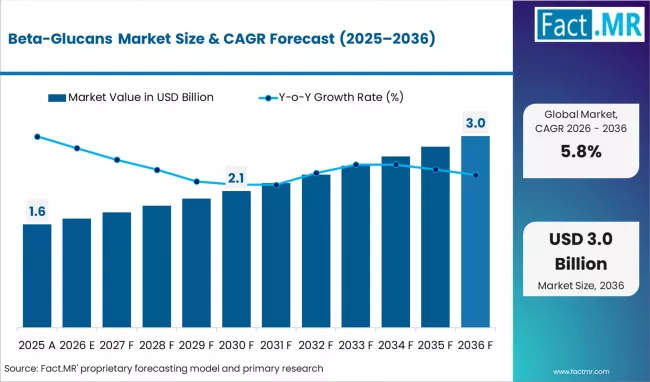
Beta Glucans Market Market Value Analysis | Source: Fact.MR
| Metric | Value |
|---|---|
| Estimated Value in 2026 | USD 1.7 billion |
| Forecast Value in 2036 | USD 3.0 billion |
| Forecast CAGR (2026 to 2036) | 5.8% |
Source: Fact.MR analysis. Updated Mar 16, 2026
Beta-Glucans Market Definition
Beta-glucans are natural polysaccharides from yeast, oats, barley, and mushrooms used as bioactive ingredients in supplements, functional foods and beverages, cosmetics, and animal feed for immune, cholesterol, and skin-barrier benefits.
Market Inclusions
Global and regional revenue forecasts from 2026-2036 by source, functionality, application, and distribution channel. Covers yeast, oat, barley, and mushroom beta-glucans across supplements, food and beverages, cosmetics, and animal feed worldwide.
Market Exclusions
Excludes whole oats or barley without extraction, general dietary fibre not identified as beta-glucan, other fungal polysaccharides such as chitin, and finished products containing beta-glucan below functional dosage levels.
Research Methodology
- Primary Research: Interviews with supplement formulators, functional food buyers, cosmetics developers, animal nutrition specialists, and clinical dietitians across Asia Pacific, Europe, and North America.
- Desk Research: Sources include EFSA opinions, FDA health claim databases, Health Canada regulations, Japan FOSHU records, TGA medicine databases, ingredient manufacturer reports, and clinical procurement documents from 2024-2025.
- Market Sizing and Forecasting: Hybrid model using shipment volumes, average selling prices, supplement market size data, functional food innovation trends, and primary industry interviews.
- Data Validation and Update Cycle: Forecasts validated using manufacturer revenue data, regulatory claim updates, supplement shipment statistics, functional food product launches, and expert interviews.
Summary of Beta-Glucans Market
- Market Definition
- Beta-glucans are immune-support and cholesterol-management ingredients derived from yeast, oats, barley, and mushrooms used in supplements, functional foods, cosmetics, and animal feed globally.
- Demand Drivers
- Japan FOSHU approvals enable premium beta-glucan functional foods and supplements with 30-50% higher prices.
- EFSA authorised cholesterol-lowering claims encourage reformulation of cereals, oat drinks, and bakery products in Europe.
- Clinical evidence for yeast beta-glucan immune benefits drives hospital nutrition procurement in Japan, Australia, and the U.S.
- Key Segments Analyzed
- By Source: Yeast beta-glucans hold about 30% share in 2026 due to high purity and established clinical-grade supply chains.
- By Functionality: Soluble beta-glucans lead with around 45% share due to cholesterol-reduction properties and functional food claim eligibility.
- By Application: Health and dietary supplements dominate with about 40% share due to higher ingredient value and clinical nutrition demand.
- Analyst Opinion at FACT.MR
- Shambhu Nath Jha, Principal Consultant, notes that FOSHU approvals, EFSA claims, and TGA-listed supplements create premium regulatory-driven markets that support higher margins for clinical-grade beta-glucan producers.
- Strategic Implications
- Suppliers should invest in EFSA, FDA, and FOSHU-aligned clinical evidence to qualify for health claim labelling.
- Manufacturers should develop GMP-certified yeast beta-glucan production to access hospital clinical nutrition markets.
- Companies should implement traceable and sustainable oat and barley supply chains for clean-label functional food programs.
- Methodology
- Market sizing based on ingredient shipment volumes and average selling prices by source and application.
- Regulatory databases such as EFSA, FDA, Health Canada, FOSHU, and TGA supported demand analysis.
- Forecasts used supplement market growth, functional food innovation trends, clinical procurement data, and industry interviews.
Segmental Analysis
Beta-Glucans Market Analysis by Source
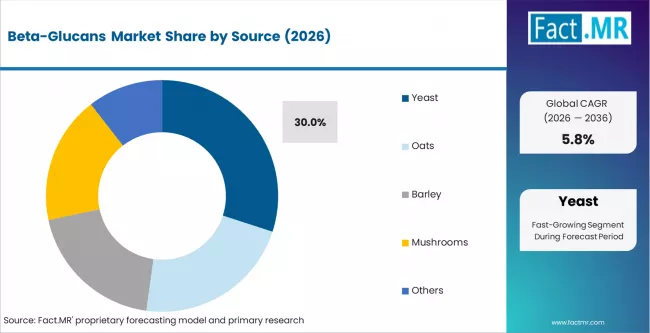
Beta Glucans Market Analysis By Source | Source: Fact.MR
According to FACT.MR, yeast-derived beta-glucans are expected to hold around 30% market share in 2026 due to their well-researched immune-modulating properties and strong clinical evidence supporting pharmaceutical-grade supplement positioning.
- Lesaffre Investment: In January 2025, Lesaffre expanded Lynside Immunity beta-glucan production in France, adding about 500 tonnes of annual supply for clinical nutrition and premium supplement markets. [5]
- Biothera Technology Development: In 2024, Biothera published new clinical data confirming Wellmune yeast beta-glucan benefits for respiratory health in active adults, supporting premium immune supplement positioning. [6]
- Oat Beta-Glucan Adoption Trend: EFSA’s 2024 register update showed oat beta-glucan remained the most cited functional ingredient in cholesterol-claim food products, with product launches increasing 14% year-on-year. [7]
Beta-Glucans Market Analysis by Functionality
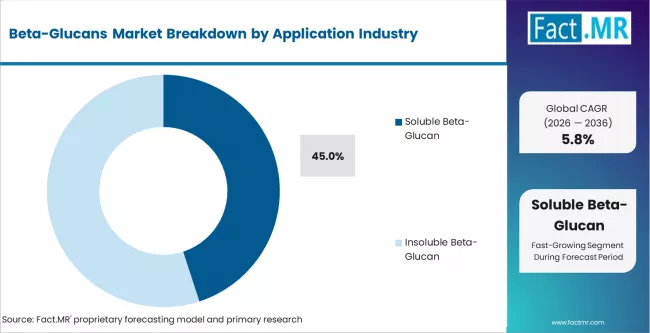
Beta Glucans Market Analysis By Functionality | Source: Fact.MR
FACT.MR estimates soluble beta-glucan will account for about 45% share in 2026 due to its viscosity-forming mechanism that supports authorised cholesterol-lowering health claims in food products.
- Kerry Group Soluble Investment: In 2025, Kerry launched a high-concentration oat beta-glucan extraction process allowing manufacturers to meet EFSA 3 g daily dose requirements in lower-volume formulations. [8]
- Tate and Lyle Technology: In October 2024, Tate and Lyle introduced Meripro oat beta-glucan concentrate with improved cold-water dispersibility for beverage and dairy fortification. [9]
- Soluble Beta-Glucan Adoption Trend: Oatly reported that beta-glucan labelling supported a 15-25% price premium for its oat drink products across European retail markets. [10]
Drivers, Restraints, and Opportunities
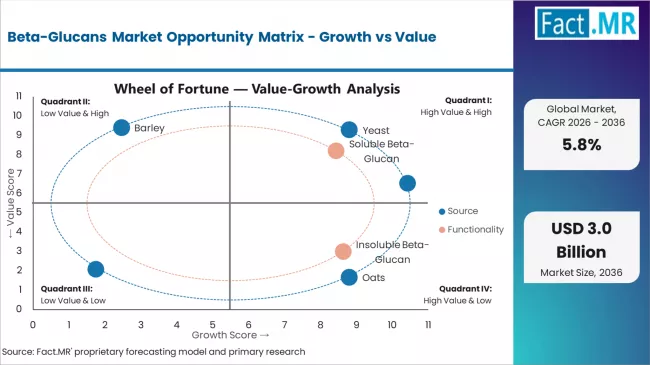
Beta Glucans Market Opportunity Matrix Growth Vs Value | Source: Fact.MR
FACT.MR analysts state that the beta-glucans market is shifting from a commodity dietary fibre segment to a specialised bioactive ingredient market supported by regulatory health claims.
Adoption was previously limited by high extraction costs compared with standard dietary fibre, but improved oat processing and yeast fermentation technologies have reduced costs while stronger clinical evidence has increased premium health claim demand. Commodity dietary fibre ingredients are gradually being replaced by characterized beta-glucan in premium foods and supplements where authorised health claims support stronger product differentiation.
- EFSA Health Claim Framework: EU Regulation 432/2012 allows cholesterol-lowering claims for oat and barley beta-glucan at 3 g daily intake, driving reformulation of cereals, oat drinks, and bakery products in Germany, France, and the Netherlands. [2]
- Japan FOSHU Immune Approval: Japan’s Consumer Affairs Agency expanded FOSHU approvals in 2024 to include additional immune health claims for yeast beta-glucan products, supporting new functional food and supplement launches. [3]
- Australia TGA Supplement Growth: The TGA Listed Medicine pathway enables immune health claims for beta-glucan supplements, supporting product expansion by brands such as Blackmores and Swisse in pharmacy and health retail channels. [4]
Regional Analysis
The beta-glucans market is analysed across Asia Pacific, Europe, North America, Latin America, and Middle East and Africa, covering 40+ countries with distinct demand profiles shaped by regulatory health claim frameworks, supplement market maturity, functional food innovation pace, and clinical nutrition programme adoption. The full report offers market attractiveness analysis based on health claim approval timelines, supplement market growth trajectories, and functional food innovation pipeline data.
.webp "Top Country Growth Comparison Beta Glucans Market Cagr (2026 2036)")
Top Country Growth Comparison Beta Glucans Market Cagr (2026 2036) | Source: Fact.MR
| Country | CAGR (2026-2036) |
|---|---|
| Japan | 7.0% |
| Australia | 6.7% |
| Canada | 6.0% |
| Germany | 5.8% |
| USA | 5.5% |
Source: Fact.MR analysis. Updated Mar 16, 2026
Source: Fact.MR (FACT.MR) analysis, based on proprietary forecasting model and primary research
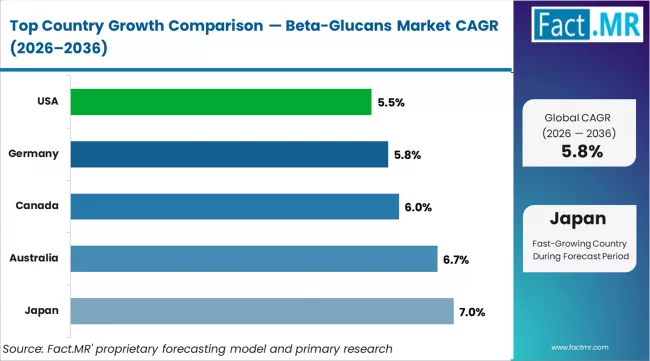
Beta Glucans Market Cagr Analysis By Country | Source: Fact.MR
Asia Pacific Beta-Glucans Market Analysis
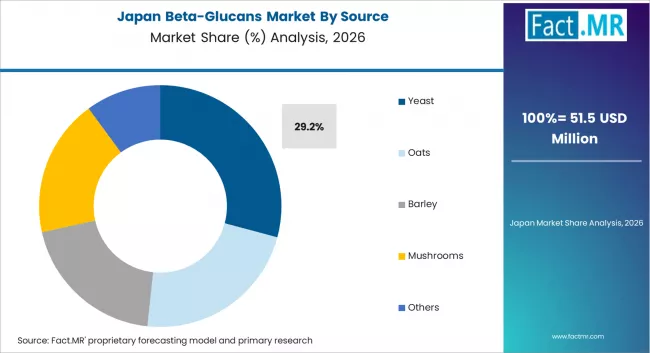
Beta Glucans Market Japan Market Share Analysis By Source | Source: Fact.MR
Asia Pacific is the fastest-growing region due to Japan’s FOSHU-regulated functional food market and Australia’s premium immune supplement sector. Kirin Holdings and Meiji Holdings lead Japanese product development, while Blackmores and Swisse dominate Australia’s pharmacy-based supplement market.
- Japan: Beta-glucan demand in Japan is expected to grow at 7.0% CAGR through 2036. Japan approved five new FOSHU applications for yeast beta-glucan immune health claims in 2024, expanding approved benefits beyond cholesterol and blood glucose into immune support. Kirin Holdings expanded its iMUSE beta-glucan supplement range in 2024 and reported strong growth with new products targeting sports nutrition and elderly immune support.
- Australia: The Australian beta-glucans market is forecast to record 6.7% CAGR through 2036. Blackmores reported immune health as its fastest-growing supplement category in FY2025, with beta-glucan products among its leading pharmacy sellers. The TGA expanded permitted claims in 2024 allowing upper respiratory tract health messaging for beta-glucan supplements. CSIRO also released clinical evidence in October 2024 confirming oat beta-glucan cholesterol reduction benefits in adults with cardiovascular risk.
FACT.MR’s analysis of the beta-glucans market in South Asia and Pacific covers Japan, South Korea, India, Australia and New Zealand, ASEAN, and Rest of South Asia and Pacific. Readers can find country CAGR forecasts, FOSHU approval timelines, TGA listed medicine data, functional food beta-glucan innovation pipeline information, and supplement market growth benchmarks by country.
Europe Beta-Glucans Market Analysis
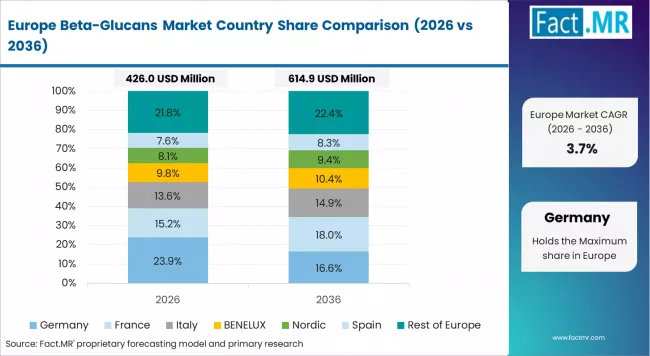
Beta Glucans Market Europe Country Market Share Analysis, 2026 & 2036 | Source: Fact.MR
Europe leads globally in regulatory frameworks for beta-glucan health claims under EU Regulation 432/2012, supporting premium functional food positioning across member states. Kerry Group and Tate and Lyle dominate oat beta-glucan supply, while Lesaffre leads yeast beta-glucan production for supplements and clinical nutrition.
- Germany: Beta-glucan consumption in Germany is projected to expand at 5.8% CAGR through 2036. Germany’s Federal Institute for Risk Assessment confirmed the safety of oat beta-glucan at the EFSA-recommended 3 g daily intake in January 2025. Kellogg’s Germany expanded its Special K oat beta-glucan cereal range in 2024 with EFSA-compliant formulations distributed across REWE and EDEKA stores.
- Canada: Canada’s beta-glucans market is anticipated to grow at 6.0% CAGR through 2036. Health Canada’s oat beta-glucan heart health claim supported 14 new Natural Health Product licence applications in 2024. Quaker Canada launched new instant oat products with cholesterol health claims in September 2024 across Loblaws and Sobeys retail stores.
FACT.MR’s analysis of the beta-glucans market in Europe covers Germany, France, the United Kingdom, Italy, Spain, Nordic countries, BENELUX, and Rest of Western Europe. The report includes EFSA authorised claim product launch data, organic ingredient certification trends, and country-level forecasts by source and functionality.
North America Beta-Glucans Market Analysis
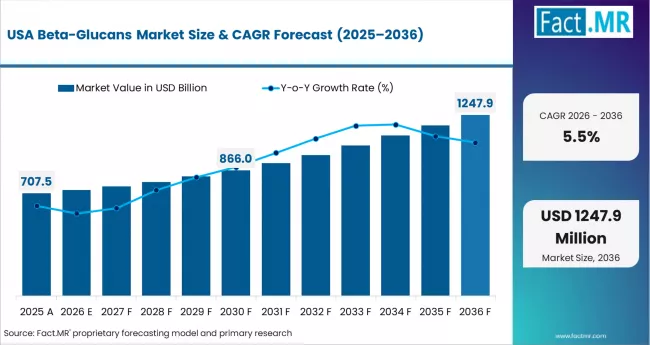
Beta Glucans Market Country Value Analysis | Source: Fact.MR
North America represents the largest beta-glucans revenue market due to the United States’ strong dietary supplement and functional food industry. Kemin Industries and Biothera Pharmaceuticals lead yeast beta-glucan supply, while Kerry Group and Tate and Lyle supply oat beta-glucan to functional food manufacturers.
- United States: The U.S. beta-glucans market is predicted to grow at 5.5% CAGR through 2036. The FDA’s updated 2024 health claim confirms that 3 g daily oat beta-glucan intake supports coronary heart disease risk reduction. Kemin Industries expanded its KetaShield yeast beta-glucan clinical nutrition programme in January 2025 through hospital procurement agreements. General Mills maintained FDA-authorised heart health beta-glucan labelling for Cheerios across U.S. markets.
FACT.MR’s analysis of the beta-glucans market in North America covers the United States, Canada, and Mexico. The report includes FDA health claim compliance data, supplement market growth forecasts, clinical nutrition programme procurement benchmarks, and country-level revenue forecasts by source and application.
Competitive Aligners for Market Players
Beta Glucans Market Analysis By Company | Source: Fact.MR
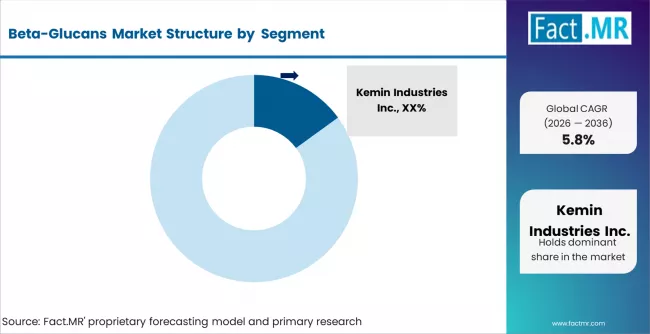
The global beta-glucans market is moderately fragmented, with a mix of large ingredient companies and specialised producers competing across different applications and regions. Major companies such as Kerry Group, Tate and Lyle, and Lesaffre operate alongside specialised beta-glucan suppliers like Kemin Industries, Biothera Pharmaceuticals, and Biotec BetaGlucans. No single company controls more than 20% of global revenue, as the market is divided by source types, applications, and regional regulatory frameworks.
Competition is mainly driven by factors such as clinical evidence supporting health claims, beta-glucan purity and molecular weight quality, GMP-certified manufacturing, and regulatory expertise across EFSA, FDA, Health Canada, and Japan’s FOSHU system.
Companies with vertically integrated production and strong clinical research capabilities hold a clear advantage. Biothera’s Wellmune yeast beta-glucan has one of the most extensive clinical evidence bases for immune health, supported by multiple controlled trials. Lesaffre’s Lynside Immunity benefits from its large-scale yeast fermentation infrastructure, ensuring consistent quality and supply. Meanwhile, Kerry Group and Tate and Lyle use their established food ingredient networks to supply oat beta-glucan to functional food manufacturers. Large brands and supplement companies typically rely on multiple certified suppliers to maintain supply security and ensure access to clinically validated ingredients.
Key Players
- Kemin Industries Inc.
- Lesaffre Group
- Biothera Pharmaceuticals Inc.
- Ceapro Inc.
- Garuda International Inc.
- Kerry Group Plc
- Tate and Lyle Plc
- Biotec BetaGlucans AS
- Super Beta Glucan Inc.
- Angel Yeast Co., Ltd.
Bibliography
- [1] European Food Safety Authority (EFSA). (2024). Register of Authorised Health Claims: Beta-Glucan from Oats and Barley Cholesterol Maintenance Claim Status Update and Minimum Daily Dose Requirement Confirmation Under Regulation (EU) 432/2012. November 2024.
- [2] Consumer Affairs Agency, Government of Japan. (2024). FOSHU Approval Register Update: New Beta-Glucan Immune Health Claim Approvals from Yeast-Derived Sources and Kirin Holdings iMUSE Functional Ingredient Division Performance Disclosure. December 2024.
- [3] Blackmores Group. (2024). Annual Report 2024: Immune Health Supplement Category Revenue Growth, Beta-Glucan Product Range Expansion in Australian Pharmacy Channels, and TGA Listed Medicine Programme Update. October 2024.
- [4] Lesaffre Group. (2025). Press Release: Lynside Immunity Yeast Beta-Glucan Production Capacity Expansion at Marcq-en-Barœul Facility 500 Tonne Annual Capacity Addition for European Clinical Nutrition and Premium Supplement Customers. January 2025.
- [5] Biothera Pharmaceuticals Inc. (2024). Clinical Research Publication: Wellmune Yeast Beta-Glucan Upper Respiratory Tract Health Efficacy in Physically Active Adults Randomised Controlled Trial Results in Journal of the American College of Nutrition. September 2024.
- [6] European Food Safety Authority (EFSA). (2024). Annual Register of Article 13 Health Claim Notifications: Oat Beta-Glucan Cholesterol Claim Product Notification Count and Year-on-Year Growth in New Product Launches. October 2024.
- [7] Kerry Group Plc. (2025). Ingredient Portfolio Update: Oat Beta-Glucan Soluble Fibre High-Concentration Extraction Format Launch Targeting EFSA-Compliant Functional Snack Bar and Baked Good Applications. January 2025.
- [8] Tate and Lyle Plc. (2024). Product Launch: Meripro Oat Beta-Glucan Concentrate with Enhanced Cold-Water Dispersibility for Beverage and Dairy Fortification Applications with EFSA Cholesterol Health Claim Eligibility. October 2024.
- [9] Oatly AB. (2024). Annual Report and Sustainability Review 2024: Oat Beta-Glucan Content as Primary Health Positioning Element in European Oat Drink Portfolio and Premium Price Positioning Data Versus Standard Plant Milk Alternatives. December 2024.
This Report Addresses
- Strategic insights on EU EFSA cholesterol claims, Japan FOSHU immune approvals, Australia TGA supplement pathway, Health Canada claims, and FDA oat heart health regulations influencing beta-glucan demand.
- Market forecast from USD 1.7 billion in 2026 to USD 3.0 billion by 2036 at 5.8% CAGR across source, functionality, application, distribution channel, and region.
- Growth opportunities across Japan FOSHU immune approvals, Australia supplement expansion by Blackmores and Swisse, Germany EFSA-compliant food reformulations, Canada Quaker heart-health launches, and U.S. clinical nutrition procurement.
- Country CAGR outlook including Japan 7.0%, Australia 6.7%, Canada 6.0%, Germany 5.8%, and United States 5.5%, supported by regulatory frameworks and functional food innovation.
- Competitive analysis of Lesaffre, Biothera Pharmaceuticals, Kerry Group, Tate and Lyle, Kemin Industries, Ceapro, and Angel Yeast based on clinical evidence, GMP production, and regulatory compliance.
- Technology tracking covering yeast beta-glucan extraction optimisation, oat beta-glucan beverage dispersibility, mushroom bioactivity research, GMP-grade production, and cosmetic formulation development.
- Regulatory analysis of EFSA beta-glucan claims, FDA oat heart health claims, Health Canada NHP monograph, Japan FOSHU approvals, TGA supplement regulations, and CFIA oat standards.
- Report delivery includes PDF, Excel datasets, PowerPoint summary, and dashboard tools supported by regulatory databases, product launch data, manufacturer disclosures, and primary interviews.
Segmentation
Scope of Report
Beta Glucans Market Breakdown By Source, Functionality, And Region | Source: Fact.MR
| Attribute | Details |
|---|---|
| Quantitative Units | USD 1.7 billion (2026) to USD 3.0 billion (2036), at a CAGR of 5.8% |
| Market Definition | Natural polysaccharides from yeast, oats, barley, and mushrooms used in health supplements, functional foods, cosmetics, and animal feed for immune and metabolic benefits. |
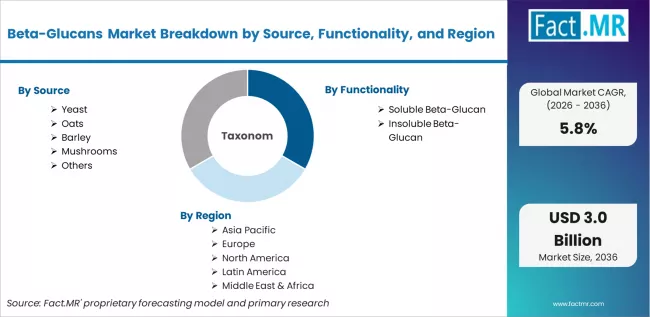
| Source Segmentation | Yeast, Oats, Barley, Mushrooms, Others |
| Functionality Segmentation | Soluble Beta-Glucan, Insoluble Beta-Glucan |
| Application Segmentation | Health and Dietary Supplements (40%), Food and Beverages, Cosmetics and Personal Care, Animal Feed, Others |
| Distribution Segmentation | Online Retail, Specialty Stores, Pharmacies, Supermarkets, Others |
| Application Coverage | Immune-support dietary supplements, cholesterol-reducing functional foods, skin barrier cosmetics, animal feed immune additives, and clinical nutrition formulations. |
| Regions Covered | Asia Pacific, Europe, North America, Latin America, Middle East and Africa |
| Countries Covered | China, Japan, South Korea, India, Australia and New Zealand, ASEAN, Rest of South Asia and Pacific, Germany, UK, France, Italy, Spain, Nordic, BENELUX, Rest of Western Europe, Russia, Poland, Hungary, USA, Canada, Mexico, Brazil, Chile, Ecuador, Rest of Latin America, Saudi Arabia, GCC, Turkey, South Africa, Rest of MEA |
| Key Companies Profiled | Kemin Industries, Lesaffre Group, Biothera Pharmaceuticals, Ceapro Inc., Garuda International, Kerry Group, Tate and Lyle, Biotec BetaGlucans, Super Beta Glucan, Angel Yeast |
| Forecast Period | 2026 to 2036 |
| Approach | Hybrid top-down and bottom-up model using ingredient shipment volumes, application spend by end-use vertical, and primary interviews with supplement formulators and food ingredient buyers. |
Source: Fact.MR analysis. Updated Mar 16, 2026
Beta-Glucans Market by Segments
-
By Source:
- Yeast
- Oats
- Barley
- Mushrooms
- Others
-
By Functionality:
- Soluble Beta-Glucan
- Insoluble Beta-Glucan
-
By Application:
- Health and Dietary Supplements
- Food and Beverages
- Cosmetics and Personal Care
- Animal Feed
- Others
-
By Distribution Channel:
- Online Retail
- Specialty Stores
- Pharmacies
- Supermarkets
- Others
-
By Region:
- North America
- United States
- Canada
- Mexico
- Latin America
- Brazil
- Chile
- Ecuador
- Rest of Latin America
- Western Europe
- Germany
- United Kingdom
- France
- Italy
- Spain
- Nordic
- BENELUX
- Rest of Western Europe
- Eastern Europe
- Russia
- Poland
- Hungary
- Balkan and Baltic
- Rest of Eastern Europe
- East Asia
- China
- Japan
- South Korea
- South Asia and Pacific
- India
- ASEAN
- Australia and New Zealand
- Rest of South Asia and Pacific
- Middle East and Africa
- Kingdom of Saudi Arabia
- Other GCC Countries
- Turkey
- South Africa
- Other African Union
- Rest of Middle East and Africa
- North America
Frequently Asked Questions
How large is the beta-glucans market in 2025?
What will the market size be in 2026?
What is the projected market size by 2036?
What is the expected CAGR?
Which source segment leads the market?
Which functionality segment dominates?
Which application segment holds the largest share?
Which country shows the fastest growth?
What is the primary restraint?
Who worked on this report


Preview the report firsthand - request a free sample
Free SampleGet the brochure for pricing and purchase details
Download PDF