- Base Value(2025): 4.4 Bn
- Estimated Value(2026): 4.6 Bn
- Forecast Value (2036): 7.9 Bn
- CAGR (2026 - 2036): 6.5%
Betaine Anhydrous for Sports Hydration Beverages Market Forecast and Outlook By Fact.MR
In 2025, the betaine anhydrous for sports hydration beverages market was valued at USD 4.4 billion. Based on Fact.MR analysis, demand for betaine anhydrous for sports hydration beverages is estimated to grow to USD 4.6 billion in 2026 and USD 7.9 billion by 2036. FACT.MR projects a CAGR of 6.5% during the forecast period.
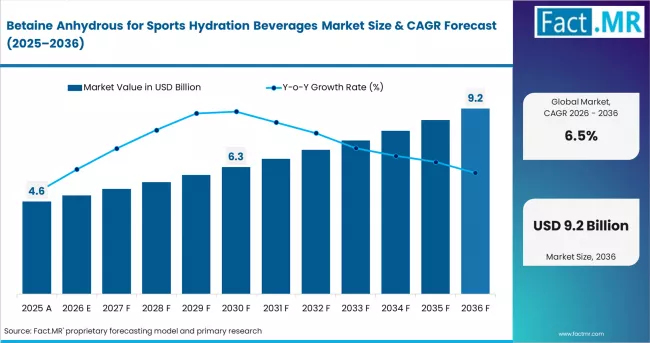
Betaine Anhydrous For Sports Hydration Beverages Market Market Value Analysis | Source: Fact.MR
Summary of Betaine Anhydrous for Sports Hydration Beverages Market
- Market Definition
- The market includes natural and synthetic betaine anhydrous in both powder and liquid forms. These products are used as osmolytes and endurance performance ingredients. They are applied in sports hydration beverages, electrolyte formulations, dietary supplements, and functional foods across global sports nutrition supply chains.
- Demand Drivers
- U.S. sports beverage brands are shifting to certified natural betaine. Used for clean-label osmolyte and endurance claims.
- China's sports nutrition sector is expanding. Government fitness programmes drive betaine demand in hydration drinks.
- EU sports nutrition regulations support compliant betaine adoption. Used in premium hydration beverages in Germany and the UK.
- Key Segments Analyzed
- By Application: Sports Nutrition & Hydration Beverages leads 40% in 2026. Driven by osmolyte function and endurance performance benefits in RTD formats.
- By Form: Powder leads 72% in 2026. Widely used in RTD drink blending and electrolyte mix manufacturing.
- By Source: Natural betaine leads 70% in 2026. Driven by clean-label demand from sports beverage brand owners.
- By Geography: China leads 7.5% CAGR. Driven by fitness programme expansion and beverage sector growth.
- Analyst Opinion at FACT.MR
- Shambhu Nath Jha, Principal Consultant at Fact.MR, opines, ' CXOs will find that rising clean-label osmolyte demand is creating a structural divide between premium, certified betaine suppliers and commodity producers. Companies that offer sugar beet–origin traceability and strong application-specific documentation are better positioned to capture higher margins as sports beverage reformulation continues to accelerate.
- Strategic Implications
- Invest in natural sugar beet-derived betaine with certified origin documentation to qualify for premium sports beverage and clean-label supplement brand procurement programmes.
- Develop betaine powder grades with defined solubility and stability specifications for RTD electrolyte beverage manufacturing targeting the fastest-growing application format.
-
Methodology
- Market sizing based on betaine ingredient shipment volumes by application grade. Validated with 2024–2025 producer revenue and sports beverage procurement data.
- FDA GRAS notifications, EFSA sports nutrition guidance, and Codex standards supported demand and country analysis.
- Forecasts incorporate sports nutrition growth benchmarks, RTD beverage trends, and clean-label ingredient adoption data from primary research.
| Metric | Value |
|---|---|
| Estimated Value in 2026 | USD 4.6 billion |
| Forecast Value in 2036 | USD 7.9 billion |
| Forecast CAGR (2026 to 2036) | 6.5% |
Source: Fact.MR analysis. Updated Apr 14, 2026
The market is expected to generate USD 3.3 billion in incremental revenue during the forecast period, reflecting strong and sustained growth. Demand is primarily driven by the expansion of RTD sports hydration beverages and increasing adoption of endurance supplements across North America and Asia Pacific. However, growth is partly moderated by the higher production costs of natural betaine compared to synthetic alternatives, along with fluctuations in sugar beet harvests that impact supply and pricing.
At the same time, the beverage industry’s shift toward natural and transparent ingredient sourcing is strengthening demand for certified betaine grades. Major sports nutrition brands are increasingly requiring traceability documentation, which is creating a divide in the market. Suppliers lacking origin certification are facing pricing commoditization and reduced participation in premium product formulations.
At the country level, China leads growth with a projected CAGR of 7.5% through 2036, supported by rapid expansion in the sports hydration beverage sector and government-backed fitness initiatives. India follows with 7.0% CAGR, driven by organised fitness sector growth and increasing RTD sports drink distribution in urban areas. The United States is expected to grow at 6.5% CAGR due to continued clean-label reformulation in hydration and electrolyte beverages. Germany records 6.1% CAGR, supported by EU compliance standards and growth in premium functional beverage retail channels, while the United Kingdom is projected at 5.7% CAGR, driven by established sports nutrition retail infrastructure and rising consumption among recreational athletes. Structural challenges in mature markets include pricing pressure from synthetic betaine and limited consumer awareness of betaine as a hydration ingredient outside professional sports nutrition.
Segmental Analysis
Betaine Anhydrous for Sports Hydration Beverages Market Analysis by Application
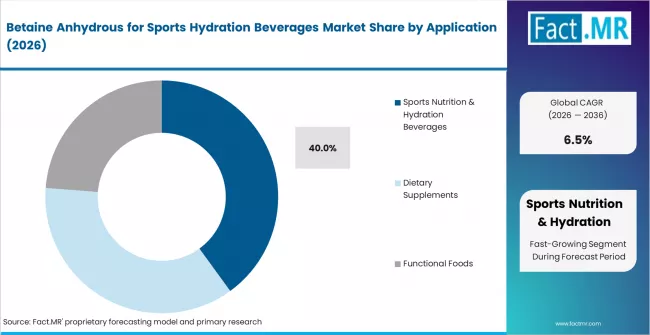
Betaine Anhydrous For Sports Hydration Beverages Market Analysis By Application | Source: Fact.MR
Based on FACT.MR's betaine anhydrous for sports hydration beverages market report, consumption in sports nutrition & hydration beverages is estimated to hold 40% share in 2026. This segment leads due to betaine's osmolyte function in supporting cellular hydration and its documented endurance performance benefits in RTD electrolyte and hydration drink formulations.
- BASF Expansion: BASF SE expanded food-grade betaine production capacity at its Ludwigshafen facility in Q3 2024, targeting increased supply to European sports beverage manufacturers reformulating with natural osmolyte ingredients. [4]
- IFF Development: IFF launched a new certified natural betaine range derived from sugar beet processing in early 2025, with standardised purity and solubility specifications targeting RTD sports drink and electrolyte mix manufacturers in North America. [5]
- Hydration Trend: The Global Wellness Institute reported a 14% increase in functional hydration beverage product launches containing osmolyte ingredients including betaine in 2024, with natural source claims representing 68% of new product specifications. [6]
Betaine Anhydrous for Sports Hydration Beverages Market Analysis by Form
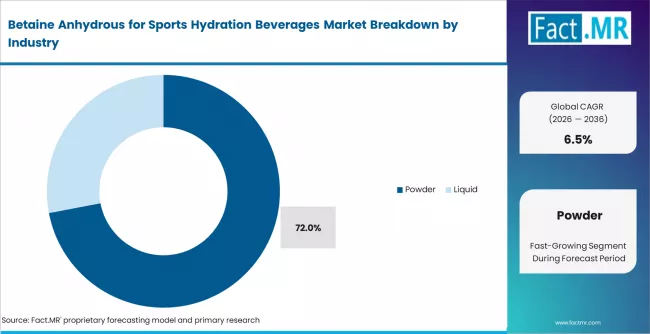
Betaine Anhydrous For Sports Hydration Beverages Market Analysis By Form | Source: Fact.MR
Based on FACT.MR's betaine anhydrous for sports hydration beverages market report, powder form is estimated to hold 72% share in 2026. Powder dominates due to ease of blending in dry-mix electrolyte sachets and RTD drink manufacturing, consistent dosing in supplement capsules, and compatibility with large-scale sports nutrition ingredient dispensing systems.
- Solvay Investment: Solvay SA disclosed investment in betaine powder processing optimisation at its Rheinberg Germany facility in 2024, targeting improved solubility grades for functional beverage dry-blending applications in European and North American sports nutrition markets. [7]
- Evonik Development: Evonik Industries introduced a liquid betaine concentrate for RTD beverage manufacturing in late 2024, offering pump-dosable formulation for high-volume sports drink production lines requiring consistent osmolyte delivery. [8]
- Powder Demand Trend: Contract sports nutrition manufacturers in North America reported betaine powder as the top-specified osmolyte ingredient in 2024 electrolyte product briefs, with documentation requirements for certified natural source content reinforced by retail buyer audits. [9]
Drivers, Restraints, and Opportunities
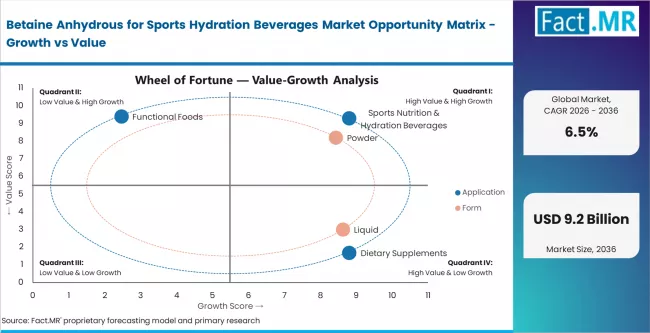
Betaine Anhydrous For Sports Hydration Beverages Market Opportunity Matrix Growth Vs Value | Source: Fact.MR
FACT.MR identifies two key demand dynamics. Synthetic betaine supply is facing displacement in premium formulations. Natural betaine with origin certification commands 25–40% price premiums. Sports hydration beverage volume is growing. It is driven by osmolyte function and hydration claims. Endurance and electrolyte product reformulation supports the structural shift.
Synthetic betaine holds volume share in commodity supplement segments. Natural certified betaine demand is rising in sports beverages and premium RTD drinks. Brand owners require origin documentation to meet clean-label commitments. This supports revenue growth despite margin pressure at commodity grade level.
- U.S. Sports Nutrition Growth: Sports hydration beverage sales grew 11% in 2024. Betaine is a key osmolyte ingredient in electrolyte formulations. Procurement by brands such as Gatorade and Liquid I.V. is driving volume. [3]
- EU Regulatory Alignment: EFSA updated sports nutrition ingredient guidance in 2024 under EU Regulation 1169/2011. Compliant betaine labelling is required for hydration claim products. This reinforces demand for documented natural betaine in European markets. [2]
- China Fitness Policy Expansion: China's National Fitness Plan 2021–2025 programme accelerated sports beverage sector investment in 2024. Betaine demand in RTD hydration products grew through e-commerce channels on JD.com and Tmall. Domestic beverage brands increased natural ingredient procurement. [1]
Regional Analysis
The betaine anhydrous for sports hydration beverages market is assessed across Asia Pacific, North America, Europe, Latin America, and Middle East and Africa, covering 40+ countries with distinct demand profiles shaped by sports nutrition industry maturity, RTD beverage sector scale, and national sports ingredient regulatory frameworks. The full report provides market attractiveness analysis by region and country.
.webp "Top Country Growth Comparison Betaine Anhydrous For Sports Hydration Beverages Market Cagr (2026 2036)")
Top Country Growth Comparison Betaine Anhydrous For Sports Hydration Beverages Market Cagr (2026 2036) | Source: Fact.MR
| Country | CAGR (2026 to 2036) |
|---|---|
| China | 7.5% |
| India | 7.0% |
| United States | 6.5% |
| Germany | 6.1% |
| United Kingdom | 5.7% |
Source: Fact.MR analysis. Updated Apr 14, 2026
Source: Fact.MR (FACT.MR) analysis, based on proprietary forecasting model and primary research
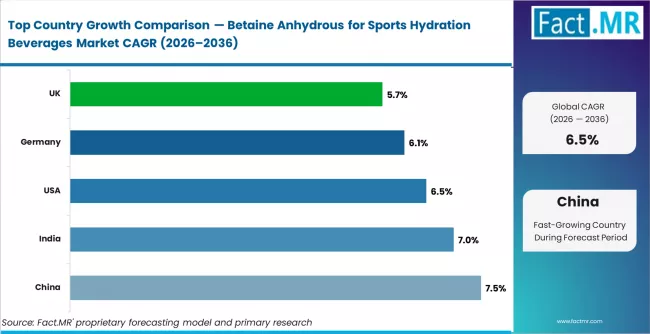
Betaine Anhydrous For Sports Hydration Beverages Market Cagr Analysis By Country | Source: Fact.MR
Asia Pacific Betaine Anhydrous for Sports Hydration Beverages Market Analysis
Asia Pacific is the fastest-growing region. Growth is driven by China’s expanding sports beverage sector and India’s rising fitness-led RTD drink adoption. Sunwin Biotech leads natural betaine supply, while domestic brands in both countries are scaling hydration portfolios.
- China: China’s betaine anhydrous demand is expected to grow at a 7.5% CAGR through 2036. The National Fitness Plan 2021–2025 accelerated investment in sports hydration products, with a 13% increase in functional beverage retail value in 2024. Sunwin Biotech expanded extraction capacity at its Shandong facility in 2024 to support domestic brands selling RTD electrolyte drinks via JD.com and Tmall. E-commerce-led demand remains a key differentiator from India.
- India: India is set to record a 7.0% CAGR through 2036. Updated 2024 labelling guidelines by FSSAI clarified approval pathways for osmolytes like betaine in hydration beverages. Expansion of organised fitness centres in tier-1 and tier-2 cities is boosting RTD sports drink distribution through gym-linked retail channels, unlike China’s digital model. BASF strengthened its distribution network in 2024 to meet demand from emerging beverage and supplement brands.
Fact.MR covers China, India, Japan, South Korea, ASEAN, and ANZ. The analysis includes sports nutrition policy data, RTD beverage trends, and country-level forecasts.
North America Betaine Anhydrous for Sports Hydration Beverages Market Analysis
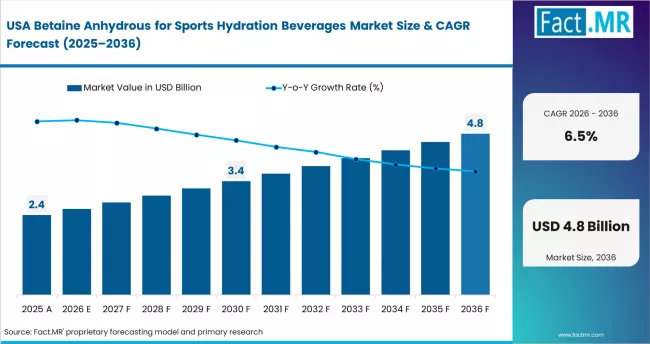
Betaine Anhydrous For Sports Hydration Beverages Market Country Value Analysis | Source: Fact.MR
North America represents the largest market by value. Growth is supported by clean-label reformulation trends in hydration and electrolyte beverages, with BASF and IFF as key suppliers operating through established distributor networks.
- United States: The U.S. market is projected to expand at a 6.5% CAGR through 2036. In 2024, the FDA reinforced GMP documentation standards, raising qualification requirements for ingredient suppliers and favouring certified natural betaine. Retailers such as Whole Foods and Target introduced stricter clean-label sourcing standards, accelerating demand for traceable osmolytes. Growth is primarily driven by brand-led reformulation strategies.
Fact.MR covers the U.S., Canada, and Mexico. The analysis includes FDA documentation data, retail clean-label procurement trends, and country-level demand forecasts.
Europe Betaine Anhydrous for Sports Hydration Beverages Market Analysis Europe is a premium, regulation-driven market. Demand is shaped by EFSA guidelines and organic certification requirements, with BASF, Solvay, and Evonik leading supply.
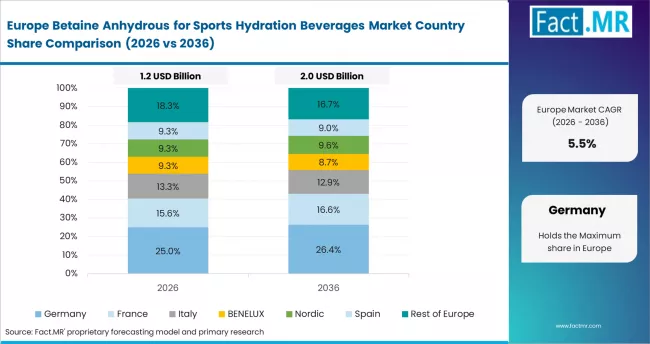
Betaine Anhydrous For Sports Hydration Beverages Market Europe Country Market Share Analysis, 2026 & 2036 | Source: Fact.MR
- Germany: Germany’s market is forecast to grow at a 6.1% CAGR through 2036. Updated EFSA guidance under Regulation (EU) 1169/2011 strengthened documentation requirements for osmolyte claims, supporting demand for traceable natural betaine. Retailers such as MyProtein Germany and dm-drogerie markt expanded hydration product ranges in 2024–2025, increasing supplier compliance pressure. Growth is largely regulation and retail driven.
- United Kingdom: The UK is expected to grow at a 5.7% CAGR through 2036. Post-Brexit, the Food Standards Agency introduced updated sports nutrition guidelines in 2025, maintaining betaine approval under UK-specific regulations. Brands like Myprotein and Science in Sport expanded certified betaine-based hydration products, supported by UK-focused distributor networks distinct from EU supply chains.
Fact.MR covers Germany, France, the UK, Italy, Spain, and the rest of Europe. The analysis includes EFSA compliance data, sports nutrition retail trends, and country-level forecasts.
Competitive Aligners for Market Players
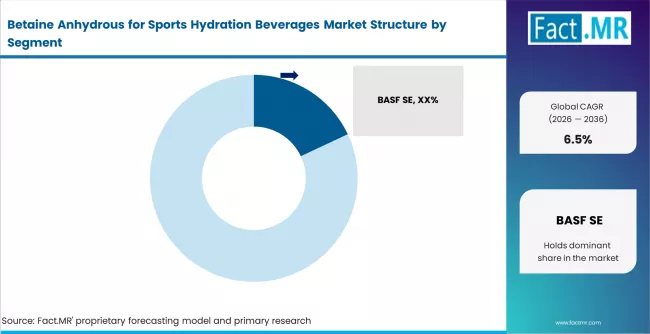
Betaine Anhydrous For Sports Hydration Beverages Market Analysis By Company | Source: Fact.MR
The competitive landscape of the betaine anhydrous market in sports hydration applications reflects a controlled level of consolidation, where a handful of established suppliers dominate global volumes. Rivalry is not primarily price-driven but instead revolves around product credibility, including verified origin, consistent purity levels, and performance suitability in beverage formulations. Leading participants such as BASF SE and Solvay SA have secured strong positions by focusing on high-grade, certified offerings that meet evolving clean-label standards.
Operational strength in this market is shaped by upstream integration and compliance capability. Companies with direct control over sugar beet sourcing and processing benefit from improved traceability and supply reliability, which are increasingly valued by buyers. At the same time, maintaining regulatory alignment across multiple jurisdictions, including EFSA, FDA, and Chinese standards, has become essential for participation in global supply chains. BASF SE utilises its broad production infrastructure to cater to both standard and premium segments, while IFF focuses on natural-origin betaine supported by its ingredient sourcing network, targeting higher-value beverage applications. Procurement behavior among sports nutrition brands further shapes market dynamics. Large beverage and supplement manufacturers typically adopt multi-supplier strategies to reduce supply risk and ensure continuity.
However, once a specific betaine grade is validated within a formulation, switching suppliers becomes complex due to the need for reformulation, testing, and regulatory approvals. This creates longer supplier relationships and gives certified natural betaine producers a degree of pricing advantage over standard synthetic alternatives.
Key Players
- BASF SE
- IFF (International Flavors & Fragrances)
- Solvay SA
- Evonik Industries
- Nutreco
- Sunwin Biotech
Scope of Report
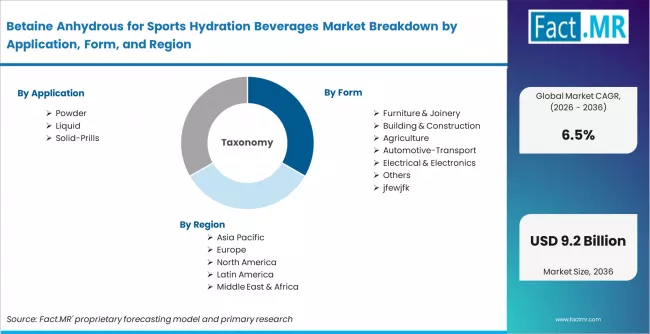
Betaine Anhydrous For Sports Hydration Beverages Market Breakdown By Application, Form, And Region | Source: Fact.MR
| Attribute | Details |
|---|---|
| Quantitative Units | USD 4.6 billion (2026) to USD 7.9 billion (2036), at a CAGR of 6.5% |
| Market Definition | Natural and synthetic betaine anhydrous in powder and liquid forms sold as an osmolyte and performance ingredient for sports hydration beverages, dietary supplements, and functional foods globally. |
| Application Segmentation | Sports Nutrition & Hydration Beverages, Dietary Supplements, Functional Foods |
| Form Segmentation | Powder, Liquid |
| Source Segmentation | Natural Betaine, Synthetic Betaine |
| Application Coverage | Hydration beverage osmolyte ingredient supply, sports endurance supplement formulation, RTD electrolyte drink manufacturing, functional food performance ingredient, and clean-label betaine procurement. |
| Regions Covered | North America, Europe, Asia Pacific, Latin America, Middle East and Africa |
| Countries Covered | USA, Canada, Mexico, Germany, UK, France, Italy, Spain, Nordic, BENELUX, China, Japan, South Korea, India, ASEAN, Australia and New Zealand, Brazil, Argentina, Chile, Saudi Arabia, GCC, Turkey, South Africa, Rest of MEA |
| Key Companies Profiled | BASF SE, IFF (International Flavors & Fragrances), Solvay SA, Evonik Industries, Nutreco, Sunwin Biotech |
| Forecast Period | 2026 to 2036 |
| Approach | Hybrid top-down and bottom-up model using betaine ingredient shipment volumes by application and form, average selling prices by grade and channel, sports nutrition market growth benchmarks, functional beverage ingredient procurement data, and primary interviews with beverage formulators and sports nutrition brand managers. |
Source: Fact.MR analysis. Updated Apr 14, 2026
Betaine Anhydrous for Sports Hydration Beverages Market by Segments
-
By Application:
- Sports Nutrition & Hydration Beverages
- Dietary Supplements
- Functional Foods
-
By Form:
- Powder
- Liquid
-
By Source:
- Natural Betaine
- Synthetic Betaine
-
By Region:
- North America
- United States
- Canada
- Mexico
- Latin America
- Brazil
- Mexico
- Argentina
- Chile
- Rest of Latin America
- Western Europe
- Germany
- United Kingdom
- France
- Italy
- Spain
- Nordic Countries
- BENELUX
- Rest of Western Europe
- Eastern Europe
- Russia
- Poland
- Hungary
- Balkan and Baltic
- Rest of Eastern Europe
- East Asia
- China
- Japan
- South Korea
- South Asia and Pacific
- India
- ASEAN
- Australia and New Zealand
- Rest of South Asia and Pacific
- Middle East and Africa
- Kingdom of Saudi Arabia
- Other GCC Countries
- Turkey
- South Africa
- Rest of Middle East and Africa
- North America
This Report Addresses
- Strategic insights on demand across U.S., China, India, Germany, and UK markets. Covers clean-label reformulation, RTD beverage expansion, and fitness programme-driven adoption trends.
- Market forecast from USD 4.6 billion in 2026 to USD 7.9 billion by 2036 at a CAGR of 6.5%.
- Growth opportunities across U.S. clean-label beverage reformulation, China RTD sports drink expansion, India fitness channel distribution, Germany EU-compliant ingredient procurement, and UK FSA-guided natural betaine adoption.
- Segment analysis by application (sports nutrition, supplements, functional foods), form (powder, liquid), and source (natural, synthetic).
- Regional outlook covering Asia Pacific fitness-driven betaine demand, North America clean-label osmolyte reformulation, and Europe EU regulation-led certified ingredient procurement.
- Competitive analysis of BASF SE, IFF, Solvay, Evonik, Nutreco, and Sunwin Biotech. Focus on origin certification, grade documentation, and channel-specific positioning.
- Technology tracking on natural betaine extraction advances, certified solubility grade development, liquid betaine concentrates formats, and sports nutrition regulatory compliance.
- Report delivered in PDF, Excel datasets, and presentation formats. Supported by primary interviews, producer disclosures, EFSA guidance data, FDA GMP documentation, and sports nutrition retail statistics.
Bibliography
- [1] National Development and Reform Commission, China. (2024). National Fitness Plan 2021–2025 Progress Review: Sports Hydration Beverage Sector Investment Growth and Functional Ingredient Procurement Including Natural Betaine for RTD Electrolyte Drink Formulation via E-Commerce Retail Channels. 2024. ndrc.gov.cn
- [2] European Food Safety Authority. (2024). Sports Nutrition Ingredient Safety Assessment Update: Betaine Anhydrous Osmolyte Use in Sports Hydration Beverage and Electrolyte Formulation Under EU Regulation 1169/2011 Nutrition and Health Claims Framework. 2024. efsa.europa.eu
- [3] Global Wellness Institute. (2024). Functional Hydration Beverage Market Report 2024: Sports Hydration Beverage Sales Growth of 11% in U.S. Retail Including Betaine as Leading Osmolyte Ingredient in Electrolyte and Endurance Performance Hydration Product Formulations. December 2024. globalwellnessinstitute.org
- [4] BASF SE. (Q3 2024). Operations Update: Food-Grade Betaine Anhydrous Production Capacity Expansion at Ludwigshafen Facility Targeting Increased Supply to European Sports Beverage and Electrolyte Drink Manufacturers Requiring EU-Compliant Natural Osmolyte Ingredient Documentation. 2024. basf.com/investor-relations
- [5] IFF. (January 2025). Product Launch: Certified Natural Betaine Anhydrous Range from Sugar Beet Processing with Standardised Purity and Solubility Specifications for RTD Sports Drink and Electrolyte Mix Manufacturers in North America Pursuing Clean-Label Osmolyte Ingredient Sourcing. January 2025. iff.com
- [6] Global Wellness Institute. (2024). Functional Hydration Beverage Ingredient Trends 2024: Natural Source Osmolyte Ingredient Claims Including Betaine Anhydrous in Sports Hydration Product New Launch Activity Representing 68% of New Product Specifications. 2024. globalwellnessinstitute.org
- [7] Solvay SA. (2024). Operations Update: Betaine Powder Processing Optimisation Investment at Rheinberg Germany Facility Targeting Improved Solubility Grades for Functional Beverage Dry-Blending in European and North American Sports Nutrition Ingredient Markets. 2024. solvay.com
- [8] Evonik Industries. (Late 2024). Product Development: Liquid Betaine Concentrate for RTD Beverage Manufacturing with Pump-Dosable Formulation for High-Volume Sports Drink Production Lines Requiring Consistent Osmolyte Delivery in European Markets. 2024. evonik.com
- [9] Contract Nutrition Manufacturing Association. (2024). 2024 Sports Nutrition Ingredient Procurement Report: Betaine Powder as Top-Specified Osmolyte Ingredient in North American Electrolyte Product Briefs with Certified Natural Source Documentation Required by Sports Retail Buyer Audits. 2024. cnma.org
Betaine Anhydrous for Sports Hydration Beverages Market Definition
The betaine anhydrous for sports hydration beverages market comprises natural and synthetic trimethylglycine ingredients available in both powder and liquid forms. These ingredients are used as osmolytes and endurance-enhancing additives in sports drinks, electrolyte formulations, and dietary supplements.
Betaine Anhydrous for Sports Hydration Beverages Market Inclusions
Includes global and regional forecasts from 2026 to 2036 by application and form. Covers natural and synthetic betaine in sports nutrition, dietary supplement, and functional food applications sold via sports retail, online, and foodservice channels.
Betaine Anhydrous for Sports Hydration Beverages Market Exclusions
Excludes betaine hydrochloride for digestive supplements and betaine for animal nutrition unless used in dual-channel ingredient supply. Omits finished branded sports drink product sales at consumer price. Also excludes creatine and taurine-based hydration formulations.
Betaine Anhydrous for Sports Hydration Beverages Market Research Methodology
- Primary Research
- Interviews with betaine ingredient suppliers, sports beverage formulators, and brand managers. Covers North America, Europe, China, and India.
- Desk Research
- Uses FDA GRAS notifications, EFSA sports nutrition guidelines, and China GB standards data. Includes producer reports from 2024–2025.
- Market Sizing and Forecasting
- Based on ingredient shipment volumes and pricing by application grade. Includes sports nutrition and RTD beverage demand benchmarks. Supported by procurement data.
- Data Validation and Update Cycle
- Validated using producer revenues and beverage ingredient market data. Cross-checked with expert inputs. Updated regularly.
Frequently Asked Questions
How large is the betaine anhydrous for sports hydration beverages market in 2025?
What will the market size be in 2026?
What is the projected market size by 2036?
What is the expected CAGR of the betaine anhydrous for sports hydration beverages market?
What is the absolute dollar opportunity in this market?
Which application segment leads the market?
Which form segment holds the largest share?
Which region grows fastest?
Which country shows the fastest growth?
What factors are driving market growth?
What are the major restraints?
Which source segment dominates?
Who worked on this report


Preview the report firsthand - request a free sample
Free SampleGet the brochure for pricing and purchase details
Download PDF