- Market Value (2025): USD 247.9 Mn
- Estimated Value (2026): USD 290 Mn
- Forecast Value (2036): USD 1,394 Mn
- CAGR (2026-2036): 17.0%
What is the Bio Aviation Polymers Market forecast to be worth by 2036?
USD 290 million in 2026 to USD 1,394 million by 2036, at 17.0% CAGR.
- The bio aviation polymers market reached USD 247.9 million in 2025.
- Demand is projected to increase from USD 290 million in 2026 to USD 1,394 million by 2036.
- The market is forecast to record 17.0% CAGR from 2026 to 2036 as cabin-interior suppliers and UAV builders qualify renewable polymer systems.
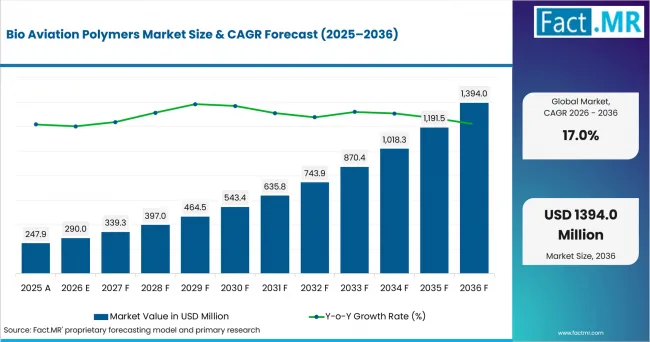
Bio Aviation Polymers Market Value Analysis | Source: Fact.MR
What are the defining numbers behind Bio Aviation Polymers Market growth?
An absolute opportunity of USD 1,104 million is expected between 2026 and 2036.
- Demand Drivers in the Market
- Aircraft-interiors teams need bio-epoxy panels that pass applicable flammability, heat-release and smoke-density requirements without extending cabin approval cycles.
- IATA reported that full-year global passenger demand, measured in revenue passenger kilometres, increased 5.3% in 2025 versus 2024.
- Engineering teams need lighter polymers for UAV airframes and advanced air mobility housings where range and payload remain strict limits.
- Aerospace converters need renewable thermoplastics that support repeatable melt processing and documented lot-to-lot quality.
- OEM qualification teams need traceable evidence because EASA rules require interior panels to meet heat-release and smoke-density specifications.
- Key Segments Analyzed
- By Polymer System: Bio-epoxy is expected to hold 41.0% share in 2026 because cabin panels need resin systems with FST evidence.
- By Application: Cabin interiors are projected to account for 28.0% share in 2026 owing to trim panels, partitions and monument parts.
- By Performance: FST-compliant grade is anticipated to capture 51.0% share in 2026 due to aircraft interior safety requirements.
- By Platform: Commercial aircraft are estimated to represent 46.0% share in 2026 as passenger fleets create recurring refurbishment volume.
- Analyst Opinion at Fact.MR
- Shambhu Nath Jha, Principal Consultant at Fact.MR, states, "Bio aviation polymers are not purchased only for renewable content. Aerospace customers first ask whether the material survives FST, fatigue and processing review. Suppliers are expected to win approvals when they combine bio-based chemistry with complete qualification files and stable supply."
- Strategic Implications
- Polymer producers should connect renewable feedstock claims with batch-level aerospace test records.
- Aircraft-interiors suppliers should prioritize bio-epoxy systems in panels, monuments and visible cabin trim.
- UAV manufacturers should test bio-thermoplastics where lower weight supports payload and range targets.
- Composite converters should document processing windows before promoting bio-materials into certified airframe applications.
Japan is projected to record 21.1% CAGR through 2036, supported by passenger recovery and domestic aerospace material work. South Korea is expected to post 20.1% CAGR as flight activity and defense-aerospace programs widen qualification demand. The UK is anticipated to advance at 17.9% CAGR due to cabin-interiors capability. The USA is forecast to hold 15.0% CAGR because aircraft utilization and manufacturing investment support trial volume. Germany is estimated to record 13.5% CAGR as strict qualification routines slow switching from legacy polymers.
How does the Bio Aviation Polymers Market break down by segment?
Bio-epoxy leads Polymer System at 41.0%; FST-compliant grade leads Performance at 51.0%.
Which Polymer System dominates?
Bio-epoxy holds 41.0% share in 2026.
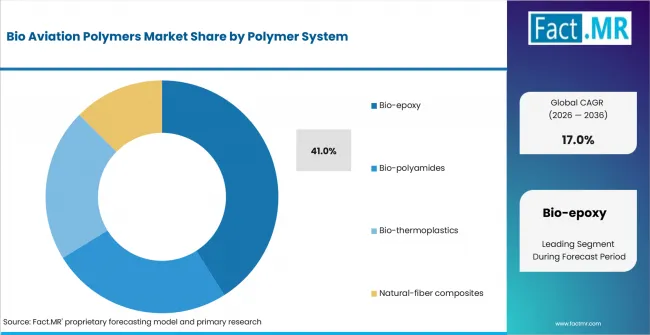
Bio Aviation Polymers Market Analysis By Polymer System | Source: Fact.MR
Bio-epoxy is expected to lead Polymer System because cabin panels need renewable resin chemistry with proven curing and FST data. Bio-polyamides are projected to gain use in clips, brackets and molded housings. Arkema states that Rilsan Polyamide 11 is used in 100% bio-based composites for transportation and aerospace.
What leads the Application segment?
Cabin interiors account for 28.0% share in 2026.
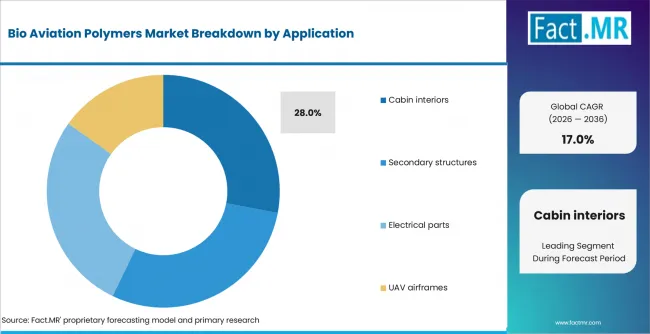
Bio Aviation Polymers Market Analysis By Application | Source: Fact.MR
Cabin interiors are projected to account for the largest application share because panels and monuments offer visible substitution routes with lower structural risk. Secondary structures follow when fatigue evidence is complete.
How does Performance shape demand?
FST-compliant grade leads with 51.0% share in 2026.
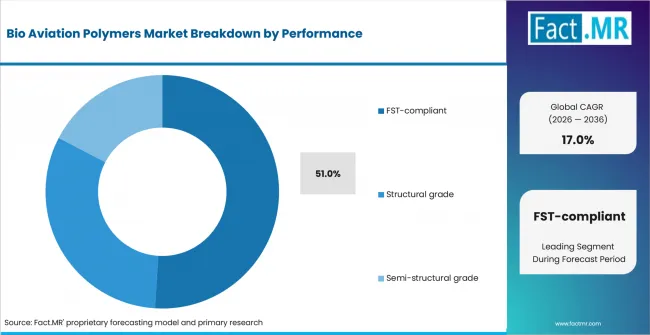
Bio Aviation Polymers Market Analysis By Performance | Source: Fact.MR
FST-compliant grade is anticipated to lead Performance because aircraft interiors cannot shift materials without applicable flammability, heat-release and smoke-density evidence. Structural grade faces deeper test plans. EASA CS-25 requires interior ceiling and wall panels and partitions on aeroplanes with passenger capacities of 20 or more to meet applicable heat-release and smoke-density specifications.
What supports Commercial aircraft within Platform?
Commercial aircraft represent 46.0% share in 2026.
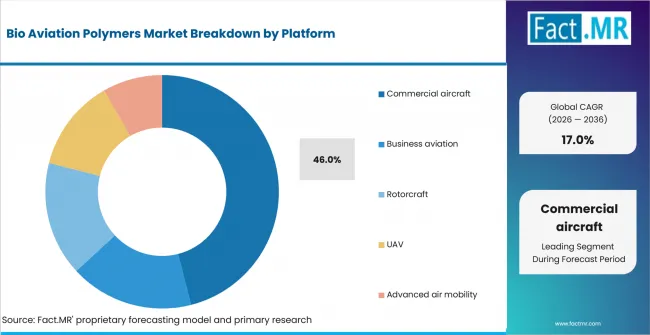
Bio Aviation Polymers Market Analysis By Platform | Source: Fact.MR
Commercial aircraft are forecast to hold the largest platform share because fleet size creates repeated material qualification opportunities. Business aviation is anticipated to use bio-polymers in premium interiors. UAV programs give suppliers a faster proving ground where many parts carry lower passenger-safety risk.
What is accelerating Bio Aviation Polymers Market adoption, and what is holding it back?
Cabin-material substitution drives it; certification and feedstock limits restrain it.
Drivers Impact Analysis
| DRIVER | (~) % IMPACT ON CAGR | GEOGRAPHIC RELEVANCE | IMPACT TIMELINE |
|---|---|---|---|
| Cabin-interior FST substitution | +2.1% | Global | Short term (<= 2 years) |
| Aircraft lightweighting and refurbishment | +1.7% | North America, East Asia, Europe | Medium term (2-4 years) |
| UAV and advanced air mobility trials | +1.2% | USA, Japan, South Korea | Medium term (2-4 years) |
| Bio-polyamide composite processing | +0.8% | Europe, Japan | Long term (>= 4 years) |
- Cabin-interior FST substitution: Cabin buyers are expected to approve bio-polymer systems only where test files address applicable flammability, heat-release and smoke-density requirements.
- Aircraft lightweighting and refurbishment: Airlines are using existing aircraft more intensively as passenger demand returns. IATA reported full-year 2025 RPK demand up 5.3% and load factor at 83.6%. Higher utilization is expected to keep cabin refresh work visible and create replacement routes for lighter bio-based interiors.
- UAV and advanced air mobility trials: UAV and AAM builders need lightweight housings and airframe parts qualified faster than passenger-cabin systems. Hexcel Corporation highlighted helicopter, UAV and Air Mobility applications at Aero India 2025. These programs are anticipated to act as proving grounds for polymer process data.
Opportunity Impact Analysis
| OPPORTUNITY | (~) % IMPACT ON CAGR | GEOGRAPHIC RELEVANCE | IMPACT TIMELINE |
|---|---|---|---|
| Bio-epoxy cabin panels | +1.3% | North America, Europe | Short term (<= 2 years) |
| Thermoplastic qualification routes | +1.0% | USA, Japan, Europe | Medium term (2-4 years) |
| Natural-fiber composite trials | +0.7% | Europe, Japan | Long term (>= 4 years) |
| AAM and UAV housings | +0.6% | USA, South Korea | Medium term (2-4 years) |
- Bio-epoxy cabin panels: Cabin interiors give bio-epoxy suppliers a practical route because many parts are visible and replaceable during refurbishment. The opportunity is projected to center on panels and monuments where resin suppliers provide FST evidence with stable surface quality.
- Natural-fiber composite trials: Natural-fiber composites are anticipated to remain selective because moisture control and repeatability remain central to aviation use. They fit non-critical interior components where renewable content is visible to brands. Suppliers need clear conditioning and aging evidence before wider specification.
- AAM and UAV housings: Smaller aircraft programs are expected to test bio-thermoplastics faster than large aircraft platforms. Evonik Industries AG describes ROHACELL foam-core sandwich structures for weight-sensitive eVTOL applications. This supports lightweight-composite design context, but it is not evidence of bio-based thermoplastic adoption.
Restraints Impact Analysis
| RESTRAINT | (~) % IMPACT ON CAGR | GEOGRAPHIC RELEVANCE | IMPACT TIMELINE |
|---|---|---|---|
| Certification evidence burden | -0.8% | Global | Short term (<= 2 years) |
| Bio-feedstock and resin cost | -0.6% | Europe, North America | Medium term (2-4 years) |
| Limited approved grade availability | -0.5% | East Asia, Europe | Medium term (2-4 years) |
| Conservative aircraft programs | -0.4% | Global | Long term (>= 4 years) |
- Certification evidence burden: Certification files are expected to slow substitution because each polymer family needs material allowables and part-level proof. Aerospace engineers must protect approved designs and avoid rework.
- Bio-feedstock and resin cost: Feedstock cost is anticipated to limit broad substitution when renewable monomers compete with established petroleum-based systems. Aircraft programs often buy small qualified lots, so suppliers cannot rely on mass-market scale quickly. Price evidence becomes more sensitive when parts do not reduce weight enough to offset premiums.
- Limited approved grade availability: Approved grade availability remains narrow for bio-based aviation polymers. Aerospace buyers prefer materials with known processing windows and long-term supplier support. New grades are expected to advance slowly when data packages do not cover fatigue, fire behavior and environmental aging.
- Conservative aircraft programs: Aircraft program teams are expected to move cautiously because polymer switching is expected to disturb tooling, repair manuals and supplier documentation. Adoption is therefore concentrated in interiors, UAV parts and limited secondary structures before broader airframe use.
Which countries are scaling the Bio Aviation Polymers Market through 2036?
- The country comparison spans 7.6 percentage points across the five profiled markets.
- Japan remains 1.0 percentage point above South Korea as passenger recovery supports higher material trial intensity.
- South Korea remains 2.2 percentage points above the UK because flight activity and defense exports support qualification work.
- The UK remains 2.9 percentage points above the USA as cabin-interiors depth supports faster application testing.
- The USA remains 1.5 percentage points above Germany due to aircraft utilization and manufacturing investment.
- Germany closes the displayed range as strict qualification and tax cost pressure slow polymer switching.
Comparable CAGRs create different entry conditions due to certification intensity, FST testing, bio-polymer sourcing and aircraft-platform mix. Full report coverage includes North America, Latin America, Western Europe, Eastern Europe, East Asia, South Asia & Pacific, Middle East & Africa.
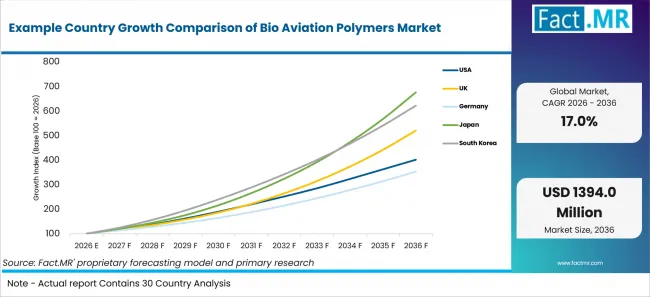
Example Country Growth Comparison Of Bio Aviation Polymers Market | Source: Fact.MR
| Country | CAGR (2026-2036) |
|---|---|
| Japan | 21.1% |
| South Korea | 20.1% |
| United Kingdom | 17.9% |
| USA | 15.0% |
| Germany | 13.5% |
What is powering Japan adoption?
21.1% CAGR through 2036, supported by passenger recovery and bio-material qualification.
Japan’s growth is supported by improving aviation activity and a strong materials-development ecosystem. MLIT reported on June 30, 2026 that FY2025 domestic scheduled air passenger traffic reached 112.50 million, up 3.4%, while JNTO reported on January 21, 2026 that visitor arrivals to Japan reached 42.684 million in 2025, up 15.8% year over year. Aerospace teams are expected to evaluate bio-epoxy and lighter bio-polymer systems for cabin, UAV and advanced air mobility applications where FST performance and weight reduction are important.
How is South Korea scaling demand?
20.1% CAGR through 2036, driven by air-traffic growth and defense-aerospace activity.
South Korea’s growth reflects rising aviation activity and a broader aerospace and defense manufacturing base. MOLIT reported on February 24, 2026 that 2025 air traffic exceeded 1.01 million flights, up 6.8%, while Korea.kr reported on June 16, 2026 that K-defense exports reached USD 15.4 billion in 2025, up 60.4% from 2024. Local experience in battery materials and advanced manufacturing is expected to support bio-polymer trials for UAV housings, electrical parts and molded components.
What supports the United Kingdom outlook?
17.9% CAGR through 2036, backed by aircraft-interiors capability and green-aerospace funding.
The United Kingdom’s growth is supported by a large commercial aviation market and continued investment in lower-emission aerospace technologies. The UK Civil Aviation Authority reported on March 20, 2026 that UK airports handled 302 million passengers in 2025, up 2.0% year over year, while the UK government announced in June 2025 more than GBP 250 million in joint investment for green aerospace technology projects. Interiors suppliers and advanced air mobility developers are expected to test bio-epoxy and bio-thermoplastic materials first in lower-risk cabin and small-volume applications.
What supports USA adoption?
15.0% CAGR through 2036, supported by aircraft utilization and aerospace manufacturing investment.
The USA’s growth is supported by high commercial aircraft utilization and substantial manufacturing investment. BTS reported on October 10, 2025 that U.S. airlines carried 92.2 million systemwide scheduled-service passengers in July 2025, while BEA reported in June 2026 that U.S. manufacturing attracted USD 121.8 billion in new foreign direct investment during 2025. AAM developers and commercial-interiors suppliers are expected to evaluate bio-polymers where lower weight and lower structural risk can support earlier qualification.
How is Germany developing demand?
13.5% CAGR through 2036, shaped by aerospace scale and strict qualification routines.
Germany’s growth is supported by its established aerospace manufacturing base and advanced materials expertise. BDLI reported in May 2026 that Germany’s aerospace industry generated EUR 62 billion in revenue in 2025 and employed 130,000 people. German component manufacturers are expected to favor bio-polymers that can demonstrate consistent processing, repair performance and compatibility with established thermoplastic manufacturing methods.
Who leads the Bio Aviation Polymers Market?
Syensqo and Arkema lead direct bio-polymer coverage, while Toray Advanced Composites and Hexcel Corporation strengthen aerospace composite qualification.
Syensqo is included for specialty polymers used in aerospace and high-performance transport applications. Arkema offers 100% bio-based Rilsan® PA11 and thermoplastic composite solutions incorporating bio-based polyamides. In May 2026, Toray Advanced Composites expanded the NCAMP qualifications of its Toray Cetex® TC1225 LMPAEK™ thermoplastic composite material system to include TC1225/TORAYCA™ T700 unidirectional tape prepreg.
Evonik Industries AG adds aerospace polymer and foam capability through ROHACELL sandwich-core applications. Hexcel Corporation brings carbon-fiber and prepreg depth across commercial aerospace, UAV and air mobility programs. Teijin Limited completes the company set through aviation composite material participation. Competition is expected to center on qualification records, renewable-content proof and processing support.
Which companies are the key providers?
Key companies include Syensqo; Arkema; Toray Advanced Composites; Evonik Industries AG; Hexcel Corporation; and Teijin Limited.
- Syensqo
- Arkema
- Toray Advanced Composites
- Evonik Industries AG
- Hexcel Corporation
- Teijin Limited
Bibliography
- Arkema. (2025, February 25). Arkema at JEC WORLD 2025.
- Bureau of Transportation Statistics. (2025, October 10). July 2025 U.S. airline traffic data up 0.4% from the same month last year.
- Department for Business and Trade. (2025, June 17). £250m for green aerospace projects ahead of Industrial Strategy.
- European Union Aviation Safety Agency. (2026, April 30). Easy Access Rules for Additional Airworthiness Specifications: Revision from October 2025.
- Federal Statistical Office (Destatis). (2026a, April 1). 2.1 billion euros of aviation tax declared in 2025 for roughly 84.0 million air passengers.
- Federal Statistical Office (Destatis). (2026b, August 6). New orders in manufacturing in June 2026: +3.1% on the previous month.
- Hexcel Corporation. (2025, January 24). Hexcel highlights latest innovations for aerospace applications at Aero India 2025.
- International Air Transport Association. (2026, January 29). Strong 2025 passenger demand masks ongoing capacity constraints.
- Office for National Statistics. (2026, June 12). 30.3: Manufacture of Air and Spacecraft and Related Machinery: CVM: momy gr.
- Toray Advanced Composites. (2026, May 27). Toray Advanced Composites expands NCAMP qualifications of high-performance low melt PAEK composite material system.
- UK Civil Aviation Authority. (2026, February 24). UK aviation officially breaks records with over 300m passenger journeys in 2025.
This Report Answers
- The report explains bio aviation polymer use across polymer system, application, performance, platform and region.
- Segment analysis identifies bio-epoxy, cabin interiors, FST-compliant grades and commercial aircraft.
- Country analysis examines Japan, South Korea, the UK, the USA and Germany.
- Competitive analysis reviews Syensqo, Arkema, Toray Advanced Composites, Evonik Industries AG, Hexcel Corporation and Teijin Limited.
- Application analysis assesses how FST rules and qualification time affect buyer decisions.
What does the Bio Aviation Polymers Market cover?
Bio-epoxy, bio-polyamides, bio-thermoplastics and natural-fiber composites used in aviation applications.
The Bio Aviation Polymers Market covers renewable-content polymer systems used in aircraft interiors, secondary structures, electrical parts and UAV airframes. Its boundary is adjacent to aerospace composites where composite reinforcement and aerospace qualification define broader material choices.
The analysis includes resin and thermoplastic systems where aviation use depends on FST performance and qualified processing. High-load primary structures remain outside the core unless bio-polymer content is part of a certified advanced polymer composites package.
Prepreg and tape routes are considered only when renewable resin or polymer content is visible in the aviation material system. This keeps the market distinct from conventional carbon prepreg supply.
What is included in the scope?
Bio aviation polymer systems used in certified and pre-certified aircraft applications.
The scope includes bio-epoxy, bio-polyamides, bio-thermoplastics and natural-fiber composites used in aircraft interiors and UAVs. Cabin demand includes parts comparable with aerospace floor panels where fire behavior drives material selection.
Renewable resin coverage includes material routes linked with bio-based plastics when the polymer is formulated for aviation qualification.
Broader renewable polymer references are used only where they relate to aviation-grade bioplastics and documented aerospace applications.
Polyamide routes include castor-based and mass-balance routes such as mass-balanced polyamides when they are tied to aircraft components.
Coating-only products are excluded unless sold as part of a polymer part system, since bio-based aircraft coatings follow a separate specification path.
Natural-fiber routes are included when they are engineered for aviation parts and benchmarked against biocomposite applications with moisture and aging evidence.
What is excluded from the scope?
Conventional aerospace plastics and coating-only products are outside the scope.
The scope excludes petroleum-only aircraft polymers, general commodity plastics, metal aircraft parts and adhesives sold without a bio-based aviation polymer function. Commodity materials are excluded even when they overlap with high-performance polymers in temperature or chemical-resistance requirements.
The scope also excludes sustainable aviation fuel, airport equipment and carbon-fiber reinforcement sold without a renewable resin or polymer system. General composites are counted only when the polymer matrix or functional aviation part carries bio-based content.
How Was the Analysis Built?
The analysis draws on 120+ sources and 35+ company portfolios.
- Primary Research: Primary research includes discussions with interiors suppliers, polymer producers, composite converters, aviation procurement teams and UAV developers. These conversations examine qualification priorities and supplier selection.
- Desk Research: Desk research covers government statistics, aviation regulators, company announcements, standards and trade association data. Every source used appears in the bibliography.
- Market Sizing and Forecasting: Market estimates combine passenger activity, aircraft-platform mix, polymer pricing, segment shares, supplier participation and adoption barriers.
- Data Validation and Update Cycle: Findings are validated by comparing interviews with official data, regulatory requirements and portfolio mapping. Updates review launches, approvals and material adoption.
What is the report’s scope and coverage?
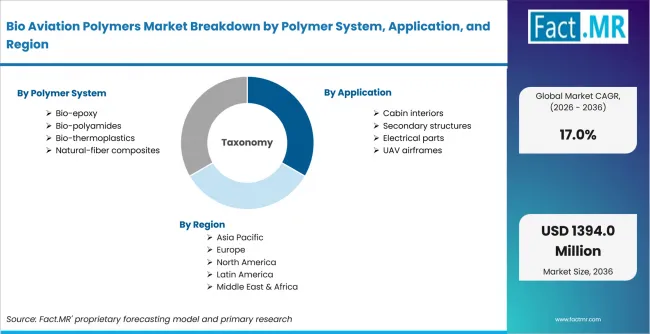
Bio Aviation Polymers Market Breakdown By Polymer System, Application, And Region | Source: Fact.MR
| Attribute | Details |
|---|---|
| Quantitative Units | USD million |
| Market Definition | Bio-based and partly renewable polymer systems used in aviation applications, including bio-epoxy, bio-polyamides, bio-thermoplastics and natural-fiber composites. |
| Polymer System | Bio-epoxy; Bio-polyamides; Bio-thermoplastics; Natural-fiber composites |
| Application | Cabin interiors; Secondary structures; Electrical parts; UAV airframes |
| Performance | FST-compliant; Structural grade; Semi-structural grade |
| Platform | Commercial aircraft; Business aviation; Rotorcraft; UAV; Advanced air mobility |
| Regions Covered | North America; Latin America; Western Europe; Eastern Europe; East Asia; South Asia & Pacific; Middle East & Africa |
| Countries Covered | USA; United Kingdom; Germany; Japan; South Korea |
| Key Companies Profiled | Syensqo; Arkema; Toray Advanced Composites; Evonik Industries AG; Hexcel Corporation; Teijin Limited |
| Forecast Period | 2026 to 2036 |
| Approach | Hybrid top-down and bottom-up approach using aviation material qualification, aircraft platform mix, segment shares, country adoption and provider portfolio review. |
How is the market segmented?
-
By Polymer System
- Bio-epoxy
- Bio-polyamides
- Bio-thermoplastics
- Natural-fiber composites
-
By Application
- Cabin interiors
- Secondary structures
- Electrical parts
- UAV airframes
-
By Performance
- FST-compliant
- Structural grade
- Semi-structural grade
-
By Platform
- Commercial aircraft
- Business aviation
- Rotorcraft
- UAV
- Advanced air mobility
- Advanced air mobility
-
Region
- North America
- Latin America
- Western Europe
- Eastern Europe
- East Asia
- South Asia & Pacific
- Middle East & Africa