- Market Value (2025): USD 1.9 Bn
- Estimated Value (2026): USD 2.1 Bn
- Forecast Value (2036): USD 4.9 Bn
- CAGR (2026-2036): 8.8%
What is the Bio Degradable Polymer Coated NPK Market forecast to be worth by 2036?
USD 4.9 billion by 2036 at 8.8% CAGR.
- The Bio Degradable Polymer Coated NPK Market reached USD 1.9 billion in 2025.
- Demand is projected to increase from USD 2.1 billion in 2026 to USD 4.9 billion by 2036.
- The market is forecast to record an 8.8% CAGR from 2026 to 2036.
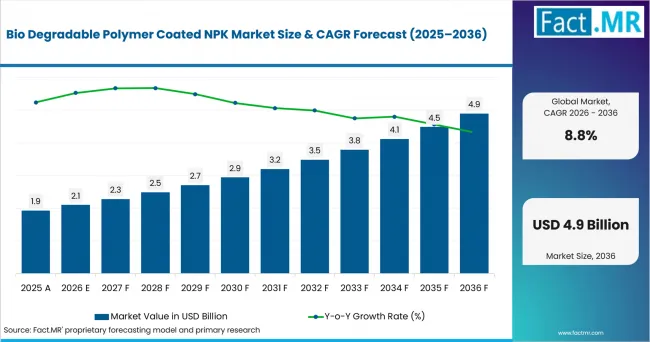
Bio Degradable Polymer Coated Npk Market Value Analysis | Source: Fact.MR
What are the defining numbers behind Bio Degradable Polymer Coated NPK Market growth?
An absolute opportunity of USD 2.8 billion is expected between 2026 and 2036.
- Demand Drivers in the Market
- Fertilizer buyers are placing more attention on nutrient-use efficiency because conventional nutrient availability can move out of step with crop uptake. Better synchronization reduces the amount of fertilizer exposed to leaching, runoff or other losses before plants can use it.
- Controlled-release NPK can reduce the need for repeated fertilizer applications where labour availability, irrigation schedules or rainfall make split applications difficult. A coated granule gives growers one route to meter nitrogen, phosphorus and potassium over a defined crop period.
- Regulation is increasing the importance of coating chemistry. Commission Delegated Regulation (EU) 2024/2770 establishes biodegradability criteria for coating agents used in EU fertilising products, making coating performance and end-of-life behaviour part of product qualification.
- Large field-crop programmes create a commercial case when fewer application passes offset part of the coated-fertilizer premium. Suppliers therefore need local evidence that release duration fits crop calendars and soil-temperature or moisture conditions.
- Public nutrient-management programmes are encouraging more balanced fertilizer use. FAO has called for improved nitrogen-use efficiency, while India and China continue to promote more efficient fertilizer practices, supporting demand for products that can show measurable nutrient-management benefits.
- Key Segments Analyzed
- Polymer Coated NPK Fertilizers account for 46.0% of Product Category in 2026 because they combine balanced NPK nutrition with controlled nutrient release in a commercially familiar granular format.
- Field Crops hold 43.0% of Application in 2026 as broad-acre production can benefit from fewer application passes and nutrient release aligned with longer crop cycles.
- Farmers represent 61.0% of End User in 2026 because they make the final trade-off between fertilizer premium, application labour and expected agronomic return.
- Cereals & Grains account for 45.0% of Crop Type in 2026 due to the scale of wheat and maize cultivation and the need to manage nutrient availability across large planted areas.
- Biodegradable Polymer Encapsulation holds 43.0% of Coating Technology in 2026 because it controls nutrient release while addressing emerging requirements for polymer biodegradability.
- Analyst Opinion at Fact.MR
- Shambhu Nath Jha, Principal Consultant at Fact.MR, states, “Adoption of biodegradable polymer-coated NPK will depend on whether suppliers can prove that controlled release creates a farm-level economic benefit under local soil and climate conditions. Buyers will compare the product premium with fewer field passes, nutrient-use efficiency and crop response, while coating compliance becomes more important in regulated markets.”
- Strategic Implications
- Suppliers should develop crop-specific release profiles because coating performance changes with temperature, moisture and crop duration.
- Field trials should quantify the effect of fewer fertilizer passes and improved nutrient timing so growers can compare the premium with conventional NPK programmes.
- Manufacturers serving Europe need documented biodegradability evidence alongside nutrient and release specifications as polymer criteria become part of fertilizer qualification.
- Distributors should align inventory with local crop calendars and provide agronomy support because controlled-release products require clearer application guidance than standard compound fertilizer.
How does the Bio Degradable Polymer Coated NPK Market break down by segment?
The market is segmented by Product Category, Application, End User, Crop Type and Coating Technology.
Why do Polymer Coated NPK Fertilizers lead Product Category?
Polymer Coated NPK Fertilizers are projected to account for a 46.0% share in 2026.
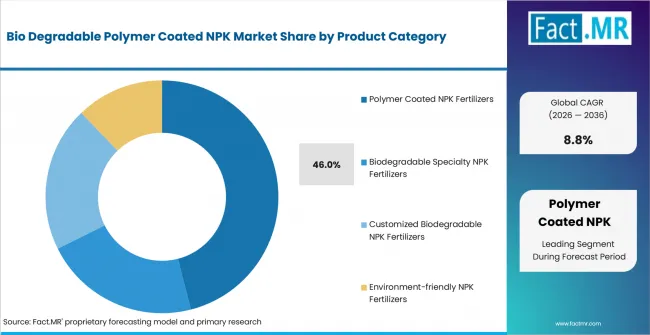
Bio Degradable Polymer Coated Npk Market Analysis By Product Category | Source: Fact.MR
Polymer-coated NPK leads because the product combines three primary nutrients in one controlled-release granule. Farmers can use one formulation instead of coordinating separate nutrient sources, while the coating regulates how quickly nutrients become available after application.
The format also fits established granular-fertilizer distribution. ICL introduced eqo.x biodegradable release technology in 2022 for controlled-release fertilizer, illustrating how coating platforms are being adapted to commercial crop-nutrition programmes while suppliers prepare for stricter polymer requirements.
Why do Field Crops lead Application?
Field Crops are projected to account for a 43.0% share in 2026.
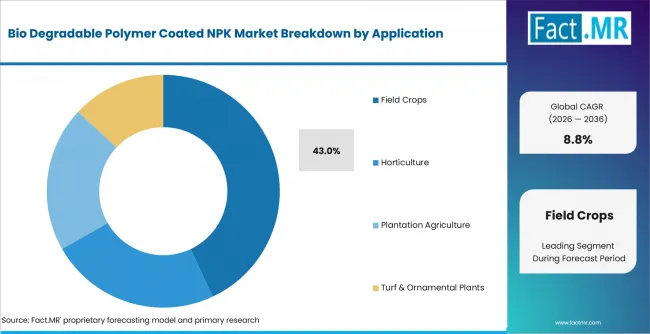
Bio Degradable Polymer Coated Npk Market Analysis By Application | Source: Fact.MR
Field Crops lead because broad-acre cultivation makes labour and machinery passes an important part of fertilizer economics. Rice and corn systems can also face nutrient losses when rainfall or irrigation releases nutrients before crop demand peaks.
A defined release period can reduce the need for later applications across large areas. Adoption is therefore tied to whether the coated product survives handling and releases nutrients within the crop window rather than simply offering a sustainability claim.
Why do Farmers lead End User?
Farmers are projected to account for a 61.0% share in 2026.
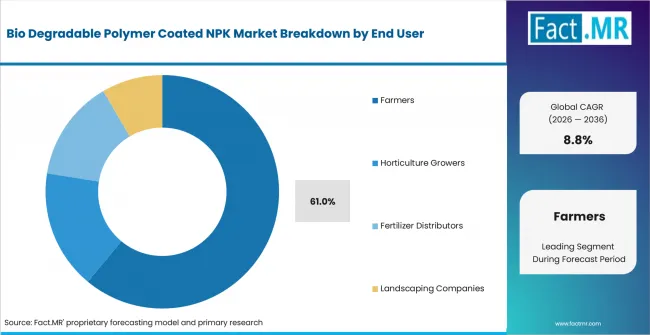
Bio Degradable Polymer Coated Npk Market Analysis By End User | Source: Fact.MR
Farmers lead because they decide whether the agronomic and operating benefits justify the higher purchase price of coated fertilizer. The comparison includes crop value, field size, application cost and the reliability of nutrient release under local conditions.
Farm-level proof is central to conversion. Products that reduce fertilizer passes or improve nutrient timing have a clearer purchase case where labour is constrained or repeated applications are difficult to schedule.
Why do Cereals & Grains lead Crop Type?
Cereals & Grains are projected to account for a 45.0% share in 2026.
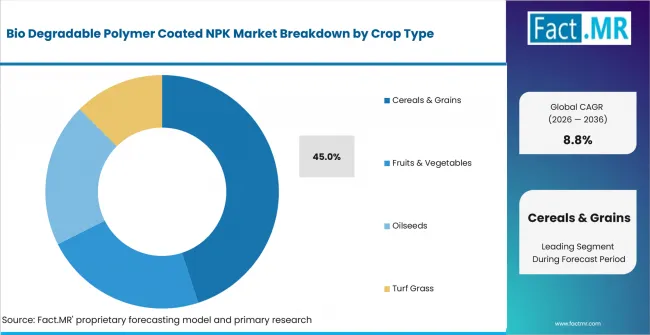
Bio Degradable Polymer Coated Npk Market Analysis By Crop Type | Source: Fact.MR
Cereals & Grains lead because wheat and maize are cultivated across extensive areas and require substantial nutrient inputs. Small improvements in nutrient timing can affect fertilizer use across many hectares, creating a scalable application for controlled-release NPK.
China reported fertilizer-use efficiency of 43.3% for wheat, maize and rice in 2025. The policy focus on scientific fertilization and efficiency strengthens the case for products that can demonstrate controlled nutrient delivery under grain-crop conditions.
Why does Biodegradable Polymer Encapsulation lead Coating Technology?
Biodegradable Polymer Encapsulation is projected to account for a 43.0% share in 2026.
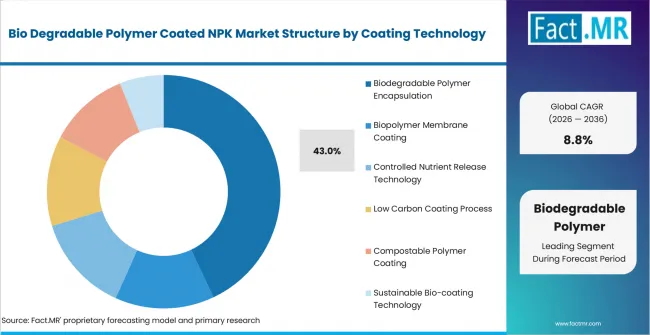
Bio Degradable Polymer Coated Npk Market Analysis By Coating Technology | Source: Fact.MR
Biodegradable polymer encapsulation leads because the coating is the physical layer that controls nutrient release while giving suppliers a route to address concerns about persistent polymer residues. The commercial requirement is predictable release during the crop cycle followed by degradation after the coating has completed its function.
Commission Delegated Regulation (EU) 2024/2770 sets biodegradability criteria for coating agents used in EU fertilising products. This makes verified coating behaviour relevant to product qualification and supports investment in encapsulation systems designed around controlled release and post-use degradation.
What is accelerating Bio Degradable Polymer Coated NPK Market adoption, and what is holding it back?
Drivers Impact Analysis
| Factor | (~) % Impact on CAGR | Geographic Relevance | Impact Timeline |
|---|---|---|---|
| Pressure to align NPK release with crop uptake while reducing nutrient losses | +1.5% | Global | 2026-2036 |
| Farm and regulatory focus on improving nutrient-use efficiency | +1.3% | Global | 2026-2036 |
| Conventional fertilizer losses when nutrient availability does not match crop demand | +1.0% | Global | 2026-2036 |
| Policy support for balanced nutrient management and more efficient fertilizer use | +0.8% | Global | 2026-2036 |
Source: Fact.MR analysis. Updated Aug 11, 2026
Opportunity Impact Analysis
| Factor | (~) % Impact on CAGR | Geographic Relevance | Impact Timeline |
|---|---|---|---|
| Crop-specific release formulations supported by local field trials | +0.9% | China; India; Brazil | Medium term (2-4 years) |
| Biodegradable coating compliance for regulated fertilizer markets | +0.7% | Germany; France; Europe | Medium term (2-4 years) |
| Distributor agronomy support for controlled-release fertilizer adoption | +0.6% | Global | Medium term (2-4 years) |
| Controlled-release use in horticulture and plantation crop programmes | +0.5% | Brazil; Indonesia; France | Long term (>= 4 years) |
Source: Fact.MR analysis. Updated Aug 11, 2026
Restraints Impact Analysis
| Factor | (~) % Impact on CAGR | Geographic Relevance | Impact Timeline |
|---|---|---|---|
| Higher farm-gate price and the need to validate release behaviour under local conditions | -1.1% | Global | 2026-2032 |
| Product qualification requires field evidence across soil, moisture and temperature conditions | -0.8% | Global | 2026-2032 |
| Coated NPK can cost more than conventional compound fertilizer | -0.6% | Global | 2026-2032 |
Source: Fact.MR analysis. Updated Aug 11, 2026
Which countries are scaling the Bio Degradable Polymer Coated NPK Market through 2036?
- Brazil is expected to record a 9.1% CAGR through 2036. Dependence on imported fertilizer makes nutrient productivity commercially important, particularly across field-crop operations where fertilizer volumes and inland logistics costs can be substantial.
- In the USA, the market is forecast to rise at an 8.7% CAGR. Purchase decisions are closely tied to field performance and fewer application passes, while investment in domestic fertilizer capacity is broadening the supply environment available to growers.
- Germany is projected to grow at an 8.3% CAGR. Fertilizer-use rules and requirements around polymer coatings increase the importance of documented nutrient-release performance and compliance evidence before products gain wider acceptance.
- France is forecast to post a 7.9% CAGR. Greater emphasis on efficient nitrogen use and more precise fertilizer application supports controlled-release NPK, although adoption remains tied to measurable farm-level returns.
- Indonesia is expected to expand at a 7.5% CAGR. Updated NPK quality standards create a clearer product-performance benchmark, while subsidized fertilizer programmes continue to shape buyer expectations on price, availability and formulation consistency.
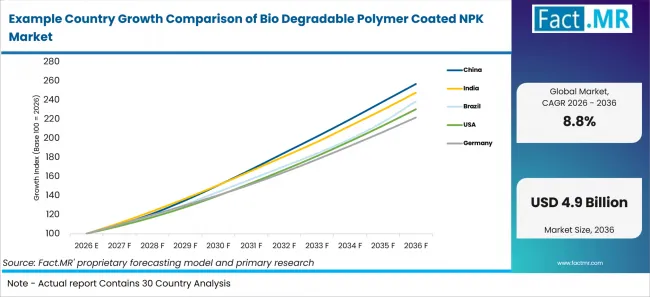
Example Country Growth Comparison Of Bio Degradable Polymer Coated Npk Market | Source: Fact.MR
| Country | CAGR (2026-2036) |
|---|---|
| Brazil | 9.1% |
| USA | 8.7% |
| Germany | 8.3% |
| France | 7.9% |
| Indonesia | 7.5% |
Source: Fact.MR analysis. Updated Aug 11, 2026
What is driving Brazil’s growth through 2036?
Brazil is forecast to expand at a 9.1% CAGR from 2026 to 2036.
Brazil imports a large share of the fertilizer used by its agricultural sector. The National Fertilizer Plan was introduced to reduce dependence on imported inputs and strengthen domestic fertilizer capability.
Large soybean, maize and sugarcane programmes also create demand for products that can support long crop cycles across extensive acreage. Controlled-release NPK can gain relevance where improved nutrient timing offsets part of the premium and reduces the need for additional field operations.
What is driving the USA’s growth through 2036?
The USA is forecast to expand at an 8.7% CAGR from 2026 to 2036.
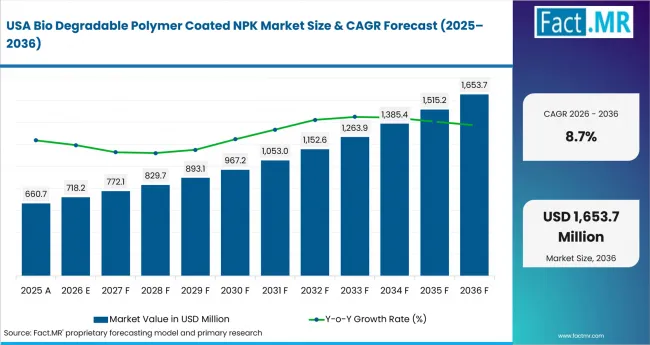
Bio Degradable Polymer Coated Npk Market Country Value Analysis | Source: Fact.MR
U.S. growers assess controlled-release fertilizer against agronomic response and operating cost. The purchase case strengthens where a product can reduce fertilizer passes or limit nutrient exposure to losses without weakening crop performance.
USDA has used fertilizer-production investment programmes to expand domestic capacity and competition. A broader supply environment can support greater availability of differentiated fertilizer products, while coated NPK still needs local agronomic evidence to justify its premium.
What is driving Germany’s growth through 2036?
Germany is forecast to expand at an 8.3% CAGR from 2026 to 2036.
Germany combines national fertilizer controls with EU requirements governing fertilising products. Official guidance states that fertilizer type, quantity and timing should align with plant and soil requirements, placing nutrient management directly into farm practice.
Polymer-coated products sold under the EU framework also face biodegradability requirements. Suppliers therefore need to document nutrient analysis and release performance together with coating compliance before premium products can move through regulated agricultural channels.
What is driving France’s growth through 2036?
France is forecast to expand at a 7.9% CAGR from 2026 to 2036.
France is placing continued attention on agricultural input efficiency within its climate and farm-transition policies. Fertilizer decisions increasingly sit alongside wider efforts to reduce agricultural emissions and improve resource use.
Controlled-release NPK can fit this direction where it reduces unnecessary applications and matches nutrient delivery with crop requirements. Adoption will still depend on whether the coated product creates a clear economic return compared with conventional fertilizer practice.
What is driving Indonesia’s growth through 2036?
Indonesia is forecast to expand at a 7.5% CAGR from 2026 to 2036.
Indonesia updated its solid NPK standard through SNI 2803:2024, creating a current quality reference for solid NPK fertilizer. Product qualification therefore matters alongside agronomic performance.
Suppliers of biodegradable polymer-coated NPK need consistent nutrient analysis and coating quality while working through a market where subsidized fertilizer programmes influence farmer expectations on price and availability.
Who leads the Bio Degradable Polymer Coated NPK Market?
ICL Group Ltd. is the leading company in the market. Its position is supported by controlled-release fertilizer experience and by the eqo.x biodegradable release technology, which gives the company a direct platform for products designed around nutrient-release control and coating degradation.
Yara International ASA and Nutrien Ltd. compete through broad crop-nutrition portfolios and established agricultural channels. Their route into biodegradable coated NPK depends on formulation capability, field support and the ability to justify a premium against conventional compound fertilizer.
Haifa Group, COMPO EXPERT GmbH and Kingenta Ecological Engineering Group Co., Ltd. compete through specialty nutrition and controlled-release expertise. EuroChem Group AG, Coromandel International Limited, Sumitomo Chemical Co., Ltd., The Mosaic Company and Borealis AG add fertilizer, specialty-chemistry or regional manufacturing capability.
Supplier selection depends on coating performance, release-duration options, nutrient formulation, local agronomy support and product availability. Buyers also assess whether biodegradability evidence and application guidance are sufficient for the target crop and regulatory market.
Which companies are the key providers?
Key companies include ICL Group Ltd.; Yara International ASA; Nutrien Ltd.; Haifa Group; COMPO EXPERT GmbH; EuroChem Group AG; Coromandel International Limited; Kingenta Ecological Engineering Group Co., Ltd.; Sumitomo Chemical Co., Ltd.; The Mosaic Company; and Borealis AG.
- ICL Group Ltd.
- Yara International ASA
- Nutrien Ltd.
- Haifa Group
- COMPO EXPERT GmbH
- EuroChem Group AG
- Coromandel International Limited
- Kingenta Ecological Engineering Group Co., Ltd.
- Sumitomo Chemical Co., Ltd.
- The Mosaic Company
- Borealis AG
Bibliography
- European Commission. (2024). Commission Delegated Regulation (EU) 2024/2770 on biodegradability criteria for coating agents and water retention polymers. European Union.
- Food and Agriculture Organization of the United Nations. (2025). Sustainable Nitrogen Management in Agrifood Systems. FAO.
- ICL Group Ltd. (2022). ICL Launches Biodegradable Coated Fertilizer Technology. ICL Group Ltd.
- Ministry of Agriculture and Rural Affairs of the People’s Republic of China. (2026). Fertilizer-use efficiency of major grain crops during the 14th Five-Year Plan. Government of China.
- Press Information Bureau, Government of India. (2024). Financial Assistance to Organic Farmers and PM-PRANAM. Government of India.
- Government of Brazil. (2022). Brazilian Government Launches National Fertilizer Plan to Reduce Input Imports. Government of Brazil.
- United States Department of Agriculture. (2024). New Investments through Fertilizer Production Expansion Program. U.S. Department of Agriculture.
- Federal Ministry of Food and Agriculture, Germany. (2024). Fertilisation. Government of Germany.
- Ministry for Ecological Transition, France. (2026). National Low-Carbon Strategy: Agriculture. Government of France.
- Badan Standardisasi Nasional. (2024). SNI 2803:2024 Pupuk NPK Padat. Government of Indonesia.
This Report Answers
- The report examines demand for Bio Degradable Polymer Coated NPK across Product Category, Application, End User, Crop Type and Coating Technology.
- Segment analysis assesses the leading product, application, buyer, crop and coating categories that shape purchasing and positioning.
- Country analysis evaluates market development across China, India, Brazil, the USA, Germany, France and Indonesia.
- Competitive analysis examines fertilizer producers and specialty nutrition suppliers with controlled-release or biodegradable coating capabilities.
- The analysis considers nutrient-use efficiency, coating biodegradability, crop-specific release performance and farm-level economics that influence adoption.
What does the Bio Degradable Polymer Coated NPK Market cover?
The Bio Degradable Polymer Coated NPK Market covers NPK fertilizer products that use biodegradable, bio-based or related polymer coating systems to control nutrient release over a defined period. The assessment examines Product Category, Application, End User, Crop Type and Coating Technology across the stated regions and countries.
What is included in the scope?
The scope includes Polymer Coated NPK Fertilizers, Biodegradable Specialty NPK Fertilizers, Customized Biodegradable NPK Fertilizers and Environment-friendly NPK Fertilizers. Applications include Field Crops, Horticulture, Plantation Agriculture and Turf & Ornamental Plants together with the listed subsegments.
End User coverage includes Farmers, Horticulture Growers, Fertilizer Distributors and Landscaping Companies with their stated buyer groups. Crop Type covers Cereals & Grains, Fruits & Vegetables, Oilseeds and Turf Grass with the listed crops. Coating Technology includes biodegradable encapsulation, biopolymer membranes, controlled nutrient-release technologies and the other stated coating approaches.
What is excluded from the scope?
The scope excludes conventional uncoated NPK fertilizer sold without a controlled-release coating. Single-nutrient fertilizers are excluded unless they form part of a coated NPK formulation covered by the market definition.
Fertilizer application equipment, standalone soil amendments and crop-protection products also fall outside the market. Adjacent controlled-release fertilizer products are included only when they meet the NPK and coating definition used in this assessment.
How Was the Analysis Built?
- Primary Research: Discussions with fertilizer manufacturers, coating-technology suppliers, agronomists, distributors, commercial farms and agricultural input buyers examine product qualification, crop fit, field economics and purchasing requirements.
- Desk Research: The review covers fertilizer regulations, nutrient-efficiency programmes, agricultural standards, crop and fertilizer policy, company disclosures and technical literature on controlled-release coatings. Sources used in the analysis are recorded in the bibliography.
- Market Sizing and Forecasting: Estimates combine NPK fertilizer demand with controlled-release penetration, crop-area requirements, application intensity, coating-technology adoption, segment mix and country-level growth. The model also considers farm economics and polymer-compliance requirements.
- Validation and Update Cycle: Findings are cross-checked against public evidence and company activity. Updates account for coating regulations, product launches, fertilizer-policy changes, manufacturing capacity and new field evidence.
Segmentation
What is the report's scope and coverage?
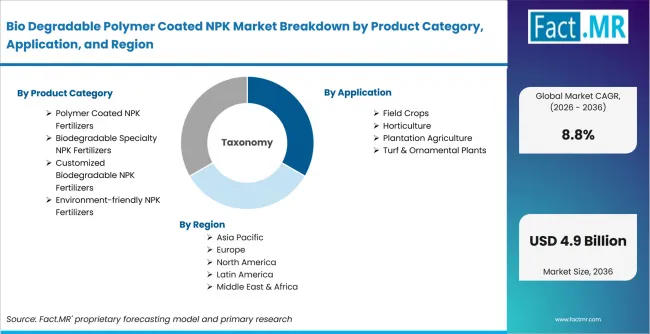
Bio Degradable Polymer Coated Npk Market Breakdown By Product Category, Application, And Region | Source: Fact.MR
| Attribute | Details |
|---|---|
| Quantitative Units | USD 2.1 billion in 2026 to USD 4.9 billion by 2036 at 8.8% CAGR |
| Market Definition | Bio Degradable Polymer Coated NPK fertilizer products using biodegradable or related controlled-release coating systems across the stated segments and applications |
| Segments Covered | Product Category; Application; End User; Crop Type; Coating Technology |
| Regions Covered | North America; Latin America; Europe; East Asia; South Asia and Pacific; Middle East and Africa |
| Countries Covered | China; India; Brazil; USA; Germany; France; Indonesia |
| Key Companies Profiled | ICL Group Ltd.; Yara International ASA; Nutrien Ltd.; Haifa Group; COMPO EXPERT GmbH; and others |
| Forecast Period | 2026 to 2036 |
| Approach | Hybrid top-down and bottom-up approach using controlled-release fertilizer demand, crop requirements, coating adoption, application intensity, segment mix, country growth and provider portfolios |
Source: Fact.MR analysis. Updated Aug 11, 2026
How is the market segmented?
-
By Product Category:
- Polymer Coated NPK Fertilizers
- Controlled Release NPK Fertilizers
- Slow Release NPK Fertilizers
- Biodegradable Specialty NPK Fertilizers
- High Efficiency NPK Fertilizers
- Micronutrient Enriched NPK Fertilizers
- Customized Biodegradable NPK Fertilizers
- Crop-specific NPK Formulations
- Region-specific NPK Formulations
- Environment-friendly NPK Fertilizers
- Organic Compatible NPK Fertilizers
- Low Emission NPK Fertilizers
- Polymer Coated NPK Fertilizers
-
By Application:
- Field Crops
- Rice Cultivation
- Corn Cultivation
- Horticulture
- Greenhouse Cultivation
- Protected Agriculture
- Plantation Agriculture
- Palm Plantations
- Sugarcane Cultivation
- Turf & Ornamental Plants
- Golf Course Management
- Nursery Cultivation
- Field Crops
-
By End User:
- Farmers
- Commercial Farms
- Agricultural Cooperatives
- Horticulture Growers
- Plantation Owners
- Government Agriculture Programs
- Fertilizer Distributors
- Agricultural Input Retailers
- Agricultural Enterprises
- Landscaping Companies
- Municipal Authorities
- Nursery Operators
- Farmers
-
By Crop Type:
- Cereals & Grains
- Wheat
- Maize
- Fruits & Vegetables
- Fruits
- Vegetables
- Oilseeds
- Soybean
- Cotton
- Turf Grass
- Ornamental Plants
- Floriculture Crops
- Cereals & Grains
-
By Coating Technology:
- Biodegradable Polymer Encapsulation
- Starch-based Polymer Coating
- Polylactic Acid Coating Technology
- Biopolymer Membrane Coating
- Multi-layer Controlled Release Coating
- Bio-based Resin Coating
- Controlled Nutrient Release Technology
- Moisture Responsive Polymer Coating
- Microbial Degradable Coating Technology
- Low Carbon Coating Process
- Compostable Polymer Coating
- Sustainable Bio-coating Technology
- Biodegradable Polymer Encapsulation
-
By Region:
- North America
- Latin America
- Western Europe
- Eastern Europe
- East Asia
- South Asia and Pacific
- Middle East & Africa
Frequently Asked Questions
Which Product Category leads the market?
Which Application leads the market?
Which End User leads the market?
Which Crop Type leads the market?
Which Coating Technology leads the market?
What CAGR does China record from 2026 to 2036?
What is the primary driver in this market?
What is the main restraint?
Which companies are included in the market assessment?
Who worked on this report


Preview the report firsthand - request a free sample
Free SampleGet the brochure for pricing and purchase details
Download PDF