- Market Value (2025): USD 3.1 Bn
- Estimated Value (2026): USD 3.4 Bn
- Forecast Value (2036): USD 8.0 Bn
- CAGR (2026-2036): 8.9%
What is the Bio Degradable Polymer Coated Urea Market forecast to be worth by 2036?
USD 8.0 billion by 2036.
- The Bio Degradable Polymer Coated Urea Market reached USD 3.1 billion in 2025.
- Demand is projected to increase from USD 3.4 billion in 2026 to USD 8.0 billion by 2036.
- The market is forecast to record an 8.9% CAGR from 2026 to 2036.
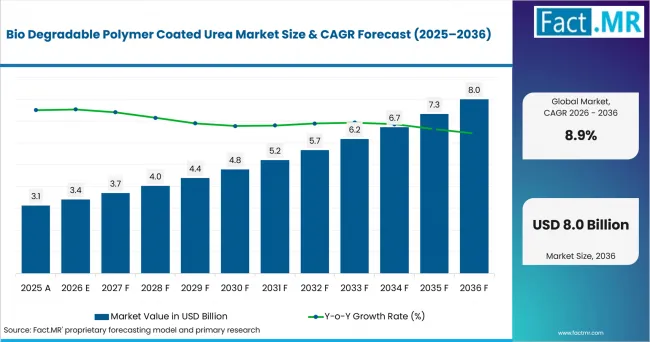
Bio Degradable Polymer Coated Urea Market Value Analysis | Source: Fact.MR
What are the defining numbers behind Bio Degradable Polymer Coated Urea Market growth?
An absolute opportunity of USD 4.5 billion is expected between 2026 and 2036.
- Demand Drivers in the Market
- Nitrogen-use efficiency is becoming a more explicit purchasing criterion. USDA Natural Resources Conservation Service guidance recognizes slow-release and controlled-release nitrogen formulations, including polymer-coated fertilizers, as a nutrient-management option for improving nutrient-use efficiency and reducing loss risk.
- China is reinforcing the same operating logic at field level. The Ministry of Agriculture and Rural Affairs reported fertilizer-use efficiency of 43.3% across wheat, maize and rice in 2025 and linked progress to wider use of new fertilizer products together with improved application methods. This gives suppliers a clearer route to position coated urea around measurable nitrogen performance.
- Coating chemistry is becoming part of product qualification. Commission Delegated Regulation (EU) 2024/2770 establishes biodegradability criteria for coating agents used in EU fertilising products. Suppliers serving regulated markets therefore need evidence on nutrient release and coating degradation, rather than relying on a generic sustainability claim.
- Key Segments Analyzed
- Biodegradable Polymer Coated Urea accounts for 47.0% of the Product Category segment in 2026 because the fertilizer and release coating are purchased as one nitrogen-management product.
- Field Crops hold 44.0% of the Application segment in 2026 as broad-acre production can benefit from controlled nitrogen availability and fewer field applications.
- Farmers represent 63.0% of the End User segment in 2026 because farm-level buyers make the final trade-off between the coated product premium and expected savings from nutrient efficiency or reduced application work.
- Cereals & Grains account for 46.0% of the Crop Type segment in 2026 due to the recurring nitrogen requirements of rice, wheat and maize production.
- Biodegradable Polymer Encapsulation holds 43.0% of the Coating Technology segment in 2026 because encapsulation directly controls nutrient diffusion while addressing the need for coating degradation after nutrient release.
- Analyst Opinion at Fact.MR
- Shambhu Nath Jha, Senior Consultant at Fact.MR, states, “Demand for biodegradable polymer-coated urea will depend on whether suppliers can justify the premium against conventional urea through fewer field applications and more predictable nitrogen availability. Release profiles need to fit crop duration and local soil conditions, while coating biodegradability must be supported by clear technical evidence.”
- Strategic Implications
- Suppliers should specify release duration by crop and climate so buyers can compare a coated grade with the timing of local nitrogen demand.
- Field trials should quantify avoided applications and nitrogen retention in terms that farmers can translate into per-hectare economics.
- In subsidy-sensitive markets, the commercial case must be framed against the effective farm price of conventional urea instead of the nominal price of other specialty fertilizers.
- European market access requires clear documentation on coating biodegradability alongside nutrient analysis and release performance.
How does the Bio Degradable Polymer Coated Urea Market break down by segment?
The market is segmented by Product Category, Application, End User, Crop Type, Coating Technology, and Region.
Why does Biodegradable Polymer Coated Urea lead Product Category?
Biodegradable Polymer Coated Urea is projected to account for a 47.0% share in 2026.
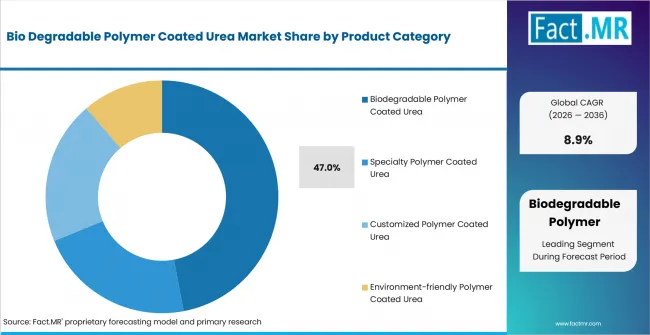
Bio Degradable Polymer Coated Urea Market Analysis By Product Category | Source: Fact.MR
ICL markets urea-based products using its eqo.x biodegradable release technology, with the coating designed to control nutrient release and degrade after its release function is complete. Adoption still depends on whether the release period matches local soil temperature and crop duration.
Why do Field Crops lead Application?
Field Crops are projected to account for a 44.0% share in 2026.
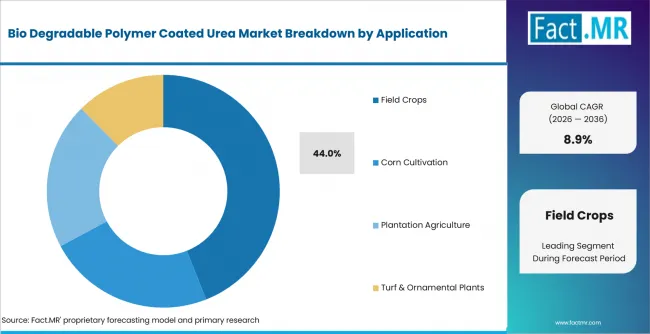
Bio Degradable Polymer Coated Urea Market Analysis By Application | Source: Fact.MR
USDA NRCS guidance recognizes polymer-coated fertilizers within controlled-release nitrogen strategies for improving nutrient-use efficiency. The guidance also stresses local agronomic validation, which keeps field-crop adoption tied to crop recommendations and documented performance rather than coating technology alone.
Why do Farmers lead End User?
Farmers are projected to account for a 63.0% share in 2026.
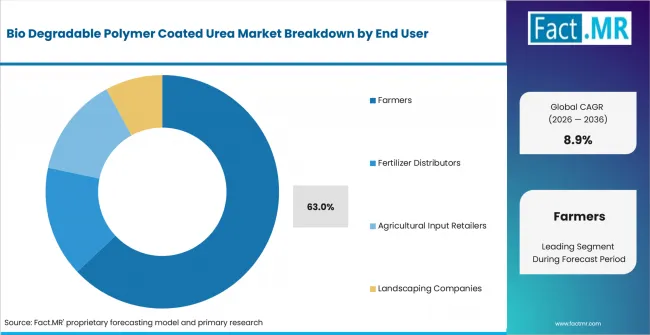
Bio Degradable Polymer Coated Urea Market Analysis By End User | Source: Fact.MR
Farmers lead because they absorb the product premium and capture the operating benefit. Their decision is based on whether fewer applications or lower nitrogen loss can compensate for the higher purchase price. Soil temperature, rainfall pattern and crop duration therefore affect the economics directly. This makes local evidence important. A distributor can explain release technology, but the farmer still needs confidence that the coated urea will release within the crop window and will not leave the crop short of nitrogen during a high-demand stage.
Why do Cereals & Grains lead Crop Type?
Cereals & Grains are projected to account for a 46.0% share in 2026.
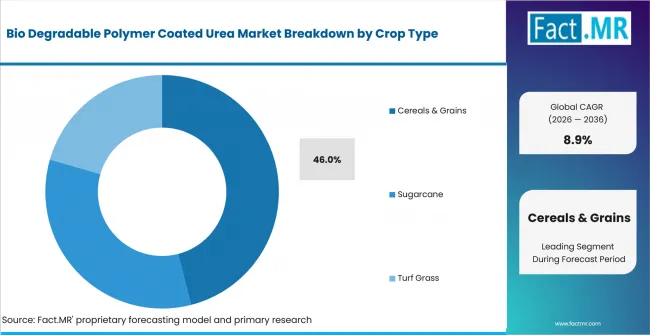
Bio Degradable Polymer Coated Urea Market Analysis By Crop Type | Source: Fact.MR
Cereals & Grains lead because rice, wheat and maize require recurring nitrogen inputs across extensive cultivated areas. Even modest improvements in nutrient timing can affect fertilizer use and field operations when applied over broad acreage.
China reported fertilizer-use efficiency of 43.3% across wheat, maize and rice in 2025. The same official review links continued improvement to new fertilizer products and more precise application methods, supporting demand for nitrogen products that can be incorporated into crop-specific efficiency programmes.
Why does Biodegradable Polymer Encapsulation lead Coating Technology?
Biodegradable Polymer Encapsulation is projected to account for a 43.0% share in 2026.
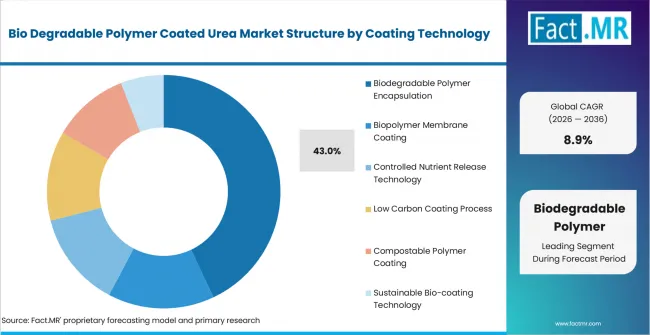
Bio Degradable Polymer Coated Urea Market Analysis By Coating Technology | Source: Fact.MR
Biodegradable polymer encapsulation leads because the coating forms the release barrier around the urea granule. Water enters through the coating, dissolves the nutrient and allows nitrogen to move into the soil over a controlled period. The supplier can therefore design a release profile around coating thickness and material behaviour.
Regulation is increasing the value of documented degradation. Commission Delegated Regulation (EU) 2024/2770 sets biodegradability criteria for coating agents used in EU fertilising products. This pushes product development toward coatings that can provide controlled release during use and meet defined end-of-life requirements afterward.
What is accelerating Bio Degradable Polymer Coated Urea Market adoption, and what is holding it back?
Drivers Impact Analysis
| Factor | (~) % Impact on CAGR | Geographic Relevance | Impact Timeline |
|---|---|---|---|
| Need to protect nitrogen from loss while reducing repeated field applications | +1.5% | Global | Near |
| Policy focus on nitrogen-use efficiency and balanced nutrient management | +1.3% | Global | Mid |
| Controlled-release adoption across field crops and cereal production | +1.0% | Global | Long |
| Biodegradability requirements for fertilizer coating polymers | +0.8% | Global | Long |
Source: Fact.MR analysis. Updated Aug 11, 2026
Restraints Impact Analysis
| Factor | (~) % Impact on CAGR | Geographic Relevance | Impact Timeline |
|---|---|---|---|
| Premium over conventional or subsidized urea | -1.1% | Global | Mid |
| Need to validate release behaviour under local soil and climate conditions | -0.8% | Global | Near |
| Qualification requirements for coating performance and biodegradation | -0.6% | Global | Long |
Source: Fact.MR analysis. Updated Aug 11, 2026
Which countries are scaling the Bio Degradable Polymer Coated Urea Market?
- China is forecast to grow at a 10.1% CAGR from 2026 to 2036. Fertilizer-use efficiency is embedded in national agronomy programmes, giving controlled-release urea a role where growers can document better nitrogen timing across grain production.
- India is projected to expand at a 9.7% CAGR. Subsidized conventional urea creates a demanding price benchmark, so coated products need to earn adoption through fewer applications, lower nitrogen loss or a more stable nutrient supply during the crop cycle.
- Brazil is expected to record a 9.3% CAGR through 2036. Dependence on imported fertilizer and long inland supply routes increase the value of products that improve nitrogen productivity across commercial crop programmes.
- In the USA, the market is forecast to rise at an 8.9% CAGR. Controlled-release nitrogen is already recognized within nutrient-management guidance, while farm adoption remains tied to local recommendations and field evidence.
- Germany is projected to grow at an 8.5% CAGR. Nutrient-management obligations and EU coating rules increase the importance of release documentation and polymer biodegradability for products entering professional agricultural channels.
- Indonesia is expected to expand at an 8.1% CAGR. Subsidized fertilizer remains central to farm purchasing, which means specialty coated urea must demonstrate a clear agronomic return within a price-sensitive distribution system.
- France is forecast to post a 7.7% CAGR. Policy is moving toward tighter nitrogen balances and lower mineral nitrogen use, creating room for controlled-release products when they can reduce unnecessary applications without compromising crop nutrition.
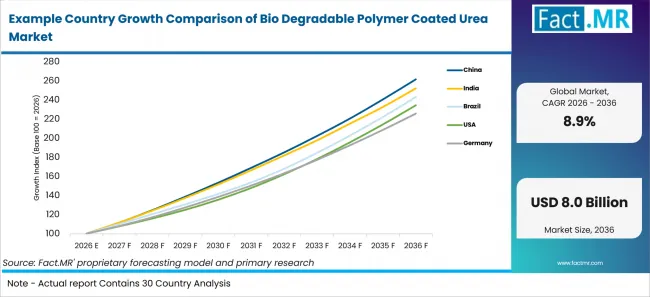
Example Country Growth Comparison Of Bio Degradable Polymer Coated Urea Market | Source: Fact.MR
Country CAGR (2026-2036)
| Country | CAGR (2026-2036) |
|---|---|
| China | 10.1% |
| India | 9.7% |
| Brazil | 9.3% |
| USA | 8.9% |
| Germany | 8.5% |
| Indonesia | 8.1% |
| France | 7.7% |
Source: Fact.MR analysis. Updated Aug 11, 2026
What is driving China’s growth through 2036?
China is forecast to expand at a 10.1% CAGR from 2026 to 2036.
China is combining fertilizer-efficiency targets with a broad extension system. The Ministry of Agriculture and Rural Affairs reported that soil-testing and formulated-fertilization technology covered more than 95% of the three main grain crops in 2025. This gives suppliers an established channel for matching coated-urea release periods with crop recommendations.
The same programme promotes new fertilizer products alongside improved application methods. Biodegradable coated urea can fit this framework where field trials show that a controlled release curve protects nitrogen availability without increasing the total nutrient requirement.
What is driving India’s growth through 2036?
India is forecast to expand at a 9.7% CAGR from 2026 to 2036.
India’s urea market is shaped by a statutory subsidized price and a nationwide point-of-sale distribution system. This keeps conventional urea accessible and forces coated products to demonstrate value through farm operations rather than product positioning alone.
Policy is also encouraging more balanced fertilizer use. PM-PRANAM provides incentives to states and union territories that reduce chemical fertilizer consumption relative to their recent baseline. Controlled-release urea can gain relevance where local programmes link reduced nitrogen loss with soil-health or resource-efficiency objectives.
What is driving Brazil’s growth through 2036?
Brazil is forecast to expand at a 9.3% CAGR from 2026 to 2036.
Brazil imports more than 80% of the fertilizer used by its agricultural sector, according to the National Fertilizer Plan. This exposure makes nutrient productivity and reliable fertilizer supply commercially important for crop producers operating far from ports and blending centres.
The National Fertilizer Plan also calls for fertilizer technologies suited to tropical production conditions. Biodegradable coated urea can fit this direction when suppliers adapt release duration to soil temperature, rainfall and the timing requirements of crops such as maize or sugarcane.
What is driving the USA’s growth through 2036?
The USA is forecast to expand at an 8.9% CAGR from 2026 to 2036.
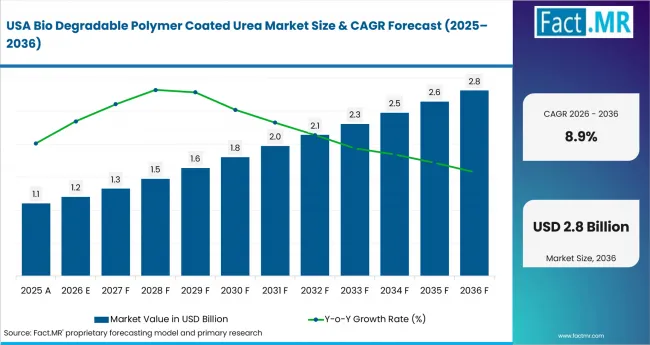
Bio Degradable Polymer Coated Urea Market Country Value Analysis | Source: Fact.MR
USDA NRCS includes polymer-coated fertilizers among controlled-release nitrogen options that can improve nutrient-use efficiency. The framework also requires scientific support and alignment with state or Land Grant University recommendations, which creates a practical qualification path for suppliers.
That structure favours products with clear release specifications and regional trial results. A coated urea grade is more likely to move beyond a test plot when the recommendation shows how it fits the nitrogen budget and whether it can replace part of a split-application programme.
What is driving Germany’s growth through 2036?
Germany is forecast to expand at an 8.5% CAGR from 2026 to 2036.
German agriculture operates under nutrient-management rules designed to limit nitrogen losses, while the German Environment Agency continues to focus on measures that improve plant nitrogen utilization and reduce nitrate or ammonia emissions. Buyers therefore place weight on documented application performance.
EU biodegradability criteria add a separate product requirement for coating agents. Suppliers need to show that the polymer can perform its release function and meet the applicable degradation criteria, which increases the value of technical documentation during product qualification.
What is driving Indonesia’s growth through 2036?
Indonesia is forecast to expand at an 8.1% CAGR from 2026 to 2036.
Indonesia allocated 9.5 million tonnes of subsidized fertilizer for 2025, including 4.6 million tonnes of urea. The size of the subsidized channel means specialty products must compete against an established supply system with strong farmer expectations around price and availability.
Biodegradable coated urea therefore needs a targeted route to adoption. Plantation crops and other applications where labour or field access has a material cost can provide a clearer commercial case than broad substitution of standard urea across all farm segments.
What is driving France’s growth through 2036?
France is forecast to expand at a 7.7% CAGR from 2026 to 2036.
France is strengthening nitrogen-management targets. A 2026 government fertilizer strategy calls for wider use of nitrogen balances and a reduction in the gross nitrogen surplus by 2030, while the national low-carbon strategy also points toward lower use of mineral nitrogen fertilizer.
Controlled-release urea can support this direction when the coating helps align nitrogen availability with crop demand. Adoption will still depend on field economics because growers need the reduction in applications or nutrient loss to justify the coated product premium.
Who leads the Bio Degradable Polymer Coated Urea Market?
Yara International ASA is the leading company in the Bio Degradable Polymer Coated Urea Market. Its position is supported by a global crop-nutrition business and a broad nitrogen-fertilizer production and distribution footprint, which provide access to commercial farming channels across multiple regions.
Nutrien Ltd. and ICL Group Ltd. compete through established crop-nutrition portfolios, while ICL adds a documented biodegradable controlled-release platform through eqo.x. COMPO EXPERT GmbH and Haifa Group bring experience in coated and specialty fertilizer programmes for professional growers.
Kingenta Ecological Engineering Group Co., Ltd. has developed bio-based coated controlled-release fertilizer technology, adding another route to biodegradable coating development. Coromandel International Limited, EuroChem Group AG, Borealis AG and The Mosaic Company contribute manufacturing or regional distribution capabilities that can support coated-urea commercialization.
Competition depends on release consistency and local agronomic evidence. Coating degradation and granule durability also affect qualification. Suppliers with strong farm channels still need crop-specific proof, while coating specialists need production economics that can compete with conventional urea benchmarks.
Which companies are the key providers?
- Yara International ASA
- Nutrien Ltd.
- ICL Group Ltd.
- COMPO EXPERT GmbH
- Coromandel International Limited
- EuroChem Group AG
- Kingenta Ecological Engineering Group Co., Ltd.
- Sumitomo Chemical Co., Ltd.
- The Mosaic Company
- Borealis AG
- Haifa Group
Bibliography
- European Commission. (2024). Commission Delegated Regulation (EU) 2024/2770 on Biodegradability Criteria for Coating Agents and Water Retention Polymers. European Union.
- Ministry of Agriculture and Rural Affairs of the People’s Republic of China. (2026). Fertilizer-use Efficiency of Wheat, Maize and Rice During the 14th Five-Year Plan. Government of China.
- Press Information Bureau, Government of India. (2024). Urea Is Provided to Farmers at a Statutorily Notified Maximum Retail Price. Government of India.
- Press Information Bureau, Government of India. (2026). PM-PRANAM Launched to Promote Sustainable Fertilizer Use and Restore Soil Health Across States. Government of India.
- Ministry of Agriculture and Livestock, Brazil. (2022). The National Fertilizer Plan. Government of Brazil.
- United States Department of Agriculture, Natural Resources Conservation Service. (2022). E590A: Improving Nutrient Uptake Efficiency and Reducing Risk of Nutrient Losses. USDA.
- German Environment Agency. (2025). Risks and Benefits of Inhibitors in Agriculture. Federal Republic of Germany.
- Directorate General of Agricultural Infrastructure and Facilities, Ministry of Agriculture, Indonesia. (2025). Subsidized Fertilizer Distribution for 2025. Government of Indonesia.
- Ministry of Agriculture and Food Sovereignty, France. (2026). Emergency Fertilizer Plan for Farmers and a Sustainable Fertilizer Strategy. Government of France.
- Yara International ASA. (2026). Annual Report 2025. Yara International ASA.
- ICL Growing Solutions. (2022). eqo.x Biodegradable Release Technology. ICL Group Ltd.
- Kingenta Ecological Engineering Group Co., Ltd. (2025). Bio-based Coated Controlled-release Fertilizer Technology. Kingenta.
This Report Answers
- The report examines demand for Bio Degradable Polymer Coated Urea across Product Category, Application, End User, Crop Type and Coating Technology.
- Segment analysis explains why biodegradable coated urea, field-crop applications, farmers, cereal production and biodegradable polymer encapsulation shape purchasing decisions.
- Country analysis evaluates market development across China, India, Brazil, the USA, Germany, Indonesia and France.
- Competitive analysis examines nitrogen fertilizer producers and specialty nutrition suppliers with controlled-release or biodegradable coating capabilities.
- The analysis considers nitrogen-use efficiency, coating biodegradability, crop-specific release performance and farm-level economics that influence adoption.
What does the Bio Degradable Polymer Coated Urea Market cover?
The market covers urea fertilizer products that use biodegradable, bio-based or related polymer coating systems to control nitrogen release over a defined period. The assessment examines Product Category, Application, End User, Crop Type and Coating Technology across the stated regions and countries.
What is included in the scope?
The scope includes Biodegradable Polymer Coated Urea, Specialty Polymer Coated Urea, Customized Polymer Coated Urea and Environment-friendly Polymer Coated Urea within Product Category. Application coverage includes Field Crops, Corn Cultivation, Plantation Agriculture, Turf & Ornamental Plants and their stated subsegments.
End User coverage includes Farmers, Fertilizer Distributors, Agricultural Input Retailers, Landscaping Companies and their stated subsegments. Crop Type covers Cereals & Grains, Sugarcane, Turf Grass and related crop subsegments. Coating Technology includes biodegradable encapsulation, biopolymer membrane systems, controlled nutrient-release technologies and the other stated coating approaches.
What is excluded from the scope?
The scope excludes conventional uncoated urea sold without a controlled-release coating. Urease inhibitors and nitrification inhibitors are excluded when sold as standalone additives rather than as part of a coated urea product covered by the market definition.
Non-urea NPK fertilizers, standalone soil amendments, fertilizer application equipment and crop-protection products also fall outside the market. Adjacent controlled-release fertilizers are included only when they meet the urea and coating definition used in this assessment.
How Was the Analysis Built?
- Primary Research: Discussions with urea producers, coating-technology suppliers, agronomists, fertilizer distributors, commercial farms and agricultural input buyers examine release performance, crop fit, farm economics and product qualification.
- Desk Research: The review covers fertilizer regulation, nitrogen-efficiency programmes, agricultural standards, crop-nutrition policy, company disclosures and technical literature on controlled-release coatings. Sources used in the analysis are recorded in the bibliography.
- Market Sizing and Forecasting: Estimates combine urea demand with controlled-release penetration, crop-area requirements, application intensity, coating-technology adoption, segment shares and country-level growth. The model also considers farm economics and polymer-compliance requirements.
- Validation and Update Cycle: Findings are cross-checked against public evidence and company activity. Updates account for coating regulation, product launches, fertilizer-policy changes, manufacturing capacity and field evidence.
Segmentation
What is the report's scope and coverage?
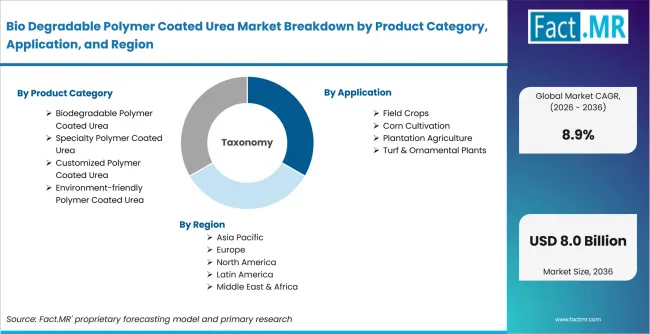
Bio Degradable Polymer Coated Urea Market Breakdown By Product Category, Application, And Region | Source: Fact.MR
| Attribute | Details |
|---|---|
| Quantitative Units | USD 3.4 billion in 2026 to USD 7.9 billion by 2036 at 8.9% CAGR |
| Market Definition | Bio Degradable Polymer Coated Urea covers urea fertilizers that use biodegradable or bio-based polymer coating technologies to control nitrogen release across the stated product, application, end-user, crop and coating segments. |
| Segments Covered | Product Category; Application; End User; Crop Type; Coating Technology |
| Regions Covered | North America; Latin America; Europe; East Asia; South Asia and Pacific; Middle East and Africa |
| Countries Covered | China; India; Brazil; USA; Germany; Indonesia; France, with more than 25 additional countries included in the broader assessment |
| Key Companies Profiled | Yara International ASA; Nutrien Ltd.; ICL Group Ltd.; COMPO EXPERT GmbH; Coromandel International Limited; and others |
| Forecast Period | 2026 to 2036 |
| Approach | Hybrid top-down and bottom-up approach using urea demand, controlled-release adoption, crop-area requirements, coating technology penetration, segment shares, country growth and company portfolio review |
Source: Fact.MR analysis. Updated Aug 11, 2026
How is the market segmented?
-
By Product Category
- Biodegradable Polymer Coated Urea
- Controlled Release Urea
- Slow Release Urea
- Specialty Polymer Coated Urea
- High Efficiency Urea
- Micronutrient Enriched Urea
- Customized Polymer Coated Urea
- Crop-specific Urea Formulations
- Region-specific Urea Formulations
- Environment-friendly Polymer Coated Urea
- Organic Compatible Urea
- Low Emission Urea
- Biodegradable Polymer Coated Urea
-
By Application
- Field Crops
- Rice Cultivation
- Wheat Cultivation
- Corn Cultivation
- Oilseed Cultivation
- Horticulture
- Plantation Agriculture
- Palm Plantations
- Greenhouse Cultivation
- Turf & Ornamental Plants
- Golf Course Management
- Nursery Cultivation
- Field Crops
-
By End User
- Farmers
- Commercial Farms
- Agricultural Cooperatives
- Fertilizer Distributors
- Agricultural Enterprises
- Government Agriculture Programs
- Agricultural Input Retailers
- Plantation Owners
- Horticulture Growers
- Landscaping Companies
- Municipal Authorities
- Nursery Operators
- Farmers
-
By Crop Type
- Cereals & Grains
- Rice
- Wheat
- Maize
- Soybean
- Fruits & Vegetables
- Sugarcane
- Oil Palm
- Greenhouse Crops
- Turf Grass
- Ornamental Plants
- Floriculture Crops
- Cereals & Grains
-
By Coating Technology
- Biodegradable Polymer Encapsulation
- Starch-based Polymer Coating
- Polylactic Acid Coating Technology
- Biopolymer Membrane Coating
- Multi-layer Controlled Release Coating
- Bio-based Resin Coating
- Controlled Nutrient Release Technology
- Moisture Responsive Polymer Coating
- Microbial Degradable Coating Technology
- Low Carbon Coating Process
- Compostable Polymer Coating
- Sustainable Bio-coating Technology
- Biodegradable Polymer Encapsulation
Frequently Asked Questions
Which Product Category leads the market?
Which Application leads the market?
Which End User leads the market?
Which Crop Type leads the market?
Which Coating Technology leads the market?
Which country records a 10.1% CAGR from 2026 to 2036?
What is the primary driver in this market?
What is the main restraint?
Which companies are included in the market assessment?
Who worked on this report


Preview the report firsthand - request a free sample
Free SampleGet the brochure for pricing and purchase details
Download PDF