- Market Value (2025): USD 965.5 Mn
- Estimated Value (2026): USD 1120.0 Mn
- Forecast Value (2036): USD 4941.0 Mn
- CAGR (2026-2036): 16.0%
What is the Bio Barrier Coatings Market forecast to be worth by 2036?
USD 1,120.0 million in 2026 to USD 4941.0 million by 2036, at 16.0% CAGR.
- The bio barrier coatings market reached USD 965.5 million in 2025.
- Demand is projected to increase from USD 1120.0 million in 2026 to USD 4941.0 million by 2036.
- The market is forecast to record 16.0% CAGR from 2026 to 2036.
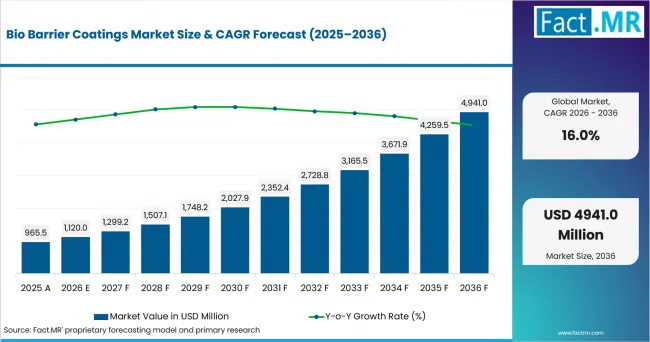
Bio Barrier Coatings Market Value Analysis | Source: Fact.MR
What are the defining numbers behind Bio Barrier Coatings Market growth?
An absolute opportunity of USD 3821.0 million is expected between 2026 and 2036.
- Demand Drivers in the Market
- Food brands need grease and moisture resistance that allows paper wraps, trays and cartons to carry oily or chilled foods without adding plastic film layers.
- USDA Economic Research Service reported in June 2026 that U.S. food spending reached USD 2.51 trillion in 2025. That food system scale keeps coated paperboard relevant for quick-service and takeaway packaging.
- The FDA determined in January 2025 that 35 food contact notifications for PFAS-based grease-proofing substances in paper and paperboard food packaging were no longer effective. Bio-based and water-based alternatives benefit from that regulatory shift.
- E-commerce and delivery packaging are increasing the need for coated paper with scuff, moisture and oil resistance. U.S. Census Bureau data for August 2026 placed second-quarter 2026 retail e-commerce sales at USD 340.2 billion.
- Key Segments Analyzed
- By Material: Bio-polymers are expected to hold 38.0% share in 2026 owing to their fit with plastic-free coating claims and fiber-packaging conversion work.
- By Format: Coating is projected to account for 41.0% share in 2026 because converters can apply it to existing paper and board substrates.
- By Function: Barrier protection is anticipated to capture 36.0% share in 2026 since grease, moisture and liquid resistance remain the core purchase test.
- By Application: Food packaging is estimated to represent 40.0% share in 2026 as fast food, bakery and retail packs require barrier performance with food-contact compliance.
- Analyst Opinion at Fact.MR
- Shambhu Nath Jha, Principal Consultant at Fact.MR, states, "Bio barrier coatings are being judged less by green claims and more by qualification proof. Converters are expected to favor chemistries that pass oil, grease and moisture tests while keeping coated fiber acceptable to mills. Suppliers that combine application support, food-contact documentation and recovery evidence are better placed to move from trials into repeat supply."
- Strategic Implications
- Coating suppliers should publish repulpability and food-contact documentation by substrate because buyer approval depends on evidence across cupstock, cartons and flexible paper.
- Paper converters should align coating choice with line speed, drying load and coat weight so the sustainability case also works at commercial scale.
- Food brands should test bio barrier coatings first in wraps, bakery cartons and dry-food formats where shelf-life risk is easier to control.
- Packaging procurement teams should compare barrier coatings by failure mode, including grease staining, water uptake and heat-seal strength.
The USA is projected to record 17.6% CAGR through 2036 driven by foodservice scale and PFAS-free paper conversion. Germany is expected to post 16.8% CAGR as EU packaging rules and recycling systems push documentation-led adoption. Japan is forecast to advance at 15.7% CAGR through compact retail formats and export packaging needs. France is anticipated to reach 15.0% CAGR supported by retail activity and e-commerce packaging commitments. Brazil is estimated to record 14.4% CAGR as food exports and plastic packaging reverse logistics widen testing routes.
How does the Bio Barrier Coatings Market break down by segment?
Coating leads Format at 41.0%; Food packaging leads Application at 40.0%.
Which Material dominates?
Bio-polymers are expected to hold 38.0% share in 2026.
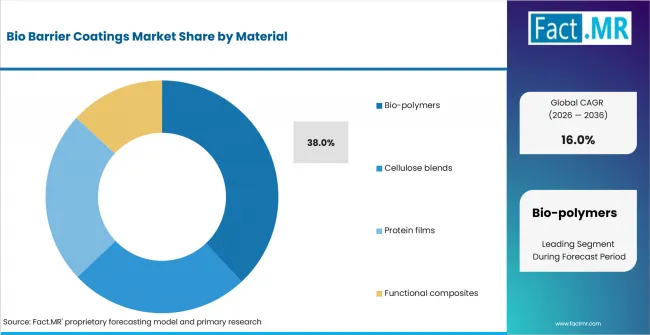
Bio Barrier Coatings Market Analysis By Material | Source: Fact.MR
Bio-polymers lead because they connect barrier performance with the plastic-reduction language used by food brands and retailers. Their role is strongest where a coating must protect paper from oil and moisture while keeping the packaging route clear for recycling or composting review. Formulators also favor them when a single chemistry family can support several food-packaging formats.
Michelman introduced two bio-based, plastic-free coatings in April 2026 for paper-based retail food packaging applications. The Nuvita Life coating family combines barrier functionality, including mineral-oil resistance, with recyclability and compostability options for fiber-based packaging.
What leads the Format segment?
Coating is projected to account for 41.0% share in 2026.
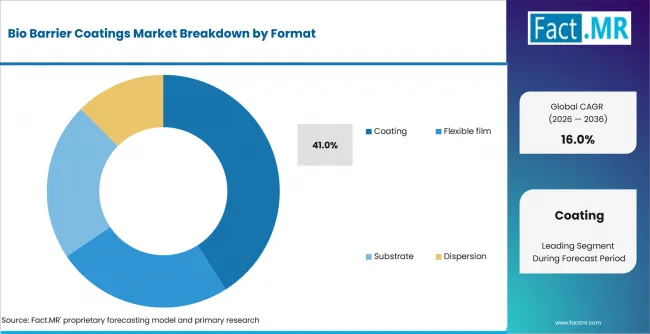
Bio Barrier Coatings Market Analysis By Format | Source: Fact.MR
Coating leads format demand because it can be applied to paper, paperboard and molded fiber without changing the full package structure. Brand teams gain a lower-friction route to replace plastic film layers where the substrate remains familiar to printers and converters. This makes coating trials easier to compare across paper grades and regional filling lines.
Solenis showcased paper and packaging solutions in August 2025 that repel hot and cold liquids, oils, greases and water vapor in paper packaging. The breadth of these barrier functions supports the use of coating-based solutions as alternatives to polyethylene films and other conventional barrier treatments in fiber-based packaging.
How does Function shape demand?
Barrier protection is anticipated to lead with 36.0% share in 2026.
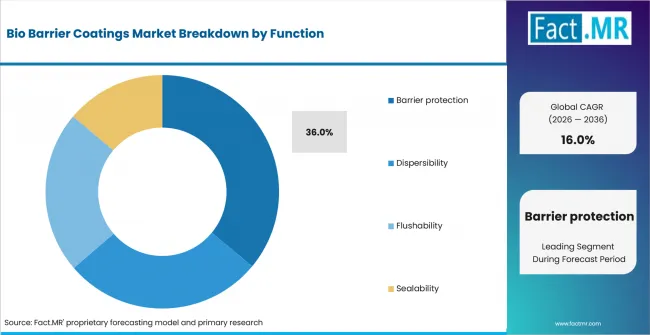
Bio Barrier Coatings Market Analysis By Function | Source: Fact.MR
Barrier protection leads because coated paper must first solve a failure problem. Grease staining, water uptake and mineral oil migration create visible package risk, so purchasers approve coatings only after the function works on the chosen paper grade. Sealability then becomes part of the same review when coated packs enter heat-sealed applications.
BASF and UPM announced a May 2026 collaboration pairing UPM packaging papers with BASF’s waterborne Joncryl® HPB barrier technology. The combination provides formulators with water-based coating routes for paper and board packaging where barrier performance, recyclability and protection requirements influence material selection.
What supports Food packaging within Application?
Food packaging is estimated to represent 40.0% share in 2026.
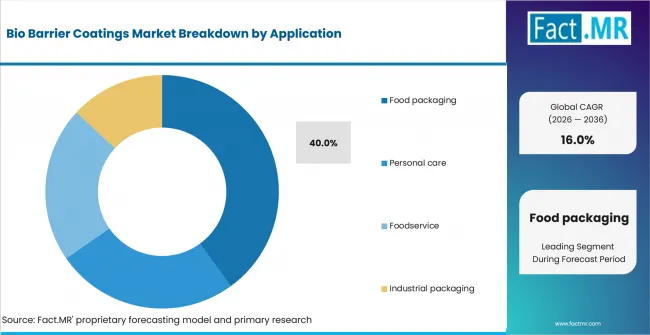
Bio Barrier Coatings Market Analysis By Application | Source: Fact.MR
Food packaging leads application demand because bakery, quick-service and retail food formats expose paper to oil, steam and chilled distribution. The segment also carries food-contact review, making supplier documentation as important as coating performance. Approval cycles therefore depend on formulation stability, migration files and package testing rather than branding claims alone.
Japan’s MAFF reported in February 2026 that agricultural, forestry and fishery products and food exports reached JPY 1,700.5 billion in 2025. Growth in export-oriented food shipments can increase packaging requirements for barrier performance that helps maintain product quality during storage and transportation.
What is accelerating Bio Barrier Coatings Market adoption, and what is holding it back?
Demand is expected to rise through PFAS-free paper conversion, food packaging tests and recovery proof requirements.
Drivers Impact Analysis
| DRIVER | (~) % IMPACT ON CAGR | GEOGRAPHIC RELEVANCE | IMPACT TIMELINE |
|---|---|---|---|
| PFAS-free grease-proofing transition | +1.7% | North America, Europe | Short term (<= 2 years) |
| Foodservice and takeaway coated paper use | +1.4% | Global | Medium term (2-4 years) |
| E-commerce protective paper packaging | +1.1% | North America, Europe, East Asia | Medium term (2-4 years) |
| Converter use of existing coating assets | +0.8% | Global | Long term (>= 4 years) |
- PFAS-free grease-proofing transition: The FDA phase-out is expected to raise interest in alternative grease and oil barriers for paper food packaging. Suppliers with clear food-contact records gain a faster qualification route.
- Foodservice and takeaway coated paper use: Foodservice formats need protection against hot liquids, oils and grease. Bio barrier coatings are expected to gain trials in wraps, cups and bakery boards where visible staining creates brand risk.
- E-commerce protective paper packaging: Shipping exposes paper packs to abrasion and moisture. Coatings that add protection without plastic film are expected to fit mailer, dry-food and personal-care formats.
Opportunity Impact Analysis
| OPPORTUNITY | (~) % IMPACT ON CAGR | GEOGRAPHIC RELEVANCE | IMPACT TIMELINE |
|---|---|---|---|
| Bio-polymers for fiber food packaging | +1.3% | North America, Europe, East Asia | Short term (<= 2 years) |
| Printable coatings for paper conversion lines | +1.0% | Global | Medium term (2-4 years) |
| Mineral-oil and oxygen barrier use cases | +0.7% | Europe, Japan | Long term (>= 4 years) |
- Bio-polymers for fiber food packaging: Bio-based coating chemistries give formulators a route to match plastic-free claims with grease or mineral-oil barrier functions in retail food packs.
- Printable coatings for paper conversion lines: Print-applied and dispersion coatings are expected to expand where converters want to use familiar coaters, flexographic equipment and drying systems.
- Mineral-oil and oxygen barrier use cases: Recycled board and wrapped foods are expected to create demand for coatings that manage migration or aroma protection in specific pack formats.
Restraints Impact Analysis
| RESTRAINT | (~) % IMPACT ON CAGR | GEOGRAPHIC RELEVANCE | IMPACT TIMELINE |
|---|---|---|---|
| Repulpability and mill acceptance risk | -0.6% | North America, Europe | Short term (<= 2 years) |
| Food-contact and migration documentation burden | -0.5% | Global | Medium term (2-4 years) |
| Cost and drying load on coating lines | -0.4% | Global | Long term (>= 4 years) |
- Repulpability and mill acceptance risk: Coated fiber packaging must meet mill-level recovery and repulpability requirements. Adoption can slow when coating systems interfere with fiber separation, recycling efficiency or acceptance within existing recovery infrastructure.
- Food-contact and migration documentation burden: Packaging teams require supporting documentation for each coating, substrate and intended food-contact condition. Qualification can take longer for hot, fatty or frozen-food applications where migration and barrier-performance requirements are more demanding.
- Cost and drying load on coating lines: Water-based coating systems can increase drying requirements and place greater emphasis on coat-weight control and line efficiency. Adoption tends to progress faster when production trials demonstrate acceptable throughput alongside barrier and package performance.
Which countries are scaling the Bio Barrier Coatings Market through 2036?
- The country comparison spans 3.2 percentage points across the displayed forecast range.
- The USA remains 0.8 percentage point above Germany as foodservice scale and PFAS-free paper conversion widen qualification work.
- Germany remains 1.1 percentage points above Japan as EU packaging rules and recovery evidence improve approval routes.
- Japan remains 0.7 percentage point above France as food export packaging and compact retail formats raise barrier-performance needs.
- France remains 0.6 percentage point above Brazil as e-commerce packaging commitments keep fiber formats under review.
- Brazil closes the displayed range through food exports, retail growth and plastic packaging reverse logistics.
Comparable CAGRs create different entry conditions due to regulation, recycling systems, food packaging mix and converter readiness. Full report coverage includes North America, Latin America, Western Europe, Eastern Europe, East Asia, South Asia & Pacific, Middle East & Africa.
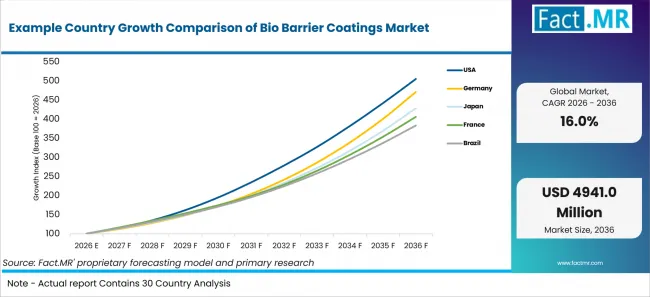
Example Country Growth Comparison Of Bio Barrier Coatings Market | Source: Fact.MR
| Country | CAGR (2026-2036) |
|---|---|
| USA | 17.6% |
| Germany | 16.8% |
| Japan | 15.7% |
| France | 15.0% |
| Brazil | 14.4% |
What supports USA adoption?
17.6% CAGR, supported by foodservice scale and PFAS-free paper conversion.
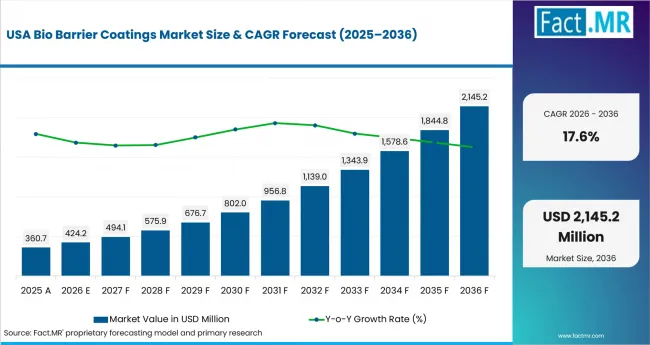
Bio Barrier Coatings Market Country Value Analysis | Source: Fact.MR
U.S. adoption is shaped by foodservice scale and online retail movement. USDA Economic Research Service reported in June 2026 that U.S. food spending reached USD 2.51 trillion in 2025. Paper packaging teams are expected to test bio barrier coatings where grease resistance, food-contact clearance and recovery evidence must be aligned before national rollout.
How is Germany scaling demand?
16.8% CAGR, backed by EU packaging rules and paper recycling depth.
Germany benefits from a mature packaging recovery base and EU-level rule clarity. Umweltbundesamt reported in January 2026 that around 5.5 million tonnes of packaging waste collected by the dual systems were recovered in 2024. Coated paper suppliers therefore need to show that barrier layers perform in use and still meet recovery expectations after disposal.
How does Japan perform?
15.7% CAGR, led by compact retail formats and food export packaging needs.
Japan develops demand through compact retail formats that require clean appearance and controlled leakage. METI reported in August 2025 that the domestic B2C e-commerce market reached JPY 26.1 trillion in 2024. Bio barrier coatings are expected to gain attention where chilled, bakery and export packs need a thin coating layer with consistent surface performance.
What supports France’s growth?
15.0% CAGR, linked to retail packaging and e-commerce packaging commitments.
France combines retail activity with public pressure to reduce packaging impact. INSEE reported in June 2026 that retail trade and commercial craft sales increased 2.3% in volume in 2025. France’s strengthened e-commerce environmental charter, signed in March 2025, includes commitments to reduce packaging volumes and increase the use of recycled, recyclable or reusable packaging.
How is Brazil developing demand?
14.4% CAGR, supported by food exports and plastic packaging reverse logistics.
Brazilian demand is tied to food exports and the need for moisture control in warm distribution conditions. Brazil’s Ministry of Agriculture and Livestock reported in January 2026 that agribusiness exports reached USD 169.2 billion in 2025. Decree No. 12,688 of October 2025 established a national reverse-logistics system for plastic packaging, strengthening requirements around collection, recovery, recycling and recycled content.
Who leads the Bio Barrier Coatings Market?
Michelman is active through Nuvita Life and Michem barrier coating platforms for paper packaging. Its April 2026 Nuvita Life launch gives converters bio-based and plastic-free options for retail food packaging requiring oil, grease and mineral-oil barrier performance.
Solenis competes through TopScreen barrier coatings for cupstock, oil and grease resistance, and water-repellent paper packaging. Its August 2025 packaging showcase focused on paperization through coatings and additives that repel liquids, oils, greases and water vapor.
BASF supplies Joncryl HPB water-based resins for functional paper and board coatings. Its May 2026 collaboration with UPM combines packaging papers and barrier technology to support recyclable fiber-based packaging concepts for converters and formulators.
Stora Enso, Mondi and Ahlstrom add paperboard and specialty-paper capabilities. Stora Enso provides dispersion-coated board for grease-resistant foodservice applications. Mondi ramped up FunctionalBarrier Paper Ultimate in August 2025.
Competition is likely to center on barrier consistency, recyclability performance, converting compatibility and technical support as brands and converters move packaging concepts from trials toward commercial production.
Which companies are the key providers?
Key companies include Michelman; Solenis; BASF; Stora Enso; and Mondi.
- Michelman
- Solenis
- BASF
- Stora Enso
- Mondi
Bibliography
- U.S. Food and Drug Administration. (2025, January 3). FDA determines authorization for 35 food contact notifications related to PFAS are no longer effective.
- U.S. Census Bureau. (2026, August 18). Quarterly retail e-commerce sales.
- U.S. Environmental Protection Agency. (2024, August). An assessment of the U.S. recycling system: Financial estimates to modernize material recovery infrastructure (EPA 530-R-24-010).
- Directorate-General for Communication. (2026, August 12). New packaging rules for less waste and easier recycling. European Commission.
- German Environment Agency, & Central Agency Packaging Register. (2026, January 27). Facts against myths: Packaging waste recycling in Germany is working.
- Eurostat. (2025, October 22). Plastic packaging waste in the EU: 35.3 kg per person.
- Ministry of Economy, Trade and Industry. (2025, August 26). Results of FY2024 E-Commerce Market Survey compiled.
- Ministry of the Environment, Government of Japan. (2026, March 27). Municipal solid waste generation and disposal in FY2024.
- Institut national de la statistique et des études économiques. (2026, June 18). Activité des formes de vente du commerce de détail: Données annuelles de 2020 à 2025.
- Ministère de la Transition écologique, de la Biodiversité, de la Forêt, de la Mer et de la Pêche. (2025, March 3). Les acteurs du e-commerce s’engagent : signature de la nouvelle charte 2025 pour la réduction de l’impact environnemental du commerce en ligne.
- Ministério da Agricultura e Pecuária. (2026, January 8). Agronegócio brasileiro fecha 2025 com recorde em exportações de US$ 169 bilhões e superávit de US$ 149,07 bilhões.
- Brazilian Institute of Geography and Statistics. (2026, February 13). Retail sales close 2025 with rise of 1.6%.
- Presidência da República. (2025, October 21). Decreto nº 12.688, de 21 de outubro de 2025.
- Michelman. (2026, April 30). Michelman introduces Nuvita® Life 4002 & Nuvita® Life 4605: Bio-based barrier coatings for paper packaging applications.
- Solenis. (2025, August 13). Solenis to showcase sustainable paper and packaging solutions at FACHPACK 2025 and PACK EXPO Las Vegas 2025.
- BASF SE. (2026, May 4). UPM and BASF accelerate the transition to recyclable, fiber-based packaging.
- Mondi. (2025, August 14). Mondi ramps up FunctionalBarrier Paper Ultimate to meet growing demand for sustainable high-barrier paper-based packaging.
This Report Answers
- The report explains where bio barrier coatings are used across material, format, function and application.
- Segment analysis identifies the leading subsegments and the coating-performance reasons behind their position.
- Country analysis examines listed markets and the regulatory or packaging mechanisms supporting adoption.
- Competitive analysis reviews current providers across bio-based coatings, water-based polymers, paperboard and specialty papers.
- Application analysis assesses how grease resistance, moisture protection and recovery proof influence purchase decisions.
What does the Bio Barrier Coatings Market cover?
The Bio Barrier Coatings Market covers coatings that help fiber packaging resist grease, moisture, oxygen and mineral-oil exposure.
Barrier paper coverage helps place coated substrates within fiber packaging substitution. Paper coating materials coverage supports upstream chemistry context for binder and surface-performance choices. The assessment also connects with sustainable packaging as brands qualify recyclable fiber formats.
What is included in the scope?
The scope includes barrier coatings used on paper and board for food packaging, foodservice, personal care and industrial packaging.
Fiber-board substitution paths are aligned with bio-based paperboard laminates. Migration-control work is related to mineral oil barrier coatings. Food-contact demand is also linked with sustainable food packaging.
What is excluded from the scope?
Outside the scope are uncoated paper grades, commodity printing inks, conventional plastic films sold without a barrier-coating function and finished packs where coating revenue is inseparable from the package sale. Oxygen-focused wraps are tracked separately from this coating-focused assessment.
Conventional PE extrusion layers are treated only as substitution references when they explain bio barrier coating adoption. Raw bio-polymer resin sales are outside coverage unless the material is sold into a formulated coating system for paper or board packaging.
How Was the Analysis Built?
The analysis draws on 120+ sources, 35+ company portfolios, 25+ countries, and more than 20 industry interviews.
- Primary Research: Primary research includes discussions with coating formulators, converters, food brands, distributors and procurement teams. These conversations examine purchasing priorities, line trials, approval requirements and acceptance barriers.
- Desk Research: Desk research covers government statistics, regulatory publications, company releases, technical studies, standards and public policy. Every external reference appears in the bibliography.
- Market Sizing and Forecasting: Market estimates combine historical performance, demand indicators, pricing trends, segment shares, country growth, adoption patterns and barriers to expansion.
- Data Validation and Update Cycle: Findings are validated against public data, company activity, regulatory changes and trade patterns. Updates review product launches, portfolio changes, partnerships and commercial adoption shifts.
What is the report’s scope and coverage?
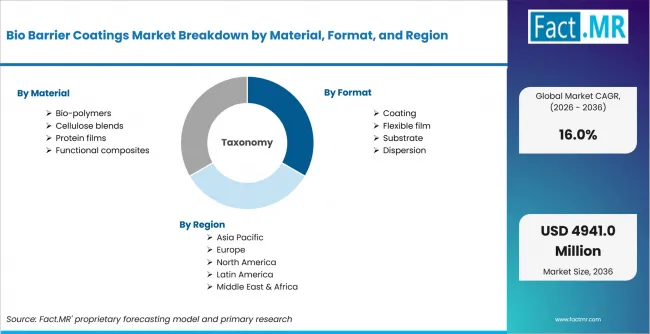
Bio Barrier Coatings Market Breakdown By Material, Format, And Region | Source: Fact.MR
| Attribute | Details |
|---|---|
| Quantitative Units | USD million |
| Market Definition | Bio-based and water-based barrier coatings applied to paper, paperboard, molded fiber and flexible fiber formats to provide grease, moisture, oxygen, mineral-oil, seal and dispersibility functions. |
| Material | Bio-polymers; Cellulose blends; Protein films; Functional composites |
| Format | Coating; Flexible film; Substrate; Dispersion |
| Function | Barrier protection; Dispersibility; Flushability; Sealability |
| Application | Food packaging; Personal care; Foodservice; Industrial packaging |
| Regions Covered | North America; Latin America; Western Europe; Eastern Europe; East Asia; South Asia & Pacific; Middle East & Africa |
| Countries Covered | USA; Germany; Japan; France; Brazil |
| Key Companies Profiled | Michelman; Solenis; BASF; Stora Enso; Mondi |
| Forecast Period | 2026 to 2036 |
| Approach | Hybrid top-down and bottom-up approach using coated paper conversion, food packaging applications, material chemistry mix, country regulation, company portfolio review and converter validation. |
How is the market segmented?
-
By Material:
- Bio-polymers
- Cellulose blends
- Protein films
- Functional composites
-
By Format:
- Coating
- Flexible film
- Substrate
- Dispersion
-
By Function:
- Barrier protection
- Dispersibility
- Flushability
- Sealability
-
By Application:
- Food packaging
- Personal care
- Foodservice
- Industrial packaging
-
By Region:
- North America
- Latin America
- Western Europe
- Eastern Europe
- East Asia
- South Asia & Pacific
- Middle East & Africa