- Market Value (2025): USD 230.3 Mn
- Estimated Value (2026): USD 248.0 Mn
- Forecast Value (2036): USD 520.0 Mn
- CAGR (2026-2036): 7.7%
What is the Mineral Oil Barrier Coatings Market forecast to be worth by 2036?
USD 248.0 million in 2026 to USD 520.0 million by 2036 at 7.7% CAGR.
- The mineral oil barrier coatings market crossed a valuation of USD 230.3 million in 2025.
- Demand is projected to increase from USD 248.0 million in 2026 to USD 520.0 million by 2036.
- The market is forecast to record a 7.7% CAGR from 2026 to 2036 as recycled paperboard users need documented mineral oil migration control.
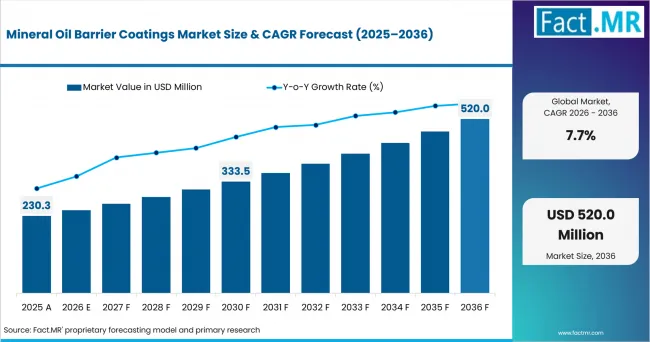
Mineral Oil Barrier Coatings Market Market Value Analysis | Source: Fact.MR
What are the defining numbers behind Mineral Oil Barrier Coatings Market growth?
The market is projected to add USD 272.0 million by 2036, led by Recycled board and MOSH barrier qualification across food packaging applications.
- Demand Drivers in the Market
- Food packaging producers need coatings that reduce MOSH transfer when recycled fiber is used in paper and board.
- Paper and board manufacturers need acrylic dispersion coatings that work on existing coating lines without major equipment changes.
- Packaging companies need clear proof that coatings reduce mineral oil transfer when more recycled fiber is used in food packaging.
- Regulatory staff need complete food-contact documents as European packaging rules place greater attention on material safety and paper recycling.
- Key Segments Analyzed
- By Barrier Target: MOSH barrier is expected to hold 30% share in 2026 supported by migration-control needs in recycled board.
- By Chemistry: Acrylic dispersion is projected to account for 34% share in 2026 owing to water-based coating line fit.
- By Substrate: Recycled board is anticipated to capture 47% share in 2026 due to higher exposure to recovered-fiber mineral oil sources.
- By Application: Dry foods are estimated to represent 32% share in 2026 attributable to direct use in cereal and carton formats.
- By Region: Europe is forecast to lead adoption in 2026 driven by packaging waste regulation and food-contact scrutiny.
- Analyst Opinion at Fact.MR
- Shambhu Nath Jha, Senior Analyst at Fact.MR, states, “Mineral oil barrier coating approval now depends on more than choosing a coating. Companies need clear proof that the product limits mineral oil transfer and runs well on existing coating lines. They also review how the coating affects paper recycling before placing larger orders.”
- Strategic Implications
- Companies should test MOSH barrier coatings on recycled board before making claims to food packaging producers.
- Packaging companies should compare mineral oil transfer and recycling results before changing an approved food packaging structure.
- Coating makers should keep separate test records for acrylic dispersion and wax blend products because each follows a different approval route.
Companies now compete by showing clear test results and proving that their coatings work on normal production lines. Solenis offers TopScreen biowax coatings for food paper packaging and says they are free from MOSH and MOAH. Michelman provides water-based coatings for dry and frozen food packs. BASF offers Joncryl HPB for paperboard that needs water protection and heat sealing.
Germany is anticipated to advance at an 8.8% CAGR due to stricter packaging rules and a well-developed paperboard industry. Brazil is estimated to record an 8.1% CAGR, supported by food packaging and pulp-based materials. The United States is forecast to post a 7.3% CAGR as paper packaging capacity expands.
How does the Mineral Oil Barrier Coatings Market break down by segment?
MOSH barrier leads at 30% by barrier target and Acrylic dispersion leads at 34% by chemistry segment in 2026.
What leads the Barrier Target segment?
MOSH barrier holds 30% share in 2026.
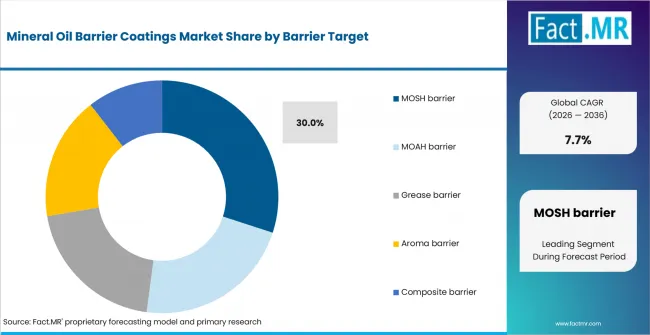
Mineral Oil Barrier Coatings Market Analysis By Barrier Target | Source: Fact.MR
MOSH barrier is expected to hold 30% share in 2026 supported by recycled-board applications that need mineral oil migration control. MOAH barrier remains relevant where aromatic hydrocarbon limits are part of food packaging buyer review. Grease barrier and Aroma barrier address adjacent food packaging needs when converters balance migration control with handling and shelf-life demands. Composite barrier systems remain part of the segment where one coating layer must carry more than one barrier function.
What leads the Chemistry segment?
Acrylic dispersion accounts for 34% share in 2026.
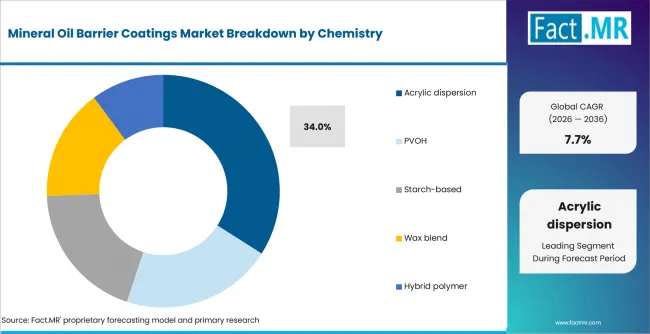
Mineral Oil Barrier Coatings Market Analysis By Chemistry | Source: Fact.MR
Acrylic dispersion is projected to account for 34% share in 2026 owing to water-based chemistry fit across paper and board coating lines. PVOH remains relevant where oxygen and oil resistance are part of the required barrier profile. Starch-based systems serve buyers that favor bio-based inputs and lower material complexity in paper packaging applications. Wax blend and Hybrid polymer systems remain in use where heat sealability and moisture resistance shape approval decisions.
Where is Substrate demand strongest?
Recycled board leads with 47% share in 2026.
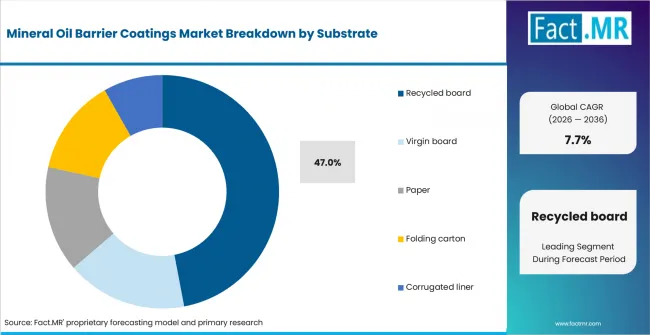
Mineral Oil Barrier Coatings Market Analysis By Substrate | Source: Fact.MR
Recycled board is anticipated to capture 47% share in 2026 as recovered fiber can carry mineral oil sources into food packaging. Virgin board follows where converters want cleaner input streams or lower testing burden during food packaging approval. Paper and Folding carton formats remain active where coating weight and printability guide converter approval. Corrugated liner is relevant when shipping formats need barrier claims without losing recyclability targets in paper recovery systems.
What supports Dry foods within Application?
Dry foods are projected to hold 32% share in 2026.
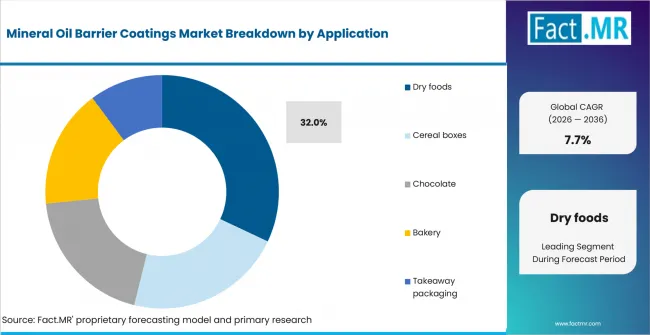
Mineral Oil Barrier Coatings Market Analysis By Application | Source: Fact.MR
Dry foods are estimated to represent 32% share in 2026 attributable to cereal boxes and carton formats that face mineral oil migration review. Cereal boxes remain a direct route since recycled board use is common in secondary packaging. Chocolate and Bakery applications need barrier choices that protect product quality and meet food-contact expectations. Takeaway packaging remains relevant where grease and moisture control overlap with mineral oil migration-control needs.
What is accelerating Mineral Oil Barrier Coatings Market adoption, and what is holding it back?
Recycled-board migration control is anticipated to drive market growth and qualification cost is expected to restrain the pace of approval.
Drivers Impact Analysis
| DRIVER | (~) % IMPACT ON CAGR | GEOGRAPHIC RELEVANCE | IMPACT TIMELINE |
|---|---|---|---|
| Mineral oil migration control in MOSH barrier | +0.8% | China and export suppliers | Medium term (2-4 years) |
| Food-contact qualification testing | +0.6% | Europe and North America | Short term (<= 2 years) |
| Recycled paperboard approval programs | +0.5% | Asia Pacific | Medium term (2-4 years) |
| Local support near paperboard converters | +0.4% | Global | Long term (>= 4 years) |
Source: Fact.MR analysis. Updated Jul 16, 2026
- Mineral oil migration control in MOSH barrier: Demand grows when coatings reduce mineral oil transfer from recycled board without making recycling harder. Packaging companies still need full production tests before replacing an approved coating.
- Food-contact qualification testing: Companies use these tests to confirm that coated packaging is safe during normal filling, storage, and handling. Clear records can shorten the approval process.
- Recycled paperboard approval programs: Recycled paperboard creates more need for barrier coatings because food safety and recycling must be considered together. Approval becomes easier when companies provide migration results and plant trial support.
- Local support near paperboard producers: Nearby support helps manufacturers test coating weight and mineral oil transfer at the same time. Faster review and clear records can make repeat orders easier.
Opportunity Impact Analysis
| OPPORTUNITY | (~) % IMPACT ON CAGR | GEOGRAPHIC RELEVANCE | IMPACT TIMELINE |
|---|---|---|---|
| Grades tuned for Recycled board | +0.5% | Global | Medium term (2-4 years) |
| Application labs for Acrylic dispersion | +0.4% | Asia Pacific and Europe | Short term (<= 2 years) |
| Rule-ready documentation | +0.4% | Europe and United Kingdom | Medium term (2-4 years) |
| Local trials with paperboard converters | +0.3% | India and Brazil | Long term (>= 4 years) |
Source: Fact.MR analysis. Updated Jul 16, 2026
- Grades tuned for Recycled board: Recycled board creates room for coatings that manage migration without blocking recovery routes. Supplier approval improves when migration data and recycling evidence are packaged together for buyers.
- Application labs for Acrylic dispersion: Acrylic dispersion systems need coating-line testing before a converter treats performance as repeatable. Application labs can reduce trial waste when they connect drying behavior with barrier results under paperboard coating conditions.
- Rule-ready documentation: European buyers need files that explain food-contact status and packaging recovery behavior in plain terms. Documentation is expected to become a sales tool when buyers compare otherwise similar coatings for regulated food packaging.
- Local trials with paperboard converters: Local trial support helps converters test coated paper and board under site-specific handling conditions. The opportunity is stronger in India and Brazil where packaging growth expands validation needs across converter plants.
Restraints Impact Analysis
| RESTRAINT | (~) % IMPACT ON CAGR | GEOGRAPHIC RELEVANCE | IMPACT TIMELINE |
|---|---|---|---|
| Qualification cost | -0.4% | Global processors | Medium term (2-4 years) |
| Fit limits in Acrylic dispersion | -0.3% | Global | Short term (<= 2 years) |
| Documentation burden | -0.3% | Europe and North America | Medium term (2-4 years) |
| Scale-up risk | -0.2% | High-volume plants | Long term (>= 4 years) |
Source: Fact.MR analysis. Updated Jul 16, 2026
- Qualification cost: Food packaging qualification requires migration testing and line trials before buyers approve recurring orders. Adoption is expected to slow where converters cannot spread testing cost across enough recurring packaging volume.
- Fit limits in Acrylic dispersion: Acrylic systems can face drying and coating-weight limits on some paperboard lines. Buyers are projected to hold back when process fit is uncertain after heat exposure in commercial runs.
- Documentation burden: Food-contact files and recycling evidence take time to prepare and review during formal buyer approval. This burden weighs more in Europe and North America where customers expect formal proof before approval.
- Scale-up risk: A coating that works at laboratory scale can perform differently during high-volume production. Large plants are expected to approve fewer grades when suppliers cannot prove repeatability before commercial runs.
Which countries are scaling Mineral Oil Barrier Coatings Market fastest?
Germany 8.8%, Brazil 8.1%, United States 7.3%
.webp "Top Country Growth Comparison Mineral Oil Barrier Coatings Market Cagr (2026 2036)")
Top Country Growth Comparison Mineral Oil Barrier Coatings Market Cagr (2026 2036) | Source: Fact.MR
Regional analysis covers North America; Europe; Asia Pacific; Latin America; and the Middle East & Africa.
| COUNTRY | 2026 to 2036 |
|---|---|
| Germany | 8.8% |
| Brazil | 8.1% |
| United States | 7.3% |
Source: Fact.MR analysis. Updated Jul 16, 2026
What is driving China’s growth through 2036?
10.4% CAGR, supported by large paperboard production and export packaging demand.
China has a broad paperboard production base that serves both local and export packaging. Export orders often require clear proof that a coating limits mineral oil transfer. Lower production prices in 2025 may also encourage packaging producers to compare water-based barrier products more closely before placing repeat orders.
How is India scaling Mineral Oil Barrier Coatings demand?
9.6% CAGR, backed by packaged-food growth and rising carton use.
More packaged food is increasing the need for cartons and paper-based packs in India. This gives coating companies more opportunities to run trials for dry-food packaging. Approval depends on whether the barrier works on existing coating lines and provides clear food-contact results.
What supports Germany’s outlook?
8.8% CAGR, driven by strict European packaging rules and an established paper industry.
Germany operates within demanding European food-contact and packaging rules. Its large use of paper and cardboard keeps recycled board under close review. Mineral oil barrier coatings gain importance where packaging must meet safety needs without making paper recovery more difficult.
What underpins Brazil’s growth?
8.1% CAGR, linked to food production and local pulp and paper activity.
Brazil benefits from close links between food processing and paper packaging. Higher output from both industries creates more use of cartons and dry-food packs. Coating demand rises when local producers need added protection against mineral oil transfer from recycled board.
How is the United States developing Mineral Oil Barrier Coatings demand?
7.3% CAGR, supported by containerboard scale and existing paper packaging capacity.
The United States already has a large network of paper mills and packaging plants. This allows new coatings to be tested across food and retail packaging without building new production systems. Products that limit mineral oil transfer while running well on current lines are expected to gain wider use.
Who leads the Mineral Oil Barrier Coatings Market?
Solenis and Michelman lead direct barrier-coating coverage and BASF and ACTEGA strengthen water-based paperboard coating technology.
Solenis brings paper packaging chemistry and TopScreen barrier coating coverage for food-grade paper applications. Michelman offers water-based protective barrier coatings across dry-food and flexible packaging uses that need barrier proof. BASF contributes Joncryl HPB technology for functional paperboard coatings that combine liquid barrier and heat-seal behavior. These companies compete on documented migration performance and coating-line support rather than broad packaging claims.
Archroma launched Cartaseal OGB F10 on March 18 2024 as a PFAS-free water-based oil and grease barrier coating for paper and board. Henkel expanded its paper barrier and heat-seal coatings portfolio on April 8 2026 with water-based systems for paper applications. ACTEGA announced on April 8 2026 that it would present barrier technologies and food-safe coatings for paper and board at Interpack 2026.
Which companies are the key providers?
Solenis and Michelman are key providers with BASF and ACTEGA profiled alongside Archroma and Henkel in the company set.
- Solenis
- Michelman
- BASF
- ACTEGA
- Archroma
- Henkel
Bibliography
- American Forest & Paper Association. (2026, May 29). AF&PA releases 66th Annual Paper Industry Capacity and Fiber Consumption Survey. AF&PA.
- ACTEGA. (2026, April 8). ACTEGA at Interpack 2026. ACTEGA EMEA.
- Archroma. (2024, March 18). Archroma launches Cartaseal OGB F10, a PFAS-free barrier coating for oil and grease applications. Archroma.
- European Paper Recycling Council. (2025). Monitoring Report 2024. European Paper Recycling Council.
- Henkel Adhesive Technologies. (2026, April 8). Henkel expands its barrier and heat seal coatings portfolio for paper applications. Henkel.
- India Brand Equity Foundation. (2025). India paper and packaging industry. IBEF.
This Report Addresses
- The report explains how Barrier Target and Chemistry affect the use of mineral oil barrier coatings in food packaging.
- Segment analysis covers MOSH barrier and Acrylic dispersion as the leading categories in 2026.
- Regional outlook evaluates US, Germany, France, UK and 30+ countries.
- The company section profiles Solenis, Michelman, BASF, ACTEGA, Archroma, and Henkel.
- The barrier review covers both MOSH and MOAH control. Each system is assessed against different food packaging needs.
- The use-case review covers Dry foods, Cereal boxes, Chocolate, Bakery, and Takeaway packaging where mineral oil control is required
What does the Mineral Oil Barrier Coatings Market cover?
The market covers MOSH barrier; MOAH barrier; Acrylic dispersion; and Recycled board systems used to limit mineral oil migration in food packaging.
The Mineral Oil Barrier Coatings Market covers coating systems designed to limit MOSH and MOAH migration across paper and board packaging. Coverage includes barrier-target choices that serve recycled board alongside virgin board and folding carton formats.
The market differs from general paper coatings since commercial value comes from a defined migration-control function and approval support. Broad grease barriers remain outside the boundary unless mineral oil control is part of the purchased function.
What is included in the scope?
The scope includes barrier coatings used on recycled paper and board packaging to limit MOSH/MOAH mineral oil migration.
The scope includes MOSH barrier and MOAH barrier systems across Acrylic dispersion and PVOH chemistries alongside Starch-based and Wax blend systems. Coverage spans Recycled board and Virgin board formats alongside Paper and Folding carton formats. Corrugated liner is included when mineral oil migration control is the purchased function for shipping formats. Dry foods and Cereal boxes are included where food packaging approval requires documented barrier performance.
What is excluded from the scope?
General paper coatings and packaging materials without mineral oil barrier function are outside the scope.
The scope excludes paperboard and coating products sold only for print appearance or general water resistance. Commodity paper and board materials are excluded unless the purchased function includes MOSH or MOAH control. Food packaging equipment remains outside the boundary because value in this market comes from coating chemistry and approval support.
How was the analysis built?
120+ sources; 35+ company portfolios; 25+ countries; and 20+ interviews.
- Primary Research: Primary research includes discussions with manufacturers, service providers, technology developers, distributors, end users, procurement teams, and subject-matter experts. These conversations examine purchasing priorities, product adoption, operational challenges, approval requirements, competitive positioning, and the factors that influence wider market acceptance.
- Desk Research: Desk research covers government statistics, regulatory publications, company filings, trade data, technical studies, industry associations, standards, public policy, and other authoritative sources. Every source used in the analysis is documented in the bibliography.
- Market Sizing and Forecasting: Market estimates combine historical performance, demand indicators, pricing and volume trends, segment shares, company participation, country-level growth, adoption patterns, investment activity, and barriers to market expansion.
- Data Validation and Update Cycle: Findings are validated by comparing primary interviews with public data, company activity, regulatory changes, trade patterns, and industry developments. Regular updates review new product launches, capacity changes, partnerships, approvals, procurement trends, and shifts in commercial adoption.
Segmentation
What is the report’s scope and coverage?
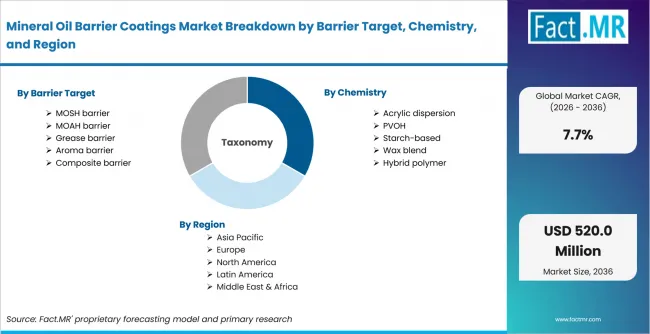
Mineral Oil Barrier Coatings Market Breakdown By Barrier Target, Chemistry, And Region | Source: Fact.MR
| Attribute | Details |
|---|---|
| Quantitative Units | USD million |
| Market Definition | Barrier coatings used on recycled paper; board; and food packaging to limit MOSH/MOAH mineral oil migration |
| Barrier Target | MOSH barrier; MOAH barrier; Grease barrier; Aroma barrier; Composite barrier |
| Chemistry | Acrylic dispersion; PVOH; Starch-based; Wax blend; Hybrid polymer |
| Substrate | Recycled board; Virgin board; Paper; Folding carton; Corrugated liner |
| Application | Dry foods; Cereal boxes; Chocolate; Bakery; Takeaway packaging |
| Regions Covered | North America; Europe; Asia Pacific; Central and South America; Middle East and Africa |
| Countries Covered | Germany; Brazil; United States; India; China |
| Key Companies Profiled | Solenis; Michelman; BASF; ACTEGA; Archroma; Henkel |
| Forecast Period | 2026 to 2036 |
| Approach | Hybrid top-down and bottom-up approach using food packaging barrier coatings; segment shares; country growth; supplier mapping; and technical validation |
Source: Fact.MR analysis. Updated Jul 16, 2026
How is the market segmented?
-
By Barrier Target:
- MOSH barrier
- MOAH barrier
- Grease barrier
- Aroma barrier
- Composite barrier
-
By Chemistry:
- Acrylic dispersion
- PVOH
- Starch-based
- Wax blend
- Hybrid polymer
-
By Substrate:
- Recycled board
- Virgin board
- Paper
- Folding carton
- Corrugated liner
-
By Application:
- Dry foods
- Cereal boxes
- Chocolate
- Bakery
- Takeaway packaging
-
By Region:
- North America
- United States
- Canada
- Europe
- Germany
- United Kingdom
- France
- Italy
- Spain
- Asia Pacific
- Japan
- South Korea
- Australia
- Central & South America
- Brazil
- Argentina
- Mexico
- Chile
- Middle East & Africa
- UAE
- Saudi Arabia
- South Africa
- North America
Frequently Asked Questions
Which Barrier Target leads the Mineral Oil Barrier Coatings Market?
Which Chemistry leads the Mineral Oil Barrier Coatings Market?
Which Substrate leads the Mineral Oil Barrier Coatings Market?
Which Application leads the Mineral Oil Barrier Coatings Market?
Which Region leads the Mineral Oil Barrier Coatings Market?
How does Germany perform in the Mineral Oil Barrier Coatings Market?
How does Brazil perform in the Mineral Oil Barrier Coatings Market?
How does the United States perform in the Mineral Oil Barrier Coatings Market?
What is the primary driver in the Mineral Oil Barrier Coatings Market?
What is the main restraint in the Mineral Oil Barrier Coatings Market?
Why is MOSH barrier important?
Why do food packaging converters dominate demand?
Who worked on this report


Preview the report firsthand - request a free sample
Free SampleGet the brochure for pricing and purchase details
Download PDF