- Market Value (2025): USD 20.5 Bn
- Estimated Value (2026): USD 21.8 Bn
- Forecast Value (2036): USD 40.5 Bn
- CAGR (2026-2036): 6.4%
What is the Biopharmaceuticals Packaging Market forecast to be worth by 2036?
USD 40.5 billion by 2036 at a 6.4% CAGR.
- The biopharmaceuticals packaging market reached USD 20.5 billion in 2025.
- Demand is projected to increase from USD 21.8 billion in 2026 to USD 40.5 billion by 2036.
- The market is forecast to expand at a 6.4% CAGR from 2026 to 2036.
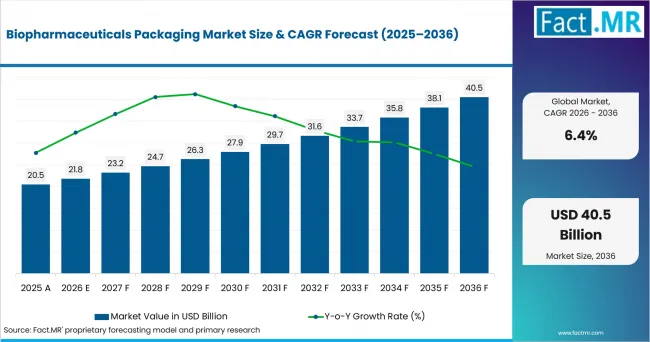
Biopharmaceuticals Packaging Market Value Analysis | Source: Fact.MR
What are the defining numbers behind Biopharmaceuticals Packaging Market growth?
USD 18.7 billion is expected between 2026 and 2036.
- Demand Drivers in the Market
- The commercial biologics pipeline is widening the number of formulations that require validated containment. FDA continued to publish new biological license approvals through 2025 and 2026, while its January 2026 cell and gene therapy update noted that CBER had approved close to 50 cell and gene therapies over the preceding decade. Each new product requires a container-closure system matched to its stability, route of administration and manufacturing process. This supports demand across pharmaceutical packaging used for injectable and temperature-sensitive products.
- Sterility and container-closure integrity remain purchase requirements for injectable biologics. FDA guidance treats the packaging system as part of product quality documentation, while EU GMP Annex 1 requires sterile manufacturers to manage contamination control across filling and closure operations. Packaging suppliers therefore compete on material compatibility, particulate control and documented integrity rather than container cost alone.
- Vaccines create a recurring need for temperature-qualified containment and transport. WHO states that most vaccines require refrigerated storage between 2°C and 8°C, while some products require frozen or ultra-cold conditions. Its 2025 international shipping guidance added specific treatment of ultra-low-temperature vaccine shipments, increasing specification depth for cold chain packaging.
- Ready-to-use sterile formats are reducing preparation steps at fill-finish sites. Stevanato reports continued customer movement toward pre-sterilized vials and cartridges, while West made its Synchrony S1 prefillable syringe system commercially available in 2026 for biologics and vaccine applications. Packaging that arrives washed, sterilized and line-ready can reduce on-site processing requirements for drug manufacturers.
- Advanced therapies increase demand for low-temperature and low-extractable packaging. Merck offers single-use freeze assemblies validated for integrity at temperatures down to -80°C, while Gore supplies silicone-free syringe plungers and flexible freeze containers for sensitive biologic applications. These requirements raise the value of packaging engineered around protein stability and cold handling.
- Key Segments Analyzed
- Primary Packaging accounts for 42.6% of Product in 2026 because vials, syringes and other direct-contact containers form the immediate barrier between a biopharmaceutical formulation and the external environment.
- Glass Based Packaging holds 38.9% of Material in 2026, supported by the use of pharmaceutical glass in sterile vials and syringes where chemical resistance and container integrity are central qualification criteria.
- Sterile Packaging represents 54.3% of Packaging Format in 2026 because vaccines and injectable biologics require controlled filling, closure and contamination-prevention processes.
- Vaccines account for 36.8% of Application in 2026 as routine immunization and newer vaccine platforms require qualified vials, syringes and temperature-controlled shipping configurations.
- Pharmaceutical Companies hold 45.7% of End Use in 2026 because marketing authorization holders and drug manufacturers directly qualify packaging systems against formulation stability, filling-line compatibility and regulatory documentation requirements.
- Analyst Opinion at Fact.MR
- Shambhu Nath Jha, Principal Consultant at Fact.MR, states, “Biopharmaceutical packaging decisions are moving closer to formulation and fill-finish strategy. Buyers need containment systems that preserve product quality through sterilization, storage and administration. Suppliers that can provide validated material data and line-ready formats should gain relevance as biologics portfolios diversify through 2036.”
- Strategic Implications
- Packaging suppliers should enter drug-development programmes before commercial fill-finish is locked. Early compatibility work can reduce the cost of changing vials, stoppers or syringe components after stability studies are underway.
- Ready-to-use platforms can shift value from the container itself toward validated preparation and sterility assurance. Suppliers with pre-washed and pre-sterilized formats can address manufacturers seeking shorter changeovers and lower cleanroom handling requirements.
- A dual material strategy is becoming useful for sensitive biologics. Glass remains established, while cyclic olefin polymer formats offer an alternative where breakage or surface interaction creates formulation risk.
- Cold-chain packaging should be sold with clear qualification data for the intended temperature range. Vaccine and advanced-therapy buyers need evidence that packaging remains intact through refrigerated, frozen or ultra-cold distribution conditions.
How does the Biopharmaceuticals Packaging Market break down by segment?
The market is segmented by Product, Material, Packaging Format, Application and End Use.
Why does Primary Packaging lead Product?
Primary Packaging is projected to account for a 42.6% share in 2026.
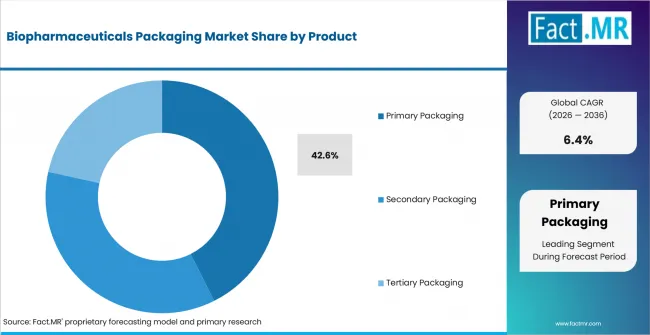
Biopharmaceuticals Packaging Market Analysis By Product | Source: Fact.MR
Primary packaging leads because the vial, syringe, ampoule, cartridge or bottle directly contacts the biopharmaceutical formulation. Its material and closure system therefore influence sterility, extractables, moisture or gas ingress and the product’s stability profile during shelf life.
FDA container-closure guidance requires sponsors to provide information showing that packaging is suitable for the drug or biological product. This makes primary containment a qualification decision that sits inside CMC development. The same requirement supports adjacent demand in contract packaging when drug owners outsource fill-finish and packaging operations.
Why does Glass Based Packaging lead Material?
Glass Based Packaging is projected to account for a 38.9% share in 2026.
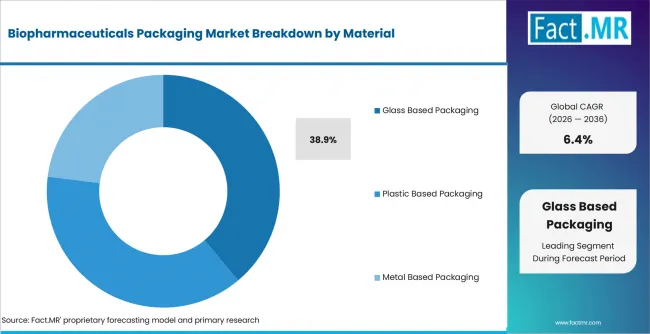
Biopharmaceuticals Packaging Market Analysis By Material | Source: Fact.MR
Glass leads because parenteral biologics commonly use vials and syringes that need dimensional consistency, low permeability and established pharmaceutical compatibility. Type I borosilicate glass is particularly relevant where the formulation is sensitive to interaction with the container wall.
WHO notes that vaccine vials are commonly made from glass because the material can maintain package integrity across demanding transport temperatures. FDA also issued specific 2024 guidance for post-approval changes involving glass vials and stoppers used with sterile drug products, including biological products. These requirements support continued demand for qualified glass packaging systems.
Why does Sterile Packaging lead Packaging Format?
Sterile Packaging is projected to account for a 54.3% share in 2026.
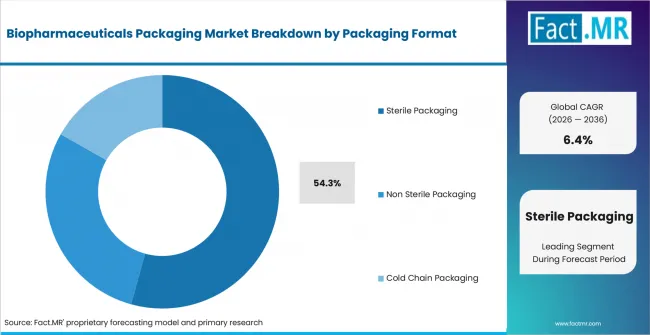
Biopharmaceuticals Packaging Market Analysis By Packaging Format | Source: Fact.MR
Sterile formats lead because many biologics are administered by injection and cannot rely on terminal processing that would damage the active molecule. Packaging components must therefore enter the fill-finish workflow with defined cleanliness, sterilization and integrity controls.
EU GMP Annex 1 places sterile manufacturing within a contamination-control strategy that covers equipment, components and closure processes. Ready-to-use vials and syringes reduce washing and sterilization steps at the drug manufacturer, which can simplify aseptic operations and support faster line changeovers.
Why do Vaccines lead Application?
Vaccines are projected to account for a 36.8% share in 2026.
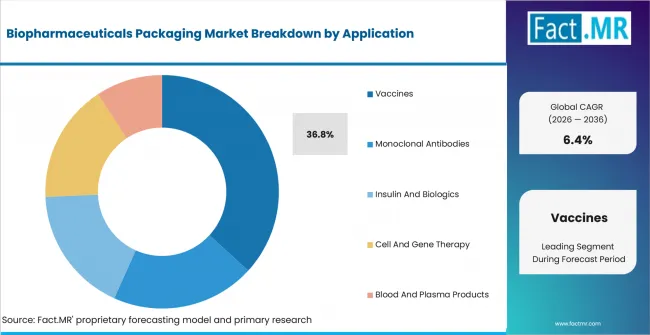
Biopharmaceuticals Packaging Market Analysis By Application | Source: Fact.MR
Vaccines lead because each dose depends on a validated container and a distribution configuration that preserves potency through storage and transport. Presentations range from single-dose syringes to multi-dose vials, with secondary and tertiary packaging selected around programme volume and temperature requirements.
WHO’s 2025 international shipping guidance covers conventional and ultra-low-temperature vaccine shipments. Its technical guidance also notes that most vaccines remain within a 2°C to 8°C cold chain. These requirements create recurring demand for vials, cartons and insulated systems and connect the segment with the prefilled syringes category where dose presentation is shifting toward ready-to-administer formats.
Why do Pharmaceutical Companies lead End Use?
Pharmaceutical Companies are projected to account for a 45.7% share in 2026.
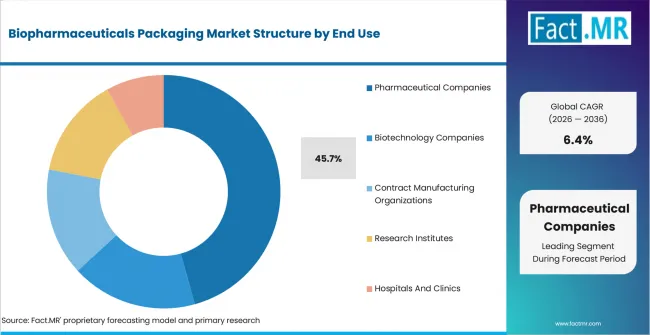
Biopharmaceuticals Packaging Market Analysis By End Use | Source: Fact.MR
Pharmaceutical companies lead because they remain responsible for demonstrating that the container-closure system protects the product throughout its approved shelf life. Packaging selection is therefore linked to stability studies, filling-line validation and regulatory submissions rather than being treated as a downstream purchasing choice.
Drug owners also coordinate changes across manufacturing sites and contract partners. When a vial, stopper or syringe component changes, the company may need comparability work and updated documentation before the new configuration can be implemented. That gives established packaging systems a long qualification life once they are embedded in a commercial product.
What is accelerating Biopharmaceuticals Packaging Market adoption, and what is holding it back?
Growth is being supported by biologic approvals, sterile injectable manufacturing and temperature-sensitive therapies. Adoption is moderated by qualification cost, change-control requirements and the technical risk of container interaction with sensitive formulations.
Drivers Impact Analysis
| Factor | (~) % Impact on CAGR | Geographic Relevance | Impact Timeline |
|---|---|---|---|
| Biologic and vaccine pipeline expansion | +1.4% | Global | Short term (≤ 2 years) |
| Sterile injectable manufacturing expansion | +1.1% | USA; Germany; UK | Short term (≤ 2 years) |
| Temperature-sensitive therapy growth | +0.9% | Global | Medium term (2–4 years) |
| Ready-to-use vial and syringe adoption | +0.7% | USA; Europe; Japan | Medium term (2–4 years) |
| Cell and gene therapy commercialization | +0.5% | USA; Germany; UK; Japan | Long term (≥ 4 years) |
Source: Fact.MR analysis. Updated Aug 25, 2026
Opportunity Impact Analysis
| Factor | (~) % Impact on CAGR | Geographic Relevance | Impact Timeline |
|---|---|---|---|
| Prefilled syringe and cartridge conversion | +0.8% | USA; Europe; Japan | Medium term (2–4 years) |
| Ready-to-use sterile container platforms | +0.7% | Germany; USA; Japan | Medium term (2–4 years) |
| Advanced polymer containment for sensitive biologics | +0.6% | Global | Medium term (2–4 years) |
| Frozen and ultra-cold packaging systems | +0.5% | USA; Europe; Japan | Long term (≥ 4 years) |
Source: Fact.MR analysis. Updated Aug 25, 2026
Restraints Impact Analysis
| Factor | (~) % Impact on CAGR | Geographic Relevance | Impact Timeline |
|---|---|---|---|
| Packaging qualification and change-control burden | -0.9% | Global | Short term (≤ 2 years) |
| Glass breakage and formulation compatibility risk | -0.7% | Global | Short term (≤ 2 years) |
| Cold-chain validation and distribution cost | -0.6% | Global | Medium term (2–4 years) |
| Specialty glass and polymer supply constraints | -0.4% | Import-dependent markets | Medium term (2–4 years) |
Source: Fact.MR analysis. Updated Aug 25, 2026
Which countries are scaling the Biopharmaceuticals Packaging Market through 2036?
- Germany: The country’s pharmaceutical manufacturing base gives packaging suppliers a dense customer network for sterile injectables and biologics. Destatis recorded 381 pharmaceutical manufacturing establishments and 134,195 employees in the sector in 2025, supporting local demand for qualified primary containers and fill-finish components.
- Brazil: Domestic vaccine production is creating direct packaging requirements around vials, syringes and cold-chain distribution. Brazil’s Ministry of Health reported that the first 1.3 million doses of the domestically produced single-dose dengue vaccine had already been manufactured for the 2026 rollout.
- USA: FDA continues to approve new biological products across vaccines, blood products and advanced therapies. Each approval creates a formulation-specific packaging requirement that must be supported by stability and container-closure documentation before commercial release.
- UK: The country retains a sizeable life-sciences manufacturing base. A 2026 government evaluation reported 1,860 life-science companies whose primary activity was manufacturing in 2023/24, employing more than 130,000 people. This supports demand for primary packaging and outsourced fill-finish formats.
- Japan: PMDA continues to approve regenerative medical products and other new medicines. The presence of gene and cell therapies increases requirements for sterile containment, cryogenic handling and traceable packaging configurations suited to small, high-value batches.
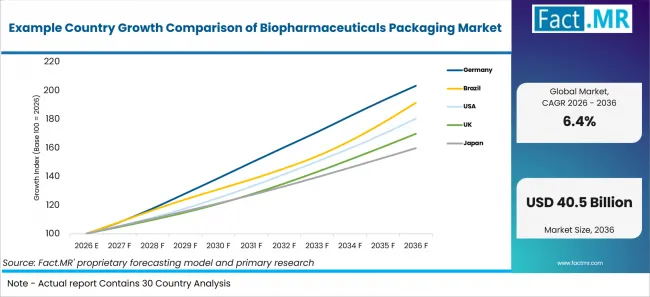
Example Country Growth Comparison Of Biopharmaceuticals Packaging Market | Source: Fact.MR
Country CAGR (2026-2036)
| Country | CAGR, 2026-2036 |
|---|---|
| Germany | 7.4% |
| Brazil | 6.7% |
| USA | 6.1% |
| UK | 5.4% |
| Japan | 4.8% |
Source: Fact.MR analysis. Updated Aug 25, 2026
What is driving Germany’s growth through 2036?
Germany is forecast to expand at a 7.4% CAGR from 2026 to 2036.
Growth is supported by a manufacturing base that combines conventional pharmaceutical production with biotechnology-led launches. The vfa reported that 41% of medicines with new active ingredients introduced in Germany during 2025 were produced using genetic engineering. These products frequently require injectable presentation and tighter compatibility control than conventional oral formulations.
German buyers also operate within EU sterile-manufacturing rules. Annex 1 requirements increase the value of pre-sterilized containers and documented closure systems because manufacturers must control contamination risk across component preparation, filling and sealing.
What is driving Brazil’s growth through 2036?
Brazil is forecast to expand at a 6.7% CAGR from 2026 to 2036.
Brazil is expanding domestic vaccine technology alongside established immunobiological production. Fiocruz reported in August 2025 that Bio-Manguinhos had developed a national mRNA platform for vaccines and therapies, creating a local base for products that require sterile primary packaging and temperature-managed distribution.
The Ministry of Health also confirms domestic production of yellow-fever vaccine through Bio-Manguinhos. A broader domestic product base can increase demand for qualified glass containers and secondary cold-chain formats close to fill-finish sites.
What is driving USA’s growth through 2036?
The USA is forecast to expand at a 6.1% CAGR from 2026 to 2036.
The United States combines a continuing flow of new biological approvals with detailed container-closure requirements. FDA’s 2024 guidance on glass vial and stopper changes applies to approved sterile drug products, including biologics, showing that packaging changes remain controlled after commercial approval.
Advanced therapies add another layer of packaging complexity. FDA said in January 2026 that CBER had approved close to 50 cell and gene therapies over the previous decade. These products can require low-temperature storage, small-batch packaging and strict chain-of-custody controls.
What is driving the UK’s growth through 2036?
The UK is forecast to expand at a 5.4% CAGR from 2026 to 2036.
Government policy is supporting domestic medicines manufacturing, including vaccines and biotherapeutics. The UK’s manufacturing funds have targeted commercial-scale projects and fill-finish capacity, which increases the local requirement for validated vials, syringe components and secondary packaging.
The MHRA’s decentralised manufacturing framework came into effect in July 2025 for point-of-care and modular manufacturing. As production moves closer to treatment settings in selected applications, packaging systems must support controlled identity, integrity and storage through more distributed workflows.
What is driving Japan’s growth through 2036?
Japan is forecast to expand at a 4.8% CAGR from 2026 to 2036.
Japan’s regenerative-medicine pathway is generating packaging requirements for cell and gene therapies that may be produced in limited batches and handled under controlled temperatures. PMDA’s 2025 approval records include regenerative products such as Elevidys and Vyjuvek, while additional products continued to appear in 2026 review listings.
These therapies increase demand for packaging that can maintain sterility and traceability through storage and administration. Japanese pharmaceutical manufacturers also rely on established vial and syringe formats for vaccines and other injectable biologics, sustaining replacement and qualification demand.
Who Leads the Biopharmaceuticals Packaging Market?
Merck KGaA leads the Biopharmaceuticals Packaging Market.
Merck participates through biopharmaceutical fluid-management and storage systems, including sterile single-use assemblies and freeze configurations used in the movement and storage of sensitive process fluids. Its Mobius portfolio includes freeze assemblies tested for integrity at temperatures down to -80°C, which is relevant where biopharmaceutical handling extends into frozen storage.
West Pharmaceutical Services competes through elastomer closures, vial and syringe components and integrated containment systems for injectable drugs. Its 2026 Synchrony S1 prefillable syringe system includes configurations for biologics and vaccines. W.L. Gore adds fluoropolymer-based packaging and drug-delivery components, including silicone-free syringe plungers and flexible freeze containers.
Gerresheimer and Stevanato Group compete through ready-to-use vials, syringes and cartridges. Both companies are investing around pre-sterilized container platforms that reduce preparation work at fill-finish sites. LOG Pharma Packaging, Pacific Vial Manufacturing, Shandong Pharmaceutical Glass and Chongqing Zhengchuan Pharmaceutical Packaging add vial and glass-container capacity across regional supply chains.
Piramal Glass Private Limited was acquired by Blackstone in 2021 and now operates as PGP Glass.
Supplier selection depends on container integrity, material compatibility and the ability to support regulatory documentation. Ready-to-use formats can shorten filling preparation, while alternative polymers gain relevance where glass breakage or surface interaction creates a formulation risk.
Which companies are the key providers?
Key companies profiled include Merck KGaA; LOG Pharma Packaging; W.L. Gore & Associates Inc.; West Pharmaceutical Services Inc.; Pacific Vial Manufacturing; Piramal Glass Private Limited; Gerresheimer AG; Stevanato Group; Shandong Pharmaceutical Glass Co.; and Chongqing Zhengchuan Pharmaceutical Packaging Co.
- Merck KGaA
- LOG Pharma Packaging
- W.L. Gore & Associates Inc.
- West Pharmaceutical Services Inc.
- Pacific Vial Manufacturing
- Piramal Glass Private Limited
- Gerresheimer AG
- Stevanato Group
- Shandong Pharmaceutical Glass Co
- Chongqing Zhengchuan Pharmaceutical Packaging Co.
Bibliography
- U.S. Food and Drug Administration. (2025). 2025 Biological Approvals. Center for Biologics Evaluation and Research.
- U.S. Food and Drug Administration. (2026). FDA Increases Flexibility on Requirements for Cell and Gene Therapies to Advance Innovation.
- U.S. Food and Drug Administration. (2024). Container Closure System and Component Changes: Glass Vials and Stoppers.
- U.S. Food and Drug Administration. (1999). Container Closure Systems for Packaging Human Drugs and Biologics.
- European Commission. (2022). EU GMP Annex 1: Manufacture of Sterile Medicinal Products. Directorate-General for Health and Food Safety.
- World Health Organization. (2025). Guidelines for the International Packaging and Shipping of Vaccines, 7th edition.
- World Health Organization. (2024). How Are Vaccines Developed and Produced?
- Federal Statistical Office of Germany. (2026). Employees and Turnover of Manufacturing Establishments: Manufacture of Pharmaceutical Products, 2025.
- German Association of Research-Based Pharmaceutical Companies. (2026). Innovationsbilanz 2025.
- Ministry of Health, Brazil. (2025). Vaccination: 2025 Health Balance. Government of Brazil.
- Fiocruz. (2025). Fiocruz Moves Forward with National Platform for mRNA Vaccines.
- Department for Science, Innovation and Technology, UK. (2026). Evaluation of the Medicines and Diagnostics Manufacturing Transformation Fund and the Life Sciences Innovative Manufacturing Fund.
- Medicines and Healthcare products Regulatory Agency. (2025). Decentralised Manufacture: UK Guideline on Good Manufacturing Practice.
- Pharmaceuticals and Medical Devices Agency, Japan. (2026). Review Reports: Regenerative Medical Products.
- Merck. (2026). Mobius 2D and 3D Assemblies and Storage Systems.
- West Pharmaceutical Services, Inc. (2026). Annual Report on Form 10-K for 2025.
- West Pharmaceutical Services, Inc. (2026). West Synchrony S1 Prefillable Syringe System Commercially Available at Pharmapack.
- W. L. Gore & Associates. (2026). Pharmaceutical and Biopharmaceutical Solutions.
- Gerresheimer AG. (2025). Gerresheimer at CPHI 2025: High-Value Solutions for Innovative Therapies.
- Stevanato Group. (2026). Annual Report on Form 20-F for 2025.
- PGP Glass. (2026). Company Overview and Milestones.
This Report Answers
- How biopharmaceutical packaging demand is changing across direct-contact containers and downstream transport formats.
- Which product, material, packaging format, application and end-use categories account for the leading positions in the 2026 market.
- How sterile manufacturing requirements and temperature control influence packaging qualification.
- Why growth differs across Germany, Brazil, the USA, the UK and Japan.
- How packaging suppliers compete through ready-to-use formats, material performance and fill-finish compatibility.
What does the Biopharmaceuticals Packaging Market cover?
The Biopharmaceuticals Packaging Market covers packaging systems used to contain, protect and move commercial biopharmaceutical products. Revenue is counted for primary, secondary and tertiary packaging products that are supplied for vaccines, monoclonal antibodies, insulin and other biologics, cell and gene therapies and blood or plasma products.
The market includes sterile and non-sterile configurations together with cold-chain packaging where the physical packaging is sold as part of the product-protection system.
What is included in the scope?
The scope includes primary packaging such as vials, syringes, ampoules, cartridges and bottles. It also includes secondary packaging such as bottles and cartons and labeling systems, together with tertiary shipping containers and pallet systems.
Material coverage includes glass-based packaging, plastic-based packaging and metal-based packaging. The assessment includes sterile packaging, non-sterile packaging and cold-chain formats used for refrigerated or frozen storage. Buyers include pharmaceutical companies, biotechnology companies, contract manufacturing organizations, research institutes and hospitals or clinics.
What is excluded from the scope?
Packaging used exclusively for conventional small-molecule medicines is excluded when it is not supplied for a biopharmaceutical application. General consumer packaging and laboratory containers that do not enter a commercial biopharmaceutical packaging workflow are outside the market.
Cold-chain logistics services and temperature-monitoring software are excluded unless revenue relates directly to the physical packaging system. Upstream bioprocess equipment is also excluded when it is used only inside manufacturing and does not function as packaging for stored or distributed biopharmaceutical product.
How Was the Analysis Built?
The analysis combines primary research with desk research across the defined segment and country structure.
- Primary Research: Interviews are directed toward pharmaceutical packaging manufacturers, biologics producers, fill-finish operators, contract manufacturers and cold-chain specialists. Discussions examine container qualification, material selection, line compatibility and purchasing criteria.
- Desk Research: The review uses regulatory guidance from FDA, EU authorities, WHO and national agencies, together with official manufacturing statistics and current company disclosures. These sources explain packaging requirements, demand mechanisms and competitive positioning.
- Market Sizing and Forecasting: Sizing variables include biologics production, injectable dose volume, packaging content per dose, sterile fill-finish capacity, material mix and temperature-controlled shipment requirements. Country forecasts consider manufacturing activity and the local mix of vaccines and advanced therapies.
- Data Validation and Update Cycle: Findings are cross-checked against regulatory developments, company product activity and manufacturing evidence. Updates review changes in packaging formats, sterile processing requirements and biopharmaceutical production capacity.
Segmentation
What is the report's scope and coverage?
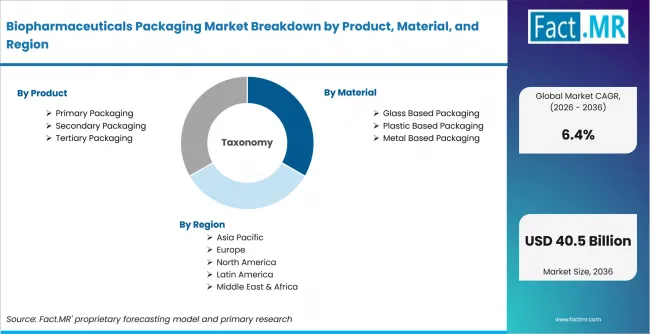
Biopharmaceuticals Packaging Market Breakdown By Product, Material, And Region | Source: Fact.MR
| Attribute | Details |
|---|---|
| Quantitative Units | USD Billion |
| Market Definition | Packaging systems used to contain, protect and distribute commercial biopharmaceutical products across the defined product, material, format, application and end-use segments |
| Segments Covered | Product; Material; Packaging Format; Application; End Use |
| Regions Covered | North America; Latin America; Europe; East Asia; South Asia and Pacific; Middle East and Africa |
| Countries Covered | Germany; Brazil; USA; UK; Japan |
| Key Companies Profiled | Merck KGaA; LOG Pharma Packaging; W.L. Gore & Associates Inc.; West Pharmaceutical Services Inc.; Pacific Vial Manufacturing; and others |
| Forecast Period | 2026 to 2036 |
| Base Year | 2026 |
| Market Value, 2026 | USD 21.8 billion |
| Market Value, 2036 | USD 40.5 billion |
| CAGR, 2026-2036 | 6.4% |
| Absolute Opportunity | USD 18.7 billion |
| Approach | Hybrid demand-side and top-down analysis using biopharmaceutical production, packaging content, material mix, sterile fill-finish requirements and country-level demand |
Source: Fact.MR analysis. Updated Aug 25, 2026
How is the market segmented?
-
By Product:
- Primary Packaging
- Vials
- Syringes
- Ampoules
- Cartridges
- Bottles
- Secondary Packaging
- Bottles And Cartons
- Labeling Systems
- Tertiary Packaging
- Shipping Containers
- Pallet Systems
- Primary Packaging
-
By Material:
- Glass Based Packaging
- Type I Borosilicate Glass
- Type II Treated Glass
- Plastic Based Packaging
- Polyethylene
- Polypropylene
- Cyclic Olefin Polymer
- Metal Based Packaging
- Foil Based Containers
- Protective Caps And Closures
- Glass Based Packaging
-
By Packaging Format:
- Sterile Packaging
- Non Sterile Packaging
- Cold Chain Packaging
- Refrigerated Packaging
- Frozen Storage Packaging
-
By Application:
- Vaccines
- Monoclonal Antibodies
- Insulin And Biologics
- Cell And Gene Therapy
- Blood And Plasma Products
-
By End Use:
- Pharmaceutical Companies
- Biotechnology Companies
- Contract Manufacturing Organizations
- Research Institutes
- Hospitals And Clinics
-
By Region:
- North America
- Latin America
- Western Europe
- Eastern Europe
- East Asia
- South Asia and Pacific
- Middle East & Africa
Frequently Asked Questions
What is the Biopharmaceuticals Packaging Market value in 2026?
At what CAGR is the market projected to grow?
What is the projected market value by 2036?
Which Product leads the market?
Which Material leads the market?
Which Packaging Format leads the market?
Which Application leads the market?
Which End Use leads the market?
Which country records the highest listed CAGR?
Which company leads the Biopharmaceuticals Packaging Market?
Which companies are included in the market assessment?
Who worked on this report


Preview the report firsthand - request a free sample
Free SampleGet the brochure for pricing and purchase details
Download PDF