- Market Value (2025): USD 321.7 Mn
- Estimated Value (2026): USD 370.0 Mn
- Forecast Value (2036): USD 1497.0 Mn
- CAGR (2026-2036): 15.0%
What is the Bio Anti-Fouling Polymers Market forecast to be worth by 2036?
USD 370.0 million in 2026 to USD 1497.0 million by 2036 at a 15.0% CAGR.
- The bio anti-fouling polymers market reached USD 321.7 million in 2025.
- Demand is projected to increase from USD 370.0 million in 2026 to USD 1497.0 million by 2036.
- The market is forecast to record 15.0% CAGR from 2026 to 2036 as vessel owners and coating formulators adopt polymer surfaces that control marine growth with lower toxic release.
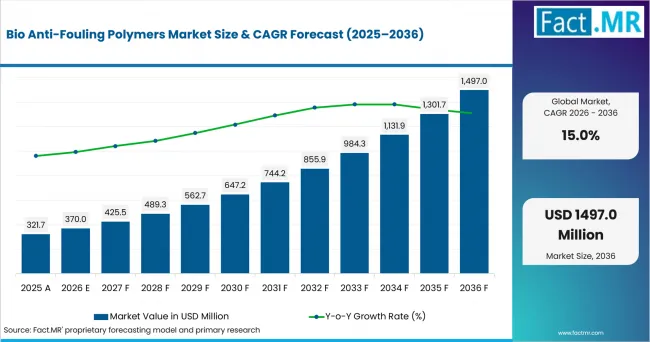
Bio Anti Fouling Polymers Market Value Analysis | Source: Fact.MR
What are the defining numbers behind Bio Anti-Fouling Polymers Market growth?
An absolute opportunity of USD 1,127.0 million is expected between 2026 and 2036.
- Demand Drivers in the Market
- Vessel owners need coatings that maintain a smoother hull surface because marine growth raises drag during long voyages.
- Shipyards need foul-release systems that fit dry-dock schedules, so coatings with simpler newbuilding application carry practical value.
- Aquaculture operators need coated nets, cages and service gear that reduce organism build-up while keeping cleaning cycles manageable.
- Marine coating formulators need polymer chemistries that meet stricter biofouling and discharge rules without returning to organotin-era chemistry.
- Port authorities are raising documentation expectations. IMO MEPC 83 approved guidance on in-water cleaning of ships’ biofouling in April 2025 and approved a new output to develop a legally binding framework for the control and management of ships’ biofouling.
- Key Segments Analyzed
- By Polymer: Zwitterionic is expected to hold 40.0% share in 2026 owing to its hydration layer, which reduces protein and organism attachment.
- By Mode: Foul release is projected to account for 52.0% share in 2026 because low-surface-energy coatings suit moving vessels and planned cleaning.
- By Vessel Area: Hull is anticipated to capture 39.0% share in 2026 due to its direct link with drag, fuel use and emissions management.
- By Customer: Commercial shipping is estimated to represent 51.0% share in 2026 as fleet operators monitor hull condition across voyages and dry-dock cycles.
- Analyst Opinion at Fact.MR
- Shambhu Nath Jha, Principal Consultant at Fact.MR, states, “Biofouling is shifting from a paint-only problem to an operating-risk problem. The market is expected to reward polymer systems that hold a clean surface during real vessel schedules, not only during static laboratory tests. Coating providers should combine validated foul-release chemistry, dry-dock application support and documentation that helps ship operators pass port and class reviews.”
- Strategic Implications
- Shipyards should document coating windows and surface-preparation needs so newbuilding teams are able to avoid post-delivery rework.
- Vessel owners should track speed loss and fouling inspection results when comparing bio-based silicone and zwitterionic systems.
- Aquaculture customers should evaluate polymer coatings against cleaning labor, gear downtime and local water-quality rules.
South Korea is forecast to record 17.9% CAGR through 2036, supported by port throughput and shipbuilding programs. The USA is projected to post 16.3% CAGR as aquaculture support and vessel-discharge rules shape coating choices. Germany is anticipated to advance at 14.8% CAGR due to seaport traffic and coatings capability. The UK is estimated to reach 14.1% CAGR as port freight and fishing fleets sustain underwater-surface maintenance. Japan is expected to post 13.3% CAGR, led by container-port traffic and marine production.
How does the Bio Anti-Fouling Polymers Market break down by segment?
Zwitterionic leads Polymer at 40.0%; Foul release leads Mode at 52.0%.
Which Polymer dominates?
Zwitterionic is expected to hold 40.0% share in 2026.
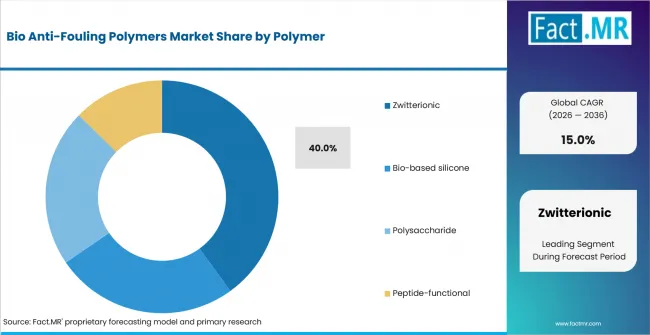
Bio Anti Fouling Polymers Market Analysis By Polymer | Source: Fact.MR
Zwitterionic polymers lead because their charged surface binds water and creates a hydration layer that makes early attachment harder. That mechanism fits vessels and aquaculture gear where owners want lower fouling without heavy reliance on leaching biocides. Adoption is strongest where coating formulators need a documentable technical route during customer qualification.
What leads the Mode segment?
Foul release is projected to account for 52.0% share in 2026.
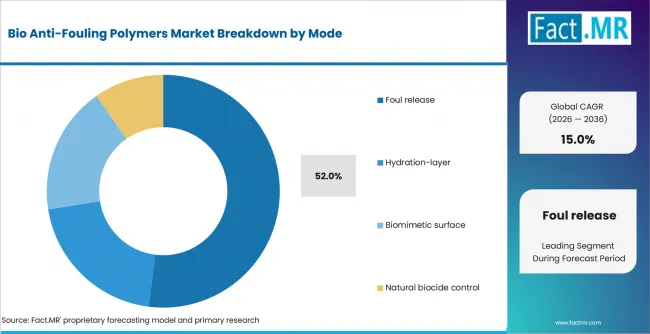
Bio Anti Fouling Polymers Market Analysis By Mode | Source: Fact.MR
Foul-release systems lead because they reduce the strength of organism attachment instead of depending mainly on toxic release. PPG reported in March 2025 that SIGMAGLIDE 2390 is a biocide-free coating used on a COSCO Shipping crude oil tanker drydocking. That development shows why low-surface-energy polymer systems are being positioned for commercial vessels where fuel and cleaning costs are measured.
How does Vessel Area shape demand?
Hull is anticipated to capture 39.0% share in 2026.
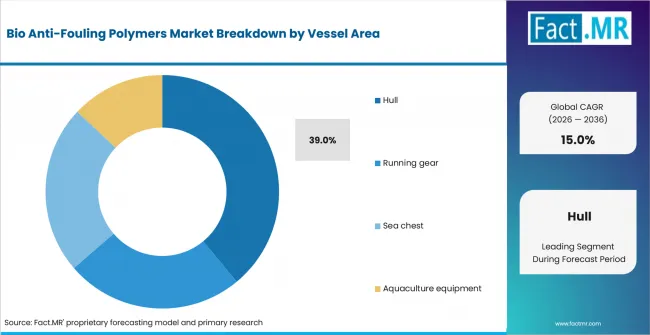
Bio Anti Fouling Polymers Market Analysis By Vessel Area | Source: Fact.MR
Hull surfaces account for the main exposed area on most vessels and have the most direct effect on drag. IMO notes that biofouling is the accumulation of aquatic organisms on hulls and other submerged surfaces. This keeps the hull at the center of polymer selection, performance monitoring and in-water cleaning discussions.
What supports Commercial shipping within Customer?
Commercial shipping is estimated to represent 51.0% share in 2026.
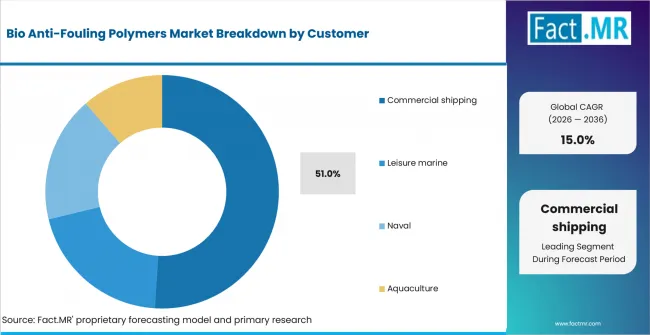
Bio Anti Fouling Polymers Market Analysis By Customer | Source: Fact.MR
Commercial shipping leads because large fleets have repeat dry-dock cycles and measurable voyage economics. UN Trade and Development reported that the world merchant fleet stood at about 112,500 vessels of at least 100 gross tons at the start of 2025. A large installed fleet gives coating providers a recurring market for hull systems that reduce drag and cleaning disruption.
What is accelerating Bio Anti-Fouling Polymers Market adoption, and what is holding it back?
Demand is expected to rise amid clean-hull rules and fuel-cost scrutiny. Growth is constrained by qualification cost and cleaning compatibility.
| DRIVER | (~) % IMPACT ON CAGR | GEOGRAPHIC RELEVANCE | IMPACT TIMELINE |
|---|---|---|---|
| Clean-hull fuel efficiency programs | +1.8% | Global | Short term (<= 2 years) |
| IMO biofouling framework development | +1.4% | Global | Medium term (2-4 years) |
| Newbuilding use of silicone foul-release coatings | +1.1% | Asia, Europe | Medium term (2-4 years) |
| Aquaculture gear biofouling control | +0.8% | East Asia, North America | Long term (>= 4 years) |
Source: Fact.MR analysis. Updated Aug 24, 2026
- Clean-hull fuel efficiency programs: Vessel owners track hull condition because marine growth increases drag and raises operating cost.
- IMO biofouling framework development: MEPC 83 approved a new output in April 2025 to develop a legally binding framework for the control and management of ships’ biofouling, with the proposed scope including testing, verification, certification, documentation, record-keeping, and enforcement.
- Newbuilding silicone foul-release coatings: Shipyards are becoming a larger route to adoption when products are tested for construction-stage exposure and launch timing.
| OPPORTUNITY | (~) % IMPACT ON CAGR | GEOGRAPHIC RELEVANCE | IMPACT TIMELINE |
|---|---|---|---|
| Biocide-light polymer coating platforms | +1.2% | Global | Medium term (2-4 years) |
| Hull-cleaning and coating compatibility | +0.9% | Europe, East Asia | Short term (<= 2 years) |
| Aquaculture equipment coatings | +0.7% | East Asia, North America | Long term (>= 4 years) |
Source: Fact.MR analysis. Updated Aug 24, 2026
- Biocide-light polymer platforms: Formulators position bio-based silicone, zwitterionic and biomimetic surfaces for owners that want lower toxic-release profiles.
- Hull-cleaning compatibility: IMO guidance highlights coating damage and discharge risks during in-water cleaning, giving validated polymer surfaces a clearer role.
- Aquaculture equipment coatings: Net, cage and service-vessel operators need surfaces that reduce fouling without creating extra cleaning residue in farm waters.
| RESTRAINT | (~) % IMPACT ON CAGR | GEOGRAPHIC RELEVANCE | IMPACT TIMELINE |
|---|---|---|---|
| Long qualification cycles for vessel coatings | -0.6% | Global | Medium term (2-4 years) |
| Environmental approval burden for antifouling chemistry | -0.5% | North America, Europe | Medium term (2-4 years) |
| Dry-dock application limits for silicone systems | -0.4% | Global | Short term (<= 2 years) |
Source: Fact.MR analysis. Updated Aug 24, 2026
- Long qualification cycles: Fleet operators usually need service evidence before switching hull coatings across several vessels.
- Environmental approval burden: Antifouling chemistry faces discharge and water-quality review, especially where cleaning happens near ports or aquaculture sites.
- Dry-dock application limits: Silicone systems often require controlled surface preparation and weather windows, which raises cost during busy dock periods.
Which countries are scaling the Bio Anti-Fouling Polymers Market through 2036?
- The country comparison spans 4.6 percentage points between South Korea and Japan across the forecast period.
- South Korea remains 1.6 percentage points above the USA as port throughput and shipbuilding activity keep hull-performance needs visible.
- The USA remains 1.5 percentage points above Germany as aquaculture support and vessel-discharge rules shape coating selection.
- Germany remains 0.7 percentage point above the UK, supported by seaport traffic and coatings-sector capability.
- The UK remains 0.8 percentage point above Japan as port freight and fishing fleets sustain recurring underwater maintenance.
- Japan closes the displayed range while container-port activity and fishery production support steady adoption.
Comparable CAGRs create different entry conditions due to shipbuilding intensity, port freight, aquaculture exposure, environmental oversight and dry-dock economics. Full report coverage includes North America, Latin America, Western Europe, Eastern Europe, East Asia, South Asia & Pacific, Middle East & Africa.
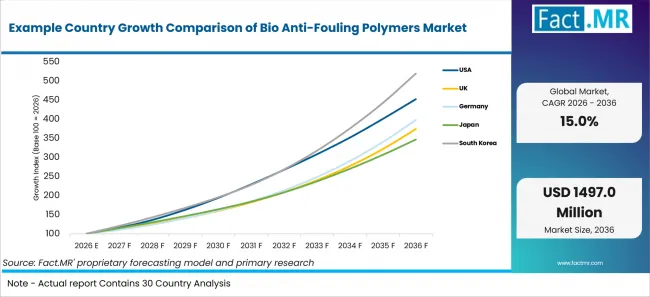
Example Country Growth Comparison Of Bio Anti Fouling Polymers Market | Source: Fact.MR
| Country | CAGR (2026-2036) |
|---|---|
| South Korea | 17.9% |
| USA | 16.3% |
| Germany | 14.8% |
| UK | 14.1% |
| Japan | 13.3% |
Source: Fact.MR analysis. Updated Aug 24, 2026
What supports South Korea adoption?
17.9% CAGR, supported by port throughput, shipbuilding programs and aquaculture production.
South Korea has a large operating base for hull coatings and vessel maintenance. The Ministry of Oceans and Fisheries reported in January 2026 that Korean ports handled 1.57101 billion tons of cargo in 2025. The same ministry reported in February 2026 that fisheries production reached 3.93 million tonnes in 2025. A 17.9% CAGR is expected through 2036 as shipyards and aquaculture operators evaluate polymer coatings during fleet renewal, gear cleaning and service-vessel maintenance.
What supports USA adoption?
16.3% CAGR, led by aquaculture funding, vessel-discharge rules and clean-hull economics.
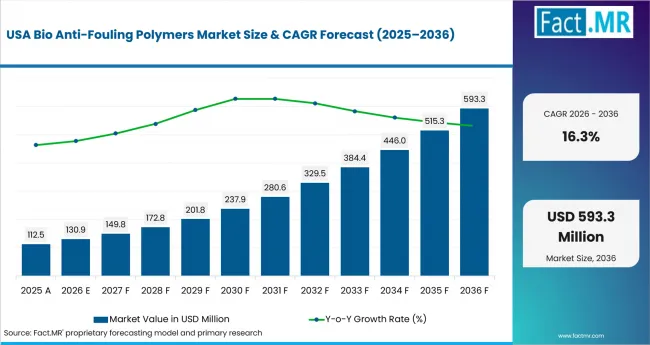
Bio Anti Fouling Polymers Market Country Value Analysis | Source: Fact.MR
USA demand is shaped by aquaculture investment and vessel-discharge compliance. NOAA reported in April 2026 that its Sea Grant Program invested USD 11.9 million in FY 2025 to fund 37 aquaculture research and extension projects. EPA’s 2024 Vessel Incidental Discharge National Standards of Performance include three general discharge standards and specific standards for 20 categories of vessel equipment and systems. The market is projected to record 16.3% CAGR by 2036 as commercial fleets and aquaculture operators seek coatings that reduce fouling while supporting cleaner documentation. Premium polymer systems still face slower uptake where dry-dock budgets prioritize repair work before coating upgrades.
What supports Germany adoption?
14.8% CAGR, reinforced by seaport freight, aquaculture equipment needs and coating expertise.
Germany combines port traffic with a mature coatings and chemical base. Destatis reported in April 2026 that goods transport by sea reached 279.595 million tonnes in 2025. Destatis also reported in June 2026 that aquaculture produced about 16,600 tonnes of fish and 22,600 tonnes of mussels in 2025. The country is anticipated to post 14.8% CAGR through 2036 as vessel operators and gear owners test polymer systems for documented underwater performance.
What supports UK adoption?
14.1% CAGR, backed by port freight, fishing-vessel activity and marina water-quality pressure.
UK adoption is linked to commercial ports and smaller working vessels. The Department for Transport reported in July 2026 that UK ports handled 428.3 million tonnes of freight in 2025. The Marine Management Organisation reported in December 2025 that the UK fishing fleet had 5,232 vessels in 2024. The market is forecast to advance at 14.1% CAGR from 2026 to 2036 as port-support vessels, fishing craft and leisure marine users seek lower-toxicity fouling control.
How does Japan perform?
13.3% CAGR, led by port-container activity, fisheries production and local coating capability.
Japan remains a steady market for polymer antifouling systems across ports, fishing vessels and aquaculture equipment. MAFF reported in May 2025 that Japan’s fishery and aquaculture production reached 3,634,800 tonnes in 2024. MLIT reported in August 2025 that container cargo handled at Japanese ports reached about 21.98 million TEU in 2024. Japan is expected to post 13.3% CAGR through 2036 as marine coating suppliers connect local formulation capability with service-vessel and equipment needs.
Who leads the Bio Anti-Fouling Polymers Market?
AkzoNobel N.V. remains active in marine coatings with International brand fouling-control systems, giving the company access to commercial shipping and shipyard channels. Hempel A/S launched Hempaguard NB in June 2025, a silicone hull coating designed specifically for application during newbuild construction.
Lloyd’s Register awarded Jotun A/S’s SeaQuantum Skate coating its Recognised Enhanced Antifouling Type Approval and type-approved the associated HullSkater robotic cleaning equipment in June 2025, certifying the combination as an integrated hull-cleaning and coating solution. PPG offers the biocide-free SIGMAGLIDE 2390 technology and reported its application to the underwater hull of a COSCO Shipping crude-oil tanker during drydocking in March 2025. Nippon Paint Marine Coatings Co., Ltd. offers AQUATERRAS, a biocide-free self-polishing marine coating technology. I-Tech AB commercializes the antifouling ingredient Selektope and announced a supply and license agreement with a major Asian-based paint company in January 2025 for its integration into marine paint formulations.
Competition centers on proof under real vessel service, compatibility with in-water cleaning and documentation for port or class review. Coating providers that connect polymer chemistry with application support are better placed than vendors that sell a surface claim without operating evidence.
Which companies are the key providers?
Key companies include AkzoNobel N.V.; Hempel A/S; Jotun A/S; PPG Industries, Inc.; Nippon Paint Marine Coatings Co., Ltd.; and I-Tech AB.
- AkzoNobel N.V.
- Hempel A/S
- Jotun A/S
- PPG Industries, Inc.
- Nippon Paint Marine Coatings Co., Ltd.
- I-Tech AB
Bibliography
- UN Trade and Development. (2025, September 24). Review of Maritime Transport 2025: Staying the course in turbulent waters.
- NOAA Fisheries. (2026, April 1). Home-grown seafood: NOAA's aquaculture highlights from 2025.
- U.S. Environmental Protection Agency. (2026, June 25). The Vessel Incidental Discharge Act (VIDA).
- Department for Transport. (2026, July 29). Port freight annual statistics: 2025.
- Marine Management Organisation. (2025, December 2). UK sea fisheries annual statistics report 2024.
- Joint Nature Conservation Committee. (2026, June 25). UK Overseas Territory Protected Area statistics.
- Federal Statistical Office (Destatis). (2026, April 13). Goods transport on sea by main traffic relations [Data table].
- Statistisches Bundesamt. (2026, June 5). KORREKTUR: 1,2 % weniger Fisch aus Aquakulturen im Jahr 2025.
- Federal Statistical Office (Destatis). (2026, April 9). Goods transport on inland waterways by main traffic relations [Data table].
- Ministry of Data and Statistics. (2026, February 27). Preliminary results of the Fishery Production Survey in 2025.
- Hempel A/S. (2025, June 2). Hempel launches Hempaguard NB, the first silicone hull coating for newbuilds.
- Jotun. (2025, October 20). Jotun's HSS receives Lloyd's Register's first full antifouling approval.
- PPG. (2025, March 17). PPG announces first drydocking for COSCO Shipping with electrostatic application of PPG SIGMAGLIDE coating.
- I-Tech AB. (2025, January 30). I-Tech AB signs supply and license agreement with major Asian-based paint company.
This Report Answers
- The report explains where bio anti-fouling polymers are used across polymer type and performance mode. It also covers vessel area and customer group.
- Segment analysis identifies priority subsegments and the operational reasons vessel owners prioritize them.
- Country analysis examines the listed markets and the port, fisheries or regulatory mechanisms supporting polymer coating demand.
- Competitive analysis reviews current marine coating providers and ingredient specialists active in antifouling systems.
- Application analysis assesses how hull drag, cleaning compatibility and water-quality scrutiny influence purchase decisions.
What does the Bio Anti-Fouling Polymers Market cover?
The Bio Anti-Fouling Polymers Market covers polymer systems that reduce marine organism attachment on underwater surfaces. It is adjacent to the biocide-free antifouling coatings space, but it focuses on polymer surfaces and bio-inspired mechanisms.
The study also links to the hull coatings category where underwater performance and dry-dock timing shape purchase decisions.
What is included in the scope?
The scope includes silicone coatings used for marine foul release, plus zwitterionic, polysaccharide and peptide-functional surfaces used on hulls or equipment. It includes bio-based coatings where the formulation supports lower-toxicity fouling control in marine service.
The study tracks bioplastics only when they support vessel or aquaculture equipment coatings. The broader polymers category provides upstream resin context, but commodity resin sales are excluded from market sizing. The scope considers high-performance polymers where durability affects seawater service life.
What is excluded from the scope?
General paints and coatings sold above the waterline are excluded when they do not provide antifouling performance. Separate anti-corrosion coatings are excluded unless sold as part of an underwater antifouling package.
General coating additives are excluded unless they are part of a biofouling-control polymer formulation. Coating additives are considered only when they directly support the antifouling formulation.
How Was the Analysis Built?
The analysis draws on 120+ sources, 35+ company portfolios, 25+ countries, and more than 20 industry interviews.
- Primary Research: Primary research includes discussions with manufacturers, service providers, technology developers, distributors, end users, procurement teams, and subject-matter experts. These conversations examine purchasing priorities, product adoption, operational challenges, approval requirements, competitive positioning, and the factors that influence wider market acceptance.
- Desk Research: Desk research covers government statistics, regulatory publications, company filings, trade data, technical studies, industry associations, standards, public policy, and other authoritative sources. Every source used in the analysis is documented in the bibliography.
- Market Sizing and Forecasting: Market estimates combine historical performance, demand indicators, pricing and volume trends, segment shares, company participation, country-level growth, adoption patterns, investment activity, and barriers to market expansion.
- Data Validation and Update Cycle: Findings are validated by comparing primary interviews with public data, company activity, regulatory changes, trade patterns, and industry developments. Regular updates review new product launches, capacity changes, partnerships, approvals, procurement trends, and shifts in commercial adoption.
Segmentation
What is the report’s scope and coverage?
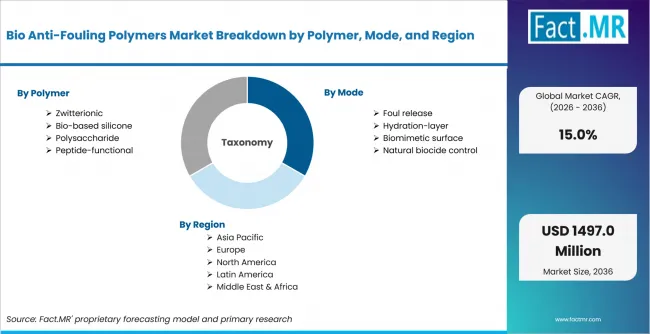
Bio Anti Fouling Polymers Market Breakdown By Polymer, Mode, And Region | Source: Fact.MR
| Attribute | Details |
|---|---|
| Quantitative Units | USD million |
| Market Definition | Polymer-based marine antifouling and foul-release materials that use bio-inspired, bio-based or biocide-light surface chemistry to reduce organism attachment on underwater surfaces. |
| Polymer | Zwitterionic; Bio-based silicone; Polysaccharide; Peptide-functional |
| Mode | Foul release; Hydration-layer; Biomimetic surface; Natural biocide control |
| Vessel Area | Hull; Running gear; Sea chest; Aquaculture equipment |
| Customer | Commercial shipping; Leisure marine; Naval; Aquaculture |
| Regions Covered | North America; Latin America; Western Europe; Eastern Europe; East Asia; South Asia & Pacific; Middle East & Africa |
| Countries Covered | USA; UK; Germany; Japan; South Korea |
| Key Companies Profiled | AkzoNobel N.V.; Hempel A/S; Jotun A/S; PPG Industries, Inc.; Nippon Paint Marine Coatings Co., Ltd.; I-Tech AB |
| Forecast Period | 2026 to 2036 |
| Approach | Hybrid top-down and bottom-up approach using vessel operations, marine coatings activity, aquaculture equipment use, country port indicators and provider portfolio review. |
Source: Fact.MR analysis. Updated Aug 24, 2026
How is the market segmented?
-
By Polymer:
- Zwitterionic
- Bio-based silicone
- Polysaccharide
- Peptide-functional
-
By Mode:
- Foul release
- Hydration-layer
- Biomimetic surface
- Natural biocide control
-
By Vessel Area:
- Hull
- Running gear
- Sea chest
- Aquaculture equipment
-
By Customer:
- Commercial shipping
- Leisure marine
- Naval
- Aquaculture
-
By Region:
- North America
- Latin America
- Western Europe
- Eastern Europe
- East Asia
- South Asia & Pacific
- Middle East & Africa
Frequently Asked Questions
How big is the bio anti-fouling polymers market in 2026?
What is the CAGR of the bio anti-fouling polymers market from 2026 to 2036?
Which polymer leads the bio anti-fouling polymers market?
Which mode leads the bio anti-fouling polymers market?
Who are the leading companies in the bio anti-fouling polymers market?
Who worked on this report


Preview the report firsthand - request a free sample
Free SampleGet the brochure for pricing and purchase details
Download PDF