Bio-Based Deicers and Anti-Icing Chemicals for Roads Market
Bio-Based Deicers and Anti-Icing Chemicals for Roads Market Size and Share Forecast Outlook 2026 to 2036
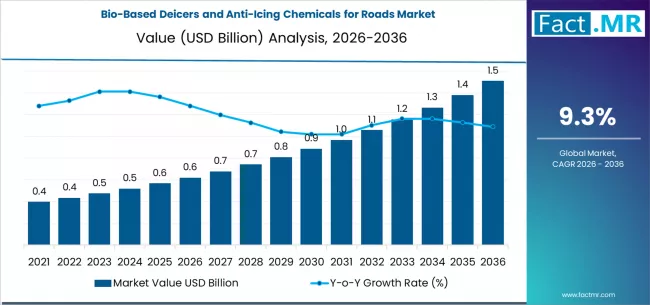
Bio-based deicers and anti-icing chemicals for roads market is projected to grow from USD 0.6 billion in 2026 to USD 1.5 billion by 2036, at a CAGR of 9.3%. Bio-Based Liquid Deicers will dominate with a 32.0% market share, while airports & runways will lead the application type segment with a 28.0% share.
Bio-Based Deicers and Anti-Icing Chemicals for Roads Market Forecast and Outlook 2026 to 2036
Projected to grow from USD 0.62 billion in 2026 to USD 1.51 billion by 2036, the global market for bio-based deicers and anti-icing chemicals is advancing at a CAGR of 9.3%. This growth signals a pivotal shift in winter maintenance strategies, moving beyond conventional rock salt and chloride-based chemicals towards sustainable, corrosion-inhibiting solutions derived from renewable feedstocks.
Key Takeaways from the Bio-Based Deicers and Anti-Icing Chemicals for Roads Market
- Market Value for 2026: USD 0.62 Billion
- Market Value for 2036: USD 1.51 Billion
- Forecast CAGR (2026-2036): 9.3%
- Leading Product Type Share (2026): Bio-Based Liquid Deicers (32%)
- Leading Application Type Share (2026): Airports & Runways (28%)
- Leading End-User Share (2026): Government & Municipal Authorities (34%)
- Key Players in the Market: Cargill Inc., Envirotech Services, Compass Minerals, Dow Inc., K-Tech Specialty Coatings
Environmental regulations targeting chloride pollution in waterways and the escalating infrastructure costs of corrosion damage are compelling this transition across public and private sectors. Bio-based liquid deicers represent the dominant product category, commanding a 32% market share. Their pre-wetting and anti-icing capabilities allow for more effective and preventative ice control.
The most critical application arena is airports and runways, accounting for 28% of demand, where safety and pavement integrity are paramount. Government and municipal authorities constitute the leading end-user segment with a 34% share, driven by public procurement policies increasingly favoring environmentally preferable purchasing for road maintenance.
The market's expansion is rooted in the urgent need to balance public safety with environmental stewardship. Traditional deicers, while effective and low-cost, contribute to soil degradation, water contamination, and accelerate the corrosion of vehicles, bridges, and concrete.
Bio-based alternatives, often formulated from agricultural by-products like corn, beet, or soybean derivatives, offer effective freezing-point depression with significantly lower corrosive impact and improved biodegradability. The evolution of this market focuses on enhancing the cold-temperature performance, cost-competitiveness, and supply chain resilience of these green chemistries.
Metric
| Metric | Value |
|---|---|
| Market Value (2026) | USD 0.62 Billion |
| Market Forecast Value (2036) | USD 1.51 Billion |
| Forecast CAGR (2026-2036) | 9.3% |
Category
| Category | Segments |
|---|---|
| Product Type | Bio-Based Liquid Deicers, Agricultural product Deicers (Corn, Beet, Soy), Acetate-Based Anti-Icing Agents, Bioethanol & Glycol Blends, Other Eco-Friendly Deicing Chemicals |
| Application Type | Airports & Runways, Highways & Municipal Roads, Residential & Commercial Pavements, Industrial & Logistics Facilities |
| End-User | Government & Municipal Authorities, Airport & Aviation Authorities, Highway Maintenance Contractors, Commercial Facility Operators, Industrial & Private Property Owners |
| Region | North America, Latin America, Western Europe, Eastern Europe, East Asia, South Asia & Pacific, MEA |
Segmental Analysis
By Product Type, Which Formulation is Leading Adoption?
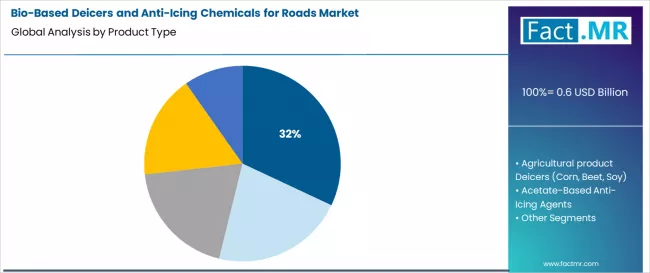
Bio-based liquid deicers hold the largest share at 32%. Their leadership is attributed to operational efficiency and preventative benefits. These liquids are often applied before a snow event (anti-icing) to prevent bond formation between ice and pavement, reducing the mechanical force and material needed for removal.
Derived from renewable agricultural sources, they typically leave behind organic residues less harmful to soil and vegetation compared to chloride ions, aligning with broader environmental management goals for roadside ecosystems.
By Application Type, Where are Performance Requirements Most Stringent?
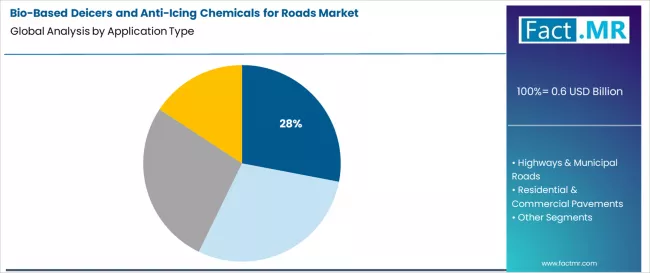
Airports and runways represent the leading application, with a 28% share. In aviation, the margin for error is zero. Effective deicing is critical for safe takeoffs and landings, but chemical residues must not compromise pavement integrity or aircraft components.
Bio-based acetate and glycol-blend formulations are increasingly specified because they offer reliable ice-melting performance at very low temperatures while minimizing the corrosive attack on sensitive airport infrastructure and reducing oxygen demand in stormwater runoff.
By End-User, Who is Driving Initial Market Penetration?
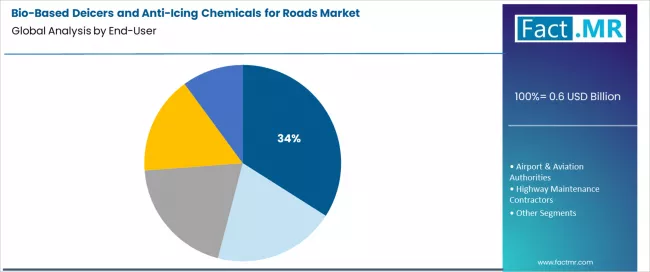
Government and municipal authorities are the primary end-users, comprising 34% of the market. Their procurement decisions are shaped by a combination of regulatory pressure to reduce chloride loads in watersheds, lifecycle cost analyses that factor in infrastructure corrosion, and public demand for greener municipal services.
While upfront costs for bio-based products can be higher, these authorities are increasingly evaluating total cost of ownership, including reduced damage to bridges, concrete, and vehicle fleets, which drives pilot programs and eventual large-scale adoption.
What are the Drivers, Restraints, and Key Trends of the Bio-Based Deicers Market?
Escalating regulatory restrictions on chloride application, particularly in environmentally sensitive watersheds and urban areas, serve as the primary market driver. The documented cost of corrosion to public infrastructure, estimated in billions annually, provides a powerful economic argument for less corrosive alternatives.
Growing public awareness and preference for sustainable community practices further pressure maintenance decision-makers to adopt greener solutions. The proven effectiveness of certain bio-based products at extreme temperatures also supports their use in critical applications. A significant market restraint is the higher direct chemical cost compared to ubiquitous rock salt. This cost differential can be a barrier for budget-constrained municipalities and contractors.
Some bio-based products may also have a lower effective melting temperature or require different application equipment and timing, demanding retraining of maintenance crews. Concerns about the nutrient load potentially contributing to algal blooms in certain water bodies present an environmental trade-off that requires careful management and site-specific selection.
Key trends include the development of enhanced formulation blends that combine bio-based components with minimal amounts of traditional salts or corrosion inhibitors to optimize cost and performance. Integration of smart application technologies such as GPS-guided spreaders and RWIS, is maximizing the efficiency of these higher-value products. There is also a trend toward localized production using regionally sourced agricultural feedstocks to improve supply chain sustainability and reduce transportation carbon footprints.
Analysis of the Bio-Based Deicers and Anti-Icing Chemicals Market by Key Countries
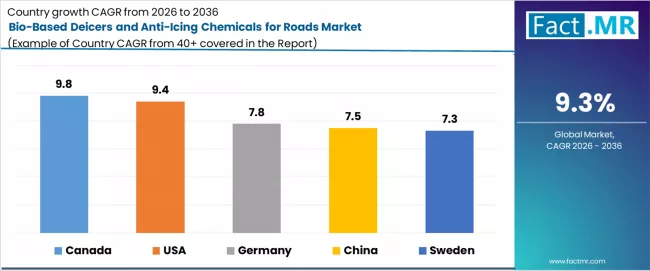
| Country | CAGR (2026-2036) |
|---|---|
| Canada | 9.80% |
| USA | 9.40% |
| Germany | 7.80% |
| China | 7.50% |
| Sweden | 7.30% |
How do Canada's Climate and Environmental Policies Converge to Drive Growth?
Canada's leading CAGR of 9.80% is a direct result of its severe winter climate intersecting with proactive environmental protection policies. Provinces and municipalities are implementing stringent chloride management plans to protect freshwater resources, which are particularly vulnerable in spring melt periods.
The extensive use of deicers on vast highway networks and at major airports creates a large addressable market. Canadian innovation often focuses on enhancing the performance of bio-based blends in extreme cold, making them viable across the country's diverse climate zones.
What is the Impact of the USA's Infrastructure and Regulatory Landscape?
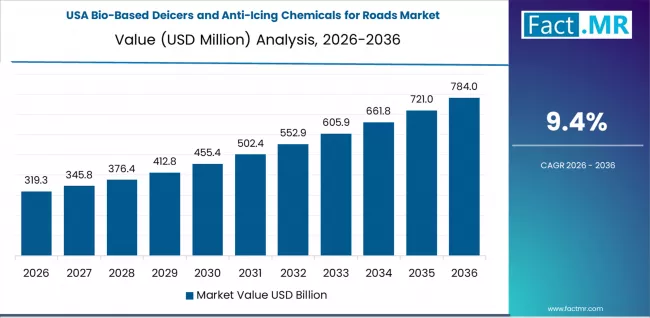
The USA's 9.40% growth is fueled by a combination of federal and state-level initiatives. The EPA’s focus on water quality standards pushes states to limit chloride runoff. The massive scale of the country's highway and airport infrastructure, coupled with a growing awareness of the hidden costs of corrosion damage from road salts, is driving state Departments of Transportation to test and adopt bio-based alternatives, particularly for use on bridges and in environmentally sensitive areas.
Why is Germany a Focus for Precision and Environmental Compliance?
Germany's 7.80% CAGR reflects its strict adherence to EU water framework directives and its engineering-driven approach to maintenance. German authorities prioritize solutions that protect concrete autobahns and bridges from deterioration.
Preference for precise, preventative anti-icing strategies over reactive salting aligns perfectly with the use of liquid bio-based agents. This focus on preserving high-value infrastructure and meeting stringent environmental compliance creates a receptive market for premium, performance-proven green deicers.
How is China's Urbanization and Environmental Focus Influencing the Market?
China's 7.50% growth is linked to its rapid urbanization and increasing governmental emphasis on ecological civilization. As northern Chinese cities expand, managing winter road safety while controlling pollution runoff becomes a significant challenge.
National and municipal policies promoting sponge city concepts to manage water quality are encouraging the exploration of less corrosive deicing options for urban roads and at key transportation hubs like airports, where operational continuity is critical.
What Role does Sweden's Pioneering Stance on Environmental Protection Play?
Sweden's 7.30% growth is anchored in its long-standing, ambitious environmental policies and early adoption of sustainable practices. Swedish municipalities and the national transport administration have been pioneers in testing and implementing acetate-based and other bio-deicers to protect Scandinavia's sensitive aquatic ecosystems.
The country's research into the full lifecycle environmental impact of deicing chemicals sets a benchmark that influences procurement specifications and drives continuous product improvement from suppliers.
Competitive Landscape of the Bio-Based Deicers and Anti-Icing Chemicals Market
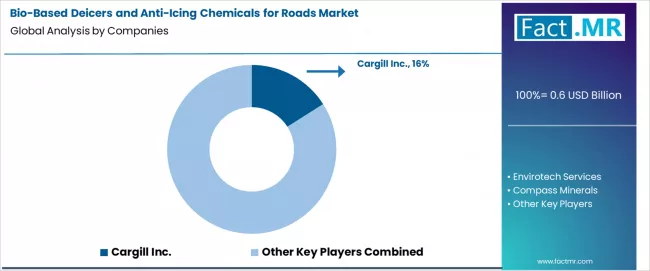
The competitive environment features established agribusiness giants, specialty chemical companies, and niche environmental technology firms. Competition is based on proprietary feedstock processing, formulation expertise for specific temperature ranges and surfaces, and the ability to provide a reliable, large-scale supply of consistent product.
Building strong relationships with public works departments and airport authorities through demonstrable field trial data and comprehensive technical support is crucial. Success also depends on navigating and helping shape the evolving regulatory landscape for environmental product claims.
Key Players in the Bio-Based Deicers and Anti-Icing Chemicals Market
- Cargill Inc.
- Envirotech Services
- Compass Minerals
- Dow Inc.
- K-Tech Specialty Coatings
Scope of Report
| Items | Values |
|---|---|
| Quantitative Units | USD Billion |
| Product Type | Bio-Based Liquid Deicers, Agricultural Product-Based, Acetate-Based, Bioethanol/Glycol Blends, Others |
| Application Type | Airports & Runways, Highways & Municipal Roads, Residential/Commercial Pavements, Industrial Facilities |
| End-User | Government & Municipal Authorities, Airport Authorities, Highway Contractors, Commercial & Industrial Operators |
| Key Countries | Canada, USA, Germany, China, Sweden |
| Key Companies | Cargill Inc., Envirotech Services, Compass Minerals, Dow Inc., K-Tech Specialty Coatings |
| Additional Analysis | Comparative analysis of ice-melting capacity & effective temperature range; corrosion impact testing on steel and concrete; environmental fate & toxicity of breakdown products; operational cost-benefit analysis vs. rock salt; review of winter maintenance best practices integrating green chemicals; regulatory frameworks for chloride reduction. |
Market by Segments
-
Product Type :
- Bio-Based Liquid Deicers
- Agricultural product Deicers (Corn, Beet, Soy)
- Acetate-Based Anti-Icing Agents
- Bioethanol & Glycol Blends
- Other Eco-Friendly Deicing Chemicals
-
Application Type :
- Airports & Runways
- Highways & Municipal Roads
- Residential & Commercial Pavements
- Industrial & Logistics Facilities
-
End-User :
- Government & Municipal Authorities
- Airport & Aviation Authorities
- Highway Maintenance Contractors
- Commercial Facility Operators
- Industrial & Private Property Owners
-
Region :
-
North America
- USA
- Canada
-
Latin America
- Brazil
- Mexico
- Argentina
- Rest of Latin America
-
Western Europe
- Germany
- UK
- France
- Spain
- Italy
- BENELUX
- Rest of Western Europe
-
Eastern Europe
- Russia
- Poland
- Czech Republic
- Rest of Eastern Europe
-
East Asia
- China
- Japan
- South Korea
- Rest of East Asia
-
South Asia & Pacific
- India
- ASEAN
- Australia
- Rest of South Asia & Pacific
-
MEA
- Saudi Arabia
- UAE
- Turkiye
- Rest of MEA
-
Table of Content
- Executive Summary
- Global Market Outlook
- Demand to side Trends
- Supply to side Trends
- Technology Roadmap Analysis
- Analysis and Recommendations
- Market Overview
- Market Coverage / Taxonomy
- Market Definition / Scope / Limitations
- Market Background
- Market Dynamics
- Drivers
- Restraints
- Opportunity
- Trends
- Scenario Forecast
- Demand in Optimistic Scenario
- Demand in Likely Scenario
- Demand in Conservative Scenario
- Opportunity Map Analysis
- Product Life Cycle Analysis
- Supply Chain Analysis
- Investment Feasibility Matrix
- Value Chain Analysis
- PESTLE and Porter’s Analysis
- Regulatory Landscape
- Regional Parent Market Outlook
- Production and Consumption Statistics
- Import and Export Statistics
- Market Dynamics
- Global Market Analysis 2021 to 2025 and Forecast, 2026 to 2036
- Historical Market Size Value (USD Million) Analysis, 2021 to 2025
- Current and Future Market Size Value (USD Million) Projections, 2026 to 2036
- Y to o to Y Growth Trend Analysis
- Absolute $ Opportunity Analysis
- Global Market Pricing Analysis 2021 to 2025 and Forecast 2026 to 2036
- Global Market Analysis 2021 to 2025 and Forecast 2026 to 2036, By Product Type
- Introduction / Key Findings
- Historical Market Size Value (USD Million) Analysis By Product Type, 2021 to 2025
- Current and Future Market Size Value (USD Million) Analysis and Forecast By Product Type, 2026 to 2036
- Bio-Based Liquid Deicers
- Agricultural product Deicers (Corn, Beet, Soy)
- Acetate-Based Anti-Icing Agents
- Bioethanol & Glycol Blends
- Other Eco-Friendly Deicing Chemicals
- Bio-Based Liquid Deicers
- Y to o to Y Growth Trend Analysis By Product Type, 2021 to 2025
- Absolute $ Opportunity Analysis By Product Type, 2026 to 2036
- Global Market Analysis 2021 to 2025 and Forecast 2026 to 2036, By Application Type
- Introduction / Key Findings
- Historical Market Size Value (USD Million) Analysis By Application Type, 2021 to 2025
- Current and Future Market Size Value (USD Million) Analysis and Forecast By Application Type, 2026 to 2036
- Airports & Runways
- Highways & Municipal Roads
- Residential & Commercial Pavements
- Industrial & Logistics Facilities
- Airports & Runways
- Y to o to Y Growth Trend Analysis By Application Type, 2021 to 2025
- Absolute $ Opportunity Analysis By Application Type, 2026 to 2036
- Global Market Analysis 2021 to 2025 and Forecast 2026 to 2036, By End-User
- Introduction / Key Findings
- Historical Market Size Value (USD Million) Analysis By End-User, 2021 to 2025
- Current and Future Market Size Value (USD Million) Analysis and Forecast By End-User, 2026 to 2036
- Government & Municipal Authorities
- Airport & Aviation Authorities
- Highway Maintenance Contractors
- Commercial Facility Operators
- Industrial & Private Property Owners
- Government & Municipal Authorities
- Y to o to Y Growth Trend Analysis By End-User, 2021 to 2025
- Absolute $ Opportunity Analysis By End-User, 2026 to 2036
- Global Market Analysis 2021 to 2025 and Forecast 2026 to 2036, By Region
- Introduction
- Historical Market Size Value (USD Million) Analysis By Region, 2021 to 2025
- Current Market Size Value (USD Million) Analysis and Forecast By Region, 2026 to 2036
- North America
- Latin America
- Western Europe
- Eastern Europe
- East Asia
- South Asia and Pacific
- Middle East & Africa
- Market Attractiveness Analysis By Region
- North America Market Analysis 2021 to 2025 and Forecast 2026 to 2036, By Country
- Historical Market Size Value (USD Million) Trend Analysis By Market Taxonomy, 2021 to 2025
- Market Size Value (USD Million) Forecast By Market Taxonomy, 2026 to 2036
- By Country
- USA
- Canada
- Mexico
- By Product Type
- By Application Type
- By End-User
- By Country
- Market Attractiveness Analysis
- By Country
- By Product Type
- By Application Type
- By End-User
- Key Takeaways
- Latin America Market Analysis 2021 to 2025 and Forecast 2026 to 2036, By Country
- Historical Market Size Value (USD Million) Trend Analysis By Market Taxonomy, 2021 to 2025
- Market Size Value (USD Million) Forecast By Market Taxonomy, 2026 to 2036
- By Country
- Brazil
- Chile
- Rest of Latin America
- By Product Type
- By Application Type
- By End-User
- By Country
- Market Attractiveness Analysis
- By Country
- By Product Type
- By Application Type
- By End-User
- Key Takeaways
- Western Europe Market Analysis 2021 to 2025 and Forecast 2026 to 2036, By Country
- Historical Market Size Value (USD Million) Trend Analysis By Market Taxonomy, 2021 to 2025
- Market Size Value (USD Million) Forecast By Market Taxonomy, 2026 to 2036
- By Country
- Germany
- UK
- Italy
- Spain
- France
- Nordic
- BENELUX
- Rest of Western Europe
- By Product Type
- By Application Type
- By End-User
- By Country
- Market Attractiveness Analysis
- By Country
- By Product Type
- By Application Type
- By End-User
- Key Takeaways
- Eastern Europe Market Analysis 2021 to 2025 and Forecast 2026 to 2036, By Country
- Historical Market Size Value (USD Million) Trend Analysis By Market Taxonomy, 2021 to 2025
- Market Size Value (USD Million) Forecast By Market Taxonomy, 2026 to 2036
- By Country
- Russia
- Poland
- Hungary
- Balkan & Baltic
- Rest of Eastern Europe
- By Product Type
- By Application Type
- By End-User
- By Country
- Market Attractiveness Analysis
- By Country
- By Product Type
- By Application Type
- By End-User
- Key Takeaways
- East Asia Market Analysis 2021 to 2025 and Forecast 2026 to 2036, By Country
- Historical Market Size Value (USD Million) Trend Analysis By Market Taxonomy, 2021 to 2025
- Market Size Value (USD Million) Forecast By Market Taxonomy, 2026 to 2036
- By Country
- China
- Japan
- South Korea
- By Product Type
- By Application Type
- By End-User
- By Country
- Market Attractiveness Analysis
- By Country
- By Product Type
- By Application Type
- By End-User
- Key Takeaways
- South Asia and Pacific Market Analysis 2021 to 2025 and Forecast 2026 to 2036, By Country
- Historical Market Size Value (USD Million) Trend Analysis By Market Taxonomy, 2021 to 2025
- Market Size Value (USD Million) Forecast By Market Taxonomy, 2026 to 2036
- By Country
- India
- ASEAN
- Australia & New Zealand
- Rest of South Asia and Pacific
- By Product Type
- By Application Type
- By End-User
- By Country
- Market Attractiveness Analysis
- By Country
- By Product Type
- By Application Type
- By End-User
- Key Takeaways
- Middle East & Africa Market Analysis 2021 to 2025 and Forecast 2026 to 2036, By Country
- Historical Market Size Value (USD Million) Trend Analysis By Market Taxonomy, 2021 to 2025
- Market Size Value (USD Million) Forecast By Market Taxonomy, 2026 to 2036
- By Country
- Kingdom of Saudi Arabia
- Other GCC Countries
- Turkiye
- South Africa
- Other African Union
- Rest of Middle East & Africa
- By Product Type
- By Application Type
- By End-User
- By Country
- Market Attractiveness Analysis
- By Country
- By Product Type
- By Application Type
- By End-User
- Key Takeaways
- Key Countries Market Analysis
- USA
- Pricing Analysis
- Market Share Analysis, 2025
- By Product Type
- By Application Type
- By End-User
- Canada
- Pricing Analysis
- Market Share Analysis, 2025
- By Product Type
- By Application Type
- By End-User
- Mexico
- Pricing Analysis
- Market Share Analysis, 2025
- By Product Type
- By Application Type
- By End-User
- Brazil
- Pricing Analysis
- Market Share Analysis, 2025
- By Product Type
- By Application Type
- By End-User
- Chile
- Pricing Analysis
- Market Share Analysis, 2025
- By Product Type
- By Application Type
- By End-User
- Germany
- Pricing Analysis
- Market Share Analysis, 2025
- By Product Type
- By Application Type
- By End-User
- UK
- Pricing Analysis
- Market Share Analysis, 2025
- By Product Type
- By Application Type
- By End-User
- Italy
- Pricing Analysis
- Market Share Analysis, 2025
- By Product Type
- By Application Type
- By End-User
- Spain
- Pricing Analysis
- Market Share Analysis, 2025
- By Product Type
- By Application Type
- By End-User
- France
- Pricing Analysis
- Market Share Analysis, 2025
- By Product Type
- By Application Type
- By End-User
- India
- Pricing Analysis
- Market Share Analysis, 2025
- By Product Type
- By Application Type
- By End-User
- ASEAN
- Pricing Analysis
- Market Share Analysis, 2025
- By Product Type
- By Application Type
- By End-User
- Australia & New Zealand
- Pricing Analysis
- Market Share Analysis, 2025
- By Product Type
- By Application Type
- By End-User
- China
- Pricing Analysis
- Market Share Analysis, 2025
- By Product Type
- By Application Type
- By End-User
- Japan
- Pricing Analysis
- Market Share Analysis, 2025
- By Product Type
- By Application Type
- By End-User
- South Korea
- Pricing Analysis
- Market Share Analysis, 2025
- By Product Type
- By Application Type
- By End-User
- Russia
- Pricing Analysis
- Market Share Analysis, 2025
- By Product Type
- By Application Type
- By End-User
- Poland
- Pricing Analysis
- Market Share Analysis, 2025
- By Product Type
- By Application Type
- By End-User
- Hungary
- Pricing Analysis
- Market Share Analysis, 2025
- By Product Type
- By Application Type
- By End-User
- Kingdom of Saudi Arabia
- Pricing Analysis
- Market Share Analysis, 2025
- By Product Type
- By Application Type
- By End-User
- Turkiye
- Pricing Analysis
- Market Share Analysis, 2025
- By Product Type
- By Application Type
- By End-User
- South Africa
- Pricing Analysis
- Market Share Analysis, 2025
- By Product Type
- By Application Type
- By End-User
- USA
- Market Structure Analysis
- Competition Dashboard
- Competition Benchmarking
- Market Share Analysis of Top Players
- By Regional
- By Product Type
- By Application Type
- By End-User
- Competition Analysis
- Competition Deep Dive
- Cargill Inc.
- Overview
- Product Portfolio
- Profitability by Market Segments (Product/Age /Sales Channel/Region)
- Sales Footprint
- Strategy Overview
- Marketing Strategy
- Product Strategy
- Channel Strategy
- Envirotech Services
- Compass Minerals
- Dow Inc.
- K-Tech Specialty Coatings
- Cargill Inc.
- Competition Deep Dive
- Assumptions & Acronyms Used
- Research Methodology
List Of Table
- Table 1: Global Market Value (USD Million) Forecast by Region, 2021 to 2036
- Table 2: Global Market Value (USD Million) Forecast by Product Type, 2021 to 2036
- Table 3: Global Market Value (USD Million) Forecast by Application Type, 2021 to 2036
- Table 4: Global Market Value (USD Million) Forecast by End-User, 2021 to 2036
- Table 5: North America Market Value (USD Million) Forecast by Country, 2021 to 2036
- Table 6: North America Market Value (USD Million) Forecast by Product Type, 2021 to 2036
- Table 7: North America Market Value (USD Million) Forecast by Application Type, 2021 to 2036
- Table 8: North America Market Value (USD Million) Forecast by End-User, 2021 to 2036
- Table 9: Latin America Market Value (USD Million) Forecast by Country, 2021 to 2036
- Table 10: Latin America Market Value (USD Million) Forecast by Product Type, 2021 to 2036
- Table 11: Latin America Market Value (USD Million) Forecast by Application Type, 2021 to 2036
- Table 12: Latin America Market Value (USD Million) Forecast by End-User, 2021 to 2036
- Table 13: Western Europe Market Value (USD Million) Forecast by Country, 2021 to 2036
- Table 14: Western Europe Market Value (USD Million) Forecast by Product Type, 2021 to 2036
- Table 15: Western Europe Market Value (USD Million) Forecast by Application Type, 2021 to 2036
- Table 16: Western Europe Market Value (USD Million) Forecast by End-User, 2021 to 2036
- Table 17: Eastern Europe Market Value (USD Million) Forecast by Country, 2021 to 2036
- Table 18: Eastern Europe Market Value (USD Million) Forecast by Product Type, 2021 to 2036
- Table 19: Eastern Europe Market Value (USD Million) Forecast by Application Type, 2021 to 2036
- Table 20: Eastern Europe Market Value (USD Million) Forecast by End-User, 2021 to 2036
- Table 21: East Asia Market Value (USD Million) Forecast by Country, 2021 to 2036
- Table 22: East Asia Market Value (USD Million) Forecast by Product Type, 2021 to 2036
- Table 23: East Asia Market Value (USD Million) Forecast by Application Type, 2021 to 2036
- Table 24: East Asia Market Value (USD Million) Forecast by End-User, 2021 to 2036
- Table 25: South Asia and Pacific Market Value (USD Million) Forecast by Country, 2021 to 2036
- Table 26: South Asia and Pacific Market Value (USD Million) Forecast by Product Type, 2021 to 2036
- Table 27: South Asia and Pacific Market Value (USD Million) Forecast by Application Type, 2021 to 2036
- Table 28: South Asia and Pacific Market Value (USD Million) Forecast by End-User, 2021 to 2036
- Table 29: Middle East & Africa Market Value (USD Million) Forecast by Country, 2021 to 2036
- Table 30: Middle East & Africa Market Value (USD Million) Forecast by Product Type, 2021 to 2036
- Table 31: Middle East & Africa Market Value (USD Million) Forecast by Application Type, 2021 to 2036
- Table 32: Middle East & Africa Market Value (USD Million) Forecast by End-User, 2021 to 2036
List Of Figures
- Figure 1: Global Market Pricing Analysis
- Figure 2: Global Market Value (USD Million) Forecast 2021 to 2036
- Figure 3: Global Market Value Share and BPS Analysis by Product Type, 2026 and 2036
- Figure 4: Global Market Y to o to Y Growth Comparison by Product Type, 2026 to 2036
- Figure 5: Global Market Attractiveness Analysis by Product Type
- Figure 6: Global Market Value Share and BPS Analysis by Application Type, 2026 and 2036
- Figure 7: Global Market Y to o to Y Growth Comparison by Application Type, 2026 to 2036
- Figure 8: Global Market Attractiveness Analysis by Application Type
- Figure 9: Global Market Value Share and BPS Analysis by End-User, 2026 and 2036
- Figure 10: Global Market Y to o to Y Growth Comparison by End-User, 2026 to 2036
- Figure 11: Global Market Attractiveness Analysis by End-User
- Figure 12: Global Market Value (USD Million) Share and BPS Analysis by Region, 2026 and 2036
- Figure 13: Global Market Y to o to Y Growth Comparison by Region, 2026 to 2036
- Figure 14: Global Market Attractiveness Analysis by Region
- Figure 15: North America Market Incremental Dollar Opportunity, 2026 to 2036
- Figure 16: Latin America Market Incremental Dollar Opportunity, 2026 to 2036
- Figure 17: Western Europe Market Incremental Dollar Opportunity, 2026 to 2036
- Figure 18: Eastern Europe Market Incremental Dollar Opportunity, 2026 to 2036
- Figure 19: East Asia Market Incremental Dollar Opportunity, 2026 to 2036
- Figure 20: South Asia and Pacific Market Incremental Dollar Opportunity, 2026 to 2036
- Figure 21: Middle East & Africa Market Incremental Dollar Opportunity, 2026 to 2036
- Figure 22: North America Market Value Share and BPS Analysis by Country, 2026 and 2036
- Figure 23: North America Market Value Share and BPS Analysis by Product Type, 2026 and 2036
- Figure 24: North America Market Y to o to Y Growth Comparison by Product Type, 2026 to 2036
- Figure 25: North America Market Attractiveness Analysis by Product Type
- Figure 26: North America Market Value Share and BPS Analysis by Application Type, 2026 and 2036
- Figure 27: North America Market Y to o to Y Growth Comparison by Application Type, 2026 to 2036
- Figure 28: North America Market Attractiveness Analysis by Application Type
- Figure 29: North America Market Value Share and BPS Analysis by End-User, 2026 and 2036
- Figure 30: North America Market Y to o to Y Growth Comparison by End-User, 2026 to 2036
- Figure 31: North America Market Attractiveness Analysis by End-User
- Figure 32: Latin America Market Value Share and BPS Analysis by Country, 2026 and 2036
- Figure 33: Latin America Market Value Share and BPS Analysis by Product Type, 2026 and 2036
- Figure 34: Latin America Market Y to o to Y Growth Comparison by Product Type, 2026 to 2036
- Figure 35: Latin America Market Attractiveness Analysis by Product Type
- Figure 36: Latin America Market Value Share and BPS Analysis by Application Type, 2026 and 2036
- Figure 37: Latin America Market Y to o to Y Growth Comparison by Application Type, 2026 to 2036
- Figure 38: Latin America Market Attractiveness Analysis by Application Type
- Figure 39: Latin America Market Value Share and BPS Analysis by End-User, 2026 and 2036
- Figure 40: Latin America Market Y to o to Y Growth Comparison by End-User, 2026 to 2036
- Figure 41: Latin America Market Attractiveness Analysis by End-User
- Figure 42: Western Europe Market Value Share and BPS Analysis by Country, 2026 and 2036
- Figure 43: Western Europe Market Value Share and BPS Analysis by Product Type, 2026 and 2036
- Figure 44: Western Europe Market Y to o to Y Growth Comparison by Product Type, 2026 to 2036
- Figure 45: Western Europe Market Attractiveness Analysis by Product Type
- Figure 46: Western Europe Market Value Share and BPS Analysis by Application Type, 2026 and 2036
- Figure 47: Western Europe Market Y to o to Y Growth Comparison by Application Type, 2026 to 2036
- Figure 48: Western Europe Market Attractiveness Analysis by Application Type
- Figure 49: Western Europe Market Value Share and BPS Analysis by End-User, 2026 and 2036
- Figure 50: Western Europe Market Y to o to Y Growth Comparison by End-User, 2026 to 2036
- Figure 51: Western Europe Market Attractiveness Analysis by End-User
- Figure 52: Eastern Europe Market Value Share and BPS Analysis by Country, 2026 and 2036
- Figure 53: Eastern Europe Market Value Share and BPS Analysis by Product Type, 2026 and 2036
- Figure 54: Eastern Europe Market Y to o to Y Growth Comparison by Product Type, 2026 to 2036
- Figure 55: Eastern Europe Market Attractiveness Analysis by Product Type
- Figure 56: Eastern Europe Market Value Share and BPS Analysis by Application Type, 2026 and 2036
- Figure 57: Eastern Europe Market Y to o to Y Growth Comparison by Application Type, 2026 to 2036
- Figure 58: Eastern Europe Market Attractiveness Analysis by Application Type
- Figure 59: Eastern Europe Market Value Share and BPS Analysis by End-User, 2026 and 2036
- Figure 60: Eastern Europe Market Y to o to Y Growth Comparison by End-User, 2026 to 2036
- Figure 61: Eastern Europe Market Attractiveness Analysis by End-User
- Figure 62: East Asia Market Value Share and BPS Analysis by Country, 2026 and 2036
- Figure 63: East Asia Market Value Share and BPS Analysis by Product Type, 2026 and 2036
- Figure 64: East Asia Market Y to o to Y Growth Comparison by Product Type, 2026 to 2036
- Figure 65: East Asia Market Attractiveness Analysis by Product Type
- Figure 66: East Asia Market Value Share and BPS Analysis by Application Type, 2026 and 2036
- Figure 67: East Asia Market Y to o to Y Growth Comparison by Application Type, 2026 to 2036
- Figure 68: East Asia Market Attractiveness Analysis by Application Type
- Figure 69: East Asia Market Value Share and BPS Analysis by End-User, 2026 and 2036
- Figure 70: East Asia Market Y to o to Y Growth Comparison by End-User, 2026 to 2036
- Figure 71: East Asia Market Attractiveness Analysis by End-User
- Figure 72: South Asia and Pacific Market Value Share and BPS Analysis by Country, 2026 and 2036
- Figure 73: South Asia and Pacific Market Value Share and BPS Analysis by Product Type, 2026 and 2036
- Figure 74: South Asia and Pacific Market Y to o to Y Growth Comparison by Product Type, 2026 to 2036
- Figure 75: South Asia and Pacific Market Attractiveness Analysis by Product Type
- Figure 76: South Asia and Pacific Market Value Share and BPS Analysis by Application Type, 2026 and 2036
- Figure 77: South Asia and Pacific Market Y to o to Y Growth Comparison by Application Type, 2026 to 2036
- Figure 78: South Asia and Pacific Market Attractiveness Analysis by Application Type
- Figure 79: South Asia and Pacific Market Value Share and BPS Analysis by End-User, 2026 and 2036
- Figure 80: South Asia and Pacific Market Y to o to Y Growth Comparison by End-User, 2026 to 2036
- Figure 81: South Asia and Pacific Market Attractiveness Analysis by End-User
- Figure 82: Middle East & Africa Market Value Share and BPS Analysis by Country, 2026 and 2036
- Figure 83: Middle East & Africa Market Value Share and BPS Analysis by Product Type, 2026 and 2036
- Figure 84: Middle East & Africa Market Y to o to Y Growth Comparison by Product Type, 2026 to 2036
- Figure 85: Middle East & Africa Market Attractiveness Analysis by Product Type
- Figure 86: Middle East & Africa Market Value Share and BPS Analysis by Application Type, 2026 and 2036
- Figure 87: Middle East & Africa Market Y to o to Y Growth Comparison by Application Type, 2026 to 2036
- Figure 88: Middle East & Africa Market Attractiveness Analysis by Application Type
- Figure 89: Middle East & Africa Market Value Share and BPS Analysis by End-User, 2026 and 2036
- Figure 90: Middle East & Africa Market Y to o to Y Growth Comparison by End-User, 2026 to 2036
- Figure 91: Middle East & Africa Market Attractiveness Analysis by End-User
- Figure 92: Global Market - Tier Structure Analysis
- Figure 93: Global Market - Company Share Analysis
- FAQs -
How big is the bio-based deicers and anti-icing chemicals for roads market in 2026?
The global bio-based deicers and anti-icing chemicals for roads market is estimated to be valued at USD 0.6 billion in 2026.
What will be the size of bio-based deicers and anti-icing chemicals for roads market in 2036?
The market size for the bio-based deicers and anti-icing chemicals for roads market is projected to reach USD 1.5 billion by 2036.
How much will be the bio-based deicers and anti-icing chemicals for roads market growth between 2026 and 2036?
The bio-based deicers and anti-icing chemicals for roads market is expected to grow at a 9.3% CAGR between 2026 and 2036.
What are the key product types in the bio-based deicers and anti-icing chemicals for roads market?
The key product types in bio-based deicers and anti-icing chemicals for roads market are bio-based liquid deicers, agricultural product deicers (corn, beet, soy), acetate-based anti-icing agents, bioethanol & glycol blends and other eco-friendly deicing chemicals.
Which application type segment to contribute significant share in the bio-based deicers and anti-icing chemicals for roads market in 2026?
In terms of application type, airports & runways segment to command 28.0% share in the bio-based deicers and anti-icing chemicals for roads market in 2026.