Bio-Based Cleaning Chemicals for Solar Panels Market
Bio-Based Cleaning Chemicals for Solar Panels Market Size and Share Forecast Outlook 2026 to 2036
Bio-based cleaning chemicals for solar panels market is projected to grow from USD 147.0 million in 2026 to USD 367.6 million by 2036, at a CAGR of 9.6%. Biodegradable surfactant concentrates will dominate with a 30.0% market share, while manual spray & rinse (contract crews) will lead the application method segment with a 32.0% share.
Bio-Based Cleaning Chemicals for Solar Panels Market Forecast and Outlook 2026 to 2036
The global bio-based cleaning chemicals for solar panels market is projected to reach USD 367.64 million by 2036. The market is valued at USD 147.00 million in 2026 and is set to rise at a CAGR of 9.6% during the assessment period. By formulation & chemistry, biodegradable surfactant concentrates hold a leading 30% share. Manual spray & rinse (contract crews) represents the dominant application method at 32%, while utility-scale solar farms (O&M contracts) are the primary end-market & customer, accounting for 44.00% market share.
Key Takeaways from the Bio-Based Cleaning Chemicals for Solar Panels Market
- Market Value for 2026: USD 147.00 Million
- Market Value for 2036: USD 367.64 Million
- Forecast CAGR (2026-2036): 9.6%
- Leading Formulation & Chemistry Share (2026): Biodegradable surfactant concentrates (30%)
- Leading Application Method Share (2026): Manual spray & rinse (contract crews) (32%)
- Leading End-Market & Customer Share (2026): Utility-scale solar farms (O&M contracts) (44.00%)
- Key Players in the Market: Ecolab, Emil Otto, Verteco, IPC, WattUp, Ecoppia, Lavee
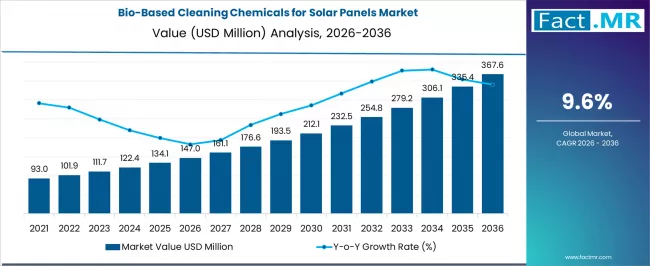
Defining trends involve the transition from chemical-intensive, phosphate-based cleaners to high-performance, biology-derived formulations that clean effectively without leaving residues that impair light transmission or harm surrounding ecosystems. Innovation is rapidly advancing in waterless polymeric fluids and anti-soiling bio-coatings that work synergistically with robotic cleaning systems. Integration of these specialized chemistries with IoT-enabled, water-conserving cleaning hardware is becoming critical for maximizing energy yield and reducing operational costs.
Regulatory pressures on water usage in arid regions and environmental protection laws restricting runoff from solar farms are primary market drivers. Policies promoting sustainable operations and maintenance (O&M) in the renewable energy sector act as significant catalysts, positioning bio-based cleaners as an essential component for the long-term sustainability and social license of large-scale solar projects.
Bio-Based Cleaning Chemicals for Solar Panels Market
| Metric | Value |
|---|---|
| Market Value (2026) | USD 147.00 Million |
| Market Forecast Value (2036) | USD 367.64 Million |
| Forecast CAGR (2026-2036) | 9.6% |
Category
| Category | Segments |
|---|---|
| Formulation & Chemistry | Biodegradable surfactant concentrates, Enzymatic and bio-catalytic cleaners, Waterless & polymeric waterless cleaning fluids, Organic acid and chelant blends, Solvent-free foam & gel cleaners, Anti-soiling and hydrophilic bio-coatings |
| Application Method | Manual spray & rinse (contract crews), Automated vehicle & truck mounted wash systems, Robotic & autonomous waterless systems (integrated chemistries), On-module pre-treatment (manufacturer/OEM applied), Dry wipe & brush systems with bio-fluids (rooftop/residential) |
| End-Market & Customer | Utility-scale solar farms (O&M contracts), Commercial & industrial rooftop arrays, Residential rooftop systems, PV manufacturing & module finishing (factory cleaning) |
| Region | North America, Latin America, Western Europe, Eastern Europe, East Asia, South Asia & Pacific, MEA |
Segmental Analysis
By Formulation & Chemistry, Which Technology Balances Effective Cleaning with Environmental Safety?

Biodegradable surfactant concentrates lead the segment with a 30% share. This dominance is due to their ability to effectively loosen and emulsify organic soiling from dust, pollen, and bird droppings without the use of harsh acids, alkalis, or phosphates. Derived from plant-based feedstocks, they break down quickly in the environment, preventing soil and water contamination, a critical requirement for solar farms often located in ecologically sensitive or arid areas, while maintaining high cleaning efficacy to restore panel efficiency.
By Application Method, Which Approach Remains the Most Flexible and Widespread for Diverse Site Conditions?
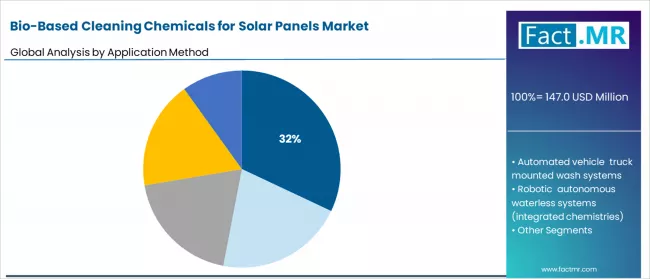
Manual spray & rinse (contract crews) commands the largest application method share at 32%. Despite the growth of automation, manual cleaning remains the most adaptable method for complex terrain, smaller sites, and arrays with irregular layouts. It requires lower upfront capital and allows for visual inspection. The use of concentrated, portable bio-based chemicals by trained crews offers an effective balance of flexibility, cost, and environmental compliance for a vast portion of the global installed PV base.
By End-Market & Customer, Who is the Primary Driver of Volume and Performance Demand?
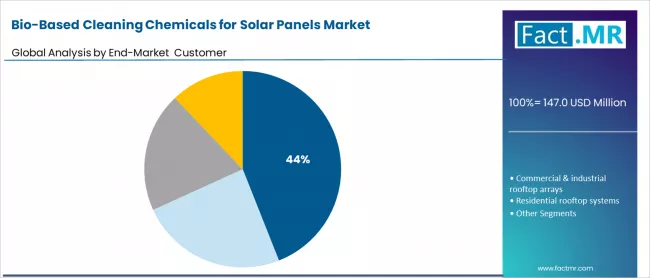
Utility-scale solar farms (O&M contracts) represent the dominant end-market at 44.00%. These massive installations have the highest financial stake in maintaining optimal energy output; even a minor percentage loss in efficiency equates to significant revenue loss. Their scale necessitates large-volume chemical purchases and professional O&M contracts. The environmental scrutiny on these projects and their frequent location in water-scarce regions make the adoption of effective, water-efficient, and eco-friendly bio-based cleaners a top operational priority.
What are the Drivers, Restraints, and Key Trends of the Bio-Based Cleaning Chemicals for Solar Panels Market?
Market growth is driven by the exponential global expansion of solar PV capacity, creating a vast and growing addressable market for O&M chemicals. Stringent environmental regulations, particularly in regions like the EU and California, prohibit toxic runoff from industrial sites, including solar farms. Critical water scarcity in prime solar locations (e.g., Middle East, India, US Southwest) demands cleaning solutions that reduce, recycle, or eliminate water use. Furthermore, the pursuit of higher ESG scores by solar asset owners and operators is pushing the adoption of green cleaning protocols.
A significant restraint is the higher per-liter cost of advanced bio-based formulations compared to conventional chemical cleaners, requiring a clear demonstration of return-on-investment through improved panel yield or reduced water/waste disposal costs. Performance skepticism persists regarding the ability of "gentler" bio-products to remove heavy, caked-on soiling in all climates. The fragmentation of the O&M service provider market can also slow the adoption of newer, specialized chemistries.
Key trends include the deep integration of cleaning chemistries with autonomous, waterless robotic systems, where the fluid is part of a patented cleaning process. The development of "anti-soiling" bio-coatings that create a slippery, hydrophilic surface to prevent dirt adhesion is gaining traction. There is also a rise in concentrate and tablet formats to minimize shipping weight and packaging waste, and the use of smart dosing systems that mix concentrate with on-site recycled water.
Analysis of the Bio-Based Cleaning Chemicals for Solar Panels Market by Key Countries
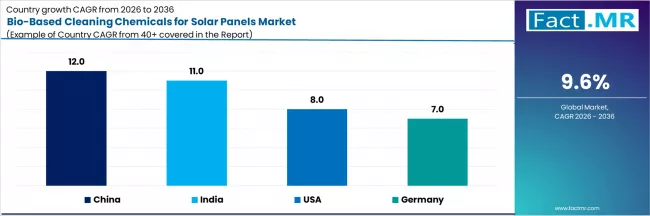
| Country | CAGR (2026-2036) |
|---|---|
| China | 12.00% |
| India | 11.00% |
| USA | 8.00% |
| Germany | 7.00% |
| Saudi Arabia | 10.50% |
How does China's Dominant Solar Capacity and Green Industrial Policy Drive Market Leadership?
China leads with a 12.00% CAGR, driven by its world-leading installed capacity of both utility-scale and distributed solar. National "ecological civilization" policies promote green practices across all industries, including renewable energy O&M. The vast scale of solar assets creates immense, recurring demand for cleaning solutions, pushing domestic chemical producers to develop and scale cost-effective bio-based surfactants and additives tailored to local soiling conditions (e.g., dust, industrial pollution).
Why is India's Rapid Solar Expansion and Extreme Water Stress a Key Growth Driver?
Aggressive solar targets and the severe water scarcity prevalent in its major solar states such as Rajasthan and Gujarat fuel India’s 11.00% growth. This combination makes water-conserving or waterless bio-cleaning technologies not just preferable but often essential. Government and industry focus on sustainable O&M to protect long-term asset viability is accelerating the adoption of advanced bio-based fluids, gels, and robotic cleaning systems integrated with specialized chemistry.
What Role does the USA's Mature Solar Market and Regulatory Diversity Play?
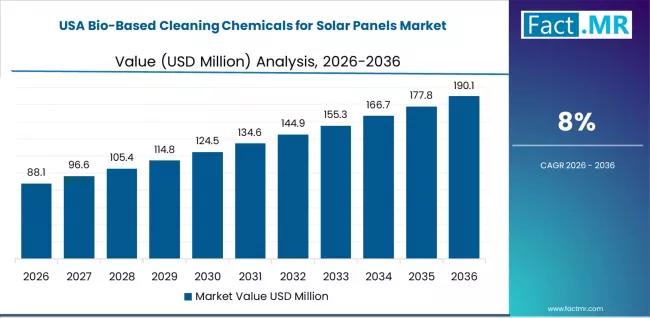
The USA's 8.00% growth is underpinned by a large, mature solar market with diverse regulatory environments. States like California have strict rules on water use and chemical runoff, driving demand in key regions. The high value of electricity and competitive O&M market incentivizes solutions that maximize yield. The market demands proven, high-performance bio-products that can be used in both manual applications for distributed generation and in automated systems for large-scale plants.
How does Germany's Precision Engineering and Focus on Resource Efficiency Influence the Market?
Germany's 7.00% growth reflects its engineering-driven approach to efficiency and resource conservation. While soiling is less severe than in sun belts, the focus on maximizing ROI from both large and small installations is high. German engineering firms are leaders in developing precise, automated, and water-minimizing cleaning hardware, which in turn drives demand for compatible, high-purity, and effective bio-based cleaning fluids and coatings that leave no residue.
What Factors Underpin Saudi Arabia's and the GCC's Focus on Waterless Technology in Mega-Projects?
Saudi Arabia's 10.50% growth is motivated by its visionary giga-scale solar projects in hyper-arid environments where water for cleaning is prohibitively expensive and scarce. This creates a non-negotiable demand for waterless cleaning technologies. The market is a testing ground for advanced robotic dry-cleaning systems and the specialized polymeric or coating-based bio-fluids that enable them, making it a critical innovation hub for waterless solar maintenance chemistries.
Competitive Landscape of the Bio-Based Cleaning Chemicals for Solar Panels Market
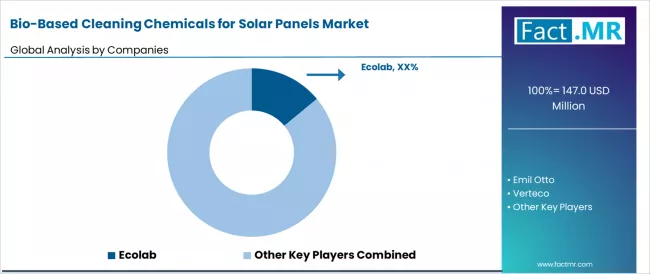
The competitive landscape is fragmented, featuring global industrial cleaning specialists, niche solar technology firms, and robotic cleaning OEMs. Industrial cleaning giants like Ecolab compete by leveraging their broad expertise in sustainable surfactant chemistry and large-scale supply chains to serve utility O&M providers.
Specialized solar cleaning chemical companies like IPC and Emil Otto compete with deep application knowledge and formulations specifically tested and optimized for PV glass and soiling types. Robotic cleaning system manufacturers like Ecoppia, Lavee, and Verteco compete with vertically integrated, proprietary chemical solutions that are part of their closed-loop, automated service offering. Competition intensifies around proving measurable gains in energy yield, reducing water consumption, and forming partnerships with large solar asset owners and O&M service providers.
Key Players in the Bio-Based Cleaning Chemicals for Solar Panels Market
- Ecolab
- Emil Otto
- Verteco
- IPC
- WattUp
- Ecoppia
- Lavee
Scope of Report
| Items | Values |
|---|---|
| Quantitative Units | USD Million |
| Formulation & Chemistry | Biodegradable surfactant concentrates, Enzymatic cleaners, Waterless polymeric fluids, Organic acid blends, Solvent-free foam & gel, Anti-soiling bio-coatings |
| Application Method | Manual spray & rinse, Automated vehicle systems, Robotic waterless systems, On-module pre-treatment, Dry wipe & brush systems |
| End-Market & Customer | Utility-scale solar farms, Commercial & industrial arrays, Residential systems, PV manufacturing |
| Key Countries | China, India, USA, Germany, Saudi Arabia |
| Key Companies | Ecolab, Emil Otto, Verteco, IPC, WattUp, Ecoppia, Lavee |
| Additional Analysis | Analysis of soiling loss mitigation efficacy, water savings/recycling potential, impact on PV module warranties and surface degradation, field performance data across climates, and total cost of ownership vs. conventional cleaning. |
Bio-Based Cleaning Chemicals for Solar Panels Market by Segments
-
Formulation & Chemistry :
- Biodegradable surfactant concentrates
- Enzymatic and bio-catalytic cleaners
- Waterless & polymeric waterless cleaning fluids
- Organic acid and chelant blends
- Solvent-free foam & gel cleaners
- Anti-soiling and hydrophilic bio-coatings
-
Application Method :
- Manual spray & rinse (contract crews)
- Automated vehicle & truck mounted wash systems
- Robotic & autonomous waterless systems (integrated chemistries)
- On-module pre-treatment (manufacturer/OEM applied)
- Dry wipe & brush systems with bio-fluids (rooftop/residential)
-
End-Market & Customer :
- Utility-scale solar farms (O&M contracts)
- Commercial & industrial rooftop arrays
- Residential rooftop systems
- PV manufacturing & module finishing (factory cleaning)
-
Region :
-
North America
- USA
- Canada
-
Latin America
- Brazil
- Chile
- Mexico
- Rest of Latin America
-
Western Europe
- Germany
- UK
- Spain
- France
- Italy
- UK
- BENELUX
- Rest of Western Europe
-
Eastern Europe
- Poland
- Russia
- Czech Republic
- Rest of Eastern Europe
-
East Asia
- China
- Japan
- South Korea
- Rest of East Asia
-
South Asia & Pacific
- India
- Australia
- ASEAN
- Rest of South Asia & Pacific
-
MEA
- Saudi Arabia
- UAE
- South Africa
- Israel
- Rest of MEA
-
Table of Content
- Executive Summary
- Global Market Outlook
- Demand to side Trends
- Supply to side Trends
- Technology Roadmap Analysis
- Analysis and Recommendations
- Market Overview
- Market Coverage / Taxonomy
- Market Definition / Scope / Limitations
- Market Background
- Market Dynamics
- Drivers
- Restraints
- Opportunity
- Trends
- Scenario Forecast
- Demand in Optimistic Scenario
- Demand in Likely Scenario
- Demand in Conservative Scenario
- Opportunity Map Analysis
- Product Life Cycle Analysis
- Supply Chain Analysis
- Investment Feasibility Matrix
- Value Chain Analysis
- PESTLE and Porter’s Analysis
- Regulatory Landscape
- Regional Parent Market Outlook
- Production and Consumption Statistics
- Import and Export Statistics
- Market Dynamics
- Global Market Analysis 2021 to 2025 and Forecast, 2026 to 2036
- Historical Market Size Value (USD Million) Analysis, 2021 to 2025
- Current and Future Market Size Value (USD Million) Projections, 2026 to 2036
- Y to o to Y Growth Trend Analysis
- Absolute $ Opportunity Analysis
- Global Market Pricing Analysis 2021 to 2025 and Forecast 2026 to 2036
- Global Market Analysis 2021 to 2025 and Forecast 2026 to 2036, By Formulation Chemistry
- Introduction / Key Findings
- Historical Market Size Value (USD Million) Analysis By Formulation Chemistry, 2021 to 2025
- Current and Future Market Size Value (USD Million) Analysis and Forecast By Formulation Chemistry, 2026 to 2036
- Biodegradable surfactant concentrates
- Enzymatic and bio-catalytic cleaners
- Waterless polymeric waterless cleaning fluids
- Organic acid and chelant blends
- Solvent-free foam & gel cleaners
- Anti-soiling and hydrophilic bio-coatings
- Biodegradable surfactant concentrates
- Y to o to Y Growth Trend Analysis By Formulation Chemistry, 2021 to 2025
- Absolute $ Opportunity Analysis By Formulation Chemistry, 2026 to 2036
- Global Market Analysis 2021 to 2025 and Forecast 2026 to 2036, By Application Method
- Introduction / Key Findings
- Historical Market Size Value (USD Million) Analysis By Application Method, 2021 to 2025
- Current and Future Market Size Value (USD Million) Analysis and Forecast By Application Method, 2026 to 2036
- Manual spray & rinse (contract crews)
- Automated vehicle truck mounted wash systems
- Robotic autonomous waterless systems (integrated chemistries)
- On-module pre-treatment (manufacturerOEM applied)
- Dry wipe brush systems with bio-fluids (rooftopresidential)
- Manual spray & rinse (contract crews)
- Y to o to Y Growth Trend Analysis By Application Method, 2021 to 2025
- Absolute $ Opportunity Analysis By Application Method, 2026 to 2036
- Global Market Analysis 2021 to 2025 and Forecast 2026 to 2036, By End-Market Customer
- Introduction / Key Findings
- Historical Market Size Value (USD Million) Analysis By End-Market Customer, 2021 to 2025
- Current and Future Market Size Value (USD Million) Analysis and Forecast By End-Market Customer, 2026 to 2036
- Utility-scale solar farms (O&M contracts)
- Commercial & industrial rooftop arrays
- Residential rooftop systems
- PV manufacturing & module finishing (factory cleaning)
- Utility-scale solar farms (O&M contracts)
- Y to o to Y Growth Trend Analysis By End-Market Customer, 2021 to 2025
- Absolute $ Opportunity Analysis By End-Market Customer, 2026 to 2036
- Global Market Analysis 2021 to 2025 and Forecast 2026 to 2036, By Region
- Introduction
- Historical Market Size Value (USD Million) Analysis By Region, 2021 to 2025
- Current Market Size Value (USD Million) Analysis and Forecast By Region, 2026 to 2036
- North America
- Latin America
- Western Europe
- Eastern Europe
- East Asia
- South Asia and Pacific
- Middle East & Africa
- Market Attractiveness Analysis By Region
- North America Market Analysis 2021 to 2025 and Forecast 2026 to 2036, By Country
- Historical Market Size Value (USD Million) Trend Analysis By Market Taxonomy, 2021 to 2025
- Market Size Value (USD Million) Forecast By Market Taxonomy, 2026 to 2036
- By Country
- USA
- Canada
- Mexico
- By Formulation Chemistry
- By Application Method
- By End-Market Customer
- By Country
- Market Attractiveness Analysis
- By Country
- By Formulation Chemistry
- By Application Method
- By End-Market Customer
- Key Takeaways
- Latin America Market Analysis 2021 to 2025 and Forecast 2026 to 2036, By Country
- Historical Market Size Value (USD Million) Trend Analysis By Market Taxonomy, 2021 to 2025
- Market Size Value (USD Million) Forecast By Market Taxonomy, 2026 to 2036
- By Country
- Brazil
- Chile
- Rest of Latin America
- By Formulation Chemistry
- By Application Method
- By End-Market Customer
- By Country
- Market Attractiveness Analysis
- By Country
- By Formulation Chemistry
- By Application Method
- By End-Market Customer
- Key Takeaways
- Western Europe Market Analysis 2021 to 2025 and Forecast 2026 to 2036, By Country
- Historical Market Size Value (USD Million) Trend Analysis By Market Taxonomy, 2021 to 2025
- Market Size Value (USD Million) Forecast By Market Taxonomy, 2026 to 2036
- By Country
- Germany
- UK
- Italy
- Spain
- France
- Nordic
- BENELUX
- Rest of Western Europe
- By Formulation Chemistry
- By Application Method
- By End-Market Customer
- By Country
- Market Attractiveness Analysis
- By Country
- By Formulation Chemistry
- By Application Method
- By End-Market Customer
- Key Takeaways
- Eastern Europe Market Analysis 2021 to 2025 and Forecast 2026 to 2036, By Country
- Historical Market Size Value (USD Million) Trend Analysis By Market Taxonomy, 2021 to 2025
- Market Size Value (USD Million) Forecast By Market Taxonomy, 2026 to 2036
- By Country
- Russia
- Poland
- Hungary
- Balkan & Baltic
- Rest of Eastern Europe
- By Formulation Chemistry
- By Application Method
- By End-Market Customer
- By Country
- Market Attractiveness Analysis
- By Country
- By Formulation Chemistry
- By Application Method
- By End-Market Customer
- Key Takeaways
- East Asia Market Analysis 2021 to 2025 and Forecast 2026 to 2036, By Country
- Historical Market Size Value (USD Million) Trend Analysis By Market Taxonomy, 2021 to 2025
- Market Size Value (USD Million) Forecast By Market Taxonomy, 2026 to 2036
- By Country
- China
- Japan
- South Korea
- By Formulation Chemistry
- By Application Method
- By End-Market Customer
- By Country
- Market Attractiveness Analysis
- By Country
- By Formulation Chemistry
- By Application Method
- By End-Market Customer
- Key Takeaways
- South Asia and Pacific Market Analysis 2021 to 2025 and Forecast 2026 to 2036, By Country
- Historical Market Size Value (USD Million) Trend Analysis By Market Taxonomy, 2021 to 2025
- Market Size Value (USD Million) Forecast By Market Taxonomy, 2026 to 2036
- By Country
- India
- ASEAN
- Australia & New Zealand
- Rest of South Asia and Pacific
- By Formulation Chemistry
- By Application Method
- By End-Market Customer
- By Country
- Market Attractiveness Analysis
- By Country
- By Formulation Chemistry
- By Application Method
- By End-Market Customer
- Key Takeaways
- Middle East & Africa Market Analysis 2021 to 2025 and Forecast 2026 to 2036, By Country
- Historical Market Size Value (USD Million) Trend Analysis By Market Taxonomy, 2021 to 2025
- Market Size Value (USD Million) Forecast By Market Taxonomy, 2026 to 2036
- By Country
- Kingdom of Saudi Arabia
- Other GCC Countries
- Turkiye
- South Africa
- Other African Union
- Rest of Middle East & Africa
- By Formulation Chemistry
- By Application Method
- By End-Market Customer
- By Country
- Market Attractiveness Analysis
- By Country
- By Formulation Chemistry
- By Application Method
- By End-Market Customer
- Key Takeaways
- Key Countries Market Analysis
- USA
- Pricing Analysis
- Market Share Analysis, 2025
- By Formulation Chemistry
- By Application Method
- By End-Market Customer
- Canada
- Pricing Analysis
- Market Share Analysis, 2025
- By Formulation Chemistry
- By Application Method
- By End-Market Customer
- Mexico
- Pricing Analysis
- Market Share Analysis, 2025
- By Formulation Chemistry
- By Application Method
- By End-Market Customer
- Brazil
- Pricing Analysis
- Market Share Analysis, 2025
- By Formulation Chemistry
- By Application Method
- By End-Market Customer
- Chile
- Pricing Analysis
- Market Share Analysis, 2025
- By Formulation Chemistry
- By Application Method
- By End-Market Customer
- Germany
- Pricing Analysis
- Market Share Analysis, 2025
- By Formulation Chemistry
- By Application Method
- By End-Market Customer
- UK
- Pricing Analysis
- Market Share Analysis, 2025
- By Formulation Chemistry
- By Application Method
- By End-Market Customer
- Italy
- Pricing Analysis
- Market Share Analysis, 2025
- By Formulation Chemistry
- By Application Method
- By End-Market Customer
- Spain
- Pricing Analysis
- Market Share Analysis, 2025
- By Formulation Chemistry
- By Application Method
- By End-Market Customer
- France
- Pricing Analysis
- Market Share Analysis, 2025
- By Formulation Chemistry
- By Application Method
- By End-Market Customer
- India
- Pricing Analysis
- Market Share Analysis, 2025
- By Formulation Chemistry
- By Application Method
- By End-Market Customer
- ASEAN
- Pricing Analysis
- Market Share Analysis, 2025
- By Formulation Chemistry
- By Application Method
- By End-Market Customer
- Australia & New Zealand
- Pricing Analysis
- Market Share Analysis, 2025
- By Formulation Chemistry
- By Application Method
- By End-Market Customer
- China
- Pricing Analysis
- Market Share Analysis, 2025
- By Formulation Chemistry
- By Application Method
- By End-Market Customer
- Japan
- Pricing Analysis
- Market Share Analysis, 2025
- By Formulation Chemistry
- By Application Method
- By End-Market Customer
- South Korea
- Pricing Analysis
- Market Share Analysis, 2025
- By Formulation Chemistry
- By Application Method
- By End-Market Customer
- Russia
- Pricing Analysis
- Market Share Analysis, 2025
- By Formulation Chemistry
- By Application Method
- By End-Market Customer
- Poland
- Pricing Analysis
- Market Share Analysis, 2025
- By Formulation Chemistry
- By Application Method
- By End-Market Customer
- Hungary
- Pricing Analysis
- Market Share Analysis, 2025
- By Formulation Chemistry
- By Application Method
- By End-Market Customer
- Kingdom of Saudi Arabia
- Pricing Analysis
- Market Share Analysis, 2025
- By Formulation Chemistry
- By Application Method
- By End-Market Customer
- Turkiye
- Pricing Analysis
- Market Share Analysis, 2025
- By Formulation Chemistry
- By Application Method
- By End-Market Customer
- South Africa
- Pricing Analysis
- Market Share Analysis, 2025
- By Formulation Chemistry
- By Application Method
- By End-Market Customer
- USA
- Market Structure Analysis
- Competition Dashboard
- Competition Benchmarking
- Market Share Analysis of Top Players
- By Regional
- By Formulation Chemistry
- By Application Method
- By End-Market Customer
- Competition Analysis
- Competition Deep Dive
- Ecolab
- Overview
- Product Portfolio
- Profitability by Market Segments (Product/Age /Sales Channel/Region)
- Sales Footprint
- Strategy Overview
- Marketing Strategy
- Product Strategy
- Channel Strategy
- Emil Otto
- Verteco
- IPC
- WattUp
- Ecoppia
- Lavee
- Ecolab
- Competition Deep Dive
- Assumptions & Acronyms Used
- Research Methodology
List Of Table
- Table 1: Global Market Value (USD Million) Forecast by Region, 2021 to 2036
- Table 2: Global Market Value (USD Million) Forecast by Formulation Chemistry, 2021 to 2036
- Table 3: Global Market Value (USD Million) Forecast by Application Method, 2021 to 2036
- Table 4: Global Market Value (USD Million) Forecast by End-Market Customer, 2021 to 2036
- Table 5: North America Market Value (USD Million) Forecast by Country, 2021 to 2036
- Table 6: North America Market Value (USD Million) Forecast by Formulation Chemistry, 2021 to 2036
- Table 7: North America Market Value (USD Million) Forecast by Application Method, 2021 to 2036
- Table 8: North America Market Value (USD Million) Forecast by End-Market Customer, 2021 to 2036
- Table 9: Latin America Market Value (USD Million) Forecast by Country, 2021 to 2036
- Table 10: Latin America Market Value (USD Million) Forecast by Formulation Chemistry, 2021 to 2036
- Table 11: Latin America Market Value (USD Million) Forecast by Application Method, 2021 to 2036
- Table 12: Latin America Market Value (USD Million) Forecast by End-Market Customer, 2021 to 2036
- Table 13: Western Europe Market Value (USD Million) Forecast by Country, 2021 to 2036
- Table 14: Western Europe Market Value (USD Million) Forecast by Formulation Chemistry, 2021 to 2036
- Table 15: Western Europe Market Value (USD Million) Forecast by Application Method, 2021 to 2036
- Table 16: Western Europe Market Value (USD Million) Forecast by End-Market Customer, 2021 to 2036
- Table 17: Eastern Europe Market Value (USD Million) Forecast by Country, 2021 to 2036
- Table 18: Eastern Europe Market Value (USD Million) Forecast by Formulation Chemistry, 2021 to 2036
- Table 19: Eastern Europe Market Value (USD Million) Forecast by Application Method, 2021 to 2036
- Table 20: Eastern Europe Market Value (USD Million) Forecast by End-Market Customer, 2021 to 2036
- Table 21: East Asia Market Value (USD Million) Forecast by Country, 2021 to 2036
- Table 22: East Asia Market Value (USD Million) Forecast by Formulation Chemistry, 2021 to 2036
- Table 23: East Asia Market Value (USD Million) Forecast by Application Method, 2021 to 2036
- Table 24: East Asia Market Value (USD Million) Forecast by End-Market Customer, 2021 to 2036
- Table 25: South Asia and Pacific Market Value (USD Million) Forecast by Country, 2021 to 2036
- Table 26: South Asia and Pacific Market Value (USD Million) Forecast by Formulation Chemistry, 2021 to 2036
- Table 27: South Asia and Pacific Market Value (USD Million) Forecast by Application Method, 2021 to 2036
- Table 28: South Asia and Pacific Market Value (USD Million) Forecast by End-Market Customer, 2021 to 2036
- Table 29: Middle East & Africa Market Value (USD Million) Forecast by Country, 2021 to 2036
- Table 30: Middle East & Africa Market Value (USD Million) Forecast by Formulation Chemistry, 2021 to 2036
- Table 31: Middle East & Africa Market Value (USD Million) Forecast by Application Method, 2021 to 2036
- Table 32: Middle East & Africa Market Value (USD Million) Forecast by End-Market Customer, 2021 to 2036
List Of Figures
- Figure 1: Global Market Pricing Analysis
- Figure 2: Global Market Value (USD Million) Forecast 2021 to 2036
- Figure 3: Global Market Value Share and BPS Analysis by Formulation Chemistry, 2026 and 2036
- Figure 4: Global Market Y to o to Y Growth Comparison by Formulation Chemistry, 2026 to 2036
- Figure 5: Global Market Attractiveness Analysis by Formulation Chemistry
- Figure 6: Global Market Value Share and BPS Analysis by Application Method, 2026 and 2036
- Figure 7: Global Market Y to o to Y Growth Comparison by Application Method, 2026 to 2036
- Figure 8: Global Market Attractiveness Analysis by Application Method
- Figure 9: Global Market Value Share and BPS Analysis by End-Market Customer, 2026 and 2036
- Figure 10: Global Market Y to o to Y Growth Comparison by End-Market Customer, 2026 to 2036
- Figure 11: Global Market Attractiveness Analysis by End-Market Customer
- Figure 12: Global Market Value (USD Million) Share and BPS Analysis by Region, 2026 and 2036
- Figure 13: Global Market Y to o to Y Growth Comparison by Region, 2026 to 2036
- Figure 14: Global Market Attractiveness Analysis by Region
- Figure 15: North America Market Incremental Dollar Opportunity, 2026 to 2036
- Figure 16: Latin America Market Incremental Dollar Opportunity, 2026 to 2036
- Figure 17: Western Europe Market Incremental Dollar Opportunity, 2026 to 2036
- Figure 18: Eastern Europe Market Incremental Dollar Opportunity, 2026 to 2036
- Figure 19: East Asia Market Incremental Dollar Opportunity, 2026 to 2036
- Figure 20: South Asia and Pacific Market Incremental Dollar Opportunity, 2026 to 2036
- Figure 21: Middle East & Africa Market Incremental Dollar Opportunity, 2026 to 2036
- Figure 22: North America Market Value Share and BPS Analysis by Country, 2026 and 2036
- Figure 23: North America Market Value Share and BPS Analysis by Formulation Chemistry, 2026 and 2036
- Figure 24: North America Market Y to o to Y Growth Comparison by Formulation Chemistry, 2026 to 2036
- Figure 25: North America Market Attractiveness Analysis by Formulation Chemistry
- Figure 26: North America Market Value Share and BPS Analysis by Application Method, 2026 and 2036
- Figure 27: North America Market Y to o to Y Growth Comparison by Application Method, 2026 to 2036
- Figure 28: North America Market Attractiveness Analysis by Application Method
- Figure 29: North America Market Value Share and BPS Analysis by End-Market Customer, 2026 and 2036
- Figure 30: North America Market Y to o to Y Growth Comparison by End-Market Customer, 2026 to 2036
- Figure 31: North America Market Attractiveness Analysis by End-Market Customer
- Figure 32: Latin America Market Value Share and BPS Analysis by Country, 2026 and 2036
- Figure 33: Latin America Market Value Share and BPS Analysis by Formulation Chemistry, 2026 and 2036
- Figure 34: Latin America Market Y to o to Y Growth Comparison by Formulation Chemistry, 2026 to 2036
- Figure 35: Latin America Market Attractiveness Analysis by Formulation Chemistry
- Figure 36: Latin America Market Value Share and BPS Analysis by Application Method, 2026 and 2036
- Figure 37: Latin America Market Y to o to Y Growth Comparison by Application Method, 2026 to 2036
- Figure 38: Latin America Market Attractiveness Analysis by Application Method
- Figure 39: Latin America Market Value Share and BPS Analysis by End-Market Customer, 2026 and 2036
- Figure 40: Latin America Market Y to o to Y Growth Comparison by End-Market Customer, 2026 to 2036
- Figure 41: Latin America Market Attractiveness Analysis by End-Market Customer
- Figure 42: Western Europe Market Value Share and BPS Analysis by Country, 2026 and 2036
- Figure 43: Western Europe Market Value Share and BPS Analysis by Formulation Chemistry, 2026 and 2036
- Figure 44: Western Europe Market Y to o to Y Growth Comparison by Formulation Chemistry, 2026 to 2036
- Figure 45: Western Europe Market Attractiveness Analysis by Formulation Chemistry
- Figure 46: Western Europe Market Value Share and BPS Analysis by Application Method, 2026 and 2036
- Figure 47: Western Europe Market Y to o to Y Growth Comparison by Application Method, 2026 to 2036
- Figure 48: Western Europe Market Attractiveness Analysis by Application Method
- Figure 49: Western Europe Market Value Share and BPS Analysis by End-Market Customer, 2026 and 2036
- Figure 50: Western Europe Market Y to o to Y Growth Comparison by End-Market Customer, 2026 to 2036
- Figure 51: Western Europe Market Attractiveness Analysis by End-Market Customer
- Figure 52: Eastern Europe Market Value Share and BPS Analysis by Country, 2026 and 2036
- Figure 53: Eastern Europe Market Value Share and BPS Analysis by Formulation Chemistry, 2026 and 2036
- Figure 54: Eastern Europe Market Y to o to Y Growth Comparison by Formulation Chemistry, 2026 to 2036
- Figure 55: Eastern Europe Market Attractiveness Analysis by Formulation Chemistry
- Figure 56: Eastern Europe Market Value Share and BPS Analysis by Application Method, 2026 and 2036
- Figure 57: Eastern Europe Market Y to o to Y Growth Comparison by Application Method, 2026 to 2036
- Figure 58: Eastern Europe Market Attractiveness Analysis by Application Method
- Figure 59: Eastern Europe Market Value Share and BPS Analysis by End-Market Customer, 2026 and 2036
- Figure 60: Eastern Europe Market Y to o to Y Growth Comparison by End-Market Customer, 2026 to 2036
- Figure 61: Eastern Europe Market Attractiveness Analysis by End-Market Customer
- Figure 62: East Asia Market Value Share and BPS Analysis by Country, 2026 and 2036
- Figure 63: East Asia Market Value Share and BPS Analysis by Formulation Chemistry, 2026 and 2036
- Figure 64: East Asia Market Y to o to Y Growth Comparison by Formulation Chemistry, 2026 to 2036
- Figure 65: East Asia Market Attractiveness Analysis by Formulation Chemistry
- Figure 66: East Asia Market Value Share and BPS Analysis by Application Method, 2026 and 2036
- Figure 67: East Asia Market Y to o to Y Growth Comparison by Application Method, 2026 to 2036
- Figure 68: East Asia Market Attractiveness Analysis by Application Method
- Figure 69: East Asia Market Value Share and BPS Analysis by End-Market Customer, 2026 and 2036
- Figure 70: East Asia Market Y to o to Y Growth Comparison by End-Market Customer, 2026 to 2036
- Figure 71: East Asia Market Attractiveness Analysis by End-Market Customer
- Figure 72: South Asia and Pacific Market Value Share and BPS Analysis by Country, 2026 and 2036
- Figure 73: South Asia and Pacific Market Value Share and BPS Analysis by Formulation Chemistry, 2026 and 2036
- Figure 74: South Asia and Pacific Market Y to o to Y Growth Comparison by Formulation Chemistry, 2026 to 2036
- Figure 75: South Asia and Pacific Market Attractiveness Analysis by Formulation Chemistry
- Figure 76: South Asia and Pacific Market Value Share and BPS Analysis by Application Method, 2026 and 2036
- Figure 77: South Asia and Pacific Market Y to o to Y Growth Comparison by Application Method, 2026 to 2036
- Figure 78: South Asia and Pacific Market Attractiveness Analysis by Application Method
- Figure 79: South Asia and Pacific Market Value Share and BPS Analysis by End-Market Customer, 2026 and 2036
- Figure 80: South Asia and Pacific Market Y to o to Y Growth Comparison by End-Market Customer, 2026 to 2036
- Figure 81: South Asia and Pacific Market Attractiveness Analysis by End-Market Customer
- Figure 82: Middle East & Africa Market Value Share and BPS Analysis by Country, 2026 and 2036
- Figure 83: Middle East & Africa Market Value Share and BPS Analysis by Formulation Chemistry, 2026 and 2036
- Figure 84: Middle East & Africa Market Y to o to Y Growth Comparison by Formulation Chemistry, 2026 to 2036
- Figure 85: Middle East & Africa Market Attractiveness Analysis by Formulation Chemistry
- Figure 86: Middle East & Africa Market Value Share and BPS Analysis by Application Method, 2026 and 2036
- Figure 87: Middle East & Africa Market Y to o to Y Growth Comparison by Application Method, 2026 to 2036
- Figure 88: Middle East & Africa Market Attractiveness Analysis by Application Method
- Figure 89: Middle East & Africa Market Value Share and BPS Analysis by End-Market Customer, 2026 and 2036
- Figure 90: Middle East & Africa Market Y to o to Y Growth Comparison by End-Market Customer, 2026 to 2036
- Figure 91: Middle East & Africa Market Attractiveness Analysis by End-Market Customer
- Figure 92: Global Market - Tier Structure Analysis
- Figure 93: Global Market - Company Share Analysis
- FAQs -
How big is the bio-based cleaning chemicals for solar panels market in 2026?
The global bio-based cleaning chemicals for solar panels market is estimated to be valued at USD 147.0 million in 2026.
What will be the size of bio-based cleaning chemicals for solar panels market in 2036?
The market size for the bio-based cleaning chemicals for solar panels market is projected to reach USD 367.6 million by 2036.
How much will be the bio-based cleaning chemicals for solar panels market growth between 2026 and 2036?
The bio-based cleaning chemicals for solar panels market is expected to grow at a 9.6% CAGR between 2026 and 2036.
What are the key product types in the bio-based cleaning chemicals for solar panels market?
The key product types in bio-based cleaning chemicals for solar panels market are biodegradable surfactant concentrates, enzymatic and bio-catalytic cleaners, waterless polymeric waterless cleaning fluids, organic acid and chelant blends, solvent-free foam & gel cleaners and anti-soiling and hydrophilic bio-coatings.
Which application method segment to contribute significant share in the bio-based cleaning chemicals for solar panels market in 2026?
In terms of application method, manual spray & rinse (contract crews) segment to command 32.0% share in the bio-based cleaning chemicals for solar panels market in 2026.