- Market Value (2025): USD 769.9 Mn
- Estimated Value (2026): USD 840.0 Mn
- Forecast Value (2036): USD 2006.9 Mn
- CAGR (2026-2036): 9.1%
What is the Bio-Based Coupling Relays Market forecast to be worth by 2036?
USD 840.0 million in 2026 to USD 2,006.9 million by 2036 at a 9.1% CAGR.
- The Bio-Based Coupling Relays Market reached USD 769.9 million in 2025.
- Demand is projected to increase from USD 840.0 million in 2026 to USD 2,006.9 million by 2036.
- The market is forecast to record 9.1% CAGR from 2026 to 2036 as panel builders and automation OEMs specify relays with documented polymer content.
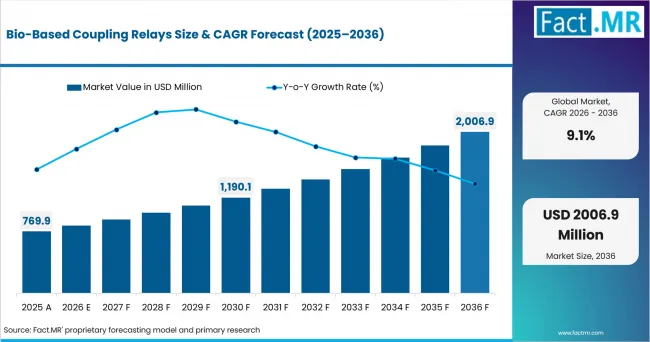
Bio Based Coupling Relays Value Analysis | Source: Fact.MR
What are the defining numbers behind Bio-Based Coupling Relays Market growth?
An absolute opportunity of USD 1,166.9 million is expected between 2026 and 2036.
- Demand Drivers in the Market
- Panel builders need relay housings that keep the same socket footprint and DIN-rail spacing and add clearer material records for control-cabinet projects.
- Automation OEMs require compact interposing relays when machines add sensors and distributed control points across production lines.
- European Bioplastics reported in December 2025 that global biobased plastics production capacity is projected to rise from 2.31 million tonnes in 2025 to 4.69 million tonnes by 2030. Wider resin availability supports material trials for relay housings.
- Industrial distributors favor relay families with familiar coil voltages and approval records since replacement demand depends on quick matching during plant maintenance.
- Energy-system integrators need reliable switching interfaces as battery cabinets, inverters and renewable-energy panels add more low-voltage control circuits.
- Key Segments Analyzed
- By Housing Material: Bio-attributed engineering plastic is expected to hold 38.0% share in 2026 as it preserves molding behavior and improves material-origin documentation.
- By Relay Architecture: Electromechanical coupling relay is projected to account for 41.0% share in 2026 since plant engineers value visible isolation and simple replacement in control cabinets.
- By Coil Voltage: 24 VDC is anticipated to capture 44.0% share in 2026 owing to its broad use in PLC cabinets and low-voltage industrial circuits.
- By Application: Industrial automation is estimated to represent 36.0% share in 2026, supported by signal isolation needs across sensors and controller interfaces.
- Analyst Opinion at Fact.MR
- Shambhu Nath Jha, Principal Consultant at Fact.MR, states, “Bio-based coupling relays draw attention in control cabinets where the switching component is small but repeated many times. The market is expected to reward suppliers that document polymer origin and keep approvals and installation habits intact. Effective portfolios combine compact relays, familiar sockets and credible material records that panel teams trust during design reviews.”
- Strategic Implications
- Relay manufacturers should prepare one technical file that covers housing material content, flame behavior and approval status for engineering teams.
- Industrial distributors should train sales teams to compare bio-based ranges by socket compatibility, coil voltage coverage and replacement simplicity.
- Automation OEMs should qualify relay families early in cabinet design so bio-based material choices fit scheduled panel approval work.
- Material suppliers should support relay makers with molding data, thermal aging results and consistent resin availability across regional plants.
Germany is projected to record 8.3% CAGR through 2036 due to automation depth and electrical-equipment relay renewal. The UK is anticipated to post 7.9% CAGR as retrofit activity supports panel component replacement. France is forecast to advance at 7.3% CAGR through electrical-equipment output and automation upgrades. The USA is estimated to hold 7.0% CAGR as electrical-component shipments and local relay assembly support availability. Japan is expected to reach 4.3% CAGR through established electronics production and strict relay qualification.
How does the Bio-Based Coupling Relays Market break down by segment?
Bio-attributed engineering plastic leads Housing Material at 38.0%; 24 VDC leads Coil Voltage at 44.0%.
Which Housing Material dominates?
Bio-attributed engineering plastic is expected to hold 38.0% share in 2026.
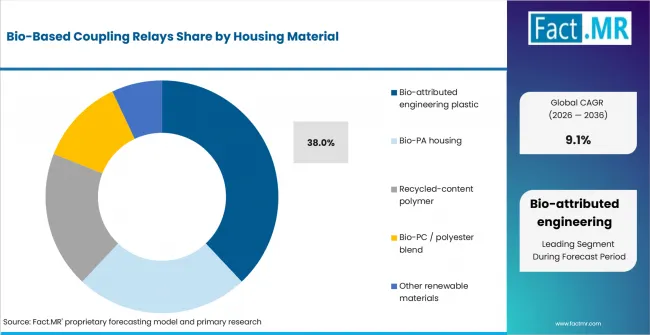
Bio Based Coupling Relays Analysis By Housing Material | Source: Fact.MR
Bio-attributed engineering plastic leads since it lets relay makers retain known molding performance and insulation behavior. The material route also supports buyer requests for lower-carbon sourcing records and keeping the relay footprint familiar.
What leads the Relay Architecture segment?
Electromechanical coupling relay is projected to account for 41.0% share in 2026.
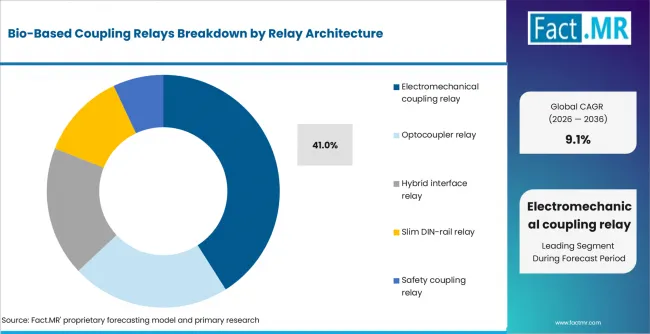
Bio Based Coupling Relays Analysis By Relay Architecture | Source: Fact.MR
Electromechanical coupling relays remain widely selected where plant teams want physical contact separation, simple fault checks and fast field replacement. Their appeal is strongest in control panels where electricians already understand sockets, test buttons and coil ratings.
Weidmuller USA unveiled CUBESERIES Industrial Relay Modules in June 2025 for switching small loads, decoupling systems and multiplying signals. The company began relay kitting in Richmond, Virginia, with UL-listed assemblies for U.S. customers, showing how modular relay ranges support regional availability.
How does Coil Voltage shape demand?
24 VDC is anticipated to capture 44.0% share in 2026.
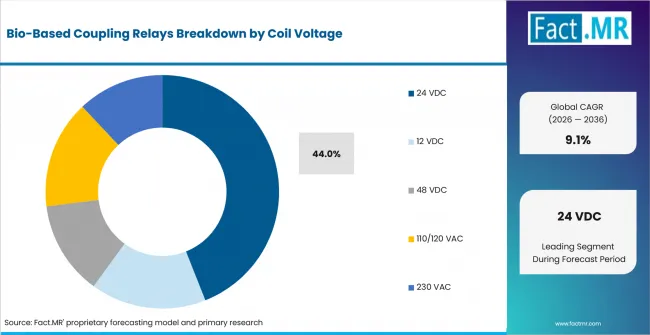
Bio Based Coupling Relays Analysis By Coil Voltage | Source: Fact.MR
24 VDC leads since many PLC input and output circuits already use low-voltage control power. Standard voltage practice allows panel builders to use the same relay family across sensors, actuators and interposing functions.
The 24 VDC preference also supports smaller cabinets and easier troubleshooting. Relay makers benefit when one socket and accessory platform covers 12 VDC, 48 VDC and AC coil alternatives for nearby applications.
What supports Industrial Automation within Application?
Industrial automation is estimated to represent 36.0% share in 2026.
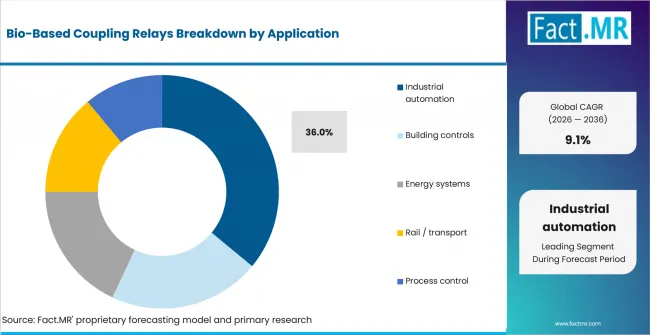
Bio Based Coupling Relays Analysis By Application | Source: Fact.MR
Industrial automation leads as coupling relays are placed between controllers and field devices in many machines. They protect PLC outputs, isolate noisy signals and help technicians replace a switching point and keep controller hardware in service.
The International Federation of Robotics reported in September 2025 that 542,000 industrial robots were installed globally in 2024. More automated cells increase the number of cabinet-level interfaces that need reliable relay isolation and clear installation records.
What is accelerating Bio-Based Coupling Relays Market adoption, and what is holding it back?
Demand is expected to rise through polymer documentation, compact control cabinets and automation upgrades. Growth is constrained by approval cycles, material cost and qualification risk.
Drivers Impact Analysis
| DRIVER | (~) % IMPACT ON CAGR | GEOGRAPHIC RELEVANCE | IMPACT TIMELINE |
|---|---|---|---|
| Material-origin documentation in relay housings | +1.2% | Europe, North America | Medium term (2-4 years) |
| Compact cabinet and DIN-rail interface demand | +1.0% | Global | Short term (<= 2 years) |
| Automation retrofit and machine rebuilding | +0.8% | Europe, Japan, USA | Medium term (2-4 years) |
| Energy-system control and DC switching growth | +0.6% | Global | Long term (>= 4 years) |
- Material-origin documentation in relay housings: Engineering teams increasingly request evidence on polymer content and compliance. Bio-based housings gain consideration when they match the electrical and fire-safety requirements used for conventional relay enclosures.
- Compact cabinet and DIN-rail interface demand: Machine builders continue to reduce cabinet size and add more signals. Slim relay modules, compatible sockets and clear coil-voltage ranges help panel teams standardize layouts.
- Automation retrofit and machine rebuilding: Replacement projects often keep the existing control concept and upgrade field devices. Coupling relays are practical change points since they are placed between controllers and loads.
Opportunity Impact Analysis
| OPPORTUNITY | (~) % IMPACT ON CAGR | GEOGRAPHIC RELEVANCE | IMPACT TIMELINE |
|---|---|---|---|
| Bio-PA and bio-PC blends for certified housings | +0.9% | Europe, Japan | Medium term (2-4 years) |
| Modular relay kits for local panel builders | +0.7% | USA, Europe | Short term (<= 2 years) |
| Energy storage and inverter control cabinets | +0.5% | Global | Long term (>= 4 years) |
- Bio-PA and bio-PC blends for certified housings: Relay suppliers have room to differentiate when material claims are backed by test data. The opportunity depends on stable resin supply and repeatable molding quality.
- Modular relay kits for local panel builders: Pre-assembled relay sets reduce selection errors and shorten panel-building work. Local kitting improves availability when buyers need replacement parts with country-specific approvals.
- Energy storage and inverter control cabinets: Battery and renewable-energy cabinets need control interfaces for contactors, sensors and alarms. Bio-based relay housings gain relevance when energy projects track component-level material choices.
Restraints Impact Analysis
| RESTRAINT | (~) % IMPACT ON CAGR | GEOGRAPHIC RELEVANCE | IMPACT TIMELINE |
|---|---|---|---|
| Flame-rating and insulation qualification burden | -0.6% | Global | Short term (<= 2 years) |
| Higher cost for specialty bio-based polymers | -0.4% | Europe, North America | Medium term (2-4 years) |
| Conservative change cycles in control cabinets | -0.3% | Japan, Germany, USA | Long term (>= 4 years) |
- Flame-rating and insulation qualification burden: A housing material change requires thermal, electrical and fire-safety review before a relay family reaches regular catalog use.
- Higher cost for specialty bio-based polymers: Relay makers face margin pressure when material premiums are hard to recover on small DIN-rail components.
- Conservative change cycles in control cabinets: Maintenance teams prefer proven relay footprints and coil ratings. New housing materials need clear equivalence to fit existing approval routines.
Which countries are scaling the Bio-Based Coupling Relays Market through 2036?
- The country comparison spans 4.0 percentage points and forms two practical growth bands across the forecast period.
- Germany remains 0.4 percentage point above the UK through automation depth and electrical-equipment relay renewal.
- The UK remains 0.6 percentage point above France with manufacturing output supporting retrofit relay replacement.
- France remains 0.3 percentage point above the USA through electrical-equipment production and control-cabinet demand.
- The USA remains 2.7 percentage points above Japan with local relay assembly and electrical-component shipments supporting availability.
- Japan closes the displayed range through mature electronics production and strict component qualification cycles.
Comparable CAGRs can create different entry conditions due to material approval depth, catalog availability, automation density and relay replacement cycles. Full report coverage includes North America, Latin America, Western Europe, Eastern Europe, East Asia, South Asia & Pacific, Middle East & Africa.
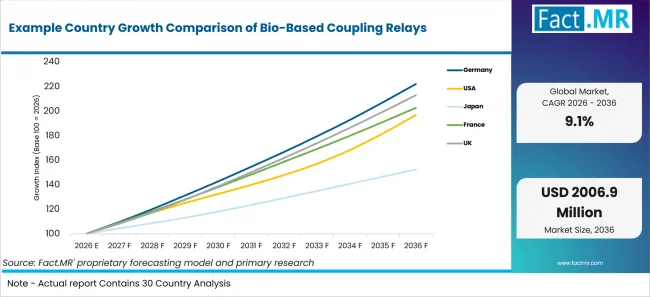
Example Country Growth Comparison Of Bio Based Coupling Relays | Source: Fact.MR
| Country | CAGR (2026-2036) |
|---|---|
| Germany | 8.3% |
| United Kingdom | 7.9% |
| France | 7.3% |
| United States | 7.0% |
| Japan | 4.3% |
What supports Germany adoption?
8.3% CAGR, supported by automation depth and electrical-equipment relay renewal.
Germany’s control-cabinet base is expected to keep bio-based coupling relay demand focused on proven DIN-rail formats. Destatis reported in October 2025 that new orders for the manufacture of electrical equipment rose 7.2% month on month in August 2025, after seasonal and calendar adjustment. Better order flow gives relay suppliers more room to qualify bio-based housings for automation panels.
How is the United Kingdom scaling demand?
7.9% CAGR, shaped by retrofit work and panel-component replacement.
The UK market is expected to scale through maintenance-led replacement and compact relay kits used by panel builders. The Office for National Statistics reported in July 2026 that UK manufacturers’ product sales totaled GBP 452.0 billion in 2025. That manufacturing base supports steady demand for relay interfaces used in machines and building controls.
What supports France growth?
7.3% CAGR, reinforced by electrical-equipment output and automation replacement needs.
France is expected to advance where relay makers pair material records with standard electrical performance. INSEE reported in February 2026 that output in France’s manufacture of electrical equipment was 2.2% higher in the fourth quarter of 2025 than in the fourth quarter of 2024. That production base supports relay-interface demand in control equipment and industrial automation panels.
How is the USA developing demand?
7.0% CAGR, supported by electrical-component shipments and localized relay assembly.
The USA is expected to develop through broad electrical-component demand and local availability from relay specialists. The U.S. Census Bureau reported in February 2026 that preliminary shipments of electrical equipment, appliances, and components totaled USD 209,575 million in 2025. That shipment base supports relay demand across industrial panels and energy-control cabinets.
How does Japan perform?
4.3% CAGR, led by industrial electronics production and strict component qualification.
Japan’s bio-based coupling relay demand is expected to remain selective because buyers emphasize reliability records and consistent component quality. JEITA reported, based on METI data, that Japan’s industrial electronic equipment production totaled JPY 3,416,604 million in 2025. That electronics base supports relay-interface demand and long qualification cycles shape adoption timing.
Who leads the Bio-Based Coupling Relays Market?
Siemens has directly documented bio-based material use in coupling relays through its SIRIUS 3RQ4 series. In its October 2025 launch announcement, Siemens stated that the SIRIUS 3RQ4 coupling-relay housing uses plastic consisting of 70% bio-based material derived from biomass waste. The relays provide functions including galvanic isolation, signal amplification and signal adaptation between PLCs and peripheral devices and are designed for use with Siemens controllers.
Phoenix Contact and Weidmüller provide relevant adjacent evidence in conventional coupling-relay and interface-relay systems. Phoenix Contact’s October 2025 PLC-INTERFACE Ethernet Gateway connects relay modules with controller networks through multiprotocol Ethernet communication. Weidmüller’s June 2025 CUBESERIES launch expanded its industrial relay-module offering, while U.S. relay kitting supports assembly, testing and direct supply of relay kits for industrial control-cabinet applications.
Schneider Electric, Finder, and TE Connectivity are profiled as established relay or control-interface suppliers relevant to adjacent applications. Their inclusion reflects relay-portfolio relevance, while product-specific bio-based housing evidence should be assessed separately for each supplier.
Competition centers on approval records, compact design and catalog availability. Relay suppliers with bio-based housing options need the same electrical performance evidence that buyers expect from conventional coupling relays.
Which companies are the key providers?
Key companies include Siemens, Phoenix Contact, Weidmuller, Schneider Electric, Finder, and TE Connectivity.
- Siemens
- Phoenix Contact
- Weidmuller
- Schneider Electric
- Finder
- TE Connectivity
Bibliography
- European Bioplastics. (2025, December 2). EUBP presents the results of the 2025 market data report.
- International Federation of Robotics. (2025, September 25). World Robotics 2025 report – INDUSTRIAL ROBOTS – released by IFR.
- Siemens. (2025, October 10). From frying oil to coupling relays: Siemens and Envalior collaborate on more sustainable electrical products.
- Phoenix Contact. (2025, October 1). Reinventing automation with relays: The network-capable PLC-Interface Ethernet Gateway remote relay system with multi-protocol connection to the controller.
- Weidmuller USA. (2025, June 2). Weidmuller USA unveils CUBESERIES Industrial Relay Modules.
- Federal Statistical Office (Destatis). (2025, October 7). New orders in manufacturing in August 2025: -0.8% on the previous month.
- Office for National Statistics. (2026, July 24). UK manufacturers’ sales by product: 2025.
- Institut national de la statistique et des études économiques. (2026, February 5). In December 2025, manufacturing output fell back sharply (-0.8%).
- U.S. Census Bureau. (2026, February 23). Monthly full report on manufacturers’ shipments, inventories and orders: December 2025.
- Japan Electronics and Information Technology Industries Association. (2026, March 19). December 2025 production by the Japanese electronics industry.
This Report Answers
- The report explains how bio-based relay housing materials are used across coupling relays for industrial automation and control systems and building controls.
- Segment analysis compares housing material, relay architecture, coil voltage and application. It also connects polymer choices with adjacent bio-based plastics supply trends.
- Country analysis examines Germany, the United Kingdom, France, the United States and Japan through automation, electronics and electrical-equipment indicators.
- Competitive analysis reviews current providers across electromechanical relays, optocouplers and modular interface systems used near relay boxes and junction blocks in electrical assemblies.
- Application analysis assesses how panel density, coil voltage choice and safety circuits influence relay selection in machine-control environments.
What does the Bio-Based Coupling Relays Market cover?
The Bio-Based Coupling Relays Market covers interface relays that use bio-based, bio-attributed or recycled-content bio-based polymer housings. The assessment includes electromechanical, optocoupler, hybrid and safety relay formats used in industrial panels and control equipment.
Demand is assessed across housing materials, coil voltages and end applications. The market also overlaps with solid-state relay and fuse box component platforms when buyers compare mechanical isolation with electronic switching.
What is included in the scope?
The scope includes coupling relays in plug-in-module, slim DIN-rail, optocoupler and hybrid interface formats. It covers relay assemblies used for machine signals, building-control circuits and energy-system control cabinets.
Products are included when bio-based or bio-attributed housings form part of the value proposition. The assessment also considers relay use in machine safety circuits where approval records and service replacement remain central to supplier selection.
It includes socketed relays, LED indicators, protection modules and accessories used with industrial plug and socket connections inside panel assemblies. Regional coverage follows manufacturing demand and relay distribution patterns.
What is excluded from the scope?
The scope excludes raw resin sales, general plastic housings and mechanical shaft couplings. It also excludes full control panels, programmable controllers and power-distribution equipment sold without coupling relay functionality.
High-voltage power switching equipment is outside the market boundary when sold as full switchgear systems. The assessment excludes wiring harnesses and connector and terminal systems when those products are sold outside a coupling relay module.
How Was the Analysis Built?
The analysis draws on 120+ sources, 35+ company portfolios, 25+ countries, and more than 20 industry interviews.
- Primary Research: Primary research includes discussions with manufacturers, service providers, technology developers, distributors, end users, and subject-matter experts. These conversations examine purchasing priorities, product adoption, operational challenges, approval requirements, competitive positioning, and the factors that influence wider market acceptance.
- Desk Research: Desk research covers government statistics, regulatory publications, company filings, trade data, technical studies, industry associations, standards, public policy, and other authoritative sources. Every source used in the analysis is documented in the bibliography.
- Market Sizing and Forecasting: Market estimates combine historical performance, demand indicators, pricing and volume trends, segment shares, company participation, country-level growth, adoption patterns, investment activity, and barriers to market expansion.
- Data Validation and Update Cycle: Findings are validated by comparing primary interviews with public data, company activity, regulatory changes, trade patterns, and industry developments. Regular updates review new product launches, capacity changes, partnerships, approvals, and shifts in commercial adoption.
What is the report’s scope and coverage?
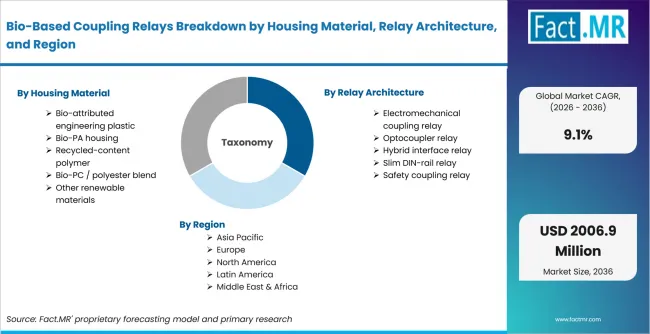
Bio Based Coupling Relays Breakdown By Housing Material, Relay Architecture, And Region | Source: Fact.MR
| Attribute | Details |
|---|---|
| Quantitative Units | USD million in 2026 to USD million by 2036 at a CAGR |
| Market Definition | Bio-based coupling relays are interface relays that use bio-based or bio-attributed housing materials and provide electrical isolation, signal switching and control-cabinet connectivity. |
| Housing Material | Bio-attributed engineering plastic; Bio-PA housing; Recycled-content bio-based polymer; Bio-PC / polyester blend; Other renewable materials |
| Relay Architecture | Electromechanical coupling relay; Optocoupler relay; Hybrid interface relay; Slim DIN-rail relay; Safety coupling relay |
| Coil Voltage | 24 VDC; 12 VDC; 48 VDC; 110/120 VAC; 230 VAC |
| Application | Industrial automation; Building controls; Energy systems; Rail / transport; Process control |
| Regions Covered | North America; Latin America; Western Europe; Eastern Europe; East Asia; South Asia & Pacific; Middle East & Africa |
| Countries Covered | Germany; United Kingdom; France; United States; Japan |
| Key Companies Profiled | Siemens; Phoenix Contact; Weidmuller; Schneider Electric; Finder; TE Connectivity |
| Forecast Period | 2026 to 2036 |
| Approach | Hybrid top-down and bottom-up approach using relay replacement demand, housing material mix, application fit, country adoption and provider portfolio review. |
How is the market segmented?
-
By Housing Material
- Bio-attributed engineering plastic
- Bio-PA housing
- Recycled-content bio-based polymer
- Bio-PC / polyester blend
- Other renewable materials
-
By Relay Architecture
- Electromechanical coupling relay
- Optocoupler relay
- Hybrid interface relay
- Slim DIN-rail relay
- Safety coupling relay
-
By Coil Voltage
- 24 VDC
- 12 VDC
- 48 VDC
- 110/120 VAC
- 230 VAC
-
By Application
- Industrial automation
- Building controls
- Energy systems
- Rail / transport
- Process control
-
By Region
- North America
- Latin America
- Western Europe
- Eastern Europe
- East Asia
- South Asia & Pacific
- Middle East & Africa