- Market Value (2025): USD 246.4 Mn
- Estimated Value (2026): USD 268.0 Mn
- Forecast Value (2036): USD 620.0 Mn
- CAGR (2026-2036): 8.7%
What is the LNG Emergency Release Couplings Market forecast to be worth by 2036?
USD 268.0 million in 2026 to USD 620.0 million by 2036 at 8.7% CAGR.
- The LNG emergency release couplings market was valued at USD 246.4 million in 2025 when terminal safety audits focused on dry-break isolation and emergency separation.
- Demand is projected to increase from USD 268.0 million in 2026 to USD 620.0 million by 2036.
- The market is forecast to record 8.7% CAGR from 2026 to 2036 as terminal operators and bunkering operators specify couplings for cryogenic transfer protection.
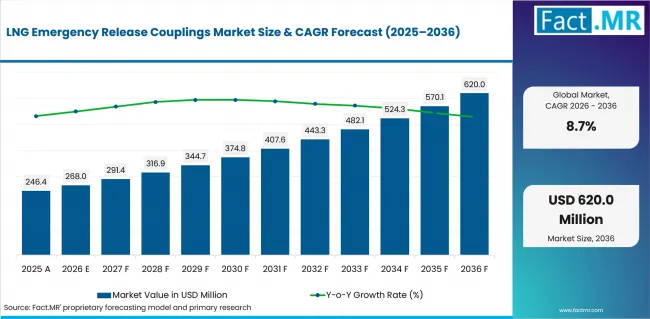
Lng Emergency Release Couplings Market Value Analysis | Source: Fact.MR
What are the defining numbers behind LNG Emergency Release Couplings Market growth?
USD 352.0 million absolute opportunity by 2036, led by Double ball-valve PERCs and Hydraulic actuation alongside LNG marine loading arms and Terminal operators.
- Demand Drivers in the Market
- Vessel movement can turn a routine LNG transfer into a release risk if the connection cannot separate cleanly. Terminals therefore specify emergency-release couplings that shut both sides of the line when a vessel moves beyond the permitted range.
- Frequent bunkering calls leave little room for a coupling that needs lengthy inspection or replacement after every activation. Resettable cryogenic units create demand by returning the transfer point to service quickly.
- Satellite LNG plants and truck-loading operations need transfer equipment that fits an established loading routine. That keeps demand tied to couplings that work with the site’s existing connection layout.
- Shipowners will not approve a transfer procedure unless the manifold protection is proven within the loading arm’s movement limits. This requirement makes certified emergency-release performance a buying criterion.
- Key Segments Analyzed
- By Release Mechanism: Double ball-valve PERCs are expected to hold 36.0% share in 2026 because two-valve isolation helps reduce release volume during separation.
- By Actuation: Hydraulic actuation is projected to account for 42.0% share in 2026 due to its fit with powered loading-arm safety systems.
- By Application: LNG marine loading arms are anticipated to capture 52.0% share in 2026 owing to their direct use at export and import berths.
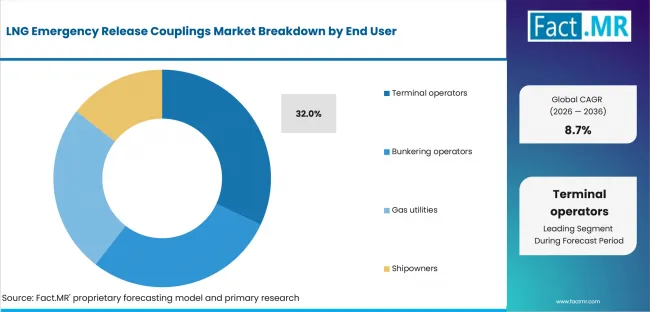
- By End User: Terminal operators are estimated to represent 32.0% share in 2026 since berth safety cases place the coupling inside procurement checks.
- Analyst Opinion at Fact.MR
- Shambhu Nath Jha, Sr. Consultant at Fact.MR, states, “Emergency release couplings are not routine hose hardware; they are the planned break point in an LNG transfer incident. Procurement is expected to favor providers that prove valve closure after cold cycling and show reset steps clearly. Better tender files combine type-test evidence and actuator sequence notes with local service coverage.”
- Strategic Implications
- Terminal engineering teams need an agreed release philosophy before berth upgrades enter procurement. The decision is reviewed beside marine loading arms when arm movement and valve sequence must match.
- Equipment providers have to align hydraulic power units and seal materials with the LNG transfer package.
- Investors are expected to separate LNG emergency release exposure from general hose hardware. Demand connected with LNG fuel pump and metering systems becomes valuable only when transfer safety devices appear in the same project file.
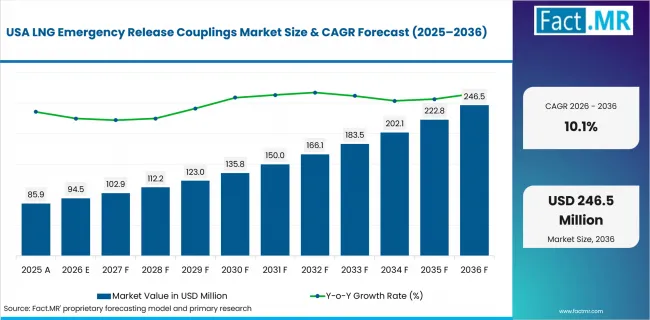
Qatar is expected to record 10.4% CAGR through 2036 on the strength of North Field expansion and high-duty LNG berth work. The USA is projected to post 10.1% CAGR due to Gulf Coast export-terminal use and spill-prevention review. Singapore is anticipated to advance at 9.7% CAGR through LNG bunkering programs and port fuel rules. Norway is estimated to hold 9.4% CAGR under Arctic LNG transfer conditions and cold-weather maintenance requirements. The Netherlands is forecast at 9.1% CAGR due to Gate terminal operations and Northwest Europe import flexibility.
How does the LNG Emergency Release Couplings Market break down by segment?
Double ball-valve PERCs are expected to lead Release Mechanism at 36.0% share in 2026. Hydraulic actuation is projected to lead Actuation at 42.0% share in 2026.
Which release mechanism dominates?
Double ball-valve PERCs account for 36.0% share in 2026.
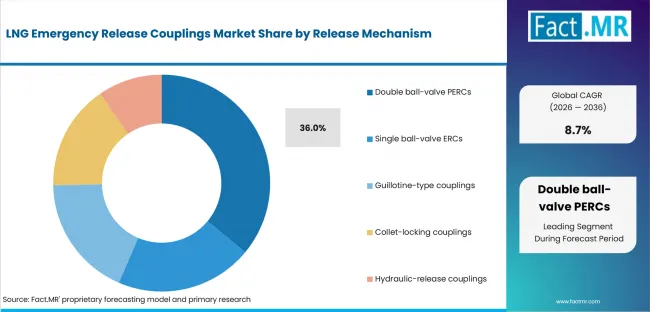
Lng Emergency Release Couplings Market Analysis By Release Mechanism | Source: Fact.MR
Double ball-valve PERCs are expected to lead release mechanisms because terminal operators want two isolation points during emergency separation. Single ball-valve ERCs remain useful in smaller transfer systems where reset work is simple. Guillotine-type couplings and collet-locking couplings serve narrower uses when release geometry decides selection. Hydraulic-release couplings fit packages where the release function is built into powered LNG transfer systems.
What leads the Actuation segment?
Hydraulic actuation holds 42.0% share in 2026.
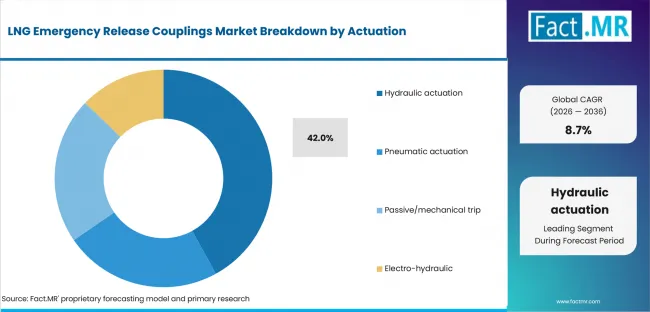
Lng Emergency Release Couplings Market Analysis By Actuation | Source: Fact.MR
Hydraulic actuation is projected to remain the main actuation route in LNG terminals where loading-arm movement and valve closure follow one controlled sequence. Pneumatic actuation serves sites that already maintain instrument-air systems. Passive mechanical trips fit smaller installations where simple reset work is valued. Electro-hydraulic systems are anticipated to gain attention in projects that link release status with control-room evidence.
How does Application shape demand?
LNG marine loading arms lead with 52.0% share in 2026.
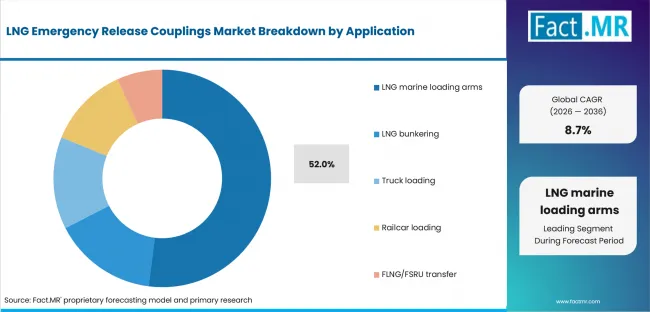
Lng Emergency Release Couplings Market Analysis By Application | Source: Fact.MR
LNG marine loading arms are anticipated to account for the main application share because berth safety depends on controlled separation before a vessel moves outside the transfer envelope. LNG bunkering adds demand where ship-to-ship transfer needs compact release hardware. Truck loading and railcar loading use smaller couplings where gas utilities operate satellite supply chains. FLNG and FSRU transfer applications require deeper documentation due to offshore movement and service exposure.
What supports Terminal operators within End User?
Terminal operators hold 32.0% share in 2026.
Lng Emergency Release Couplings Market Analysis By End User | Source: Fact.MR
Terminal operators are estimated to lead end users because they carry berth safety responsibility and maintenance accountability after each release event. Bunkering operators focus on compact equipment that resets quickly between vessel calls. Gas utilities use ERCs where LNG moves through truck or rail transfer points. Shipowners influence specifications when vessel manifolds require proof of safe disconnection.
What is accelerating LNG Emergency Release Couplings Market adoption, and what is holding it back?
Terminal safety upgrades drive it; cryogenic seal qualification restrains it.
Drivers Impact Analysis
| DRIVER | (~) % IMPACT ON CAGR |
GEOGRAPHIC RELEVANCE | IMPACT TIMELINE |
|---|---|---|---|
| Terminal safety case upgrades | +2.2% | Qatar, USA, Netherlands | Short term (<= 2 years) |
| Marine loading arm renewal | +1.8% | USA, Qatar, Netherlands | Short term (<= 2 years) |
| Bunkering transfer standardization | +1.5% | Singapore and Northwest Europe | Medium term (2-4 years) |
| Hydraulic release reliability | +1.1% | Global terminals | Medium term (2-4 years) |
| Service and reset documentation | +0.8% | Mature LNG ports | Long term (>= 4 years) |
Source: Fact.MR analysis. Updated Jul 24, 2026
- Terminal safety case upgrades: Emergency release couplings are expected to move into review when berth operators update spill control and breakaway procedures. Procurement teams compare valve closure sequence and reset instructions before accepting the system.
- Marine loading arm renewal: Loading-arm projects place the ERC close to the ship interface. The position is projected to keep double ball-valve PERCs linked with berth upgrades.
- Bunkering transfer standardization: LNG bunkering operators are expected to favor couplings that fit repeated ship-to-ship and shore-to-ship transfers. Standard interfaces shorten crew training and reduce inspection disputes.
- Hydraulic release reliability: Hydraulic actuation is projected to remain attractive where terminal systems already use powered release logic. Providers are expected to show predictable closure after cryogenic cycling.
- Service and reset documentation: Operators are anticipated to prefer providers that train crews on reassembly and post-release inspection. Clear records reduce downtime after controlled separation events.
Opportunity Impact Analysis
| OPPORTUNITY | (~) % IMPACT ON CAGR |
GEOGRAPHIC RELEVANCE | IMPACT TIMELINE |
|---|---|---|---|
| Bunkering vessel interfaces | +1.2% | Singapore and Europe | Medium term (2-4 years) |
| Retrofit kits for loading arms | +1.0% | USA and Netherlands | Medium term (2-4 years) |
| Smaller truck and rail systems | +0.7% | Gas utilities | Long term (>= 4 years) |
| Electro-hydraulic monitoring | +0.6% | New terminals | Long term (>= 4 years) |
Source: Fact.MR analysis. Updated Jul 24, 2026
- Bunkering vessel interfaces: Port operators are expected to evaluate compact couplings as LNG bunkering expands beyond pilot berths. The better fit comes from hardware that protects hoses without slowing routine fuel transfer.
- Retrofit kits for loading arms: Older berths create opportunity where operators refresh emergency release systems without replacing the full arm. Retrofit work depends on flange fit and actuator compatibility before site acceptance testing.
- Smaller truck and rail systems: Satellite LNG sites are forecast to add demand for simpler couplings at loading bays. These systems require easy inspection steps more than complex release controls.
- Electro-hydraulic monitoring: New terminal projects are anticipated to attach more value to release-event logs and actuator status. That change favors systems that connect mechanical separation with control-room evidence.
Restraints Impact Analysis
| RESTRAINT | (~) % IMPACT ON CAGR |
GEOGRAPHIC RELEVANCE | IMPACT TIMELINE |
|---|---|---|---|
| Cryogenic seal qualification | -1.1% | Global | Short term (<= 2 years) |
| False-trip cost | -0.9% | Marine terminals | Short term (<= 2 years) |
| Long terminal approval cycles | -0.7% | Export and import hubs | Medium term (2-4 years) |
| Limited service access | -0.5% | Remote LNG sites | Long term (>= 4 years) |
Source: Fact.MR analysis. Updated Jul 24, 2026
- Cryogenic seal qualification: LNG ERCs need to maintain sealing performance after repeated cold and ambient cycles. Qualification failures delay provider approval even when the mechanical design looks suitable.
- False-trip cost: A release event stops transfer and triggers inspection work. Operators resist products that lack clear trip thresholds or reset evidence.
- Long terminal approval cycles: Safety changes move through engineering review and insurance review before site acceptance. The process slows adoption when a coupling changes the release philosophy.
- Limited service access: Remote LNG sites are expected to face longer downtime when specialized parts are not stocked locally. Regional service depth therefore influences provider selection.
Which countries are scaling LNG Emergency Release Couplings Market fastest?
The country comparison is defined by two LNG roles that shape coupling selection. Qatar and the USA track above the rest because large terminal berths keep marine loading-arm systems central to procurement. Singapore follows through LNG bunkering activity. Norway and the Netherlands form a tighter cluster where cold-weather service and import-terminal flexibility shape specification.
- Qatar shows a notable position because Ras Laffan expansion work increases the focus on berth safety and loading-arm reliability.
- USA demand follows Gulf Coast exports where terminal operators compare emergency release systems during berth upgrades.
- Singapore builds demand through LNG bunkering procedures and port fuel programs that require repeatable hose separation.
- Norway reflects a colder operating profile where LNG transfer hardware must support offshore and Arctic service conditions.
- The Netherlands stays aligned with import flexibility because Gate terminal links global LNG supply with Northwest European gas networks.
Comparable CAGRs are therefore expected to produce different market entry conditions across these countries. Deployment timing depends on terminal safety cases and local service depth while commercial readiness also reflects actuator proof and seal qualification.
The full report provides country-level CAGR analysis across North America, Latin America, Europe, East Asia, South Asia, Oceania and the Middle East and Africa.
Country CAGR (2026-2036)
Lng Emergency Release Couplings Market Value Analysis | Source: Fact.MR
| Country | CAGR (2026-2036) |
|---|---|
| Qatar | 10.4% |
| USA | 10.1% |
| Singapore | 9.7% |
| Norway | 9.4% |
| Netherlands | 9.1% |
Source: Fact.MR analysis. Updated Jul 24, 2026
What supports Qatar adoption?
10.4% CAGR, supported by Ras Laffan expansion and high-duty LNG berth operations.
Qatar’s growth reflects export-terminal work where emergency release couplings are treated as berth-safety equipment. The country is expected to record 10.4% CAGR through 2036 as Ras Laffan projects concentrate testing around loading arms and hydraulic release logic. QatarEnergy LNG operations give providers a clear path to discuss reset steps before repeat ship calls.
How is the USA scaling demand?
10.1% CAGR, driven by Gulf Coast LNG export activity and terminal safety reviews.
Lng Emergency Release Couplings Market Country Value Analysis | Source: Fact.MR
USA demand is linked to export terminals where loading arms run under tight marine safety procedures. Gulf Coast projects keep ERC selection close to berth design and spill-control documentation. The country is projected to post 10.1% CAGR by 2036 as terminal operators compare service coverage before approving coupling packages.
What is driving Singapore’s growth from 2026 to 2036?
9.7% CAGR, backed by LNG bunkering and port fuel-transition programs.
Singapore’s growth reflects a port setting where LNG bunkering depends on repeatable hose handling. The Maritime and Port Authority framework gives operators a clearer path for LNG-fueled harbor craft and bunkering services. The country is anticipated to advance at 9.7% CAGR from 2026 to 2036 when coupling reset steps fit fast port schedules.
How is Norway developing demand?
9.4% CAGR, driven by Arctic LNG transfer and cold-weather service requirements.
Norway’s outlook is shaped by LNG export operations around Hammerfest and service conditions that test seals at low temperatures. The country is estimated to hold 9.40% CAGR through 2036 as marine transfer equipment is required to support safe release in colder weather. Equipment providers are anticipated to benefit when cryogenic test records match local service readiness.
How does the Netherlands perform?
9.1% CAGR, led by Gate terminal operations and Northwest Europe import flexibility.
The Netherlands reflects an import-led role where LNG terminals connect global cargoes with regional gas networks. Gate terminal activity keeps emergency release hardware linked to jetty operations and regasification support. The country is forecast at 9.1% CAGR through 2036 due to maintenance demand at busy Rotterdam facilities.
Who leads the LNG Emergency Release Couplings Market?
Trelleborg’s KLAW emergency release coupling range and MannTek’s cryogenic breakaway systems show the clearest direct relevance, while SVT GmbH and Emco Wheaton strengthen the wider LNG loading and transfer-safety landscape.
KLAW, a Trelleborg brand, supports LNG transfer safety through Trelleborg’s KLAW emergency release coupling range. MannTek contributes cryogenic breakaway couplings and powered emergency release systems designed for LNG transfer operations. SVT GmbH supports LNG terminals through loading-arm and transfer-safety equipment. Emco Wheaton provides LNG emergency release systems based on double-ball-valve isolation.
From 2026 to 2036, competition is expected to depend on valve-closure reliability, cryogenic seal performance and evidence from repeated cold-cycle testing. Terminal operators are also likely to compare actuator response, reset procedures, loading-arm compatibility and regional service availability. Providers that demonstrate clean separation across marine loading arms, bunkering systems and other LNG transfer points may gain stronger demand from export terminals, import terminals and LNG-fueling operators.
Which companies are the key providers?
Companies include KLAW, a Trelleborg brand, MannTek, SVT GmbH, and Emco Wheaton (Gardner Denver).
- KLAW, a Trelleborg brand
- MannTek
- SVT GmbH
- Emco Wheaton (Gardner Denver)
Bibliography
- Eurostat. (2026, March 25). EU imports of energy products decreased again in 2025. European Commission.
- Department of Energy. (2026, July 6). U.S. natural gas is supplying energy to the world: April 2026 summary.
- Maritime and Port Authority of Singapore. (2026, January 14). LNG bunker supplier licence application.
- U.S. Department of Energy. (2026, June). Natural gas imports and exports monthly 2026.
- U.S. Energy Information Administration. (2026, April 16). U.S. natural gas exports to grow nearly 30% by 2027 as LNG facilities ramp up.
This Report Answers
- The report provides strategic intelligence on the LNG Emergency Release Couplings Market across Release Mechanism and Actuation choices that shape LNG transfer safety programs.
- Segment analysis covers Double ball-valve PERCs and Hydraulic actuation within the 2026 market share view.
- Country outlook evaluates Qatar and the USA alongside Singapore. Norway and the Netherlands complete the growth comparison across the profiled markets.
- Competitive analysis profiles KLAW, a Trelleborg brand and MannTek. SVT GmbH and Emco Wheaton (Gardner Denver) complete the provider set.
- Application assessment covers LNG marine loading arms and LNG bunkering. Truck loading and railcar loading complete the application view alongside FLNG/FSRU transfer.
What does the LNG Emergency Release Couplings Market cover?
Emergency release couplings are used to separate LNG transfer lines safely when vessel movement or drive-away risk threatens the system.
The LNG Emergency Release Couplings Market covers devices used in marine loading arms, bunkering hose strings and LNG loading systems. Coverage extends to truck and rail transfer points where gas utilities manage satellite supply. The market also includes powered and passive release systems when they are specified for cryogenic LNG service.
The market differs from general cryogenic equipment because commercial value comes from controlled separation and immediate valve closure. General valves, hoses and swivels are included only when they are part of the emergency release coupling assembly.
What is included in scope?
The scope includes emergency release couplings and related PERC or ERC systems used in LNG transfer applications.
Included applications cover ship-to-shore loading and ship-to-ship transfer. The analysis also covers LNG bunkering, truck loading and railcar loading where a planned release point is specified. ERCs used near LNG refueling interfaces are included when the release function is built into the fuel-transfer system.
What is excluded from scope?
The scope excludes general LNG valves, ordinary hose couplings and loading arms sold without an emergency release function.
General marine transfer systems are outside the scope when they lack a planned separation point with automatic valve closure. The report also excludes non-LNG breakaway couplings used only for ambient fuels or non-cryogenic chemicals.
How Was the Analysis Built?
The analysis draws on 120+ sources, 35+ company portfolios, 25+ countries, and more than 20 industry interviews.
- Primary Research: Primary research includes discussions with manufacturers, service providers, technology developers, distributors, end users, procurement teams, and subject-matter experts. These conversations examine purchasing priorities, product adoption, operational challenges, approval requirements, competitive positioning, and the factors that influence wider market acceptance.
- Desk Research: Desk research covers government statistics, regulatory publications, company filings, trade data, technical studies, industry associations, standards, public policy, and other authoritative sources. Every source used in the analysis is documented in the bibliography.
- Market Sizing and Forecasting: Market estimates combine historical performance, demand indicators, pricing and volume trends, segment shares, company participation, country-level growth, adoption patterns, investment activity, and barriers to market expansion.
- Data Validation and Update Cycle: Findings are validated by comparing primary interviews with public data, company activity, regulatory changes, trade patterns, and industry developments. Regular updates review new product launches, capacity changes, partnerships, approvals, procurement trends, and shifts in commercial adoption.
Segmentation
What is the report’s scope and coverage?
Lng Emergency Release Couplings Market Breakdown By Release Mechanism, Actuation, And Region | Source: Fact.MR
| Attribute | Details |
|---|---|
| Quantitative Units | USD million in 2026 to USD million by 2036 at a % CAGR |
| Market Definition | Emergency release couplings designed for LNG transfer systems where controlled separation, immediate valve closure and cryogenic seal integrity protect people, equipment and transfer lines |
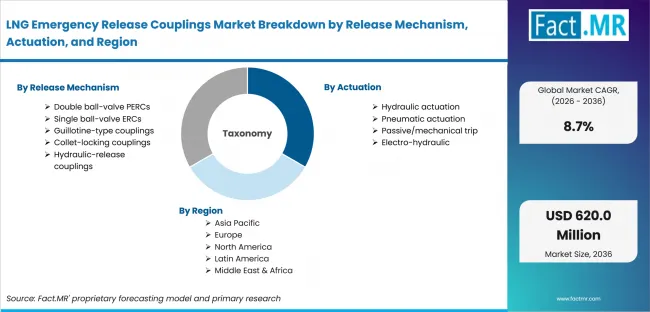
| Release Mechanism | Double ball-valve PERCs; Single ball-valve ERCs; Guillotine-type couplings; Collet-locking couplings; Hydraulic-release couplings |
| Actuation | Hydraulic actuation; Pneumatic actuation; Passive/mechanical trip; Electro-hydraulic |
| Application | LNG marine loading arms; LNG bunkering; Truck loading; Railcar loading; FLNG/FSRU transfer |
| End User | Terminal operators; Bunkering operators; Gas utilities; Shipowners |
| Regions Covered | North America; Latin America; Europe; East Asia; South Asia and Pacific; Middle East and Africa |
| Countries Covered | Qatar; USA; Singapore; Norway; Netherlands |
| Key Companies Profiled | KLAW, a Trelleborg brand; MannTek; SVT GmbH; Emco Wheaton (Gardner Denver) |
| Forecast Period | 2026 to 2036 |
| Approach | Hybrid top-down and bottom-up approach using LNG transfer projects; marine loading-arm demand; LNG bunkering activity; truck and rail transfer requirements; cryogenic seal qualification; actuator selection; terminal safety cases; reset documentation; service coverage and company portfolio review |
Source: Fact.MR analysis. Updated Jul 24, 2026
How is the market segmented?
-
By Release Mechanism:
- Double ball-valve PERCs
- Single ball-valve ERCs
- Guillotine-type couplings
- Collet-locking couplings
- Hydraulic-release couplings
-
By Actuation:
- Hydraulic actuation
- Pneumatic actuation
- Passive/mechanical trip
- Electro-hydraulic
-
By Application:
- LNG marine loading arms
- LNG bunkering
- Truck loading
- Railcar loading
- FLNG/FSRU transfer
-
By End User:
- Terminal operators
- Bunkering operators
- Gas utilities
- Shipowners
-
By Region:
- North America
- Europe
- Middle East and Africa
- South Asia & Oceania
Frequently Asked Questions
Which Release Mechanism leads the LNG Emergency Release Couplings Market?
Which Actuation category leads demand?
Which Application leads by share?
Which End User category ranks first?
Why do LNG marine loading arms lead Application demand?
What is the main driver for LNG emergency release couplings?
What restrains adoption?
Which companies are profiled?
Who worked on this report


Preview the report firsthand - request a free sample
Free SampleGet the brochure for pricing and purchase details
Download PDF