- Market Value (2025): USD 1106.1 Mn
- Estimated Value (2026): USD 1220.0 Mn
- Forecast Value (2036): USD 3251.7 Mn
- CAGR (2026-2036): 10.3%
What is the Residual Current Monitors Market forecast to be worth by 2036?
USD 1,220.0 million in 2026 to USD 3,251.7 million by 2036 at a 10.3% CAGR.
- The Residual Current Monitors Market was valued at USD 1,106.1 million in 2025.
- Demand to increase from USD 1,220.0 million in 2026 to USD 3,251.7 million by 2036.
- The market is forecast to record 10.3% CAGR from 2026 to 2036, with EV charging, machinery monitoring and critical-facility uptime requirements identified as key demand drivers.
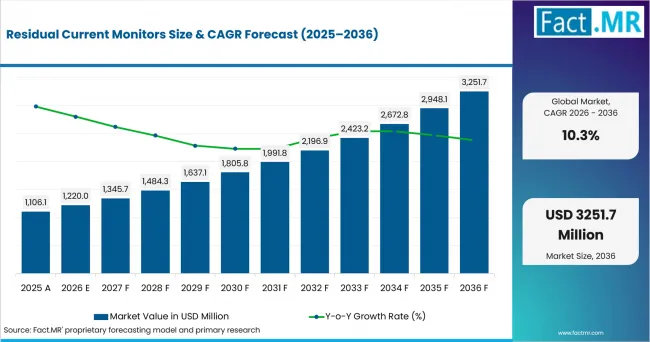
Residual Current Monitors Value Analysis | Source: Fact.MR
What are the defining numbers behind Residual Current Monitors Market growth?
An absolute dollar opportunity is USD 2,031.7 million is expected between 2026 and 2036.
- Demand Drivers in the Market
- EV charging uses mode-specific residual-current protection and detection functions. IEC 62752:2024 covers in-cable control and protection devices with residual-current functions for Mode 2 charging, while IEC 62955:2018 covers residual direct-current detecting devices intended for Mode 3 charging.
- Industrial plants use residual-current alarms to detect insulation decline before a machinery circuit trip interrupts production or damages connected equipment.
- DIN-rail residual-current monitors are suitable for integration into standard distribution panels and retrofit applications where enclosure space is constrained.
- Critical facilities can use channel-level residual-current monitoring to localize faults across final circuits and equipment feeds, including server-rack applications where continuous leakage visibility is required.
- Public construction provides broader context for electrical infrastructure activity. The U.S. Census Bureau estimated public construction spending at a seasonally adjusted annual rate of USD 543.4 billion in July 2026; total construction spending was USD 2,157.6 billion.
- Key Segments Analyzed
- By Monitoring Type: Type A (AC and pulsating DC residual current) is expected to hold 31.0% share in 2026, supported by standard low-voltage circuits and conventional machinery loads.
- By System Voltage: 230/400 VAC is projected to account for 43.0% share in 2026, owing to wide use across commercial panels and three-phase equipment.
- By Application: Industrial machinery is anticipated to capture 25.0% share in 2026, driven by motors, drives and control cabinets that need early fault indication.
- By Mounting: DIN-rail is estimated to represent 38.0% share in 2026, reinforced by retrofit work inside existing distribution boards.
- Analyst Opinion at Fact.MR
- Shambhu Nath Jha, Principal Consultant at Fact.MR, states, “Residual current monitoring is becoming a maintenance and safety signal, beyond a simple electrical accessory. Facility teams are expected to compare suppliers on leakage sensitivity, alarm selectivity and installation speed. Vendors that combine Type B sensing, clear standards documentation and retrofit-friendly mounting fit the next phase of panel upgrades.”
- Strategic Implications
- Manufacturers should document residual-current thresholds by application so design engineers match devices to chargers, machinery and mixed AC/DC loads.
- Panel builders should align DIN-rail monitor layouts with retrofit and new-build requirements.
- Facility operators should connect residual-current alarms to plant systems so leakage trends are visible before shutdown thresholds are reached.
- Distributors should train sales teams on Type A, Type B and DC residual-current differences so product selection follows circuit behavior and rated voltage.
France to record 10.0% CAGR through 2036, with EV charging infrastructure as a key contextual driver. The USA is projected at 9.7% CAGR amid public charging and construction activity. Germany is forecast at 9.4% CAGR alongside grid expansion and photovoltaic deployment. Japan is estimated at 9.1% CAGR with construction activity supporting electrical upgrades. The UK is forecast at 8.1% CAGR as public charging infrastructure expands.
How does the Residual Current Monitors Market break down by segment?
230/400 VAC to lead System Voltage at 43.0% share in 2026; DIN-rail leads Mounting at 38.0% share.
Which Monitoring Type dominates?
Type A (AC and pulsating DC residual current) to hold 31.0% share in 2026.
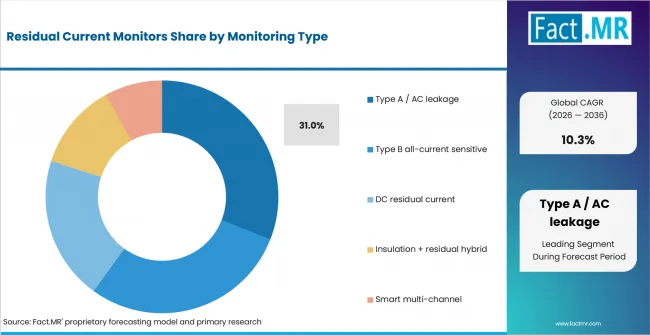
Residual Current Monitors Analysis By Monitoring Type | Source: Fact.MR
Type A residual-current monitors to lead the monitoring-type segment in 2026. Type A devices are designed to detect sinusoidal AC and pulsating DC residual currents, while Type B devices extend detection to additional residual-current waveforms including smooth DC.
What leads the System Voltage segment?
230/400 VAC to account for 43.0% share in 2026.
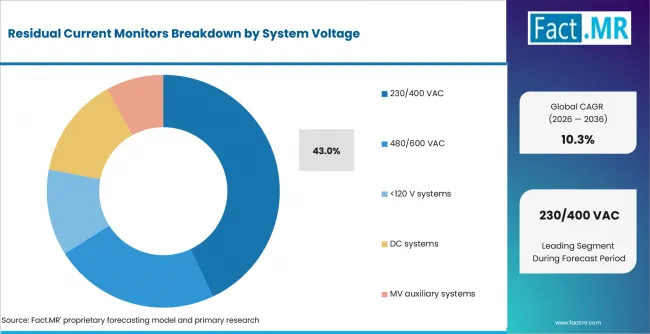
Residual Current Monitors Analysis By System Voltage | Source: Fact.MR
The 230/400 VAC band is projected to account for the widest voltage share because it matches common building distribution and three-phase industrial supply. Monitors in this band are installed near machine groups, EV chargers and facility panels where alarm thresholds must be visible to maintenance teams. Schneider Electric lists Vigirex residual-current relays with associated toroids for earth-leakage protection and monitoring, with several models available for front-panel mounting.
How does Application shape demand?
Industrial machinery to represent 25.0% share in 2026.
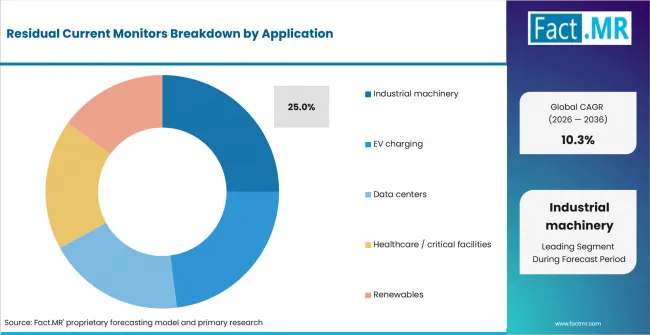
Residual Current Monitors Analysis By Application | Source: Fact.MR
Industrial machinery is anticipated to hold the main application share because drives, motors and controls create leakage patterns that maintenance teams need to interpret. Continuous monitoring helps plant engineers identify slow insulation decline before a machine trip affects output. Bundesnetzagentur reported that it approved roughly 2,000 km of power lines in 2025, describing this as approximately 45% more than in 2024.
What supports DIN-rail demand within Mounting?
DIN-rail mounting to represent 38.0% share in 2026.
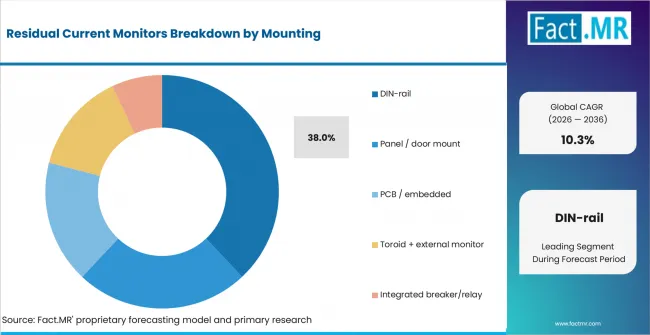
Residual Current Monitors Analysis By Mounting | Source: Fact.MR
DIN-rail units are estimated to lead mounting because they match industrial control cabinets and building boards. The format helps installers add leakage monitoring during panel upgrades while keeping the enclosure design familiar. Siemens describes SENTRON 5SV8 COM residual-current measuring devices in accordance with IEC 62020-1. In its 5 March 2026 announcement, Siemens stated that the SENTRON ECPD would soon be available with an integrated Residual Current Monitoring function.
What is accelerating Residual Current Monitors Market adoption, and what is holding it back?
EV charging and machinery monitoring are modeled as key drivers; retrofit labor and threshold selection are modeled as restraints.
Driver Impact Analysis
| DRIVER | (~) % IMPACT ON CAGR | GEOGRAPHIC RELEVANCE | IMPACT TIMELINE |
|---|---|---|---|
| EV charging leakage detection | +1.6% | North America, Europe, East Asia | Short term (<= 2 years) |
| Industrial machinery uptime programs | +1.4% | Germany, USA, Japan | Medium term (2-4 years) |
| Data center and critical-facility continuity | +1.1% | USA, UK, France | Medium term (2-4 years) |
| Panel retrofit and DIN-rail replacement cycles | +0.8% | Global | Long term (>= 4 years) |
Source: Fact.MR analysis. Updated Sep 8, 2026
- EV charging leakage detection: Residual-current detection is an important safety function in AC charging systems. Monitoring devices that identify leakage conditions and support coordinated protective action can strengthen charger safety while helping operators maintain compliance with relevant electrical protection requirements.
- Industrial machinery uptime programs: Manufacturers use leakage monitoring to identify insulation deterioration before it results in an unexpected trip. Motors, drives, and control cabinets create multiple monitoring points, making residual-current monitors valuable where a single electrical fault can disrupt an entire production cell.
- Data center and critical-facility continuity: Data centers, healthcare facilities, and other critical sites need early leakage warnings because unplanned shutdowns can interrupt essential operations. Continuous residual-current monitoring helps maintenance teams identify developing faults and schedule intervention before service continuity is affected.
- Panel retrofit and DIN-rail replacement cycles: Compact DIN-rail devices support installation in existing electrical panels where enclosure space is limited. Retrofit demand favors monitors with straightforward wiring, clear labeling, stable alarm settings, and easy integration into established distribution boards.
Opportunity Impact Analysis
| OPPORTUNITY | (~) % IMPACT ON CAGR | GEOGRAPHIC RELEVANCE | IMPACT TIMELINE |
|---|---|---|---|
| Type B monitors for mixed AC/DC loads | +1.2% | Europe, Japan, USA | Short term (<= 2 years) |
| Networked multi-channel monitoring | +1.0% | Global | Medium term (2-4 years) |
| Critical healthcare and data center retrofits | +0.7% | UK, USA, France | Long term (>= 4 years) |
Source: Fact.MR analysis. Updated Sep 8, 2026
- Type B monitors for mixed AC/DC loads: EV charging systems can produce both AC and DC residual-current components, increasing demand for monitors designed to detect mixed fault currents. Type B and related devices support safer charger operation where conventional AC-only detection may be insufficient.
- Networked multi-channel monitoring: Multi-channel residual-current monitoring lets facility teams compare leakage behavior across several feeders and final circuits. Network connectivity supports centralized visibility, trend review, and planned maintenance across plants, commercial buildings, and other sites with multiple monitored panels.
- Critical healthcare and data center retrofits: Hospitals and data centers require reliable circuit monitoring because uncontrolled power loss can disrupt essential operations. Early leakage detection helps engineering teams schedule maintenance before outages occur, favoring systems with clear alarms, stable thresholds, and dependable continuous monitoring.
Restraint Impact Analysis
| RESTRAINT | (~) % IMPACT ON CAGR | GEOGRAPHIC RELEVANCE | IMPACT TIMELINE |
|---|---|---|---|
| Retrofit labor and shutdown windows | -0.6% | Global | Short term (<= 2 years) |
| RCD and RCM functional distinction | -0.5% | Europe, North America | Medium term (2-4 years) |
| Incorrect threshold selection | -0.4% | Global | Long term (>= 4 years) |
Source: Fact.MR analysis. Updated Sep 8, 2026
- Retrofit labor and shutdown windows: Residual-current monitoring retrofits can require panel access, sensor placement, wiring changes, and temporary circuit interruption. These installation needs can slow adoption in space-constrained or continuously operated facilities where maintenance windows are limited.
- RCD and RCM functional distinction: Residual-current monitors provide detection and warning, while protective devices may also disconnect the circuit automatically. Buyers therefore need to match product functionality with the required monitoring, alarm, and protection role to avoid unsuitable device selection.
- Incorrect threshold selection: Residual-current response settings must reflect local operating conditions, connected loads, and applicable standards. Poorly selected thresholds can create nuisance alarms or insufficient sensitivity, making proper commissioning and parameter configuration important for reliable monitoring.
Which countries are scaling the Residual Current Monitors Market through 2036?
- The country comparison spans 1.9 percentage points and forms a closely grouped growth range across the forecast period.
- France remains 0.3 percentage point above the USA through EV charging infrastructure expansion and associated leakage-detection requirements.
- The USA remains 0.3 percentage point above Germany as public charging activity and nonresidential electrical upgrades support residual-current monitoring demand.
- Germany remains 0.3 percentage point above Japan through grid expansion, photovoltaic deployment, and broader electrical-system modernization.
- Japan remains 1.0 percentage point above the United Kingdom as construction activity supports electrical upgrades and new monitoring installations.
- The United Kingdom closes the displayed range through continued expansion of public EV charging infrastructure and associated residual-current safety requirements.
Comparable CAGRs can create different entry conditions due to charging-network scale, industrial electrical upgrades, grid modernization, construction activity, and retrofit requirements. Full report coverage includes North America, Latin America, Western Europe, Eastern Europe, East Asia, South Asia & Pacific, Middle East & Africa.
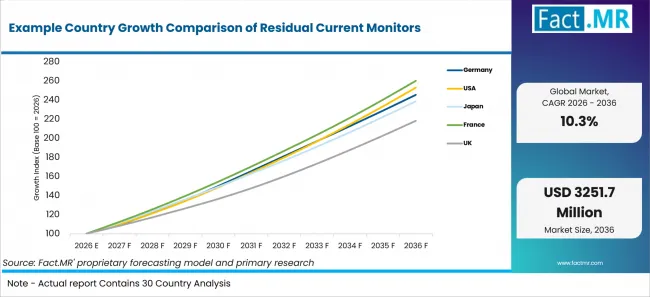
Example Country Growth Comparison Of Residual Current Monitors | Source: Fact.MR
| Country | CAGR (2026-2036) |
|---|---|
| France | 10.0% |
| USA | 9.7% |
| Germany | 9.4% |
| Japan | 9.1% |
| United Kingdom | 8.1% |
Source: Fact.MR analysis. Updated Sep 8, 2026
What supports France adoption?
10.0% CAGR, supported by expanding EV charging infrastructure and leakage-detection needs.
The Ministry of Economy reported in May 2025 that France had more than 168,000 publicly accessible charging points. A larger charging network increases the number of electrical installations requiring residual-current detection, creating demand for monitoring devices that support charger safety and early leakage identification.
How is the USA scaling demand?
9.7% CAGR, driven by public charging expansion and electrical infrastructure activity.
The U.S. Department of Transportation reported in January 2025 that the country had more than 206,000 publicly available EV charging ports. This broad charging base supports demand for residual-current monitoring across charger installations, while nonresidential electrical upgrades create additional opportunities for leakage detection and panel-level monitoring.
What is supporting Germany’s adoption?
9.4% CAGR, led by photovoltaic deployment and grid modernization.
Destatis reported in March 2026 that Germany had just under 4.8 million metered photovoltaic installations feeding public electricity networks at the end of 2025. Growing distributed generation increases the need for electrical monitoring, fault visibility, and residual-current detection across connected power systems and distribution infrastructure.
How does Japan perform?
9.1% CAGR, backed by construction activity and electrical-system upgrades.
MLIT reported in April 2026 that private-sector construction orders received by 50 major construction companies increased 13.7% year on year in fiscal 2025. Continued construction activity supports new electrical installations and panel upgrades, creating demand for residual-current monitoring across commercial, industrial, and infrastructure projects.
What supports the United Kingdom’s growth?
8.1% CAGR, shaped by expanding public EV charging infrastructure.
The Department for Transport reported 121,171 public EV chargers as of 1 July 2026. Expansion of the charging network increases demand for residual-current detection and monitoring functions that help identify leakage conditions and support safe operation across public charging installations.
Who leads the Residual Current Monitors Market?
Bender and Siemens offer dedicated residual-current monitoring products, while Schneider Electric, ABB, and Phoenix Contact also provide relevant residual-current relays, monitoring modules or sensors.
Bender offers residual-current and insulation-monitoring products, including multi-channel and Type B devices. Its May 2025 LINETRAXX SmartDetect RCMS425 launch added four-channel residual-current monitoring for earthed power-supply systems.
Siemens competes through SENTRON 5SV8 COM residual-current measuring devices in accordance with IEC 62020-1 and through its 2026 circuit-protection portfolio expansion, under which the SENTRON ECPD is planned to become available with an integrated Residual Current Monitoring function.
Schneider Electric offers VigiPacT/Vigirex residual-current relays used with associated toroids for earth-leakage protection and monitoring. ABB offers RD-series residual-current relays for leakage-current detection, protection and monitoring.
Which companies are the key providers?
Key companies include Bender, Siemens, Schneider Electric, ABB, and Phoenix Contact.
- Bender
- ABB
- Schneider Electric
- Siemens
- Phoenix Contact
Bibliography
- Bender. (2025, May 26). Introducing the new LINETRAXX® SmartDetect RCMS425 residual current monitoring devices.
- Bender. (2025, July). LINETRAXX® RCMS150 series: Residual current monitor type B with integrated measuring current transformers for earthed AC/DC systems (TN and TT systems) [Technical data sheet].
- Siemens. (2026, March 5). Siemens expands semiconductor-based circuit protection portfolio, debuts circular soft starter.
- Siemens. (2025, September). Circuit protection devices with communication and metering function [System manual] (L1V30827018B_RS-AB_008).
- Schneider Electric. (2025, February 20). Pact series - VigiPacT - Catalog 2023: Residual currents protection relays [Catalog] (Version 1.5, LVPED220034EN).
- Strunk, K. (2025, October 14). How can the charging process be optimally controlled? Phoenix Contact E-Mobility.
- U.S. Census Bureau. (2026, September 1). Monthly construction spending, July 2026.
- U.S. Department of Transportation. (2025, January 10). INVESTING IN AMERICA: Biden-Harris Administration announces $635 million in awards to continue expanding zero-emission EV charging and refueling infrastructure.
- Bundesnetzagentur. (2026, January 2). Energy transition clears crucial hurdle – significant progress in electricity grid expansion in 2025.
- Statistisches Bundesamt (Destatis). (2026, March 12). 4,8 Millionen Photovoltaikanlagen zum Jahresende 2025 installiert [4.8 million photovoltaic installations installed at the end of 2025].
- Ministère de l’Économie, des Finances et de la Souveraineté industrielle et numérique. (2025, May 16). Les bornes de recharge se déploient sur le territoire.
- Department for Transport. (2026, August 27). Public electric vehicle charging infrastructure statistics: 1 July 2026.
- Office for National Statistics. (2026, February 12). Construction output in Great Britain: December 2025, new orders and Construction Output Price Indices, October to December 2025.
- International Electrotechnical Commission. (2024). In-cable control and protection device (IC-CPD) for mode 2 charging of electric road vehicles (IEC 62752:2024).
This Report Answers
- The report explains where residual current monitors are used across monitoring type and voltage range. It covers application and mounting format.
- Segment analysis identifies Type A (AC and pulsating DC residual current), 230/400 VAC systems, industrial machinery and DIN-rail mounting as the largest listed 2026 segments.
- Country analysis examines France, the USA, Germany, Japan and the United Kingdom across charging infrastructure and electrical-upgrade activity.
- Competitive analysis reviews Bender, ABB, Schneider Electric, Siemens, Phoenix Contact across residual-current and earth-leakage monitoring portfolios.
- Application analysis assesses how machinery uptime, charger safety and critical-site continuity influence residual-current monitor selection.
What does the Residual Current Monitors Market cover?
The Residual Current Monitors Market covers devices and modules that detect residual current, compare it with a defined response value and provide a warning or monitoring signal when the response threshold is exceeded. It includes DIN-rail monitors, panel relays, toroid-linked systems, PCB modules and integrated units.
The assessment covers industrial machinery, EV charging, data centers, healthcare and renewable-energy applications. Adjacent context includes switchgear assemblies, molded case circuit breakers and current sensors where the electrical-safety boundary overlaps with residual-current monitoring.
What is included in the scope?
The scope includes standalone residual current monitors, monitoring relays, DC leakage modules, multi-channel systems and toroid-linked configurations. It includes products used for alarm, measurement and integration with higher-level controls.
It includes Type A (AC and pulsating DC residual current), Type B all-current sensitive, DC residual-current and hybrid insulation-monitoring configurations. Related monitoring areas include switchgear monitoring systems, DC power distribution, DC distribution networks and charging hardware used in electrical rooms.
What is excluded from the scope?
For this report, standard residual-current devices used only for automatic tripping are outside the defined market scope unless they also provide a residual-current monitoring function. Circuit breakers, fuses, surge protection devices and meters are outside the scope unless residual-current monitoring is built into the product.
General building-management software, design services and installation labor are outside the scope when sold separately. Adjacent categories such as motor protection devices and arc flash protection are covered only when residual-current measurement is a named product function.
How Was the Analysis Built?
The analysis draws on 120+ sources, 35+ company portfolios, 25+ countries, and more than 20 industry interviews.
- Primary Research: Primary research includes discussions with manufacturers, service providers, technology developers, distributors, end users, and subject-matter experts. These conversations examine purchasing priorities, product adoption, operational challenges, approval requirements, competitive positioning, and the factors that influence wider market acceptance.
- Desk Research: Desk research covers government statistics, regulatory publications, company filings, trade data, technical studies, industry associations, standards, public policy, and other authoritative sources. Every source used in the analysis is documented in the bibliography.
- Market Sizing and Forecasting: Market estimates combine historical performance, demand indicators, pricing and volume trends, segment shares, company participation, country-level growth, adoption patterns, investment activity, and barriers to market expansion.
- Data Validation and Update Cycle: Findings are validated by comparing primary interviews with public data, company activity, regulatory changes, trade patterns, and industry developments. Regular updates review new product launches, capacity changes, partnerships, approvals, and shifts in commercial adoption.
Segmentation
What is the report’s scope and coverage?
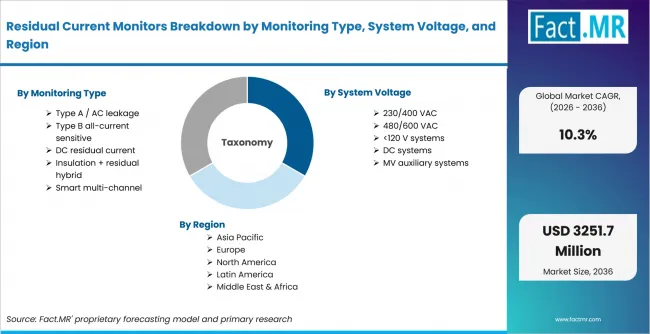
Residual Current Monitors Breakdown By Monitoring Type, System Voltage, And Region | Source: Fact.MR
| Attribute | Details |
|---|---|
| Quantitative Units | USD million |
| Market Definition | Devices and modules that continuously detect residual or leakage current in electrical systems and issue alarms or signals before insulation faults create safety or uptime risks. |
| Monitoring Type | Type A (AC and pulsating DC residual current); Type B all-current sensitive; DC residual current; Insulation + residual hybrid; Smart multi-channel |
| System Voltage | 230/400 VAC; 480/600 VAC; <120 V systems; DC systems; MV auxiliary systems |
| Application | Industrial machinery; EV charging; Data centers; Healthcare / critical facilities; Renewables |
| Mounting | DIN-rail; Panel / door mount; PCB / embedded; Toroid + external monitor; Integrated breaker / relay |
| Regions Covered | North America; Latin America; Western Europe; Eastern Europe; East Asia; South Asia & Pacific; Middle East & Africa |
| Countries Covered | France; USA; Germany; Japan; United Kingdom |
| Key Companies Profiled | Bender; ABB; Schneider Electric; Siemens; Phoenix Contact |
| Forecast Period | 2026 to 2036 |
| Approach | Hybrid top-down and bottom-up approach using electrical safety rules, installed-panel analysis, charging infrastructure, industrial applications, country adoption and provider portfolio review. |
Source: Fact.MR analysis. Updated Sep 8, 2026
How is the market segmented?
-
By Monitoring Type
- Type A (AC and pulsating DC residual current)
- Type B all-current sensitive
- DC residual current
- Insulation + residual hybrid
- Smart multi-channel
-
By System Voltage
- 230/400 VAC
- 480/600 VAC
- <120 V systems
- DC systems
- MV auxiliary systems
-
By Application
- Industrial machinery
- EV charging
- Data centers
- Healthcare / critical facilities
- Renewables
-
By Mounting
- DIN-rail
- Panel / door mount
- PCB / embedded
- Toroid + external monitor
- Integrated breaker / relay
-
By Region
- North America
- Latin America
- Western Europe
- Eastern Europe
- East Asia
- South Asia & Pacific
- Middle East & Africa
Frequently Asked Questions
How big is the residual current monitors market in 2026?
What is the CAGR of the residual current monitors market from 2026 to 2036?
Which monitoring type leads the residual current monitors market?
Which system voltage leads the residual current monitors market?
Who are the leading companies in the residual current monitors market?
Who worked on this report


Preview the report firsthand - request a free sample
Free SampleGet the brochure for pricing and purchase details
Download PDF