Couplings Market

Couplings Market Size and Share Forecast Outlook 2025 to 2035

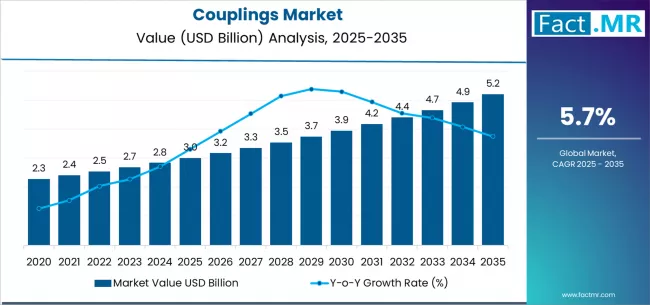
Couplings market is projected to grow from USD 3.0 billion in 2025 to USD 5.2 billion by 2035, at a CAGR of 5.7%. Flexible will dominate with a 50.0% market share, while automotive will lead the end use segment with a 40.0% share.

Couplings Market Forecast and Outlook 2025 to 2035

The global couplings market is valued at USD 3.0 billion in 2025 and is slated to reach USD 5.2 billion by 2035, recording an absolute increase of USD 2.2 billion over the forecast period. This translates into a total growth of 73.3%, with the market forecast to expand at a compound annual growth rate (CAGR) of 5.7% between 2025 and 2035.

The overall market size is expected to grow by approximately 1.73X during the same period, supported by increasing demand for power transmission solutions, growing adoption of industrial automation technologies across automotive and manufacturing sectors, and rising preference for flexible coupling systems in construction applications.

Quick Stats for Couplings Market

  • Couplings Market Value (2025): USD 3.0 billion
  • Couplings Market Forecast Value (2035): USD 5.2 billion
  • Couplings Market Forecast CAGR: 5.7%
  • Leading Type in Couplings Market: Flexible (50.0%)
  • Key Growth Regions in Couplings Market: North America, Europe, Asia Pacific
  • Key Players in Couplings Market: Rexnord, Timken, KTR, Lovejoy, Siemens, SKF, NSK, Fenner

Couplings Market Market Value Analysis

The couplings market represents a specialized segment of the global mechanical components industry, characterized by technological innovation and robust demand across automotive, industrial, and construction channels. Market dynamics are influenced by evolving machinery requirements for reliable power transmission, growing interest in maintenance-free coupling technologies, and expanding partnerships between coupling manufacturers and equipment producers in developed and emerging economies. Traditional rigid coupling systems continue evolving as manufacturers seek proven flexible alternatives that offer enhanced vibration dampening and reliable mechanical performance characteristics.

Industrial behavior in the couplings market reflects broader manufacturing trends toward high-performance, durable systems that provide both operational efficiency benefits and extended equipment life improvements. The market benefits from the growing popularity of flexible coupling applications, which are recognized for their superior vibration absorption and manufacturing compatibility across automotive and industrial applications. Additionally, the versatility of couplings as both standalone mechanical components and integrated transmission solutions supports demand across multiple industrial applications and machinery segments.

Regional adoption patterns vary significantly, with North American markets showing strong preference for automotive implementations, while European markets demonstrate increasing adoption of industrial applications alongside conventional construction systems. The manufacturing landscape continues to evolve with sophisticated and feature-rich coupling products gaining traction in mainstream operations, reflecting equipment manufacturer willingness to invest in proven transmission technology improvements and reliability-oriented features.

The competitive environment features established mechanical component companies alongside specialized coupling manufacturers that focus on unique design capabilities and advanced manufacturing methods. Production efficiency and technology development optimization remain critical factors for market participants, particularly as performance requirements and durability standards continue to evolve. Distribution strategies increasingly emphasize multi-channel approaches that combine traditional industrial supply chains with direct manufacturer partnerships through technology licensing agreements and custom engineering contracts.

Market consolidation trends indicate that larger mechanical component companies are acquiring specialty coupling manufacturers to diversify their product portfolios and access specialized transmission segments. Advanced coupling integration has gained momentum as automotive companies seek to differentiate their offerings while maintaining competitive performance standards. The emergence of specialized coupling variants, including enhanced flexible formulations and application-specific options, reflects changing industrial priorities and creates new market opportunities for innovative transmission system developers.

Between 2025 and 2030, the couplings market is projected to expand from USD 3.0 billion to USD 3.9 billion, resulting in a value increase of USD 0.9 billion, which represents 40.9% of the total forecast growth for the decade. This phase of development will be shaped by increasing adoption of flexible coupling systems, rising demand for automotive transmission solutions, and growing emphasis on vibration control features with advanced mechanical characteristics. Manufacturing facilities are expanding their coupling capabilities to address the growing demand for specialized coupling implementations, advanced transmission options, and application-specific offerings across industrial segments.

Couplings Market Key Takeaways

Metric Value
Estimated Value (2025E) USD 3.0 billion
Forecast Value (2035F) USD 5.2 billion
Forecast CAGR (2025-2035) 5.7%

From 2030 to 2035, the market is forecast to grow from USD 3.9 billion to USD 5.2 billion, adding another USD 1.3 billion, which constitutes 59.1% of the overall ten-year expansion. This period is expected to be characterized by the expansion of industrial applications, the integration of innovative coupling solutions, and the development of specialized coupling implementations with enhanced mechanical profiles and extended durability capabilities. The growing adoption of advanced manufacturing formulations will drive demand for couplings with superior transmission characteristics and compatibility with modern industrial technologies across manufacturing operations.

Between 2020 and 2025, the couplings market experienced steady growth, driven by increasing demand for flexible coupling systems and growing recognition of advanced transmission technologies as essential components for modern automotive and industrial equipment across manufacturing and construction applications. The market developed as equipment manufacturers recognized the potential for coupling solutions to provide both mechanical benefits and operational advantages while enabling streamlined transmission protocols. Technological advancement in coupling design and application-based development began emphasizing the critical importance of maintaining transmission efficiency and mechanical reliability in diverse industrial environments.

Why is the Couplings Market Growing?

Market expansion is being supported by the increasing global demand for advanced power transmission systems and the corresponding need for coupling technologies that can provide superior mechanical benefits and operational advantages while enabling enhanced equipment performance and extended compatibility across various automotive and industrial applications. Modern equipment manufacturers and mechanical specialists are increasingly focused on implementing proven transmission technologies that can deliver effective power transfer, minimize traditional mechanical limitations, and provide consistent performance throughout complex machinery configurations and diverse operational conditions. Couplings proven ability to deliver exceptional transmission efficiency against traditional alternatives, enable advanced mechanical integration, and support modern equipment protocols makes it an essential component for contemporary automotive and industrial operations.

The growing emphasis on equipment reliability and operational efficiency is driving demand for couplings that can support large-scale manufacturing requirements, improve mechanical outcomes, and enable advanced transmission systems. Manufacturer preference for components that combine effective power transmission with proven durability and performance enhancement benefits is creating opportunities for innovative coupling implementations. The rising influence of industrial automation trends and mechanical efficiency awareness is also contributing to increased demand for couplings that can provide advanced features, seamless equipment integration, and reliable performance across extended operational cycles.

Opportunity Pathways - Couplings Market

The couplings market is poised for steady growth and technological advancement. As manufacturing facilities across North America, Europe, Asia-Pacific, and emerging markets seek components that deliver exceptional transmission characteristics, advanced mechanical capabilities, and reliable manufacturing options, coupling solutions are gaining prominence not just as mechanical components but as strategic enablers of transmission technologies and advanced mechanical functionality.

Rising flexible coupling adoption in automotive applications and expanding industrial automation initiatives globally amplify demand, while manufacturers are leveraging innovations in mechanical engineering, advanced manufacturing integration, and transmission optimization technologies.

  • Pathway A - Flexible Coupling Implementations. Premium automotive and industrial manufacturers increasingly require coupling solutions with flexible designs and advanced transmission profiles for enhanced equipment appeal and performance positioning capabilities. Component developers who develop flexible platforms with superior mechanical standards can command premium pricing. Expected revenue pool: USD 1.5 billion - USD 2.6 billion.
  • Pathway B - Automotive Transmission Platforms. Growing demand for automotive applications, high-performance capabilities, and unique mechanical features drives need for advanced automotive capabilities with specialized manufacturing integration. Opportunity: USD 1.2 billion - USD 2.1 billion.
  • Pathway C - Industrial Applications. Advanced industrial formulations capable of meeting specific mechanical requirements, equipment compatibility, and specialized transmission profiles enable market expansion and enhanced component appeal for industrial-focused operations. Revenue lift: USD 1.1 billion - USD 1.8 billion.
  • Pathway D - Construction Equipment Integration. Expanding reach into construction applications with optimized power transmission, advanced mechanical capabilities, and extended functionality features. Manufacturers will seek partners who supply integrated construction solutions with complete coupling functionality. Pool: USD 0.8 billion - USD 1.3 billion.
  • Pathway E - Geographic Expansion & Local Manufacturing. Strong growth in APAC, particularly China, India, and Southeast Asia. Local manufacturing lowers costs, reduces transportation complexity, and enables faster response to regional mechanical preferences. Expected upside: USD 0.9 billion - USD 1.5 billion.
  • Pathway F - Rigid Coupling Development. Increasing demand for rigid coupling systems, application-specific functionality, and specialized mechanical profiles with validated performance characteristics for manufacturing facilities. USD 0.9 billion - USD 1.6 billion.
  • Pathway G - Universal Coupling Expansion. Developing comprehensive universal coupling solutions, multi-application services, and enhancement programs creates differentiation and addresses specialized requirements for versatile applications and facility operators. Growing demand from independent manufacturing services. Pool: USD 0.6 billion - USD 1.0 billion.

Segmental Analysis

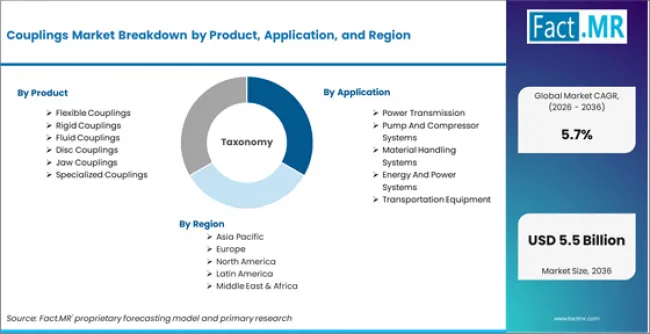
The market is segmented by type, end use, and region. By type, the market is divided into flexible, rigid, and universal categories. By end use, it covers automotive, industrial, and construction segments. Regionally, the market is divided into North America, Europe, and Asia-Pacific.

By Type, the Flexible Segment Accounts for 50.0% Market Share

Couplings Market Analysis By Type

The flexible segment is projected to account for 50.0% of the couplings market in 2025. Manufacturing facilities and transmission integrators increasingly utilize flexible implementations for their superior vibration dampening characteristics when operating across diverse application platforms, excellent mechanical properties, and widespread acceptance in applications ranging from basic power transmission to premium automotive operations.

Flexible coupling technology's established mechanical methods and proven transmission capabilities directly address the facility requirements for dependable coupling solutions in complex industrial environments.

Flexible couplings form the foundation of modern automotive adoption patterns, as it represents the implementation with the greatest market penetration and established manufacturer acceptance across multiple application categories and mechanical segments. Investments in flexible coupling standardization and system consistency continue to strengthen adoption among automotive producers and industrial companies.

With manufacturers prioritizing vibration control and mechanical enhancement, flexible implementations align with both functionality preferences and cost expectations, making them the central component of comprehensive power transmission strategies.

By End Use, the Automotive Segment Accounts for 40.0% Market Share

Couplings Market Analysis By End Use

Automotive applications are projected to represent 40.0% of couplings demand in 2025, underscoring their critical role as the primary end use type for transmission enhancement across vehicle manufacturing operations.

Manufacturing facilities prefer couplings for automotive use for their exceptional mechanical characteristics, scalable manufacturing options, and ability to enhance power transmission while ensuring consistent mechanical quality throughout diverse manufacturing platforms and automotive operations. Positioned as essential transmission components for modern automotive systems, coupling solutions offer both technological advantages and mechanical efficiency benefits.

The segment is supported by continuous innovation in coupling technologies and the growing availability of specialized implementations that enable diverse automotive requirements with enhanced mechanical uniformity and extended durability capabilities. Manufacturing facilities are investing in advanced technologies to support large-scale transmission integration and product development.

As automotive performance trends become more prevalent and mechanical efficiency awareness increases, automotive applications will continue to represent a major implementation market while supporting advanced manufacturing utilization and technology integration strategies.

By End Use, the Industrial Segment Accounts for 35.0% Market Share

The industrial segment is expected to capture 35.0% of the couplings market in 2025, driven by increasing demand for reliable power transmission systems that enhance equipment performance while maintaining operational efficiency.

Industrial manufacturers are increasingly adopting couplings for machinery applications, processing equipment, and manufacturing systems due to their superior mechanical reliability and vibration control capabilities. The segment benefits from growing industrial automation requirements and continuous innovation in coupling formulations tailored for industrial applications.

What are the Drivers, Restraints, and Key Trends of the Couplings Market?

The couplings market is advancing steadily due to increasing demand for advanced power transmission technologies and growing adoption of coupling systems that provide superior mechanical characteristics and operational benefits while enabling enhanced equipment performance across diverse automotive and industrial applications.

The market faces challenges, including complex manufacturing requirements, evolving performance standards, and the need for specialized mechanical expertise and quality programs. Innovation in coupling design and advanced manufacturing systems continues to influence product development and market expansion patterns.

Expansion of Industrial Automation Technologies and Equipment Integration

The growing adoption of advanced industrial automation, sophisticated mechanical capabilities, and manufacturing efficiency awareness is enabling component developers to produce advanced coupling solutions with superior mechanical positioning, enhanced transmission profiles, and seamless integration functionalities.

Advanced automation systems provide improved equipment outcomes while allowing more efficient manufacturing workflows and reliable performance across various industrial applications and operational conditions. Developers are increasingly recognizing the competitive advantages of equipment integration capabilities for market differentiation and component positioning.

Integration of Advanced Manufacturing Methods and Mechanical Engineering

Modern coupling manufacturers are incorporating advanced manufacturing technology, mechanical integration, and sophisticated production solutions to enhance product appeal, enable intelligent transmission features, and deliver value-added solutions to industrial customers.

These technologies improve coupling performance while enabling new market opportunities, including multi-application transmission systems, optimized mechanical treatments, and enhanced durability characteristics. Advanced mechanical integration also allows developers to support comprehensive industrial technologies and market expansion beyond traditional coupling approaches.

Analysis of the Couplings Market by Key Countries

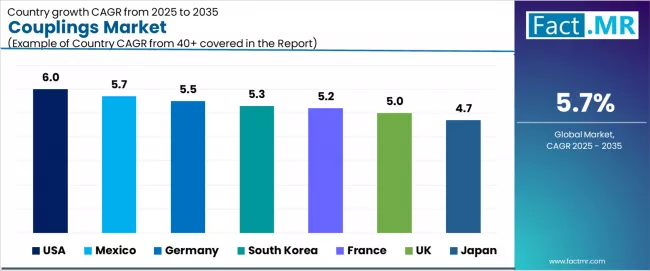
Couplings Market Cagr Analysis By Country

Country CAGR (2025-2035)
USA 6.0%
Mexico 5.7%
Germany 5.5%
South Korea 5.3%
France 5.2%
UK 5.0%
Japan 4.7%

The couplings market is experiencing steady growth globally, with the USA leading at a 6.0% CAGR through 2035, driven by expanding automotive manufacturing capacity, growing industrial automation programs, and significant investment in mechanical component development. Mexico follows at 5.7%, supported by increasing manufacturing expansion, growing coupling integration patterns, and expanding automotive infrastructure. Germany shows growth at 5.5%, emphasizing mechanical technology leadership and coupling development.

South Korea records 5.3%, focusing on expanding automotive capabilities and mechanical technology modernization. France exhibits 5.2% growth, emphasizing manufacturing innovation excellence and premium coupling development. The UK demonstrates 5.0% growth, prioritizing advanced mechanical technology development and quality-focused manufacturing patterns. Japan shows 5.0% growth, supported by automotive excellence initiatives and quality-focused mechanical patterns.

USA Leads Global Market Growth with Automotive Manufacturing Expansion

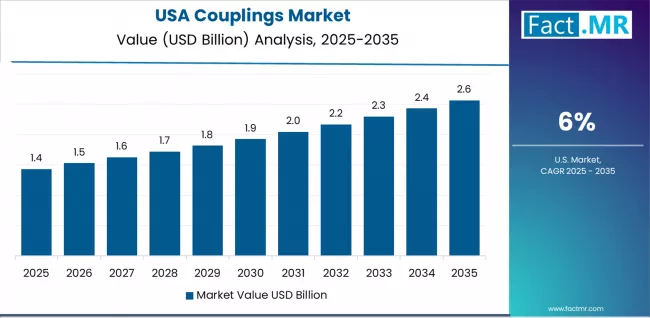
Couplings Market Country Value Analysis

The couplings industry in the USA is projected to exhibit robust growth with a CAGR of 6.0% through 2035, driven by expanding automotive manufacturing capacity and rapidly growing industrial integration supported by government initiatives promoting advanced mechanical technology development.

The country's strong position in automotive production and increasing investment in manufacturing infrastructure are creating substantial demand for advanced coupling implementations. Major manufacturing facilities and technology companies are establishing comprehensive transmission capabilities to serve both domestic automotive demand and expanding industrial markets.

Government support for manufacturing innovation initiatives and automotive development is driving demand for advanced coupling systems throughout major manufacturing regions and production centers across the country. Strong automotive growth and an expanding network of technology-focused producers are supporting the rapid adoption of couplings among manufacturers seeking advanced mechanical capabilities and integrated transmission technologies.

Mexico Demonstrates Strong Manufacturing Growth and Automotive Expansion

The couplings industry in Mexico is growing at a CAGR of 5.7%, driven by the country's expanding automotive sector, growing manufacturing capacity, and increasing adoption of advanced coupling technologies. The country's initiatives promoting manufacturing modernization and growing industrial development awareness are driving requirements for technology-integrated coupling systems. International coupling providers and domestic manufacturing companies are establishing extensive production and integration capabilities to address the growing demand for advanced coupling solutions.

Strong automotive expansion and expanding modern manufacturing operations are driving adoption of integrated transmission systems with superior coupling capabilities and advanced integration among large automotive producers and progressive manufacturing operations. Growing technology diversity and increasing manufacturing enhancement adoption are supporting market expansion for advanced coupling implementations with seamless integration profiles and modern transmission delivery throughout the country's manufacturing regions. Mexico's strategic location and cost-effective manufacturing capabilities make it an attractive destination for coupling production facilities serving both domestic and North American markets.

Germany Demonstrates Mechanical Technology Leadership with Innovation Growth

The couplings industry in Germany is expanding at a CAGR of 5.5%, supported by the country's mechanical technology heritage, strong emphasis on advanced coupling technology, and robust demand for advanced coupling systems in automotive and industrial applications. The nation's mature manufacturing sector and technology-focused operations are driving sophisticated coupling implementations throughout the industry. Leading facilities and mechanical specialists are investing extensively in coupling development and advanced integration technologies to serve both domestic and international markets.

Rising demand for mechanical enhancement technologies and advanced manufacturing systems is creating requirements for sophisticated coupling solutions with exceptional transmission capabilities among quality-conscious facilities seeking enhanced manufacturing experiences and advanced integration methods. Strong mechanical tradition and growing investment in advanced technologies are supporting adoption of quality coupling platforms with advanced development methods and enhanced transmission profiles across manufacturing operations in major industrial regions.

South Korea Demonstrates Strong Manufacturing Integration and Technology Development

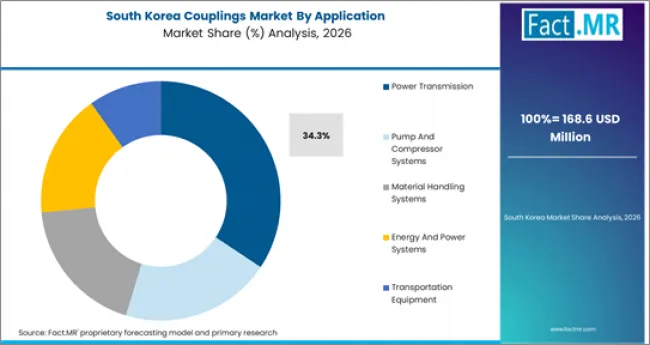
Couplings Market South Korea Market Share Analysis By End Use

The couplings industry in South Korea is growing at a CAGR of 5.3%, driven by the country's expanding automotive sector, growing technology integration capacity, and increasing adoption of advanced coupling technologies. The country's initiatives promoting automotive modernization and growing manufacturing development awareness are driving requirements for technology-integrated coupling systems. International coupling providers and domestic automotive companies are establishing extensive production and integration capabilities to address the growing demand for advanced coupling solutions.

Rising automotive requirements and expanding manufacturing programs are creating opportunities for coupling adoption across manufacturing centers, progressive producers, and modern automotive facilities in major industrial regions. Growing focus on mechanical integration and transmission improvement features is driving adoption of coupling platforms among manufacturers seeking enhanced transmission capabilities and advanced mechanical experiences.

France Focuses on Manufacturing Development and Industrial Enhancement Programs

The couplings industry in France is growing at a CAGR of 5.2%, driven by the country's expanding automotive sector, growing manufacturing development programs, and increasing investment in coupling technology development. France's large automotive market and commitment to manufacturing advancement are supporting demand for diverse coupling solutions across multiple industrial segments. Manufacturers are establishing comprehensive integration capabilities to serve the growing domestic market and expanding manufacturing opportunities.

Strong automotive expansion and expanding modern manufacturing operations are driving adoption of integrated transmission systems with superior coupling capabilities and advanced integration among large automotive producers and progressive manufacturing operations. Growing technology diversity and increasing manufacturing enhancement adoption are supporting market expansion for advanced coupling implementations with seamless integration profiles and modern transmission delivery throughout the country's manufacturing regions.

UK Exhibits Manufacturing Technology Development and Premium Innovation Growth

The couplings industry in the UK is growing at a CAGR of 5.0%, driven by the country's focus on manufacturing technology advancement, emphasis on premium industrial innovation, and strong position in coupling development. The UK's established manufacturing innovation capabilities and commitment to technology diversification are supporting investment in specialized coupling technologies throughout major industrial regions. Industry leaders are establishing comprehensive technology integration systems to serve domestic premium manufacturing production and enhancement applications.

Innovations in transmission platforms and coupling integration capabilities are creating demand for advanced coupling implementations with exceptional mechanical properties among progressive manufacturing facilities seeking enhanced technology differentiation and industrial appeal. Growing premium manufacturing adoption and increasing focus on mechanical innovation are driving adoption of advanced coupling platforms with integrated transmission delivery and coupling optimization across manufacturing enterprises throughout the country.

Japan Shows Quality Manufacturing Focus and Technology-Driven Mechanical Systems

Couplings Market Japan Market Share Analysis By Type

The couplings industry in Japan is expanding at a CAGR of 4.7%, supported by the country's manufacturing excellence initiatives, growing quality technology sector, and strategic emphasis on advanced coupling development. Japan's advanced quality control capabilities and integrated manufacturing systems are driving demand for high-quality coupling platforms in premium applications, automotive technology, and advanced manufacturing applications. Leading facilities are investing in specialized capabilities to serve the stringent requirements of technology-focused manufacturing and premium automotive producers.

Quality manufacturing advancement and technology-focused development are creating requirements for specialized coupling solutions with superior quality integration, exceptional transmission capabilities, and advanced mechanical features among quality-conscious manufacturing operations and premium automotive producers. Strong position in manufacturing technology innovation is supporting adoption of advanced coupling systems with validated transmission characteristics and quality integration capabilities throughout the country's automotive technology sector.

Europe Market Split by Countries

Couplings Market Europe Country Market Share Analysis, 2025 & 2035

The couplings market in Europe is projected to grow from USD 0.9 billion in 2025 to USD 1.6 billion by 2035, registering a CAGR of 5.4% over the forecast period. Germany is expected to maintain its leadership position with a 32.0% market share in 2025, growing to 33.5% by 2035, supported by its strong mechanical engineering culture, sophisticated automotive manufacturing capabilities, and comprehensive industrial sector serving diverse coupling applications across Europe.

France follows with a 23.0% share in 2025, projected to reach 23.8% by 2035, driven by robust demand for automotive technologies in manufacturing applications, advanced industrial development programs, and transmission enhancement markets, combined with established automotive infrastructure and technology integration expertise. The UK holds a 18.5% share in 2025, expected to reach 17.8% by 2035, supported by strong manufacturing technology sector and growing premium industrial activities.

Italy commands a 12.0% share in 2025, projected to reach 11.5% by 2035, while the Netherlands accounts for 8.5% in 2025, expected to reach 9.0% by 2035. The Rest of Europe region is anticipated to maintain momentum, with its collective share moving from 6.0% to 4.4% by 2035, attributed to increasing manufacturing modernization and growing technology penetration implementing advanced coupling programs.

Competitive Landscape of the Couplings Market

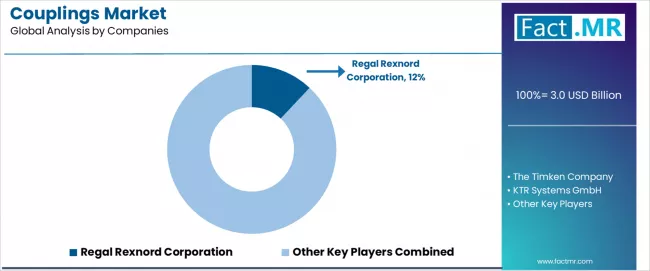
Couplings Market Analysis By Company

The couplings market is characterized by competition among established mechanical component companies, specialized coupling manufacturers, and integrated transmission solution providers. Companies are investing in coupling technology research, manufacturing optimization, advanced production system development, and comprehensive coupling portfolios to deliver consistent, high-quality, and application-specific coupling solutions. Innovation in advanced mechanical integration, transmission enhancement, and equipment compatibility improvement is central to strengthening market position and competitive advantage.

Regal Rexnord Corporation leads the market with a 12% market share, offering comprehensive coupling solutions including quality transmission platforms and advanced mechanical systems with a focus on premium and automotive applications. Timken provides specialized manufacturing capabilities with an emphasis on advanced coupling implementations and innovative transmission solutions.

KTR Systems GmbH delivers comprehensive mechanical services with a focus on integrated platforms and large-scale manufacturing applications. Lovejoy specializes in advanced coupling technologies and specialized transmission implementations for premium applications. Siemens focuses on automotive-oriented coupling integration and innovative technology solutions.

The competitive landscape is further strengthened by companies like SKF, which brings expertise in advanced bearing and coupling technologies, while NSK focuses on precision coupling solutions for diverse applications. Fenner emphasizes flexible coupling systems and manufacturing integration, and Dana specializes in automotive transmission components. These companies continue to invest in research and development, strategic partnerships, and manufacturing capacity expansion to maintain their market positions and capture emerging opportunities in the growing couplings sector.

Key Players in the Couplings Market

  • Regal Rexnord Corporation
  • The Timken Company
  • KTR Systems GmbH
  • Lovejoy, Inc.
  • Siemens AG
  • SKF AB
  • NSK Ltd.
  • Fenner Drives, Inc.
  • Dana Incorporated
  • Bonfiglioli Riduttori S.p.A.
  • Gear Motions, Inc.

Scope of the Report

Item Value
Quantitative Units USD 3.0 Billion
Type Flexible; Rigid; Universal
End Use Automotive; Industrial; Construction
Regions Covered North America; Europe; Asia-Pacific
Countries Covered USA; Germany; France; South Korea; UK; Japan; Mexico; and 40+ additional countries
Key Companies Profiled Rexnord; Timken; KTR; Lovejoy; Siemens; SKF
Additional Attributes Dollar sales by type and end use category; regional demand trends; competitive landscape; technological advancements in coupling engineering; advanced transmission development; mechanical innovation; equipment integration protocols

Couplings Market by Segments

  • Type :

    • Flexible
    • Rigid
    • Universal
  • End Use :

    • Automotive
    • Industrial
    • Construction
  • Region :

    • North America

      • USA
      • Canada
      • Mexico
    • Europe

      • Germany
      • UK
      • France
      • Italy
      • Spain
      • Nordic
      • BENELUX
      • Rest of Europe
    • Asia-Pacific

      • China
      • Japan
      • South Korea
      • India
      • ASEAN
      • Australia & New Zealand
      • Rest of Asia-Pacific

Table of Content

  1. Executive Summary
    • Global Market Outlook
    • Demand to side Trends
    • Supply to side Trends
    • Technology Roadmap Analysis
    • Analysis and Recommendations
  2. Market Overview
    • Market Coverage / Taxonomy
    • Market Definition / Scope / Limitations
  3. Market Background
    • Market Dynamics
      • Drivers
      • Restraints
      • Opportunity
      • Trends
    • Scenario Forecast
      • Demand in Optimistic Scenario
      • Demand in Likely Scenario
      • Demand in Conservative Scenario
    • Opportunity Map Analysis
    • Product Life Cycle Analysis
    • Supply Chain Analysis
    • Investment Feasibility Matrix
    • Value Chain Analysis
    • PESTLE and Porter’s Analysis
    • Regulatory Landscape
    • Regional Parent Market Outlook
    • Production and Consumption Statistics
    • Import and Export Statistics
  4. Global Market Analysis 2020 to 2024 and Forecast, 2025 to 2035
    • Historical Market Size Value (USD Million) Analysis, 2020 to 2024
    • Current and Future Market Size Value (USD Million) Projections, 2025 to 2035
      • Y to o to Y Growth Trend Analysis
      • Absolute $ Opportunity Analysis
  5. Global Market Pricing Analysis 2020 to 2024 and Forecast 2025 to 2035
  6. Global Market Analysis 2020 to 2024 and Forecast 2025 to 2035, By Type
    • Introduction / Key Findings
    • Historical Market Size Value (USD Million) Analysis By Type, 2020 to 2024
    • Current and Future Market Size Value (USD Million) Analysis and Forecast By Type, 2025 to 2035
      • Flexible
      • Rigid
      • Universal
    • Y to o to Y Growth Trend Analysis By Type, 2020 to 2024
    • Absolute $ Opportunity Analysis By Type, 2025 to 2035
  7. Global Market Analysis 2020 to 2024 and Forecast 2025 to 2035, By End Use
    • Introduction / Key Findings
    • Historical Market Size Value (USD Million) Analysis By End Use, 2020 to 2024
    • Current and Future Market Size Value (USD Million) Analysis and Forecast By End Use, 2025 to 2035
      • Automotive
      • Industrial
      • Construction
    • Y to o to Y Growth Trend Analysis By End Use, 2020 to 2024
    • Absolute $ Opportunity Analysis By End Use, 2025 to 2035
  8. Global Market Analysis 2020 to 2024 and Forecast 2025 to 2035, By Region
    • Introduction
    • Historical Market Size Value (USD Million) Analysis By Region, 2020 to 2024
    • Current Market Size Value (USD Million) Analysis and Forecast By Region, 2025 to 2035
      • North America
      • Latin America
      • Western Europe
      • Eastern Europe
      • East Asia
      • South Asia and Pacific
      • Middle East & Africa
    • Market Attractiveness Analysis By Region
  9. North America Market Analysis 2020 to 2024 and Forecast 2025 to 2035, By Country
    • Historical Market Size Value (USD Million) Trend Analysis By Market Taxonomy, 2020 to 2024
    • Market Size Value (USD Million) Forecast By Market Taxonomy, 2025 to 2035
      • By Country
        • USA
        • Canada
        • Mexico
      • By Type
      • By End Use
    • Market Attractiveness Analysis
      • By Country
      • By Type
      • By End Use
    • Key Takeaways
  10. Latin America Market Analysis 2020 to 2024 and Forecast 2025 to 2035, By Country
    • Historical Market Size Value (USD Million) Trend Analysis By Market Taxonomy, 2020 to 2024
    • Market Size Value (USD Million) Forecast By Market Taxonomy, 2025 to 2035
      • By Country
        • Brazil
        • Chile
        • Rest of Latin America
      • By Type
      • By End Use
    • Market Attractiveness Analysis
      • By Country
      • By Type
      • By End Use
    • Key Takeaways
  11. Western Europe Market Analysis 2020 to 2024 and Forecast 2025 to 2035, By Country
    • Historical Market Size Value (USD Million) Trend Analysis By Market Taxonomy, 2020 to 2024
    • Market Size Value (USD Million) Forecast By Market Taxonomy, 2025 to 2035
      • By Country
        • Germany
        • UK
        • Italy
        • Spain
        • France
        • Nordic
        • BENELUX
        • Rest of Western Europe
      • By Type
      • By End Use
    • Market Attractiveness Analysis
      • By Country
      • By Type
      • By End Use
    • Key Takeaways
  12. Eastern Europe Market Analysis 2020 to 2024 and Forecast 2025 to 2035, By Country
    • Historical Market Size Value (USD Million) Trend Analysis By Market Taxonomy, 2020 to 2024
    • Market Size Value (USD Million) Forecast By Market Taxonomy, 2025 to 2035
      • By Country
        • Russia
        • Poland
        • Hungary
        • Balkan & Baltic
        • Rest of Eastern Europe
      • By Type
      • By End Use
    • Market Attractiveness Analysis
      • By Country
      • By Type
      • By End Use
    • Key Takeaways
  13. East Asia Market Analysis 2020 to 2024 and Forecast 2025 to 2035, By Country
    • Historical Market Size Value (USD Million) Trend Analysis By Market Taxonomy, 2020 to 2024
    • Market Size Value (USD Million) Forecast By Market Taxonomy, 2025 to 2035
      • By Country
        • China
        • Japan
        • South Korea
      • By Type
      • By End Use
    • Market Attractiveness Analysis
      • By Country
      • By Type
      • By End Use
    • Key Takeaways
  14. South Asia and Pacific Market Analysis 2020 to 2024 and Forecast 2025 to 2035, By Country
    • Historical Market Size Value (USD Million) Trend Analysis By Market Taxonomy, 2020 to 2024
    • Market Size Value (USD Million) Forecast By Market Taxonomy, 2025 to 2035
      • By Country
        • India
        • ASEAN
        • Australia & New Zealand
        • Rest of South Asia and Pacific
      • By Type
      • By End Use
    • Market Attractiveness Analysis
      • By Country
      • By Type
      • By End Use
    • Key Takeaways
  15. Middle East & Africa Market Analysis 2020 to 2024 and Forecast 2025 to 2035, By Country
    • Historical Market Size Value (USD Million) Trend Analysis By Market Taxonomy, 2020 to 2024
    • Market Size Value (USD Million) Forecast By Market Taxonomy, 2025 to 2035
      • By Country
        • Kingdom of Saudi Arabia
        • Other GCC Countries
        • Turkiye
        • South Africa
        • Other African Union
        • Rest of Middle East & Africa
      • By Type
      • By End Use
    • Market Attractiveness Analysis
      • By Country
      • By Type
      • By End Use
    • Key Takeaways
  16. Key Countries Market Analysis
    • USA
      • Pricing Analysis
      • Market Share Analysis, 2024
        • By Type
        • By End Use
    • Canada
      • Pricing Analysis
      • Market Share Analysis, 2024
        • By Type
        • By End Use
    • Mexico
      • Pricing Analysis
      • Market Share Analysis, 2024
        • By Type
        • By End Use
    • Brazil
      • Pricing Analysis
      • Market Share Analysis, 2024
        • By Type
        • By End Use
    • Chile
      • Pricing Analysis
      • Market Share Analysis, 2024
        • By Type
        • By End Use
    • Germany
      • Pricing Analysis
      • Market Share Analysis, 2024
        • By Type
        • By End Use
    • UK
      • Pricing Analysis
      • Market Share Analysis, 2024
        • By Type
        • By End Use
    • Italy
      • Pricing Analysis
      • Market Share Analysis, 2024
        • By Type
        • By End Use
    • Spain
      • Pricing Analysis
      • Market Share Analysis, 2024
        • By Type
        • By End Use
    • France
      • Pricing Analysis
      • Market Share Analysis, 2024
        • By Type
        • By End Use
    • India
      • Pricing Analysis
      • Market Share Analysis, 2024
        • By Type
        • By End Use
    • ASEAN
      • Pricing Analysis
      • Market Share Analysis, 2024
        • By Type
        • By End Use
    • Australia & New Zealand
      • Pricing Analysis
      • Market Share Analysis, 2024
        • By Type
        • By End Use
    • China
      • Pricing Analysis
      • Market Share Analysis, 2024
        • By Type
        • By End Use
    • Japan
      • Pricing Analysis
      • Market Share Analysis, 2024
        • By Type
        • By End Use
    • South Korea
      • Pricing Analysis
      • Market Share Analysis, 2024
        • By Type
        • By End Use
    • Russia
      • Pricing Analysis
      • Market Share Analysis, 2024
        • By Type
        • By End Use
    • Poland
      • Pricing Analysis
      • Market Share Analysis, 2024
        • By Type
        • By End Use
    • Hungary
      • Pricing Analysis
      • Market Share Analysis, 2024
        • By Type
        • By End Use
    • Kingdom of Saudi Arabia
      • Pricing Analysis
      • Market Share Analysis, 2024
        • By Type
        • By End Use
    • Turkiye
      • Pricing Analysis
      • Market Share Analysis, 2024
        • By Type
        • By End Use
    • South Africa
      • Pricing Analysis
      • Market Share Analysis, 2024
        • By Type
        • By End Use
  17. Market Structure Analysis
    • Competition Dashboard
    • Competition Benchmarking
    • Market Share Analysis of Top Players
      • By Regional
      • By Type
      • By End Use
  18. Competition Analysis
    • Competition Deep Dive
      • Regal Rexnord Corporation
        • Overview
        • Product Portfolio
        • Profitability by Market Segments (Product/Age /Sales Channel/Region)
        • Sales Footprint
        • Strategy Overview
          • Marketing Strategy
          • Product Strategy
          • Channel Strategy
      • The Timken Company
      • KTR Systems GmbH
      • Lovejoy, Inc.
      • Siemens AG
      • SKF AB
      • NSK Ltd.
      • Fenner Drives, Inc.
      • Dana Incorporated
      • Bonfiglioli Riduttori S.p.A.
      • Gear Motions, Inc.
  19. Assumptions & Acronyms Used
  20. Research Methodology

List Of Table

  • Table 1: Global Market Value (USD Million) Forecast by Region, 2020 to 2035
  • Table 2: Global Market Value (USD Million) Forecast by Type, 2020 to 2035
  • Table 3: Global Market Value (USD Million) Forecast by End Use, 2020 to 2035
  • Table 4: North America Market Value (USD Million) Forecast by Country, 2020 to 2035
  • Table 5: North America Market Value (USD Million) Forecast by Type, 2020 to 2035
  • Table 6: North America Market Value (USD Million) Forecast by End Use, 2020 to 2035
  • Table 7: Latin America Market Value (USD Million) Forecast by Country, 2020 to 2035
  • Table 8: Latin America Market Value (USD Million) Forecast by Type, 2020 to 2035
  • Table 9: Latin America Market Value (USD Million) Forecast by End Use, 2020 to 2035
  • Table 10: Western Europe Market Value (USD Million) Forecast by Country, 2020 to 2035
  • Table 11: Western Europe Market Value (USD Million) Forecast by Type, 2020 to 2035
  • Table 12: Western Europe Market Value (USD Million) Forecast by End Use, 2020 to 2035
  • Table 13: Eastern Europe Market Value (USD Million) Forecast by Country, 2020 to 2035
  • Table 14: Eastern Europe Market Value (USD Million) Forecast by Type, 2020 to 2035
  • Table 15: Eastern Europe Market Value (USD Million) Forecast by End Use, 2020 to 2035
  • Table 16: East Asia Market Value (USD Million) Forecast by Country, 2020 to 2035
  • Table 17: East Asia Market Value (USD Million) Forecast by Type, 2020 to 2035
  • Table 18: East Asia Market Value (USD Million) Forecast by End Use, 2020 to 2035
  • Table 19: South Asia and Pacific Market Value (USD Million) Forecast by Country, 2020 to 2035
  • Table 20: South Asia and Pacific Market Value (USD Million) Forecast by Type, 2020 to 2035
  • Table 21: South Asia and Pacific Market Value (USD Million) Forecast by End Use, 2020 to 2035
  • Table 22: Middle East & Africa Market Value (USD Million) Forecast by Country, 2020 to 2035
  • Table 23: Middle East & Africa Market Value (USD Million) Forecast by Type, 2020 to 2035
  • Table 24: Middle East & Africa Market Value (USD Million) Forecast by End Use, 2020 to 2035

List Of Figures

  • Figure 1: Global Market Pricing Analysis
  • Figure 2: Global Market Value (USD Million) Forecast 2020-2035
  • Figure 3: Global Market Value Share and BPS Analysis by Type, 2025 and 2035
  • Figure 4: Global Market Y to o to Y Growth Comparison by Type, 2025-2035
  • Figure 5: Global Market Attractiveness Analysis by Type
  • Figure 6: Global Market Value Share and BPS Analysis by End Use, 2025 and 2035
  • Figure 7: Global Market Y to o to Y Growth Comparison by End Use, 2025-2035
  • Figure 8: Global Market Attractiveness Analysis by End Use
  • Figure 9: Global Market Value (USD Million) Share and BPS Analysis by Region, 2025 and 2035
  • Figure 10: Global Market Y to o to Y Growth Comparison by Region, 2025-2035
  • Figure 11: Global Market Attractiveness Analysis by Region
  • Figure 12: North America Market Incremental Dollar Opportunity, 2025-2035
  • Figure 13: Latin America Market Incremental Dollar Opportunity, 2025-2035
  • Figure 14: Western Europe Market Incremental Dollar Opportunity, 2025-2035
  • Figure 15: Eastern Europe Market Incremental Dollar Opportunity, 2025-2035
  • Figure 16: East Asia Market Incremental Dollar Opportunity, 2025-2035
  • Figure 17: South Asia and Pacific Market Incremental Dollar Opportunity, 2025-2035
  • Figure 18: Middle East & Africa Market Incremental Dollar Opportunity, 2025-2035
  • Figure 19: North America Market Value Share and BPS Analysis by Country, 2025 and 2035
  • Figure 20: North America Market Value Share and BPS Analysis by Type, 2025 and 2035
  • Figure 21: North America Market Y to o to Y Growth Comparison by Type, 2025-2035
  • Figure 22: North America Market Attractiveness Analysis by Type
  • Figure 23: North America Market Value Share and BPS Analysis by End Use, 2025 and 2035
  • Figure 24: North America Market Y to o to Y Growth Comparison by End Use, 2025-2035
  • Figure 25: North America Market Attractiveness Analysis by End Use
  • Figure 26: Latin America Market Value Share and BPS Analysis by Country, 2025 and 2035
  • Figure 27: Latin America Market Value Share and BPS Analysis by Type, 2025 and 2035
  • Figure 28: Latin America Market Y to o to Y Growth Comparison by Type, 2025-2035
  • Figure 29: Latin America Market Attractiveness Analysis by Type
  • Figure 30: Latin America Market Value Share and BPS Analysis by End Use, 2025 and 2035
  • Figure 31: Latin America Market Y to o to Y Growth Comparison by End Use, 2025-2035
  • Figure 32: Latin America Market Attractiveness Analysis by End Use
  • Figure 33: Western Europe Market Value Share and BPS Analysis by Country, 2025 and 2035
  • Figure 34: Western Europe Market Value Share and BPS Analysis by Type, 2025 and 2035
  • Figure 35: Western Europe Market Y to o to Y Growth Comparison by Type, 2025-2035
  • Figure 36: Western Europe Market Attractiveness Analysis by Type
  • Figure 37: Western Europe Market Value Share and BPS Analysis by End Use, 2025 and 2035
  • Figure 38: Western Europe Market Y to o to Y Growth Comparison by End Use, 2025-2035
  • Figure 39: Western Europe Market Attractiveness Analysis by End Use
  • Figure 40: Eastern Europe Market Value Share and BPS Analysis by Country, 2025 and 2035
  • Figure 41: Eastern Europe Market Value Share and BPS Analysis by Type, 2025 and 2035
  • Figure 42: Eastern Europe Market Y to o to Y Growth Comparison by Type, 2025-2035
  • Figure 43: Eastern Europe Market Attractiveness Analysis by Type
  • Figure 44: Eastern Europe Market Value Share and BPS Analysis by End Use, 2025 and 2035
  • Figure 45: Eastern Europe Market Y to o to Y Growth Comparison by End Use, 2025-2035
  • Figure 46: Eastern Europe Market Attractiveness Analysis by End Use
  • Figure 47: East Asia Market Value Share and BPS Analysis by Country, 2025 and 2035
  • Figure 48: East Asia Market Value Share and BPS Analysis by Type, 2025 and 2035
  • Figure 49: East Asia Market Y to o to Y Growth Comparison by Type, 2025-2035
  • Figure 50: East Asia Market Attractiveness Analysis by Type
  • Figure 51: East Asia Market Value Share and BPS Analysis by End Use, 2025 and 2035
  • Figure 52: East Asia Market Y to o to Y Growth Comparison by End Use, 2025-2035
  • Figure 53: East Asia Market Attractiveness Analysis by End Use
  • Figure 54: South Asia and Pacific Market Value Share and BPS Analysis by Country, 2025 and 2035
  • Figure 55: South Asia and Pacific Market Value Share and BPS Analysis by Type, 2025 and 2035
  • Figure 56: South Asia and Pacific Market Y to o to Y Growth Comparison by Type, 2025-2035
  • Figure 57: South Asia and Pacific Market Attractiveness Analysis by Type
  • Figure 58: South Asia and Pacific Market Value Share and BPS Analysis by End Use, 2025 and 2035
  • Figure 59: South Asia and Pacific Market Y to o to Y Growth Comparison by End Use, 2025-2035
  • Figure 60: South Asia and Pacific Market Attractiveness Analysis by End Use
  • Figure 61: Middle East & Africa Market Value Share and BPS Analysis by Country, 2025 and 2035
  • Figure 62: Middle East & Africa Market Value Share and BPS Analysis by Type, 2025 and 2035
  • Figure 63: Middle East & Africa Market Y to o to Y Growth Comparison by Type, 2025-2035
  • Figure 64: Middle East & Africa Market Attractiveness Analysis by Type
  • Figure 65: Middle East & Africa Market Value Share and BPS Analysis by End Use, 2025 and 2035
  • Figure 66: Middle East & Africa Market Y to o to Y Growth Comparison by End Use, 2025-2035
  • Figure 67: Middle East & Africa Market Attractiveness Analysis by End Use
  • Figure 68: Global Market - Tier Structure Analysis
  • Figure 69: Global Market - Company Share Analysis

- FAQs -

How big is the couplings market in 2025?

The global couplings market is estimated to be valued at USD 3.0 billion in 2025.

What will be the size of couplings market in 2035?

The market size for the couplings market is projected to reach USD 5.2 billion by 2035.

How much will be the couplings market growth between 2025 and 2035?

The couplings market is expected to grow at a 5.7% CAGR between 2025 and 2035.

What are the key product types in the couplings market?

The key product types in couplings market are flexible, rigid and universal.

Which end use segment to contribute significant share in the couplings market in 2025?

In terms of end use, automotive segment to command 40.0% share in the couplings market in 2025.

Couplings Market