- Market Value (2025): USD 1.2 Bn
- Estimated Value (2026): USD 1.3 Bn
- Forecast Value (2036): USD 3.1 Bn
- CAGR (2026-2036): 8.7%
What is the Bio-Based Electronics Assembly Adhesives Market forecast to be worth by 2036?
USD 1.3 billion in 2026 to USD 3.1 billion by 2036 at an 8.7% CAGR.
- The Bio-Based Electronics Assembly Adhesives Market was valued at USD 1.2 billion in 2025.
- Demand will increase from USD 1.3 billion in 2026 to USD 3.1 billion by 2036.
- The market will grow at 8.7% CAGR from 2026 to 2036 as parts makers test bio-based bonding inputs for repeatable plant work use.
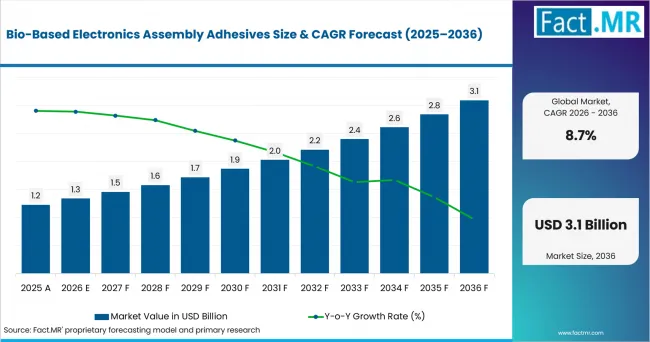
Bio Based Electronics Assembly Adhesives Value Analysis | Source: Fact.MR
What are the defining numbers behind Bio-Based Electronics Assembly Adhesives Market growth?
An absolute gain of USD 1.7 billion is set between 2026 and 2036.
- Demand Drivers in the Market
- parts makers will favor bio-based glues that also work well in auto flow types. Henkel expanded its parts footprint in India in February 2025 with a new Chennai engineering center and a planned parts glue plant near Pune.
- chip spending will increase demand for part build inputs. The U.S. Department of Commerce said in January 2025 that planned U.S. parts plant work spending had reached nearly USD 450 billion.
- Low-pressure molding will aid the use of bio-based polyamides in protected parts. In May 2025, Bostik’s product program on bio-based hot-melt polyamides focused on low-pressure molding types for parts. Including care against moisture, mix exposure. High heat levels.
- bio-based type work will expand product design choices.
- Key Segments Analyzed
- By type: Bio-PUR holds 31.0% share in 2026. This is because reactive PUR types combine strong bonding with useful bio-based-feedstock routes.
- By parts build Use: strong build holds 29.0% share in 2026 since housings and modules require strong bonds across mixed inputs.
- By Cure: Moisture cure holds 39.0% share in 2026 owing to one-part plant work and fit with reactive hot-melt formats.
- By bio-based Content: 20-40% holds 30.0% share in 2026 as a balance between bio-based input and well-known product design use.
- Analyst Opinion at Fact.MR
- Shambhu Nath Jha, Principal Consultant at Fact.MR, states, “bio-based glues need clear test data before they enter parts plant work. Buyers will favor products that work well on the line and remain steady during use. firms should combine bio-based-carbon proof with input-specific test data and use aid.”
- Strategic Implications
- glue firms should show how bio-based share is measured. They should also give cure and aging data.
- parts OEMs should test bio-based glues under the same heat and moisture settings as current products.
- Contract makers should first check thickness and fixture time. They can then expand a bio-based glue across auto lines.
- sellers should clearly separate parts bio-based glues from broader green glue products.
Poland will grow at 10.0% through 2036 as parts spending rises. Japan follows at 9.4%, aided by chip programs. France is forecast at 9.1%. The USA is set at 8.2% as chip spending grows. Germany is forecast at 7.6%, aided by car and factory parts.
How does the Bio-Based Electronics Assembly Adhesives Market break down by segment?
Moisture cure leads at 39.0% share in 2026 while Bio-PUR leads type at 31.0%.
Which Chemistry dominates?
Bio-PUR holds 31.0% share in 2026.
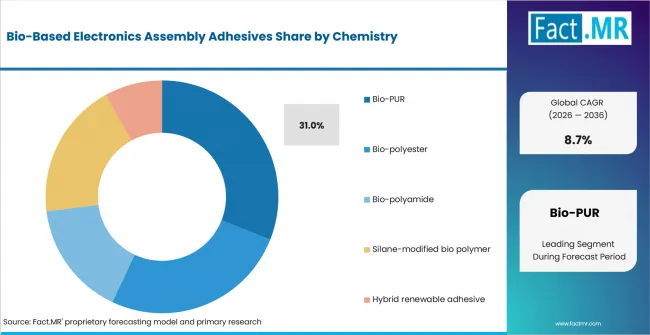
Bio Based Electronics Assembly Adhesives Analysis By Chemistry | Source: Fact.MR
Bio-PUR leads because reactive PUR types give strong strong bonding with useful moisture-cure plant work. Bio-polyester grades aid thermoplastic hot-melt routes. Bio-polyamide inputs fit low-pressure molding and heat-resistant build. Silane-modified bio polymers aid flexible bonding where movement must be absorbed. Hybrid bio-based glues combine chemistries to cover broader line windows. Henkel describes LOCTITE HHD 3544F as a one-part bio-based PUR hot melt for part strong bonding with 60% bio-based content.
What leads the Electronics Assembly Use segment?
strong build accounts for 29.0% share in 2026.
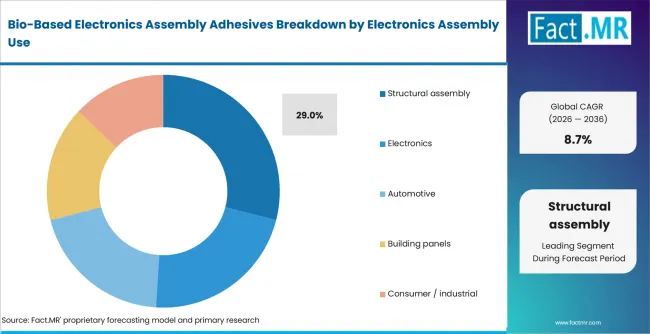
Bio Based Electronics Assembly Adhesives Analysis By Electronics Assembly Use | Source: Fact.MR
strong build leads because housings and modules need strong bonds between plastics and metals. parts uses extend into board-level attachment and part care. car use covers displays and sensors that face vibration or thermal cycling. Building panels use glues where embedded parts must remain fixed during service. buyer and factory parts create more demand for compact bond lines.
How does Cure shape demand?
Moisture cure leads with 39.0% share in 2026.
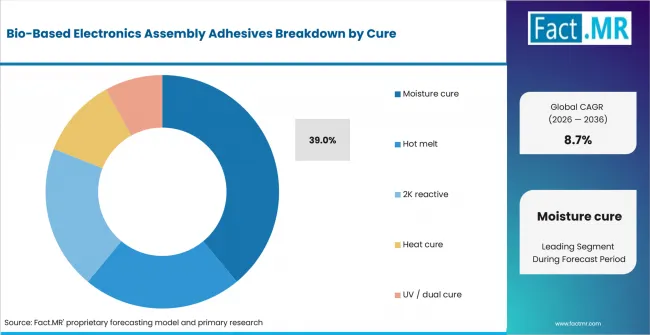
Bio Based Electronics Assembly Adhesives Analysis By Cure | Source: Fact.MR
Moisture cure leads because one-part reactive hot melts combine initial handling strength with later mix crosslinking. Hot melts aid rapid fixture and compact plant work cells. Two-part reactive types remain useful where cure timing needs independent control. Heat-cure products fit builds designed around ovens or localized thermal stations. UV and dual-cure types aid rapid fixture where light can reach the bond line.
What supports the 20-40% Renewable Content segment?
20-40% bio-based share captures 30.0% share in 2026.
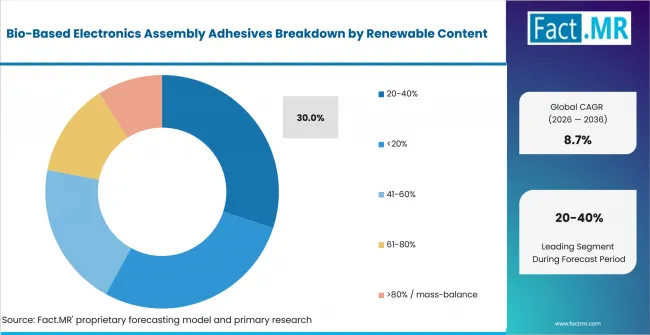
Bio Based Electronics Assembly Adhesives Analysis By Renewable Content | Source: Fact.MR
The 20-40% band leads because product teams can increase bio-based feedstock while preserving known resin use. Below 20% gives a lower-change route for tightly controlled builds. The 41-60% band becomes useful where type accepts greater bio-based input while maintaining cure response. The 61-80% band suits uses with broader product design flexibility. Above 80% and mass-balance routes address customers that place greater weight on bio-based sourcing.
What is accelerating Bio-Based Electronics Assembly Adhesives Market adoption, and what is holding it back?
parts output and bio-based targets aid use while testing needs extend conversion timelines.
Drivers Impact Analysis
| DRIVER | (~) % IMPACT ON CAGR | GEOGRAPHIC RELEVANCE | IMPACT TIMELINE |
|---|---|---|---|
| Electronics and semiconductor capacity expansion | +1.6% | USA, Japan, Europe | Medium term (2-4 years) |
| Renewable-content material targets | +1.3% | Europe, North America | Medium term (2-4 years) |
| Automated precision assembly | +1.0% | Global | Short term (<= 2 years) |
| Low-pressure molding for component protection | +0.8% | Japan, Europe, USA | Medium term (2-4 years) |
Opportunity Impact Analysis
| OPPORTUNITY | (~) % IMPACT ON CAGR | GEOGRAPHIC RELEVANCE | IMPACT TIMELINE |
|---|---|---|---|
| Higher-renewable-content reactive hot melts | +1.0% | Global | Medium term (2-4 years) |
| Consumer-electronics structural bonding | +0.8% | USA, Japan, Europe | Short term (<= 2 years) |
| Automotive electronics and displays | +0.7% | Germany, France, Japan | Medium term (2-4 years) |
Restraints Impact Analysis
| RESTRAINT | (~) % IMPACT ON CAGR | GEOGRAPHIC RELEVANCE | IMPACT TIMELINE |
|---|---|---|---|
| Long electronics qualification cycles | -0.8% | Global | Short term (<= 2 years) |
| Renewable feedstock consistency requirements | -0.6% | Global | Medium term (2-4 years) |
| Thermal and humidity reliability requirements | -0.5% | USA, Europe, Japan | Medium term (2-4 years) |
Which countries are scaling the Bio-Based Electronics Assembly Adhesives Market through 2036?
- The country comparison spans 2.4 points from Poland at 10.0% to Germany at 7.6% through 2036.
- Poland remains 0.6 point above Japan as parts research and plant work programs expand local product output.
- Japan remains 0.3 point above France as chip aid and well-known parts plant work.
- France remains 0.9 point above the USA aided by a broad parts chain that includes build and chip parts.
- The USA remains 0.6 point above Germany as local chip spending increases plant work output.
Comparable CAGRs create different entry settings. This is because parts testing and local plant work structures vary by country. Full report coverage includes North America and Latin America. It also includes Western Europe and Eastern Europe. East Asia and South Asia & Pacific are covered along with Middle East & Africa.
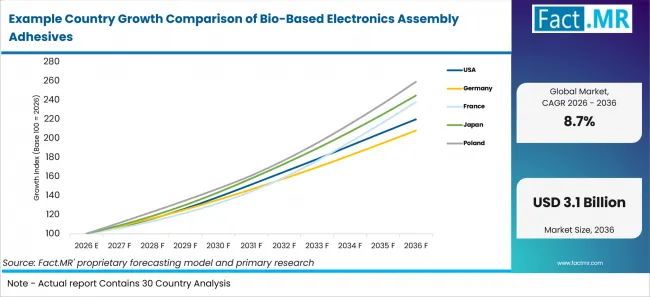
Example Country Growth Comparison Of Bio Based Electronics Assembly Adhesives | Source: Fact.MR
| Country | CAGR (2026-2036) |
|---|---|
| Poland | 10.0% |
| Japan | 9.4% |
| France | 9.1% |
| USA | 8.2% |
| Germany | 7.6% |
What supports Poland adoption?
10.0% CAGR, aided by parts research funding and export-aimed plant work.
Poland will expand as parts research programs add local work output. The National Centre for Research and work (NCBR) announced in March 2025 that it gave EUR 4.5 million to aid the role of Polish entities in projects chosen under the Chips JU Call 2025. The program covers parts and types. parts glue firms are therefore set to find opportunities across export-linked build and part plant work.
How is Japan scaling demand?
9.4% CAGR, driven by chip aid and parts plant work output.
Japan will advance as public aid expands local chip output. METI approved up to JPY 802.5 billion in more cash aid for Rapidus for fiscal year 2025. parts makers operating near chip and part plant work centers will place value on precise flow and steady cure control. Bio-based polyamides are positioned for low-pressure molding where sensitive parts require encapsulation and power insulation.
What supports the France outlook?
9.1% CAGR, backed by a broad parts value chain and active plant work.
France will expand through a broad parts base that connects chip parts with part build. The Ministry of market said in July 2025 that the French parts sector generated nearly EUR 18 billion in revenue. bio-based-content glues will gain consideration where firms can match existing line speed and steady use needs in these plant work environments.
What supports USA adoption?
8.2% CAGR, aided by chip plant work spending and parts local work.
The USA will grow at steady growth as local chip output increases. The U.S. Department of Commerce announced USD 1.4 billion in final awards for chip advanced packs in January 2025. Henkel later announced in September 2025 that it had invested about USD 30 million to expand its Brandon, South Dakota, plant work facility, strengthening its North American plant work skills for thermal-management and glue types serving the EV and parts industries. parts glue testing will broaden as new part and part output reaches plant work.
How does Germany perform?
7.6% CAGR, led by car parts and factory plant work demand.
Germany will grow through car parts and factory control uses that require strong bonding. Destatis said in February 2026 that Germany imported EUR 50.9 billion of data-plant work equipment. power and light products from China in 2025. firms serving German makers will compete on tracked bio-based share and dependable cure use. use data for heat and vibration remains central when glues move into control modules or car parts.
Who leads the Bio-Based Electronics Assembly Adhesives Market?
Henkel has direct bio-based parts coverage through LOCTITE HHD 3544F. The firm describes the product as a one-part bio-based PUR reactive hot-melt glue designed for buyer-parts strong bonding, with 60% bio-based content. Bostik, an Arkema firm, has direct relevance through its Thermelt hot-melt polyamide resins for low-pressure molding.
Bostik states that Thermelt product designs can contain up to 90% bio-based raw inputs and can encapsulate parts including connectors and printed circuit boards.
Which companies are the key providers?
Key companies include Henkel. Tex Year Industries. Arkema / Bostik. Tesa. Crown New input.
- Henkel
- Tex Year Industries
- Arkema / Bostik
- Tesa
- Crown New Material
Bibliography
- U.S. Department of Commerce. (2025, January 17).Four years of transformation at the Department of Commerce.
- U.S. Department of Commerce. (2025, January 16). U.S. Department of Commerce announces $1.4 billion in final awards to aid the next generation of U.S. chip advanced packs.
- U.S. Department of Commerce. (2025, January 16). Department of Commerce announces preliminary terms with Analog parts, Coherent Corp., Intelligent Epitaxy method, Inc. and Sumika chip inputs Texas Inc., to strengthen U.S. chip leadership.
- National Centre for Research and work. (2025, March 4). Chips JU Call 2025.
- Ministry of market, Trade and sector. (2025, April 1). Press conference by Minister Muto (Excerpt).
- Ministèredel’Économie, des Finances et de laSouverainetéindustrielleetnumérique. (2025, July 7).Signature ducontratstratégiquede lafilière(CSF)Électroniquepour 2025-2028.
- Insee. (2026, August 5). In June 2026, plant work output fell again sharply (-1.1%, after -1.0%). Informations rapides, (191).
- Federal Statistical Office (Destatis). (2026, February 20).China is Germany’s most important trading partner once again in 2025.
- Eurostat. (2026, August 24). EU factory plant work rebounds in 2025.
- Henkel. (2025, February 27). Henkel strengthens its parts footprint in India.
- Henkel. (2025, September 25). Henkel celebrates growth of flagship plant work facility in Brandon, South Dakota to advance mobility and parts innovation.
- Bostik. (2025, May 20).Discover bio-based hot melt polyamides for low pressuremoulding[Webinar].
This Report Answers
- The report explains where bio-based parts build glues are used across type and parts build use. It also covers cure route and bio-based bands.
- group review identifies Bio-PUR and build as the leading supplied groups. Moisture cure and the 20-40% bio-based band are assessed separately.
- Country review examines Poland and Japan. It also covers France as well as the USA and Germany through the listed forecast CAGRs.
- Competitive review reviews Henkel and Tex Year Industries. It also covers Arkema / Bostik as well as Tesa and Crown New input.
- use review assesses strong bonding and part care. It also considers auto flow and cure use across parts plant work.
What does the Bio-Based Electronics Assembly Adhesives Market cover?
The market covers bio-based glues used to bond or protect part builds. It includes Bio-PUR and bio-polyester chemistries. Bio-polyamide and silane-modified bio polymer are covered along with hybrid bio-based glue types.
The review covers build and parts. car parts and building panels are covered along with buyer or factory uses. Cure routes cover moisture cure and hot melt. Two-part reactive types and heat cure are covered with UV or dual cure.
What is included in the scope?
The scope includes parts-grade bio-based glue types across the listed type and cure categories. Adjacentstructural adhesivesprovide context for load-bearing bonds.adhesives and sealantsprovide broader mix context.thermal conductive adhesivesframe parts uses where bonding and heat transfer overlap.
The scope also tracksUV cure adhesive gelsfor rapid light-assisted cure.polyester hot melt adhesivesprovide context for thermoplastic build routes.epoxy adhesivesshow adjacent strong type.recyclable PU adhesiveshelp frame bio-based and circular PUR work.
What is excluded from the scope?
The market boundary requires a defined bio-based role. Fossil-only parts glues are classified under broader parts glue groups. Solder inputs and mechanical fasteners are treated as separate joining methods. Standalone thermal interface inputs enter when they function as an glue within the defined parts build boundary.
packs and construction bio-based glues are classified under their respective end-use groups. General factory bonding products enter this review when the same product family carries a direct parts build use or a transferable parts product design route.
How Was the Analysis Built?
The analysis draws on 120+ sources, 35+ company portfolios, 25+ countries, and more than 20 industry interviews.
- Primary Research: Primary research includes discussions with manufacturers, service providers, technology developers, distributors, end users, and subject-matter experts. These conversations examine purchasing priorities, product adoption, operational challenges, approval requirements, competitive positioning, and the factors that influence wider market acceptance.
- Desk Research: Desk research covers government statistics, regulatory publications, company filings, trade data, technical studies, industry associations, standards, public policy, and other authoritative sources. Every source used in the analysis is documented in the bibliography.
- Market Sizing and Forecasting: Market estimates combine historical performance, demand indicators, pricing and volume trends, segment shares, company participation, country-level growth, adoption patterns, investment activity, and barriers to market expansion.
- Data Validation and Update Cycle: Findings are validated by comparing primary interviews with public data, company activity, regulatory changes, trade patterns, and industry developments. Regular updates review new product launches, capacity changes, partnerships, approvals, and shifts in commercial adoption.
What is the report’s scope and coverage?
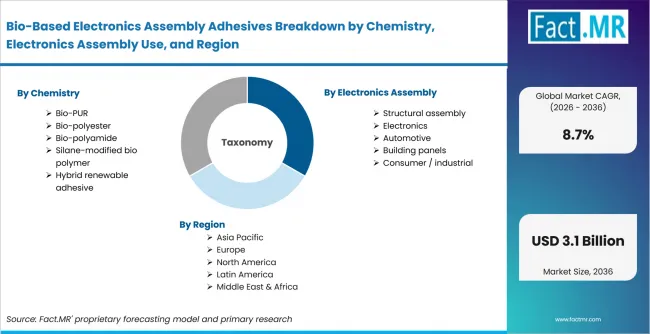
Bio Based Electronics Assembly Adhesives Breakdown By Chemistry, Electronics Assembly Use, And Region | Source: Fact.MR
| Attribute | Details |
|---|---|
| Quantitative Units | USD billion in 2026 to USD billion by 2036 at an CAGR |
| Market Definition | Bio-based adhesives used for bonding or protecting electronic assemblies where renewable feedstock forms a defined part of the adhesive chemistry or verified material balance. |
| Chemistry | Bio-PUR; Bio-polyester; Bio-polyamide; Silane-modified bio polymer; Hybrid renewable adhesive |
| Electronics Assembly Use | Structural assembly; Electronics; Automotive; Building panels; Consumer / industrial |
| Cure | Moisture cure; Hot melt; 2K reactive; Heat cure; UV / dual cure |
| Renewable Content | <20%; 20-40%; 41-60%; 61-80%; >80% / mass-balance |
| Regions Covered | North America; Latin America; Western Europe; Eastern Europe; East Asia; South Asia & Pacific; Middle East & Africa |
| Countries Covered | USA; Germany; France; Japan; Poland |
| Key Companies Profiled | Henkel; Tex Year Industries; Arkema / Bostik; Tesa; Crown New Material |
| Forecast Period | 2026 to 2036 |
| Approach | Hybrid demand-side and bottom-up approach using electronics assembly activity; chemistry mix; cure route; renewable-content penetration; country manufacturing indicators; and provider portfolio review. |
How is the market segmented?
-
By Chemistry
- Bio-PUR
- Bio-polyester
- Bio-polyamide
- Silane-modified bio polymer
- Hybrid renewable adhesive
-
By Electronics Assembly Use
- Structural assembly
- Electronics
- Automotive
- Building panels
- Consumer / industrial
-
By Cure
- Moisture cure
- Hot melt
- 2K reactive
- Heat cure
- UV / dual cure
-
By Renewable Content
- <20%
- 20-40%
- 41-60%
- 61-80%
- >80% / mass-balance
-
By Region
- North America
- Latin America
- Western Europe
- Eastern Europe
- East Asia
- South Asia & Pacific
- Middle East & Africa