- Market Value (2025): USD 250.1 Mn
- Estimated Value (2026): USD 275.0 Mn
- Forecast Value (2036): USD 710.0 Mn
- CAGR (2026-2036): 9.9%
What is the Recyclable PU Adhesives Market forecast to be worth by 2036?
USD 275.0 million in 2026 to USD 710.0 million by 2036 at 9.9% CAGR.
- The recyclable PU adhesives market crossed a valuation of USD 250.1 million in 2025 as packaging manufacturers continued evaluating and approving new adhesive solutions.
- Demand is projected to rise from USD 275.0 million in 2026 to USD 710.0 million by 2036.
- The market is forecast to record 9.9% CAGR because label release and wash water load keep the product in technical review.
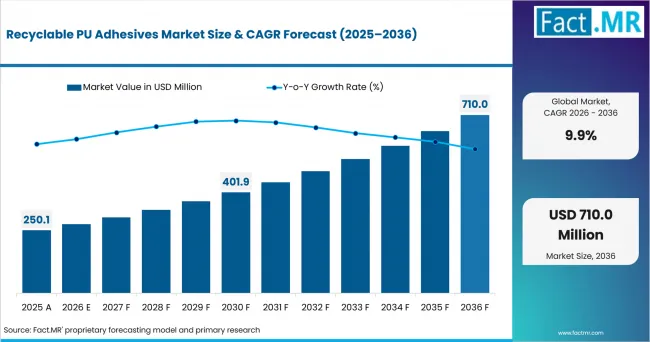
Recyclable Pu Adhesives Market Market Value Analysis | Source: Fact.MR
What are the defining numbers behind Recyclable PU Adhesives Market growth?
USD 435.0 million absolute opportunity by 2036 is led by flexible packaging.
- Demand Drivers in the Market
- Flexible packaging demand is rising as businesses look for packaging materials that help reduce waste and support recycling efforts.
- Solvent-free PU adhesives are being tested for their ability to maintain packaging quality while making recycled material processing easier.
- Recycling facilities prefer adhesives that allow labels to be removed easily, helping improve material recovery and reduce processing challenges.
- 1K adhesives are gaining attention because they are easy to apply and perform well in bottle recycling operations.
- Key Segments Analyzed
- By Application: Flexible packaging holds 46% share in 2026, driven by growing demand for recyclable packaging solutions.
- By Chemistry: Solvent-free PU accounts for 31% share in 2026 due to its strong recyclability performance and industry acceptance.
- By Recycling Route: Mono-material packaging holds a 30% share in 2026, supported by its compatibility with recycling processes.
- By End Use: Food packaging leads with a 30% share in 2026, driven by high adoption of sustainable packaging materials.
- By Cure Type: 1K adhesives account for 35% share in 2026 due to their ease of use and suitability for recycling applications.
- Analyst Opinion at Fact.MR
- Shambhu Nath Jha, Senior Analyst at Fact.MR, states, “Recyclable PU adhesives are important part of packaging design. Companies need solutions that support both packaging performance and recycling goals.”
- Strategic Implications
- Flexible packaging producers are adopting recyclable PU adhesives supported by label release performance and recycling targets.
- Brand owners are using mono-material packaging solutions reinforced by recyclable adhesive validation and approval testing.
- Recycling operators are depending on adhesive compatibility driven by sorting efficiency and material recovery requirements.
- Packaging manufacturers are adopting solvent-free PU systems shaped by recyclability goals and customer qualification needs.
How does the Recyclable PU Adhesives Market break down by segment?
Flexible packaging leads with 46% by application segment, while Solvent-free PU accounts for 31% by chemistry.
What leads the Application segment?
Flexible packaging holds 46% share in 2026.
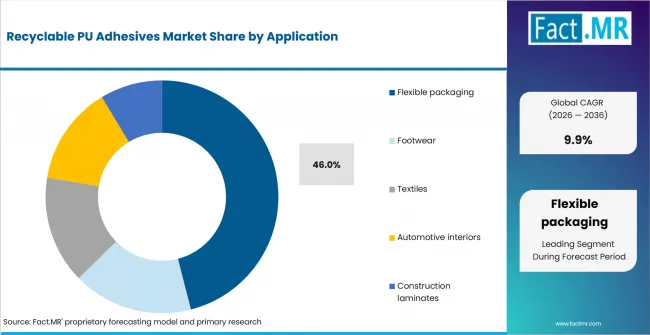
Recyclable Pu Adhesives Market Analysis By Application | Source: Fact.MR
Flexible packaging leads the market due to growing demand for packaging solutions that help reduce waste and support recycling efforts. Companies are adopting recyclable PU adhesives to support mono-material packaging structures and improve end-of-life processing. While footwear and automotive interiors also contribute to market demand, flexible packaging remains the largest application segment.
How does Chemistry shape demand?
Solvent-free PU accounts for 31% share in 2026.
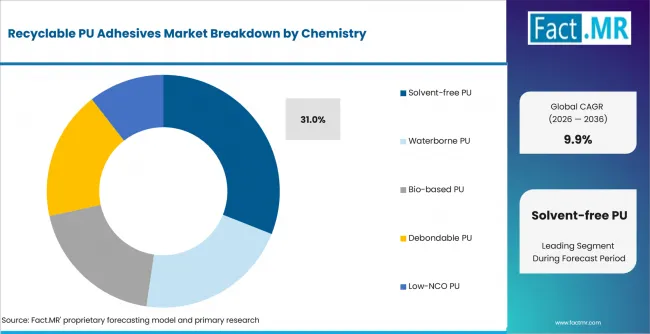
Recyclable Pu Adhesives Market Analysis By Chemistry | Source: Fact.MR
Solvent-free PU is becoming a preferred choice because it supports packaging performance and recyclability. While waterborne PU and debondable PU are also used, increasing focus on recyclable packaging is driving greater interest in solvent-free adhesive technologies. The Packaging and Packaging Waste Regulation (PPWR) established recyclability requirements intended to increase the use of packaging components compatible with recycling systems. This regulatory emphasis is supporting interest in solvent-free and recycling-compatible adhesive technologies.
Where is Recycling Route demand strongest?
Mono-material packaging leads with 30% share in 2026.
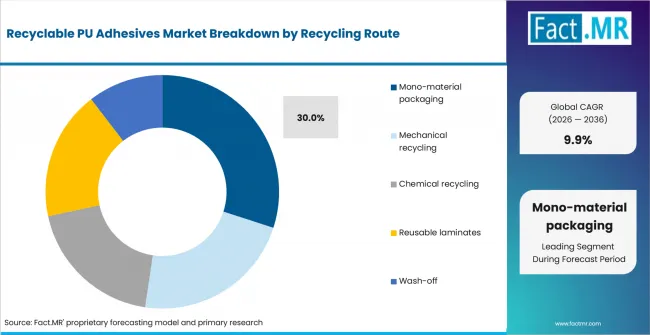
Recyclable Pu Adhesives Market Analysis By Recycling Route | Source: Fact.MR
Mono-material packaging offers a practical solution when label release can affect approval timelines. Mechanical recycling and reusable laminates remain viable alternatives depending on customer requirements. Its broader use depends on demonstrating reliable performance during normal storage and processing conditions. RecyClass updated its Design for Recycling Guidelines in 2025, placing additional focus on packaging components such as adhesives that influence recyclability performance, further supporting the development of mono-material packaging solutions.
What supports End Use adoption?
Food packaging holds 30% share in 2026.
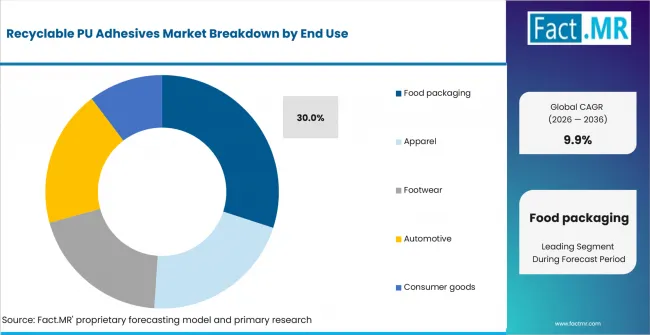
Recyclable Pu Adhesives Market Analysis By End Use | Source: Fact.MR
Food packaging remains an important application when reducing wash water load is a priority. Apparel and automotive applications continue to be considered where requirements differ. Wider use depends on products demonstrating reliable performance during routine handling and production. Packaging waste continues to remain a major waste stream across European markets, increasing attention on recyclable food-packaging formats and supporting demand for recyclable adhesive systems.
Which Cure Type dominates?
1K accounts for 35% share in 2026.
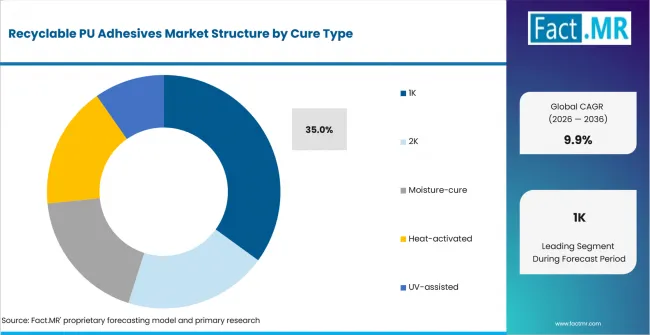
Recyclable Pu Adhesives Market Analysis By Cure Type | Source: Fact.MR
1K adhesives are widely adopted because they provide reliable performance and simplified manufacturing processes. Alternative cure systems such as 2K, moisture-cure, and heat-activated adhesives remain important for applications requiring different bonding characteristics.
What is accelerating Recyclable PU Adhesives Market adoption and what is holding it back?
Flake quality is expected to support adoption of recyclable PU adhesives, while qualification costs and process compatibility may slow growth. Adoption will be higher where users can quickly confirm product performance.
Drivers Impact Analysis
| DRIVER | (~) % IMPACT ON CAGR | GEOGRAPHIC RELEVANCE | IMPACT TIMELINE |
|---|---|---|---|
| Flake quality control in Flexible packaging | +0.8% | China and export suppliers | Medium term (2-4 years) |
| Label release testing | +0.6% | Europe and North America | Short term (<= 2 years) |
| Flexible packaging approval programs | +0.5% | Asia Pacific | Medium term (2-4 years) |
| Local support near label converters | +0.4% | Global | Long term (>= 4 years) |
Source: Fact.MR analysis. Updated Jul 14, 2026
- Flake quality improvement: Higher-quality recycled flakes are encouraging the use of recyclable PU adhesives in flexible packaging applications.
- Recyclability requirements: Growing demand for packaging that meets recycling and sustainability goals is supporting market adoption.
- Converter approval and testing: Faster validation and approval by packaging converters are helping recyclable PU adhesives gain wider acceptance.
Opportunity Impact Analysis
| OPPORTUNITY | (~) % IMPACT ON CAGR | GEOGRAPHIC RELEVANCE | IMPACT TIMELINE |
|---|---|---|---|
| Grades tuned for Flexible packaging | +0.5% | Global | Medium term (2-4 years) |
| Application labs for Solvent-free PU | +0.4% | Asia Pacific and Europe | Short term (<= 2 years) |
| Rule-ready documentation | +0.4% | Europe and United Kingdom | Medium term (2-4 years) |
| Local trials with bottle washers | +0.3% | India and Brazil | Long term (>= 4 years) |
Source: Fact.MR analysis. Updated Jul 14, 2026
- Flexible packaging grades: The opportunity expands when suppliers provide clear performance data and supporting test results that are easy to verify.
- Application support for solvent-free PU: Adoption can increase when customers can quickly test and validate adhesive performance in their own operations.
- Local converter trials: Growth potential is higher when adhesive performance can be demonstrated consistently under real production conditions.
Restraints Impact Analysis
| RESTRAINT | (~) % IMPACT ON CAGR | GEOGRAPHIC RELEVANCE | IMPACT TIMELINE |
|---|---|---|---|
| Qualification cost | -0.4% | Global processors | Medium term (2-4 years) |
| Fit limits in Solvent-free PU | -0.3% | Global | Short term (<= 2 years) |
| Documentation burden | -0.3% | Europe and North America | Medium term (2-4 years) |
| Scale-up risk | -0.2% | High-volume plants | Long term (>= 4 years) |
Source: Fact.MR analysis. Updated Jul 14, 2026
- High validation costs: Customers often need extensive trials and testing before approving recyclable PU adhesives, increasing adoption costs.
- Performance and process risks: Concerns about sealing, bonding, and recyclability performance can slow the transition from conventional adhesives.
- Long approval cycles: Regulatory, brand-owner, and converter approval processes can delay commercialization and wider market penetration.
Which countries are scaling Recyclable PU Adhesives Market fastest?
China 13.4%; India 12.4%; Germany 11.4%; Brazil 10.4%; United States 9.5%.
.webp "Top Country Growth Comparison Recyclable Pu Adhesives Market Cagr (2026 2036)")
Top Country Growth Comparison Recyclable Pu Adhesives Market Cagr (2026 2036) | Source: Fact.MR
| COUNTRY | CAGR |
|---|---|
| China | 13.4% |
| India | 12.4% |
| Germany | 11.4% |
| Brazil | 10.4% |
| United States | 9.5% |
Source: Fact.MR analysis. Updated Jul 14, 2026
How is China scaling demand?
13.4% CAGR, supported by local manufacturing activity and customer testing around PU adhesives or sustainable packaging adhesives.
China is increasing demand through its strong manufacturing base and growing focus on sustainable packaging. Rapid expansion in packaging production and active customer trials of PU adhesives are supporting market growth. Local suppliers and testing facilities also help speed up product approval and adoption. Growing packaging waste reduction initiatives and recycling targets are encouraging companies to evaluate packaging components that can be more easily processed through recycling systems, including PU adhesive technologies.
What supports the India outlook?
12.4% CAGR, driven by expanding packaging production and increasing trials of PU adhesives.
India is driving market growth with expanding manufacturing capacity and higher adoption of sustainable packaging. Customer testing of recyclable PU adhesives and strong converter activity are accelerating product acceptance.
How is Germany developing demand?
11.4% CAGR, fueled by rising demand for recyclable packaging, strong converter activity, and faster product qualification processes.
Germany is expanding adoption through growing demand for sustainable packaging and rigorous product testing. Strong converter networks and local application support enable faster movement from lab evaluation to plant approval.
What underpins Brazil’s growth?
10.4% CAGR, backed by manufacturing expansion and closer alignment between product trials and commercial purchasing decisions.
Brazil is increasing demand through its growing packaging sector and greater focus on reducing packaging waste. Expanding manufacturing activity, increased interest in packaging designed for recycling, and customer trials of PU adhesives are supporting market growth.
What is driving United States’s growth through 2036?
9.5% CAGR, driven by packaging industry innovation and faster commercialization of recyclable PU adhesives.
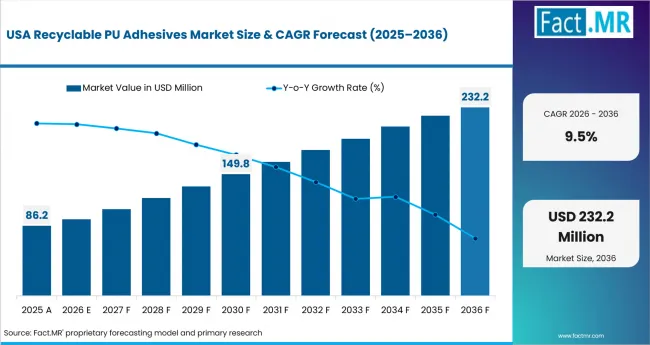
Recyclable Pu Adhesives Market Country Value Analysis | Source: Fact.MR
Demand in the United States is growing as investment in packaging solutions designed for recycling continues to increase. Ongoing testing of PU adhesives and strong technical support are helping products move from qualification to commercial use.
Who leads the Recyclable PU Adhesives Market?
Henkel and H.B. Fuller lead the market with strong packaging adhesive portfolios and close relationships with packaging converters. Dow, Bostik, Arkema, and Covestro support the market through sustainable adhesive development and technical expertise.
These companies compete by helping customers maintain packaging performance while supporting recovery and reuse efforts. Their focus is on delivering reliable products that simplify testing and approval.
The strongest suppliers will be those that can turn customer trials into long-term commercial adoption through proven recycling performance.
Which companies are the key providers?
Henkel and H.B. Fuller are key providers. Bostik and Covestro are also profiled. Dow and Arkema complete the company set.
- Henkel
- Bostik
- H.B. Fuller
- Arkema
- Covestro
- Dow
Bibliography
- European Commission. (2025). Packaging and packaging waste. European Commission.
- European Union. (2025). Regulation (EU) 2025/40 of the European Parliament and of the Council on packaging and packaging waste. EUR-Lex.
- RecyClass. (2025). Design for recycling guidelines. RecyClass.
- European Environment Agency. (2025). Country profiles on municipal and packaging waste management – 2025. European Environment Agency.
- U.S. Environmental Protection Agency. (2025). U.S. recycling infrastructure assessment and state data collection reports. U.S. EPA.
- U.S. Environmental Protection Agency. (2025). Containers and packaging: Product-specific data. U.S. EPA.
This Report Addresses
- The report provides strategic intelligence on Recyclable PU Adhesives Market across Application and Chemistry choices.
- Segment analysis covers Flexible packaging and Solvent-free PU share.
- Regional outlook evaluates China and India with three additional growth countries in the Recyclable PU Adhesives Market.
- Competitive analysis profiles Henkel and Dow followed by the remaining named providers.
- Use-case assessment covers Flexible packaging and adjacent applications in PU Adhesives / Sustainable Packaging Adhesives.
What does the Recyclable PU Adhesives Market cover?
Polyurethane adhesives designed to support recyclable packaging structures, particularly flexible packaging applications.
The Recyclable PU Adhesives Market covers adhesive systems developed to maintain packaging performance while supporting recycling compatibility. Coverage includes solvent-free and other PU adhesive technologies used in flexible packaging and related laminated structures where recyclability is a key purchasing requirement.
The market remains distinct from the broader polyurethane chemicals industry because value is created through recycling performance, packaging compatibility, and converter approval rather than through the sale of generic polyurethane materials.
What is included in the scope?
Recyclable PU adhesive systems used across packaging and other laminated material applications.
The scope includes polyurethane adhesives designed for recyclable flexible packaging, textiles, footwear, and other laminated structures. Coverage spans Flexible Packaging and Solvent-free PU systems where customers purchase a recyclable bonding solution for a defined application.
Included sales cover adhesive grades, technical support, product qualification activities, and repeat commercial supply. The market also includes converter trials, packaging approval programs, and sustainability-focused adhesive solutions that support recycling objectives.
What is excluded from the scope?
Commodity polyurethane materials and non-adhesive products are outside the scope.
The scope excludes commodity PU resins and intermediate chemicals sold without a recyclability-focused adhesive function. Equipment, recycling machinery, and standalone packaging materials are not included in the market.
General-purpose chemicals and packaging materials are excluded unless they are formulated, marketed, and sold as recyclable PU adhesive solutions for a specific commercial application.
How was the analysis built?
120+ sources, 35+ company portfolios, 25+ countries, and 20+ industry interviews.
- Primary Research:
- Primary research includes interviews with packaging converters, adhesive manufacturers, recyclers, brand owners, and flexible packaging specialists. It also incorporates input from procurement managers, application engineers, technical service teams, and sustainability leaders involved in adhesive selection, testing, and commercialization.
- Desk Research:
- Desk research evaluates packaging waste regulations, recyclability guidelines, adhesive product portfolios, recycling standards, and sustainability frameworks. Company publications, technical papers, regulatory documents, and industry association resources are also reviewed to assess market trends and competitive developments.
- Market-Sizing and Forecasting:
- Forecasting uses flexible packaging production, recyclable packaging adoption rates, adhesive consumption patterns, converter qualification activity, and sustainability-driven demand. Models also consider recycling targets, packaging innovation trends, regional manufacturing activity, and average adhesive pricing across end-use applications.
- Data Validation and Update Cycle:
- Forecasts are validated through industry interviews that test assumptions on product performance, adoption rates, and customer approval cycles. Company portfolio reviews, converter feedback, and regional demand assessments help confirm market direction, while continuous monitoring of regulations, recycling guidelines, and product launches supports forecast updates.
Segmentation
What is the report’s scope and coverage?
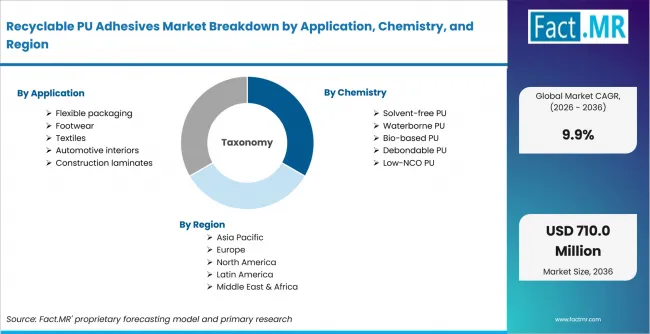
Recyclable Pu Adhesives Market Breakdown By Application, Chemistry, And Region | Source: Fact.MR
| Attribute | Details |
|---|---|
| Quantitative Units | USD Million in 2026 to USD Million by 2036 at CAGR |
| Market Definition | Polyurethane adhesives designed to support recyclable flexible packaging, textiles, footwear, and laminated materials. |
| Application | Flexible packaging; Footwear; Textiles; Automotive interiors; Construction laminates |
| Chemistry | Solvent-free PU; Waterborne PU; Bio-based PU; Debondable PU; Low-NCO PU |
| Recycling Route | Mono-material packaging; Mechanical recycling; Chemical recycling; Reusable laminates; Wash-off |
| End Use | Food packaging; Apparel; Footwear; Automotive; Consumer goods |
| Cure Type | 1K; 2K; Moisture-cure; Heat-activated; UV-assisted |
| Regions Covered | North America; Europe; Asia Pacific; Latin America; Middle East and Africa |
| Countries Covered | China; India; Germany; Brazil; United States |
| Key Companies Profiled | Henkel; Dow; Bostik; H.B. Fuller; Arkema; Covestro |
| Forecast Period | 2026 to 2036 |
| Approach | Hybrid top-down and bottom-up approach using PU Adhesives / Sustainable Packaging Adhesives; segment shares; country growth; and technical validation |
Source: Fact.MR analysis. Updated Jul 14, 2026
How is the market segmented?
-
By Application:
- Flexible packaging
- Footwear
- Textiles
- Automotive interiors
- Construction laminates
-
By Chemistry
- Solvent-free PU
- Waterborne PU
- Bio-based PU
- Debondable PU
- Low-NCO PU
-
By Recycling Route
- Mono-material packaging
- Mechanical recycling
- Chemical recycling
- Reusable laminates
- Wash-off
-
By End Use
- Food packaging
- Apparel
- Footwear
- Automotive
- Consumer goods
-
By Cure Type
- 1K
- 2K
- Moisture-cure
- Heat-activated
- UV-assisted
-
By Region:
- North America
- United States
- Canada
- Europe
- Germany
- United Kingdom
- France
- Italy
- Spain
- Asia Pacific
- India
- China
- Japan
- South Korea
- Australia
- Central & South America
- Brazil
- Argentina
- Mexico
- Chile
- Middle East & Africa
- UAE
- Saudi Arabia
- South Africa
- North America
Frequently Asked Questions
Which Application leads the Recyclable PU Adhesives Market?
Which Chemistry leads the Recyclable PU Adhesives Market?
Which country records the highest CAGR in the Recyclable PU Adhesives Market?
What is the primary driver in the Recyclable PU Adhesives Market?
What is the main restraint in the Recyclable PU Adhesives Market?
Why do buyers continue testing Recyclable PU Adhesives Market?
Who worked on this report


Preview the report firsthand - request a free sample
Free SampleGet the brochure for pricing and purchase details
Download PDF