- Market Value (2025): USD 688.4 Mn
- Estimated Value (2026): USD 760.0 Mn
- Forecast Value (2036): USD 2044.1 Mn
- CAGR (2026-2036): 10.4%
What is the Bio-Based Extrusion Aids Market forecast to be worth by 2036?
USD 760.0 million in 2026 to USD 2044.1 million by 2036, at 10.4% CAGR.
- The Bio-Based Extrusion Aids Market reached USD 688.4 million in 2025.
- Demand is projected to increase from USD 760.0 million in 2026 to USD 2044.1 million by 2036.
- The market is forecast to record 10.4% CAGR from 2026 to 2036 as compounders and converters reformulate around bio-based polymers and PFAS-free aids.
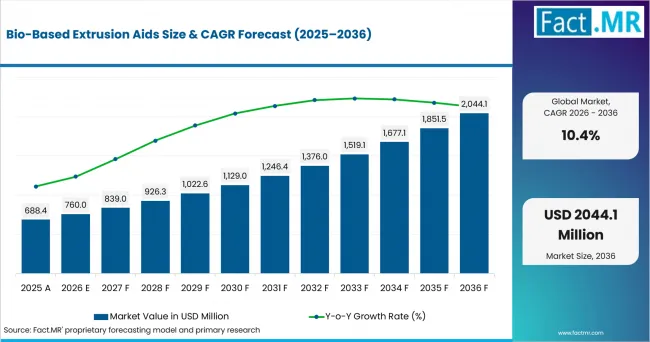
Bio Based Extrusion Aids Value Analysis | Source: Fact.MR
What are the defining numbers behind Bio-Based Extrusion Aids Market growth?
USD 1284.1 million absolute opportunity by 2036, led by bio-based fatty esters, PLA and film extrusion.
- Demand Drivers in the Market
- Film converters need low-friction aids because bio-based resins often show narrower processing windows during thin-gauge extrusion.
- Compounders need torque control as fillers and recycled content raise screw load in PLA and starch-based blends.
- Packaging brands need material documentation after the European Commission confirmed that the Packaging and Packaging Waste Regulation entered into force on 11 February 2025.
- Resin producers need surface-quality control since melt fracture and die build-up affect commercial acceptance of bio-based films.
- Biopolymer suppliers need scale-up support after European Bioplastics reported that global biobased plastics capacity is projected to increase from 2.31 million tonnes in 2025 to about 4.69 million tonnes by 2030.
- Key Segments Analyzed
- By Chemistry: Bio-based fatty esters are expected to hold 31.0% share in 2026, supported by their use as internal and external lubricants.
- By Target Polymer: PLA is projected to account for 29.0% share in 2026 because it is widely used in rigid and flexible bio-based packaging.
- By Function: Lubrication and torque reduction are anticipated to capture 30.0% share in 2026 owing to energy and line-stability needs.
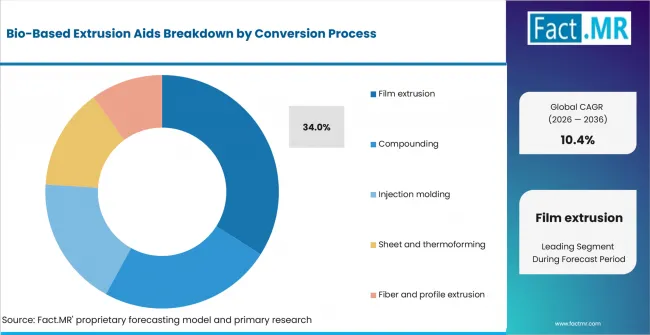
- By Conversion Process: Film extrusion is estimated to represent 34.0% share in 2026, led by packaging films and thin-sheet applications.
- Analyst Opinion at Fact.MR
- Shambhu Nath Jha, Principal Consultant at Fact.MR, states, “Processing aids are drawing attention because bio-based resin goals are meeting plant-floor limits. Suppliers are expected to gain share by proving lower torque, clean release and stable film appearance across real extrusion lines. Stronger portfolios combine renewable chemistry, food-contact documentation and technical support for PLA, PHA and bio-polyolefin trials.”
- Strategic Implications
- Additive suppliers should publish resin-specific dosage guidance for PLA, PHA and bio-polyolefin extrusion lines.
- Compounders should qualify lubricants and release aids through torque, die-pressure and surface-finish trials before scale-up.
- Film converters should link additive selection with food-contact status and haze control so packaging customers receive clearer approval files.
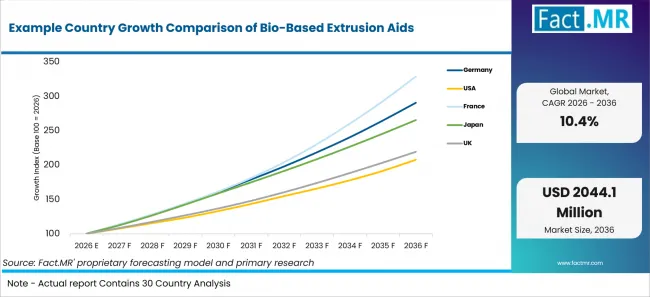
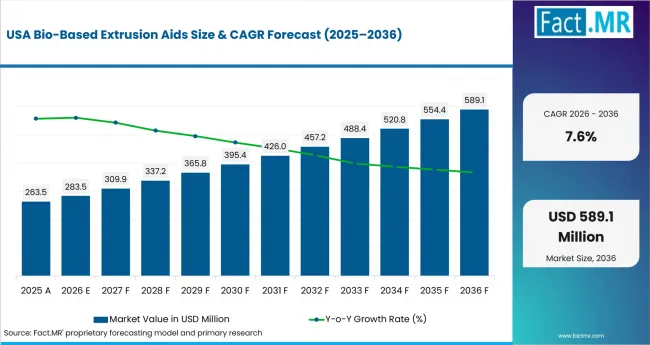
France is expected to post 12.7% CAGR through 2036, supported by packaging recovery pressure and bio-based polymer trials. Germany is projected to record 11.3% CAGR through 2036, tied to recycling discipline and specialty additive know-how. Japan is anticipated to advance at 10.3% CAGR through 2036 due to precision film conversion. The UK is estimated to reach 8.2% CAGR through 2036 as packaging fees affect material choices. The USA is forecast to record 7.6% CAGR through 2036 on plastics manufacturing scale and PFAS reporting pressure.
How does the Bio-Based Extrusion Aids Market break down by segment?
Film extrusion leads Conversion Process at 34.0%; bio-based fatty esters lead Chemistry at 31.0%.
Which Chemistry dominates?
Bio-based fatty esters hold 31.0% share in 2026.
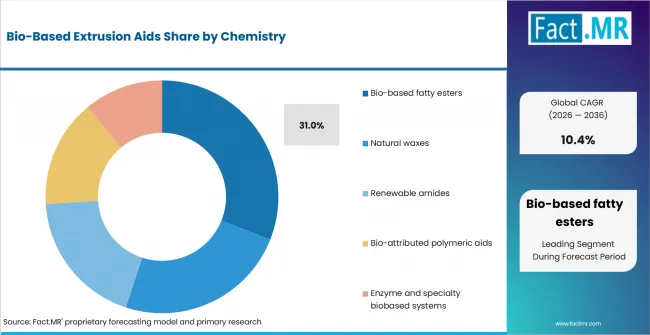
Bio Based Extrusion Aids Analysis By Chemistry | Source: Fact.MR
Bio-based fatty esters lead because they reduce friction between the polymer melt and metal surfaces. The function is valuable in PLA and starch blends where melt strength and thermal sensitivity narrow operating windows.
Baerlocher lists BAEROLUB® fatty ester products across internal and combined lubrication roles, including glycerol esters and fatty acid ester waxes. These lubricant chemistries support melt-flow control and reduced polymer-to-metal adhesion during plastics processing, making them relevant to formulation work where ester-based processing aids are required.
What leads the Target Polymer segment?
PLA accounts for 29.0% share in 2026.
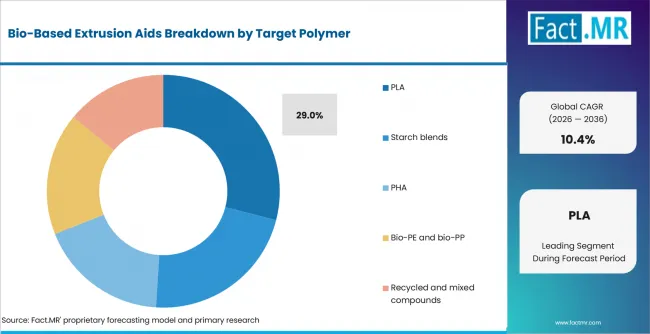
Bio Based Extrusion Aids Analysis By Target Polymer | Source: Fact.MR
PLA leads the polymer mix because it is one of the common commercial bio-based polymers used by packaging converters. European Bioplastics reported in December 2025 that packaging represented 41.3% of global bioplastics production capacity, equal to 0.95 million tonnes.
That packaging base raises the need for additives that stabilize melt flow during extrusion. PLA processors often shortlist aids by torque response, food-contact documentation and surface appearance after line trials.
How does Function shape demand?
Lubrication and torque reduction lead with 30.0% share in 2026.
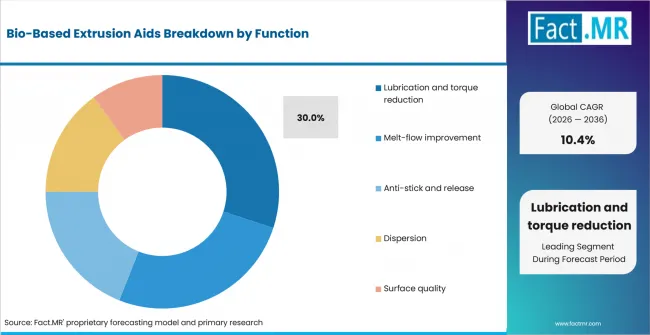
Bio Based Extrusion Aids Analysis By Function | Source: Fact.MR
Lubrication and torque reduction lead because converters need line stability before they approve newer resin blends. Lower friction helps protect throughput when materials carry fillers, recycled content or heat-sensitive bio-based components.
Clariant describes Licocare RBW Vita as a bio-based additive based on renewable rice bran wax, a non-food-competing by-product of rice bran oil production. Clariant positions the range as lubricants, dispersion agents and nucleating agents for plastics, including biopolymers such as PLA. This renewable wax chemistry supports melt-flow and release functions in bio-based resin systems.
What supports Film extrusion within Conversion Process?
Film extrusion represents 34.0% share in 2026.
Bio Based Extrusion Aids Analysis By Conversion Process | Source: Fact.MR
Film extrusion leads because packaging films expose die lines, shark skin and haze faster than thicker molded parts. The process gives extrusion aids a measurable role in surface quality and line uptime.
What is accelerating Bio-Based Extrusion Aids Market adoption, and what is holding it back?
Demand is expected to rise through resin reformulation and PFAS-free processing needs. Growth is constrained by qualification cost and resin variability.
Drivers Impact Analysis
| DRIVER | (~) % IMPACT ON CAGR | GEOGRAPHIC RELEVANCE | IMPACT TIMELINE |
|---|---|---|---|
| Bio-based polymer capacity expansion | +1.7% | Europe, North America, East Asia | Medium term (2-4 years) |
| PFAS-free processing aid reformulation | +1.3% | Europe, USA | Short term (<= 2 years) |
| Film extrusion surface-quality needs | +1.1% | Global | Medium term (2-4 years) |
Source: Fact.MR analysis. Updated Sep 4, 2026
- Bio-based polymer capacity expansion: Greater availability of PLA, PHA, and bio-based polyolefins is increasing formulation work around melt flow, release behavior, and surface quality. Processing-aid suppliers can benefit by offering systems tailored to the rheology and conversion requirements of these renewable polymer platforms.
- PFAS-free processing aid reformulation: Regulatory scrutiny of PFAS is encouraging converters and resin producers to evaluate non-fluorinated processing aids. Suppliers that can maintain extrusion stability, melt flow, surface quality, and release performance without fluorinated chemistries are better positioned to support reformulation programs.
- Film extrusion surface-quality needs: Thin-film applications make processing defects more visible, increasing the need for aids that support smooth extrusion and consistent appearance. Converters typically assess performance through haze, die-pressure behavior, surface finish, and overall film quality before approving new formulations.
Opportunity Impact Analysis
| OPPORTUNITY | (~) % IMPACT ON CAGR | GEOGRAPHIC RELEVANCE | IMPACT TIMELINE |
|---|---|---|---|
| Food-contact additive packages for packaging films | +1.2% | Europe, UK, USA | Medium term (2-4 years) |
| Bio-based aids for recycled and mixed compounds | +0.9% | Germany, France, Japan | Long term (>= 4 years) |
| Technical service for plant trials | +0.7% | Global | Short term (<= 2 years) |
Source: Fact.MR analysis. Updated Sep 4, 2026
- Food-contact additive packages for packaging films: Pre-documented processing-aid packages can help converters shorten qualification work for food-contact packaging applications. Suppliers that provide clear technical, regulatory, and application information can support faster trials and more consistent adoption across film formulations.
- Bio-based aids for recycled and mixed compounds: Recycled and mixed polymer streams can show greater variability in flow, dispersion, and release behavior. Bio-based processing aids can support more stable conversion where resin quality changes between batches, helping processors maintain surface quality and operating consistency.
- Technical service for plant trials: Suppliers with application laboratories and field-support capabilities can help converters optimize dosage under actual screw-speed, temperature, and die conditions. Practical trial support reduces formulation uncertainty and improves the likelihood of successful scale-up.
Restraints Impact Analysis
| RESTRAINT | (~) % IMPACT ON CAGR | GEOGRAPHIC RELEVANCE | IMPACT TIMELINE |
|---|---|---|---|
| Higher qualification burden versus conventional aids | -0.6% | Global | Short term (<= 2 years) |
| Variable resin quality in bio-based polymers | -0.4% | Europe, East Asia | Medium term (2-4 years) |
| Cost pressure in packaging conversion | -0.3% | UK, USA, France | Medium term (2-4 years) |
Source: Fact.MR analysis. Updated Sep 4, 2026
- Higher qualification burden versus conventional aids: New bio-based processing-aid packages often require line trials, compatibility checks, and compliance reviews before routine use. These additional qualification steps can lengthen adoption timelines compared with established conventional additives.
- Variable resin quality in bio-based polymers: Differences in moisture content, melt strength, viscosity, and thermal behavior can make bio-based polymers more difficult to process consistently. Additive suppliers therefore need formulation guidance that accounts for resin variability across grades and batches.
- Cost pressure in packaging conversion: Film converters compare bio-based processing aids with conventional alternatives based on dosage efficiency, scrap reduction, line stability, and productivity. Adoption can slow when performance gains do not clearly offset the higher cost of specialty additive systems.
Which countries are scaling the Bio-Based Extrusion Aids Market through 2036?
- The country comparison spans 5.06 percentage points across the forecast period.
- France remains 1.39 percentage points above Germany through packaging recovery pressure and PLA conversion trials.
- Germany remains 1.00 percentage point above Japan through recycling performance and specialty additive manufacturing depth.
- Japan remains 2.09 percentage points above the UK through precision polymer processing and controlled film conversion.
- The UK remains 0.58 percentage point above the USA as packaging fees and recycled-content rules shape converter choices.
- The USA closes the displayed range through plastics manufacturing scale and PFAS reporting pressure.
Comparable CAGRs create different entry conditions because each country weighs packaging policy, resin supply and converter economics differently. Full report coverage includes North America, Latin America, Western Europe, Eastern Europe, East Asia, South Asia & Pacific, Middle East & Africa.
Example Country Growth Comparison Of Bio Based Extrusion Aids | Source: Fact.MR
| Country | CAGR (2026-2036) |
|---|---|
| France | 12.7% |
| Germany | 11.3% |
| Japan | 10.3% |
| United Kingdom | 8.2% |
| United States | 7.6% |
Source: Fact.MR analysis. Updated Sep 4, 2026
What supports France adoption?
12.7% CAGR, supported by packaging recovery pressure and bio-based polymer conversion.
France connects packaging policy with converter trials. ADEME reported on 7 April 2026 that approximately 4,893 kt of household packaging and graphic paper were sorted for recycling in 2024, while the recycling rate for household packaging reached 69.6%. This packaging-recovery scale keeps films, sheet and thermoforming prominent conversion settings for additives that support surface finish and processing stability. Suppliers need to prove low dosage, clean surface finish and food-contact documentation before converters change additive packs.
What supports Germany adoption?
11.3% CAGR, driven by recycling discipline and specialty additive capability.
Germany combines a demanding recycling system with a deep polymer-processing base. UBA and ZSVR reported in January 2026 that around 5.5 million tonnes of packaging waste collected by Germany’s dual systems were recovered in 2024. This scale keeps material quality and design-for-recycling prominent in packaging conversion. Bio-based extrusion aids can add value when they reduce die build-up, protect film appearance and support easier compound processing.
How does Japan perform?
10.3% CAGR, led by precision conversion and controlled processing conditions.
Japan rewards stable processing more than broad additive substitution. The Ministry of the Environment reported on 27 March 2026 that total municipal waste generation reached 38,110,000 t in FY2024. The waste-management environment keeps scrap control and stable line performance relevant to polymer conversion. Japanese converters are expected to qualify bio-based aids with surface quality and thermal stability carrying weight in PLA, PHA and profile extrusion.
What supports the United Kingdom's growth?
8.2% CAGR, backed by packaging fees and recycled-content economics.
The United Kingdom links packaging economics to material selection. HM Revenue & Customs updated its guidance in February 2026 to show a Plastic Packaging Tax rate of GBP 228.82 per tonne from 1 April 2026. The tax applies to finished plastic packaging components containing less than 30% recycled plastic, creating a direct cost consideration around recycled-content levels in packaging material selection. Bio-based extrusion aids must prove film quality and line-speed value for wider use by packaging converters.
What supports USA adoption?
7.6% CAGR, supported by plastics manufacturing scale and PFAS reporting pressure.
Bio Based Extrusion Aids Country Value Analysis | Source: Fact.MR
The USA gives extrusion-aid suppliers a wide conversion base. The Bureau of Economic Analysis reported in June 2026 that plastics and rubber parts manufacturing accounted for 21,800 current employees among acquired enterprises in 2025. This figure indicates the scale of acquired plastics and rubber manufacturing activity. PFAS reporting requirements add a second reason for converters to review non-fluorinated aid packages.
Who leads the Bio-Based Extrusion Aids Market?
Emery Oleochemicals contributes natural-based ester chemistry and additive capability. At STLE 2025, the company highlighted DEHYLUB® ester base stocks and EMEROX® specialty acids for lubricant and performance-fluid applications, demonstrating ester-chemistry expertise relevant to lubrication rather than establishing a direct polymer-extrusion processing-aid claim.
Baerlocher supports the market through BAEROLUB® lubricants, fatty-acid derivatives, metal soaps and BAEROPOL® additive systems. In August 2025, Baerlocher highlighted Baerolub® AID as a PFAS-free polymer processing-aid alternative and Baeropol® T-Blend as a recycling-support additive family. Clariant competes through AddWorks™ PPA products for PFAS-free polyolefin extrusion processing.
Which companies are the key providers?
Key companies include Emery Oleochemicals; Baerlocher; Clariant; and Struktol.
- Emery Oleochemicals
- Baerlocher
- Clariant
- Struktol
Bibliography
- ADEME, Van de Voorde, J., & Parisot, F. (2026, April 7). Emballages ménagers et papiers graphiques : données 2024 [Bilan annuel].
- Baerlocher. (2025, October 8). K Show 2025: Baerlocher drives the plastic industry with innovative solutions for circular economy, PFAS-free alternatives, tin replacement.
- Clariant. (2025, June 5). Clariant launches innovative PFAS-free polymer processing aids for more sustainable polyolefin extrusion.
- Croda International Plc. (2026). Key performance indicators. In Annual report and accounts 2025.
- Emery Oleochemicals. (2025, May 8). Emery Oleochemicals to present sustainable innovations in ester base stocks & additives at STLE 2025.
- European Bioplastics. (2025, December 2). EUBP presents the results of the 2025 Market Data Report.
- European Commission, Directorate-General for Environment. (2025, February 11). New rules enter into force for a more sustainable and competitive packaging economy.
- Evonik Industries AG. (2026, April 9). Evonik displays its latest solutions at CHINAPLAS 2026.
- HM Revenue & Customs. (2026, February 12). Plastic Packaging Tax: Steps to take. GOV.UK.
- Ministry of the Environment, Government of Japan. (2026, March 27). Municipal solid waste generation and disposal in FY2024.
- German Environment Agency, & Central Agency Packaging Register. (2026, January 27). Facts against myths: Packaging waste recycling in Germany is working.
- U.S. Bureau of Economic Analysis. (2026, June 10). New foreign direct investment in the United States, 2025.
- U.S. Environmental Protection Agency. (2026, April 9). Update on reporting deadline for TSCA PFAS Reporting Rule.
This Report Answers
- The report explains where bio-based extrusion aids are used across chemistry, target polymer and conversion process.
- Segment analysis identifies the subsegments that carry the clearest link to torque reduction, melt flow and surface quality.
- Country analysis reviews France, Germany, Japan, the United Kingdom and the United States through regulation, resin use and converter economics.
- Competitive analysis reviews current providers across fatty esters, waxes, amides, PFAS-free aids and compounding support.
- Application analysis assesses how film extrusion and compounding turn additive performance into lower scrap and smoother processing.
What does the Bio-Based Extrusion Aids Market cover?
The Bio-Based Extrusion Aids Market covers additives used to improve processing during extrusion of bio-based and mixed polymer systems. The assessment is aligned with adjacent extrusion aids and bio polymer processing aids where line stability decides commercial acceptance.
Coverage includes bioplastics, bio-based plastics and resin systems used in films, compounds, molded parts and profiles. It also covers additive functions that reduce torque, improve melt flow and protect surface appearance.
What is included in the scope?
The scope includes commercial bio-based extrusion aids, fatty ester lubricants, natural waxes, renewable amides and bio-attributed polymeric aids. It also includes additives used with biopolymer films and bioplastics for packaging.
The scope includes aids that perform as halogen-free extrusion aids, polymer reactive-extrusion additives or lubricant packages when their use directly supports bio-based or mixed polymer extrusion.
What is excluded from the scope?
The scope excludes conventional fluoropolymer-only aids where no bio-based or PFAS-free positioning is attached. It also excludes unrelated compatibilizer additives sold outside extrusion performance claims.
General lubricant additives, commodity waxes and PVC bio-based plasticizers are excluded unless the product is sold for bio-based extrusion, compounding or film-conversion performance.
How Was the Analysis Built?
The analysis draws on 120+ sources, 35+ company portfolios, 25+ countries, and more than 20 industry interviews.
- Primary Research: Primary research includes discussions with manufacturers, service providers, technology developers, distributors, end users, and subject-matter experts. These conversations examine purchasing priorities, product adoption, operational challenges, approval requirements, competitive positioning, and the factors that influence wider market acceptance.
- Desk Research: Desk research covers government statistics, regulatory publications, company filings, trade data, technical studies, industry associations, standards, public policy, and other authoritative sources. Every source used in the analysis is documented in the bibliography.
- Market Sizing and Forecasting: Market estimates combine historical performance, demand indicators, pricing and volume trends, segment shares, company participation, country-level growth, adoption patterns, investment activity, and barriers to market expansion.
- Data Validation and Update Cycle: Findings are validated by comparing primary interviews with public data, company activity, regulatory changes, trade patterns, and industry developments. Regular updates review new product launches, capacity changes, partnerships, approvals, and shifts in commercial adoption.
Segmentation
What is the report's scope and coverage?
Bio Based Extrusion Aids Breakdown By Chemistry, Target Polymer, And Region | Source: Fact.MR
| Attribute | Details |
|---|---|
| Quantitative Units | USD million |
| Market Definition | Bio-based extrusion aids are additives used to improve melt flow, torque control, release, dispersion and surface quality during thermoplastic extrusion and related conversion. |
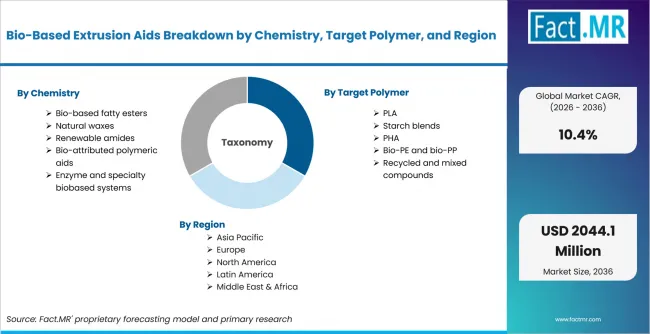
| Chemistry | Bio-based fatty esters; Natural waxes; Renewable amides; Bio-attributed polymeric aids; Enzyme and specialty biobased systems |
| Target Polymer | PLA; Starch blends; PHA; Bio-PE and bio-PP; Recycled and mixed compounds |
| Function | Lubrication and torque reduction; Melt-flow improvement; Anti-stick and release; Dispersion; Surface quality |
| Conversion Process | Film extrusion; Compounding; Injection molding; Sheet and thermoforming; Fiber and profile extrusion |
| Regions Covered | North America; Latin America; Western Europe; Eastern Europe; East Asia; South Asia & Pacific; Middle East & Africa |
| Countries Covered | France; Germany; Japan; United Kingdom; United States |
| Key Companies Profiled | Emery Oleochemicals; Baerlocher; Clariant; Struktol |
| Forecast Period | 2026 to 2036 |
| Approach | Hybrid top-down and bottom-up approach using resin adoption, additive function, conversion process, country indicators and provider portfolio review. |
Source: Fact.MR analysis. Updated Sep 4, 2026
How is the market segmented?
-
By Chemistry:
- Bio-based fatty esters
- Natural waxes
- Renewable amides
- Bio-attributed polymeric aids
- Enzyme and specialty biobased systems
-
By Target Polymer:
- PLA
- Starch blends
- PHA
- Bio-PE and bio-PP
- Recycled and mixed compounds
-
By Function:
- Lubrication and torque reduction
- Melt-flow improvement
- Anti-stick and release
- Dispersion
- Surface quality
-
By Conversion Process:
- Film extrusion
- Compounding
- Injection molding
- Sheet and thermoforming
- Fiber and profile extrusion
-
By Region:
- North America
- Latin America
- Western Europe
- Eastern Europe
- East Asia
- South Asia & Pacific
- Middle East & Africa
Frequently Asked Questions
How big is the bio-based extrusion aids market in 2026?
What is the CAGR of the bio-based extrusion aids market from 2026 to 2036?
Which chemistry leads the bio-based extrusion aids market?
Which target polymer leads the bio-based extrusion aids market?
Who are the leading companies in the bio-based extrusion aids market?
Who worked on this report


Preview the report firsthand - request a free sample
Free SampleGet the brochure for pricing and purchase details
Download PDF