- Market Value (2025): USD 1.6 Bn
- Estimated Value (2026): USD 1.7 Bn
- Forecast Value (2036): USD 3.5 Bn
- CAGR (2026-2036): 7.7%
What is the Halogen-Free Extrusion Aids Market forecast to be worth by 2036?
USD 1.7 billion in 2026 to USD 3.5 billion by 2036, at 7.7% CAGR.
- The Halogen-Free Extrusion Aids Market crossed a valuation of USD 1.6 billion in 2025.
- Demand is projected to increase from USD 1.7 billion in 2026 to USD 3.5 billion by 2036.
- The market is forecast to record 7.7% CAGR from 2026 to 2036 as cable compounders and packaging converters replace fluorinated aids with non-halogen process systems.
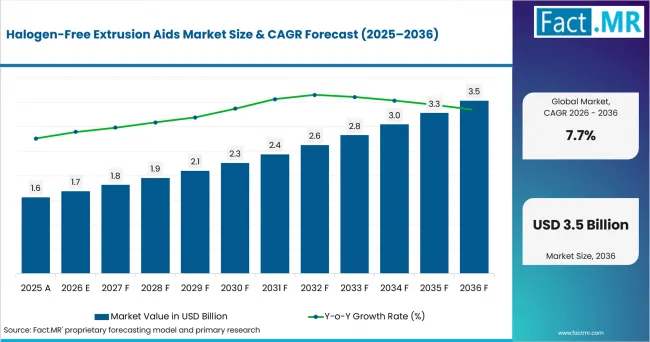
Halogen Free Extrusion Aids Market Value Analysis | Source: Fact.MR
What are the defining numbers behind Halogen-Free Extrusion Aids Market growth?
USD 1.85 billion absolute opportunity by 2036, led by silicone-based aids, HFFR wire and cable compounds and wire and cable applications.
- Demand Drivers in the Market
- Cable compounders need lower die pressure and smoother surface finish due to high mineral loading in HFFR compounds.
- Packaging film converters need PFAS-free process control as brand owners review food-contact materials and regulatory exposure.
- Masterbatch producers need non-halogen aid packages that can be dosed into several polymer systems without changing line hardware.
- Automotive compounders need reliable extrusion behavior for flame-retardant parts used near high-voltage systems and electrical components.
- Key Segments Analyzed
- By Aid Chemistry: Silicone-based aids are expected to hold 34.0% share in 2026 due to their balance of melt-fracture control and PFAS-free positioning.
- By Target Compound: HFFR wire and cable compounds are projected to account for 41.0% share in 2026 as fire-safe cable jackets demand stable extrusion at high filler loadings.
- By Extrusion Problem Addressed: Surface defects and sharkskin are anticipated to capture 30.0% share in 2026, supported by film and cable producers that measure visible surface quality during line approval.
- By End-use Industry: Wire and cable is estimated to represent 45.0% share in 2026 owing to stronger use of low-smoke and flame-retardant compounds across power, building and transport cables.
- Analyst Opinion at Fact.MR
- Shambhu Nath Jha, Principal Consultant at Fact.MR, states, “The commercial test is simple: the aid must keep a loaded compound moving without fluorinated chemistry. Demand is expected to move toward suppliers that prove lower die pressure, cleaner surfaces and sound documentation. Strong portfolios combine silicone, polyamide and organic polymer options with application trials that mirror real extrusion settings.”
- Strategic Implications
- Additive suppliers should build PFAS-free processing-aid lines around cable, film and masterbatch use cases instead of promoting one universal grade.
- Compounders should qualify more than one chemistry route so extrusion settings remain flexible when a customer changes flame-retardant loadings.
- Cable producers should link process-aid selection with smoke, flame and surface-quality testing during compound approval.
- Packaging converters should request food-contact and migration documentation early since compliance review now shapes material selection.
The UK is projected to post 9.1% CAGR through 2036, led by grid investment and vehicle electrification. The USA is expected to reach 8.2% through grid upgrades and packaging conversion. Germany is forecast to record 7.7% through transmission approvals. South Korea is anticipated to advance at 6.9% through EV exports and grid flexibility. France is estimated to reach 6.5% as grid spending and electric mobility expand cable demand.
How does the Halogen-Free Extrusion Aids Market break down by segment?
Silicone-based aids lead Aid Chemistry at 34.0%; wire and cable leads End-use Industry at 45.0%.
Which Aid Chemistry dominates?
Silicone-based aids hold 34.0% share in 2026.
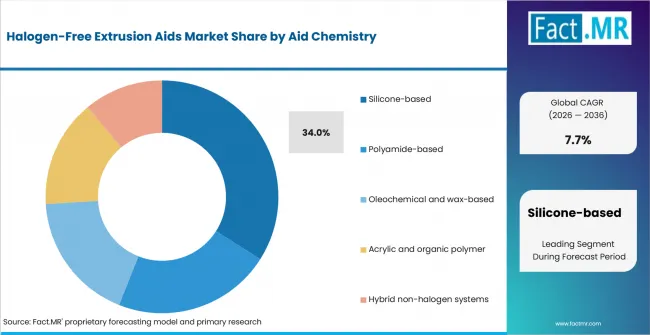
Halogen Free Extrusion Aids Market Analysis By Aid Chemistry | Source: Fact.MR
Silicone-based aids are expected to lead because they provide a non-fluorinated route for melt-fracture control in polyolefin and cable extrusion. Polyamide-based, oleochemical, wax-based, acrylic, organic polymer, and hybrid non-halogen systems remain relevant across friction control, lubrication, and processing applications. Dow Inc. introduced DOWSIL 5-1050 PPA in September 2025 as an alternative to fluoropolymer-based aids for film packaging.
What leads the Target Compound segment?
HFFR wire and cable compounds account for 41.0% share in 2026.
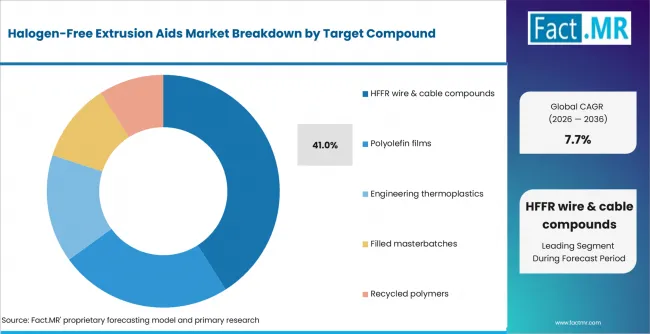
Halogen Free Extrusion Aids Market Analysis By Target Compound | Source: Fact.MR
HFFR wire and cable compounds are projected to lead because mineral-filled flame-retardant systems can increase torque, die pressure, and surface defects during extrusion. Polyolefin films, engineering thermoplastics, filled masterbatches, and recycled polymers also create demand for processing aids. The U.S. Department of Energy announced about USD 1.9 billion in March 2026 for grid upgrades, including reconductoring and higher-capacity conductors.
How do extrusion problems shape demand?
Surface defects and sharkskin lead with 30.0% share in 2026.
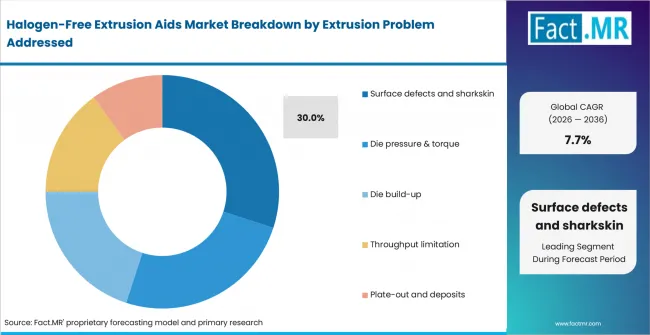
Halogen Free Extrusion Aids Market Analysis By Extrusion Problem Addressed | Source: Fact.MR
Surface defects and sharkskin are anticipated to lead because visible surface quality is an important approval factor in film, cable jacket, and profile extrusion. Die pressure, torque, die build-up, throughput limitations, and deposits also influence processing-aid selection. Clariant AG’s PFAS-free AddWorks PPA line targets sharkskin reduction, improved surface quality, and greater extrusion efficiency.
What supports wire and cable within End-use Industry?
Wire and cable represents 45.0% share in 2026.
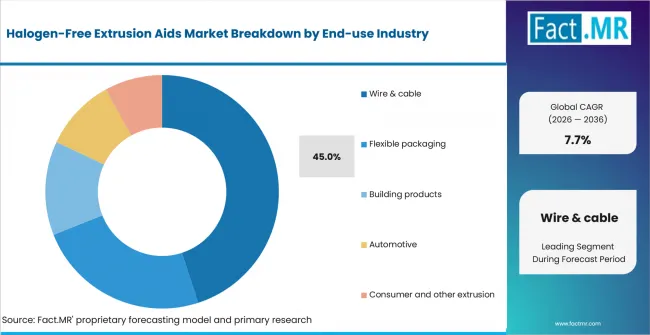
Halogen Free Extrusion Aids Market Analysis By End Use Industry | Source: Fact.MR
Wire and cable is estimated to lead because HFFR compounds combine flame-safety requirements with a narrow processing window. Flexible packaging, building products, automotive applications, and other extrusion uses also support demand for non-fluorinated processing aids. The EU Packaging and Packaging Waste Regulation entered into force on February 11, 2025 and establishes requirements for the manufacturing, composition, and reusable or recoverable nature of packaging placed on the EU market.
What is accelerating Halogen-Free Extrusion Aids Market adoption, and what is holding it back?
PFAS-free conversion drives it; qualification time restrains it.
Drivers Impact Analysis
| DRIVER | (~) % IMPACT ON CAGR | GEOGRAPHIC RELEVANCE | IMPACT TIMELINE |
|---|---|---|---|
| PFAS-free packaging conversion | +1.8% | North America, Europe | Short term (<= 2 years) |
| HFFR cable extrusion | +1.6% | Europe, USA, East Asia | Medium term (2-4 years) |
| Die-pressure reduction | +1.1% | Global | Short term (<= 2 years) |
| Recycled polymer compounding | +0.8% | Europe, North America | Long term (>= 4 years) |
Source: Fact.MR analysis. Updated Sep 2, 2026
- PFAS-free conversion: Packaging and film processors are shifting away from fluorinated processing aids as customer and regulatory screening becomes stricter. Silicone-based alternatives can support melt-fracture control, surface quality, and die-lip cleanliness while helping converters meet non-fluorinated formulation requirements.
- HFFR cable extrusion: Grid development and low-smoke cable specifications support demand for processing aids that stabilize highly filled flame-retardant compounds. These aids can help manage extrusion pressure, surface quality, and processing consistency during cable production.
- Line-efficiency gains: Extrusion aids can reduce surface defects, torque, and processing instability when compounds operate near their performance limits. Manufacturers use these improvements to maintain throughput, limit cleaning interruptions, and achieve more consistent product quality across extrusion runs.
Opportunity Impact Analysis
| OPPORTUNITY | (~) % IMPACT ON CAGR | GEOGRAPHIC RELEVANCE | IMPACT TIMELINE |
|---|---|---|---|
| Silicone and hybrid platforms | +1.2% | Global | Short term (<= 2 years) |
| Grid cable compounds | +1.0% | USA, Europe, South Korea | Medium term (2-4 years) |
| Recycled-polymer aids | +0.7% | Europe, North America | Long term (>= 4 years) |
Source: Fact.MR analysis. Updated Sep 2, 2026
- Silicone and hybrid platforms: Suppliers can strengthen qualification prospects by offering processing aids that perform across both film and cable extrusion. Broad application compatibility helps compounders simplify product selection while addressing melt-fracture, surface-quality, and processing-efficiency requirements.
- Grid-related cable compounds: Transmission and grid-development projects support demand for cable systems that require stable jackets and insulation. Processing-aid suppliers can align product trials with cable manufacturers’ qualification cycles and support consistent extrusion of highly filled compounds.
- Recycled polymers: Recovered polymer feedstocks often show greater variability than virgin materials, creating challenges in melt flow and extrusion stability. Processing aids can help operators manage melt behavior, improve surface quality, and maintain more consistent line performance.
Restraints Impact Analysis
| RESTRAINT | (~) % IMPACT ON CAGR | GEOGRAPHIC RELEVANCE | IMPACT TIMELINE |
|---|---|---|---|
| Qualification cycles | -0.6% | Global | Short term (<= 2 years) |
| Specialty aid cost | -0.5% | North America, Europe | Medium term (2-4 years) |
| Resin and filler variation | -0.4% | Global | Long term (>= 4 years) |
Source: Fact.MR analysis. Updated Sep 2, 2026
- Long qualification cycles: Cable and packaging customers test extrusion behavior before changing a process aid. New grades must prove surface quality, die cleanliness and end-use compliance.
- Specialty-chemistry cost: Silicone, polyamide and organic polymer aids can raise formulation cost. The barrier is sharper when resin and cable-metal costs are already moving.
- Resin and filler variation: One aid chemistry rarely performs the same way across HFFR, film and recycled polymer systems. Suppliers need application support to reduce trial rework.
Which countries are scaling the Halogen-Free Extrusion Aids Market through 2036?
- The country comparison spans 2.58 percentage points between the United Kingdom and France across the 2026 to 2036 period.
- The United Kingdom stays above the displayed group, supported by transmission investment and low-smoke cable use.
- The United States follows as grid upgrades and PFAS-free packaging reviews push processors toward fluorine-free aids.
- Germany holds the middle range where transmission approvals combine with a concentrated cable and plastics base.
- South Korea advances through grid-flexibility spending and EV-linked cable extrusion.
- France closes the range as RTE investment keeps cable qualification active.
Full report coverage includes North America, Latin America, Western Europe, Eastern Europe, East Asia, South Asia & Pacific, and Middle East & Africa.
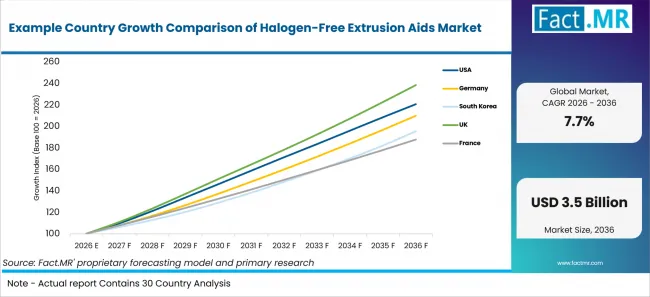
Example Country Growth Comparison Of Halogen Free Extrusion Aids Market | Source: Fact.MR
| Country | CAGR (2026-2036) |
|---|---|
| United Kingdom | 9.1% |
| United States | 8.2% |
| Germany | 7.7% |
| South Korea | 6.9% |
| France | 6.5% |
Source: Fact.MR analysis. Updated Sep 2, 2026
What supports United Kingdom adoption?
9.1% CAGR through 2036, driven by grid investment and low-smoke cable conversion.
The United Kingdom’s cable and packaging converters are anticipated to use more fluorine-free extrusion aids as grid equipment and zero-emission vehicles increase material reviews. Ofgem said in March 2025 that new rules opened early access to almost GBP 4.0 billion for transmission equipment and services. The UK is projected to post 9.1% CAGR through 2036 as low-smoke cable compounds and packaging films move through chemistry review.
How is the United States scaling demand?
8.2% CAGR through 2036, supported by grid upgrades and PFAS-free packaging conversion.
Film and cable processors in the United States are expected to widen PFAS-free aid trials as packaging and grid materials face tighter documentation. The U.S. Department of Energy announced approximately USD 1.9 billion in March 2026 to accelerate upgrades for the national power grid. The USA is expected to record 8.2% CAGR through 2036 as silicone and organic aid suppliers support qualification on industrial extrusion lines.
What supports Germany’s outlook?
7.7% CAGR through 2036, led by transmission-line approvals and industrial compounding strength.
Germany’s extrusion base is anticipated to favor aids that reduce die pressure in HFFR cable compounds and preserve surface quality. Bundesnetzagentur said in January 2026 that it approved roughly 2,000 km of power lines in 2025. Germany is forecast to record 7.7% CAGR through 2036 as grid cable demand and local additive support move together.
How is South Korea developing demand?
6.9% CAGR through 2036, driven by grid flexibility investment and EV-linked extrusion demand.
South Korea’s electronics and vehicle supply chain is expected to keep demand focused on cable jackets and filled compounds that process cleanly. The Ministry of Climate, Energy and Environment reported in February 2026 that the government would provide KRW 117.6 billion for distribution-network energy storage system deployment in 2026. South Korea is anticipated to post 6.9% CAGR through 2036 as grid flexibility and EV-linked extrusion increase qualification work.
What underpins France’s growth?
6.5% CAGR through 2036, supported by grid spending and electric-vehicle penetration.
France’s cable compounders are expected to qualify non-halogen aids where grid projects and electric-vehicle use raise low-smoke cable requirements. CRE approved RTE’s EUR 4.24 billion 2026 investment program in February 2026, with the decision published in March 2026. France is estimated to advance at 6.5% CAGR through 2036 as cable and packaging customers prefer process aids with clear chemistry documentation.
Who leads the Halogen-Free Extrusion Aids Market?
Clariant AG is active through AddWorks™ PPA, a PFAS-free polymer processing-aid line designed for polyolefin extrusion, including blown and cast film applications. The June 2025 launch targets extrusion efficiency, sharkskin elimination, and improved film surface quality.
Dow Inc. competes through DOWSIL™ 5-1050 PPA, introduced in September 2025 as an alternative to fluoropolymer-based PPAs for film packaging. The product contains a silicone additive in a polyethylene carrier. Arkema S.A. offers Kynar® PVDF and Orgasol® Polyamide 12 polymer processing aids for the extrusion of thermoplastic resins, particularly polyolefins. Ampacet Corporation, Avient Corporation, and Tosaf Compounds Ltd. also market PFAS-free or non-PFAS processing aids for polyolefin extrusion and film applications.
Competition centers on application testing, food-contact documentation, cable-grade qualification and evidence of lower die pressure. Suppliers that support customer trials across HFFR cable compounds, films and recycled polymers are better positioned.
Which companies are the key providers?
Key companies include Clariant AG; Dow Inc.; Arkema S.A.; Ampacet Corporation; Avient Corporation; and Tosaf Compounds Ltd.
- Clariant AG
- Dow Inc.
- Arkema S.A.
- Ampacet Corporation
- Avient Corporation
- Tosaf Compounds Ltd.
Bibliography
- Arkema. (2025, May). Arkema showcase Kynar® PVDF and Orgasol® Polyamide 12, Polymer Processing Aid (PPRA).
- Bundesnetzagentur. (2026, January 2). Energy transition clears crucial hurdle – significant progress in electricity grid expansion in 2025.
- Clariant. (2025, June 5). Clariant launches innovative PFAS-free polymer processing aids for more sustainable polyolefin extrusion.
- Commission de régulation de l’énergie. (2026, March 9). La CRE approuve le programme d’investissements de RTE pour l'année 2026, pour un montant de 4,24 milliards d'euros, conforme avec la trajectoire retenue par la CRE dans sa décision sur le tarif d’utilisation des réseaux publics d’électricité (TURPE 7).
- Dow. (2025, September 23). Dow unveils an alternative to fluoropolymer-based polymer processing aids for film packaging.
- European Chemicals Agency. (2025, August 27). ECHA announces timeline for PFAS restriction evaluation.
- Directorate-General for Environment. (2025, February 11). New rules enter into force for a more sustainable and competitive packaging economy. European Commission.
- Ministry of Climate, Energy and Environment. (2026, February 20). Carbon-Neutral “Next-Generation Distributed Power Grid” Launches Full-Scale Rollout This Year.
- U.S. Department of Energy. (2026, March 12). Energy Department announces $1.9B investment in critical grid infrastructure to reduce electricity costs.
- U.S. Environmental Protection Agency. (2026, April 9). Update on reporting deadline for TSCA PFAS reporting rule.
- Ofgem. (2025, March 20). Britain on fast track to net zero with early access to £4 billion infrastructure investment.
- Avient Corporation. (2024, May 6). Avient launches non-PFAS process aid for extrusion applications at NPE 2024.
- Tosaf. (2024, January 21). PFAS-free additives for the plastics industry.
This Report Answers
- The report explains where halogen-free extrusion aids are used across aid chemistry, target compound, extrusion problem and end-use industry.
- It also covers country adoption and supplier capabilities that support qualification.
- Segment analysis identifies leading subsegments and the operating reasons processors prioritize them.
- Country analysis examines the listed markets and the grid, packaging, vehicle and industrial mechanisms that support demand.
- Competitive analysis reviews current providers across PFAS-free process aids, silicone-based PPAs, masterbatch delivery and polymer processing aids.
- Application analysis assesses sharkskin, die build-up, torque and line cleaning.
What does the Halogen-Free Extrusion Aids Market cover?
The Halogen-Free Extrusion Aids Market covers non-halogen additives that improve extrusion behavior in polymer compounds. It includes aids that reduce melt fracture, control die pressure, limit deposits and support cleaner output.
The assessment covers silicone-based, polyamide-based, oleochemical and wax-based, acrylic and organic polymer, and hybrid non-halogen systems.
What is included in the scope?
The scope includes commercial process aids, masterbatch-delivered aids and formulated packages sold for halogen-free extrusion performance. It covers aids used when surface quality, torque, die pressure or deposits are measurable targets.
Coverage includes wire and cable, flexible packaging and building products. It also covers automotive compounds and consumer extrusion uses. The scope reflects links with additive masterbatch use, PCR-compatible masterbatches, recycling compatibilizer additives and wire and cable materials where additives influence processing stability.
What is excluded from the scope?
The scope excludes fluoropolymer-based processing aids, base polymers, flame retardants sold alone, raw fillers, extruders, die hardware and finished cable or packaging products. General lubricants are excluded without a stated halogen-free extrusion-aid function.
Standalone compound markets are treated as adjacent categories. Halogen-free flame retardant systems, PVC additives and compatibilizer additives is adjacent to this assessment but separate from the market boundary.
How Was the Analysis Built?
The analysis draws on 120+ sources, 35+ company portfolios, 25+ countries, and more than 20 industry interviews.
- Primary Research: Primary research includes discussions with manufacturers, service providers, technology developers, distributors, end users, and subject-matter experts. These conversations examine purchasing priorities, product adoption, operational challenges, approval requirements, competitive positioning, and the factors that influence wider market acceptance.
- Desk Research: Desk research covers government statistics, regulatory publications, company filings, trade data, technical studies, industry associations, standards, public policy, and other authoritative sources. Every source used in the analysis is documented in the bibliography.
- Market Sizing and Forecasting: Market estimates combine historical performance, demand indicators, pricing and volume trends, segment shares, company participation, country-level growth, adoption patterns, investment activity, and barriers to market expansion.
- Data Validation and Update Cycle: Findings are validated by comparing primary interviews with public data, company activity, regulatory changes, trade patterns, and industry developments. Regular updates review new product launches, capacity changes, partnerships, approvals, and shifts in commercial adoption.
Segmentation
What is the report’s scope and coverage?
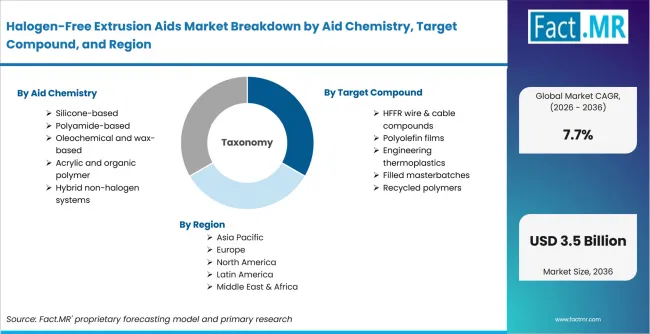
Halogen Free Extrusion Aids Market Breakdown By Aid Chemistry, Target Compound, And Region | Source: Fact.MR
| Attribute | Details |
|---|---|
| Quantitative Units | USD billion |
| Market Definition | Non-halogen process additives that improve melt flow, surface finish, die cleanliness and extrusion stability. |
| Aid Chemistry | Silicone-based; Polyamide-based; Oleochemical and wax-based; Acrylic and organic polymer; Hybrid non-halogen systems |
| Target Compound | HFFR wire and cable compounds; Polyolefin films; Engineering thermoplastics; Filled masterbatches; Recycled polymers |
| Extrusion Problem Addressed | Surface defects and sharkskin; Die pressure and torque; Die build-up; Throughput limitation; Plate-out |
| End-use Industry | Wire and cable; Flexible packaging; Building products; Automotive; Consumer and other extrusion |
| Regions Covered | North America; Latin America; Western Europe; Eastern Europe; East Asia; South Asia & Pacific; Middle East & Africa |
| Countries Covered | United Kingdom; United States; Germany; South Korea; France |
| Companies Profiled | Clariant AG; Dow Inc.; Arkema S.A.; Ampacet Corporation; Avient Corporation; Tosaf Compounds Ltd. |
| Forecast Period | 2026 to 2036 |
| Approach | Hybrid sizing using compound demand, process-aid dosage, end-use indicators, country signals and provider portfolios. |
Source: Fact.MR analysis. Updated Sep 2, 2026
How is the market segmented?
-
By Aid Chemistry
- Silicone-based
- Polyamide-based
- Oleochemical and wax-based
- Acrylic and organic polymer
- Hybrid non-halogen systems
-
By Target Compound
- HFFR wire and cable compounds
- Polyolefin films
- Engineering thermoplastics
- Filled masterbatches
- Recycled polymers
-
By Extrusion Problem Addressed
- Surface defects and sharkskin
- Die pressure and torque
- Die build-up
- Throughput limitation
- Plate-out and deposits
-
By End-use Industry
- Wire and cable
- Flexible packaging
- Building products
- Automotive
- Consumer and other extrusion
-
By Region
- North America
- Latin America
- Western Europe
- Eastern Europe
- East Asia
- South Asia & Pacific
- Middle East & Africa
Frequently Asked Questions
How big is the halogen-free extrusion aids market in 2026?
What is the CAGR of the halogen-free extrusion aids market from 2026 to 2036?
Which aid chemistry leads the halogen-free extrusion aids market?
Which target compound leads the halogen-free extrusion aids market?
Who are the leading companies in the halogen-free extrusion aids market?
Who worked on this report


Preview the report firsthand - request a free sample
Free SampleGet the brochure for pricing and purchase details
Download PDF