- Market Value (2025): USD 1.6 Bn
- Estimated Value (2026): USD 1.8 Bn
- Forecast Value (2036): USD 3.9 Bn
- CAGR (2026-2036): 8.2%
What is the Bio Flushable Substrates Market forecast to be worth by 2036?
USD 1.8 billion in 2026 to USD 3.9 billion by 2036, at 8.2% CAGR.
- The Bio Flushable Substrates Market reached USD 1.6 billion in 2025.
- Demand is projected to increase from USD 1.8 billion in 2026 to USD 3.9 billion by 2036.
- The market is forecast to record an 8.2% CAGR from 2026 to 2036 as wipe brands qualify plastic-free substrates for toilet tissue and hygiene formats.
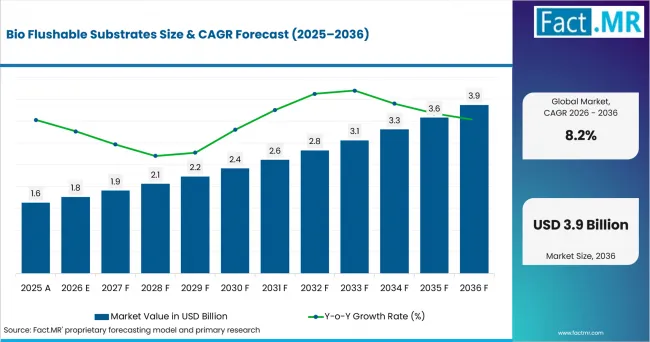
Bio Flushable Substrates Value Analysis | Source: Fact.MR
What are the defining numbers behind Bio Flushable Substrates Market growth?
An absolute opportunity of USD 2.1 billion is expected between 2026 and 2036.
- Demand Drivers in the Market
- Wipe brands need cellulose-rich webs that keep wet hand-feel and disperse after flushing. Defra guidance published in December 2025 says England's plastic-containing wet wipe ban starts on May 19, 2027.
- Retailers need category wording that consumers understand at shelf level. Water UK reported in May 2026 that around 2.9 billion wet wipes are flushed each year in the UK and advises bin disposal for all wipes, including plastic-free products marketed as "flushable".
- Household-care brands need substrate options for septic and small-system homes. Poor dispersibility can create service complaints and repeat purchase risk where wastewater systems are more sensitive.
- Material teams need nonwoven fabric materials that pair softness with fiber separation under water. This raises the value of pulp, lyocell and dispersible binder systems that meet documented performance requirements.
- Key Segments Analyzed
- By Substrate Type: Cellulosic nonwoven is expected to hold 37.0% share in 2026 because pulp-based webs offer a familiar route to softness and dispersibility.
- By Flushability Mechanism: Wet-strength loss in sewer is projected to account for 31.0% share in 2026 as brands focus on binder and fiber systems that separate after flushing.
- By Product Application: Moist toilet tissue is anticipated to capture 38.0% share in 2026 due to direct consumer use in bathroom routines and clearer flushability labeling requirements.
- By Certification and Claim: GD4 and industry flushability is estimated to represent 34.0% share in 2026 owing to its role in buyer qualification and claim approval.
- Analyst Opinion at Fact.MR
- Fact.MR Principal Consultant Shambhu Nath Jha states, "Qualification is the practical bottleneck in this market; fiber availability is less limiting. Brands are expected to spend more time proving dispersibility, plastic-free content and wet strength under the same specification file. Suppliers that combine pulp know-how, test data and scale-ready conversion support are best placed to win repeat orders."
- Strategic Implications
- Substrate producers should document fiber origin and dispersibility in the same claim pack. Ahlstrom reports that 98% of its purchased natural-fiber inputs in 2025, defined as purchased pulp and annual fibers, came from certified or minimum-controlled sources.
- Wipe brands should align product design with flushability tests before packaging artwork is locked. Early testing reduces label rework when national rules change.
- Converters should test flushable packaging substrates and wipe substrates on existing lines before committing to full-scale material changes.
- Retailers should separate moist toilet tissue claims from general cleaning wipe claims. Clear shelf wording reduces confusion between flush-ready and bin-only products.
Germany is projected to record 10.0% CAGR. France is expected to post 8.5% CAGR as TSUU rules formalize responsibility for pre-impregnated wipes. The USA is forecast to reach 8.0% CAGR through septic-system exposure and clearer wipe labeling. The UK is anticipated to advance at 7.6% CAGR with plastic wet wipe restrictions. Japan is estimated to record 5.8% CAGR through high wastewater coverage and ageing-linked hygiene use.
How does the Bio Flushable Substrates Market break down by segment?
Cellulosic nonwoven leads at 37.0%; moist toilet tissue leads at 38.0%.
Which Substrate Type dominates?
Cellulosic nonwoven holds 37.0% share in 2026.
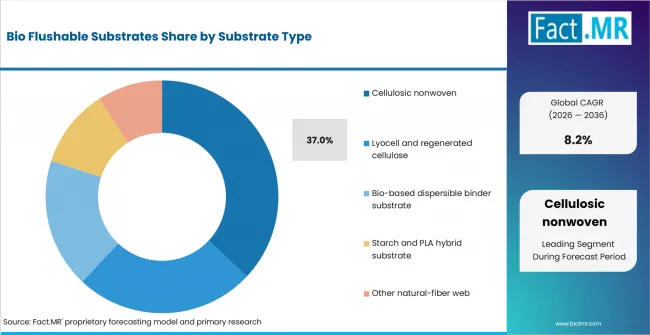
Bio Flushable Substrates Analysis By Substrate Type | Source: Fact.MR
Cellulosic nonwoven leads because pulp-based webs give wipe makers a familiar balance between softness and water response. These substrates can be engineered for strength during use, then designed to lose integrity after exposure to sewer conditions.
Ahlstrom reported in March 2026 that renewable fibers represented 94% of its total fiber use in 2025. That fiber mix supports continued qualification of cellulose-rich substrates where brands need traceable inputs and predictable web behavior.
What leads the Flushability Mechanism segment?
Wet-strength loss in sewer accounts for 31.0% share in 2026.
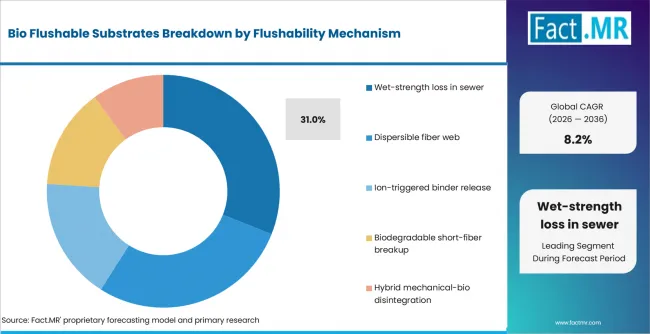
Bio Flushable Substrates Analysis By Flushability Mechanism | Source: Fact.MR
Wet-strength loss in sewer leads because brand teams need a simple performance story: the wipe stays intact during use and then breaks down in moving water. Binder chemistry and fiber entanglement decide whether that behavior is repeatable.
GD4 and IWSFG-style testing keep attention on dispersibility after flushing. Suppliers with documented wet-strength loss data have a cleaner route into private-label and branded moist toilet tissue programs.
How does Product Application shape demand?
Moist toilet tissue leads with 38.0% share in 2026.
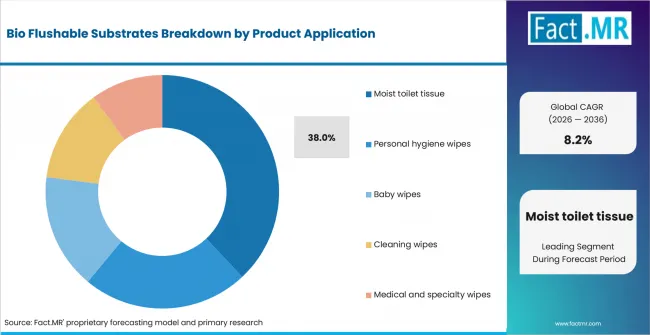
Bio Flushable Substrates Analysis By Product Application | Source: Fact.MR
Moist toilet tissue leads because the product is designed for bathroom use and faces direct claim scrutiny. The same material choice influences baby wipes, where softness and skin contact guide fiber selection even when disposal routes differ.
ADEME reports 82,300 tonnes of wipes placed on the French market in the TSUU prefiguration work. The scope includes pre-impregnated wipes used for body and household applications, giving hygiene wipes a clear place in substrate planning.
What supports Certification and Claim demand?
GD4 and industry flushability leads with 34.0% share in 2026.
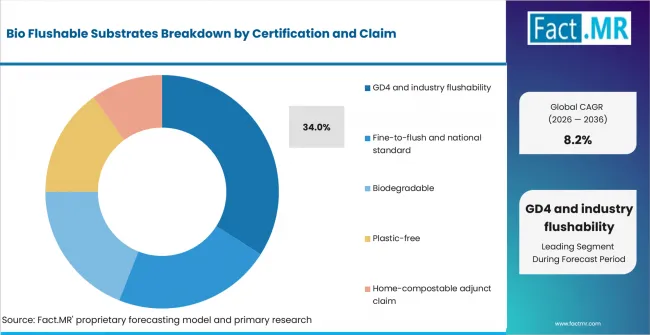
Bio Flushable Substrates Analysis By Certification And Claim | Source: Fact.MR
GD4 provides voluntary industry guidelines for assessing flushability before a flushable claim is made. The guidelines use defined test methods and pass/fail criteria to assess compatibility with wastewater infrastructure.
Demand for documented flushability testing rises when brands need consistent claim support. GD4 gives technical and marketing teams a common voluntary assessment reference.
What is accelerating Bio Flushable Substrates Market adoption, and what is holding it back?
Demand is expected to rise through restrictions on plastic-containing wet wipes and sewer-safe claim requirements. Growth may be limited by qualification cost and performance trade-offs.
Drivers Impact Analysis
| DRIVER | (~) % IMPACT ON CAGR | GEOGRAPHIC RELEVANCE | IMPACT TIMELINE |
|---|---|---|---|
| Plastic wet wipe restrictions | +1.7% | Western Europe, UK | Short term (<= 2 years) |
| Moist toilet tissue claim discipline | +1.3% | North America, Europe | Medium term (2-4 years) |
| Cellulose and lyocell substitution | +1.0% | Europe, Japan | Medium term (2-4 years) |
| Retailer pressure for clear disposal claims | +0.8% | Global | Long term (>= 4 years) |
- Plastic wet wipe restrictions: Restrictions on plastic-containing wet wipes create opportunities for substrate suppliers offering alternative materials. Cellulosic and biodegradable nonwoven structures can gain relevance as brands reformulate personal-care and hygiene wipes around evolving disposal and environmental requirements.
- Moist toilet tissue claim discipline: Premoistened wipe products require clear disposal and flushability communication. Suppliers and brands need substrates, packaging, and labeling that align with applicable requirements so consumers can distinguish flushable and non-flushable products more easily.
- Cellulose and lyocell substitution: Cellulose- and lyocell-based fibers are gaining attention as alternatives to synthetic substrates in hygiene and personal-care wipes. Their use supports softer, plant-derived material positioning while helping manufacturers redesign single-use wipe formats around lower-plastic-content goals.
Opportunity Impact Analysis
| OPPORTUNITY | (~) % IMPACT ON CAGR | GEOGRAPHIC RELEVANCE | IMPACT TIMELINE |
|---|---|---|---|
| Plastic-free private-label conversion | +1.2% | UK, France, Germany | Short term (<= 2 years) |
| Medical and specialty wipe substrates | +0.9% | North America, Europe | Medium term (2-4 years) |
| Binder systems with faster breakup | +0.7% | Global | Long term (>= 4 years) |
- Plastic-free private-label conversion: Retailers can move bathroom wipe ranges toward plastic-free material claims while preserving existing brand formats. The best openings are in moist toilet tissue and personal hygiene wipes.
- Medical and specialty wipe substrates: Medical nonwoven disposables use absorption and strength requirements that overlap with specialty wipe construction. Bio flushable formats can gain where disposal and softness requirements are both specified.
- Binder systems with faster breakup: Binder technologies that improve dispersibility can help flushable wipe products break apart more effectively after disposal. Platforms designed to work with existing converting equipment can reduce implementation barriers while supporting manufacturers seeking faster breakup without major production-line changes.
Restraints Impact Analysis
| RESTRAINT | (~) % IMPACT ON CAGR | GEOGRAPHIC RELEVANCE | IMPACT TIMELINE |
|---|---|---|---|
| Higher qualification cost | -0.6% | Europe, North America | Short term (<= 2 years) |
| Strength-dispersibility trade-off | -0.5% | Global | Medium term (2-4 years) |
| Uneven local sewer conditions | -0.4% | Global | Long term (>= 4 years) |
- Higher qualification cost: Each material change can require dispersibility, strength and packaging-claim checks before launch. This slows conversion for value wipes where small cost changes affect shelf pricing.
- Strength-dispersibility trade-off: Stronger webs can hold together better during use yet require careful binder design to disperse later. Brands therefore need more lab work before switching from conventional substrates.
- Uneven local sewer conditions: Wastewater infrastructure and operating conditions vary across regions, which can affect how flushable products behave after disposal. This variability keeps dispersibility and flushability claims under scrutiny and increases the importance of robust performance testing across different system conditions.
Which countries are scaling the Bio Flushable Substrates Market through 2036?
- The country comparison spans 4.12 percentage points and forms three practical growth bands across the forecast period.
- Germany remains 1.49 percentage points above France through plastic-free substrate qualification and dense wastewater infrastructure.
- France remains 0.51 percentage point above the USA as TSUU producer responsibility strengthens wipe documentation needs.
- The USA remains 0.36 percentage point above the UK through septic-system exposure and state-level wipe labeling rules.
- The UK remains 1.76 percentage points above Japan as plastic wet wipe restrictions shift retailer specifications toward plastic-free substrates.
- Japan closes the displayed range through high wastewater coverage and hygiene demand linked to population ageing.
Comparable CAGRs can create different entry conditions due to sewer coverage, national labeling rules, substrate testing practice and retailer claim discipline. Full report coverage includes North America, Latin America, Western Europe, Eastern Europe, East Asia, South Asia & Pacific, Middle East & Africa.
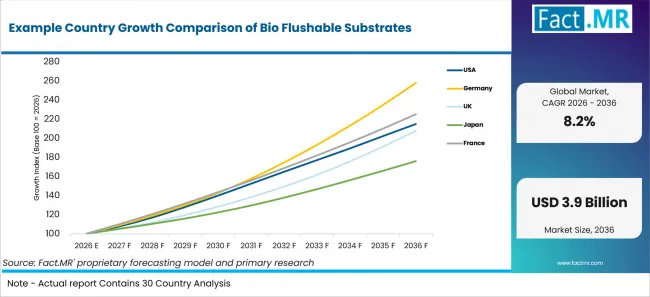
Example Country Growth Comparison Of Bio Flushable Substrates | Source: Fact.MR
| Country | CAGR |
|---|---|
| Germany | 10.0% |
| France | 8.5% |
| United States | 8.0% |
| United Kingdom | 7.6% |
| Japan | 5.8% |
What supports Germany adoption?
10.0% CAGR, supported by wastewater infrastructure, producer-responsibility requirements, and demand for verified dispersibility.
Germany has a clear fit for bio flushable substrates because sewer-connected households and hygiene brands both require clear dispersibility evidence. Umweltbundesamt reported in April 2026 that Germany operated 8,659 public wastewater treatment plants in 2022. Destatis reported in June 2026 that people aged 60 years and above made up 31% of Germany's population in 2025. That combination gives suppliers a practical route through moist toilet tissue, personal hygiene wipes and retailer claim approval.
How is France scaling demand?
8.5% CAGR, driven by TSUU rules and wipe producer responsibility.
France is linking disposable wipe products with a formal TSUU responsibility system, which makes material identification and claim control more valuable. Légifrance states that Article R543-360 entered into force on January 1, 2025 and covers pre-impregnated wipes for body and household uses. A separate Légifrance order approved Citeo Soin & Hygiène from 1 July 2025 to 31 December 2030 as the eco-organization for the wipe category. This framework formalizes producer-responsibility obligations for wipes and raises the importance of product and waste-management documentation.
What supports USA adoption?
8.0% CAGR, supported by septic-system exposure and clear wipe labeling.
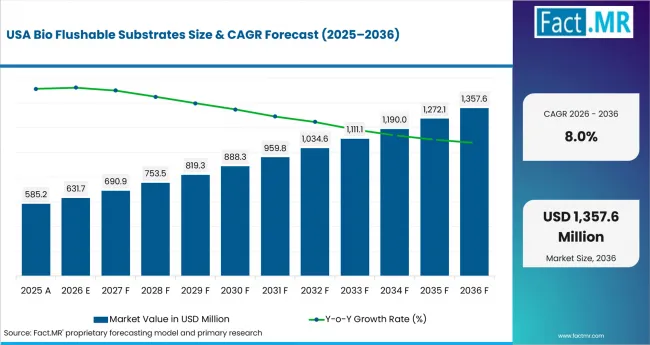
Bio Flushable Substrates Country Value Analysis | Source: Fact.MR
The USA offers a large hygiene-wipe base and a clear need for labels that separate bathroom-use claims from bin-only wipe formats. EPA reported in October 2025 that about 20% of U.S. households are served by septic wastewater treatment systems. The U.S. Census Bureau placed the national population at 341.8 million in 2025. These conditions keep moist toilet tissue suppliers focused on flushability proof across states with different wastewater concerns.
What supports United Kingdom growth?
7.6% CAGR, backed by plastic wet wipe restrictions and retailer conversion.
The UK is moving wipe specifications toward plastic-free substrates as national rules enter the product-planning cycle. DAERA reported in November 2025 that more than 25 billion wet wipes placed on the UK market in 2021 contained plastic. The same announcement states that Northern Ireland’s ban will come into effect in May 2027 following an 18-month transition period. Retailers and brands have a defined window to convert bathroom and hygiene wipe ranges toward cellulose-based designs.
How does Japan perform?
5.8% CAGR, led by wastewater coverage and ageing-linked hygiene use.
Japan grows from a mature sanitation base where wipe claims need to match local handling expectations and product quality standards. MLIT reported that national wastewater treatment population coverage reached 94.0% at the end of fiscal 2025. The Statistics Bureau of Japan reported in September 2025 that people aged 65 and above accounted for 29.4% of the population. This supports stable demand for soft hygiene substrates while keeping approval focused on reliable breakup behavior.
Who leads the Bio Flushable Substrates Market?
Suominen is an established provider through its HYDRASPUN® family of moist toilet tissue substrates and dispersible nonwovens, including grades designed to meet recognized dispersibility and flushability assessments. Lenzing supports the market through VEOCEL™ cellulosic fibers for wet wipes, moist toilet tissue and other hygiene and personal-care applications. Ahlstrom remains relevant from an adjacent materials perspective through its broader fiber-based specialty-materials expertise and responsible natural-fiber sourcing programs.
Magnera Corporation combines Glatfelter heritage with technologies accumulated through businesses including Jacob Holm. In June 2026, Magnera introduced Universa™, a consolidated industrial-wiper range combining the manufacturing expertise, technologies and product strengths of the legacy Chicopee® and Sontara® brands and integrating cross-brand nonwoven technologies.
Soane Materials adds a newer technology route through the June 2026 commercial launch of SoaneClean™ Wet Wipes, a licensable flushable-wipes platform designed to combine wet strength with rapid dispersibility. Competitive differentiation in dispersible wipe substrates includes documented dispersibility performance, renewable and cellulosic fiber sourcing, converter compatibility and the ability to support product claims across differing market and wastewater requirements.
Which companies are the key providers?
Key companies include Ahlstrom; Suominen; Lenzing AG; Magnera Corporation, including Glatfelter and Jacob Holm heritage; and Soane Materials.
- Ahlstrom
- Suominen
- Lenzing AG
- Magnera Corporation, including Glatfelter and Jacob Holm heritage
- Soane Materials
Bibliography
- Department for Environment, Food & Rural Affairs. (2025, December 17). Plastic wet wipes ban.
- Department of Agriculture, Environment and Rural Affairs. (2025, November 18). New rules to ban sale and supply of plastic wet wipes being introduced.
- Water UK. (2026, May 19). One year to go: Upcoming ban on plastic wet wipes.
- U.S. Environmental Protection Agency. (2025, October 8). Small wastewater systems research.
- U.S. Environmental Protection Agency. (2026, June 26). About small wastewater systems.
- California State Water Resources Control Board. (2026, June 15). Sanitary sewer systems general order.
- U.S. Census Bureau. (2026, January 27). U.S. population growth slows due to historic decline in net international migration.
- Statistisches Bundesamt (Destatis). (2026, June 16). Bevölkerung Deutschlands sinkt im Jahr 2025 um 0,1 %.
- Umweltbundesamt. (2026, April 17). Öffentliche Abwasserentsorgung.
- Statistics Bureau of Japan. (2025, September 14). Statistical Topics No. 146: Statistics on the elderly in Japan—On the occasion of Respect-for-Senior-Citizens Day.
- Ahlstrom. (2026, March 30). Sustainability data and targets.
- Suominen. (2025, February 21). Suominen’s HYDRASPUN® nonwovens product family – Sustainable frontrunner in moist toilet tissues.
- Lenzing AG. (2025, May 12). Lenzing’s VEOCEL™ champions sustainable innovation at IDEA25 and CIDPEX.
- Magnera Corporation. (2026, June 3). Magnera introduces Universa™.
- Soane Materials. (2026, June 29). Soane Materials launches flushable wet wipes platform solving wet strength and dispersibility in the same product.
This Report Answers
- The report explains where bio flushable substrates are used across substrate type and flushability mechanism. It also covers product application and certification or claim position.
- Segment analysis identifies the leading subsegments and the operating reasons brands prioritize them.
- Country analysis examines the listed markets and the regulatory or wastewater mechanisms supporting substrate conversion.
- Competitive analysis reviews current providers across cellulosic webs, lyocell fibers, binder systems and engineered wipe substrates.
- Application analysis assesses how moist toilet tissue, personal hygiene wipes and specialty formats influence qualification and material choice.
What does the Bio Flushable Substrates Market cover?
The Bio Flushable Substrates Market covers substrate materials used in wipes that combine in-use strength with breakup after flushing. It includes cellulose-rich nonwovens, regenerated cellulose fibers, dispersible binder substrates and hybrid natural-fiber webs used in tissue and hygiene products.
The assessment covers moist toilet tissue, personal hygiene wipes, cleaning wipes and specialty formats. Demand is assessed across substrate construction, flushability mechanism and claim type, with country analysis tied to wastewater infrastructure and product regulation.
What is included in the scope?
The scope includes fiber webs, binder-enabled substrates, lyocell-rich constructions and natural-fiber blends sold for flushable or dispersible wipe applications. It includes man-made cellulosic fibers when they are used as wipe inputs.
It includes GD4 and IWSFG-oriented substrates, Fine-to-Flush aligned formats, biodegradable claim variants and plastic-free wipe constructions. Adjacent high-tenacity cellulosic staple fibers are considered when their properties influence wipe strength and conversion behavior.
What is excluded from the scope?
The scope excludes finished wipes sold only as consumer goods, ordinary cleaning wipes, toilet paper, packaging machinery and base pulp sold outside wipe substrate conversion. It also excludes ready-to-use disinfectant wipes unless the substrate is designed for flushable or dispersible performance.
General compostable materials are outside the scope when they lack wipe-specific wet strength and dispersibility design. microfibrillated cellulose fiber is included only when it functions inside a wipe substrate or dispersible binder system.
How Was the Analysis Built?
The analysis draws on 120+ sources, 35+ company portfolios, 25+ countries, and more than 20 industry interviews.
- Primary Research: Primary research includes discussions with manufacturers, service providers, technology developers, distributors, end users, and subject-matter experts. These conversations examine purchasing priorities, product adoption, operational challenges, approval requirements, competitive positioning, and the factors that influence wider market acceptance.
- Desk Research: Desk research covers government statistics, regulatory publications, company filings, trade data, technical studies, industry associations, standards, public policy, and other authoritative sources. Every source used in the analysis is documented in the bibliography.
- Market Sizing and Forecasting: Market estimates combine historical performance, demand indicators, pricing and volume trends, segment shares, company participation, country-level growth, adoption patterns, investment activity, and barriers to market expansion.
- Data Validation and Update Cycle: Findings are validated by comparing primary interviews with public data, company activity, regulatory changes, trade patterns, and industry developments. Regular updates review new product launches, capacity changes, partnerships, approvals, and shifts in commercial adoption.
What is the report’s scope and coverage?
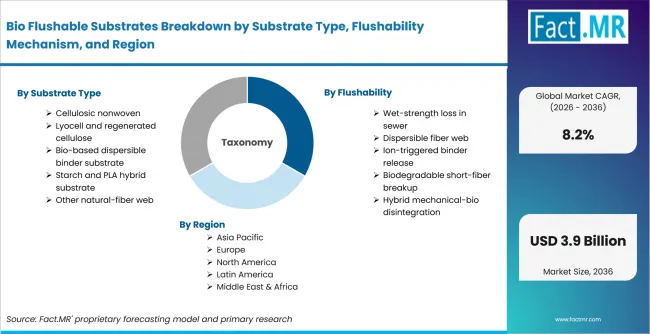
Bio Flushable Substrates Breakdown By Substrate Type, Flushability Mechanism, And Region | Source: Fact.MR
| Attribute | Details |
|---|---|
| Quantitative Units | USD billion in 2026 to USD billion by 2036 at a CAGR |
| Market Definition | Cellulose-rich, bio-based or dispersible substrate materials used in wipes designed to retain in-use strength and break down after flushing under accepted flushability assessment methods. |
| Substrate Type | Cellulosic nonwoven; Lyocell and regenerated cellulose; Bio-based dispersible binder substrate; Starch and PLA hybrid substrate; Other natural-fiber web |
| Flushability Mechanism | Wet-strength loss in sewer; Dispersible fiber web; Ion-triggered binder release; Biodegradable short-fiber breakup; Hybrid mechanical-bio disintegration |
| Product Application | Moist toilet tissue; Personal hygiene wipes; Baby wipes; Cleaning wipes; Medical and specialty wipes |
| Certification and Claim | GD4 and industry flushability; Fine-to-flush and national standard; Biodegradable; Plastic-free; Home-compostable adjunct claim |
| Regions Covered | North America; Latin America; Western Europe; Eastern Europe; East Asia; South Asia & Pacific; Middle East & Africa |
| Countries Covered | United States; Germany; United Kingdom; Japan; France |
| Key Companies Profiled | Ahlstrom; Suominen; Lenzing AG; Magnera Corporation; Soane Materials |
| Forecast Period | 2026 to 2036 |
| Approach | Hybrid top-down and bottom-up approach using wipe application mapping, substrate qualification, flushability claim review, country regulation and company portfolio validation. |
How is the market segmented?
-
By Substrate Type
- Cellulosic nonwoven
- Lyocell and regenerated cellulose
- Bio-based dispersible binder substrate
- Starch and PLA hybrid substrate
- Other natural-fiber web
-
By Flushability Mechanism
- Wet-strength loss in sewer
- Dispersible fiber web
- Ion-triggered binder release
- Biodegradable short-fiber breakup
- Hybrid mechanical-bio disintegration
-
By Product Application
- Moist toilet tissue
- Personal hygiene wipes
- Baby wipes
- Cleaning wipes
- Medical and specialty wipes
-
By Certification and Claim
- GD4 and industry flushability
- Fine-to-flush and national standard
- Biodegradable
- Plastic-free
- Home-compostable adjunct claim
-
By Region
- North America
- Latin America
- Western Europe
- Eastern Europe
- East Asia
- South Asia & Pacific
- Middle East & Africa