- Market Value (2025): USD 1.4 Bn
- Estimated Value (2026): USD 1.6 Bn
- Forecast Value (2036): USD 4.0 Bn
- CAGR (2026-2036): 9.9%
What is the Bio-Based Emollient Alternatives Market forecast to be worth by 2036?
USD 1.6 Billion in 2026 to USD 4.0 Billion by 2036 at a 9.9% CAGR.
- The Bio-Based Emollient Alternatives Market was valued at USD 1.4 Billion in 2025.
- Demand is projected to increase from USD 1.6 Billion in 2026 to USD 4.0 Billion by 2036.
- The market is forecast to record 9.9% CAGR from 2026 to 2036 as formulators replace familiar silicone sensorial profiles with bio-based alternatives.
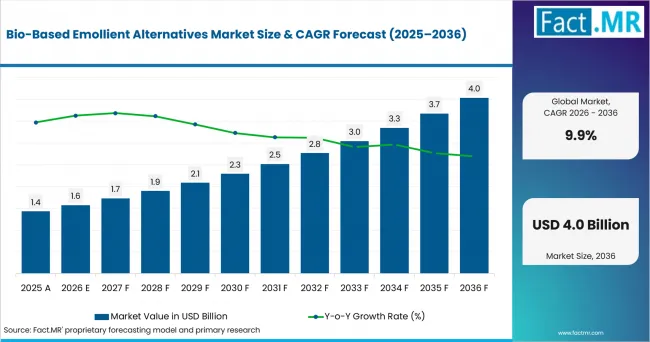
Bio Based Emollient Alternatives Market Value Analysis | Source: Fact.MR
What are the defining numbers behind Bio-Based Emollient Alternatives Market growth?
An absolute opportunity of USD 2.47 Billion is expected between 2026 and 2036.
- Demand Drivers in the Market
- Skin care formulators need lighter natural esters that deliver fast absorption without leaving a greasy finish in daily-use products.
- Feedstock planners are tracking lipid availability closely after USDA FAS projected 2025/26 world oilseed production at 693.46 million metric tons in July 2025.
- U.S. compliance teams need cleaner ingredient records after FDA counted 1,298,361 active cosmetic product listings under MoCRA as of June 30 2026.
- Sun care developers need cosmetic esters and dispersing emollients that support higher filter loads while preserving clear rub-out and dry afterfeel.
- Key Segments Analyzed
- By Emollient Chemistry: Natural esters are expected to hold 34.00% share in 2026 because ester oils give formulators a familiar route to slip and absorbency.
- By Feedstock: Vegetable oils are projected to account for 39.00% share in 2026, supported by established oleochemical conversion paths and broad regional availability.
- By Sensory Profile: Light and dry touch is anticipated to capture 31.00% share in 2026 owing to demand for quick-absorbing skin and sun care textures.
- By Personal Care Application: Skin care is estimated to represent 43.00% share in 2026, shaped by leave-on products where afterfeel is tested daily by users.
- Analyst Opinion at Fact.MR
- Shambhu Nath Jha, Principal Consultant at Fact.MR, states, "Bio-based emollient alternatives are drawing attention because texture replacement is harder than ingredient substitution. A cream loses appeal when slip drops or residue feels heavy. Suppliers are expected to win formulation slots when they combine sensory proof, natural-origin records and scale-up support."
- Strategic Implications
- Ingredient makers should document natural-origin content, biodegradability and batch traceability in a format ready for brand review.
- Beauty brands should qualify at least two bio-based emollient systems for each texture family before line refresh cycles.
- Contract manufacturers should build pilot formulas around natural esters and squalane to shorten customer sampling time.
- Distributors should train technical sales teams on sensory trade-offs because replacement decisions depend on feel and claim language.
Germany is expected to post 11.2% CAGR through 2036 due to EU silicone restrictions and personal care manufacturing depth. The USA is projected to record 10.6% as MoCRA documentation raises attention to ingredient traceability. France is anticipated to reach 9.9% owing to specialty beauty retail depth. The UK is estimated to advance at 9.4% as cosmetics stores regain volume. Japan is forecast to reach 8.9% through e-commerce reach.
How does the Bio-Based Emollient Alternatives Market break down by segment?
Skin care leads Personal Care Application at 43.00%; Vegetable oils lead Feedstock at 39.00%.
Which Emollient Chemistry segment leads?
Natural esters are expected to hold 34.00% share in 2026.
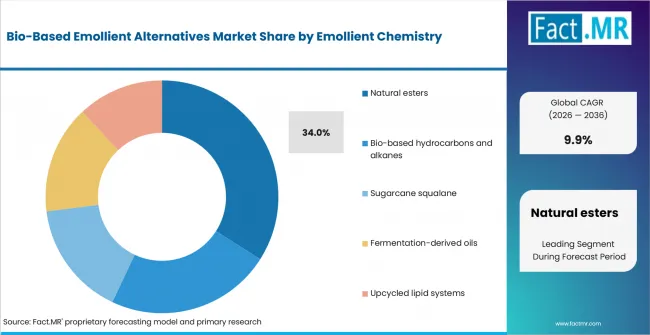
Bio Based Emollient Alternatives Market Analysis By Emollient Chemistry | Source: Fact.MR
Natural esters lead because they offer a practical replacement path for mineral oils and silicone-like ingredients. Their adjustable afterfeel helps formulators preserve familiar product behavior during reformulation.
Evonik highlighted TEGOSOFT® BC MB at in-cosmetics Global 2025 as a natural emollient produced through an eco-efficient enzymatic process. In April 2025, the company stated that enzymatic emollient production can reduce the climate footprint by more than 60% compared with a chemical process, providing a quantified sustainability benchmark for ester-based emollient production.
What leads the Feedstock segment?
Vegetable oils are projected to account for 39.00% share in 2026.
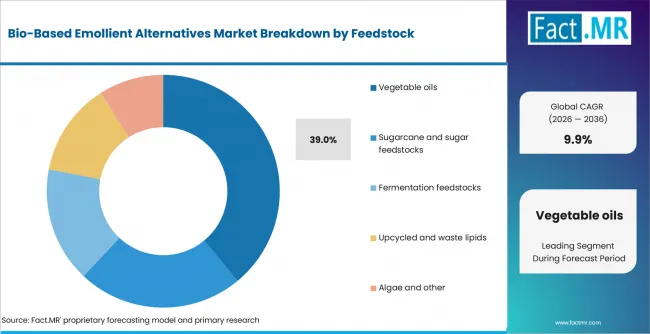
Bio Based Emollient Alternatives Market Analysis By Feedstock | Source: Fact.MR
Vegetable oils lead feedstock selection because oleochemical processors already convert them into esters, squalane inputs and specialty lipids. Their broad industrial base supports scale for ingredient makers using renewable lipid streams while still requiring tight odor and color control.
Vegetable feedstocks also fit certification routes that brands recognize. Their familiar INCI paths help brands compare replacement textures against existing ester systems during pilot formulation work.
How does Sensory Profile shape demand?
Light and dry touch is anticipated to capture 31.00% share in 2026.
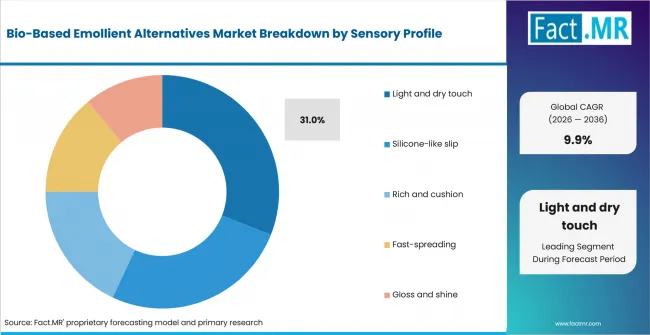
Bio Based Emollient Alternatives Market Analysis By Sensory Profile | Source: Fact.MR
Light and dry touch leads because users quickly notice oiliness, drag and residue in leave-on products. The profile fits face creams, sunscreen fluids, serums and hair oils where a fast spread improves the first-use impression. Suppliers selling squalane oil benefit when their materials replicate silicone-like slip with lower residue.
Croda identifies Crodamol GTS as a bio-based emollient and the 2025 C&T Allē Award winner for Best Base Cosmetic Ingredient for Hair/Scalp Care. The product’s positioning around hair smoothness, shine and skincare sensory attributes reinforces Croda Beauty’s role in bio-based sensory alternatives for hair and skin care.
What supports Skin care within Personal Care Application?
Skin care is estimated to represent 43.00% share in 2026.
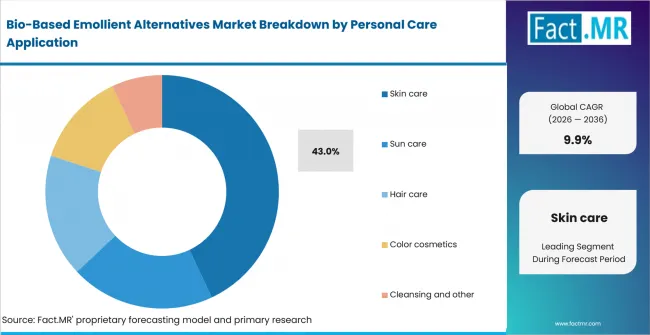
Bio Based Emollient Alternatives Market Analysis By Personal Care Application | Source: Fact.MR
Skin care leads application demand because moisturizers, serums and face oils place emollients directly against user expectations for softness and quick absorption. Leave-on formats make natural-origin claims more visible on labels, so skin care ingredients need sensory proof and clear ingredient documentation.
Sophim reported in April 2025 that Phytosqualan is produced from olive oil industry co-products and is 100% plant-based squalane. Its olive-derived, upcycled origin and lightweight, non-greasy sensoriality support its positioning in premium facial care and hair care formulations where natural origin, performance and transparency influence ingredient selection.
What is accelerating Bio-Based Emollient Alternatives Market adoption, and what is holding it back?
Demand is expected to rise through silicone replacement, skin-care texture needs and feedstock traceability. Growth is constrained by cost, validation time and documentation load.
Drivers Impact Analysis
| DRIVER | (~) % IMPACT ON CAGR | GEOGRAPHIC RELEVANCE | IMPACT TIMELINE |
|---|---|---|---|
| Silicone-feel replacement in leave-on formulas | +1.5% | Europe, North America | Short term (<= 2 years) |
| Skin-care texture reformulation | +1.2% | Global | Medium term (2-4 years) |
| Vegetable oil feedstock availability | +0.9% | Global | Medium term (2-4 years) |
| Cosmetic product documentation | +0.7% | USA, Europe | Long term (>= 4 years) |
Source: Fact.MR analysis. Updated Sep 3, 2026
- Silicone-feel replacement in leave-on formulas: Regulatory pressure around certain cyclic silicones is encouraging formulators to evaluate alternative emollient systems that can preserve slip, spreadability, and after-feel in face creams, serums, and hair styling products.
- Skin-care texture reformulation: Creams, serums, and facial oils expose sensory differences quickly, so brands often test several ester systems before replacing familiar petroleum-derived materials. Suppliers that offer consistent sensory performance and formulation guidance can support smoother reformulation.
- Vegetable oil feedstock availability: Oilseed and vegetable-oil supply supports bio-based ester production, although processors still need tight control over odor, color, purity, and batch consistency. Reliable feedstock quality is important for maintaining predictable performance in cosmetic formulations.
- Cosmetic product documentation: Cosmetic manufacturers need clear ingredient, facility, and product documentation to support regulatory compliance and product-listing requirements. Suppliers that provide well-structured technical, safety, and ingredient information can help brands manage qualification and ongoing compliance more efficiently.
Opportunity Impact Analysis
| OPPORTUNITY | (~) % IMPACT ON CAGR | GEOGRAPHIC RELEVANCE | IMPACT TIMELINE |
|---|---|---|---|
| Fermentation-derived oils for consistent texture | +1.0% | USA, Japan | Medium term (2-4 years) |
| Upcycled lipid systems for claim-led beauty | +0.8% | Europe, Japan | Long term (>= 4 years) |
| Sun-care dispersing emollients | +0.6% | North America, Europe | Short term (<= 2 years) |
Source: Fact.MR analysis. Updated Sep 3, 2026
- Fermentation-derived oils: Controlled fermentation can support more consistent sensory profiles where crop-based feedstocks introduce variation in color, odor, or viscosity. Adjacent biotech squalane demand reinforces the need for high purity, predictable skin feel, and formulation consistency.
- Upcycled lipid systems: Olive by-products, recovered lipids, and other secondary feedstocks create opportunities for emollients with stronger circularity and sourcing narratives. Brands can use these systems where traceable raw-material origin and natural-content positioning support product differentiation.
- Sun-care dispersing emollients: Mineral and organic UV filters require effective dispersing systems to maintain spreadability, reduce whitening, and support uniform application. Emollients that combine good filter compatibility with a light sensory profile can gain relevance in daily sunscreen and hybrid skin-care formulations.
Restraints Impact Analysis
| RESTRAINT | (~) % IMPACT ON CAGR | GEOGRAPHIC RELEVANCE | IMPACT TIMELINE |
|---|---|---|---|
| Vegetable oil allocation and price exposure | -0.6% | Global | Short term (<= 2 years) |
| Qualification time for sensory replacement | -0.5% | Global | Medium term (2-4 years) |
| Natural-origin documentation burden | -0.4% | USA, Europe | Long term (>= 4 years) |
Source: Fact.MR analysis. Updated Sep 3, 2026
- Vegetable oil allocation and price exposure: Biofuel, food, and oleochemical applications compete for selected lipid feedstocks, creating cost and availability pressure for specialty personal-care grades. Suppliers need flexible sourcing strategies and efficient formulation support to manage these fluctuations.
- Qualification time for sensory replacement: A natural ester may meet ingredient and labeling requirements while still falling short in sensory testing. Differences in spread, gloss, absorption, or residue can extend reformulation timelines before brands approve a replacement for established emollient systems.
- Natural-origin documentation burden: Brands increasingly require traceable records covering natural origin, biobased content, sourcing, and biodegradability before approving new emollient platforms. Suppliers with complete and well-organized technical documentation can reduce qualification delays and support faster formulation decisions.
Which countries are scaling the Bio-Based Emollient Alternatives Market through 2036?
- The country comparison spans 2.28 percentage points and forms a tight growth band across the forecast period.
- Germany remains 0.60 percentage point above the USA through EU silicone substitution and ingredient manufacturing depth.
- The USA remains 0.69 percentage point above France as MoCRA cosmetic listing requirements sharpen documentation practices.
- France remains 0.49 percentage point above the UK through specialty beauty channels and premium formulation culture.
- The UK remains 0.50 percentage point above Japan as cosmetics and toiletries stores recover across 2026 retail data.
- Japan closes the displayed range through digital beauty sales and demand for light facial textures.
Comparable CAGRs create different entry conditions because each country tests a different value-chain pressure. Europe is shaped by silicone restrictions, the USA by MoCRA documentation and Japan by e-commerce precision. Full coverage spans North America, Latin America, Western Europe, Eastern Europe, East Asia, South Asia & Pacific, Middle East & Africa.
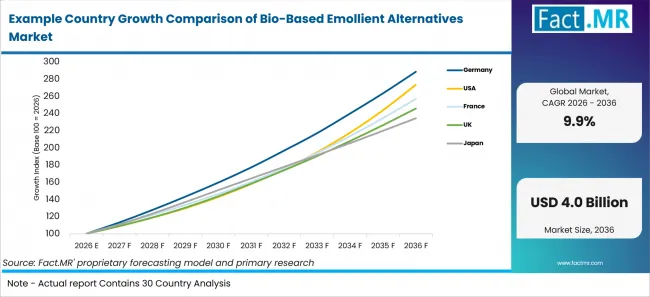
Example Country Growth Comparison Of Bio Based Emollient Alternatives Market | Source: Fact.MR
| Country | CAGR |
|---|---|
| Germany | 11.2% |
| United States | 10.6% |
| France | 9.9% |
| United Kingdom | 9.4% |
| Japan | 8.9% |
Source: Fact.MR analysis. Updated Sep 3, 2026
What supports Germany adoption?
11.2% CAGR, supported by silicone substitution and personal care manufacturing depth.
Germany is subject to EU REACH restrictions under which the 0.1% by-weight threshold for D4, D5 and D6 in cosmetic products other than wash-off cosmetics applies after June 6, 2027. Destatis estimated in January 2026 that German retail turnover increased by 2.4% in real terms in 2025 compared with 2024. The retail base supports premium skin care and sun care reformulation where natural esters must match silicone-like slip.
How is the USA scaling demand?
10.6% CAGR, driven by MoCRA documentation and sun-care reformulation.
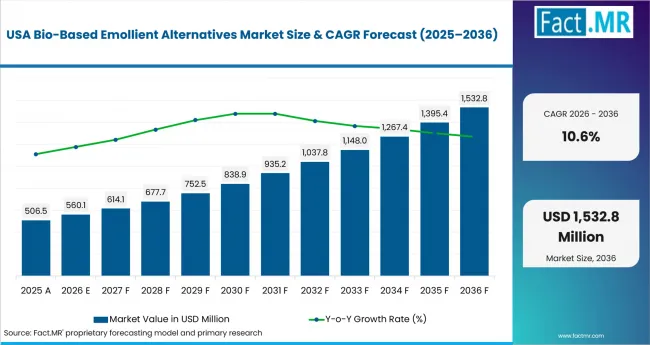
Bio Based Emollient Alternatives Market Country Value Analysis | Source: Fact.MR
The USA combines documentation-intensive cosmetic reformulation requirements with a large consumer retail channel. In August 2026, the U.S. Census Bureau estimated U.S. retail and food services sales at USD 763.6 billion in July 2026. Beauty brands operating in that channel are expected to favor emollient alternatives that combine dry touch, repeatable quality and clear formula records.
What supports France growth?
9.9% CAGR, backed by specialty beauty retail and premium skin care culture.
France combines a well-developed retail base with strong positioning in prestige beauty. INSEE reported in June 2026 that sales across France’s retail trade and commercial craft sector reached EUR 632.6 billion in 2025. The country remains well suited to olive-derived squalane, sugarcane squalane and ester systems that protect texture expectations in premium skin care.
What supports the United Kingdom growth?
9.4% CAGR, supported by cosmetics retail recovery and texture-led skin care.
The United Kingdom has an active beauty retail channel. ONS reported in May 2026 that retail sales volumes rose 0.5% in the three months to April 2026 compared with the three months to January 2026, while cosmetics and toiletries stores recorded a fourth consecutive monthly increase. The pattern supports dry-touch emollients used in face and sun formats.
How does Japan perform?
8.9% CAGR, led by e-commerce reach and light sensory preferences.
Japan benefits from an established digital beauty channel. METI reported in August 2025 that B2C e-commerce sales of cosmetics and pharmaceuticals reached ¥1.015 trillion in 2024, up 4.54% from 2023. Formulators serving humid-weather routines are expected to favor low-residue esters and squalane oils in sunscreens, serums and hair oils.
Who leads the Bio-Based Emollient Alternatives Market?
Croda, BASF, Evonik, Clariant, Inolex and Sophim are active across natural-origin emollients, ester-based sensory ingredients, squalane and silicone-alternative solutions. Competition centers on sensory equivalence, natural-origin documentation, feedstock traceability and formulation support. BASF expanded its natural-based personal care portfolio in April 2025 with Verdessence Maize, Lamesoft OP Plus and Dehyton PK45 GA/RA.
Clariant launched Clariant Beauty in April 2025, highlighting Plantasens emollients in its Skin Sanctuary formulation concept and the Eclipsogen CAP range for sun care, which the company says provides a light skin feel with no white cast. Evonik competes through renewable ester emollients and formulation support. Croda and Inolex offer sensory emollients for hair, skin and sun-care applications, while Sophim supplies olive-derived squalane for premium facial-care formulations.
Which companies are the key providers?
Key companies include Croda International Plc; BASF SE; Evonik Industries AG; Clariant AG; Inolex, Inc.; and Sophim.
- Croda International Plc
- BASF SE
- Evonik Industries AG
- Clariant AG
- Inolex, Inc.
- Sophim
Bibliography
- U.S. Census Bureau. (2026, August 14). Advance monthly sales for retail and food services.
- U.S. Department of Agriculture, Foreign Agricultural Service. (2025, July 11). Oilseeds: World markets and trade.
- Statistisches Bundesamt (Destatis). (2026, January 7). Einzelhandelsumsatz im Jahr 2025 real voraussichtlich um 2,4 % höher als im Vorjahr [Retail turnover in 2025 expected to be 2.4% higher in real terms than in the previous year].
- Institute national de la statistique et des études économiques. (2026, June 18). Activité des formes de vente du commerce de détail.
- Office for National Statistics. (2026, May 22). Retail sales, Great Britain: April 2026.
- Ministry of Economy, Trade and Industry. (2025, August 26). Results of FY2024 E-Commerce Market Survey compiled.
- Commission Regulation (EU) 2024/1328 of 16 May 2024 amending Annex XVII to Regulation (EC) No 1907/2006 of the European Parliament and of the Council concerning the Registration, Evaluation, Authorisation and Restriction of Chemicals (REACH) as regards octamethylcyclotetrasiloxane (D4), decamethylcyclopentasiloxane (D5) and dodecamethylcyclohexasiloxane (D6). (2024). Official Journal of the European Union, L, 2024/1328.
- BASF. (2025, April 3). BASF launches natural-based innovations for personal care at in-cosmetics Global 2025.
- Clariant. (2025, April 7). “Clariant Beauty” launches new solutions for personal care.
- Ross, J. (2025, December 12). Our EMEA Croda Beauty highlights for 2025. Croda Beauty.
- Evonik Industries AG. (2025, April 8). in-cosmetics® global 2025: Evonik meets growing customer demand for high-performance, eco-friendly solutions.
- Inolex. (2026, June 17). Inolex introduces LexFeel® Enhance MB for elegant, stable, high-SPF sunscreens with bemotrizinol.
- Sophim. (2025, April 26). Squalane: A key ingredient in your haircare formulations?
This Report Answers
- The report explains where bio-based emollient alternatives are used across emollient chemistry, feedstock, sensory profile and application.
- Segment analysis compares natural esters with sugarcane squalane, fermentation oils and upcycled lipid systems.
- Country analysis reviews Germany, the USA, France, the UK and Japan through retail, regulation and formulation signals.
- Competitive analysis reviews providers across natural ester chemistry, squalane oil and silicone-alternative portfolios.
- Application analysis links cosmetic and toiletry chemicals with skin care, sun care, hair care, color cosmetics and cleansing systems.
What does the Bio-Based Emollient Alternatives Market cover?
The Bio-Based Emollient Alternatives Market covers ingredients that replace or reduce petroleum-derived and silicone-based emollients in personal care products. It includes natural esters, plant-based squalane, fermentation oils and upcycled lipids. Adjacent oleochemicals are considered only when they feed cosmetic ester routes or support emollient performance.
The assessment covers skin care, sun care, hair care, color cosmetics and cleansing products. It also considers vegan hair care silicone alternatives where bio-based emollients provide shine, slip and lower buildup in rinse-off or leave-on hair formats.
What is included in the scope?
The scope includes commercial bio-based emollients sold to brands, formulators, contract manufacturers and ingredient distributors. It includes biotech squalane, sugarcane squalane, vegetable-oil esters, fermentation oils and upcycled lipid systems used for softness and residue control.
It also includes emollient systems bundled with formulation support for sunscreen, skin care and hair care products. Related biosurfactants are covered only when the formulation role supports sensory performance or mild cleansing afterfeel.
What is excluded from the scope?
The scope excludes finished personal care products, raw vegetable oils sold without cosmetic refining, fragrance oils, pigments, UV filters and packaging. It excludes finished e-commerce personal care products sold as consumer goods.
General cosmetic chemicals are excluded when they function only as surfactants, preservatives, actives, colorants or rheology modifiers without an emollient or sensory benefit.
How Was the Analysis Built?
The analysis draws on 120+ sources, 35+ company portfolios, 25+ countries, and more than 20 industry interviews.
- Primary Research: Primary research includes discussions with manufacturers, service providers, technology developers, distributors, end users, and subject-matter experts. These conversations examine purchasing priorities, product adoption, operational challenges, approval requirements, competitive positioning, and the factors that influence wider market acceptance.
- Desk Research: Desk research covers government statistics, regulatory publications, company filings, trade data, technical studies, industry associations, standards, public policy, and other authoritative sources. Every source used in the analysis is documented in the bibliography.
- Market Sizing and Forecasting: Market estimates combine historical performance, demand indicators, pricing and volume trends, segment shares, company participation, country-level growth, adoption patterns, investment activity, and barriers to market expansion.
- Data Validation and Update Cycle: Findings are validated by comparing primary interviews with public data, company activity, regulatory changes, trade patterns, and industry developments. Regular updates review new product launches, capacity changes, partnerships, approvals, and shifts in commercial adoption.
Segmentation
What is the report's scope and coverage?
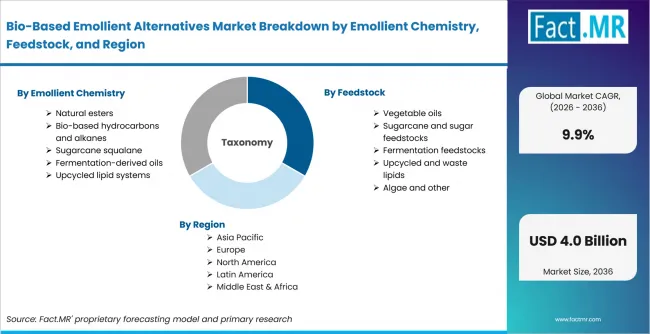
Bio Based Emollient Alternatives Market Breakdown By Emollient Chemistry, Feedstock, And Region | Source: Fact.MR
| Attribute | Details |
|---|---|
| Quantitative Units | USD Billion |
| Market Definition | Bio-based emollient alternatives used to improve spreadability, softness, slip, gloss and dry touch in personal care formulations. The scope includes natural esters, bio-based hydrocarbons and alkanes, sugarcane squalane, fermentation-derived oils and upcycled lipid systems. |
| Emollient Chemistry | Natural esters; Bio-based hydrocarbons and alkanes; Sugarcane squalane; Fermentation-derived oils; Upcycled lipid systems |
| Feedstock | Vegetable oils; Sugarcane and sugar feedstocks; Fermentation feedstocks; Upcycled and waste lipids; Algae and other |
| Sensory Profile | Light and dry touch; Silicone-like slip; Rich and cushion; Fast-spreading; Gloss and shine |
| Personal Care Application | Skin care; Sun care; Hair care; Color cosmetics; Cleansing and other |
| Regions Covered | North America; Latin America; Western Europe; Eastern Europe; East Asia; South Asia & Pacific; Middle East & Africa |
| Countries Covered | Germany; United States; France; United Kingdom; Japan |
| Key Companies Profiled | Croda International Plc; BASF SE; Evonik Industries AG; Clariant AG; Inolex, Inc.; Sophim |
| Forecast Period | 2026 to 2036 |
| Approach | Hybrid top-down and bottom-up approach using personal care application demand; emollient chemistry mix; feedstock availability; sensory testing needs; country adoption; and provider portfolio review. |
Source: Fact.MR analysis. Updated Sep 3, 2026
How is the market segmented?
-
By Emollient Chemistry
- Natural esters
- Bio-based hydrocarbons and alkanes
- Sugarcane squalane
- Fermentation-derived oils
- Upcycled lipid systems
-
By Feedstock
- Vegetable oils
- Sugarcane and sugar feedstocks
- Fermentation feedstocks
- Upcycled and waste lipids
- Algae and other
-
By Sensory Profile
- Light and dry touch
- Silicone-like slip
- Rich and cushion
- Fast-spreading
- Gloss and shine
-
By Personal Care Application
- Skin care
- Sun care
- Hair care
- Color cosmetics
- Cleansing and other
-
By Region
- North America
- Latin America
- Western Europe
- Eastern Europe
- East Asia
- South Asia & Pacific
- Middle East & Africa
Frequently Asked Questions
How big is the bio-based emollient alternatives market in 2026?
What is the CAGR of the bio-based emollient alternatives market from 2026 to 2036?
Which emollient chemistry leads the bio-based emollient alternatives market?
Which feedstock leads the bio-based emollient alternatives market?
Who are the leading companies in the bio-based emollient alternatives market?
Who worked on this report


Preview the report firsthand - request a free sample
Free SampleGet the brochure for pricing and purchase details
Download PDF