Bio-Hydrometallurgy Leaching Chemicals for Metals Market

Bio-Hydrometallurgy Leaching Chemicals for Metals Market Size and Share Forecast Outlook 2026 to 2036

Bio-hydrometallurgy leaching chemicals for metals market is projected to grow from USD 0.5 billion in 2026 to USD 1.8 billion by 2036, at a CAGR of 12.5%. Microbial cultures & bio-inocula (bacteriaarchaea consortia) will dominate with a 22.0% market share, while bioleaching & hydrometallurgy (heapcolumn tank) will lead the process route segment with a 38.0% share.

Bio-Hydrometallurgy Leaching Chemicals for Metals Market Forecast and Outlook 2026 to 2036

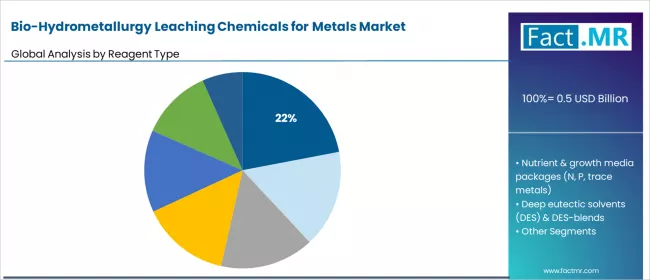
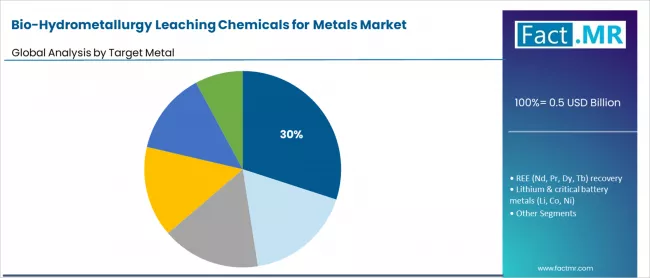
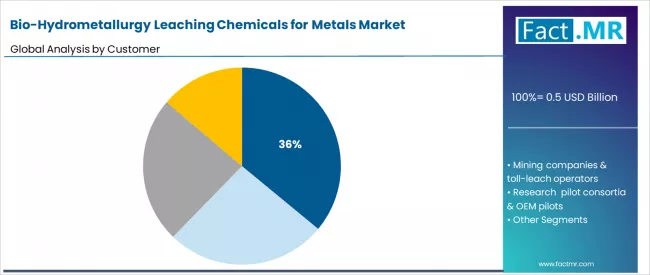
The global bio-hydrometallurgy leaching chemicals for metals market is projected to reach USD 1.76 billion by 2036. The market is valued at USD 0.54 billion in 2026 and is set to rise at a CAGR of 12.5% during the assessment period. By reagent type, microbial cultures & bio-inocula (bacteria/archaea consortia) hold a leading 22% share. Bioleaching & hydrometallurgy (heap/column & tank) represents the dominant process route at 38%, while copper & base metals (Cu, Zn, Ni) are the primary target metals at 30.00%. Dedicated recyclers & chemical recyclers are the leading customer segment, accounting for 36.0% market share.

Key Takeaways from the Bio-Hydrometallurgy Leaching Chemicals for Metals Market

  • Market Value for 2026: USD 0.54 Billion
  • Market Value for 2036: USD 1.76 Billion
  • Forecast CAGR (2026-2036): 12.5%
  • Leading Reagent Type Share (2026): Microbial Cultures & Bio-Inocula (22%)
  • Leading Process Route Share (2026): Bioleaching & Hydrometallurgy (38%)
  • Leading Target Metal Share (2026): Copper & Base Metals (30.00%)
  • Leading Customer Segment Share (2026): Dedicated Recyclers & Chemical Recyclers (36.0%)
  • Key Players in the Market: Solvay, BASF, Evonik, BRGM
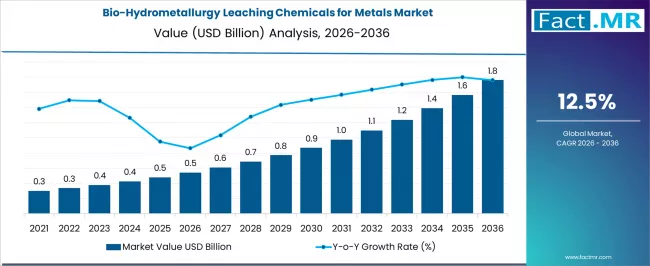
Bio Hydrometallurgy Leaching Chemicals For Metals Market Market Value Analysis

Defining trends involve the convergence of biotechnology and green chemistry, utilizing engineered microbial consortia and benign solvents to extract metals from low-grade ores and complex waste streams. Innovation is rapidly advancing in the genetic tailoring of microorganisms for higher metal tolerance and specificity, and in the formulation of deep eutectic solvents (DES) that work synergistically with biological systems. Integration of these bio-chemical approaches with traditional flowsheets is becoming critical for reducing energy consumption, acid use, and environmental liability.

Regulatory frameworks imposing stricter limits on mining effluent, tailings management, and the use of cyanide/strong acids are primary market drivers. Policies promoting the circular economy and securing supply chains for critical battery and magnet metals act as significant catalysts, positioning bio-hydrometallurgical reagents as a sustainable pathway for both primary production and urban mining.

Bio-Hydrometallurgy Leaching Chemicals for Metals Market

Metric Value
Market Value (2026) USD 0.54 Billion
Market Forecast Value (2036) USD 1.76 Billion
Forecast CAGR (2026-2036) 12.5%

Category

Category Segments
Reagent Type Microbial cultures & bio-inocula (bacteria/archaea consortia), Nutrient & growth media packages (N, P, trace metals), Deep eutectic solvents (DES) & DES-blends, Ionic liquids (task-specific ILs) & functional IL blends, Organic-acid leachants & biodegradable chelants (citric, oxalic, lactate), Mild reductants & thiosulfate & sulfite systems, Proprietary hybrid reagent packs (process suppliers)
Process Route Bioleaching & hydrometallurgy (heap/column & tank), DES/IL assisted hydrometallurgy (non-acid flowsheets), Bio-assisted recycling of magnets & e-waste, Battery & LIB upstream pretreatment & leach (green solvents), Solvometallurgy & non-aqueous green leaching routes, Pilot & R&D & demo consumables (consortia & trials)
Target Metal Copper & base metals (Cu, Zn, Ni), REE (Nd, Pr, Dy, Tb) recovery, Lithium & critical battery metals (Li, Co, Ni), Precious metals (Au, Ag, Pt group), Mixed-metal complex feeds (shredded e-waste, mixed concentrates), Other & speciality (Ti, V, minor elements)
Customer Dedicated recyclers & chemical recyclers, Mining companies & toll-leach operators, Research & pilot consortia & OEM pilots, Contract metallurgical houses & toll processors
Region North America, Latin America, Western Europe, Eastern Europe, East Asia, South Asia & Pacific, MEA

Segmental Analysis

By Reagent Type, Which Technology Represents the Most Direct Biological Intervention?
Bio Hydrometallurgy Leaching Chemicals For Metals Market Analysis By Reagent Type

Microbial cultures & bio-inocula lead the segment with a 22% share. This dominance is rooted in their role as the active biological engine of bioleaching. These specially selected or engineered consortia of iron- and sulfur-oxidizing bacteria (e.g., Acidithiobacillus ferrooxidans) and archaea directly catalyze the oxidation of sulfide minerals, generating the lixiviant (e.g., ferric iron, sulfuric acid) in situ. They are the fundamental, living reagent that enables the extraction of metals like copper and gold from ores without the need for externally applied strong acids.

By Process Route, Which Method is the Most Established and Scalable for Bulk Commodity Metals?

Bio Hydrometallurgy Leaching Chemicals For Metals Market Analysis By Process Route

Bioleaching & hydrometallurgy (heap/column & tank) commands the largest process route share at 38%. This represents the commercial-scale application of bio-hydrometallurgy, particularly for copper recovery from low-grade secondary sulfide ores and waste dumps. The process is well-proven, can handle massive volumes, and offers significantly lower operating costs and environmental impact compared to pyrometallurgical smelting, making it the workhorse route for sustainable base metal production.

By Target Metal, Which Traditional Mining Sector is the Largest Adopter of Commercial Bioleaching?
Bio Hydrometallurgy Leaching Chemicals For Metals Market Analysis By Target Metal

Copper & base metals represent the leading target at 30.00%. The copper industry has been the pioneer and largest-scale adopter of bioleaching technology for decades. The economics of extracting copper from low-grade resources, combined with the suitability of sulfide mineralogy for microbial oxidation, has made it the most mature and financially significant application. This established base provides a stable market for reagents like cultures, nutrients, and pH modifiers, while funding R&D into new applications.

By Customer, Who is Driving Adoption for Urban Mining and Complex Waste Streams?
Bio Hydrometallurgy Leaching Chemicals For Metals Market Analysis By Customer

Dedicated recyclers & chemical recyclers are the dominant customer segment at 36.0%. These players focus on recovering metals from end-of-life products (e-waste, batteries, catalysts) and industrial residues. For them, bio-hydrometallurgy offers a selective, low-emission alternative to smelting or harsh acid leaching, capable of handling complex, mixed-metal feeds. Their need for flexible, environmentally permissible processes in often non-mining jurisdictions makes them key early adopters of advanced bio-chemical leaching reagents.

What are the Drivers, Restraints, and Key Trends of the Bio-Hydrometallurgy Leaching Chemicals Market?

Market growth is driven by the urgent need for more sustainable mining practices with lower carbon and water footprints. Depleting high-grade ores make the processing of low-grade and complex materials economically necessary. Stringent global environmental regulations on emissions, effluents, and tailings are banning or restricting traditional methods. The strategic push for domestic supply chains for critical metals from secondary sources (urban mining) further propels investment in bio-based recovery technologies.

A significant restraint is the relatively slow kinetics of biological processes compared to chemical leaching, impacting project cash flow and requiring larger footprint facilities. The sensitivity of microbial systems to extreme temperatures, pH swings, and toxic impurities requires careful control and can limit applicability. High initial capital costs for bioreactors and longer ramp-up times can be a barrier. Furthermore, intellectual property around proprietary microbial strains and process designs is closely guarded, potentially slowing industry-wide knowledge transfer.

Key trends include the development of "extremophile" microbial consortia engineered for higher temperatures, salinity, or metal tolerance to expand application ranges. There is a strong focus on hybrid processes that combine an initial bio-leach with subsequent purification using green solvents like DES. The use of machine learning to model and optimize microbial community dynamics in heaps or tanks is emerging. Furthermore, there is growing interest in in-situ bioleaching and biomining, reducing the need for material movement entirely.

Analysis of the Bio-Hydrometallurgy Leaching Chemicals Market by Key Countries
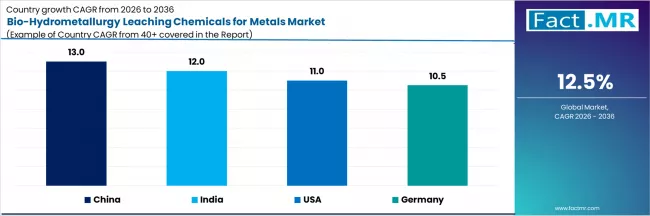
Bio Hydrometallurgy Leaching Chemicals For Metals Market Cagr Analysis By Country

Country CAGR (2026-2036)
China 13.00%
India 12.00%
USA 11.00%
Germany 10.50%

How does China's Mining Scale and Environmental Modernization Drive Market Leadership?

China leads with a 13.00% CAGR, driven by its vast mining sector and a national policy push to green its industrial base. Facing severe pollution from traditional smelting, China is investing heavily in cleaner extraction technologies. Its significant copper production and dominant position in REE and battery metal processing create immense demand for sustainable leaching solutions. Domestic research in bioleaching and DES chemistry is robust and increasingly applied at scale.

Why is India's Growing Mining Sector and E-Waste Challenge a Key Driver?

India's 12.00% growth is fueled by the expansion of its base metal mining sector under tighter environmental scrutiny and its status as a major generator of electronic waste. The need to process low-grade domestic ores and to extract value from e-waste in an environmentally sound manner is pushing adoption of bio-hydrometallurgical approaches. India's strong biotechnology sector also contributes to R&D in tailored microbial solutions for local ore types.

What Role does the USA's Focus on Critical Minerals and Remediation Play?
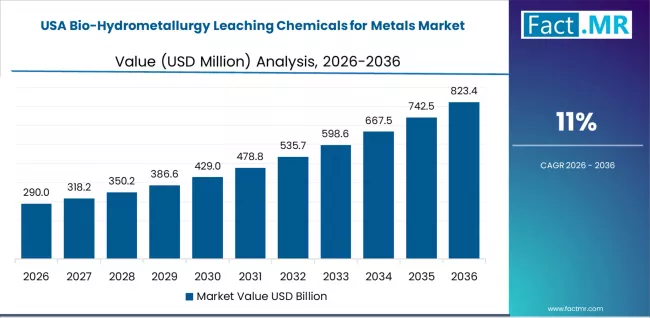
Bio Hydrometallurgy Leaching Chemicals For Metals Market Country Value Analysis

The USA's 11.00% growth is propelled by initiatives to secure domestic supplies of critical minerals and to remediate legacy mine sites. Government funding supports R&D into bioleaching for copper, cobalt, and REE recovery from both primary and secondary sources. The country's advanced biotech and chemical industries are well-positioned to develop and supply advanced reagents, while the mining industry seeks solutions to reduce its environmental liability.

How does Germany's Engineering and Recycling Technology Leadership Influence the Market?

Germany's 10.50% growth reflects its leadership in high-end engineering and closed-loop recycling systems. German research institutions and companies are at the forefront of developing sophisticated bio-hydrometallurgical processes for high-value waste streams like lithium-ion batteries and permanent magnets. The focus is on precision, selectivity, and integration of biological and chemical steps to achieve high-purity outputs for direct reuse in manufacturing.

What Factors Underpin Chile's Copper Industry and Water Scarcity Concerns?

Chile's 9.50% growth is anchored in its position as the world's top copper producer, operating in an increasingly water-scarce environment. Bioleaching offers a pathway to reduce freshwater consumption and acid use in copper extraction. Chilean mining companies are actively investing in and deploying bioleaching technologies for suitable oxide and sulfide ores, creating a significant market for specialized reagents, nutrients, and process optimization services.

Competitive Landscape of the Bio-Hydrometallurgy Leaching Chemicals Market
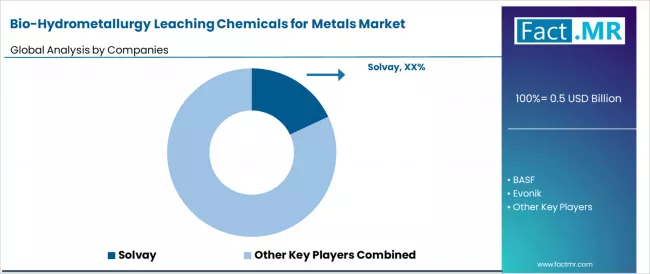
Bio Hydrometallurgy Leaching Chemicals For Metals Market Analysis By Company

The competitive landscape is niche and knowledge-intensive, featuring specialized biotechnology firms, diversified chemical giants, and government research organizations. Chemical leaders like Solvay, BASF, and Evonik compete by leveraging their expertise in specialty chemicals, solvent design, and nutrient systems to supply critical additives, DES formulations, and tailored reagent packages that enhance biological processes.

Specialized entities like BRGM (a French geological survey) often compete through deep process expertise, licensing integrated bioleaching technologies, and providing consultancy. Competition centers on securing long-term partnerships with mining majors and recyclers, providing comprehensive technical support for bioheap or bioreactor management, and developing proprietary, high-performance microbial strains or solvent blends protected by strong IP.

Key Players in the Bio-Hydrometallurgy Leaching Chemicals for Metals Market

  • Solvay
  • BASF
  • Evonik
  • BRGM

Scope of Report

Items Values
Quantitative Units USD Billion
Reagent Type Microbial cultures & bio-inocula, Nutrient & growth media, Deep eutectic solvents (DES), Ionic liquids (ILs), Organic-acid leachants & chelants, Mild reductants, Proprietary hybrid packs
Process Route Bioleaching & hydrometallurgy, DES/IL assisted, Bio-assisted recycling, Battery pretreatment & leach, Solvometallurgy, Pilot & R&D
Target Metal Copper & base metals, REE, Lithium & battery metals, Precious metals, Mixed-metal feeds, Other
Customer Dedicated recyclers, Mining companies & toll operators, Research consortia & OEMs, Contract processors
Key Countries China, India, USA, Germany, Chile
Key Companies Solvay, BASF, Evonik, BRGM
Additional Analysis Analysis of microbial oxidation rates, reagent consumption per ton of ore, metal recovery yields and selectivity, process water quality impact, lifecycle assessment vs. conventional leaching, and scalability challenges for novel reagents.

Bio-Hydrometallurgy Leaching Chemicals for Metals Market by Segments

  • Reagent Type :

    • Microbial cultures & bio-inocula (bacteria/archaea consortia)
    • Nutrient & growth media packages (N, P, trace metals)
    • Deep eutectic solvents (DES) & DES-blends
    • Ionic liquids (task-specific ILs) & functional IL blends
    • Organic-acid leachants & biodegradable chelants (citric, oxalic, lactate)
    • Mild reductants & thiosulfate & sulfite systems
    • Proprietary hybrid reagent packs (process suppliers)
  • Process Route :

    • Bioleaching & hydrometallurgy (heap/column & tank)
    • DES/IL assisted hydrometallurgy (non-acid flowsheets)
    • Bio-assisted recycling of magnets & e-waste
    • Battery & LIB upstream pretreatment & leach (green solvents)
    • Solvometallurgy & non-aqueous green leaching routes
    • Pilot & R&D & demo consumables (consortia & trials)
  • Target Metal :

    • Copper & base metals (Cu, Zn, Ni)
    • REE (Nd, Pr, Dy, Tb) recovery
    • Lithium & critical battery metals (Li, Co, Ni)
    • Precious metals (Au, Ag, Pt group)
    • Mixed-metal complex feeds (shredded e-waste, mixed concentrates)
    • Other & speciality (Ti, V, minor elements)
  • Customer :

    • Dedicated recyclers & chemical recyclers
    • Mining companies & toll-leach operators
    • Research & pilot consortia & OEM pilots
    • Contract metallurgical houses & toll processors
  • Region :

    • North America

      • USA
      • Canada
    • Latin America

      • Mexico
      • Argentina
      • Peru
      • Brazil
      • Rest of Latin America
    • Western Europe

      • Germany
      • UK
      • France
      • Spain
      • Italy
      • BENELUX
      • Rest of Western Europe
    • Eastern Europe

      • Poland
      • Russia
      • Czech Republic
      • Rest of Eastern Europe
    • East Asia

      • China
      • Japan
      • Rest of East Asia
    • South Asia & Pacific

      • India
      • Australia
      • Rest of South Asia & Pacific
    • MEA

      • South Africa
      • GCC Countries
      • Rest of MEA

Table of Content

  1. Executive Summary
    • Global Market Outlook
    • Demand to side Trends
    • Supply to side Trends
    • Technology Roadmap Analysis
    • Analysis and Recommendations
  2. Market Overview
    • Market Coverage / Taxonomy
    • Market Definition / Scope / Limitations
  3. Market Background
    • Market Dynamics
      • Drivers
      • Restraints
      • Opportunity
      • Trends
    • Scenario Forecast
      • Demand in Optimistic Scenario
      • Demand in Likely Scenario
      • Demand in Conservative Scenario
    • Opportunity Map Analysis
    • Product Life Cycle Analysis
    • Supply Chain Analysis
    • Investment Feasibility Matrix
    • Value Chain Analysis
    • PESTLE and Porter’s Analysis
    • Regulatory Landscape
    • Regional Parent Market Outlook
    • Production and Consumption Statistics
    • Import and Export Statistics
  4. Global Market Analysis 2021 to 2025 and Forecast, 2026 to 2036
    • Historical Market Size Value (USD Million) Analysis, 2021 to 2025
    • Current and Future Market Size Value (USD Million) Projections, 2026 to 2036
      • Y to o to Y Growth Trend Analysis
      • Absolute $ Opportunity Analysis
  5. Global Market Pricing Analysis 2021 to 2025 and Forecast 2026 to 2036
  6. Global Market Analysis 2021 to 2025 and Forecast 2026 to 2036, By Reagent Type
    • Introduction / Key Findings
    • Historical Market Size Value (USD Million) Analysis By Reagent Type, 2021 to 2025
    • Current and Future Market Size Value (USD Million) Analysis and Forecast By Reagent Type, 2026 to 2036
      • Microbial cultures & bio-inocula (bacteriaarchaea consortia)
      • Nutrient & growth media packages (N, P, trace metals)
      • Deep eutectic solvents (DES) & DES-blends
      • Ionic liquids (task-specific ILs) & functional IL blends
      • Organic-acid leachants & biodegradable chelants (citric, oxalic, lactate)
      • Mild reductants & thiosulfate sulfite systems
      • Proprietary hybrid reagent packs (process suppliers)
    • Y to o to Y Growth Trend Analysis By Reagent Type, 2021 to 2025
    • Absolute $ Opportunity Analysis By Reagent Type, 2026 to 2036
  7. Global Market Analysis 2021 to 2025 and Forecast 2026 to 2036, By Process Route
    • Introduction / Key Findings
    • Historical Market Size Value (USD Million) Analysis By Process Route, 2021 to 2025
    • Current and Future Market Size Value (USD Million) Analysis and Forecast By Process Route, 2026 to 2036
      • Bioleaching & hydrometallurgy (heapcolumn tank)
      • DESIL assisted hydrometallurgy (non-acid flowsheets)
      • Bio-assisted recycling of magnets & e-waste
      • Battery LIB upstream pretreatment & leach (green solvents)
      • Solvometallurgy non-aqueous green leaching routes
      • Pilot R&D & demo consumables (consortia trials)
    • Y to o to Y Growth Trend Analysis By Process Route, 2021 to 2025
    • Absolute $ Opportunity Analysis By Process Route, 2026 to 2036
  8. Global Market Analysis 2021 to 2025 and Forecast 2026 to 2036, By Target Metal
    • Introduction / Key Findings
    • Historical Market Size Value (USD Million) Analysis By Target Metal, 2021 to 2025
    • Current and Future Market Size Value (USD Million) Analysis and Forecast By Target Metal, 2026 to 2036
      • Copper & base metals (Cu, Zn, Ni)
      • REE (Nd, Pr, Dy, Tb) recovery
      • Lithium & critical battery metals (Li, Co, Ni)
      • Precious metals (Au, Ag, Pt group)
      • Mixed-metal complex feeds (shredded e-waste, mixed concentrates)
      • Other speciality (Ti, V, minor elements)
    • Y to o to Y Growth Trend Analysis By Target Metal, 2021 to 2025
    • Absolute $ Opportunity Analysis By Target Metal, 2026 to 2036
  9. Global Market Analysis 2021 to 2025 and Forecast 2026 to 2036, By Customer
    • Introduction / Key Findings
    • Historical Market Size Value (USD Million) Analysis By Customer, 2021 to 2025
    • Current and Future Market Size Value (USD Million) Analysis and Forecast By Customer, 2026 to 2036
      • Dedicated recyclers & chemical recyclers
      • Mining companies & toll-leach operators
      • Research pilot consortia & OEM pilots
      • Contract metallurgical houses & toll processors
    • Y to o to Y Growth Trend Analysis By Customer, 2021 to 2025
    • Absolute $ Opportunity Analysis By Customer, 2026 to 2036
  10. Global Market Analysis 2021 to 2025 and Forecast 2026 to 2036, By Region
    • Introduction
    • Historical Market Size Value (USD Million) Analysis By Region, 2021 to 2025
    • Current Market Size Value (USD Million) Analysis and Forecast By Region, 2026 to 2036
      • North America
      • Latin America
      • Western Europe
      • Eastern Europe
      • East Asia
      • South Asia and Pacific
      • Middle East & Africa
    • Market Attractiveness Analysis By Region
  11. North America Market Analysis 2021 to 2025 and Forecast 2026 to 2036, By Country
    • Historical Market Size Value (USD Million) Trend Analysis By Market Taxonomy, 2021 to 2025
    • Market Size Value (USD Million) Forecast By Market Taxonomy, 2026 to 2036
      • By Country
        • USA
        • Canada
        • Mexico
      • By Reagent Type
      • By Process Route
      • By Target Metal
      • By Customer
    • Market Attractiveness Analysis
      • By Country
      • By Reagent Type
      • By Process Route
      • By Target Metal
      • By Customer
    • Key Takeaways
  12. Latin America Market Analysis 2021 to 2025 and Forecast 2026 to 2036, By Country
    • Historical Market Size Value (USD Million) Trend Analysis By Market Taxonomy, 2021 to 2025
    • Market Size Value (USD Million) Forecast By Market Taxonomy, 2026 to 2036
      • By Country
        • Brazil
        • Chile
        • Rest of Latin America
      • By Reagent Type
      • By Process Route
      • By Target Metal
      • By Customer
    • Market Attractiveness Analysis
      • By Country
      • By Reagent Type
      • By Process Route
      • By Target Metal
      • By Customer
    • Key Takeaways
  13. Western Europe Market Analysis 2021 to 2025 and Forecast 2026 to 2036, By Country
    • Historical Market Size Value (USD Million) Trend Analysis By Market Taxonomy, 2021 to 2025
    • Market Size Value (USD Million) Forecast By Market Taxonomy, 2026 to 2036
      • By Country
        • Germany
        • UK
        • Italy
        • Spain
        • France
        • Nordic
        • BENELUX
        • Rest of Western Europe
      • By Reagent Type
      • By Process Route
      • By Target Metal
      • By Customer
    • Market Attractiveness Analysis
      • By Country
      • By Reagent Type
      • By Process Route
      • By Target Metal
      • By Customer
    • Key Takeaways
  14. Eastern Europe Market Analysis 2021 to 2025 and Forecast 2026 to 2036, By Country
    • Historical Market Size Value (USD Million) Trend Analysis By Market Taxonomy, 2021 to 2025
    • Market Size Value (USD Million) Forecast By Market Taxonomy, 2026 to 2036
      • By Country
        • Russia
        • Poland
        • Hungary
        • Balkan & Baltic
        • Rest of Eastern Europe
      • By Reagent Type
      • By Process Route
      • By Target Metal
      • By Customer
    • Market Attractiveness Analysis
      • By Country
      • By Reagent Type
      • By Process Route
      • By Target Metal
      • By Customer
    • Key Takeaways
  15. East Asia Market Analysis 2021 to 2025 and Forecast 2026 to 2036, By Country
    • Historical Market Size Value (USD Million) Trend Analysis By Market Taxonomy, 2021 to 2025
    • Market Size Value (USD Million) Forecast By Market Taxonomy, 2026 to 2036
      • By Country
        • China
        • Japan
        • South Korea
      • By Reagent Type
      • By Process Route
      • By Target Metal
      • By Customer
    • Market Attractiveness Analysis
      • By Country
      • By Reagent Type
      • By Process Route
      • By Target Metal
      • By Customer
    • Key Takeaways
  16. South Asia and Pacific Market Analysis 2021 to 2025 and Forecast 2026 to 2036, By Country
    • Historical Market Size Value (USD Million) Trend Analysis By Market Taxonomy, 2021 to 2025
    • Market Size Value (USD Million) Forecast By Market Taxonomy, 2026 to 2036
      • By Country
        • India
        • ASEAN
        • Australia & New Zealand
        • Rest of South Asia and Pacific
      • By Reagent Type
      • By Process Route
      • By Target Metal
      • By Customer
    • Market Attractiveness Analysis
      • By Country
      • By Reagent Type
      • By Process Route
      • By Target Metal
      • By Customer
    • Key Takeaways
  17. Middle East & Africa Market Analysis 2021 to 2025 and Forecast 2026 to 2036, By Country
    • Historical Market Size Value (USD Million) Trend Analysis By Market Taxonomy, 2021 to 2025
    • Market Size Value (USD Million) Forecast By Market Taxonomy, 2026 to 2036
      • By Country
        • Kingdom of Saudi Arabia
        • Other GCC Countries
        • Turkiye
        • South Africa
        • Other African Union
        • Rest of Middle East & Africa
      • By Reagent Type
      • By Process Route
      • By Target Metal
      • By Customer
    • Market Attractiveness Analysis
      • By Country
      • By Reagent Type
      • By Process Route
      • By Target Metal
      • By Customer
    • Key Takeaways
  18. Key Countries Market Analysis
    • USA
      • Pricing Analysis
      • Market Share Analysis, 2025
        • By Reagent Type
        • By Process Route
        • By Target Metal
        • By Customer
    • Canada
      • Pricing Analysis
      • Market Share Analysis, 2025
        • By Reagent Type
        • By Process Route
        • By Target Metal
        • By Customer
    • Mexico
      • Pricing Analysis
      • Market Share Analysis, 2025
        • By Reagent Type
        • By Process Route
        • By Target Metal
        • By Customer
    • Brazil
      • Pricing Analysis
      • Market Share Analysis, 2025
        • By Reagent Type
        • By Process Route
        • By Target Metal
        • By Customer
    • Chile
      • Pricing Analysis
      • Market Share Analysis, 2025
        • By Reagent Type
        • By Process Route
        • By Target Metal
        • By Customer
    • Germany
      • Pricing Analysis
      • Market Share Analysis, 2025
        • By Reagent Type
        • By Process Route
        • By Target Metal
        • By Customer
    • UK
      • Pricing Analysis
      • Market Share Analysis, 2025
        • By Reagent Type
        • By Process Route
        • By Target Metal
        • By Customer
    • Italy
      • Pricing Analysis
      • Market Share Analysis, 2025
        • By Reagent Type
        • By Process Route
        • By Target Metal
        • By Customer
    • Spain
      • Pricing Analysis
      • Market Share Analysis, 2025
        • By Reagent Type
        • By Process Route
        • By Target Metal
        • By Customer
    • France
      • Pricing Analysis
      • Market Share Analysis, 2025
        • By Reagent Type
        • By Process Route
        • By Target Metal
        • By Customer
    • India
      • Pricing Analysis
      • Market Share Analysis, 2025
        • By Reagent Type
        • By Process Route
        • By Target Metal
        • By Customer
    • ASEAN
      • Pricing Analysis
      • Market Share Analysis, 2025
        • By Reagent Type
        • By Process Route
        • By Target Metal
        • By Customer
    • Australia & New Zealand
      • Pricing Analysis
      • Market Share Analysis, 2025
        • By Reagent Type
        • By Process Route
        • By Target Metal
        • By Customer
    • China
      • Pricing Analysis
      • Market Share Analysis, 2025
        • By Reagent Type
        • By Process Route
        • By Target Metal
        • By Customer
    • Japan
      • Pricing Analysis
      • Market Share Analysis, 2025
        • By Reagent Type
        • By Process Route
        • By Target Metal
        • By Customer
    • South Korea
      • Pricing Analysis
      • Market Share Analysis, 2025
        • By Reagent Type
        • By Process Route
        • By Target Metal
        • By Customer
    • Russia
      • Pricing Analysis
      • Market Share Analysis, 2025
        • By Reagent Type
        • By Process Route
        • By Target Metal
        • By Customer
    • Poland
      • Pricing Analysis
      • Market Share Analysis, 2025
        • By Reagent Type
        • By Process Route
        • By Target Metal
        • By Customer
    • Hungary
      • Pricing Analysis
      • Market Share Analysis, 2025
        • By Reagent Type
        • By Process Route
        • By Target Metal
        • By Customer
    • Kingdom of Saudi Arabia
      • Pricing Analysis
      • Market Share Analysis, 2025
        • By Reagent Type
        • By Process Route
        • By Target Metal
        • By Customer
    • Turkiye
      • Pricing Analysis
      • Market Share Analysis, 2025
        • By Reagent Type
        • By Process Route
        • By Target Metal
        • By Customer
    • South Africa
      • Pricing Analysis
      • Market Share Analysis, 2025
        • By Reagent Type
        • By Process Route
        • By Target Metal
        • By Customer
  19. Market Structure Analysis
    • Competition Dashboard
    • Competition Benchmarking
    • Market Share Analysis of Top Players
      • By Regional
      • By Reagent Type
      • By Process Route
      • By Target Metal
      • By Customer
  20. Competition Analysis
    • Competition Deep Dive
      • Solvay
        • Overview
        • Product Portfolio
        • Profitability by Market Segments (Product/Age /Sales Channel/Region)
        • Sales Footprint
        • Strategy Overview
          • Marketing Strategy
          • Product Strategy
          • Channel Strategy
      • BASF
      • Evonik
      • BRGM
  21. Assumptions & Acronyms Used
  22. Research Methodology

List Of Table

  • Table 1: Global Market Value (USD Million) Forecast by Region, 2021 to 2036
  • Table 2: Global Market Value (USD Million) Forecast by Reagent Type, 2021 to 2036
  • Table 3: Global Market Value (USD Million) Forecast by Process Route, 2021 to 2036
  • Table 4: Global Market Value (USD Million) Forecast by Target Metal, 2021 to 2036
  • Table 5: Global Market Value (USD Million) Forecast by Customer, 2021 to 2036
  • Table 6: North America Market Value (USD Million) Forecast by Country, 2021 to 2036
  • Table 7: North America Market Value (USD Million) Forecast by Reagent Type, 2021 to 2036
  • Table 8: North America Market Value (USD Million) Forecast by Process Route, 2021 to 2036
  • Table 9: North America Market Value (USD Million) Forecast by Target Metal, 2021 to 2036
  • Table 10: North America Market Value (USD Million) Forecast by Customer, 2021 to 2036
  • Table 11: Latin America Market Value (USD Million) Forecast by Country, 2021 to 2036
  • Table 12: Latin America Market Value (USD Million) Forecast by Reagent Type, 2021 to 2036
  • Table 13: Latin America Market Value (USD Million) Forecast by Process Route, 2021 to 2036
  • Table 14: Latin America Market Value (USD Million) Forecast by Target Metal, 2021 to 2036
  • Table 15: Latin America Market Value (USD Million) Forecast by Customer, 2021 to 2036
  • Table 16: Western Europe Market Value (USD Million) Forecast by Country, 2021 to 2036
  • Table 17: Western Europe Market Value (USD Million) Forecast by Reagent Type, 2021 to 2036
  • Table 18: Western Europe Market Value (USD Million) Forecast by Process Route, 2021 to 2036
  • Table 19: Western Europe Market Value (USD Million) Forecast by Target Metal, 2021 to 2036
  • Table 20: Western Europe Market Value (USD Million) Forecast by Customer, 2021 to 2036
  • Table 21: Eastern Europe Market Value (USD Million) Forecast by Country, 2021 to 2036
  • Table 22: Eastern Europe Market Value (USD Million) Forecast by Reagent Type, 2021 to 2036
  • Table 23: Eastern Europe Market Value (USD Million) Forecast by Process Route, 2021 to 2036
  • Table 24: Eastern Europe Market Value (USD Million) Forecast by Target Metal, 2021 to 2036
  • Table 25: Eastern Europe Market Value (USD Million) Forecast by Customer, 2021 to 2036
  • Table 26: East Asia Market Value (USD Million) Forecast by Country, 2021 to 2036
  • Table 27: East Asia Market Value (USD Million) Forecast by Reagent Type, 2021 to 2036
  • Table 28: East Asia Market Value (USD Million) Forecast by Process Route, 2021 to 2036
  • Table 29: East Asia Market Value (USD Million) Forecast by Target Metal, 2021 to 2036
  • Table 30: East Asia Market Value (USD Million) Forecast by Customer, 2021 to 2036
  • Table 31: South Asia and Pacific Market Value (USD Million) Forecast by Country, 2021 to 2036
  • Table 32: South Asia and Pacific Market Value (USD Million) Forecast by Reagent Type, 2021 to 2036
  • Table 33: South Asia and Pacific Market Value (USD Million) Forecast by Process Route, 2021 to 2036
  • Table 34: South Asia and Pacific Market Value (USD Million) Forecast by Target Metal, 2021 to 2036
  • Table 35: South Asia and Pacific Market Value (USD Million) Forecast by Customer, 2021 to 2036
  • Table 36: Middle East & Africa Market Value (USD Million) Forecast by Country, 2021 to 2036
  • Table 37: Middle East & Africa Market Value (USD Million) Forecast by Reagent Type, 2021 to 2036
  • Table 38: Middle East & Africa Market Value (USD Million) Forecast by Process Route, 2021 to 2036
  • Table 39: Middle East & Africa Market Value (USD Million) Forecast by Target Metal, 2021 to 2036
  • Table 40: Middle East & Africa Market Value (USD Million) Forecast by Customer, 2021 to 2036

List Of Figures

  • Figure 1: Global Market Pricing Analysis
  • Figure 2: Global Market Value (USD Million) Forecast 2021 to 2036
  • Figure 3: Global Market Value Share and BPS Analysis by Reagent Type, 2026 and 2036
  • Figure 4: Global Market Y to o to Y Growth Comparison by Reagent Type, 2026 to 2036
  • Figure 5: Global Market Attractiveness Analysis by Reagent Type
  • Figure 6: Global Market Value Share and BPS Analysis by Process Route, 2026 and 2036
  • Figure 7: Global Market Y to o to Y Growth Comparison by Process Route, 2026 to 2036
  • Figure 8: Global Market Attractiveness Analysis by Process Route
  • Figure 9: Global Market Value Share and BPS Analysis by Target Metal, 2026 and 2036
  • Figure 10: Global Market Y to o to Y Growth Comparison by Target Metal, 2026 to 2036
  • Figure 11: Global Market Attractiveness Analysis by Target Metal
  • Figure 12: Global Market Value Share and BPS Analysis by Customer, 2026 and 2036
  • Figure 13: Global Market Y to o to Y Growth Comparison by Customer, 2026 to 2036
  • Figure 14: Global Market Attractiveness Analysis by Customer
  • Figure 15: Global Market Value (USD Million) Share and BPS Analysis by Region, 2026 and 2036
  • Figure 16: Global Market Y to o to Y Growth Comparison by Region, 2026 to 2036
  • Figure 17: Global Market Attractiveness Analysis by Region
  • Figure 18: North America Market Incremental Dollar Opportunity, 2026 to 2036
  • Figure 19: Latin America Market Incremental Dollar Opportunity, 2026 to 2036
  • Figure 20: Western Europe Market Incremental Dollar Opportunity, 2026 to 2036
  • Figure 21: Eastern Europe Market Incremental Dollar Opportunity, 2026 to 2036
  • Figure 22: East Asia Market Incremental Dollar Opportunity, 2026 to 2036
  • Figure 23: South Asia and Pacific Market Incremental Dollar Opportunity, 2026 to 2036
  • Figure 24: Middle East & Africa Market Incremental Dollar Opportunity, 2026 to 2036
  • Figure 25: North America Market Value Share and BPS Analysis by Country, 2026 and 2036
  • Figure 26: North America Market Value Share and BPS Analysis by Reagent Type, 2026 and 2036
  • Figure 27: North America Market Y to o to Y Growth Comparison by Reagent Type, 2026 to 2036
  • Figure 28: North America Market Attractiveness Analysis by Reagent Type
  • Figure 29: North America Market Value Share and BPS Analysis by Process Route, 2026 and 2036
  • Figure 30: North America Market Y to o to Y Growth Comparison by Process Route, 2026 to 2036
  • Figure 31: North America Market Attractiveness Analysis by Process Route
  • Figure 32: North America Market Value Share and BPS Analysis by Target Metal, 2026 and 2036
  • Figure 33: North America Market Y to o to Y Growth Comparison by Target Metal, 2026 to 2036
  • Figure 34: North America Market Attractiveness Analysis by Target Metal
  • Figure 35: North America Market Value Share and BPS Analysis by Customer, 2026 and 2036
  • Figure 36: North America Market Y to o to Y Growth Comparison by Customer, 2026 to 2036
  • Figure 37: North America Market Attractiveness Analysis by Customer
  • Figure 38: Latin America Market Value Share and BPS Analysis by Country, 2026 and 2036
  • Figure 39: Latin America Market Value Share and BPS Analysis by Reagent Type, 2026 and 2036
  • Figure 40: Latin America Market Y to o to Y Growth Comparison by Reagent Type, 2026 to 2036
  • Figure 41: Latin America Market Attractiveness Analysis by Reagent Type
  • Figure 42: Latin America Market Value Share and BPS Analysis by Process Route, 2026 and 2036
  • Figure 43: Latin America Market Y to o to Y Growth Comparison by Process Route, 2026 to 2036
  • Figure 44: Latin America Market Attractiveness Analysis by Process Route
  • Figure 45: Latin America Market Value Share and BPS Analysis by Target Metal, 2026 and 2036
  • Figure 46: Latin America Market Y to o to Y Growth Comparison by Target Metal, 2026 to 2036
  • Figure 47: Latin America Market Attractiveness Analysis by Target Metal
  • Figure 48: Latin America Market Value Share and BPS Analysis by Customer, 2026 and 2036
  • Figure 49: Latin America Market Y to o to Y Growth Comparison by Customer, 2026 to 2036
  • Figure 50: Latin America Market Attractiveness Analysis by Customer
  • Figure 51: Western Europe Market Value Share and BPS Analysis by Country, 2026 and 2036
  • Figure 52: Western Europe Market Value Share and BPS Analysis by Reagent Type, 2026 and 2036
  • Figure 53: Western Europe Market Y to o to Y Growth Comparison by Reagent Type, 2026 to 2036
  • Figure 54: Western Europe Market Attractiveness Analysis by Reagent Type
  • Figure 55: Western Europe Market Value Share and BPS Analysis by Process Route, 2026 and 2036
  • Figure 56: Western Europe Market Y to o to Y Growth Comparison by Process Route, 2026 to 2036
  • Figure 57: Western Europe Market Attractiveness Analysis by Process Route
  • Figure 58: Western Europe Market Value Share and BPS Analysis by Target Metal, 2026 and 2036
  • Figure 59: Western Europe Market Y to o to Y Growth Comparison by Target Metal, 2026 to 2036
  • Figure 60: Western Europe Market Attractiveness Analysis by Target Metal
  • Figure 61: Western Europe Market Value Share and BPS Analysis by Customer, 2026 and 2036
  • Figure 62: Western Europe Market Y to o to Y Growth Comparison by Customer, 2026 to 2036
  • Figure 63: Western Europe Market Attractiveness Analysis by Customer
  • Figure 64: Eastern Europe Market Value Share and BPS Analysis by Country, 2026 and 2036
  • Figure 65: Eastern Europe Market Value Share and BPS Analysis by Reagent Type, 2026 and 2036
  • Figure 66: Eastern Europe Market Y to o to Y Growth Comparison by Reagent Type, 2026 to 2036
  • Figure 67: Eastern Europe Market Attractiveness Analysis by Reagent Type
  • Figure 68: Eastern Europe Market Value Share and BPS Analysis by Process Route, 2026 and 2036
  • Figure 69: Eastern Europe Market Y to o to Y Growth Comparison by Process Route, 2026 to 2036
  • Figure 70: Eastern Europe Market Attractiveness Analysis by Process Route
  • Figure 71: Eastern Europe Market Value Share and BPS Analysis by Target Metal, 2026 and 2036
  • Figure 72: Eastern Europe Market Y to o to Y Growth Comparison by Target Metal, 2026 to 2036
  • Figure 73: Eastern Europe Market Attractiveness Analysis by Target Metal
  • Figure 74: Eastern Europe Market Value Share and BPS Analysis by Customer, 2026 and 2036
  • Figure 75: Eastern Europe Market Y to o to Y Growth Comparison by Customer, 2026 to 2036
  • Figure 76: Eastern Europe Market Attractiveness Analysis by Customer
  • Figure 77: East Asia Market Value Share and BPS Analysis by Country, 2026 and 2036
  • Figure 78: East Asia Market Value Share and BPS Analysis by Reagent Type, 2026 and 2036
  • Figure 79: East Asia Market Y to o to Y Growth Comparison by Reagent Type, 2026 to 2036
  • Figure 80: East Asia Market Attractiveness Analysis by Reagent Type
  • Figure 81: East Asia Market Value Share and BPS Analysis by Process Route, 2026 and 2036
  • Figure 82: East Asia Market Y to o to Y Growth Comparison by Process Route, 2026 to 2036
  • Figure 83: East Asia Market Attractiveness Analysis by Process Route
  • Figure 84: East Asia Market Value Share and BPS Analysis by Target Metal, 2026 and 2036
  • Figure 85: East Asia Market Y to o to Y Growth Comparison by Target Metal, 2026 to 2036
  • Figure 86: East Asia Market Attractiveness Analysis by Target Metal
  • Figure 87: East Asia Market Value Share and BPS Analysis by Customer, 2026 and 2036
  • Figure 88: East Asia Market Y to o to Y Growth Comparison by Customer, 2026 to 2036
  • Figure 89: East Asia Market Attractiveness Analysis by Customer
  • Figure 90: South Asia and Pacific Market Value Share and BPS Analysis by Country, 2026 and 2036
  • Figure 91: South Asia and Pacific Market Value Share and BPS Analysis by Reagent Type, 2026 and 2036
  • Figure 92: South Asia and Pacific Market Y to o to Y Growth Comparison by Reagent Type, 2026 to 2036
  • Figure 93: South Asia and Pacific Market Attractiveness Analysis by Reagent Type
  • Figure 94: South Asia and Pacific Market Value Share and BPS Analysis by Process Route, 2026 and 2036
  • Figure 95: South Asia and Pacific Market Y to o to Y Growth Comparison by Process Route, 2026 to 2036
  • Figure 96: South Asia and Pacific Market Attractiveness Analysis by Process Route
  • Figure 97: South Asia and Pacific Market Value Share and BPS Analysis by Target Metal, 2026 and 2036
  • Figure 98: South Asia and Pacific Market Y to o to Y Growth Comparison by Target Metal, 2026 to 2036
  • Figure 99: South Asia and Pacific Market Attractiveness Analysis by Target Metal
  • Figure 100: South Asia and Pacific Market Value Share and BPS Analysis by Customer, 2026 and 2036
  • Figure 101: South Asia and Pacific Market Y to o to Y Growth Comparison by Customer, 2026 to 2036
  • Figure 102: South Asia and Pacific Market Attractiveness Analysis by Customer
  • Figure 103: Middle East & Africa Market Value Share and BPS Analysis by Country, 2026 and 2036
  • Figure 104: Middle East & Africa Market Value Share and BPS Analysis by Reagent Type, 2026 and 2036
  • Figure 105: Middle East & Africa Market Y to o to Y Growth Comparison by Reagent Type, 2026 to 2036
  • Figure 106: Middle East & Africa Market Attractiveness Analysis by Reagent Type
  • Figure 107: Middle East & Africa Market Value Share and BPS Analysis by Process Route, 2026 and 2036
  • Figure 108: Middle East & Africa Market Y to o to Y Growth Comparison by Process Route, 2026 to 2036
  • Figure 109: Middle East & Africa Market Attractiveness Analysis by Process Route
  • Figure 110: Middle East & Africa Market Value Share and BPS Analysis by Target Metal, 2026 and 2036
  • Figure 111: Middle East & Africa Market Y to o to Y Growth Comparison by Target Metal, 2026 to 2036
  • Figure 112: Middle East & Africa Market Attractiveness Analysis by Target Metal
  • Figure 113: Middle East & Africa Market Value Share and BPS Analysis by Customer, 2026 and 2036
  • Figure 114: Middle East & Africa Market Y to o to Y Growth Comparison by Customer, 2026 to 2036
  • Figure 115: Middle East & Africa Market Attractiveness Analysis by Customer
  • Figure 116: Global Market - Tier Structure Analysis
  • Figure 117: Global Market - Company Share Analysis

- FAQs -

How big is the bio-hydrometallurgy leaching chemicals for metals market in 2026?

The global bio-hydrometallurgy leaching chemicals for metals market is estimated to be valued at USD 0.5 billion in 2026.

What will be the size of bio-hydrometallurgy leaching chemicals for metals market in 2036?

The market size for the bio-hydrometallurgy leaching chemicals for metals market is projected to reach USD 1.8 billion by 2036.

How much will be the bio-hydrometallurgy leaching chemicals for metals market growth between 2026 and 2036?

The bio-hydrometallurgy leaching chemicals for metals market is expected to grow at a 12.5% CAGR between 2026 and 2036.

What are the key product types in the bio-hydrometallurgy leaching chemicals for metals market?

The key product types in bio-hydrometallurgy leaching chemicals for metals market are microbial cultures & bio-inocula (bacteriaarchaea consortia), nutrient & growth media packages (n, p, trace metals), deep eutectic solvents (des) & des-blends, ionic liquids (task-specific ils) & functional il blends, organic-acid leachants & biodegradable chelants (citric, oxalic, lactate), mild reductants & thiosulfate sulfite systems and proprietary hybrid reagent packs (process suppliers).

Which process route segment to contribute significant share in the bio-hydrometallurgy leaching chemicals for metals market in 2026?

In terms of process route, bioleaching & hydrometallurgy (heapcolumn tank) segment to command 38.0% share in the bio-hydrometallurgy leaching chemicals for metals market in 2026.

Bio-Hydrometallurgy Leaching Chemicals for Metals Market