Green Leaching Agents for Battery Recycling Market

Green Leaching Agents for Battery Recycling Market Size and Share Forecast Outlook 2026 to 2036

Green leaching agents for battery recycling market is projected to grow from USD 0.5 billion in 2026 to USD 1.5 billion by 2036, at a CAGR of 12.1%. Deep Eutectic Solvents (DES) & ChCl-based systems will dominate with a 26.0% market share, while lithium recovery-oriented leachants will lead the recovery focus segment with a 28.0% share.

Green Leaching Agents for Battery Recycling Market Forecast and Outlook 2026 to 2036

The global green leaching agents for battery recycling market is projected to reach USD 1.54 billion by 2036. The market is valued at USD 0.49 billion in 2026 and is set to rise at a CAGR of 12.1% during the assessment period.

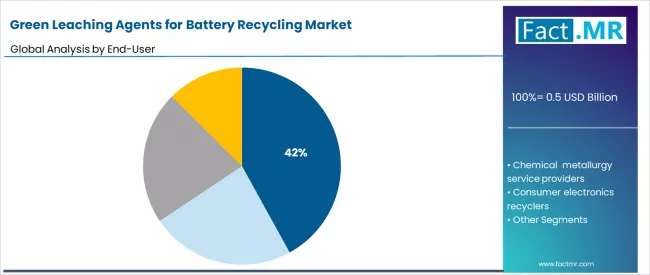
By leaching chemistry, deep eutectic solvents (DES) & ChCl-based systems hold a leading 26% share. Lithium recovery-oriented leachants represent the dominant recovery focus at 28%, while hydrometallurgy with green solvents is the primary process type at 45.00%. Dedicated EV battery recyclers are the leading end-user, accounting for 42.0% market share.

Key Takeaways from the Green Leaching Agents for Battery Recycling Market

  • Market Value for 2026: USD 0.49 Billion
  • Market Value for 2036: USD 1.54 Billion
  • Forecast CAGR (2026-2036): 12.1%
  • Leading Leaching Chemistry Share (2026): Deep Eutectic Solvents (DES) & ChCl-based systems (26%)
  • Leading Recovery Focus Share (2026): Lithium recovery-oriented leachants (28%)
  • Leading Process Type Share (2026): Hydrometallurgy with green solvents (45.00%)
  • Leading End-User Share (2026): Dedicated EV battery recyclers (42.0%)
  • Key Players in the Market: Solvomet, BASF, Umicore
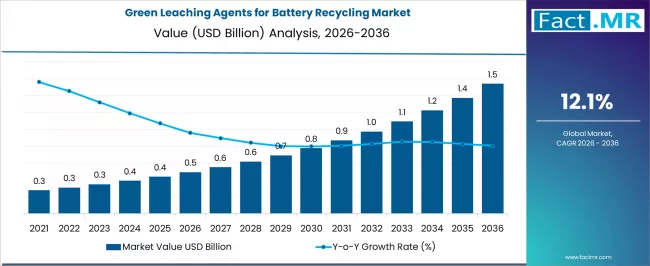
Green Leaching Agents For Battery Recycling Market Market Value Analysis

Defining trends involve the transition from high-temperature pyrometallurgy and aggressive inorganic acid leaching to ambient-temperature, selective, and regenerative solvent systems. Innovation is rapidly advancing in task-specific ionic liquids and bio-derived organic acids that offer high metal selectivity, lower energy intensity, and generate minimal secondary waste. Integration of these benign leachants with direct recycling and cathode-repair processes is becoming critical for achieving closed-loop material recovery with a reduced carbon footprint.

Regulatory frameworks, especially the EU Battery Regulation and its recycling efficiency targets, are mandating the adoption of cleaner, more efficient recycling technologies. Policies penalizing carbon-intensive processes and incentivizing high-purity material recovery are acting as significant market catalysts, positioning green leachants as the core technology for next-generation, sustainable battery recycling ecosystems.

Green Leaching Agents for Battery Recycling Market

Metric Value
Market Value (2026) USD 0.49 Billion
Market Forecast Value (2036) USD 1.54 Billion
Forecast CAGR (2026-2036) 12.1%

Category

Category Segments
Leaching Chemistry & Agent Deep Eutectic Solvents (DES) & ChCl-based systems, Ionic liquids (task-specific ILs), Organic-acid systems (citric, tartaric, oxalic, lactic), Bioleaching & microbial leachants & enzymatic systems, Low-acid & mild reductant systems (sulfite, thiosulfate variants), Solvo-metallurgical solvent-assisted leaching blends, Microwave & assisted green leaching process consumables, Hybrid & proprietary multi-functional reagent blends
Recovery Focus Lithium recovery-oriented leachants, Cobalt & nickel targeted leach systems, Manganese & mixed-oxide recovery, Copper & aluminum deactivation & separation leachants, Rare/critical minor metals (Co-byproducts, REEs), Multi-metal selective leachants (tailored formulations)
Process Type & Approach Hydrometallurgy with green solvents, Bioleaching & biological routes, Solvometallurgy & non-aqueous green solvents, Electro-assisted leaching, Hybrid Flows
End-user Dedicated EV battery recyclers, Chemical & metallurgy service providers, Consumer/electronics recyclers, Research & pilot consortiums
Region North America, Latin America, Western Europe, Eastern Europe, East Asia, South Asia & Pacific, MEA

Segmental Analysis

By Leaching Chemistry, Which System Offers a Tunable, Biodegradable, and Low-Cost Alternative to Traditional Acids?
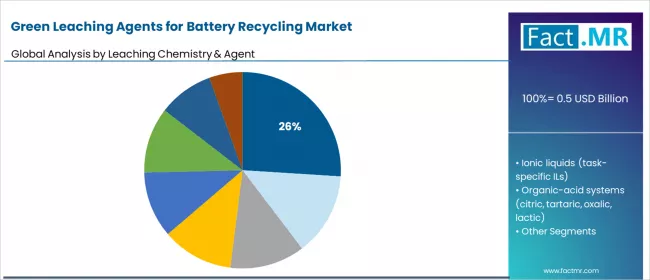
Green Leaching Agents For Battery Recycling Market Analysis By Leaching Chemistry & Agent

Deep Eutectic Solvents (DES) & ChCl-based systems lead the segment with a 26% share. This dominance is due to their unique profile as designer solvents that are often biodegradable, non-flammable, and synthesized from low-cost, renewable precursors. Their properties can be finely tuned for selective metal dissolution, offering high lithium recovery rates at near-ambient temperatures. This combination of environmental benignity, performance, and economic viability positions them as a frontrunner in green hydrometallurgy.

By Recovery Focus, Which Critical Material is the Primary Driver for New Leaching Technologies
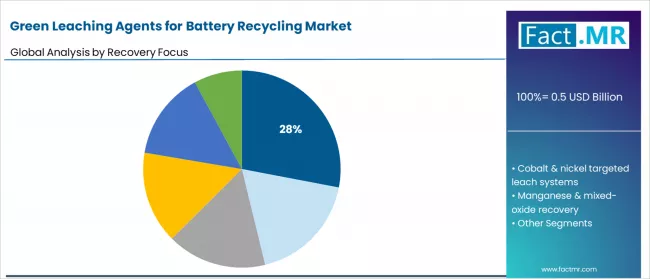
Green Leaching Agents For Battery Recycling Market Analysis By Recovery Focus

?Lithium recovery-oriented leachants command the largest recovery focus share at 28%. Traditional pyrometallurgy fails to recover lithium, and conventional acid leaching faces efficiency and purity challenges. The strategic importance of securing a domestic lithium supply chain, coupled with regulatory recycling efficiency targets that specifically mandate lithium recovery, creates immense demand for novel leachants that can selectively and efficiently extract lithium from complex black mass.

By Process Type, Which Established Method is Being Fundamentally Reformed with Green Chemistry?
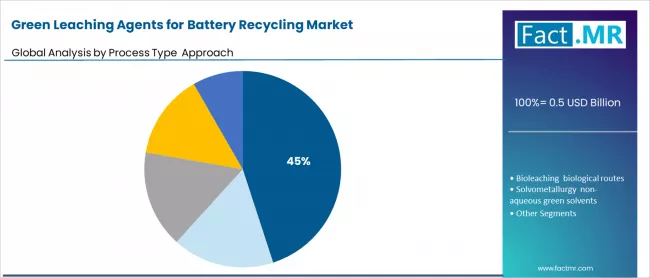
Green Leaching Agents For Battery Recycling Market Analysis By Process Type Approach

Hydrometallurgy with green solvents represents the leading process type at 45.00%. While hydrometallurgy is the established pathway for high-purity metal recovery, it has historically relied on concentrated mineral acids. The shift involves replacing these with the new generation of green solvents (DES, organic acids, ionic liquids) within the familiar hydrometallurgical framework. This allows recyclers to adopt greener chemistry while leveraging existing process knowledge and infrastructure, enabling a more feasible transition.

By End-User, Who is at the Forefront of Scaling Advanced Recycling Infrastructure?
Green Leaching Agents For Battery Recycling Market Analysis By End User

Dedicated EV battery recyclers are the dominant end-user at 42.0%. These specialized players are building large-scale, first-of-their-kind facilities focused exclusively on EV traction batteries. Their business models and investor expectations are predicated on achieving high recovery rates, low emissions, and producing battery-grade output. They are the primary innovators and early adopters, driving demand for advanced, selective, and environmentally sound leaching agents to achieve these goals.

What are the Drivers, Restraints, and Key Trends of the Green Leaching Agents for Battery Recycling Market?

Market growth is driven by stringent new regulations (EU Battery Regulation, US IRA) setting high mandatory recycling efficiency and recovery rates for Li, Co, Ni, and Cu. The economic and supply chain imperative to recapture critical raw materials domestically supports investment in advanced recycling. Growing ESG pressure on automakers and battery producers to ensure a low-carbon, circular lifecycle for their products further propels the adoption of green recycling technologies.

A significant restraint is the current technological immaturity and lack of operational data for many green leachants at commercial scale. The potentially higher reagent cost compared to bulk industrial acids can impact process economics, though this is offset by lower neutralization costs and higher value outputs. Integration of new leaching chemistries into existing or planned recycling plant designs requires careful engineering and poses technical risk. Competition from established pyrometallurgical routes also creates market inertia.

Key trends include the development of "closed-loop" or regenerative leachant systems where the solvent is recovered and reused repeatedly. There is a strong focus on selective leaching formulations that recover individual high-value metals in separate stages, simplifying downstream purification. The use of artificial intelligence for designing task-specific solvents is emerging. Furthermore, partnerships between chemical companies (providing leachants) and recyclers (providing process integration) are becoming essential for commercialization.

Analysis of the Green Leaching Agents for Battery Recycling Market by Key Countries
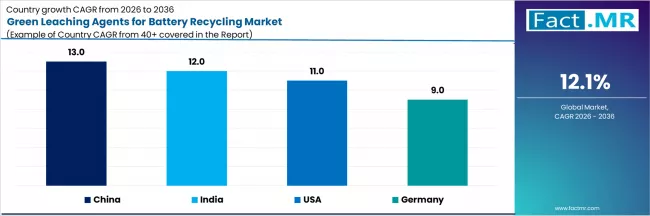
Green Leaching Agents For Battery Recycling Market Cagr Analysis By Country

Country CAGR (2026-2036)
China 13.00%
India 12.00%
USA 11.00%
Germany 9.00%
South Korea 8.50%

How does China's Dominant Battery Production and Strategic Raw Material Security Drive Market Leadership?

China leads with a 13.00% CAGR, driven by its overwhelming volume of end-of-life batteries expected from its domestic EV market and its strategic push for raw material security. Government policies strongly support the build-out of a high-tech, sustainable recycling industry. Domestic chemical and hydrometallurgical research is focused on commercializing cost-effective green leaching systems, particularly for LFP battery recovery, to close the domestic material loop at scale.

Why is India's Focus on Urban Mining and Circular Economy a Key Growth Driver?

India's 12.00% growth is fueled by its limited domestic mineral reserves and a concurrent ambition to become an EV manufacturing hub. This makes urban mining through recycling a national strategic priority. India's strong chemical industry and lower-cost R&D environment are conducive to innovating in bio-based and organic acid leaching systems tailored for the mixed battery streams expected from its rapidly growing market.

What Role does the USA's IRA-Led Push for Domestic Supply Chains and Innovation Play?
Green Leaching Agents For Battery Recycling Market Country Value Analysis

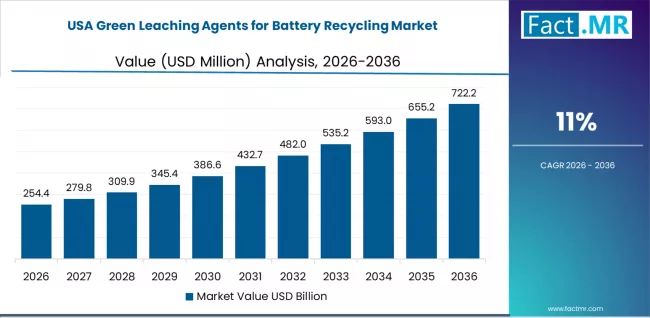
The USA's 11.00% growth is propelled by the Inflation Reduction Act (IRA), which creates powerful incentives for domestic battery material sourcing and recycling. This is catalyzing massive investments in new recycling facilities that are likely to adopt the most advanced, efficient technologies available. A strong national lab system and venture capital are driving innovation in novel solvent extraction and direct recycling methods, creating a premium market for advanced leaching chemistries.

How does Germany's Engineering Leadership and Strict EU Regulatory Framework Influence the Market?

Germany's 9.00% growth reflects its engineering prowess and its central role in implementing the EU's world-leading battery recycling regulations. German chemical companies and recycling plant engineers are at the forefront of developing and integrating high-precision, selective leaching processes that maximize recovery rates to meet and exceed EU targets. The focus is on process efficiency, solvent recyclability, and integration with sophisticated downstream separation technologies.

What Factors Underpin South Korea's Position as a Battery Giant and Closed-Loop Ambition?

South Korea's 8.50% growth is anchored in the presence of global battery cell giants such as LG, SK, and Samsung who are vertically integrating recycling to secure their own supply chains. These companies have the technical capability and strategic need to pilot and scale advanced recycling processes, including green leaching, to recover ultra-high-purity materials suitable for direct reuse in new battery cathode production.

Competitive Landscape of the Green Leaching Agents for Battery Recycling Market
Green Leaching Agents For Battery Recycling Market Analysis By Company

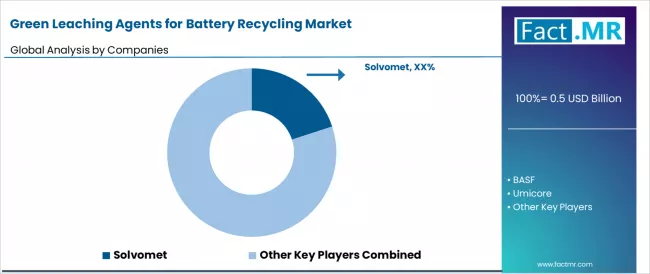
The competitive landscape is emerging and highly R&D-intensive, featuring specialized technology startups, diversified chemical giants, and integrated recyclers. Pure-play technology firms like Solvomet compete by pioneering specific solvent systems (e.g., deep eutectic solvents) and licensing their IP or selling specialized reagent formulations.

Global chemical leaders like BASF leverage their vast expertise in solvent chemistry and metallurgy to develop integrated reagent suites and provide technical solutions for full recycling flowsheets. Integrated recycler-chemical players like Umicore compete from a position of downstream integration, developing proprietary leaching chemistries optimized for their own closed-loop smelting and refining processes. Competition revolves around patent positions, proven metal recovery efficiency and selectivity data, and the ability to form strategic alliances with companies building recycling capacity.

Key Players in the Green Leaching Agents for Battery Recycling Market

  • Solvomet
  • BASF
  • Umicore

Scope of Report

Items Values
Quantitative Units USD Billion
Leaching Chemistry & Agent Deep Eutectic Solvents (DES) & ChCl-based systems, Ionic liquids (task-specific ILs), Organic-acid systems (citric, tartaric, oxalic, lactic), Bioleaching & microbial leachants & enzymatic systems, Low-acid & mild reductant systems (sulfite, thiosulfate variants), Solvometallurgical solvent-assisted leaching blends, Microwave & assisted green leaching process consumables, Hybrid & proprietary multi-functional reagent blends
Recovery Focus Lithium recovery-oriented leachants, Cobalt & nickel targeted leach systems, Manganese & mixed-oxide recovery, Copper & aluminum deactivation & separation leachants, Rare and critical minor metals (Co-byproducts, REEs), Multi-metal selective leachants (tailored formulations)
Process Type & Approach Hydrometallurgy with green solvents, Bioleaching & biological routes, Solvometallurgy & non-aqueous green solvents, Electro-assisted leaching, Hybrid Flows
End-user Dedicated EV battery recyclers, Chemical & metallurgy service providers, Consumer electronics recyclers, Research & pilot consortiums
Key Countries China, India, USA, Germany, South Korea
Key Companies Solvomet, BASF, Umicore
Additional Analysis Analysis of leaching kinetics & selectivity, solvent recovery and recyclability rates, downstream purification complexity, corrosion behavior, cradle-to-gate carbon footprint vs. conventional acids, and techno-economic modeling for green vs. traditional flowsheets.

Green Leaching Agents for Battery Recycling Market by Segments

  • Leaching Chemistry & Agent :

    • Deep Eutectic Solvents (DES) & ChCl-based systems
    • Ionic liquids (task-specific ILs)
    • Organic-acid systems (citric, tartaric, oxalic, lactic)
    • Bioleaching & microbial leachants & enzymatic systems
    • Low-acid & mild reductant systems (sulfite, thiosulfate variants)
    • Solvo-metallurgical solvent-assisted leaching blends
    • Microwave & assisted green leaching process consumables
    • Hybrid & proprietary multi-functional reagent blends
  • Recovery Focus :

    • Lithium recovery-oriented leachants
    • Cobalt & nickel targeted leach systems
    • Manganese & mixed-oxide recovery
    • Copper & aluminum deactivation & separation leachants
    • Rare and critical minor metals (Co-byproducts, REEs)
    • Multi-metal selective leachants (tailored formulations)
  • Process Type & Approach :

    • Hydrometallurgy with green solvents
    • Bioleaching & biological routes
    • Solvometallurgy & non-aqueous green solvents
    • Electro-assisted leaching
    • Hybrid Flows
  • End-User :

    • Dedicated EV battery recyclers
    • Chemical & metallurgy service providers
    • Consumer electronics recyclers
    • Research & pilot consortiums
  • Region :

    • North America

      • USA
      • Canada
    • Latin America

      • Brazil
      • Chile
      • Rest of Latin America
    • Western Europe

      • Germany
      • UK
      • France
      • Spain
      • Italy
      • BENELUX
      • Sweden
      • Rest of Western Europe
    • Eastern Europe

      • Russia
      • Poland
      • Czech Republic
      • Rest of Eastern Europe
    • East Asia

      • China
      • South Korea
      • Japan
      • Rest of East Asia
    • South Asia & Pacific

      • India
      • Australia
      • Indonesia
      • Rest of South Asia & Pacific
    • MEA

      • GCC Countries
      • South Africa
      • Rest of MEA

Table of Content

  1. Executive Summary
    • Global Market Outlook
    • Demand to side Trends
    • Supply to side Trends
    • Technology Roadmap Analysis
    • Analysis and Recommendations
  2. Market Overview
    • Market Coverage / Taxonomy
    • Market Definition / Scope / Limitations
  3. Market Background
    • Market Dynamics
      • Drivers
      • Restraints
      • Opportunity
      • Trends
    • Scenario Forecast
      • Demand in Optimistic Scenario
      • Demand in Likely Scenario
      • Demand in Conservative Scenario
    • Opportunity Map Analysis
    • Product Life Cycle Analysis
    • Supply Chain Analysis
    • Investment Feasibility Matrix
    • Value Chain Analysis
    • PESTLE and Porter’s Analysis
    • Regulatory Landscape
    • Regional Parent Market Outlook
    • Production and Consumption Statistics
    • Import and Export Statistics
  4. Global Market Analysis 2021 to 2025 and Forecast, 2026 to 2036
    • Historical Market Size Value (USD Million) Analysis, 2021 to 2025
    • Current and Future Market Size Value (USD Million) Projections, 2026 to 2036
      • Y to o to Y Growth Trend Analysis
      • Absolute $ Opportunity Analysis
  5. Global Market Pricing Analysis 2021 to 2025 and Forecast 2026 to 2036
  6. Global Market Analysis 2021 to 2025 and Forecast 2026 to 2036, By Leaching Chemistry & Agent
    • Introduction / Key Findings
    • Historical Market Size Value (USD Million) Analysis By Leaching Chemistry & Agent, 2021 to 2025
    • Current and Future Market Size Value (USD Million) Analysis and Forecast By Leaching Chemistry & Agent, 2026 to 2036
      • Deep Eutectic Solvents (DES) & ChCl-based systems
      • Ionic liquids (task-specific ILs)
      • Organic-acid systems (citric, tartaric, oxalic, lactic)
      • Bioleaching microbial leachants & enzymatic systems
      • Low-acid mild reductant systems (sulfite, thiosulfate variants)
      • Solvo-metallurgical solvent-assisted leaching blends
      • Microwave assisted green leaching process consumables
      • Hybrid proprietary multi-functional reagent blends
    • Y to o to Y Growth Trend Analysis By Leaching Chemistry & Agent, 2021 to 2025
    • Absolute $ Opportunity Analysis By Leaching Chemistry & Agent, 2026 to 2036
  7. Global Market Analysis 2021 to 2025 and Forecast 2026 to 2036, By Recovery Focus
    • Introduction / Key Findings
    • Historical Market Size Value (USD Million) Analysis By Recovery Focus, 2021 to 2025
    • Current and Future Market Size Value (USD Million) Analysis and Forecast By Recovery Focus, 2026 to 2036
      • Lithium recovery-oriented leachants
      • Cobalt & nickel targeted leach systems
      • Manganese & mixed-oxide recovery
      • Copper aluminum deactivation separation leachants
      • Rare and critical minor metals (Co-byproducts, REEs)
      • Multi-metal selective leachants (tailored formulations)
    • Y to o to Y Growth Trend Analysis By Recovery Focus, 2021 to 2025
    • Absolute $ Opportunity Analysis By Recovery Focus, 2026 to 2036
  8. Global Market Analysis 2021 to 2025 and Forecast 2026 to 2036, By Process Type Approach
    • Introduction / Key Findings
    • Historical Market Size Value (USD Million) Analysis By Process Type Approach, 2021 to 2025
    • Current and Future Market Size Value (USD Million) Analysis and Forecast By Process Type Approach, 2026 to 2036
      • Hydrometallurgy with green solvents
      • Bioleaching biological routes
      • Solvometallurgy non-aqueous green solvents
      • Electro-assisted leaching
      • Hybrid Flows
    • Y to o to Y Growth Trend Analysis By Process Type Approach, 2021 to 2025
    • Absolute $ Opportunity Analysis By Process Type Approach, 2026 to 2036
  9. Global Market Analysis 2021 to 2025 and Forecast 2026 to 2036, By End-User
    • Introduction / Key Findings
    • Historical Market Size Value (USD Million) Analysis By End-User, 2021 to 2025
    • Current and Future Market Size Value (USD Million) Analysis and Forecast By End-User, 2026 to 2036
      • Dedicated EV battery recyclers
      • Chemical metallurgy service providers
      • Consumer electronics recyclers
      • Research & pilot consortiums
    • Y to o to Y Growth Trend Analysis By End-User, 2021 to 2025
    • Absolute $ Opportunity Analysis By End-User, 2026 to 2036
  10. Global Market Analysis 2021 to 2025 and Forecast 2026 to 2036, By Region
    • Introduction
    • Historical Market Size Value (USD Million) Analysis By Region, 2021 to 2025
    • Current Market Size Value (USD Million) Analysis and Forecast By Region, 2026 to 2036
      • North America
      • Latin America
      • Western Europe
      • Eastern Europe
      • East Asia
      • South Asia and Pacific
      • Middle East & Africa
    • Market Attractiveness Analysis By Region
  11. North America Market Analysis 2021 to 2025 and Forecast 2026 to 2036, By Country
    • Historical Market Size Value (USD Million) Trend Analysis By Market Taxonomy, 2021 to 2025
    • Market Size Value (USD Million) Forecast By Market Taxonomy, 2026 to 2036
      • By Country
        • USA
        • Canada
        • Mexico
      • By Leaching Chemistry & Agent
      • By Recovery Focus
      • By Process Type Approach
      • By End-User
    • Market Attractiveness Analysis
      • By Country
      • By Leaching Chemistry & Agent
      • By Recovery Focus
      • By Process Type Approach
      • By End-User
    • Key Takeaways
  12. Latin America Market Analysis 2021 to 2025 and Forecast 2026 to 2036, By Country
    • Historical Market Size Value (USD Million) Trend Analysis By Market Taxonomy, 2021 to 2025
    • Market Size Value (USD Million) Forecast By Market Taxonomy, 2026 to 2036
      • By Country
        • Brazil
        • Chile
        • Rest of Latin America
      • By Leaching Chemistry & Agent
      • By Recovery Focus
      • By Process Type Approach
      • By End-User
    • Market Attractiveness Analysis
      • By Country
      • By Leaching Chemistry & Agent
      • By Recovery Focus
      • By Process Type Approach
      • By End-User
    • Key Takeaways
  13. Western Europe Market Analysis 2021 to 2025 and Forecast 2026 to 2036, By Country
    • Historical Market Size Value (USD Million) Trend Analysis By Market Taxonomy, 2021 to 2025
    • Market Size Value (USD Million) Forecast By Market Taxonomy, 2026 to 2036
      • By Country
        • Germany
        • UK
        • Italy
        • Spain
        • France
        • Nordic
        • BENELUX
        • Rest of Western Europe
      • By Leaching Chemistry & Agent
      • By Recovery Focus
      • By Process Type Approach
      • By End-User
    • Market Attractiveness Analysis
      • By Country
      • By Leaching Chemistry & Agent
      • By Recovery Focus
      • By Process Type Approach
      • By End-User
    • Key Takeaways
  14. Eastern Europe Market Analysis 2021 to 2025 and Forecast 2026 to 2036, By Country
    • Historical Market Size Value (USD Million) Trend Analysis By Market Taxonomy, 2021 to 2025
    • Market Size Value (USD Million) Forecast By Market Taxonomy, 2026 to 2036
      • By Country
        • Russia
        • Poland
        • Hungary
        • Balkan & Baltic
        • Rest of Eastern Europe
      • By Leaching Chemistry & Agent
      • By Recovery Focus
      • By Process Type Approach
      • By End-User
    • Market Attractiveness Analysis
      • By Country
      • By Leaching Chemistry & Agent
      • By Recovery Focus
      • By Process Type Approach
      • By End-User
    • Key Takeaways
  15. East Asia Market Analysis 2021 to 2025 and Forecast 2026 to 2036, By Country
    • Historical Market Size Value (USD Million) Trend Analysis By Market Taxonomy, 2021 to 2025
    • Market Size Value (USD Million) Forecast By Market Taxonomy, 2026 to 2036
      • By Country
        • China
        • Japan
        • South Korea
      • By Leaching Chemistry & Agent
      • By Recovery Focus
      • By Process Type Approach
      • By End-User
    • Market Attractiveness Analysis
      • By Country
      • By Leaching Chemistry & Agent
      • By Recovery Focus
      • By Process Type Approach
      • By End-User
    • Key Takeaways
  16. South Asia and Pacific Market Analysis 2021 to 2025 and Forecast 2026 to 2036, By Country
    • Historical Market Size Value (USD Million) Trend Analysis By Market Taxonomy, 2021 to 2025
    • Market Size Value (USD Million) Forecast By Market Taxonomy, 2026 to 2036
      • By Country
        • India
        • ASEAN
        • Australia & New Zealand
        • Rest of South Asia and Pacific
      • By Leaching Chemistry & Agent
      • By Recovery Focus
      • By Process Type Approach
      • By End-User
    • Market Attractiveness Analysis
      • By Country
      • By Leaching Chemistry & Agent
      • By Recovery Focus
      • By Process Type Approach
      • By End-User
    • Key Takeaways
  17. Middle East & Africa Market Analysis 2021 to 2025 and Forecast 2026 to 2036, By Country
    • Historical Market Size Value (USD Million) Trend Analysis By Market Taxonomy, 2021 to 2025
    • Market Size Value (USD Million) Forecast By Market Taxonomy, 2026 to 2036
      • By Country
        • Kingdom of Saudi Arabia
        • Other GCC Countries
        • Turkiye
        • South Africa
        • Other African Union
        • Rest of Middle East & Africa
      • By Leaching Chemistry & Agent
      • By Recovery Focus
      • By Process Type Approach
      • By End-User
    • Market Attractiveness Analysis
      • By Country
      • By Leaching Chemistry & Agent
      • By Recovery Focus
      • By Process Type Approach
      • By End-User
    • Key Takeaways
  18. Key Countries Market Analysis
    • USA
      • Pricing Analysis
      • Market Share Analysis, 2025
        • By Leaching Chemistry & Agent
        • By Recovery Focus
        • By Process Type Approach
        • By End-User
    • Canada
      • Pricing Analysis
      • Market Share Analysis, 2025
        • By Leaching Chemistry & Agent
        • By Recovery Focus
        • By Process Type Approach
        • By End-User
    • Mexico
      • Pricing Analysis
      • Market Share Analysis, 2025
        • By Leaching Chemistry & Agent
        • By Recovery Focus
        • By Process Type Approach
        • By End-User
    • Brazil
      • Pricing Analysis
      • Market Share Analysis, 2025
        • By Leaching Chemistry & Agent
        • By Recovery Focus
        • By Process Type Approach
        • By End-User
    • Chile
      • Pricing Analysis
      • Market Share Analysis, 2025
        • By Leaching Chemistry & Agent
        • By Recovery Focus
        • By Process Type Approach
        • By End-User
    • Germany
      • Pricing Analysis
      • Market Share Analysis, 2025
        • By Leaching Chemistry & Agent
        • By Recovery Focus
        • By Process Type Approach
        • By End-User
    • UK
      • Pricing Analysis
      • Market Share Analysis, 2025
        • By Leaching Chemistry & Agent
        • By Recovery Focus
        • By Process Type Approach
        • By End-User
    • Italy
      • Pricing Analysis
      • Market Share Analysis, 2025
        • By Leaching Chemistry & Agent
        • By Recovery Focus
        • By Process Type Approach
        • By End-User
    • Spain
      • Pricing Analysis
      • Market Share Analysis, 2025
        • By Leaching Chemistry & Agent
        • By Recovery Focus
        • By Process Type Approach
        • By End-User
    • France
      • Pricing Analysis
      • Market Share Analysis, 2025
        • By Leaching Chemistry & Agent
        • By Recovery Focus
        • By Process Type Approach
        • By End-User
    • India
      • Pricing Analysis
      • Market Share Analysis, 2025
        • By Leaching Chemistry & Agent
        • By Recovery Focus
        • By Process Type Approach
        • By End-User
    • ASEAN
      • Pricing Analysis
      • Market Share Analysis, 2025
        • By Leaching Chemistry & Agent
        • By Recovery Focus
        • By Process Type Approach
        • By End-User
    • Australia & New Zealand
      • Pricing Analysis
      • Market Share Analysis, 2025
        • By Leaching Chemistry & Agent
        • By Recovery Focus
        • By Process Type Approach
        • By End-User
    • China
      • Pricing Analysis
      • Market Share Analysis, 2025
        • By Leaching Chemistry & Agent
        • By Recovery Focus
        • By Process Type Approach
        • By End-User
    • Japan
      • Pricing Analysis
      • Market Share Analysis, 2025
        • By Leaching Chemistry & Agent
        • By Recovery Focus
        • By Process Type Approach
        • By End-User
    • South Korea
      • Pricing Analysis
      • Market Share Analysis, 2025
        • By Leaching Chemistry & Agent
        • By Recovery Focus
        • By Process Type Approach
        • By End-User
    • Russia
      • Pricing Analysis
      • Market Share Analysis, 2025
        • By Leaching Chemistry & Agent
        • By Recovery Focus
        • By Process Type Approach
        • By End-User
    • Poland
      • Pricing Analysis
      • Market Share Analysis, 2025
        • By Leaching Chemistry & Agent
        • By Recovery Focus
        • By Process Type Approach
        • By End-User
    • Hungary
      • Pricing Analysis
      • Market Share Analysis, 2025
        • By Leaching Chemistry & Agent
        • By Recovery Focus
        • By Process Type Approach
        • By End-User
    • Kingdom of Saudi Arabia
      • Pricing Analysis
      • Market Share Analysis, 2025
        • By Leaching Chemistry & Agent
        • By Recovery Focus
        • By Process Type Approach
        • By End-User
    • Turkiye
      • Pricing Analysis
      • Market Share Analysis, 2025
        • By Leaching Chemistry & Agent
        • By Recovery Focus
        • By Process Type Approach
        • By End-User
    • South Africa
      • Pricing Analysis
      • Market Share Analysis, 2025
        • By Leaching Chemistry & Agent
        • By Recovery Focus
        • By Process Type Approach
        • By End-User
  19. Market Structure Analysis
    • Competition Dashboard
    • Competition Benchmarking
    • Market Share Analysis of Top Players
      • By Regional
      • By Leaching Chemistry & Agent
      • By Recovery Focus
      • By Process Type Approach
      • By End-User
  20. Competition Analysis
    • Competition Deep Dive
      • Solvomet
        • Overview
        • Product Portfolio
        • Profitability by Market Segments (Product/Age /Sales Channel/Region)
        • Sales Footprint
        • Strategy Overview
          • Marketing Strategy
          • Product Strategy
          • Channel Strategy
      • BASF
      • Umicore
  21. Assumptions & Acronyms Used
  22. Research Methodology

List Of Table

  • Table 1: Global Market Value (USD Million) Forecast by Region, 2021 to 2036
  • Table 2: Global Market Value (USD Million) Forecast by Leaching Chemistry & Agent, 2021 to 2036
  • Table 3: Global Market Value (USD Million) Forecast by Recovery Focus, 2021 to 2036
  • Table 4: Global Market Value (USD Million) Forecast by Process Type Approach, 2021 to 2036
  • Table 5: Global Market Value (USD Million) Forecast by End-User, 2021 to 2036
  • Table 6: North America Market Value (USD Million) Forecast by Country, 2021 to 2036
  • Table 7: North America Market Value (USD Million) Forecast by Leaching Chemistry & Agent, 2021 to 2036
  • Table 8: North America Market Value (USD Million) Forecast by Recovery Focus, 2021 to 2036
  • Table 9: North America Market Value (USD Million) Forecast by Process Type Approach, 2021 to 2036
  • Table 10: North America Market Value (USD Million) Forecast by End-User, 2021 to 2036
  • Table 11: Latin America Market Value (USD Million) Forecast by Country, 2021 to 2036
  • Table 12: Latin America Market Value (USD Million) Forecast by Leaching Chemistry & Agent, 2021 to 2036
  • Table 13: Latin America Market Value (USD Million) Forecast by Recovery Focus, 2021 to 2036
  • Table 14: Latin America Market Value (USD Million) Forecast by Process Type Approach, 2021 to 2036
  • Table 15: Latin America Market Value (USD Million) Forecast by End-User, 2021 to 2036
  • Table 16: Western Europe Market Value (USD Million) Forecast by Country, 2021 to 2036
  • Table 17: Western Europe Market Value (USD Million) Forecast by Leaching Chemistry & Agent, 2021 to 2036
  • Table 18: Western Europe Market Value (USD Million) Forecast by Recovery Focus, 2021 to 2036
  • Table 19: Western Europe Market Value (USD Million) Forecast by Process Type Approach, 2021 to 2036
  • Table 20: Western Europe Market Value (USD Million) Forecast by End-User, 2021 to 2036
  • Table 21: Eastern Europe Market Value (USD Million) Forecast by Country, 2021 to 2036
  • Table 22: Eastern Europe Market Value (USD Million) Forecast by Leaching Chemistry & Agent, 2021 to 2036
  • Table 23: Eastern Europe Market Value (USD Million) Forecast by Recovery Focus, 2021 to 2036
  • Table 24: Eastern Europe Market Value (USD Million) Forecast by Process Type Approach, 2021 to 2036
  • Table 25: Eastern Europe Market Value (USD Million) Forecast by End-User, 2021 to 2036
  • Table 26: East Asia Market Value (USD Million) Forecast by Country, 2021 to 2036
  • Table 27: East Asia Market Value (USD Million) Forecast by Leaching Chemistry & Agent, 2021 to 2036
  • Table 28: East Asia Market Value (USD Million) Forecast by Recovery Focus, 2021 to 2036
  • Table 29: East Asia Market Value (USD Million) Forecast by Process Type Approach, 2021 to 2036
  • Table 30: East Asia Market Value (USD Million) Forecast by End-User, 2021 to 2036
  • Table 31: South Asia and Pacific Market Value (USD Million) Forecast by Country, 2021 to 2036
  • Table 32: South Asia and Pacific Market Value (USD Million) Forecast by Leaching Chemistry & Agent, 2021 to 2036
  • Table 33: South Asia and Pacific Market Value (USD Million) Forecast by Recovery Focus, 2021 to 2036
  • Table 34: South Asia and Pacific Market Value (USD Million) Forecast by Process Type Approach, 2021 to 2036
  • Table 35: South Asia and Pacific Market Value (USD Million) Forecast by End-User, 2021 to 2036
  • Table 36: Middle East & Africa Market Value (USD Million) Forecast by Country, 2021 to 2036
  • Table 37: Middle East & Africa Market Value (USD Million) Forecast by Leaching Chemistry & Agent, 2021 to 2036
  • Table 38: Middle East & Africa Market Value (USD Million) Forecast by Recovery Focus, 2021 to 2036
  • Table 39: Middle East & Africa Market Value (USD Million) Forecast by Process Type Approach, 2021 to 2036
  • Table 40: Middle East & Africa Market Value (USD Million) Forecast by End-User, 2021 to 2036

List Of Figures

  • Figure 1: Global Market Pricing Analysis
  • Figure 2: Global Market Value (USD Million) Forecast 2021 to 2036
  • Figure 3: Global Market Value Share and BPS Analysis by Leaching Chemistry & Agent, 2026 and 2036
  • Figure 4: Global Market Y to o to Y Growth Comparison by Leaching Chemistry & Agent, 2026 to 2036
  • Figure 5: Global Market Attractiveness Analysis by Leaching Chemistry & Agent
  • Figure 6: Global Market Value Share and BPS Analysis by Recovery Focus, 2026 and 2036
  • Figure 7: Global Market Y to o to Y Growth Comparison by Recovery Focus, 2026 to 2036
  • Figure 8: Global Market Attractiveness Analysis by Recovery Focus
  • Figure 9: Global Market Value Share and BPS Analysis by Process Type Approach, 2026 and 2036
  • Figure 10: Global Market Y to o to Y Growth Comparison by Process Type Approach, 2026 to 2036
  • Figure 11: Global Market Attractiveness Analysis by Process Type Approach
  • Figure 12: Global Market Value Share and BPS Analysis by End-User, 2026 and 2036
  • Figure 13: Global Market Y to o to Y Growth Comparison by End-User, 2026 to 2036
  • Figure 14: Global Market Attractiveness Analysis by End-User
  • Figure 15: Global Market Value (USD Million) Share and BPS Analysis by Region, 2026 and 2036
  • Figure 16: Global Market Y to o to Y Growth Comparison by Region, 2026 to 2036
  • Figure 17: Global Market Attractiveness Analysis by Region
  • Figure 18: North America Market Incremental Dollar Opportunity, 2026 to 2036
  • Figure 19: Latin America Market Incremental Dollar Opportunity, 2026 to 2036
  • Figure 20: Western Europe Market Incremental Dollar Opportunity, 2026 to 2036
  • Figure 21: Eastern Europe Market Incremental Dollar Opportunity, 2026 to 2036
  • Figure 22: East Asia Market Incremental Dollar Opportunity, 2026 to 2036
  • Figure 23: South Asia and Pacific Market Incremental Dollar Opportunity, 2026 to 2036
  • Figure 24: Middle East & Africa Market Incremental Dollar Opportunity, 2026 to 2036
  • Figure 25: North America Market Value Share and BPS Analysis by Country, 2026 and 2036
  • Figure 26: North America Market Value Share and BPS Analysis by Leaching Chemistry & Agent, 2026 and 2036
  • Figure 27: North America Market Y to o to Y Growth Comparison by Leaching Chemistry & Agent, 2026 to 2036
  • Figure 28: North America Market Attractiveness Analysis by Leaching Chemistry & Agent
  • Figure 29: North America Market Value Share and BPS Analysis by Recovery Focus, 2026 and 2036
  • Figure 30: North America Market Y to o to Y Growth Comparison by Recovery Focus, 2026 to 2036
  • Figure 31: North America Market Attractiveness Analysis by Recovery Focus
  • Figure 32: North America Market Value Share and BPS Analysis by Process Type Approach, 2026 and 2036
  • Figure 33: North America Market Y to o to Y Growth Comparison by Process Type Approach, 2026 to 2036
  • Figure 34: North America Market Attractiveness Analysis by Process Type Approach
  • Figure 35: North America Market Value Share and BPS Analysis by End-User, 2026 and 2036
  • Figure 36: North America Market Y to o to Y Growth Comparison by End-User, 2026 to 2036
  • Figure 37: North America Market Attractiveness Analysis by End-User
  • Figure 38: Latin America Market Value Share and BPS Analysis by Country, 2026 and 2036
  • Figure 39: Latin America Market Value Share and BPS Analysis by Leaching Chemistry & Agent, 2026 and 2036
  • Figure 40: Latin America Market Y to o to Y Growth Comparison by Leaching Chemistry & Agent, 2026 to 2036
  • Figure 41: Latin America Market Attractiveness Analysis by Leaching Chemistry & Agent
  • Figure 42: Latin America Market Value Share and BPS Analysis by Recovery Focus, 2026 and 2036
  • Figure 43: Latin America Market Y to o to Y Growth Comparison by Recovery Focus, 2026 to 2036
  • Figure 44: Latin America Market Attractiveness Analysis by Recovery Focus
  • Figure 45: Latin America Market Value Share and BPS Analysis by Process Type Approach, 2026 and 2036
  • Figure 46: Latin America Market Y to o to Y Growth Comparison by Process Type Approach, 2026 to 2036
  • Figure 47: Latin America Market Attractiveness Analysis by Process Type Approach
  • Figure 48: Latin America Market Value Share and BPS Analysis by End-User, 2026 and 2036
  • Figure 49: Latin America Market Y to o to Y Growth Comparison by End-User, 2026 to 2036
  • Figure 50: Latin America Market Attractiveness Analysis by End-User
  • Figure 51: Western Europe Market Value Share and BPS Analysis by Country, 2026 and 2036
  • Figure 52: Western Europe Market Value Share and BPS Analysis by Leaching Chemistry & Agent, 2026 and 2036
  • Figure 53: Western Europe Market Y to o to Y Growth Comparison by Leaching Chemistry & Agent, 2026 to 2036
  • Figure 54: Western Europe Market Attractiveness Analysis by Leaching Chemistry & Agent
  • Figure 55: Western Europe Market Value Share and BPS Analysis by Recovery Focus, 2026 and 2036
  • Figure 56: Western Europe Market Y to o to Y Growth Comparison by Recovery Focus, 2026 to 2036
  • Figure 57: Western Europe Market Attractiveness Analysis by Recovery Focus
  • Figure 58: Western Europe Market Value Share and BPS Analysis by Process Type Approach, 2026 and 2036
  • Figure 59: Western Europe Market Y to o to Y Growth Comparison by Process Type Approach, 2026 to 2036
  • Figure 60: Western Europe Market Attractiveness Analysis by Process Type Approach
  • Figure 61: Western Europe Market Value Share and BPS Analysis by End-User, 2026 and 2036
  • Figure 62: Western Europe Market Y to o to Y Growth Comparison by End-User, 2026 to 2036
  • Figure 63: Western Europe Market Attractiveness Analysis by End-User
  • Figure 64: Eastern Europe Market Value Share and BPS Analysis by Country, 2026 and 2036
  • Figure 65: Eastern Europe Market Value Share and BPS Analysis by Leaching Chemistry & Agent, 2026 and 2036
  • Figure 66: Eastern Europe Market Y to o to Y Growth Comparison by Leaching Chemistry & Agent, 2026 to 2036
  • Figure 67: Eastern Europe Market Attractiveness Analysis by Leaching Chemistry & Agent
  • Figure 68: Eastern Europe Market Value Share and BPS Analysis by Recovery Focus, 2026 and 2036
  • Figure 69: Eastern Europe Market Y to o to Y Growth Comparison by Recovery Focus, 2026 to 2036
  • Figure 70: Eastern Europe Market Attractiveness Analysis by Recovery Focus
  • Figure 71: Eastern Europe Market Value Share and BPS Analysis by Process Type Approach, 2026 and 2036
  • Figure 72: Eastern Europe Market Y to o to Y Growth Comparison by Process Type Approach, 2026 to 2036
  • Figure 73: Eastern Europe Market Attractiveness Analysis by Process Type Approach
  • Figure 74: Eastern Europe Market Value Share and BPS Analysis by End-User, 2026 and 2036
  • Figure 75: Eastern Europe Market Y to o to Y Growth Comparison by End-User, 2026 to 2036
  • Figure 76: Eastern Europe Market Attractiveness Analysis by End-User
  • Figure 77: East Asia Market Value Share and BPS Analysis by Country, 2026 and 2036
  • Figure 78: East Asia Market Value Share and BPS Analysis by Leaching Chemistry & Agent, 2026 and 2036
  • Figure 79: East Asia Market Y to o to Y Growth Comparison by Leaching Chemistry & Agent, 2026 to 2036
  • Figure 80: East Asia Market Attractiveness Analysis by Leaching Chemistry & Agent
  • Figure 81: East Asia Market Value Share and BPS Analysis by Recovery Focus, 2026 and 2036
  • Figure 82: East Asia Market Y to o to Y Growth Comparison by Recovery Focus, 2026 to 2036
  • Figure 83: East Asia Market Attractiveness Analysis by Recovery Focus
  • Figure 84: East Asia Market Value Share and BPS Analysis by Process Type Approach, 2026 and 2036
  • Figure 85: East Asia Market Y to o to Y Growth Comparison by Process Type Approach, 2026 to 2036
  • Figure 86: East Asia Market Attractiveness Analysis by Process Type Approach
  • Figure 87: East Asia Market Value Share and BPS Analysis by End-User, 2026 and 2036
  • Figure 88: East Asia Market Y to o to Y Growth Comparison by End-User, 2026 to 2036
  • Figure 89: East Asia Market Attractiveness Analysis by End-User
  • Figure 90: South Asia and Pacific Market Value Share and BPS Analysis by Country, 2026 and 2036
  • Figure 91: South Asia and Pacific Market Value Share and BPS Analysis by Leaching Chemistry & Agent, 2026 and 2036
  • Figure 92: South Asia and Pacific Market Y to o to Y Growth Comparison by Leaching Chemistry & Agent, 2026 to 2036
  • Figure 93: South Asia and Pacific Market Attractiveness Analysis by Leaching Chemistry & Agent
  • Figure 94: South Asia and Pacific Market Value Share and BPS Analysis by Recovery Focus, 2026 and 2036
  • Figure 95: South Asia and Pacific Market Y to o to Y Growth Comparison by Recovery Focus, 2026 to 2036
  • Figure 96: South Asia and Pacific Market Attractiveness Analysis by Recovery Focus
  • Figure 97: South Asia and Pacific Market Value Share and BPS Analysis by Process Type Approach, 2026 and 2036
  • Figure 98: South Asia and Pacific Market Y to o to Y Growth Comparison by Process Type Approach, 2026 to 2036
  • Figure 99: South Asia and Pacific Market Attractiveness Analysis by Process Type Approach
  • Figure 100: South Asia and Pacific Market Value Share and BPS Analysis by End-User, 2026 and 2036
  • Figure 101: South Asia and Pacific Market Y to o to Y Growth Comparison by End-User, 2026 to 2036
  • Figure 102: South Asia and Pacific Market Attractiveness Analysis by End-User
  • Figure 103: Middle East & Africa Market Value Share and BPS Analysis by Country, 2026 and 2036
  • Figure 104: Middle East & Africa Market Value Share and BPS Analysis by Leaching Chemistry & Agent, 2026 and 2036
  • Figure 105: Middle East & Africa Market Y to o to Y Growth Comparison by Leaching Chemistry & Agent, 2026 to 2036
  • Figure 106: Middle East & Africa Market Attractiveness Analysis by Leaching Chemistry & Agent
  • Figure 107: Middle East & Africa Market Value Share and BPS Analysis by Recovery Focus, 2026 and 2036
  • Figure 108: Middle East & Africa Market Y to o to Y Growth Comparison by Recovery Focus, 2026 to 2036
  • Figure 109: Middle East & Africa Market Attractiveness Analysis by Recovery Focus
  • Figure 110: Middle East & Africa Market Value Share and BPS Analysis by Process Type Approach, 2026 and 2036
  • Figure 111: Middle East & Africa Market Y to o to Y Growth Comparison by Process Type Approach, 2026 to 2036
  • Figure 112: Middle East & Africa Market Attractiveness Analysis by Process Type Approach
  • Figure 113: Middle East & Africa Market Value Share and BPS Analysis by End-User, 2026 and 2036
  • Figure 114: Middle East & Africa Market Y to o to Y Growth Comparison by End-User, 2026 to 2036
  • Figure 115: Middle East & Africa Market Attractiveness Analysis by End-User
  • Figure 116: Global Market - Tier Structure Analysis
  • Figure 117: Global Market - Company Share Analysis

- FAQs -

How big is the green leaching agents for battery recycling market in 2026?

The global green leaching agents for battery recycling market is estimated to be valued at USD 0.5 billion in 2026.

What will be the size of green leaching agents for battery recycling market in 2036?

The market size for the green leaching agents for battery recycling market is projected to reach USD 1.5 billion by 2036.

How much will be the green leaching agents for battery recycling market growth between 2026 and 2036?

The green leaching agents for battery recycling market is expected to grow at a 12.1% CAGR between 2026 and 2036.

What are the key product types in the green leaching agents for battery recycling market?

The key product types in green leaching agents for battery recycling market are deep eutectic solvents (des) & chcl-based systems, ionic liquids (task-specific ils), organic-acid systems (citric, tartaric, oxalic, lactic), bioleaching microbial leachants & enzymatic systems, low-acid mild reductant systems (sulfite, thiosulfate variants), solvo-metallurgical solvent-assisted leaching blends, microwave assisted green leaching process consumables and hybrid proprietary multi-functional reagent blends.

Which recovery focus segment to contribute significant share in the green leaching agents for battery recycling market in 2026?

In terms of recovery focus, lithium recovery-oriented leachants segment to command 28.0% share in the green leaching agents for battery recycling market in 2026.

Green Leaching Agents for Battery Recycling Market