- Forecast Value (2035): 9.7 Bn
- CAGR (2035): 10.5%
Bioelectric Catheters Market Outlook 2025 to 2035
The global bioelectric catheters market is expected to reach USD 9.7 Billion by 2035, up from estimated value of USD 3.6 Billion in 2025. During the forecast period 2025 to 2035, the industry is projected to expand at a CAGR of 10.4%.
The main trends in the bioelectric catheters market include the growing rates of cardiovascular and neurological diseases, the growing popularity of minimal invasive surgeries, the rapid development of artificial intelligence and IoT-based catheter systems, and the growing significance of research and development. These aspects together are driving the adoption, enhancing procedural accuracy, and patient outcomes in hospitals and specialty clinics all over the world.
Quick Stats for Bioelectric Catheters Market
- Industry Value (2025): USD 3.6 Billion
- Projected Value (2035): USD 9.7 Billion
- Forecast CAGR (2025 to 2035): 10.4%
- Leading Segment (2025): Therapeutic Catheters (60% Market Share)
- Fastest Growing Country (2025-2035): Japan (9.9% CAGR)
- Top Key Players:are Medtronic, Boston Scientific Corp., Biosense Webster, Abbott Laboratories, Biotronik SE & Co. KG, and LivaNova PLC.
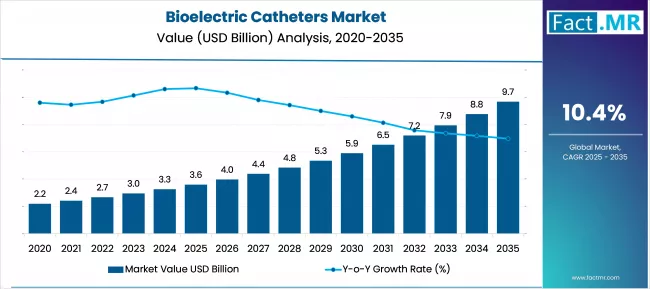
Bioelectric Catheters Market Market Value Analysis | Source: Fact.MR
What are the key factors driving growth in the Bioelectric Catheters Market?
The growing number of cardiovascular and neurological conditions is one of the driving forces, leading to the need to use advanced diagnostic and therapeutic instruments. Minimal invasive processes are preferred by clinicians because of less time to recover and better results on the patient. On-going technological improvements, such as AI-based mapping, real-time scanning, and drug eluting functions, increase the accuracy of the procedures.
Increasing investment into the area of research and development and the increased focus on catheter-based interventions only catalyze further market growth throughout hospitals, specialty clinics, and outpatient care centers worldwide.
What are the key trends driving growth in the Bioelectric Catheters market?
The market is characterized by the integration of AI, IoT, and smart mapping that is also a major trend. Smart catheters make it possible to predict, improve the accuracy of the procedure, and provide custom care to patients. Increasing attention is given to minimal invasive treatments, digitization of health, and compatibility of telemedicine. Bioelectric catheters are progressively made of flexible, polymer-based materials with infection resistant coating. Implementation of AI-assisted diagnostics and AR-guided navigation is revolutionizing surgical processes, as it is safer and more efficient and can be used in a variety of situations.
What factors hinder the growth of the Bioelectric Catheters market?
Advanced bioelectric catheter systems and related technologies are expensive, and this prevents their application in cost-conscious areas. Market entry into new innovations is sluggish by regulatory complexities and the requirement to undergo extensive clinical validation. Talented employee needs and specialized training on the use of the devices also become a hindrance. Also, there are risks of procedural complications, reimbursement problems and low adoption in the emerging markets limit growth. The factors will involve strategic pricing, training programs and regulatory support towards wider use of bioelectric catheters in the world.
What are the key regional trends driving the Bioelectric Catheters Market growth?
North America
The bioelectric catheters market is dominated by North America because of the developed healthcare facilities, high usage of minimally invasive surgeries, and high investment in research and development by the leading medtech manufacturers. The growth of the market in the field of cardiology and neurology application occurs through strategic partnerships and the integration of AI- and IoT-enabled solutions.
East Asia
East Asia has experienced rapid development due to modernization of healthcare, innovation being promoted by the government, and increased cardiovascular and neurological diseases prevalence. Manufacturers of the locality concentrate on cost-effective and technologically advanced catheters, whereas AI-supported and real-time monitoring solutions are actively introduced in hospitals.
Western Europe
The market development in Western Europe is driven by accuracy in healthcare, technology and high levels of clinical adoption of catheter-based intervention. Specialize in least invasive treatment, AR-guided treatment and high regulation compliance guarantee quality and safety of bioelectric catheter solutions in hospitals and specialist clinics.
Country-wise Outlook
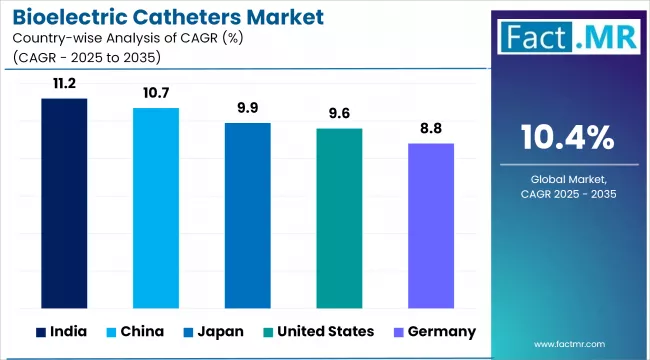
Bioelectric Catheters Market Cagr Analysis By Country | Source: Fact.MR
Innovation and Clinical Leadership Drive the United States’ Bioelectric Catheters Market
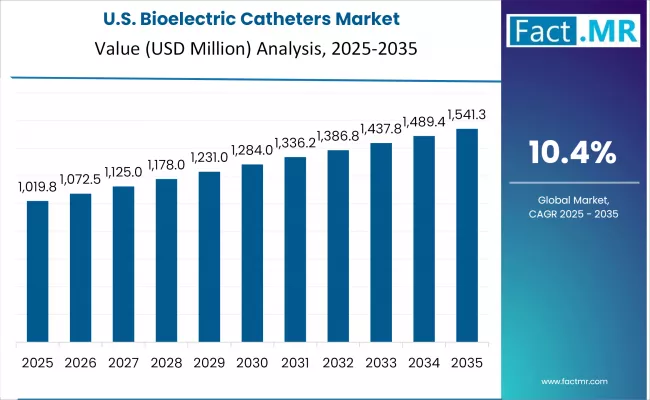
Bioelectric Catheters Market Country Value Analysis | Source: Fact.MR
U.S. market is developing at a fast pace due to the presence of efficient healthcare system, powerful research environment, and the favorable regulatory climate. Medtech major corporations and start-ups are facilitating adoption in cardiology, neurology and urology sectors via clinical trials and pilot projects. High-performance and safe solutions are validated at universities and hospitals, whereas strategic partnerships and venture capital aid the design of AI- and IoT-connected bioelectric catheters. Clinical skills and innovations put the U.S. in a position to lead the world in the use of bioelectric catheters.
Engineering Excellence and Precision Drive Germany’s Bioelectric Catheters Market
The engineering excellence, superiority of medical technology ecosystem and high uptake of minimally invasive procedures are some of the strengths of the German market that support the market growth. Research institutions and hospitals work together with local and international medtech companies to implement the use of bioelectric catheters in cardiology and neurology. A reliable performance is achieved through constant innovation in the catheter design, integration of real-time monitoring, and regulatory compliance. The attention to precision healthcare and good manufacturing capabilities in the country have put Germany in a position to be the center of high-quality and technologically advance bioelectric catheter solutions.
Technological Advancement and Digital Integration Shape Japan’s Bioelectric Catheters Market
The bioelectric catheters market in Japan is influenced by the precision engineering, excellent adoption of digital health, and emphasis on the minimally invasive operation. The leaders of domestic technologies take part with hospitals to introduce AR- and AI-managed catheters in cardiology, neurology, and urology. The digitized healthcare ecosystem in the country, the presence of robust robotics, favors the incorporation of real-time monitoring and predictive analytics. Practical and miniature catheter designs which match the workflow of surgery, and government-based innovation programs, expand adoption, making Japan a major hub of clinical innovation in the Asian region.
Category-Wise Market Outlook
Therapeutic Catheters Drive Product Type Growth
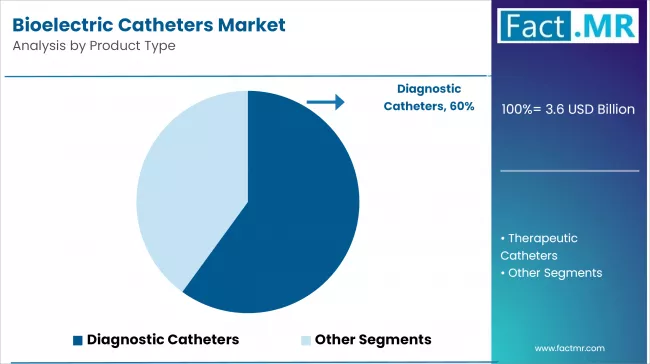
Bioelectric Catheters Market Analysis By Product Type | Source: Fact.MR
In the product type, therapeutic catheters are expanding at the dominant rate, particularly ablation catheters. Their growing use is predetermined by the growing number of cardiac arrhythmia and the need to have minimally invasive operations. Ablation catheters allow specific targeting of the abnormal tissue to normalize the heart rhythms of a patient, which will enhance patient recovery and decrease hospitalization. Future innovations in catheter tip design, energy delivery techniques and integration of real time mapping are further increasing their application in cardiac care across the globe.
Polymer-Based Catheters Lead Material Adoption
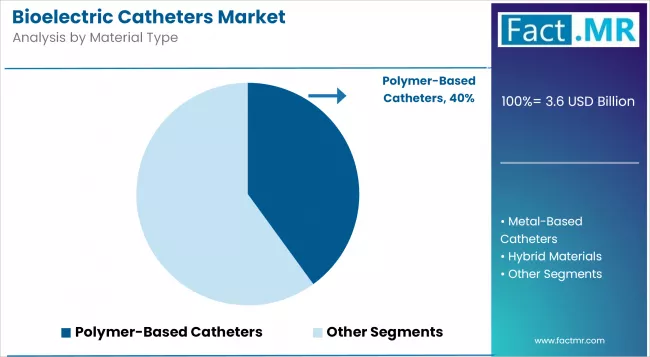
Bioelectric Catheters Market Analysis By Material Type | Source: Fact.MR
The rapidly growing material subsegment is polymer-based catheters because of flexibility, biocompatibility as well as navigation through tortuous vessels. They minimize patient pain and procedural complexities with respect to metal designs. The development of polymer engineering, e.g., polymer durability, infection prevention coating, and bioelectric monitoring incorporation, is taking the world by storm in cardiac, neurological, and urological applications.
Cardiology Emerges as Rapidly Growing Application
The rapidly growing extent of application is cardiology, especially arrhythmia management and cardiac mapping and ablation. Demand is driving the increased use of cardiovascular disease, which has been coupled with the transition to less invasive operations. Bioelectric catheters can provide specific diagnosis, real-time mapping, and specific therapy, which leads to an increase in the success rates of procedures. Implementation of AI-aided diagnostics and remote monitoring applications also creates greater uptake velocity, which means cardiology becomes the key catalyst of application growth in the Bioelectric Catheters Market.
Competitive Analysis
Competitive Outlook: Bioelectric Catheters Market
Bioelectric Catheters Market is also highly competitive as it runs the leading medical device business with the leading corporations such as Medtronic, Boston Scientific Corp., Biosense Webster, Abbott Laboratories, Biotronik SE & Co. KG and LivaNova PLC. These companies are relying on their background in cardiac care and electrophysiology to introduce new designs of catheters, new mapping technology and minimally invasive solutions. Their market positions are consolidated through their products launches and clinical trial developments and research and development investments, and they can meet the growing prevalence and demand of precision therapies in the cardiovascular disease market around the world.
The small companies such as CathRx Ltd., MicroPort Scientific Corp., Lepu Medical Technology, Terumo Corporation, Philips Healthcare, and Siemens Healthineers enhance the competition by providing niche innovations, creating alliances and establishing regional expansion policies. The intensity of competition is also increased by the fact that the focus was on the application of AI, real-time analytics of data, and IoT-readable monitoring of the catheter solutions. Collectively, these companies are leading to a pace of technological advances, an active pipeline on innovativeness and a fast-paced ecosystem that is driven by efficiency, safety, and clinical effectiveness.
Key players in the Bioelectric Catheters market are Medtronic, Boston Scientific Corp., Biosense Webster, Abbott Laboratories, Biotronik SE & Co. KG, LivaNova PLC, CathRx Ltd., MicroPort Scientific Corp., Lepu Medical Technology, Terumo Corporation, Philips Healthcare, Siemens Healthineers.
Recent Development
- In December 2024, Pulse Biosciences released study results for its Nanosecond PFA 360° Cardiac Catheter System. The system employs proprietary Nanosecond Pulsed Field Ablation (nsPFA) technology to treat atrial fibrillation. Initial studies involving 77 patients showed strong pulmonary vein isolation with short procedure times, indicating promising safety and efficacy profiles.
- In July 2024, Route 92 Medical announced the commercial launch of the FreeClimb® 88 catheter system. This FDA-cleared system is designed for neurovascular interventions, providing reliable navigation through tortuous anatomy. It includes the FreeClimb 88 catheter and the Tenzing® 8 delivery catheter, offering clinicians flexibility in reaching targeted locations in the neurovasculature.
Fact.MR has provided detailed information about the price points of key manufacturers of Bioelectric Catheters market positioned across regions, sales growth, production capacity, and speculative technological expansion, in the recently published report.
Methodology and Industry Tracking Approach
The bioelectric catheters market survey Data is offered by Fact.MR, and was done in 2025, involving more than 10,000 respondents, with the country-specific respondents being at least 250. They were mainly end-users (around 2/3), including healthcare providers, manufacturers, energy operators, and smart infrastructure operators, and the rest of the participants were industry experts, device developers, regulatory experts, consultants, and technology advisors. Held in the period between September 2024 and August 2025, the survey looked at adoption behavior, AI and IoT integration, regulatory factors, and innovations that define the next generation bioelectric catheter solutions.
In order to reinforce the analysis, over 250 secondary sources (patent, product introduction, industry guideline, and sustainability report) were analyzed with the help of advanced modeling and predictive analytics. The analysis of the market dates back to 2018 and analyzes the maturity of technologies and their adoption, as well as the changing regulatory needs. The report 2025 offers practical information, strategic generic recommendations, and future guidelines to enable stakeholders to navigate and emerge successful in the rapidly developing Bioelectric Catheters Market.
Segmentation
Segmentation of Bioelectric Catheters Market Research
-
By Product Type :
- Diagnostic Catheters
- Electrophysiology Catheters
- Mapping Catheters
- Therapeutic Catheters
- Ablation Catheters
- Drug-Eluting Catheters
- Diagnostic Catheters
-
By Material Type :
- Polymer-Based Catheters
- Metal-Based Catheters
- Hybrid Materials
-
By Application :
- Cardiology
- Arrhythmia Management
- Cardiac Mapping & Ablation
- Neurology
- Urology
- Other Therapeutic Applications
- Cardiology
-
By End User :
- Hospitals
- Cardiac Care Centers
- Ambulatory Surgical Centers
- Research & Diagnostic Laboratories
-
By Region :
- North America
- Latin America
- Western Europe
- Eastern Europe
- East Asia
- South Asia & Pacific
- Middle East & Africa
Frequently Asked Questions
What was the Global Bioelectric Catheters Market Size Reported by Fact.MR for 2025?
Who are the Major Players Operating in the Bioelectric Catheters Market?
What is the Estimated Valuation of the Bioelectric Catheters Market in 2035?
What Value CAGR did the Bioelectric Catheters Market Exhibit Over the Last Five Years?
Who worked on this report


Preview the report firsthand - request a free sample
Free SampleGet the brochure for pricing and purchase details
Download PDF