Menopause Market

Menopause Market Size and Share Forecast Outlook 2026 to 2036

Menopause market is projected to grow from USD 18.7 billion in 2026 to USD 31.8 billion by 2036, at a CAGR of 5.5%. Dietary Supplements will dominate with a 94.0% market share, while will lead the segment with a 0.0% share.

Menopause Market Forecast and Outlook 2026 to 2036

The global menopause market is set to grow from USD 18.7 billion in 2026 to USD 31.8 billion by 2036, advancing at a CAGR of 5.5%. Growth is driven by escalating demand for symptom management validation, expanding women's health awareness across developed markets, and accelerating aging population demographics among healthcare and consumer organizations seeking effective relief solutions.

Key Takeaways from the Menopause Market

  • Menopause Market Value (2026): USD 18.7 billion
  • Menopause Market Forecast Value (2036): USD 31.8 billion
  • Menopause Market Forecast CAGR: 5.5%
  • Leading Treatment in Menopause Market: Dietary Supplements (94.0%)
  • Key Growth Regions in Menopause Market: Asia Pacific, North America, and Latin America
  • Top Players in Menopause Market: Bayer AG, Theramex, AbbVie Inc., Pure Encapsulations LLC, Dr. Reddy's Laboratories Ltd.
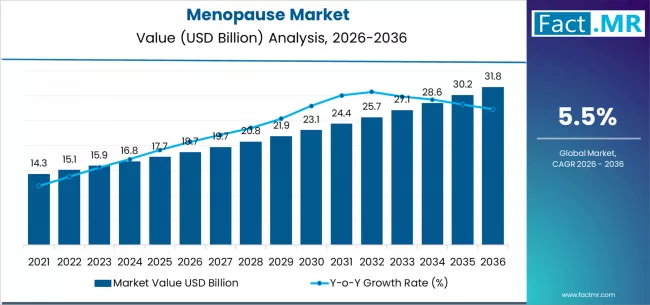
Menopause Market Market Value Analysis

Menopause management technologies are increasingly recognized as essential products for women's health practitioners, offering precise symptom alleviation capabilities, hormonal balance assurance, and comprehensive wellness characteristics compared to traditional hormone therapy approaches.

Dietary supplements dominate the market, favored in natural wellness and preventive health environments for their established safety properties, providing botanical-based mechanisms, multifunctional benefits capabilities, and consumer acceptance across diverse symptom management applications and demographic segments.

Natural remedies remain fundamental in menopause management protocols where holistic symptom relief and hormonal support match consumer requirements and wellness confidence standards. Dietary Supplement users are advancing among treatment categories as specialized natural health networks expand and women's wellness infrastructure increases accessibility in retail-convenient locations with comprehensive product structures.

Menopause Market

Metric Value
Market Value (2026) USD 18.7 billion
Market Forecast (2036) USD 31.8 billion
Growth Rate 5.5% CAGR

Category

Category Segments
Treatment Dietary Supplements; OTC Pharmaceutical Products (Hormonal Products; Non-hormonal Products)
Region North America; Europe; Asia Pacific; Latin America; Middle East & Africa

Segmental Analysis

What makes Dietary Supplements Command the Largest Share in the Menopause Market?
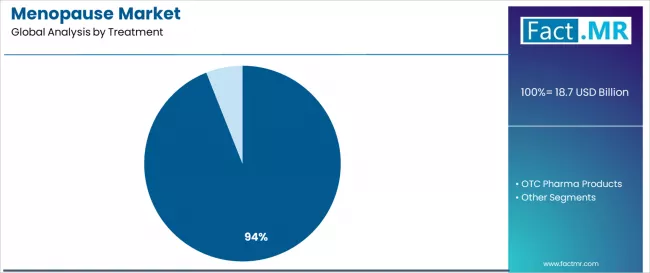
Menopause Market Analysis By Treatment

Dietary supplements command the leading position in the menopause market with a 94.0% market share through superior natural wellness characteristics, including established botanical efficacy presence, extensive safety documentation, and proven multi-symptom pathways that enable women to achieve predictable relief outcomes across varied symptom categories and diverse demographic segments.

The segment benefits from holistic advantages through multiple symptom management optimization, natural ingredient appeal without synthetic hormone concerns, and established consumer trust documentation without requiring prescription procedures. Advanced formulation technology enables black cohosh optimization, soy isoflavone variation, and red clover customization, where symptom relief and safety represent critical wellness requirements. Botanical formulations hold significant share within the Dietary Supplements segment, appealing to women seeking plant-based relief capabilities for hot flashes and night sweats.

What are the Drivers, Restraints, and Key Trends of the Menopause Market?

The menopause market is driven by a growing aging female population and rising life expectancy, which are extending the number of years women spend in post-menopausal stages. Increasing awareness and destigmatization of menopause are encouraging more women to seek symptom management and wellness solutions. Strong consumer preference for natural, botanical, and hormone-free products is further expanding demand beyond traditional prescription therapies.

Market restraints include limited and inconsistent clinical evidence supporting the efficacy of many botanical and supplement-based products, which reduces confidence among medically guided consumers and women with severe symptoms. Regulatory variation across regions and restrictions on health claims also limit product positioning and slow market expansion in tightly regulated jurisdictions.

Key trends include the shift toward personalized and symptom-specific menopause formulations, reflecting demand for targeted wellness approaches. Integration of digital health tools, such as symptom-tracking apps and telemedicine consultations, is also gaining traction, enabling more informed decision-making, better adherence, and connected menopause management ecosystems.

Analysis of the Menopause Market by Key Countries
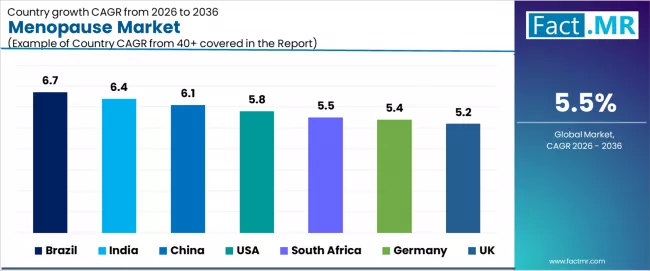
Menopause Market Cagr Analysis By Country

Country CAGR 2026-2036
Brazil 6.7%
India 6.4%
China 6.1%
USA 5.8%
South Africa 5.5%
Germany 5.4%
UK 5.2%

Why is Brazil Emerging as the Fastest-Growing Market for Menopause Products?

Brazil is recording the fastest growth in menopause products, expanding at a 6.7% CAGR through 2036, as women’s health awareness steadily improves across urban populations. Rising obesity-linked symptom severity and a growing menopausal demographic are pushing demand for affordable, natural solutions.

Major cities such as São Paulo, Rio de Janeiro, and Brasília are driving adoption through retail pharmacies and wellness stores, where international formulations increasingly sit alongside familiar natural remedies. Consumer trust is shaped by accessibility, price sensitivity, and perceived effectiveness rather than medicalization.

How is India Shaping Demand through Ayurvedic and Botanical Solutions?

India’s market is growing at a 6.4% CAGR, anchored in strong consumer preference for Ayurvedic and plant-based menopause supplements. Urban centers including Mumbai, Delhi, and Bangalore are seeing increased adoption as awareness of earlier menopause onset rises.

Traditional medicine credibility plays a decisive role, with women gravitating toward formulations that align with cultural familiarity and holistic wellness beliefs. Retail pharmacies and wellness centers are expanding reach, supported by growing dialogue around women’s health and natural symptom management.

What Role Does Traditional Medicine Play in China’s Market Growth?

China is expanding at a 6.1% CAGR, driven by the seamless integration of menopause supplements into the established Traditional Chinese Medicine ecosystem. Urban consumers in Beijing, Shanghai, and Guangzhou increasingly view botanical products as structured wellness tools rather than discretionary supplements.

E-commerce platforms and pharmacy networks reinforce adoption by combining accessibility with education. Growth reflects confidence in traditional formulations, enhanced by modern packaging, premium positioning, and digital distribution.

Why does the USA Continue to Lead in Natural Wellness Adoption?
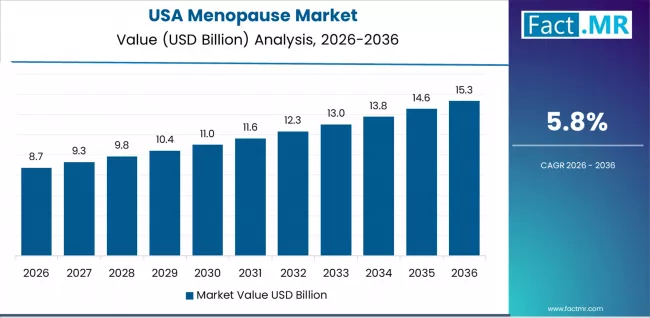
Menopause Market Country Value Analysis

The USA’s menopause supplement market is growing at a 5.8% CAGR, supported by mature dietary supplement infrastructure and strong consumer familiarity with self-care solutions. Adoption is highest in wellness-oriented regions such as California and the Northeast, where women actively seek non-prescription symptom relief backed by ingredient transparency. Regulatory clarity and quality certifications influence purchasing decisions, while an aging population sustains long-term demand for science-backed botanical formulations.

How is South Africa Building Momentum through Awareness and Accessibility?

South Africa is advancing at a 5.5% CAGR, largely driven by rising menopause awareness and improved retail access in urban areas. Johannesburg, Cape Town, and Durban are emerging as key consumption centers where pharmacies and health stores play an educational role.

Consumers prioritize affordability and clear usage guidance, often relying on pharmacist recommendations. Market growth reflects gradual normalization of menopause discussions and expanding women’s health advocacy.

Why does Germany Remain a Quality-Led Market for Menopause Supplements?

Germany’s market is growing at a 5.4% CAGR, shaped by a strong emphasis on formulation quality, ingredient purity, and clinical validation. Menopause supplements are primarily distributed through pharmacies and regulated health stores, where safety documentation influences consumer trust.

Adoption is steady rather than rapid, reflecting cautious purchasing behavior and alignment with evidence-based wellness practices. Regulatory rigor continues to define product differentiation.

What is Driving Innovation-Focused Adoption in the UK?

The UK market is expanding at a 5.2% CAGR, driven by formulation innovation and rising openness around menopause management. Retail pharmacies and wellness outlets in cities such as London and Manchester are introducing targeted blends addressing specific symptoms.

Consumers show strong interest in novel ingredient combinations supported by clear guidance. Growth is reinforced by women’s health advocacy and increasing acceptance of supplements as complementary wellness tools.

Competitive Landscape of the Menopause Market
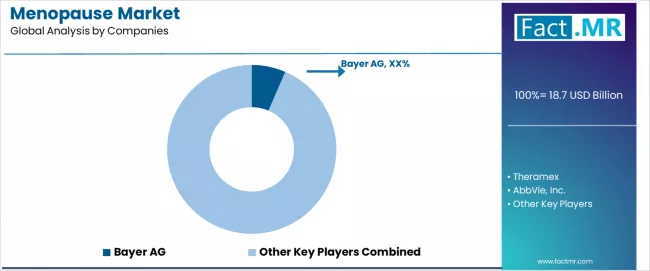
Menopause Market Analysis By Company

The menopause market is moderately fragmented, with 100–150 active participants spanning dietary supplements, nutraceuticals, and wellness-focused products. Competition reflects the maturity of menopause-related offerings, where brand trust, distribution reach, clinical credibility, and consumer education are more influential than price-based competition.

Bayer AG holds a leading position, supported by a diversified menopause product portfolio, strong clinical documentation, and extensive global distribution across pharmacy and retail channels. Other large pharmaceutical and nutraceutical companies compete through manufacturing scale, regulatory experience, and established consumer trust.

Specialized women’s health brands and natural health companies introduce competitive pressure through targeted formulations, botanical expertise, and symptom-specific positioning. These players differentiate through education-led marketing, clean-label credentials, and focused innovation addressing hot flashes, sleep disruption, and mood changes.

Direct-to-consumer brands further intensify competition by leveraging digital platforms, subscription models, and personalized product offerings, particularly in developed markets. Regional manufacturers compete on affordability and local relevance. Overall competitiveness favors companies combining validated formulations, strong distribution, and credible consumer education, while personalization and digital engagement are becoming increasingly important differentiators.

Key Players in the Menopause Market

  • Bayer AG
  • Theramex
  • AbbVie, Inc.
  • Pure Encapsulations, LLC
  • Dr. Reddy's Laboratories Ltd.
  • ReNew Life Holdings Corporation
  • Padagis
  • Aptorum Group Limited
  • Bonafide Health
  • Sirio Pharma

Scope of the Report

Items Values
Quantitative Units (2026) USD 18.7 billion
Treatment Dietary Supplements, OTC Pharma Products (Hormonal Products, Non-hormonal products)
Regions Covered North America, Europe, Asia Pacific, Latin America, MEA
Countries Covered USA, China, India, Germany, UK, France, Brazil, South Africa, and 15+ additional countries
Key Companies Profiled Bayer AG, Theramex, AbbVie Inc., Pure Encapsulations LLC, Dr. Reddy's Laboratories Ltd., ReNew Life Holdings Corporation
Additional Attributes Dollar sales by treatment categories, regional adoption trends across Asia Pacific, North America, and Latin America, competitive landscape with established pharmaceutical corporations and specialized women's health companies, consumer preferences for Dietary Supplements and natural wellness, integration with retail pharmacy facilities and e-commerce organizations, innovations in personalized formulations and digital wellness platforms, and development of sophisticated botanical systems with enhanced efficacy profiles and comprehensive clinical documentation frameworks.

Menopause Market by Segments

  • Treatment :

    • Dietary Supplements
    • OTC Pharma Products
      • Hormonal Products
      • Non-hormonal products
  • Region :

    • North America
      • USA
      • Canada
      • Mexico
    • Europe
      • Germany
      • France
      • UK
      • Italy
      • Spain
      • Rest of Europe
    • Asia Pacific
      • India
      • China
      • Japan
      • South Korea
      • ASEAN
      • Australia & New Zealand
      • Rest of Asia Pacific
    • Latin America
      • Brazil
      • Rest of Latin America
    • MEA
      • GCC Countries
      • South Africa
      • Rest of MEA

Table of Content

  1. Executive Summary
    • Global Market Outlook
    • Demand to side Trends
    • Supply to side Trends
    • Technology Roadmap Analysis
    • Analysis and Recommendations
  2. Market Overview
    • Market Coverage / Taxonomy
    • Market Definition / Scope / Limitations
  3. Market Background
    • Market Dynamics
      • Drivers
      • Restraints
      • Opportunity
      • Trends
    • Scenario Forecast
      • Demand in Optimistic Scenario
      • Demand in Likely Scenario
      • Demand in Conservative Scenario
    • Opportunity Map Analysis
    • Product Life Cycle Analysis
    • Supply Chain Analysis
    • Investment Feasibility Matrix
    • Value Chain Analysis
    • PESTLE and Porter’s Analysis
    • Regulatory Landscape
    • Regional Parent Market Outlook
    • Production and Consumption Statistics
    • Import and Export Statistics
  4. Global Market Analysis 2021 to 2025 and Forecast, 2026 to 2036
    • Historical Market Size Value (USD Million) Analysis, 2021 to 2025
    • Current and Future Market Size Value (USD Million) Projections, 2026 to 2036
      • Y to o to Y Growth Trend Analysis
      • Absolute $ Opportunity Analysis
  5. Global Market Pricing Analysis 2021 to 2025 and Forecast 2026 to 2036
  6. Global Market Analysis 2021 to 2025 and Forecast 2026 to 2036, By Treatment
    • Introduction / Key Findings
    • Historical Market Size Value (USD Million) Analysis By Treatment, 2021 to 2025
    • Current and Future Market Size Value (USD Million) Analysis and Forecast By Treatment, 2026 to 2036
      • Dietary Supplements
      • OTC Pharma Products
    • Y to o to Y Growth Trend Analysis By Treatment, 2021 to 2025
    • Absolute $ Opportunity Analysis By Treatment, 2026 to 2036
  7. Global Market Analysis 2021 to 2025 and Forecast 2026 to 2036, By Region
    • Introduction
    • Historical Market Size Value (USD Million) Analysis By Region, 2021 to 2025
    • Current Market Size Value (USD Million) Analysis and Forecast By Region, 2026 to 2036
      • North America
      • Latin America
      • Western Europe
      • Eastern Europe
      • East Asia
      • South Asia and Pacific
      • Middle East & Africa
    • Market Attractiveness Analysis By Region
  8. North America Market Analysis 2021 to 2025 and Forecast 2026 to 2036, By Country
    • Historical Market Size Value (USD Million) Trend Analysis By Market Taxonomy, 2021 to 2025
    • Market Size Value (USD Million) Forecast By Market Taxonomy, 2026 to 2036
      • By Country
        • USA
        • Canada
        • Mexico
      • By Treatment
    • Market Attractiveness Analysis
      • By Country
      • By Treatment
    • Key Takeaways
  9. Latin America Market Analysis 2021 to 2025 and Forecast 2026 to 2036, By Country
    • Historical Market Size Value (USD Million) Trend Analysis By Market Taxonomy, 2021 to 2025
    • Market Size Value (USD Million) Forecast By Market Taxonomy, 2026 to 2036
      • By Country
        • Brazil
        • Chile
        • Rest of Latin America
      • By Treatment
    • Market Attractiveness Analysis
      • By Country
      • By Treatment
    • Key Takeaways
  10. Western Europe Market Analysis 2021 to 2025 and Forecast 2026 to 2036, By Country
    • Historical Market Size Value (USD Million) Trend Analysis By Market Taxonomy, 2021 to 2025
    • Market Size Value (USD Million) Forecast By Market Taxonomy, 2026 to 2036
      • By Country
        • Germany
        • UK
        • Italy
        • Spain
        • France
        • Nordic
        • BENELUX
        • Rest of Western Europe
      • By Treatment
    • Market Attractiveness Analysis
      • By Country
      • By Treatment
    • Key Takeaways
  11. Eastern Europe Market Analysis 2021 to 2025 and Forecast 2026 to 2036, By Country
    • Historical Market Size Value (USD Million) Trend Analysis By Market Taxonomy, 2021 to 2025
    • Market Size Value (USD Million) Forecast By Market Taxonomy, 2026 to 2036
      • By Country
        • Russia
        • Poland
        • Hungary
        • Balkan & Baltic
        • Rest of Eastern Europe
      • By Treatment
    • Market Attractiveness Analysis
      • By Country
      • By Treatment
    • Key Takeaways
  12. East Asia Market Analysis 2021 to 2025 and Forecast 2026 to 2036, By Country
    • Historical Market Size Value (USD Million) Trend Analysis By Market Taxonomy, 2021 to 2025
    • Market Size Value (USD Million) Forecast By Market Taxonomy, 2026 to 2036
      • By Country
        • China
        • Japan
        • South Korea
      • By Treatment
    • Market Attractiveness Analysis
      • By Country
      • By Treatment
    • Key Takeaways
  13. South Asia and Pacific Market Analysis 2021 to 2025 and Forecast 2026 to 2036, By Country
    • Historical Market Size Value (USD Million) Trend Analysis By Market Taxonomy, 2021 to 2025
    • Market Size Value (USD Million) Forecast By Market Taxonomy, 2026 to 2036
      • By Country
        • India
        • ASEAN
        • Australia & New Zealand
        • Rest of South Asia and Pacific
      • By Treatment
    • Market Attractiveness Analysis
      • By Country
      • By Treatment
    • Key Takeaways
  14. Middle East & Africa Market Analysis 2021 to 2025 and Forecast 2026 to 2036, By Country
    • Historical Market Size Value (USD Million) Trend Analysis By Market Taxonomy, 2021 to 2025
    • Market Size Value (USD Million) Forecast By Market Taxonomy, 2026 to 2036
      • By Country
        • Kingdom of Saudi Arabia
        • Other GCC Countries
        • Turkiye
        • South Africa
        • Other African Union
        • Rest of Middle East & Africa
      • By Treatment
    • Market Attractiveness Analysis
      • By Country
      • By Treatment
    • Key Takeaways
  15. Key Countries Market Analysis
    • USA
      • Pricing Analysis
      • Market Share Analysis, 2025
        • By Treatment
    • Canada
      • Pricing Analysis
      • Market Share Analysis, 2025
        • By Treatment
    • Mexico
      • Pricing Analysis
      • Market Share Analysis, 2025
        • By Treatment
    • Brazil
      • Pricing Analysis
      • Market Share Analysis, 2025
        • By Treatment
    • Chile
      • Pricing Analysis
      • Market Share Analysis, 2025
        • By Treatment
    • Germany
      • Pricing Analysis
      • Market Share Analysis, 2025
        • By Treatment
    • UK
      • Pricing Analysis
      • Market Share Analysis, 2025
        • By Treatment
    • Italy
      • Pricing Analysis
      • Market Share Analysis, 2025
        • By Treatment
    • Spain
      • Pricing Analysis
      • Market Share Analysis, 2025
        • By Treatment
    • France
      • Pricing Analysis
      • Market Share Analysis, 2025
        • By Treatment
    • India
      • Pricing Analysis
      • Market Share Analysis, 2025
        • By Treatment
    • ASEAN
      • Pricing Analysis
      • Market Share Analysis, 2025
        • By Treatment
    • Australia & New Zealand
      • Pricing Analysis
      • Market Share Analysis, 2025
        • By Treatment
    • China
      • Pricing Analysis
      • Market Share Analysis, 2025
        • By Treatment
    • Japan
      • Pricing Analysis
      • Market Share Analysis, 2025
        • By Treatment
    • South Korea
      • Pricing Analysis
      • Market Share Analysis, 2025
        • By Treatment
    • Russia
      • Pricing Analysis
      • Market Share Analysis, 2025
        • By Treatment
    • Poland
      • Pricing Analysis
      • Market Share Analysis, 2025
        • By Treatment
    • Hungary
      • Pricing Analysis
      • Market Share Analysis, 2025
        • By Treatment
    • Kingdom of Saudi Arabia
      • Pricing Analysis
      • Market Share Analysis, 2025
        • By Treatment
    • Turkiye
      • Pricing Analysis
      • Market Share Analysis, 2025
        • By Treatment
    • South Africa
      • Pricing Analysis
      • Market Share Analysis, 2025
        • By Treatment
  16. Market Structure Analysis
    • Competition Dashboard
    • Competition Benchmarking
    • Market Share Analysis of Top Players
      • By Regional
      • By Treatment
  17. Competition Analysis
    • Competition Deep Dive
      • Bayer AG
        • Overview
        • Product Portfolio
        • Profitability by Market Segments (Product/Age /Sales Channel/Region)
        • Sales Footprint
        • Strategy Overview
          • Marketing Strategy
          • Product Strategy
          • Channel Strategy
      • Theramex
      • AbbVie, Inc.
      • Pure Encapsulations, LLC
      • Dr. Reddy's Laboratories Ltd.
      • ReNew Life Holdings Corporation
      • Padagis
      • Aptorum Group Limited
      • Bonafide Health
      • Sirio Pharma
  18. Assumptions & Acronyms Used
  19. Research Methodology

List Of Table

  • Table 1: Global Market Value (USD Million) Forecast by Region, 2021 to 2036
  • Table 2: Global Market Value (USD Million) Forecast by Treatment, 2021 to 2036
  • Table 3: North America Market Value (USD Million) Forecast by Country, 2021 to 2036
  • Table 4: North America Market Value (USD Million) Forecast by Treatment, 2021 to 2036
  • Table 5: Latin America Market Value (USD Million) Forecast by Country, 2021 to 2036
  • Table 6: Latin America Market Value (USD Million) Forecast by Treatment, 2021 to 2036
  • Table 7: Western Europe Market Value (USD Million) Forecast by Country, 2021 to 2036
  • Table 8: Western Europe Market Value (USD Million) Forecast by Treatment, 2021 to 2036
  • Table 9: Eastern Europe Market Value (USD Million) Forecast by Country, 2021 to 2036
  • Table 10: Eastern Europe Market Value (USD Million) Forecast by Treatment, 2021 to 2036
  • Table 11: East Asia Market Value (USD Million) Forecast by Country, 2021 to 2036
  • Table 12: East Asia Market Value (USD Million) Forecast by Treatment, 2021 to 2036
  • Table 13: South Asia and Pacific Market Value (USD Million) Forecast by Country, 2021 to 2036
  • Table 14: South Asia and Pacific Market Value (USD Million) Forecast by Treatment, 2021 to 2036
  • Table 15: Middle East & Africa Market Value (USD Million) Forecast by Country, 2021 to 2036
  • Table 16: Middle East & Africa Market Value (USD Million) Forecast by Treatment, 2021 to 2036

List Of Figures

  • Figure 1: Global Market Pricing Analysis
  • Figure 2: Global Market Value (USD Million) Forecast 2021 to 2036
  • Figure 3: Global Market Value Share and BPS Analysis by Treatment, 2026 and 2036
  • Figure 4: Global Market Y to o to Y Growth Comparison by Treatment, 2026 to 2036
  • Figure 5: Global Market Attractiveness Analysis by Treatment
  • Figure 6: Global Market Value (USD Million) Share and BPS Analysis by Region, 2026 and 2036
  • Figure 7: Global Market Y to o to Y Growth Comparison by Region, 2026 to 2036
  • Figure 8: Global Market Attractiveness Analysis by Region
  • Figure 9: North America Market Incremental Dollar Opportunity, 2026 to 2036
  • Figure 10: Latin America Market Incremental Dollar Opportunity, 2026 to 2036
  • Figure 11: Western Europe Market Incremental Dollar Opportunity, 2026 to 2036
  • Figure 12: Eastern Europe Market Incremental Dollar Opportunity, 2026 to 2036
  • Figure 13: East Asia Market Incremental Dollar Opportunity, 2026 to 2036
  • Figure 14: South Asia and Pacific Market Incremental Dollar Opportunity, 2026 to 2036
  • Figure 15: Middle East & Africa Market Incremental Dollar Opportunity, 2026 to 2036
  • Figure 16: North America Market Value Share and BPS Analysis by Country, 2026 and 2036
  • Figure 17: North America Market Value Share and BPS Analysis by Treatment, 2026 and 2036
  • Figure 18: North America Market Y to o to Y Growth Comparison by Treatment, 2026 to 2036
  • Figure 19: North America Market Attractiveness Analysis by Treatment
  • Figure 20: Latin America Market Value Share and BPS Analysis by Country, 2026 and 2036
  • Figure 21: Latin America Market Value Share and BPS Analysis by Treatment, 2026 and 2036
  • Figure 22: Latin America Market Y to o to Y Growth Comparison by Treatment, 2026 to 2036
  • Figure 23: Latin America Market Attractiveness Analysis by Treatment
  • Figure 24: Western Europe Market Value Share and BPS Analysis by Country, 2026 and 2036
  • Figure 25: Western Europe Market Value Share and BPS Analysis by Treatment, 2026 and 2036
  • Figure 26: Western Europe Market Y to o to Y Growth Comparison by Treatment, 2026 to 2036
  • Figure 27: Western Europe Market Attractiveness Analysis by Treatment
  • Figure 28: Eastern Europe Market Value Share and BPS Analysis by Country, 2026 and 2036
  • Figure 29: Eastern Europe Market Value Share and BPS Analysis by Treatment, 2026 and 2036
  • Figure 30: Eastern Europe Market Y to o to Y Growth Comparison by Treatment, 2026 to 2036
  • Figure 31: Eastern Europe Market Attractiveness Analysis by Treatment
  • Figure 32: East Asia Market Value Share and BPS Analysis by Country, 2026 and 2036
  • Figure 33: East Asia Market Value Share and BPS Analysis by Treatment, 2026 and 2036
  • Figure 34: East Asia Market Y to o to Y Growth Comparison by Treatment, 2026 to 2036
  • Figure 35: East Asia Market Attractiveness Analysis by Treatment
  • Figure 36: South Asia and Pacific Market Value Share and BPS Analysis by Country, 2026 and 2036
  • Figure 37: South Asia and Pacific Market Value Share and BPS Analysis by Treatment, 2026 and 2036
  • Figure 38: South Asia and Pacific Market Y to o to Y Growth Comparison by Treatment, 2026 to 2036
  • Figure 39: South Asia and Pacific Market Attractiveness Analysis by Treatment
  • Figure 40: South Asia and Pacific Market Y to o to Y Growth Comparison by rma_anu, 2026 to 2036
  • Figure 41: South Asia and Pacific Market Attractiveness Analysis by rma_anu
  • Figure 42: South Asia and Pacific Market Value Share and BPS Analysis by rma_anu, 2026 and 2036
  • Figure 43: South Asia and Pacific Market Y to o to Y Growth Comparison by rma_anu, 2026 to 2036
  • Figure 44: South Asia and Pacific Market Attractiveness Analysis by rma_anu
  • Figure 45: South Asia and Pacific Market Value Share and BPS Analysis by rma_anu, 2026 and 2036
  • Figure 46: South Asia and Pacific Market Y to o to Y Growth Comparison by rma_anu, 2026 to 2036
  • Figure 47: South Asia and Pacific Market Attractiveness Analysis by rma_anu
  • Figure 48: South Asia and Pacific Market Value Share and BPS Analysis by rma_anu, 2026 and 2036
  • Figure 49: South Asia and Pacific Market Y to o to Y Growth Comparison by rma_anu, 2026 to 2036
  • Figure 50: South Asia and Pacific Market Attractiveness Analysis by rma_anu
  • Figure 51: Middle East & Africa Market Value Share and BPS Analysis by Country, 2026 and 2036
  • Figure 52: Middle East & Africa Market Value Share and BPS Analysis by Treatment, 2026 and 2036
  • Figure 53: Middle East & Africa Market Y to o to Y Growth Comparison by Treatment, 2026 to 2036
  • Figure 54: Middle East & Africa Market Attractiveness Analysis by Treatment
  • Figure 55: Middle East & Africa Market Value Share and BPS Analysis by rma_anu, 2026 and 2036
  • Figure 56: Middle East & Africa Market Y to o to Y Growth Comparison by rma_anu, 2026 to 2036
  • Figure 57: Middle East & Africa Market Attractiveness Analysis by rma_anu
  • Figure 58: Middle East & Africa Market Value Share and BPS Analysis by rma_anu, 2026 and 2036
  • Figure 59: Middle East & Africa Market Y to o to Y Growth Comparison by rma_anu, 2026 to 2036
  • Figure 60: Middle East & Africa Market Attractiveness Analysis by rma_anu
  • Figure 61: Middle East & Africa Market Value Share and BPS Analysis by rma_anu, 2026 and 2036
  • Figure 62: Middle East & Africa Market Y to o to Y Growth Comparison by rma_anu, 2026 to 2036
  • Figure 63: Middle East & Africa Market Attractiveness Analysis by rma_anu
  • Figure 64: Middle East & Africa Market Value Share and BPS Analysis by rma_anu, 2026 and 2036
  • Figure 65: Middle East & Africa Market Y to o to Y Growth Comparison by rma_anu, 2026 to 2036
  • Figure 66: Middle East & Africa Market Attractiveness Analysis by rma_anu
  • Figure 67: Middle East & Africa Market Value Share and BPS Analysis by rma_anu, 2026 and 2036
  • Figure 68: Middle East & Africa Market Y to o to Y Growth Comparison by rma_anu, 2026 to 2036
  • Figure 69: Middle East & Africa Market Attractiveness Analysis by rma_anu
  • Figure 70: Middle East & Africa Market Value Share and BPS Analysis by rma_anu, 2026 and 2036
  • Figure 71: Middle East & Africa Market Y to o to Y Growth Comparison by rma_anu, 2026 to 2036
  • Figure 72: Middle East & Africa Market Attractiveness Analysis by rma_anu
  • Figure 73: Global Market - Tier Structure Analysis
  • Figure 74: Global Market - Company Share Analysis

- FAQs -

How big is the menopause market in 2026?

The global menopause market is estimated to be valued at USD 18.7 billion in 2026.

What will be the size of menopause market in 2036?

The market size for the menopause market is projected to reach USD 31.8 billion by 2036.

How much will be the menopause market growth between 2026 and 2036?

The menopause market is expected to grow at a 5.5% CAGR between 2026 and 2036.

What are the key product types in the menopause market?

The key product types in menopause market are dietary supplements and otc pharma products .

Which segment to contribute significant share in the menopause market in 2026?

In terms of , segment to command 0.0% share in the menopause market in 2026.

Menopause Market