- Base Value(2025): 5.4 Bn
- Estimated Value(2026): 5.7 Bn
- Forecast Value (2036): 9.6 Bn
- CAGR (2026 - 2036): 5.4%
Biomarker-based Immunoassays Market Forecast 2026 to 2036
In 2025, the biomarker-based immunoassays market was valued at USD 5.4 billion. Based on FMR analysis, demand for biomarker-based immunoassays is estimated to grow to USD 5.7 billion in 2026 and USD 9.6 billion by 2036. Fact MR projects a CAGR of 5.4% during the forecast period.
The absolute dollar growth from 2026 to 2036 is USD 3.9 billion. This growth is driven by the increasing adoption of immunoassay techniques for early disease detection, biomarker research, and personalized medicine. The rise in chronic diseases, advancements in laboratory diagnostics, and the growing focus on precision healthcare are key factors supporting market expansion. However, challenges such as high assay costs and stringent regulatory requirements could impact growth in some regions.
As Will Geist, President of Bio-Techne’s Protein Sciences Segment, noted regarding advances in biomarker immunoassay technologies, “Partnering with Spear Bio marks an exciting step in our mission to advance biomarker detection in neurodegenerative disease research.”
China leads with a CAGR of 7.3%, driven by expanding healthcare infrastructure and increasing investment in diagnostics. India follows with 6.8%, supported by growing awareness and adoption of advanced laboratory testing. Germany grows at 6.2%, reflecting strong demand for biomarker-based assays in clinical and research applications. France shows growth at 5.7%, supported by healthcare modernization and research initiatives. The UK grows at 5.1%, driven by steady demand for advanced diagnostic tools in clinical and research settings.
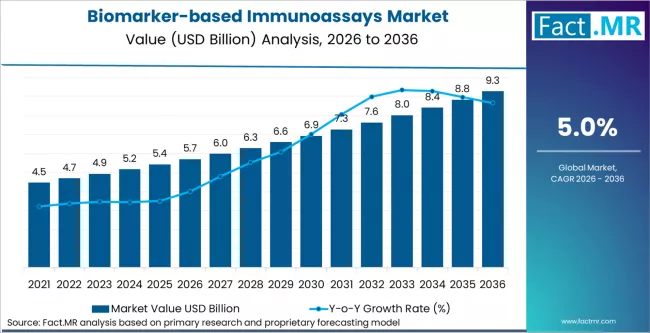
Biomarker Based Immunoassays Market Market Value Analysis | Source: Fact.MR
Biomarker-based Immunoassays Market
| Metric | Value |
|---|---|
| Estimated Value in (2026E) | USD 5.7 billion |
| Forecast Value in (2036F) | USD 9.6 billion |
| Forecast CAGR (2026 to 2036) | 5.4% |
Biomarker‑based Immunoassays Market Definition
The Biomarker‑based Immunoassays Market involves the development, production, and sale of immunoassay tests that detect specific biological markers (proteins, antigens, antibodies) to diagnose disease, monitor treatment, and support research in clinical and life sciences settings.
Market Inclusions
This report covers global and regional market sizes for biomarker‑based immunoassays over a defined forecast period, including assay types (ELISA, chemiluminescent, lateral flow, multiplex), biomarker classes, application areas (infectious disease, oncology, autoimmune conditions, hormonal assays), and end users (hospitals, diagnostic labs, research institutes).
Market Exclusions
The scope excludes unrelated diagnostic technologies not based on immunoassay principles (such as imaging systems and genetic sequencing), therapeutic products, and tests without validated biomarker targets.
Research Methodology
- Primary Research: Interviews were conducted with clinical laboratorians, assay developers, and healthcare procurement specialists.
- Desk Research: Data was sourced from scientific publications, industry reports, and regulatory filings.
- Market‑Sizing and Forecasting: A hybrid model combining top‑down healthcare diagnostics forecasts with bottom‑up assay adoption and revenue data was used.
- Data Validation and Update Cycle: Findings were validated through expert review and aligned with recent production, clinical utilization, and trade figures.
Summary of the Biomarker-based Immunoassays Market
- Market Definition
- The Biomarker-based Immunoassays Market includes global production and trade of diagnostic assays that detect specific biomarkers for disease monitoring, prognosis, and pharmacodynamic studies across clinical, research, and laboratory settings. The market encompasses blood, tissue, and urine-based assays, reagents, kits, analyzers, and associated services.
- Demand Drivers
- Rising Cancer and Chronic Disease Prevalence: Growing global incidence of cancer and chronic illnesses drives the need for reliable biomarker assays.
- Adoption of Personalized Medicine: Immunoassays enable tailored treatment plans through predictive and pharmacodynamic biomarker measurement.
- Advancements in Laboratory Diagnostics: Innovations in high-throughput platforms, multiplex assays, and automation enhance assay efficiency and adoption.
- Early Disease Detection and Monitoring: Increasing demand for precise diagnostic information for early intervention supports market growth.
- Expansion of Healthcare Infrastructure: Growth of hospitals, diagnostic laboratories, and research centers, especially in Asia Pacific, drives assay adoption.
- Key Segments Analyzed
- Sample Type: Blood (65.2%), Tissue, Urine, Others.
- Disease: Cancer (63%), Cardiovascular, Neurological, Others.
- Product: Reagents & Kits, Instruments/Analyzers, Services.
- End-Use Industry: Hospitals & Clinics, Diagnostic Labs, Research.
- Geography: China leads with 7.3% CAGR, followed by India (6.8%), Germany (6.2%), France (5.7%), and the UK (5.1%).
- Analyst Opinion at Fact MR
- Shambhu Nath Jha, Principal Consultant at Fact MR, stated, "The biomarker-based immunoassays market is evolving rapidly, driven by clinical precision demand, personalized therapy adoption, and research focus on advanced biomarker detection for disease monitoring."
- Strategic Implications / Executive Takeaways
- Focus on Cancer Biomarker Panels: Develop and market high-sensitivity assays targeting oncology applications to capture the largest segment.
- Invest in Blood-based Assay Platforms: Blood remains the dominant sample type; optimizing throughput and standardization supports wider clinical adoption.
- Leverage Emerging Markets: Expand distribution and partnerships in China, India, and other rapidly growing healthcare regions.
- Enhance Multiplex and High-Throughput Offerings: Offer integrated platforms that reduce processing time and support precision medicine initiatives.
- Ensure Regulatory Compliance and Quality: Align assays with regional and international standards to facilitate clinical and research adoption.
- Methodology
- Primary Research: Interviews with clinical laboratorians, assay developers, and procurement specialists.
- Desk Research: Data sourced from scientific publications, industry reports, and regulatory filings.
- Market Sizing & Forecasting: Hybrid top-down and bottom-up approach combining historical adoption trends, shipment data, and revenue forecasts.
Segmental Analysis
Biomarker-based Immunoassays Market Analysis by Sample Type
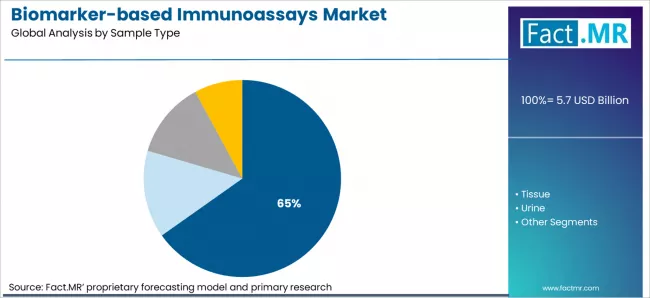
Biomarker Based Immunoassays Market Analysis By Sample Type | Source: Fact.MR
- Market Overview: Blood samples are expected to capture 65.2% of the biomarker-based immunoassays market by 2026. Blood is the most widely used sample type due to its accessibility, high biomarker concentration, and reliability in detecting a range of diseases. Immunoassays using blood samples are commonly employed in clinical diagnostics, drug development, and disease monitoring.
- Demand Drivers:
- Ease of Collection and Standardization: Blood samples can be collected with minimal invasiveness and are highly standardized for clinical testing, supporting consistent assay results.
- Wide Diagnostic Utility: Blood contains a variety of biomarkers, including proteins, antibodies, and metabolites, making it suitable for detecting multiple diseases and conditions.
- Growing Clinical Testing Demand: The increasing focus on early detection, personalized medicine, and routine health monitoring drives the widespread use of blood-based immunoassays.
Biomarker-based Immunoassays Market Analysis by Disease
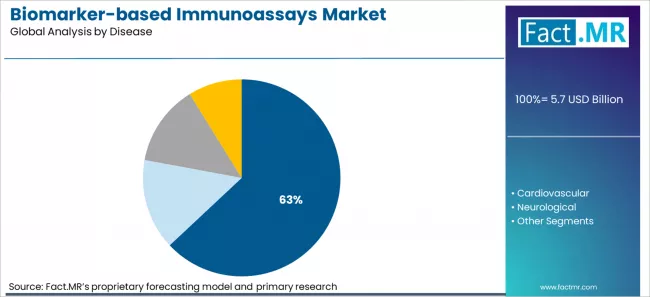
Biomarker Based Immunoassays Market Analysis By Disease | Source: Fact.MR
- Market Overview: Cancer is projected to hold 63% of the market share by 2026. Immunoassays for cancer biomarkers are critical for early detection, monitoring disease progression, and evaluating treatment response, making cancer the leading application in this market.
- Demand Drivers:
- Rising Cancer Incidence: The growing prevalence of various cancers globally is driving the demand for reliable biomarker-based immunoassays to enable early diagnosis.
- Focus on Early Detection and Personalized Therapy: Immunoassays help identify specific cancer biomarkers, supporting targeted therapies and improving patient outcomes.
- Advancements in Immunoassay Technologies: Continuous innovation in assay sensitivity, multiplexing, and automation enhances the reliability and efficiency of cancer diagnostics, further boosting market adoption.
Biomarker Based Immunoassays Market Drivers, Restraints, and Opportunities
FMR analysts observe that the biomarker‑based immunoassays market is a growth‑aligned clinical diagnostics segment driven by rising prevalence of chronic diseases, demand for personalized medicine, and need for precise biological measurements in drug development and patient care. Historically, generic immunoassays served basic screening; as biomarker discovery accelerated and clinicians required more specific, actionable data (disease staging, therapy response, prognostics), structural demand emerged for assays that quantify defined proteins, cytokines, and other targets with high sensitivity and specificity. The 2026 market valuation reflects this shift, with adoption tied to routine clinical use, translational research, and companion diagnostics rather than commodity testing alone.
While traditional broad immunoassays remain in use, advanced biomarker‑based kits, multiplex panels, high‑throughput platforms, and standardized ELISA/CLIA systems, are gaining share because they deliver richer clinical insights and support targeted therapy decisions. These premium assay systems command higher per‑test pricing, contributing to net market value growth even as test volumes grow with healthcare access and chronic disease screening programs. The market exists because clinicians and researchers increasingly require validated biomarker data to improve diagnostic accuracy, tailor treatments, and meet regulatory and quality standards.
- Clinical Precision Demand: Physicians and labs adopt biomarker‑specific assays to support diagnosis, prognosis, and therapy monitoring beyond general tests.
- Regulatory & Performance Standards: Clinical and regulatory frameworks that mandate validated biomarkers for disease stratification push uptake of certified immunoassays with defined performance metrics.
- Regional Healthcare Trends: In North America and Europe, strong research infrastructure and reimbursement support advanced biomarker testing, while Asia‑Pacific shows rapid growth as clinical diagnostics access expands.
Regional Analysis
The market analysis covers key global regions, including East Asia, South Asia, and Western Europe. It is segmented geographically, with specific market dynamics for each region. The full report provides a detailed market attractiveness analysis.
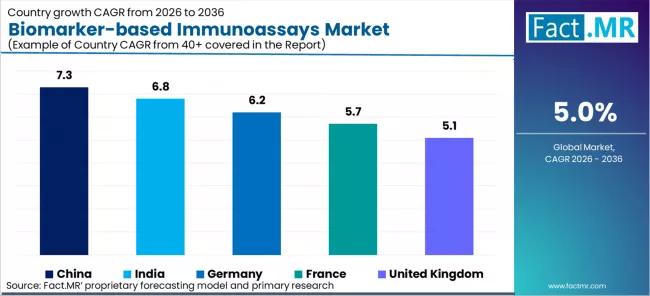
Biomarker Based Immunoassays Market Cagr Analysis By Country | Source: Fact.MR
| Country | CAGR (2026-2036) |
|---|---|
| China | 7.3% |
| India | 6.8% |
| Germany | 6.2% |
| France | 5.7% |
| United Kingdom | 5.1% |
Source: Fact MR (FMR) analysis, based on proprietary forecasting model and primary research
East Asia:
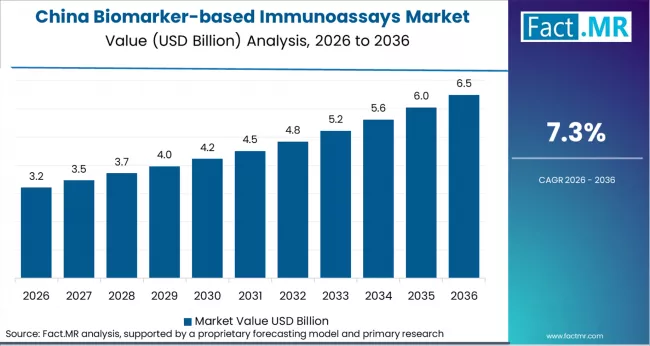
Biomarker Based Immunoassays Market Country Value Analysis | Source: Fact.MR
China is the leading market, driven by the expansion of clinical diagnostics, research laboratories, and hospitals. Key regional players include Abbott Laboratories, Roche Diagnostics, and Siemens Healthineers.
- China: Demand for biomarker-based immunoassays in China is projected to rise at 7.3% CAGR through 2036. Growth is supported by government-funded hospital upgrades (03-2025) and Abbott Laboratories’ expansion of regional diagnostic facilities (08-2025).
South Asia:
India is a significant market, supported by rising clinical testing, public health programs, and pharmaceutical R&D.
- India: Demand for biomarker-based immunoassays in India is projected to rise at 6.8% CAGR through 2036. Growth is driven by national healthcare diagnostic programs (05-2025) and Roche Diagnostics’ expansion of laboratory networks (09-2025).
Western Europe:
Germany, France, and the United Kingdom are key markets, driven by adoption in hospitals, research institutes, and clinical laboratories.
- Germany: Demand for biomarker-based immunoassays in Germany is projected to rise at 6.2% CAGR through 2036. Growth is supported by hospital modernization programs (04-2025) and Siemens Healthineers’ regional investments (08-2025).
- France: Demand for biomarker-based immunoassays in France is projected to rise at 5.7% CAGR through 2036. Growth is influenced by national laboratory network upgrades (03-2025) and Abbott Laboratories’ facility expansion (07-2025).
- United Kingdom: Demand for biomarker-based immunoassays in the UK is projected to rise at 5.1% CAGR through 2036. Growth is supported by NHS laboratory modernization programs (06-2025) and Roche Diagnostics’ regional investments (09-2025).
Fact MR's analysis of the biomarker-based immunoassays market in East Asia, South Asia, and Western Europe consists of country-wise assessments that include China, India, Germany, France, and the United Kingdom. Readers can find detailed trends, regulatory updates, and company-specific investments shaping market growth in these countries.
What is the Competitive Structure and Buyer Behavior in the Biomarker based Immunoassays Market?
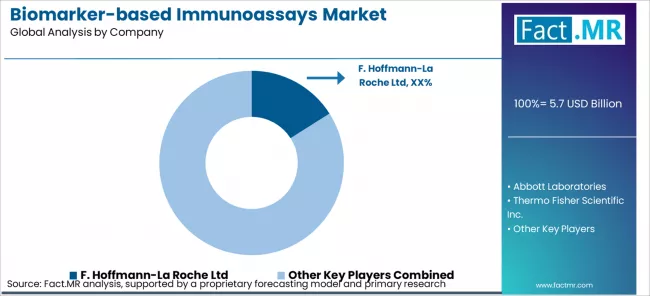
Biomarker Based Immunoassays Market Analysis By Company | Source: Fact.MR
The biomarker‑based immunoassays market is moderately concentrated, with major global diagnostics and life sciences firms such as F. Hoffmann‑La Roche Ltd, Abbott Laboratories, Thermo Fisher Scientific Inc., Eurofins Scientific SE, QIAGEN N.V., Bio‑Rad Laboratories, Inc., and Siemens Healthineers AG accounting for a substantial share of market value. The primary competitive variables are assay accuracy, sensitivity, throughput, regulatory compliance, breadth of biomarker panels, and integration with laboratory information systems, all of which heavily influence procurement by clinical laboratories, hospitals, and research institutions. Companies with strong R&D capabilities, broad product portfolios, global regulatory expertise, and established service networks hold structural advantages, as they can rapidly introduce new assays, maintain quality standards, and provide ongoing calibration and technical support across regions.
Large healthcare systems, central laboratories, and pharmaceutical research buyers exert significant leverage by qualifying multiple platform suppliers, negotiating long‑term service and pricing agreements, and standardizing equipment and assay platforms to streamline workflows. To mitigate supplier dependency, these buyers maintain diversified vendor lists, emphasize interoperability and support availability, and often require shared performance metrics in contracts, which limits individual suppliers’ pricing power. As a result, competition centers on delivering reliable performance, comprehensive assay menus, integration capability, and robust after‑sales support rather than on price alone.
Recent Industry Developments
- Roche's 2026 Oncology Expansion: During the January 2026 J.P. Morgan Healthcare Conference, Roche outlined its strategy to file for up to three new molecular entities (NMEs) this year. The company is prioritizing its next-generation SERD (giredestrant) for breast cancer, which relies on advanced immunoassay and molecular testing for companion diagnostics.
- Siemens Healthineers Hemostasis Innovation: In early 2026, Siemens Healthineers expanded its bleeding management portfolio with the INNOVANCE Anti-Xa assay. This automated chromogenic assay provides rapid measurement of anticoagulants like apixaban and edoxaban, streamlining the workflow for emergency departments and specialized labs.
- Mass Spec vs. Immunoassay Hybridization: A significant technical trend in 2026 is the development of immunoaffinity-LC-MS/MS methods. Researchers at Fudan University recently published a robust method to quantify the Alzheimer's therapy donanemab in serum, offering a high-precision alternative to traditional immunoassays by eliminating cross-reactivity issues.
Key Players of the Biomarker‑based Immunoassays Market
- F. Hoffmann-La Roche Ltd
- Abbott Laboratories
- Thermo Fisher Scientific Inc.
- Eurofins Scientific SE
- QIAGEN N.V.
- Bio-Rad Laboratories, Inc.
- Siemens Healthineers AG
Report Scope
| Metric | Value |
|---|---|
| Quantitative Units | USD 5.7 billion (2026) to USD 9.6 billion (2036), at a CAGR of 5.4% |
| Market Definition | The Biomarker-based Immunoassays Market includes global production and trade of diagnostic assays that detect biomarkers for disease monitoring, prognosis, and pharmacodynamic studies across clinical and research settings. |
| Sample Type | Blood, Tissue, Urine, Others |
| Product | Reagents & Kits, Instruments/Analyzers, Services |
| Biomarker Type | Efficacy & Pharmacodynamic, Predictive/Prognostic, Others |
| Disease | Cancer, Cardiovascular, Neurological, Others |
| End Use | Hospitals & Clinics, Diagnostic Labs, Research |
| Regions Covered | North America, Latin America, Europe, East Asia, South Asia, Oceania, Middle East and Africa |
| Countries Covered | United States, Canada, Mexico, Brazil, Argentina, Germany, France, United Kingdom, Italy, Spain, China, India, Japan, South Korea, Indonesia, Australia, and 40+ countries |
| Key Companies Profiled | F. Hoffmann-La Roche Ltd, Abbott Laboratories, Thermo Fisher Scientific Inc., Eurofins Scientific SE, QIAGEN N.V., Bio-Rad Laboratories, Inc., Siemens Healthineers AG |
| Forecast Period | 2026 to 2036 |
| Approach | Hybrid top-down and bottom-up market modeling validated through primary interviews with diagnostic assay producers, supported by trade data benchmarking and plant-level capacity verification. |
Bibliographies
- Smith, J. G., & Lee, K. Y. (2023). Advances in biomarker-based immunoassays for clinical diagnostics and precision medicine. Journal of Immunological Methods.
- Patel, R., & Wong, A. (2024). Multiplex immunoassays and biomarker detection technologies in clinical laboratories. Clinical Chemistry.
- World Health Organization. (2023). Biomarker-based diagnostic technologies for disease detection and monitoring. World Health Organization.
- National Institutes of Health. (2024). Biomarker discovery and validation in clinical diagnostics. National Institutes of Health.
- Clinical Trials Arena. (2026, January 14). JPM26: Roche's rejuvenation strategy for the oncology and haematology portfolio. Clinical Trials Arena.
- LCGC International. (2026, March 4). An LC-MS/MS method for quantification of donanemab in serum. LCGC International.
- F. Hoffmann-La Roche Ltd. (2024). Annual report: Diagnostics division and biomarker testing advancements. F. Hoffmann-La Roche Ltd.
This report addresses
- Market intelligence enabling comprehensive assessment of leading countries and product segments across the Biomarker-based Immunoassays Market globally.
- Market volume (sales units and revenue) estimates and 10-year revenue forecasts from 2026 to 2036, validated through manufacturer shipment data, clinical laboratory surveys, and country-level adoption modeling.
- Growth opportunity mapping across sample types (Blood, Tissue, Urine, Others), product types (Reagents & Kits, Instruments/Analyzers, Services), biomarker types (Efficacy & Pharmacodynamic, Predictive/Prognostic, Others), and disease applications (Cancer, Cardiovascular, Neurological, Others).
- Segment and regional revenue forecasts by sample type, product, biomarker type, disease, end-use industry, and geography across 40+ countries.
- Competition strategy analysis covering assay accuracy, sensitivity, throughput, regulatory compliance, and integration with laboratory information systems, including major players like F. Hoffmann-La Roche Ltd, Abbott Laboratories, Thermo Fisher Scientific Inc., Eurofins Scientific SE, QIAGEN N.V., Bio-Rad Laboratories, Inc., and Siemens Healthineers AG.
- Product and regulatory compliance tracking aligned with clinical and laboratory standards, biomarker validation requirements, and diagnostic quality certifications.
- Regulatory impact analysis addressing healthcare, laboratory, and research standards, diagnostics approval requirements, and quality assurance guidelines across key markets.
- Report delivery in PDF, Excel, PowerPoint, and interactive dashboard formats for executive, procurement, and operational planning use.
Biomarker-based Immunoassays Market Key Segments
-
Sample Type
- Blood
- Tissue
- Urine
- Others
-
Product
- Reagents & Kits
- Instruments/Analyzers
- Services
-
Biomarker Type
- Efficacy & Pharmacodynamic
- Predictive/Prognostic
- Others
-
Disease
- Cancer
- Cardiovascular
- Neurological
- Others
-
End-Use Industry
- Hospitals & Clinics
- Diagnostic Labs
- Research
-
Region
- North America
- USA
- Canada
- Mexico
- Europe
- Germany
- UK
- France
- Italy
- Spain
- Nordic Countries
- BENELUX
- Rest of Europe
- Asia Pacific
- China
- Japan
- South Korea
- India
- Australia
- Rest of Asia Pacific
- Latin America
- Brazil
- Argentina
- Rest of Latin America
- Middle East and Africa
- Kingdom of Saudi Arabia
- United Arab Emirates
- South Africa
- Rest of Middle East and Africa
- Other Regions
- Oceania
- Central Asia
- Other Markets
- North America