- Market Value (2025): USD 166.9 Bn
- Estimated Value (2026): USD 178.6 Bn
- Forecast Value (2036): USD 351.3 Bn
- CAGR (2026-2036): 7.0%
What is the Healthcare Contract Development and Manufacturing Organization Market forecast to be worth by 2036?
USD 178.6 billion in 2026 to USD 351.3 billion by 2036 at 7.0% CAGR.
- The healthcare contract development and manufacturing organization market reached USD 166.9 billion in 2025.
- Demand is forecast to increase from USD 178.6 billion in 2026 to USD 351.3 billion by 2036.
- The market is projected to expand at 7.0% CAGR from 2026 to 2036.
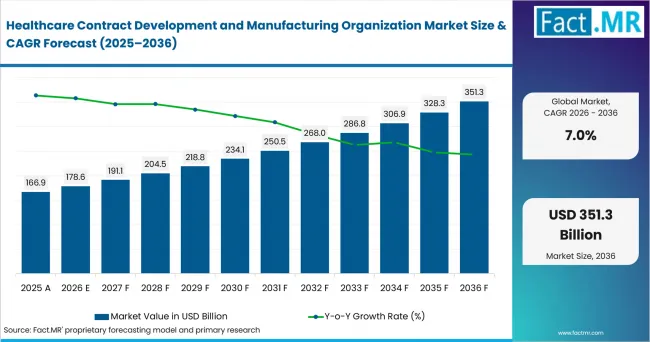
Healthcare Contract Development And Manufacturing Organization Market Value Analysis | Source: Fact.MR
What are the defining numbers behind Healthcare Contract Development and Manufacturing Organization Market growth?
USD 173.8 billion absolute opportunity by 2036.
- Demand Drivers in the Market
- Pharmaceutical sponsors are expected to rely on CDMOs when internal plants cannot absorb biologics or sterile injectable programs without delaying commercial supply. FDA’s Center for Drug Evaluation and Research said it approved 46 novel drugs in the USA in 2025, adding products that need launch and lifecycle supply.
- Development teams need partners that connect process development with analytical testing before a product moves into launch batches. EMA’s 2025 annual report said CTIS had received nearly 13,000 initial applications since launch, and EU Member States had authorized more than 10,600 clinical trials, increasing the need for clinical supply and transfer support.
- Sterile manufacturing demand is anticipated to rise as injectable biologics and specialty therapies require validated aseptic capacity.
- Procurement teams are expected to prefer long-term agreements because reserved capacity reduces supply risk before product launch.
- Key Segments Analyzed
- By Service Category: Contract Manufacturing is expected to hold 47.0% share in 2026 because sponsors need proven production capacity after development work is complete.
- By Application: Commercial Manufacturing is projected to account for 44.0% share in 2026 as approved products require stable supply and repeatable batch performance.
- By End User: Pharmaceutical Companies are anticipated to capture 42.0% share in 2026 since large sponsors outsource capacity while keeping product strategy in-house.
- By Engagement Model: Long-term Manufacturing Agreements are estimated to represent 53.0% share in 2026 due to capacity planning and supply continuity needs.
- By Manufacturing Capability: Sterile Manufacturing is forecast to hold 39.0% share in 2026 as injectable and biologic drug programs need aseptic process control.
- Analyst Opinion at Fact.MR
- Shambhu Nath Jha, Principal Consultant at Fact.MR, states, “Healthcare CDMOs are becoming supply partners and not simple production vendors. Sponsors are expected to select providers that prove process control and commercial readiness before launch scale.”
- Strategic Implications
- CDMO providers should strengthen sterile and biologics capabilities before sponsors lock capacity through multi-year agreements.
- Pharmaceutical companies should audit quality systems and technology-transfer depth before moving commercial batches to external networks.
- Investors should separate broad outsourcing exposure from providers with direct capability in commercial manufacturing and sterile biologics.
The USA leads at 7.8% CAGR through advanced outsourcing use and mature regulatory expectations. Germany follows at 7.5% with pharmaceutical manufacturing depth. Switzerland reaches 7.2% through biologics expertise. Japan posts 6.9%. China follows at 6.6%. India reaches 6.3% and South Korea records 6.0%.
How does the Healthcare Contract Development and Manufacturing Organization Market break down by segment?
Contract Manufacturing leads Service Category at 47.0% share in 2026. Commercial Manufacturing leads Application at 44.0%.
Why does Contract Manufacturing lead Service Category?
Contract Manufacturing is projected to account for 47.0% share in 2026.
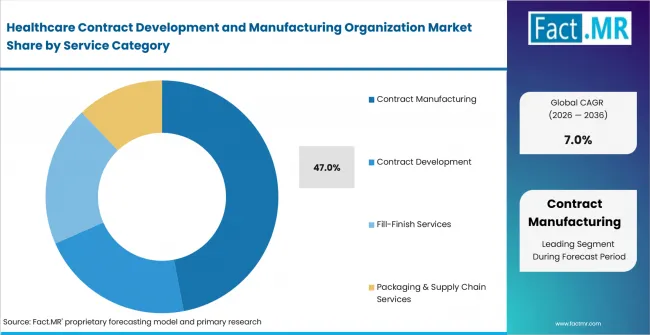
Healthcare Contract Development And Manufacturing Organization Market Analysis By Service Category | Source: Fact.MR
Sponsors turn to contract manufacturing when programs need qualified GMP batches and launch supply. Validated production is hard to duplicate inside every sponsor network. contract pharmaceutical fermentation remains relevant where biologic processes need controlled scale-up.
Why does Commercial Manufacturing lead Application?
Commercial Manufacturing is expected to hold 44.0% share in 2026.
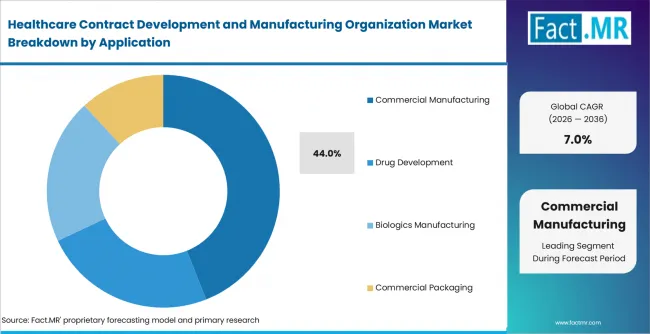
Healthcare Contract Development And Manufacturing Organization Market Analysis By Application | Source: Fact.MR
Approved therapies carry continuing supply obligations after regulatory clearance. Commercial Manufacturing therefore carries higher value than early development work. fill finish manufacturing is relevant when injectables move into final presentation. EMA also recommended 104 medicines for marketing authorization in 2025, including 38 with new active substances, so approved-product supply remains a major outsourcing need in Europe.
What supports Pharmaceutical Companies within End User?
Pharmaceutical Companies are anticipated to lead with 42.0% share in 2026.
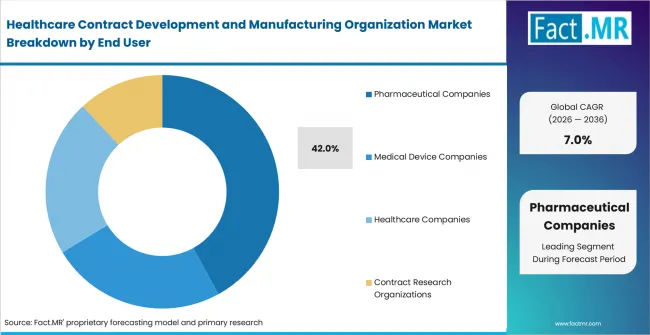
Healthcare Contract Development And Manufacturing Organization Market Analysis By End User | Source: Fact.MR
Large sponsors manage broad portfolios and need flexible capacity across dosage forms. Outsourcing keeps internal plants focused on strategic products. topical drugs cdmo shows how the model extends beyond injectable supply.
How do Long-term Manufacturing Agreements shape demand?
Long-term Manufacturing Agreements are estimated to represent 53.0% share in 2026.
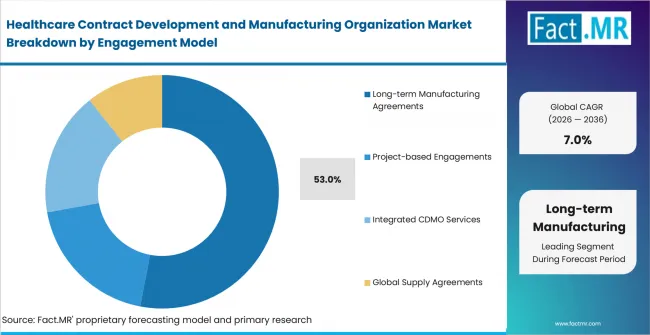
Healthcare Contract Development And Manufacturing Organization Market Analysis By Engagement Model | Source: Fact.MR
Capacity planning starts before commercial demand is fully visible. Longer agreements help sponsors secure production slots before launch scale. live biotherapeutic products shows why continuity can support process learning and release consistency. FUJIFILM Biotechnologies signed a 10-year U.S. manufacturing supply agreement with Regeneron in April 2025 valued at over USD 3 billion, showing why multi-year reserved capacity matters for biologics.
Why does Sterile Manufacturing lead Manufacturing Capability?
Sterile Manufacturing is forecast to hold 39.0% share in 2026.
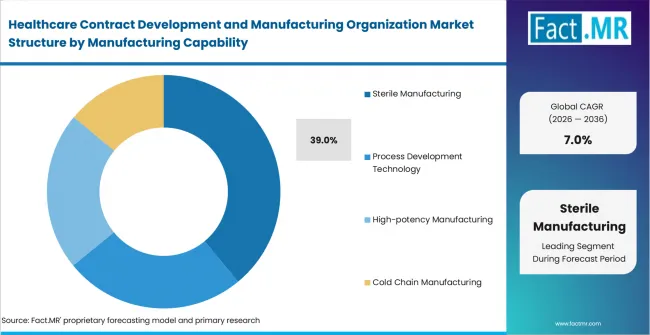
Healthcare Contract Development And Manufacturing Organization Market Analysis By Manufacturing Capability | Source: Fact.MR
Sterile operations carry high qualification pressure because injectables need controlled filling and release testing. Providers with aseptic systems can support low-contamination supply. pharmaceutical contract packaging remains relevant after qualified production. Thermo Fisher completed the acquisition of Sanofi’s sterile fill-finish and packaging site in Ridgefield, New Jersey, in September 2025, adding U.S. drug product manufacturing capacity for pharma and biotech customers.
What is accelerating Healthcare Contract Development and Manufacturing Organization Market adoption, and what is holding it back?
Demand is expected to rise as sponsors face outsourcing pressure and commercial supply needs. Sterile production limits add capacity pressure. Quality risk and technology-transfer delays remain restraints.
Drivers Impact Analysis
| DRIVER | (~) % IMPACT ON CAGR | GEOGRAPHIC RELEVANCE | IMPACT TIMELINE |
|---|---|---|---|
| Commercial supply outsourcing | +2.0% | USA, Germany, Switzerland | Short term (<= 2 years) |
| Sterile and biologics capacity | +1.7% | USA, Japan, South Korea | Short term (<= 2 years) |
| Technology transfer complexity | +1.3% | Global sponsor networks | Medium term (2-4 years) |
| Long-term capacity agreements | +1.1% | Europe and Asia Pacific | Medium term (2-4 years) |
| Quality and release documentation | +0.9% | Regulated export markets | Long term (>= 4 years) |
Source: Fact.MR analysis. Updated Aug 10, 2026
- Commercial supply outsourcing: Sponsors are expected to outsource production when internal plants are assigned to higher-priority launches or specialized assets.
- Sterile and biologics capacity: Aseptic and biologic production needs are expected to raise demand for partners with validated facilities.
- Technology transfer complexity: CDMOs with clear transfer protocols are expected to reduce handoff risk between development batches and commercial production.
Opportunity Impact Analysis
| OPPORTUNITY | (~) % IMPACT ON CAGR | GEOGRAPHIC RELEVANCE | IMPACT TIMELINE |
|---|---|---|---|
| Integrated development-to-commercial services | +1.4% | USA and Europe | Medium term (2-4 years) |
| Specialized sterile fill-finish | +1.1% | USA, Germany, South Korea | Medium term (2-4 years) |
| Complex biologics and advanced modalities | +0.8% | Switzerland, Japan, China | Long term (>= 4 years) |
| Regional supply chain diversification | +0.6% | India and East Asia | Long term (>= 4 years) |
Source: Fact.MR analysis. Updated Aug 10, 2026
- Integrated development-to-commercial services: Providers that connect formulation and process work with commercial transfer are expected to gain more approval during supplier selection.
- Specialized sterile fill-finish: Demand growth is expected to be sharper where sponsors need validated injectable capacity for biologics and specialty drugs.
- Regional supply chain diversification: Multi-site CDMO networks are expected to gain attention as sponsors look for qualified alternatives beyond a single production site.
Restraints Impact Analysis
| RESTRAINT | (~) % IMPACT ON CAGR | GEOGRAPHIC RELEVANCE | IMPACT TIMELINE |
|---|---|---|---|
| Quality and compliance risk | -1.1% | Global | Short term (<= 2 years) |
| Capacity booking pressure | -0.9% | Sterile and biologics sites | Short term (<= 2 years) |
| Technology-transfer delays | -0.7% | Cross-border projects | Medium term (2-4 years) |
| Specialized workforce gaps | -0.5% | Developing production hubs | Long term (>= 4 years) |
Source: Fact.MR analysis. Updated Aug 10, 2026
- Quality and compliance risk: Sponsors can delay outsourcing decisions when a facility has weak deviation handling or unclear release documentation.
- Capacity booking pressure: Scarce sterile capacity can create queueing risk and push smaller sponsors behind larger commercial programs.
- Technology-transfer delays: Process movement across sites requires matched equipment and trained teams before commercial production can begin.
Which countries are scaling Healthcare Contract Development and Manufacturing Organization Market fastest?
- The country comparison spans 1.8 percentage points and forms three practical growth bands across the forecast period.
- The USA remains 0.3 percentage point above Germany through advanced outsourcing use and mature sponsor networks.
- Germany remains 0.3 percentage point above Switzerland through established pharmaceutical manufacturing and quality infrastructure.
- Switzerland remains 0.3 percentage point above Japan because biologics expertise supports high-specification outsourcing demand.
- Japan remains 0.3 percentage point above China as quality expectations influence partner qualification.
- China remains 0.3 percentage point above India through broad production activity and local supplier capability.
- India remains 0.3 percentage point above South Korea. South Korea closes the displayed range through biologics capacity and export-facing pharmaceutical production.
Comparable CAGRs can create different entry conditions due to sponsor mix and site qualification standards. Full report coverage includes North America; Europe; East Asia; South Asia and Pacific; and emerging regions.
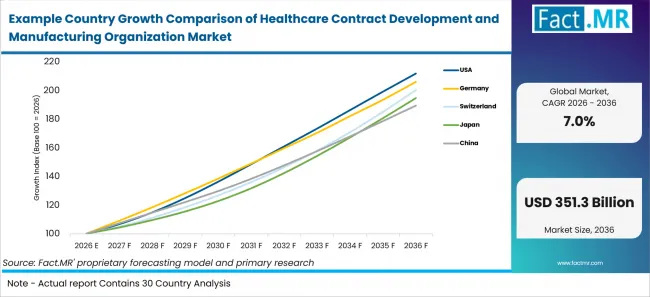
Example Country Growth Comparison Of Healthcare Contract Development And Manufacturing Organization Market | Source: Fact.MR
| Country | CAGR (2026-2036) |
|---|---|
| USA | 7.8% |
| Germany | 7.5% |
| Switzerland | 7.2% |
| Japan | 6.9% |
| China | 6.6% |
| India | 6.3% |
| South Korea | 6.0% |
Source: Fact.MR analysis. Updated Aug 10, 2026
What supports USA adoption?
The USA is projected to grow at 7.8% CAGR through 2036, supported by advanced outsourcing use and mature regulatory expectations.
USA sponsors assess CDMOs through quality history and release performance. Contract decisions are expected to depend on reliable technology transfer and stable supply. Buyers also value partners that can maintain compliance while supporting complex development and commercial production programs.
How is Germany scaling demand?
Germany is forecast to grow at 7.5% CAGR through 2036, backed by pharmaceutical manufacturing depth and strict quality systems.
German demand is supported by a strong pharmaceutical production base and established GMP practices. Sponsors are expected to favor CDMOs with consistent batch release and dependable manufacturing control. Clear documentation and predictable quality performance also influence outsourcing decisions across complex therapy programs.
What supports Switzerland’s growth?
Switzerland is anticipated to record 7.2% CAGR through 2036, led by biologics expertise and sponsor concentration.
Switzerland benefits from a strong concentration of pharmaceutical sponsors and advanced biologics activity. High-value projects are expected to favor CDMOs with precise process control and reliable quality systems. Suppliers that support complex manufacturing programs can strengthen their position in outsourced production.
How does Japan perform?
Japan is estimated to grow at 6.9% CAGR through 2036, supported by quality expectations and therapy demand tied to an aging population.
Japan’s market is shaped by strict quality expectations and careful release procedures. Sponsors place strong importance on documentation and manufacturing consistency. Demand is also supported by therapy needs linked to an aging population, creating steady opportunities for qualified outsourcing partners.
How is China scaling demand?
China is projected to grow at 6.6% CAGR through 2036, driven by expanding pharmaceutical production and local supplier capability.
China’s growth reflects domestic production scale and demand for nearby technical support. Local service depth can help sponsors manage project handoffs. China’s National Medical Products Administration reported in March 2025 that China approved 48 first-in-class innovative drugs in 2024 across nearly 20 therapeutic areas, supporting local demand for qualified development and production partners.
What is driving India’s growth from 2026 to 2036?
India is expected to grow at 6.3% CAGR through 2036, supported by pharmaceutical production depth and cost-sensitive outsourcing demand.
India’s CDMO outlook is shaped by production experience and global customer servicing. Flexible capacity supports commercial products where sponsors need reliable external options. India’s Press Information Bureau reported in February 2026 that pharmaceutical exports reached USD 30.47 billion in FY 2024-25, up 9.4%, reinforcing the export-facing base used by many outsourcing customers.
What supports South Korea’s growth?
South Korea is forecast to grow at 6.0% CAGR through 2036, backed by biomanufacturing capability and export-facing pharmaceutical production.
South Korea’s growth reflects biologics manufacturing depth and export-oriented production. Capability proof is expected to matter more than capacity alone.
Who leads the Healthcare Contract Development and Manufacturing Organization Market?
Lonza Group AG and Catalent, Inc. show the strongest direct relevance, while Samsung Biologics and FUJIFILM Biotechnologies add depth in large-scale biologics manufacturing. Lonza supports complex drug production and sterile capabilities.
Catalent strengthens development-to-commercial manufacturing coverage. Samsung Biologics expands biologics capacity, while Thermo Fisher Scientific adds sterile fill-finish expertise. WuXi AppTec, Recipharm, PCI Pharma Services, Siegfried Holding, and Boehringer Ingelheim BioXcellence broaden the competitive field across development, manufacturing, packaging, and specialized outsourcing services.
Which companies are the key providers?
Key companies include Lonza Group AG, Catalent, Inc., WuXi AppTec Co., Ltd., Samsung Biologics Co., Ltd., Recipharm AB, Thermo Fisher Scientific Inc., PCI Pharma Services, Siegfried Holding AG, Boehringer Ingelheim BioXcellence, and FUJIFILM Biotechnologies.
- Lonza Group AG
- Catalent, Inc.
- WuXi AppTec Co., Ltd.
- Samsung Biologics Co., Ltd.
- Recipharm AB
- Thermo Fisher Scientific Inc.
- PCI Pharma Services
- Siegfried Holding AG
- Boehringer Ingelheim BioXcellence
- FUJIFILM Biotechnologies
Bibliography
- U.S. Food and Drug Administration. (2025). Novel drug approvals for 2024.
- Lonza Group AG. (2025, October 8). Lonza receives Swissmedic approval for highly potent biologics drug product filling line in Stein (CH).
- Catalent, Inc. (2024, December 18). Novo Holdings completes acquisition of Catalent.
- Samsung Biologics Co., Ltd. (2026, March 31). Samsung Biologics completes acquisition of GSK’s manufacturing facility in Rockville, Maryland.
- Thermo Fisher Scientific Inc. (2025, July 16). Thermo Fisher Scientific and Sanofi expand strategic partnership to enable additional U.S. drug product manufacturing.
- FUJIFILM Biotechnologies. (2025, April 22). FUJIFILM Biotechnologies and Regeneron sign a 10-year U.S. manufacturing agreement valued at over $3 billion.
- U.S. Food and Drug Administration. (2026). Novel drug approvals for 2025.
- European Medicines Agency. (2026, June 11). Annual report 2025.
- Swissmedic. (2026, February 17). Authorisations of human medicinal products with a new active substance and additional indications 2025.
- China Daily. (2025, March 19). China approves 48 innovative drugs in 2024. National Medical Products Administration.
- Ministry of Commerce & Industry. (2026, February 21). Chintan Shivir in Ahmedabad focuses on scaling pharma exports as India crosses $30 billion mark. Press Information Bureau.
- Thermo Fisher Scientific Inc. (2025, September 2). Thermo Fisher Scientific completes acquisition of Sanofi’s Ridgefield, New Jersey site.
This Report Answers
- The report provides strategic intelligence on service and application choices that shape CDMO outsourcing decisions.
- Segment analysis covers Contract Manufacturing and Commercial Manufacturing as the share leaders within the 2026 market.
- Country outlook evaluates the USA and Germany alongside Switzerland and Japan. China; India; and South Korea complete the growth comparison across the profiled markets.
- Competitive analysis profiles Lonza Group AG and Catalent, Inc. alongside WuXi AppTec Co., Ltd. and Samsung Biologics Co., Ltd.
- Capability assessment covers Sterile Manufacturing and Biologics Manufacturing. API Manufacturing; Oral Solid Dosage; and Packaging and Labeling complete the wider view.
What does the Healthcare Contract Development and Manufacturing Organization Market cover?
Healthcare CDMOs provide outsourced development and manufacturing services for pharmaceutical and biotechnology sponsors. The market covers contract production; process support; analytical testing; and regulated packaging.
The Healthcare Contract Development and Manufacturing Organization Market covers services that move a drug program from development work to qualified supply. Coverage includes Contract Manufacturing; Contract Development; Packaging Services; Analytical Testing; and Regulatory Support. biologics manufacturing and cell and gene therapy cdmo adjacencies are relevant where sponsors need specialized production skills.
What is included in the scope?
The scope includes CDMO services sold to pharmaceutical companies and biotechnology companies. Medical device companies are included where they buy these services. Healthcare providers and research institutes follow the same rule.
The scope includes Service Category and Application. End User, Engagement Model and Manufacturing Capability are also covered. Contract Manufacturing and Contract Development form the core service view. Sterile Manufacturing; Biologics Manufacturing; API Manufacturing; Oral Solid Dosage; and Packaging and Labeling are included when outsourced.
What is excluded from the scope?
In-house pharmaceutical manufacturing remains outside the scope unless the activity is performed as a contract service for an external sponsor.
The scope excludes general consulting and unrelated healthcare outsourcing. Standalone research without manufacturing responsibility is excluded. Distribution-only activity remains outside the scope unless it is part of regulated packaging or supply support.
How Was the Analysis Built?
The analysis draws on 120+ sources, 35+ company portfolios, 25+ countries, and more than 20 interviews.
- Primary Research: Interviews with manufacturers, retailers, salon operators, and experts examine purchase priorities, adoption, approval requirements, and competitive positioning.
- Desk Research: Desk research covers government statistics, regulatory publications, company filings, trade data, technical studies, industry associations, standards, and public policy.
- Market Sizing and Forecasting: Estimates combine historical performance, demand indicators, pricing, segment shares, company participation, country growth, adoption patterns, and barriers to expansion.
- Data Validation and Update Cycle: Findings are validated against public data, company activity, regulatory changes, product launches, recalls, and adoption shifts.
Segmentation
What is the report’s scope and coverage?
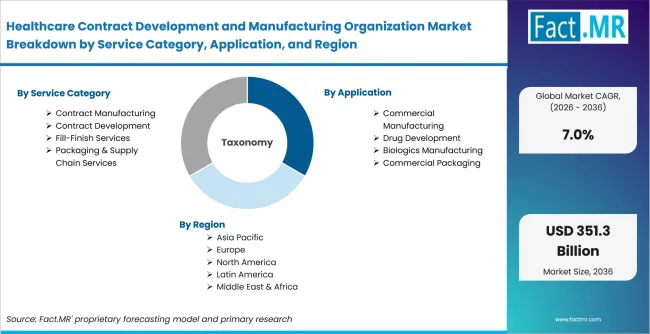
Healthcare Contract Development And Manufacturing Organization Market Breakdown By Service Category, Application, And Region | Source: Fact.MR
| Attribute | Details |
|---|---|
| Quantitative Units | USD billion |
| Market Definition | Outsourced contract development and manufacturing services used by pharmaceutical and biotechnology sponsors for process development, clinical supply, commercial production, sterile manufacturing, analytical testing, technology transfer, and regulated packaging support |
| Service Category | Contract Manufacturing; Contract Development; Packaging Services; Analytical Testing; Regulatory Support |
| Application | Commercial Manufacturing; Clinical Trial Manufacturing; Process Development; Technology Transfer; Scale-up Services |
| End User | Pharmaceutical Companies; Biotechnology Companies; Medical Device Companies; Healthcare Providers; Research Institutes |
| Engagement Model | Long-term Manufacturing Agreements; Project-based Contracts; Preferred Vendor Partnerships; Co-development Agreements; Technology Transfer Partnerships |
| Manufacturing Capability | Sterile Manufacturing; Biologics Manufacturing; API Manufacturing; Oral Solid Dosage; Packaging and Labeling |
| Regions Covered | North America; Latin America; Europe; East Asia; South Asia and Pacific; Middle East and Africa |
| Countries Covered | USA; Germany; Switzerland; Japan; China; India; South Korea |
| Key Companies Profiled | Lonza Group AG; Catalent, Inc.; WuXi AppTec Co., Ltd.; Samsung Biologics Co., Ltd.; Recipharm AB; Thermo Fisher Scientific Inc.; PCI Pharma Services; Siegfried Holding AG; Boehringer Ingelheim BioXcellence; FUJIFILM Biotechnologies |
| Forecast Period | 2026 to 2036 |
| Approach | Hybrid top-down and bottom-up approach using sponsor outsourcing demand; sterile and biologics capacity; commercial supply needs; technology-transfer requirements; country adoption patterns; and provider capability review |
Source: Fact.MR analysis. Updated Aug 10, 2026
How is the market segmented?
-
By Service Category
- Contract Manufacturing
- Drug Product Manufacturing
- Biologics Manufacturing
- Contract Development
- Preclinical Development
- Analytical Development
- Fill-Finish Services
- Aseptic Filling
- Lyophilization Services
- Packaging & Supply Chain Services
- Primary Packaging
- Secondary Packaging
- Contract Manufacturing
-
By Application
- Commercial Manufacturing
- Small Molecule Production
- Biopharmaceutical Production
- Drug Development
- Formulation Development
- Clinical Trial Manufacturing
- Biologics Manufacturing
- Monoclonal Antibody Manufacturing
- Cell & Gene Therapy Manufacturing
- Commercial Packaging
- Labeling & Serialization
- Global Distribution Support
- Commercial Manufacturing
-
By End User
- Pharmaceutical Companies
- Biotechnology Companies
- Virtual Biopharma Companies
- Medical Device Companies
- Generic Pharmaceutical Companies
- Research Organizations
- Healthcare Companies
- Hospital Networks
- Academic Research Institutes
- Contract Research Organizations
- Vaccine Developers
- Public Health Organizations
- Pharmaceutical Companies
-
By Engagement Model
- Long-term Manufacturing Agreements
- Dedicated Manufacturing Contracts
- Fee-for-service Model
- Project-based Engagements
- Milestone-based Contracts
- Strategic Development Partnerships
- Integrated CDMO Services
- End-to-end Outsourcing
- Full-service Partnerships
- Global Supply Agreements
- Regional Manufacturing Partnerships
- Flexible Capacity Agreements
- Long-term Manufacturing Agreements
-
By Manufacturing Capability
- Sterile Manufacturing
- Aseptic Fill-Finish Manufacturing
- Single-use Bioprocessing
- Process Development Technology
- Analytical Development
- Scale-up Manufacturing
- High-potency Manufacturing
- Containment Manufacturing
- Cell Therapy Manufacturing
- Cold Chain Manufacturing
- Temperature-controlled Packaging
- Cold Chain Logistics Integration
- Sterile Manufacturing
-
By Region
- North America
- Latin America
- Europe
- East Asia
- South Asia and Oceania
- Middle East and Africa
Frequently Asked Questions
How big is the healthcare contract development and manufacturing organization market in 2026?
The healthcare contract development and manufacturing organization market is valued at USD 178.6 billion in 2026 and is forecast to reach USD 351.3 billion by 2036.
Which service category leads the healthcare contract development and manufacturing organization market?
Contract Manufacturing accounts for 47.0% of the healthcare contract development and manufacturing organization market by service category in 2026, supported by sponsor demand for qualified GMP production and dependable commercial supply capacity.
Who are the leading companies in the healthcare contract development and manufacturing organization market?
Who worked on this report


Preview the report firsthand - request a free sample
Free SampleGet the brochure for pricing and purchase details
Download PDF