- Market Value (2025): USD 4.2 Bn
- Estimated Value (2026): USD 4.8 Bn
- Forecast Value (2036): USD 16.9 Bn
- CAGR (2026-2036): 13.4%
What is the High Risk IMDRF Category III & IV Software as a Medical Device Market forecast to be worth by 2036?
The market is projected to grow from USD 4.8 billion in 2026 to USD 16.9 billion by 2036, registering a CAGR of 13.4%.
- The High Risk IMDRF Category III & IV Software as a Medical Device market reached USD 4.2 billion in 2025.
- Demand is forecast to increase from USD 4.8 billion in 2026 to USD 16.9 billion by 2036.
- The market is forecast to record 13.4% CAGR from 2026 to 2036.
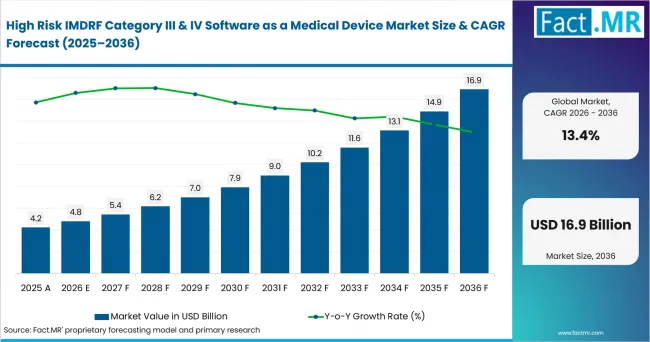
High Risk Imdrf Category Iii & Iv Software As A Medical Device Market Value Analysis | Source: Fact.MR
What are the defining numbers behind High Risk IMDRF Category III & IV Software as a Medical Device Market growth?
An absolute dollar opportunity of USD 12.1 billion is expected between 2026 and 2036.
- Demand Drivers in the Market
- Growing use of software in diagnosis and treatment decisions is increasing demand for high-risk SaMD that can support clinicians in serious and critical healthcare situations.
- Integration of artificial intelligence and machine learning into medical imaging, clinical decision support and patient monitoring is expanding the number of software functions that require regulatory review as medical devices.
- Clearer regulatory pathways for software-based medical devices are helping developers plan clinical validation, risk classification and post-market monitoring for IMDRF Category III and IV products.
- Hospitals are adopting software that can integrate with imaging systems, electronic health records and specialist workflows while maintaining traceability and clinician oversight.
- Frequent software updates and algorithm changes are increasing demand for controlled lifecycle management, documented validation and continuous performance monitoring.
- Wider use of cloud-based clinical software is supporting deployment across multiple hospital sites, provided suppliers meet cybersecurity, data-governance and service-availability requirements.
- Key Segments Analyzed
- Diagnostic Software accounts for 42.0% of Software Type in 2026, reflecting its use in identifying and characterizing conditions that require timely clinical action.
- Medical Imaging Diagnostics represents 39.0% of Application in 2026, supported by the growing use of software for image interpretation and clinical prioritization.
- Hospitals hold 44.0% of End User in 2026 because they manage high-acuity cases and maintain the specialist infrastructure required for regulated software deployment.
- Cloud-based Deployment accounts for 56.0% of Deployment Model in 2026, driven by centralized updates and access across multiple clinical locations.
- IMDRF Category III represents 61.0% of Risk Classification in 2026, covering software that informs critical decisions or drives management in serious healthcare situations.
- Analyst Opinion at Fact.MR
- “Healthcare markets are entering a period of unprecedented innovation, with AI-enabled diagnostics, precision therapeutics, and digital health platforms converging to transform patient outcomes. Markets tied to chronic disease management, advanced therapies, and healthcare IT infrastructure are positioned for sustained growth. Companies that integrate clinical evidence with digital capabilities will lead the next wave of healthcare transformation.”, says Shambhu Nath Jha, Principal Consultant, Fact.MR
- Strategic Implications
- Align clinical evaluation with the software’s intended medical purpose and risk category. IMDRF guidance requires manufacturers to establish valid clinical association, analytical validation and clinical validation for SaMD.
- Build total-product-lifecycle controls into AI-enabled software development. FDA guidance emphasizes risk management across development, marketing submission and post-market use rather than treating regulatory review as a one-time activity.
- Prepare predetermined change control plans for planned algorithm modifications. FDA, Health Canada and MHRA guidance supports documenting expected changes, validation methods and safeguards before modified software is deployed.
- Monitor deployed models for performance changes and retraining risks. Joint regulatory principles state that manufacturers should track real-world performance and manage risks created by model updates.
- Provide clinicians with clear information on intended use, limitations and expected performance. Regulatory transparency principles place emphasis on the performance of the human-AI team and the information required for safe use.
- Develop market-specific regulatory strategies because software classification and post-market requirements continue to evolve across jurisdictions. The MHRA programme covers qualification, classification, pre-market requirements and post-market controls, while Health Canada has issued guidance for Class II, III and IV machine learning-enabled devices.
How does the High Risk IMDRF Category III & IV Software as a Medical Device Market break down by segment?
Diagnostic Software is expected to lead Software Type at 42.0% share in 2026. Medical Imaging Diagnostics is projected to lead Application at 39.0% share in 2026.
Why does Diagnostic Software lead Software Type?
Diagnostic Software is projected to account for 42.0% share in 2026.
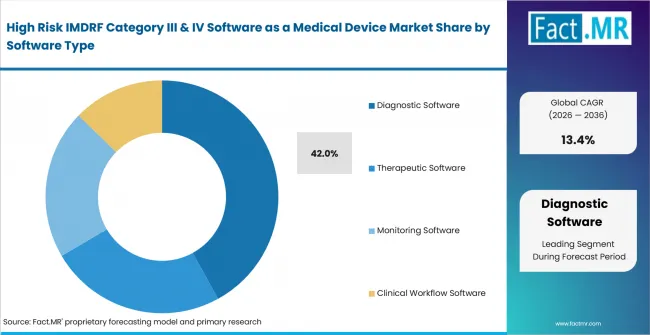
High Risk Imdrf Category Iii & Iv Software As A Medical Device Market Analysis By Software Type | Source: Fact.MR
Diagnostic Software supports the identification or characterization of a disease where an incorrect or delayed result may affect treatment decisions. Its role is especially relevant in serious and critical healthcare situations, where clinicians need patient-specific information before deciding whether to intervene or conduct further testing.
IMDRF states that SaMD risk depends on the significance of the information supplied and the seriousness of the healthcare situation. Diagnostic functions therefore account for a substantial portion of Category III and IV software when their outputs inform or drive high-consequence clinical decisions. Clinical use requires evidence of a valid clinical association and reliable analytical and clinical performance.
Why does Medical Imaging Diagnostics lead Application?
Medical Imaging Diagnostics is projected to account for 39.0% share in 2026.
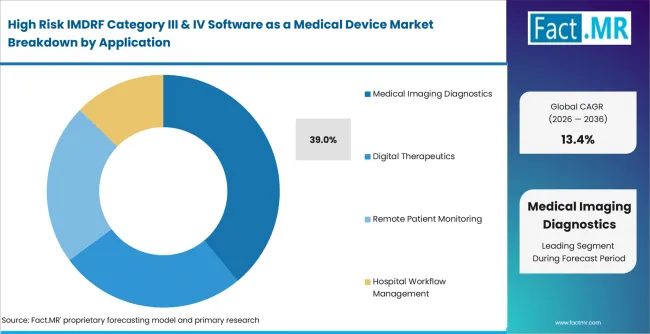
High Risk Imdrf Category Iii & Iv Software As A Medical Device Market Analysis By Application | Source: Fact.MR
Medical imaging provides standardized digital inputs that software can analyze for detection and prioritization. Algorithms may identify suspicious findings and quantify anatomical changes or alert clinicians to cases requiring rapid review. These functions can be incorporated into existing radiology workflows without creating a separate patient-data collection process.
The FDA identifies diagnostic imaging as a major area of AI-enabled medical-device development. Its regulatory research also notes that diagnostic and triage models require performance measures matched to their intended clinical functions. This established regulatory and operational use supports the segment’s position within high-risk SaMD applications.
Why do Hospitals lead End User?
Hospitals are projected to account for 44.0% share in 2026.
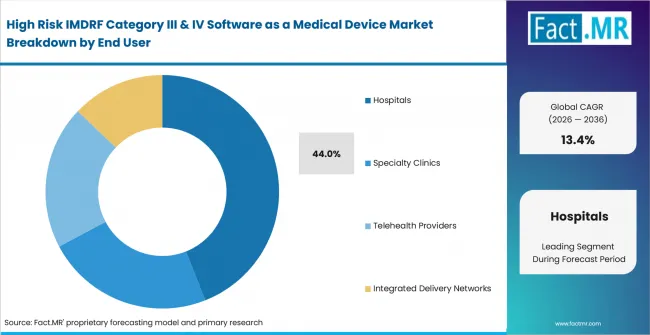
High Risk Imdrf Category Iii & Iv Software As A Medical Device Market Analysis By End User | Source: Fact.MR
Hospitals manage patients with serious and critical conditions and concentrate the specialists required to interpret high-risk software outputs. They also operate imaging archives and other clinical systems that provide the data used by diagnostic and decision-support software.
Adoption depends on how clearly clinicians can understand the software’s intended use and limitations. FDA guidance distinguishes device clinical decision-support functions according to how they process patient-specific information and whether healthcare professionals can independently review the basis of a recommendation. Hospitals therefore favour products that preserve clinical oversight and provide traceable results within existing care pathways.
Why does Cloud-based Deployment lead Deployment Model?
Cloud-based Deployment is projected to account for 56.0% share in 2026.
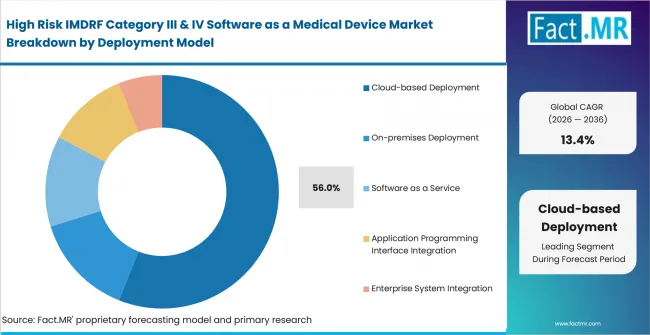
High Risk Imdrf Category Iii & Iv Software As A Medical Device Market Analysis By Deployment Model | Source: Fact.MR
Cloud deployment allows manufacturers to provide computing capacity and controlled software updates across several clinical locations. Hospitals can access the same validated software version without installing separate processing infrastructure at each site, which is useful for health systems operating distributed imaging and specialist-care networks.
IMDRF’s SaMD framework applies regardless of whether software operates through a mobile application, server or cloud platform. Regulatory responsibility therefore remains tied to the medical purpose and associated risk rather than the hosting environment. Suppliers must still manage cybersecurity and version control so that updates do not alter validated performance without appropriate assessment.
Why does IMDRF Category III lead Risk Classification?
IMDRF Category III is projected to account for 61.0% share in 2026.
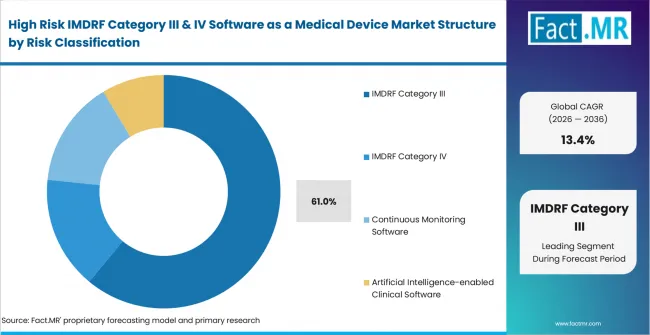
High Risk Imdrf Category Iii & Iv Software As A Medical Device Market Analysis By Risk Classification | Source: Fact.MR
Category III covers software that informs clinical management in critical situations or drives clinical management in serious situations. This captures a broad range of diagnostic and treatment-support products that influence consequential decisions while stopping short of the highest-risk functions that directly drive decisions in critical situations.
Category IV has a narrower scope because it covers functions where an incorrect output could directly lead to death or irreversible deterioration. Its higher potential consequence creates a heavier clinical-evidence and risk-control burden. The broader set of use cases classified under Category III supports its larger share of the market.
What is accelerating High Risk IMDRF Category III & IV Software as a Medical Device Market adoption, and what is holding it back?
Drivers Impact Analysis
| Driver | % Impact on CAGR | Geographic Relevance | Impact Timeline |
|---|---|---|---|
| Technology Innovation & R&D | High | Global | 2026-2036 |
| Regulatory & Policy Drivers | Medium-High | North America, Europe | 2026-2032 |
| End-User Industry Expansion | High | Asia Pacific, MEA | 2026-2036 |
| Operational & Cost Efficiency | Medium | Global | 2026-2036 |
Source: Fact.MR analysis. Updated Aug 11, 2026
Restraints Impact Analysis
| Restraint | % Impact on CAGR | Geographic Relevance | Impact Timeline |
|---|---|---|---|
| Capital Intensity & Investment | Medium | Developing Markets | 2026-2030 |
| Supply Chain & Raw Material | Medium | Global | 2026-2028 |
| Workforce & Capability Gaps | Low-Medium | Africa, Latin America | 2026-2036 |
Source: Fact.MR analysis. Updated Aug 11, 2026
Which countries are scaling the High Risk IMDRF Category III & IV Software as a Medical Device Market fastest?
- USA: The USA is forecast to expand at a 14.6% CAGR. Growth is supported by an established FDA pathway for AI-enabled medical devices and guidance covering lifecycle management, cybersecurity and predetermined change control plans. The FDA’s expanding list of authorized AI-enabled devices also gives hospitals greater regulatory familiarity with software used in imaging and clinical decision support.
- Germany: Germany is projected to grow at a 14.1% CAGR. Adoption is supported by experience assessing digital medical products and integrating regulated software into healthcare processes. BfArM provides structured guidance on evidence, data processing and interoperability for digital health applications, strengthening the wider development environment for medical software.
- UK: The UK is forecast to record a 13.7% CAGR. The MHRA is refining requirements for software and AI as medical devices across qualification, classification, pre-market assessment and post-market surveillance. Its AI Airlock programme also gives developers a controlled route for testing regulatory approaches to complex AI-enabled products.
- Japan: Japan is projected to expand at a 13.2% CAGR. PMDA maintains a dedicated Software as a Medical Device review function and consultation pathway. This allows developers to clarify product qualification and evidence requirements before formal submission, supporting software used in medical imaging and physiological-data analysis.
- Canada: Canada is forecast to grow at a 12.8% CAGR. Health Canada has issued pre-market guidance for machine learning-enabled medical devices, including Class III and IV products. The framework addresses planned algorithm changes and lifecycle evidence, helping manufacturers prepare regulated updates without treating every modification as an entirely separate product.
- France: France is projected to expand at a 12.3% CAGR. Demand is supported by the application of EU medical-device rules to software that informs or drives serious clinical decisions. Hospitals require products with appropriate clinical evidence, CE-marking documentation and integration support for imaging and specialist-care workflows.
- Australia: Australia is forecast to grow at an 11.8% CAGR. The TGA applies risk-based classification to software medical devices and requires regulated products to be included in the Australian Register of Therapeutic Goods before supply. This creates a defined route for high-risk diagnostic and clinical software entering hospital use.
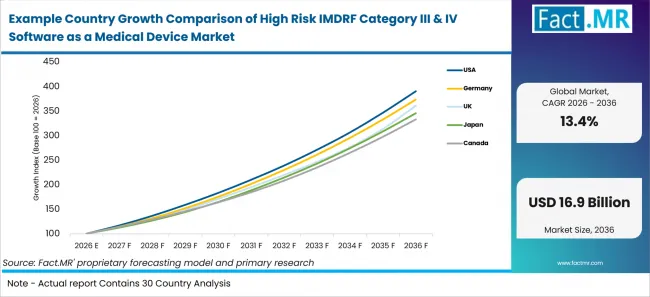
Example Country Growth Comparison Of High Risk Imdrf Category Iii & Iv Software As A Medical Device Market | Source: Fact.MR
Country-wise CAGR Forecast (2026-2036)
| Country | CAGR (%) |
|---|---|
| USA | 14.6% |
| Germany | 14.1% |
| UK | 13.7% |
| Japan | 13.2% |
| Canada | 12.8% |
| France | 12.3% |
| Australia | 11.8% |
Source: Fact.MR analysis. Updated Aug 11, 2026
What is driving the High Risk IMDRF Category III & IV Software as a Medical Device market in USA?
The USA is projected to register a CAGR of 14.6% from 2026 to 2036.
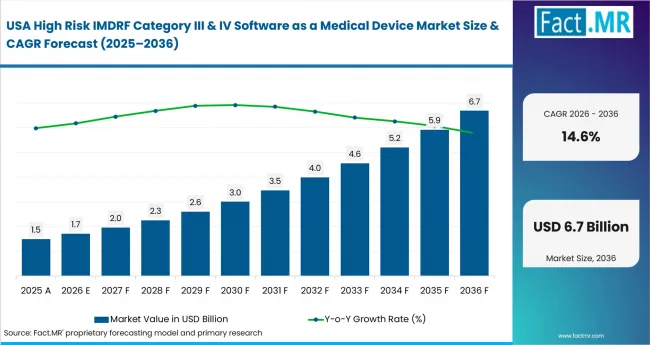
High Risk Imdrf Category Iii & Iv Software As A Medical Device Market Country Value Analysis | Source: Fact.MR
The FDA has developed a defined regulatory framework for AI-enabled medical-device software, including guidance on lifecycle risk management and the information manufacturers should include in marketing submissions. This helps developers plan clinical validation, performance documentation and post-market controls for software used in serious or critical healthcare situations.
The FDA also maintains a public list of authorized AI-enabled medical devices. This gives developers and healthcare providers greater visibility into the types of software functions reaching the market and the regulatory expectations applied to them.
What is driving the High Risk IMDRF Category III & IV Software as a Medical Device market in Germany?
Germany is projected to register a CAGR of 14.1% from 2026 to 2036.
Germany applies risk-based medical-device classification and maintains national systems for clinical investigations, regulatory notifications and market surveillance. BfArM operates the German Medical Devices Information and Database System, which connects national medical-device processes with the wider European regulatory environment.
Germany also has an established process for assessing digital medical applications. The DiGA pathway applies to lower-risk products rather than IMDRF Category III and IV software, but it has increased institutional familiarity with evidence requirements and regulated digital-health procurement.
What is driving the High Risk IMDRF Category III & IV Software as a Medical Device market in UK?
The UK is projected to register a CAGR of 13.7% from 2026 to 2036.
The MHRA is updating the regulatory framework for software and artificial intelligence used as medical devices. Its change programme covers qualification and risk classification, together with pre-market requirements and post-market surveillance. These measures provide a clearer development route for software that influences high-consequence clinical decisions.
The programme also addresses concerns specific to AI-enabled software, including model interpretability and changes caused by retraining. This increases demand for documented lifecycle controls and performance monitoring from suppliers seeking deployment within UK healthcare settings.
What is driving the High Risk IMDRF Category III & IV Software as a Medical Device market in Japan?
Japan is projected to register a CAGR of 13.2% from 2026 to 2036.
Software as a Medical Device has been regulated under Japan’s PMD Act since November 2014. PMDA maintains a dedicated SaMD review function, allowing developers to obtain product-specific guidance on approval requirements and performance evaluation.
PMDA has also examined scientific and regulatory considerations for AI-based SaMD. This supports structured assessment of software using machine learning in diagnostic and clinical applications while preserving requirements for safety and clinical performance.
What is driving the High Risk IMDRF Category III & IV Software as a Medical Device market in Canada?
Canada is projected to register a CAGR of 12.8% from 2026 to 2036.
Health Canada’s pre-market guidance covers machine learning-enabled medical devices classified as Class II, III and IV. It explains the information manufacturers should provide when submitting a new licence application or an amendment for software that uses machine learning to achieve its medical purpose.
Canada has also adopted guiding principles for good machine learning practice and predetermined change control plans. These frameworks support controlled software modification while requiring manufacturers to maintain device safety and effectiveness throughout the product lifecycle.
Who leads the High Risk IMDRF Category III & IV Software as a Medical Device Market?
Siemens Healthineers AG, GE HealthCare Technologies Inc. and Koninklijke Philips N.V. are positioned strongly within the supplied company list through their involvement in medical imaging and hospital-based clinical software.
Medtronic plc, Boston Scientific Corporation and Abbott Laboratories participate through software connected with diagnosis, monitoring and treatment workflows. Aidoc Medical Ltd. represents the specialist medical-imaging software group.
Oracle Health, Epic Systems Corporation and Veradigm LLC operate across clinical information environments. Their inclusion requires product-level assessment because general electronic health records and administrative platforms do not qualify as SaMD unless a specific software function has an independent medical purpose.
Competition depends on the ability to generate clinical evidence for the intended use and obtain approval within the relevant risk class. Hospitals also assess integration with imaging archives or electronic health records, cybersecurity controls and the ability to trace software versions.
For AI-enabled products, post-market performance monitoring is becoming a further competitive requirement. Suppliers must demonstrate how model changes are validated and how performance risks are managed after deployment.
Which companies are the key providers?
Key companies include Siemens Healthineers AG; GE HealthCare Technologies Inc.; Koninklijke Philips N.V.; Medtronic plc; Boston Scientific Corporation; Abbott Laboratories; Oracle Health; Epic Systems Corporation; Veradigm LLC; and Aidoc Medical Ltd.
- Siemens Healthineers AG
- GE HealthCare Technologies Inc.
- Koninklijke Philips N.V.
- Medtronic plc
- Boston Scientific Corporation
- Abbott Laboratories
- Oracle Health
- Epic Systems Corporation
- Veradigm LLC
- Aidoc Medical Ltd.
How is the market segmented?
-
By Software Type
- Diagnostic Software
- Computer-aided Detection Software
- Clinical Decision Support Software
- Therapeutic Software
- Prescription Digital Therapeutics
- Therapy Management Software
- Monitoring Software
- Real-time Patient Monitoring
- Predictive Patient Monitoring
- Clinical Workflow Software
- Clinical Automation Software
- Regulatory Compliance Software
- Diagnostic Software
-
By Application
- Medical Imaging Diagnostics
- Radiology Decision Support
- Cardiology Diagnostics
- Digital Therapeutics
- Chronic Disease Management
- Cardiac Rhythm Management
- Remote Patient Monitoring
- Intensive Care Monitoring
- Early Warning Systems
- Hospital Workflow Management
- Care Coordination
- Post-market Surveillance
- Medical Imaging Diagnostics
-
By End User
- Hospitals
- Diagnostic Imaging Centers
- Academic Medical Centers
- Specialty Clinics
- Physician Practices
- Home Healthcare Providers
- Telehealth Providers
- Public Healthcare Organizations
- Research Institutions
- Integrated Delivery Networks
- Multi-specialty Hospital Networks
- Regulatory Affairs Organizations
- Hospitals
-
By Deployment Model
- Cloud-based Deployment
- Private Cloud
- Hybrid Deployment
- On-premises Deployment
- Software as a Service
- Managed Services
- Application Programming Interface Integration
- Multi-tenant Platform
- Low-code Integration
- Enterprise System Integration
- Custom Enterprise Deployment
- Validated Software Infrastructure
- Cloud-based Deployment
-
By Risk Classification
- IMDRF Category III
- High-risk Diagnostic Software
- Clinical Decision Support Software
- IMDRF Category IV
- Life-supporting Software
- Autonomous Therapeutic Software
- Continuous Monitoring Software
- Real-time Clinical Monitoring
- Predictive Clinical Algorithms
- Artificial Intelligence-enabled Clinical Software
- Explainable Artificial Intelligence
- Cybersecure Medical Software
- IMDRF Category III
-
By Region
- North America
- Latin America
- Western Europe
- Eastern Europe
- East Asia
- South Asia and Pacific
- Middle East & Africa
Bibliography
- BfArM. (2026). Digital Health Applications. Federal Institute for Drugs and Medical Devices.
- BfArM. (2026). Medical Devices: Tasks and Regulatory Classification. Federal Institute for Drugs and Medical Devices.
- Health Canada. (2026). Pre-market Guidance for Machine Learning-enabled Medical Devices. Government of Canada.
- Health Canada, U.S. Food and Drug Administration and Medicines and Healthcare products Regulatory Agency. (2021). Good Machine Learning Practice for Medical Device Development: Guiding Principles.
- Health Canada, U.S. Food and Drug Administration and Medicines and Healthcare products Regulatory Agency. (2024). Predetermined Change Control Plans for Machine Learning-enabled Medical Devices: Guiding Principles.
- Medicines and Healthcare products Regulatory Agency. (2025). Software and Artificial Intelligence as a Medical Device. Government of the United Kingdom.
- Medicines and Healthcare products Regulatory Agency. (2023). Software and AI as a Medical Device Change Programme Roadmap. Government of the United Kingdom.
- Pharmaceuticals and Medical Devices Agency. (2023). Report on AI-based Software as a Medical Device. Government of Japan.
- Pharmaceuticals and Medical Devices Agency. (2026). Software as a Medical Device. Government of Japan.
- U.S. Food and Drug Administration. (2025). Artificial Intelligence-enabled Device Software Functions: Lifecycle Management and Marketing Submission Recommendations.
- U.S. Food and Drug Administration. (2026). Artificial Intelligence-enabled Medical Devices.
This Report Answers
- The report provides strategic intelligence on the High Risk IMDRF Category III & IV Software as a Medical Device Market across Software Type and Application choices that shape regulated clinical software deployment.
- Segment analysis covers Diagnostic Software and Medical Imaging Diagnostics as the share leaders within the 2026 market.
- Country outlook evaluates the USA and Germany alongside the UK and Japan. Canada, France and Australia complete the growth comparison across the profiled markets.
- Competitive analysis profiles Siemens Healthineers and GE HealthCare alongside Philips, Medtronic and Boston Scientific. Abbott Laboratories, Oracle Health, Epic Systems, Veradigm and Aidoc complete the provider set.
- Deployment and risk assessment covers Cloud-based Deployment and IMDRF Category III. On-premises Deployment, Software as a Service and IMDRF Category IV complete the wider market view.
What does the High Risk IMDRF Category III & IV Software as a Medical Device Market cover?
High-risk Software as a Medical Device is used to support diagnosis, clinical management and treatment decisions where incorrect information may affect serious or critical healthcare situations.
The High Risk IMDRF Category III & IV Software as a Medical Device Market covers regulated software used for diagnostic, therapeutic, monitoring and clinical workflow functions. Coverage extends to medical imaging diagnostics, digital therapeutics and remote patient monitoring. Hospital workflow management is included where the software performs a medical function. The market also covers cloud-based and on-premises deployment, software delivered as a service and integration with clinical systems. IMDRF Category III and Category IV software are included alongside AI-enabled clinical software where the intended medical purpose meets the high-risk definition.
What is included in the scope?
High-risk SaMD is used across hospitals and specialty clinics. Telehealth providers and integrated delivery networks are also included where regulated software supports patient-specific clinical decisions.
The scope includes Software Type and Application alongside End User, Deployment Model and Risk Classification. Coverage spans Diagnostic Software, Therapeutic Software, Monitoring Software and Clinical Workflow Software. Medical Imaging Diagnostics, Digital Therapeutics, Remote Patient Monitoring and Hospital Workflow Management complete the application scope. Cloud-based Deployment, On-premises Deployment, Software as a Service, API Integration and Enterprise System Integration are included. IMDRF Category III and IV products are covered when their intended medical purpose involves serious or critical healthcare situations.
What is excluded from the scope?
General healthcare software and administrative digital platforms without an independent medical purpose remain outside the scope of this market.
The scope excludes software used only for billing, scheduling, record storage and routine administrative workflows. General electronic health record platforms are excluded unless a specific software function independently qualifies as SaMD. Low-risk wellness applications and software that does not inform or drive clinical management in serious or critical situations are excluded. General cloud infrastructure and cybersecurity services remain outside the scope unless directly tied to deployment of regulated high-risk SaMD. Company revenue without a clear connection to qualifying medical-device software is also excluded.
How Was the Analysis Built?
The analysis draws on 120+ sources, 35+ company portfolios, 25+ countries, and more than 20 interviews.
- Primary Research: Interviews with manufacturers, retailers, salon operators, and experts examine purchase priorities, adoption, approval requirements, and competitive positioning.
- Desk Research: Desk research covers government statistics, regulatory publications, company filings, trade data, technical studies, industry associations, standards, and public policy.
- Market Sizing and Forecasting: Estimates combine historical performance, demand indicators, pricing, segment shares, company participation, country growth, adoption patterns, and barriers to expansion.
- Data Validation and Update Cycle: Findings are validated against public data, company activity, regulatory changes, product launches, recalls, and adoption shifts.
Segmentation
What is the report’s scope and coverage?
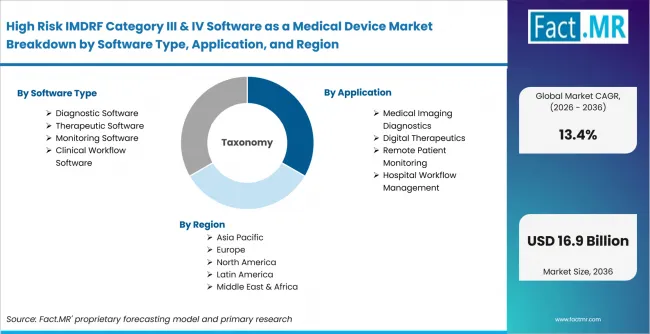
High Risk Imdrf Category Iii & Iv Software As A Medical Device Market Breakdown By Software Type, Application, And Region | Source: Fact.MR
| Attribute | Details |
|---|---|
| Quantitative Units | USD 4.8 billion in 2026 to USD 16.9 billion by 2036 at 13.4% CAGR |
| Market Definition | High-risk IMDRF Category III and IV Software as a Medical Device used to support diagnosis, clinical management and treatment decisions in serious or critical healthcare situations |
| Software Type | Diagnostic Software; Therapeutic Software; Monitoring Software; Clinical Workflow Software |
| Application | Medical Imaging Diagnostics; Digital Therapeutics; Remote Patient Monitoring; Hospital Workflow Management |
| End User | Hospitals; Specialty Clinics; Telehealth Providers; Integrated Delivery Networks |
| Deployment Model | Cloud-based Deployment; On-premises Deployment; Software as a Service; Application Programming Interface Integration; Enterprise System Integration |
| Risk Classification | IMDRF Category III; IMDRF Category IV; Continuous Monitoring Software; Artificial Intelligence-enabled Clinical Software |
| Regions Covered | North America; Europe; Asia Pacific; Latin America; Middle East & Africa |
| Countries Covered | USA; Germany; UK; Japan; Canada; France; Australia |
| Key Companies Profiled | Siemens Healthineers AG; GE HealthCare Technologies Inc.; Koninklijke Philips N.V.; Medtronic plc; Boston Scientific Corporation; Abbott Laboratories; Oracle Health; Epic Systems Corporation; Veradigm LLC; Aidoc Medical Ltd. |
| Forecast Period | 2026 to 2036 |
| Approach | Hybrid market assessment using high-risk SaMD adoption; diagnostic and clinical-decision software demand; IMDRF risk classification; clinical validation requirements; regulatory pathways; hospital deployment; AI and machine-learning integration; cloud-based delivery; cybersecurity and lifecycle controls; country-level adoption patterns; and company portfolio review |
Source: Fact.MR analysis. Updated Aug 11, 2026
Frequently Asked Questions
How big is the high risk IMDRF Category III & IV Software as a Medical Device market in 2026?
What is the CAGR of the high risk IMDRF Category III & IV Software as a Medical Device market from 2026 to 2036?
Which software type leads the high risk IMDRF Category III & IV Software as a Medical Device market?
Which application leads the high risk IMDRF Category III & IV Software as a Medical Device market?
Who are the leading companies in the high risk IMDRF Category III & IV Software as a Medical Device market?
Who worked on this report


Preview the report firsthand - request a free sample
Free SampleGet the brochure for pricing and purchase details
Download PDF