- Market Value (2025): USD 1.3 Bn
- Estimated Value (2026): USD 1.39 Bn
- Forecast Value (2036): USD 2.65 Bn
- CAGR (2026-2036): 6.7%
What is the Biopsy Forceps, Polypectomy Snares and EUS Needles Market forecast to be worth by 2036?
USD 1.39 billion in 2026 to USD 2.65 billion by 2036 at a 6.7% CAGR.
- As per Fact.MR analysis, the biopsy forceps, polypectomy snares and EUS needles market reached USD 1.3 billion in 2025.
- Demand will increase from USD 1.39 billion in 2026 to USD 2.65 billion by 2036.
- The biopsy forceps, polypectomy snares and EUS needles market will record 6.7% CAGR from 2026 to 2036.
.webp "Biopsy Forceps, Polypectomy Snares And Eus Needles Market Taxonomy (11)")
Biopsy Forceps, Polypectomy Snares And Eus Needles Market Taxonomy (11) | Source: Fact.MR
What are the defining numbers behind Biopsy Forceps, Polypectomy Snares and EUS Needles Market growth?
An absolute opportunity of USD 1.3 billion will be created between 2026 and 2036.
- Demand Drivers in the Market
- Colorectal cancer remains a heavy clinical burden. The World Health Organization reported that an estimated 1.9 million new colorectal cancer cases and more than 900,000 deaths occurred worldwide in 2022 [1]. Each screening colonoscopy that finds a polyp uses a snare or biopsy forceps.
- Lower stool-test thresholds will raise follow-up colonoscopy volumes. The UK National Screening Committee stated that cutting the FIT threshold in England from 120 to 80 µg Hb/g would produce 36% more positive screening results each year [2].
- Endoscopic ultrasound is moving from cytology toward core tissue sampling. The National Cancer Institute estimates 67,530 new pancreatic cancer cases in the United States in 2026, with 51% diagnosed at a distant stage [3]. Oncologists need intact tissue for molecular testing, which lifts demand for fine-needle biopsy designs.
- Single-use accessories are replacing reprocessed forceps, since ambulatory centers want to remove cleaning time between cases.
- Key Segments Analyzed
- By Type: Biopsy Forceps will hold 38.2% share in 2026 since nearly every diagnostic endoscopy includes at least one biopsy.
- By Application: Upper Gastrointestinal Tract will account for 44.6% share in 2026, supported by frequent gastroscopy with biopsy for reflux and Barrett’s esophagus.
- By Modality: Flexible Endoscopy will capture 70.8% share in 2026 owing to accessories built for the working channels of flexible scopes.
- By Material: Stainless Steel will represent 48.6% share in 2026, reflecting its stiff, sharp jaws at a unit cost suited to single-use volumes.
- By End-user: Hospitals will lead with 42.1% share in 2026 as they handle advanced polypectomy and EUS-guided sampling.
- Analyst Opinion at Fact.MR
- Shambhu Nath Jha, Principal Consultant at Fact.MR, states, “Screening policy will set the volume curve through 2036, since wider age bands and lower FIT thresholds send more patients to colonoscopy. Biopsy forceps will stay the volume anchor, while EUS needles will compete on core tissue yield for molecular testing. Suppliers that match capacity to national screening timetables will gain ground in tenders.”
- Strategic Implications
- Manufacturers should build snare and forceps ranges around screening colonoscopy, covering cold snares, jumbo forceps and long working lengths.
- EUS needle makers should publish comparative data on core tissue yield, given that pancreaticobiliary buyers weigh sample quality alongside price.
- Ambulatory surgical centers should standardize on bundled single-use packs to cut reprocessing time and stock complexity.
Australia will lead at 8.3% CAGR, helped by screening from age 45. The United Kingdom will follow at 7.8% as England moves to a more sensitive FIT threshold. U.S. demand will reach 7.2% on the back of colonoscopy-based screening. Ireland will post 6.6% through staged BowelScreen extensions. France will record 5.8%, while Spain will close at 4.9% as screening extends to age 74.
How does the Biopsy Forceps, Polypectomy Snares and EUS Needles Market break down by segment?
Biopsy Forceps will lead Type at 38.5%; Upper Gastrointestinal Tract will lead Application at 39.5%; Flexible Endoscopy will lead Modality at 100.0%; Stainless Steel will lead Material at 48.6%; Hospitals will lead End-user at 42.1%.
Which Type dominates?
Biopsy Forceps will hold 38.5% share in 2026.
.webp "Biopsy Forceps, Polypectomy Snares And Eus Needles Market Taxonomy (14)")
Biopsy Forceps, Polypectomy Snares And Eus Needles Market Taxonomy (14) | Source: Fact.MR
Biopsy forceps will lead because tissue sampling is part of almost every diagnostic gastroscopy and colonoscopy. Demand for biopsy forceps therefore follows endoscopy activity closely.
Snares serve screening colonoscopy, where cold snares remove most small polyps. EUS needles carry a higher unit price, and their use grows with endoscopic ultrasound systems installed in larger centers.
What leads the Application segment?
Upper Gastrointestinal Tract will account for 39.5% share in 2026.
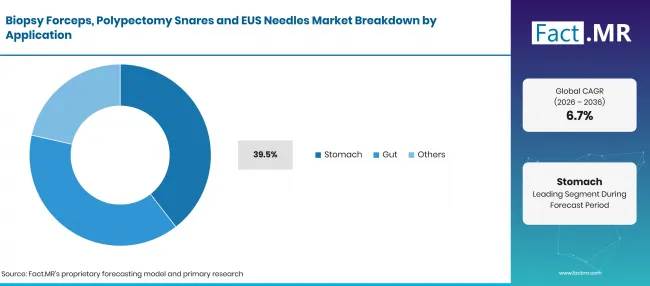
Biopsy Forceps, Polypectomy Snares And Eus Needles Market Breakdown Application | Source: Fact.MR
Upper gastrointestinal work will lead since gastroscopy is a frequent test for reflux, dyspepsia, anemia and Barrett’s esophagus surveillance. Most of these procedures include biopsy.
Gastric cancer adds to diagnostic demand. The National Cancer Institute estimates 31,510 new stomach cancer cases in the United States in 2026 [4]. Lower gastrointestinal work drives snare use, and the pancreaticobiliary system is the main use case for EUS needles.
How does Modality shape demand?
Flexible Endoscopy will capture 100.0% share in 2026.
.webp "Biopsy Forceps, Polypectomy Snares And Eus Needles Market Taxonomy (3)")
Biopsy Forceps, Polypectomy Snares And Eus Needles Market Taxonomy (3) | Source: Fact.MR
Flexible endoscopy will lead because routine diagnosis and polypectomy are done through flexible scopes. Jaw diameter and working length decide which accessories fit the flexible endoscopes installed in each unit.
Rigid endoscopy covers a narrower set of cases, such as rigid proctoscopy. Wider endoscopy devices spending supports accessory pull-through on flexible platforms.
What supports Stainless Steel within Material?
Stainless Steel will represent 48.6% share in 2026.
.webp "Biopsy Forceps, Polypectomy Snares And Eus Needles Market Taxonomy (2)")
Biopsy Forceps, Polypectomy Snares And Eus Needles Market Taxonomy (2) | Source: Fact.MR
Stainless steel will lead as it holds a sharp edge and gives the stiffness needed to cut tissue. It forms forceps jaws and needle cannulas at a cost that suits high-volume single-use products.
Nitinol helps snare loops open the same way each time and lets larger-gauge EUS needles flex through an angled echoendoscope. Supply of medical-grade shape memory alloys shapes the cost of these designs.
What supports Hospitals within End-user?
Hospitals will lead with 42.1% share in 2026.
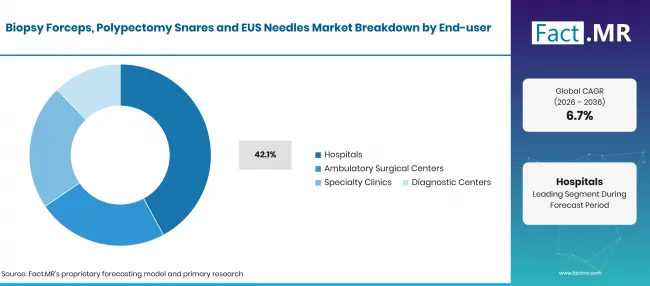
Biopsy Forceps, Polypectomy Snares And Eus Needles Market Breakdown End User | Source: Fact.MR
Hospitals will lead since they perform endoscopic mucosal resection and EUS-guided biopsy, which need anesthesia and on-site pathology. Their suites also buy endoscopy operative devices under the same contracts.
Ambulatory surgical centers and specialty clinics are gaining screening colonoscopy. The Centers for Medicare & Medicaid Services proposed a 2.4% update to ASC payment rates for 2027 [5]. These buyers are price sensitive and favor standardized single-use packs.
What is accelerating Biopsy Forceps, Polypectomy Snares and EUS Needles Market adoption, and what is holding it back?
Demand will rise through wider colorectal screening, lower FIT thresholds and growth in EUS-guided core biopsy. Growth is constrained by colonoscopy capacity limits and tender price pressure.
Drivers Impact Analysis
| DRIVER | (~) % IMPACT ON CAGR | GEOGRAPHIC RELEVANCE | IMPACT TIMELINE |
|---|---|---|---|
| Wider colorectal screening age bands | +1.9% | Global | Short term (<= 2 years) |
| Lower FIT thresholds raising follow-up colonoscopy | +1.4% | Western Europe, Australia | Medium term (2-4 years) |
| Growth of EUS-guided fine-needle biopsy | +1.2% | Global | Medium term (2-4 years) |
| Shift toward single-use accessories | +0.8% | North America, Western Europe | Long term (>= 4 years) |
Opportunity Impact Analysis
| OPPORTUNITY | (~) % IMPACT ON CAGR | GEOGRAPHIC RELEVANCE | IMPACT TIMELINE |
|---|---|---|---|
| Core biopsy needles for molecular profiling | +1.0% | Global | Medium term (2-4 years) |
| Screening colonoscopy moving to ambulatory centers | +0.8% | North America, Australia | Medium term (2-4 years) |
| Nitinol snares and needles for difficult anatomy | +0.6% | Global | Long term (>= 4 years) |
Restraints Impact Analysis
| RESTRAINT | (~) % IMPACT ON CAGR | GEOGRAPHIC RELEVANCE | IMPACT TIMELINE |
|---|---|---|---|
| Colonoscopy capacity limits | -0.8% | Western Europe, Australia | Short term (<= 2 years) |
| Pricing pressure in tenders | -0.5% | Western Europe | Medium term (2-4 years) |
| Low screening participation | -0.4% | Western Europe, Australia | Long term (>= 4 years) |
Which countries are scaling the Biopsy Forceps, Polypectomy Snares and EUS Needles Market through 2036?
- The country comparison spans 3.4 percentage points between Australia at 8.3% and Spain at 4.9%.
- Australia will keep a 0.5-point lead over the United Kingdom, helped by free screening kits for people aged 45 to 49.
- A more sensitive FIT threshold in England will give the United Kingdom a 0.6-point edge over the United States.
- In the United States, colonoscopy remains the main screening route, leaving the country 0.6 points clear of Ireland.
- Staged BowelScreen extensions will hold Ireland 0.8 points ahead of France.
- French growth will stay 0.9 points above Spain, with direct endoscopy covering many screened people.
- Spain will close the range, where regions will phase in screening up to age 74 over ten years.
Comparable CAGRs create different entry conditions, since screening age bands and colonoscopy capacity vary by country. Full report coverage includes North America, Latin America, Western Europe, Eastern Europe, East Asia, South Asia & Pacific, Middle East & Africa.
As per Fact.MR, global biopsy forceps, polypectomy snare and EUS needle consumption is estimated at USD 0.167 per capita in 2026, compared with USD 0.159 per capita in 2025. It will grow to USD 0.298 per capita by 2036 as screening programs send more people to colonoscopy and EUS centers move to core biopsy. Demand will rise across hospital endoscopy suites, ambulatory surgical centers and specialty clinics in both mature and emerging health systems. As per Fact.MR, the growth of these accessories will come less from new endoscopy units and more from higher procedure counts, single-use conversion and higher-value EUS biopsy needles.
.webp "Biopsy Forceps, Polypectomy Snares And Eus Needles Market Taxonomy (13)")
Biopsy Forceps, Polypectomy Snares And Eus Needles Market Taxonomy (13) | Source: Fact.MR
| Country | CAGR (2026-2036) |
|---|---|
| Australia | 8.3% |
| United Kingdom | 7.8% |
| United States | 6.2% |
| Ireland | 6.6% |
| France | 5.8% |
| Spain | 4.9% |
What supports Australia adoption?
8.3% CAGR, supported by screening from age 45 and a national bowel program.
Australia mails free FIT kits to people aged 50 to 74. The Australian Institute of Health and Welfare reported 42% participation in 2023 to 2024, with 73,724 people returning a positive result [6]. People aged 45 to 49 have requested 236,421 kits since July 2024 [6].
How is the United Kingdom scaling demand?
7.8% CAGR, driven by a more sensitive FIT threshold.
England invites people aged 50 to 74 for home FIT testing every two years. The threshold cut to 80 µg Hb/g is being phased in and is due to finish by March 2028 [2]. Modeling cited by the UK National Screening Committee estimates 2,017 more high-risk polyps and 663 more bowel cancers detected each year [2].
What supports United States growth?
6.2% CAGR, supported by colonoscopy-based screening.
.webp "Biopsy Forceps, Polypectomy Snares And Eus Needles Market Taxonomy (12)")
Biopsy Forceps, Polypectomy Snares And Eus Needles Market Taxonomy (12) | Source: Fact.MR
Direct colonoscopy carries most U.S. screening, which keeps snare and forceps volumes high. The National Cancer Institute reported that 72.6% of adults aged 50 to 75 had received colorectal cancer screening in 2023 [7]. In 2023, 62.8% of adults in that age group had received sigmoidoscopy or colonoscopy [7].
How is Ireland developing demand?
6.6% CAGR, driven by staged expansion of BowelScreen.
The Health Service Executive widened BowelScreen to ages 57 to 71 from April 2026 and plans to reach ages 55 to 74 over time. It will invite 49,000 people aged 57 and 67,500 people aged 71 over two years [8]. About 3,000 people have polyps removed through the programme each year [8].
What is supporting France’s adoption?
5.8% CAGR, supported by an organized program and direct endoscopic screening.
France offers biennial FIT screening to people aged 50 to 74. Santé publique France estimated screening coverage at 47.8% in 2022, with 41.6% of covered people screened by endoscopy without a recent FIT [9]. Participation in the organized program reached 30.7% in 2024 to 2025 [10].
How does Spain perform?
4.9% CAGR, shaped by a gradual extension of screening.
Spain’s Ministry of Health extended colorectal screening to age 74 in April 2026, with full coverage due within ten years [11]. A 2025 ministry report noted that the COVID-19 pandemic delayed the 100% coverage goal set for 2024 [12].
Who leads the Biopsy Forceps, Polypectomy Snares and EUS Needles Market?
Competition runs across three groups. Full-line accessory specialists such as Boston Scientific, Cook Medical, Micro-Tech Endoscopy and STERIS compete on range breadth and single-use pricing under tender. Scope makers Olympus and Fujifilm bundle accessories with endoscope and processor contracts. Olympus added the SecureFlex single-use fine needle biopsy device for EUS-guided sampling in October 2025, starting in Europe and Japan [13]. Medtronic competes in EUS through SharkCore fine needle biopsy needles. The supplier base is also consolidating. CONMED announced its exit from gastroenterology product lines in December 2025 [14]. Micro-Tech Endoscopy then agreed in March 2026 to acquire global distribution rights to the Precisor and Optibite biopsy lines and the Duraclip line from CONMED [15]. Competition will be decided by core tissue yield, channel compatibility, reliable single-use supply and success in bundled hospital tenders.
Which companies are the key providers?
Key companies include Boston Scientific Corporation; Olympus Corporation; Cook Medical LLC; Fujifilm Holdings Corporation; Medtronic plc; Micro-Tech Endoscopy (agreed to acquire Precisor and Optibite lines from CONMED); and STERIS plc.
- Boston Scientific Corporation
- Olympus Corporation
- Cook Medical LLC
- Fujifilm Holdings Corporation
- Medtronic plc
- Micro-Tech Endoscopy (agreed to acquire Precisor and Optibite lines from CONMED)
- STERIS plc
Bibliography
- [1] World Health Organization. (2026, February 13). Colorectal cancer.
- [2] UK National Screening Committee. (2026, January 26). More sensitive bowel cancer screening test implemented in line with UK NSC recommendation.
- [3] National Cancer Institute, Surveillance, Epidemiology, and End Results Program. (2026). Cancer Stat Facts: Pancreatic Cancer.
- [4] National Cancer Institute, Surveillance, Epidemiology, and End Results Program. (2026). Cancer Stat Facts: Stomach Cancer.
- [5] Centers for Medicare & Medicaid Services. (2026, July 2). Calendar Year 2027 Hospital Outpatient Prospective Payment System (OPPS) and Ambulatory Surgical Center (ASC) Proposed Rule (CMS-1850-P).
- [6] Australian Institute of Health and Welfare. (2026, June 18). Participation in the National Bowel Cancer Screening Program gradually improving.
- [7] National Cancer Institute. (2025, April). Cancer Trends Progress Report: Colorectal Cancer Screening.
- [8] Health Service Executive. (2026, March 31). 116,000 more people eligible as HSE expands bowel screening to ages 57 and 71.
- [9] Santé publique France. (2025, February 4). Estimated coverage rate for colorectal cancer screening in France in 2022.
- [10] Santé publique France. (2026, March 11). Participation au programme national de dépistage organisé du cancer colorectal. Période 2024-2025 et évolution depuis 2010 [Participation in the national organized colorectal cancer screening program, 2024-2025 and trends since 2010].
- [11] Ministerio de Sanidad. (2026, April 20). Sanidad amplía la prueba del talón a 21 patologías y eleva hasta los 74 años el cribado de cáncer colorrectal [The Ministry of Health expands the heel-prick test to 21 conditions and raises colorectal cancer screening to age 74].
- [12] Ministerio de Sanidad. (2025, November 13). Informe de situación de los procesos del programa de cribado de cáncer colorrectal en España. Año 2025 [Status report on the colorectal cancer screening program in Spain, 2025].
- [13] Olympus Corporation. (2025, October 6). Olympus Launches SecureFlex, a Single-use Fine Needle Biopsy Device.
- [14] CONMED Corporation. (2025, December 5). CONMED Corporation Announces Strategic Exit from Gastroenterology Product Lines.
- [15] Micro-Tech Endoscopy. (2026, March 18). Micro-Tech Endoscopy Signs Definitive Agreement to Acquire Duraclip, Precisor, and Optibite Product Lines from CONMED
This Report Answers
- The report explains how forceps, snares and EUS needles are used by application and modality.
- Segment analysis identifies the leading subsegment in each segment and the clinical factors behind its 2026 share.
- Country analysis compares the six listed countries through screening age bands and FIT thresholds.
- Competitive analysis reviews active accessory makers and scope platform suppliers.
- End-user analysis assesses how hospital and ambulatory settings shape the move to single-use devices.
What does the Biopsy Forceps, Polypectomy Snares and EUS Needles Market cover?
The Biopsy Forceps, Polypectomy Snares and EUS Needles Market covers cold and hot biopsy forceps, cold and hot polypectomy snares, and EUS fine-needle aspiration and fine-needle biopsy needles.
The assessment tracks flexible and rigid endoscopy across upper gastrointestinal, lower gastrointestinal and pancreaticobiliary work.
What is included in the scope?
The scope includes single-use and reusable devices sold to hospitals, ambulatory surgical centers, specialty clinics and diagnostic centers. Accessories used with disposable endoscopes are counted when sold separately.
Country volumes draw on endoscopy procedure estimates and accessory use per procedure.
What is excluded from the scope?
The scope excludes endoscopes, video processors and ultrasound consoles. Stents, clips and dilation balloons sold on their own are also excluded.
Stool tests and other colorectal cancer diagnostics fall outside the revenue boundary. Capsule endoscope systems and software are also excluded.
How Was the Analysis Built?
The analysis draws on 120+ sources, 35+ company portfolios, 25+ countries, and more than 20 industry interviews.
- Primary Research: Primary research includes discussions with manufacturers, service providers, technology developers, distributors, end users, and subject-matter experts. These conversations examine purchasing priorities, product adoption, operational challenges, approval requirements, competitive positioning, and the factors that influence wider market acceptance.
- Desk Research: Desk research covers government statistics, regulatory publications, company filings, trade data, technical studies, industry associations, standards, public policy, and other authoritative sources. Every source used in the analysis is documented in the bibliography.
- Market Sizing and Forecasting: Market estimates combine historical performance, demand indicators, pricing and volume trends, segment shares, company participation, country-level growth, adoption patterns, investment activity, and barriers to market expansion.
- Data Validation and Update Cycle: Findings are validated by comparing primary interviews with public data, company activity, regulatory changes, trade patterns, and industry developments. Regular updates review new product launches, capacity changes, partnerships, approvals, and shifts in commercial adoption.
What is the report’s scope and coverage?
.webp "Biopsy Forceps, Polypectomy Snares And Eus Needles Market Taxonomy (1)")
Biopsy Forceps, Polypectomy Snares And Eus Needles Market Taxonomy (1) | Source: Fact.MR
| Attribute | Details |
|---|---|
| Quantitative Units | USD billion in 2026 to USD billion by 2036 at a CAGR |
| Market Definition | Accessories used to sample and remove tissue during gastrointestinal endoscopy, including biopsy forceps, polypectomy snares and endoscopic ultrasound (EUS) needles, sold as single-use or reusable devices. |
| Type | Biopsy Forceps; Polypectomy Snares; Endoscopic Ultrasound Needles |
| Application | Upper Gastrointestinal Tract; Lower Gastrointestinal Tract; Pancreaticobiliary System |
| Modality | Flexible Endoscopy; Rigid Endoscopy |
| Material | Stainless Steel; Nitinol; Titanium |
| End-user | Hospitals; Ambulatory Surgical Centers; Specialty Clinics; Diagnostic Centers |
| Regions Covered | North America; Latin America; Western Europe; Eastern Europe; East Asia; South Asia & Pacific; Middle East & Africa |
| Countries Covered | Australia; United Kingdom; United States; Ireland; France; Spain |
| Key Companies Profiled | Boston Scientific Corporation; Olympus Corporation; Cook Medical LLC; Fujifilm Holdings Corporation; Medtronic plc; Micro-Tech Endoscopy; STERIS plc |
| Forecast Period | 2026 to 2036 |
| Approach | Hybrid top-down and bottom-up approach using endoscopy procedure volumes; accessory use per procedure; segment mix; country screening policy; and manufacturer portfolio review. |
How is the market segmented?
-
By Type
- Biopsy Forceps
- Polypectomy Snares
- Endoscopic Ultrasound Needles
-
By Application
- Upper Gastrointestinal Tract
- Lower Gastrointestinal Tract
- Pancreaticobiliary System
-
By Modality
- Flexible Endoscopy
- Rigid Endoscopy
-
By Material
- Stainless Steel
- Nitinol
- Titanium
-
By End-user
- Hospitals
- Ambulatory Surgical Centers
- Specialty Clinics
- Diagnostic Centers
-
By Region
- North America
- Latin America
- Western Europe
- Eastern Europe
- East Asia
- South Asia & Pacific
- Middle East & Africa