- Market Value (2025): USD 2.73 Bn
- Estimated Value (2026): USD 3.78 Bn
- Forecast Value (2036): USD 96.7 Bn
- CAGR (2026-2036): 38.3%
What is the Blockchain for Supply Chain Market forecast to be worth by 2036?
USD 3.8 billion in 2026 to USD 96.7 billion by 2036 at a 38.3% CAGR.
- According to Fact.MR estimates, the blockchain for supply chain market was valued at USD 2.73 billion in 2025.
- Market value is projected to rise from USD 3.78 billion in 2026 to USD 96.7 billion by 2036.
- The market is projected to grow at a 38.3% CAGR from 2026 to 2036 as enterprises expand blockchain applications for product authentication, shipment visibility and supplier verification.
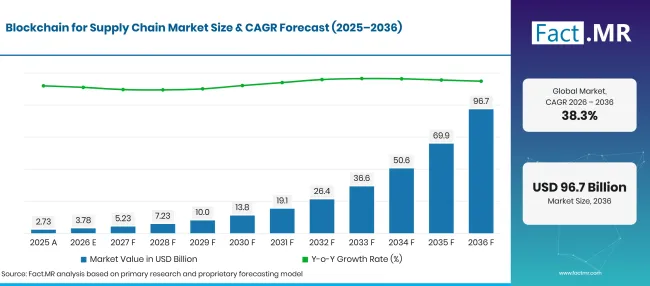
Blockchain For Supply Chain Market Forecast Global | Source: Fact.MR
| Year | Basis | Market Value (USD billion) |
|---|---|---|
| 2025 | Actual | 2.73 |
| 2026 | Estimate | 3.78 |
| 2036 | Forecast | 96.7 |
| CAGR 2026 to 2036 | Forecast period | 38.3% |
Source: Fact.MR analysis. Updated Nov 2, 2026
What are the defining numbers behind Blockchain for Supply Chain Market growth?
USD 92.9 billion absolute opportunity between 2026 and 2036.
- Demand Drivers in the Market
- Manufacturers are giving greater attention to supplier-level transparency and component authentication to improve oversight across complex sourcing networks. Blockchain platforms provide shared digital records that allow participating organizations to verify product movement and review transaction histories at different supply chain stages.
- Retailers and consumer goods companies require more comprehensive product provenance documentation to address consumer expectations and strengthen brand credibility. Digital product passports and blockchain-based authentication systems can help businesses communicate product origin and sourcing information while maintaining records of ownership changes.
- Logistics providers are exploring blockchain applications for shipment tracking and asset movement verification to improve coordination across transportation networks. Shared ledger systems can record shipment milestones and custody transfers while making relevant information accessible to authorized supply chain participants.
- Regulatory developments are increasing the importance of reliable traceability information across global supply networks. Businesses handling products covered by sustainability and sourcing requirements need to maintain documentation that supports product origin verification and supply chain disclosures. Blockchain platforms can provide tamper-resistant records that authorized participants can access when reviewing sourcing details or demonstrating compliance.
- Key Segments Analyzed
- By Component: Platform will account for 72.3% of the market in 2026, reflecting demand for distributed ledger infrastructure and enterprise blockchain applications.
- By Application: Asset Tracking will lead with a 28.4% share in 2026, supported by demand for asset visibility and movement verification.
- By Deployment Mode: On-Premises deployment holds a 60.0% share in 2026, reflecting enterprise requirements for infrastructure control and data governance.
- By Enterprise Size: Large Enterprises will represent a 75.0% share in 2026, supported by their complex supplier networks and higher technology investment capacity.
- By End-User: Manufacturing is projected to account for a 26.3% share in 2026, reflecting demand for component authentication, supplier verification and product lifecycle visibility.
- Analyst Opinion at Fact.MR
- Shambhu Nath Jha, Principal Consultant at Fact.MR, states, “Blockchain-based supply chain platforms are likely to gain interest where multiple stakeholders need reliable product records and transparent transaction histories. Vendors that simplify enterprise integration and demonstrate practical improvements in traceability will be better positioned to support wider adoption.”
- Strategic Implications
- Blockchain platform providers should prioritize interoperability with enterprise resource planning and inventory management systems.
- Manufacturers need to evaluate blockchain applications for component authentication and supplier-level traceability before extending deployment across their networks.
- Logistics providers must strengthen asset tracking capabilities through integrations with IoT sensors and digital shipment documentation.
- Retailers can consider digital product passport solutions that provide verifiable information across sourcing, distribution and customer-facing channels.
- Technology developers should offer scalable platforms with flexible deployment models to address enterprise security and data governance requirements.
- Solution providers need to demonstrate measurable improvements in traceability, transaction verification and supply chain coordination to support enterprise purchasing decisions.
Germany is set to record a 44.3% CAGR through 2036. Brazil is forecast to advance at 40.4%, followed by the USA at 36.6%. The UK is estimated to expand at 32.7%, while Japan is projected to record a 28.9% CAGR.
How does the Blockchain for Supply Chain Market break down by segment?
In Fact.MR’s segmentation, Platform leads Component at 72.3%; Asset Tracking leads Application at 28.4%; On-Premises leads Deployment Mode at 60.0%; Large Enterprises lead Enterprise Size at 75.0%; and Manufacturing leads End-User at 26.3%.
Which Component dominates?
Platform is projected to account for 72.3% of the market in 2026.
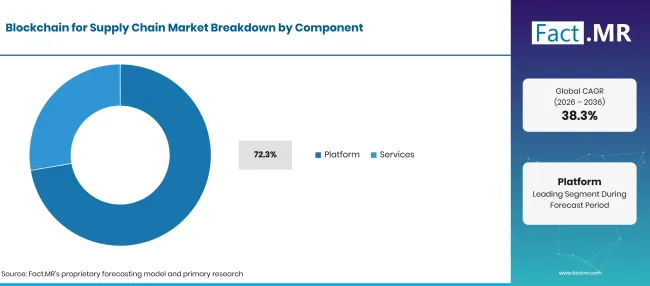
Blockchain For Supply Chain Market Breakdown Component | Source: Fact.MR
| Component | Share (2026) |
|---|---|
| Platform (Leading segment) | 72.3% |
| Other segments combined | 27.7%* |
| Total | 100.0% |
Source: Fact.MR analysis. Updated Nov 2, 2026
Blockchain platforms provide the infrastructure for recording, validating and sharing supply chain information among participating organizations. Businesses use these platforms to establish permissioned networks, execute smart contracts and maintain verifiable transaction histories. Platform adoption is supported by enterprises seeking infrastructure that connects suppliers, manufacturers, distributors and logistics partners. Services complement platform deployment through consulting, customization, system integration and ongoing technical support.
What leads the Application segment?
Asset Tracking is projected to account for 28.4% of the market in 2026.
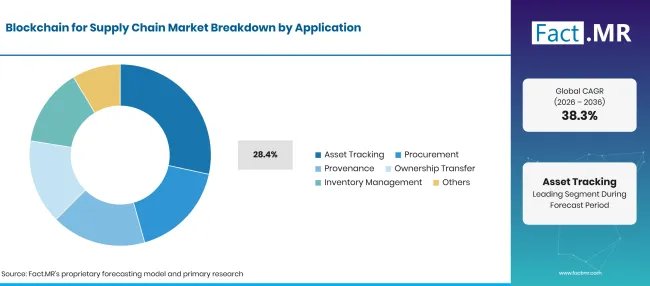
Blockchain For Supply Chain Market Breakdown Application | Source: Fact.MR
| Application | Share (2026) |
|---|---|
| Asset Tracking (Leading segment) | 28.4% |
| Other segments combined | 71.6%* |
| Total | 100.0% |
Source: Fact.MR analysis. Updated Nov 2, 2026
Asset tracking applications enable businesses to maintain records of product movement, location updates and ownership information across supply networks. Blockchain provides a shared transaction history that can help participating organizations verify changes in asset status. Ownership transfer and inventory management applications address additional requirements across manufacturing, distribution and logistics operations.
How does Deployment Mode shape demand?
On-Premises deployment is likely to account for a 60.0% share in 2026.
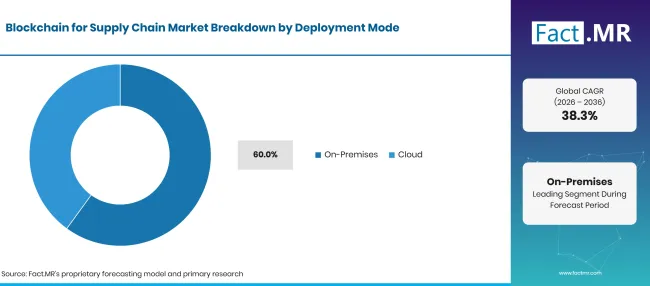
Blockchain For Supply Chain Market Breakdown Deployment Mode | Source: Fact.MR
| Deployment Mode | Share (2026) |
|---|---|
| On-Premises (Leading segment) | 60.0% |
| Other segments combined | 40.0%* |
| Total | 100.0% |
Source: Fact.MR analysis. Updated Nov 2, 2026
On-premises deployment allows enterprises to maintain greater control over blockchain infrastructure, data access and internal security policies. Organizations managing sensitive supplier information or complex integration requirements may prefer infrastructure operated within their own IT environments. Cloud deployment offers scalability and reduced infrastructure management requirements. It is relevant for businesses seeking flexible access across geographically distributed supply chain networks.
Which Enterprise Size category leads?
Large Enterprises are set to represent a 75.0% share in 2026.
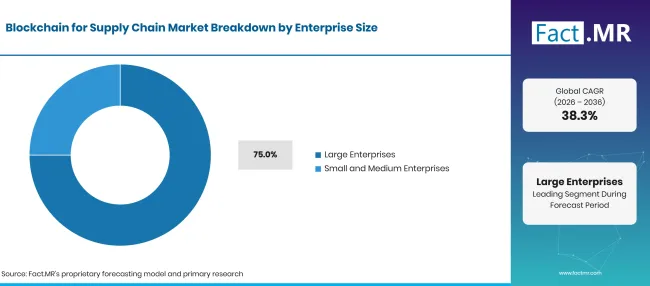
Blockchain For Supply Chain Market Breakdown Enterprise Size | Source: Fact.MR
| Enterprise Size | Share (2026) |
|---|---|
| Large Enterprises (Leading segment) | 75.0% |
| Other segments combined | 25.0%* |
| Total | 100.0% |
Source: Fact.MR analysis. Updated Nov 2, 2026
Large enterprises often manage extensive supplier networks, international procurement activities and multiple distribution channels. These operations create demand for shared digital records and consistent product traceability across business partners. Blockchain platforms can support supplier verification, inventory visibility and transaction documentation. Small and medium enterprises may adopt affordable cloud-based solutions or participate in networks established by larger customers.
Which End-User category leads?
Manufacturing is projected to account for 26.3% of the market in 2026.
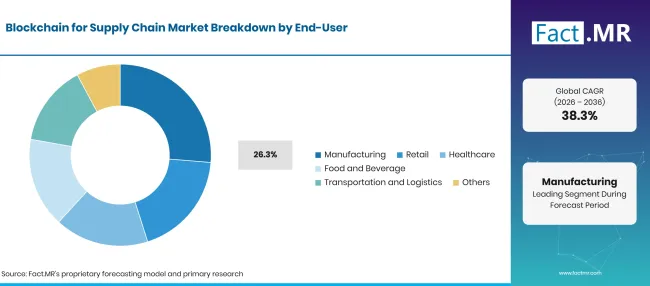
Blockchain For Supply Chain Market Breakdown End User | Source: Fact.MR
| End-User | Share (2026) |
|---|---|
| Manufacturing (Leading segment) | 26.3% |
| Other segments combined | 73.7%* |
| Total | 100.0% |
Source: Fact.MR analysis. Updated Nov 2, 2026
Manufacturers require accurate records of raw material sourcing, component movement and finished product distribution. Blockchain platforms can support supplier information verification and material tracking across production stages. Retail, healthcare and food and beverage companies also have traceability requirements related to product authenticity, regulatory documentation and distribution records. Transportation and logistics providers use these systems to improve shipment visibility and information exchange between participating organizations.
What is accelerating Blockchain for Supply Chain Market adoption, and what is holding it back?
Growing demand for product traceability and supplier verification supports adoption, while implementation costs and integration complexity create challenges.
Drivers Impact Analysis
| DRIVER | (~) % IMPACT ON CAGR | GEOGRAPHIC RELEVANCE | IMPACT TIMELINE |
|---|---|---|---|
| Increasing requirement for product traceability | +1.0% | Global | Short term (≤ 2 years) |
| Growing enterprise digitalization | +0.9% | Global | Medium term (2–4 years) |
| Supplier verification and procurement transparency | +0.7% | Europe, North America | Medium term (2–4 years) |
| Demand for counterfeit prevention | +0.6% | Global | Short term (≤ 2 years) |
| Expansion of connected logistics networks | +0.5% | Asia, Americas | Long term (≥ 4 years) |
Source: Fact.MR analysis. Updated Nov 2, 2026
Opportunity Impact Analysis
| OPPORTUNITY | (~) % IMPACT ON CAGR | GEOGRAPHIC RELEVANCE | IMPACT TIMELINE |
|---|---|---|---|
| Blockchain-based product provenance | +0.9% | Global | Medium term (2–4 years) |
| IoT-integrated asset tracking | +0.7% | Global | Medium term (2–4 years) |
| Automated procurement documentation | +0.6% | Europe, North America | Short term (≤ 2 years) |
| Cross-border supply chain verification | +0.5% | Global | Long term (≥ 4 years) |
| Digital product passport deployment | +0.8% | Europe, Asia | Long term (≥ 4 years) |
Source: Fact.MR analysis. Updated Nov 2, 2026
Restraints Impact Analysis
| RESTRAINT | (~) % IMPACT ON CAGR | GEOGRAPHIC RELEVANCE | IMPACT TIMELINE |
|---|---|---|---|
| High implementation and integration costs | -0.9% | Global | Short term (≤ 2 years) |
| Limited interoperability across platforms | -0.7% | Global | Medium term (2–4 years) |
| Data standardization challenges | -0.6% | Global | Medium term (2–4 years) |
| Supplier participation requirements | -0.5% | Emerging markets | Long term (≥ 4 years) |
| Unclear return on investment | -0.4% | Global | Short term (≤ 2 years) |
Source: Fact.MR analysis. Updated Nov 2, 2026
Which countries are scaling the Blockchain for Supply Chain Market through 2036?
| Country | CAGR (2026–2036) |
|---|---|
| Germany | 44.3% |
| Brazil | 40.4% |
| USA | 36.6% |
| UK | 32.7% |
| Japan | 28.9% |
Source: Fact.MR analysis. Updated Nov 2, 2026
What supports Germany adoption?
44.3% CAGR, supported by its extensive manufacturing base and increasing requirements for product-level traceability under European digital product passport initiatives.
Germany's blockchain for supply chain market is supported by its established automotive and industrial manufacturing ecosystem. According to Germany's Federal Statistical Office, Germany recorded seasonally and calendar-adjusted goods exports of EUR 138.2 billion in July 2026, representing a 6.1% increase compared with July 2025. This extensive cross-border movement of manufactured goods creates demand for reliable supplier documentation and product-level verification. Additionally, the European Commission's Digital Product Passport Registry became operational on 20 July 2026, establishing infrastructure for product identification and registration across the EU. These developments create opportunities for blockchain platforms supporting component authentication and material provenance across industrial supply networks. [11] [12]
How is Brazil developing blockchain adoption?
40.4% CAGR, shaped by expanding agricultural exports and the need for reliable traceability across international food supply networks.
Brazil's market is supported by opportunities to improve agricultural traceability, food provenance and export supply chain transparency. Agricultural producers, processors and distributors operate across geographically dispersed supply networks. Blockchain-based platforms can help maintain verifiable records of product origin, movement and handling. Technology providers offering integrations with logistics and inventory systems can address the needs of businesses seeking greater supply chain visibility.
According to Brazil's official foreign-trade statistics, exports from the agricultural sector reached approximately USD 64.84 billion during January–September 2026, increasing 8.89% compared with the corresponding period in 2025. This export activity creates demand for verifiable records covering product origin and movement from farms to processing facilities and international buyers. [13]
What supports United States adoption?
36.6% CAGR, drive by the scale of manufacturing and distribution activity and growing demand for inventory visibility across enterprise supply networks.
The US market benefits from enterprise digitalization and demand for stronger supply chain risk management. Manufacturing, retail, healthcare and food distribution businesses require reliable product records and supplier information. Blockchain platforms can support product authentication and transaction transparency across business partners. Providers are also developing integrations with IoT systems and enterprise applications to improve asset tracking and operational visibility.
The US market benefits from extensive manufacturing and distribution operations that require accurate product records and coordinated inventory management. According to the US Census Bureau, combined distributive trade sales and manufacturers' shipments reached approximately USD 2.12 trillion in August 2026, increasing 10.2% year over year. Manufacturers' and trade inventories stood at approximately USD 2.82 trillion at the end of the same month. The scale of these operations creates opportunities for blockchain platforms that improve transaction visibility and support product authentication across suppliers and distribution partners. [14]
How is the United Kingdom building adoption?
32.7% CAGR, supported by extensive international goods trade and increasing demand for transparent sourcing and shipment documentation.
The UK market is supported by demand for transparent sourcing, product authentication and improved logistics coordination. Retailers and manufacturers require reliable information about product origins and supplier activities. Blockchain applications can support provenance documentation and shared transaction records across procurement and distribution networks. Cloud-based solutions and enterprise integration capabilities can improve accessibility for organizations with multiple supply chain partners.
The UK market is supported by international trade activity and the need for reliable information exchange between manufacturers and distribution partners. According to the Office for National Statistics, UK goods exports reached GBP 34.4 billion in August 2026, while total goods exports amounted to GBP 104.6 billion during the three months to August 2026. The country's trade relationships create requirements for accurate shipment records and supplier verification across domestic and international supply chains. [15]
What supports Japan adoption?
28.9% CAGR, supported by its high-value manufacturing exports and government initiatives promoting logistics standardization and supply chain resilience.
Japan's market is influenced by its advanced manufacturing ecosystem and demand for reliable component traceability. Automotive, electronics and industrial equipment manufacturers require accurate records of parts movement and supplier information. Blockchain platforms can support product authentication and lifecycle documentation across complex production networks. Integration with existing enterprise systems and manufacturing technologies will remain important for wider adoption.
Japan's market is influenced by its advanced manufacturing ecosystem and the need to maintain reliable component traceability across international production networks. According to Japan's Ministry of Finance, goods exports reached approximately JPY 63.44 trillion during April–September 2026, increasing 18.3% year over year. Machinery exports accounted for approximately JPY 11.03 trillion, while electrical machinery exports reached JPY 11.90 trillion during the same period. In addition, Japan's Cabinet approved the Comprehensive Physical Distribution Policy Outline for FY2026–FY2030, which emphasizes logistics standardization and digital transformation alongside supply chain resilience. [16] [17]
Who leads the Blockchain for Supply Chain Market?
Fact.MR identifies Oracle Corporation, Infosys Limited, The Hashgraph Group, ITL Group, TRST01 and BlockSynergy Technology Limited as selected providers with active blockchain-based supply chain solutions and recent product development.
Oracle maintains an enterprise blockchain platform supporting product provenance, inventory visibility, shipment tracking and secure logistics documentation. Its October 2026 platform update added Hyperledger Besu support, demonstrating continued investment in enterprise blockchain infrastructure. [1] [2]
Infosys provides blockchain-powered distributed applications for end-to-end shipment tracking, asset visibility and product provenance. Its Decentralized Device Passport demonstrates the application of blockchain to device authentication and lifecycle traceability. [3][4]
The Hashgraph Group has expanded its enterprise traceability portfolio through TrackTrace, a production-grade platform for digital product passports. Its September 2026 collaboration with Merck demonstrates application in cocoa origin verification, product authentication and supply chain compliance. [5][6]
ITL Group introduced Xplore to support upstream sourcing visibility, blockchain-secured chain of custody and downstream product authentication. Its solution combines traceability with digital product passports and QR or NFC-enabled identification. [7]
TRST01 develops blockchain-based traceability solutions through its TRST01Chain portfolio. Its 2025 MeeS launch and 2026 EUDR Hub development demonstrate continued product expansion for agricultural and industrial supply chain compliance. [8]
BlockSynergy Technology Limited, through Jumbo Blockchain, launched TagITX with Domino India in July 2025. The platform supports product authentication through blockchain-secured QR codes and traceability information for manufacturers. [9] [10]
Competition is shaped by platform interoperability, data integrity, product identification capabilities, deployment flexibility and integration with enterprise applications. Providers that offer practical traceability solutions and simplify supplier participation can strengthen their position as businesses seek greater supply chain transparency.
Which companies are the key providers?
Key companies profiled include Oracle Corporation; Infosys Limited; The Hashgraph Group; ITL Group; TRST01; and BlockSynergy Technology Limited (Jumbo Blockchain).
- Oracle Corporation
- Infosys Limited
- The Hashgraph Group
- ITL Group
- TRST01
- BlockSynergy Technology Limited (Jumbo Blockchain)
Bibliography
- [1] Rakhmilevich, M. (2026, October 27). Oracle Blockchain Platform Enterprise Edition brings governed digital asset applications to Hyperledger Besu. Oracle
- [2] Oracle. (n.d.). Oracle Blockchain Enterprise Edition.
- [3] Infosys Limited. (n.d.). Infosys Supply Chain Distributed Application
- [4] Infosys Limited. (2025). Sustainability Cloud 2025
- [5] The Hashgraph Group. (2026, February 24). THG launches TrackTrace for Digital Product Passport (DPP)
- [6] The Hashgraph Group. (2026, September 8). The Hashgraph Group and Merck, with support from PwC Germany, develop solution for cocoa traceability and digital product passports
- [7] ITL Group. (n.d.). Xplore – Trace, Track & Authenticate
- [8] TRST01. (n.d.). About us
- [9] BlockSynergy Technology Limited. (n.d.). TagITX – Blockchain-powered supply chain and anti-counterfeit solution
- [10] Accenture. (n.d.). Tracr pioneers trust in diamond traceability
- [11] Statistisches Bundesamt (Destatis). (2026, September 8). Exports in July 2026: -0.8% on June 2026.
- [12] European Commission. (n.d.). Digital Product Passport (DPP)
- [13] Ministério da Agricultura e Pecuária. (2026, October 29). Agropecuária Brasileira em Números – Outubro de 2026
- [14] U.S. Census Bureau. (2026, October 15). Manufacturing and trade inventories and sales: August 2026
- [15] Office for National Statistics. (2026, October 15). UK trade: August 2026.
- [16] Ministry of Finance, Japan. (2026, October 29). Trade statistics: Fiscal year April–September 2026
- [17] Ministry of Economy, Trade and Industry. (2026, March 31). Cabinet decision on the Comprehensive Physical Distribution Policy Outline (FY2026–FY2030).
This Report Answers
- The report examines blockchain platform and service demand across supply chain applications.
- Component analysis compares platform infrastructure with associated implementation and integration services.
- Application analysis evaluates asset tracking, procurement, provenance and inventory management.
- Deployment analysis compares on-premises and cloud-based blockchain solutions.
- Country analysis covers Germany, Brazil, USA, UK and Japan.
- Competitive analysis profiles six companies with identifiable blockchain supply chain solutions and product developments.
- The report evaluates the role of distributed ledger technology in product authentication and supply chain transparency.
What does the Blockchain for Supply Chain Market cover?
The market covers blockchain platforms and related services used to record, verify and share supply chain information. It includes applications for tracking physical assets, documenting product origin, validating procurement transactions and maintaining ownership records. The market also considers enterprise deployment models and applications across manufacturing, retail, healthcare, food and beverage and logistics.
What is included in the scope?
Included products comprise enterprise blockchain platforms, permissioned distributed ledger networks and associated implementation services used for supply chain operations.
The scope includes asset tracking, product provenance, procurement documentation, inventory records and ownership transfer applications. Solutions integrating blockchain with IoT sensors, digital product passports and enterprise resource planning systems are included where blockchain functionality directly supports supply chain operations.
What is excluded from the scope?
The analysis excludes cryptocurrencies and speculative digital asset trading unrelated to supply chain operations.
General-purpose blockchain networks without a defined supply chain application are outside the market boundary. Standalone inventory management software, conventional logistics platforms and enterprise resource planning solutions without blockchain functionality are excluded. Hardware infrastructure and general consulting services unrelated to blockchain implementation are also outside the defined scope.
How Was the Analysis Built?
The analysis draws on 120+ sources, 35+ company portfolios, 25+ countries and more than 20 industry interviews.
- Primary Research: Primary research includes discussions with blockchain solution providers, enterprise technology vendors, manufacturers, retailers, logistics operators, procurement professionals and supply chain specialists. These discussions examine deployment requirements, purchasing priorities, integration challenges, product development and commercial adoption.
- Desk Research: Desk research covers company product announcements, official blockchain documentation, enterprise technology releases, government publications, supply chain regulations, technical standards, industry associations and digital infrastructure developments.
- Market Sizing and Forecasting: Market estimates combine historical performance, technology investment, enterprise adoption, platform deployment, pricing trends, application demand, company participation and country-level growth indicators.
- Data Validation and Update Cycle: Findings are validated by comparing primary interviews with company announcements, platform updates, partnerships, product launches and changes in enterprise blockchain deployment.
Segmentation
What is the report's scope and coverage?
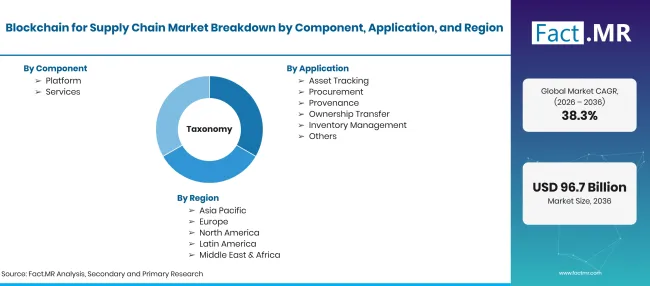
Blockchain For Supply Chain Market Taxonomy | Source: Fact.MR
| Attribute | Details |
|---|---|
| Quantitative Units | USD billion |
| Market Definition | Blockchain platforms and associated services used for supply chain traceability, provenance and transaction verification |
| Component | Platform; Services |
| Application | Asset Tracking; Procurement; Provenance; Ownership Transfer; Inventory Management; Others |
| Deployment Mode | On-Premises; Cloud |
| Enterprise Size | Large Enterprises; Small and Medium Enterprises |
| End-User | Manufacturing; Retail; Healthcare; Food and Beverage; Transportation and Logistics; Others |
| Regions Covered | North America; Latin America; Western Europe; Eastern Europe; East Asia; South Asia & Pacific; Middle East & Africa |
| Countries Covered | Germany; Brazil; USA; UK; Japan |
| Companies Profiled | Oracle; Infosys; The Hashgraph Group; ITL Group; TRST01; BlockSynergy |
| Forecast Period | 2026 to 2036 |
| Approach | Market segmentation and scenario-based analysis supported by company product developments and enterprise technology adoption indicators |
Source: Fact.MR analysis. Updated Nov 2, 2026
How is the market segmented?
-
By Component
- Platform
- Services
-
By Application
- Asset Tracking
- Procurement
- Provenance
- Ownership Transfer
- Inventory Management
- Others
-
By Deployment Mode
- On-Premises
- Cloud
-
By Enterprise Size
- Large Enterprises
- Small and Medium Enterprises
-
By End-User
- Manufacturing
- Retail
- Healthcare
- Food and Beverage
- Transportation and Logistics
- Others
-
By Region
- North America
- Latin America
- Western Europe
- Eastern Europe
- East Asia
- South Asia & Pacific
- Middle East & Africa
Frequently Asked Questions
How big is the Blockchain for Supply Chain Market in 2026?
What is the CAGR from 2026 to 2036?
Which component has the largest market share?
Which application leads the market?
Which deployment mode dominates?
Which enterprise size category leads?
Which end-user category has the largest share?
Which country has the highest projected CAGR?
Which companies are covered?
Who worked on this report


Preview the report firsthand - request a free sample
Free SampleGet the brochure for pricing and purchase details
Download PDF