- Market Value (2025): USD 0.4 Bn
- Estimated Value (2026): USD 0.6 Bn
- Forecast Value (2036): USD 18.5 Bn
- CAGR (2026-2036): 40.9%
What is the digital product passport compliance services market forecast to be worth by 2036?
USD 0.6 billion in 2026 to USD 18.5 billion by 2036, at 40.9% CAGR.
- The digital product passport compliance services market crossed a valuation of USD 0.4 billion in 2025.
- Demand is expected to increase from USD 0.6 billion in 2026 to USD 18.5 billion by 2036.
- The market is forecast to record 40.9% CAGR during 2026 to 2036 as EU product rules create a new compliance layer for batteries and other regulated goods.
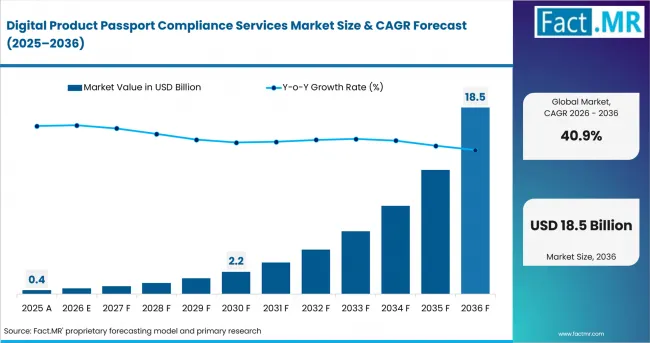
Digital Product Passport Compliance Services Market Value Analysis | Source: Fact.MR
What are the defining numbers behind digital product passport compliance services growth?
USD 17.9 billion absolute opportunity by 2036, led by Germany and France.
- Demand Drivers in the Market
- Brands need product-level data systems before regulated categories receive DPP requirements.
- Battery supply chains need passport readiness before the 2027 deadline.
- Textile and electronics firms need traceability records that can support circularity claims.
- Retailers and marketplaces need product data access before listing regulated goods in the EU.
- Key Segments Analyzed
- By Service Type: DPP Data Mapping and Compliance Readiness is expected to hold 35.0% share in 2026 because firms first need to identify data gaps.
- By Passport Category: Battery Passports lead because the first binding DPP deadline falls on batteries. The share is projected at 38.0% in 2026.
- By Customer Type: Brand Manufacturers are likely to account for 44.0% share in 2026 because they are responsible for product data readiness.
- By Delivery Model: SaaS Passport Platforms lead as brands need scalable records. The model is projected to hold 40.0% share in 2026.
- By End Use: EU Market Access is expected to hold 37.0% share in 2026 because compliance decides whether regulated products can be sold.
- By Geography: Germany is projected to record 44.5% CAGR through 2036 as EU product compliance and manufacturing data needs expand.
- Analyst Opinion at Fact.MR
- Shambhu Nath Jha, Senior Analyst at Fact.MR, states, “Digital product passports will make product compliance a data infrastructure market. Brands are already asking how to collect item-level information from suppliers before deadlines arrive. Providers that combine traceability support and managed data updates will gain stronger access to EU-facing manufacturers.”
- Strategic Implications
- Brands should start with data mapping before selecting a passport platform.
- Manufacturers need supplier evidence for materials and lifecycle data.
- DPP platforms should support identifiers and access rules that work across EU systems.
- Retailers need product-passport checks before regulated goods enter EU channels.
| Metric | Details |
|---|---|
| Industry Size 2026 | USD 0.6 billion |
| Industry Value 2036 | USD 18.5 billion |
| CAGR 2026 to 2036 | 40.9% |
Source: Fact.MR analysis. Updated Jun 19, 2026
EU Digital Product Passport services form the core of this market. These services help companies build and manage item-level traceability records for products covered under ESPR. Regulation (EU) 2024/1781 establishes the Ecodesign for Sustainable Products Regulation framework and includes digital product passport requirements. [1] This creates demand for product-level data architecture, traceability systems and compliance support.
Germany is projected to record 44.5% CAGR through 2036 as EU product compliance and manufacturing data needs expand. France is likely to post 43.2% CAGR because fashion, electronics and consumer goods brands need ESPR readiness. Italy is expected to register 42.0% CAGR as textile and furniture exporters prepare product data systems. The Netherlands is forecast to advance at 41.1% CAGR as logistics, marketplaces and EU trade flows support passport infrastructure. The United States is set to record 39.8% CAGR as exporters selling into the EU build DPP compliance programs.
How does the digital product passport compliance services market break down by segment?
DPP Data Mapping and Compliance Readiness leads at 35.0%; Battery Passports lead at 38.0%.
Which service type dominates?
DPP Data Mapping and Compliance Readiness holds 35.0% share in 2026.
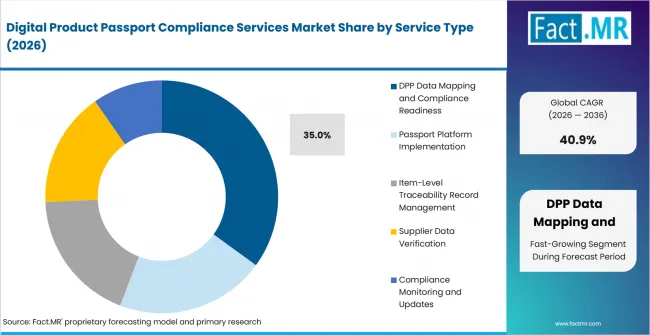
Digital Product Passport Compliance Services Market Analysis By Service Type | Source: Fact.MR
DPP data mapping and compliance readiness is expected to hold 35.0% share in 2026 because companies should first know which product data is missing. The work covers product master data and evidence ownership. Demand starts before platform deployment because brands cannot publish reliable passports without a clean data foundation.
Which passport category dominates?
Battery Passports lead because the first binding DPP deadline falls on batteries.
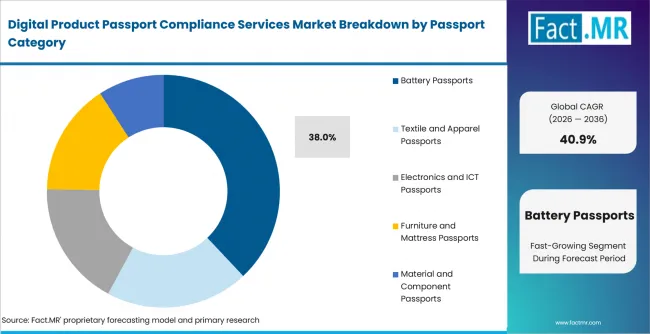
Digital Product Passport Compliance Services Market Analysis By Passport Category | Source: Fact.MR
Battery Passports lead because EV and industrial batteries face the earliest mandatory passport requirement. The passport category is projected to capture 38.0% share in 2026 as battery makers prepare for 18 February 2027 implementation. [2] These projects need product identifiers, lifecycle data and supply chain evidence. Battery passport work also creates reusable methods for later product groups.
Which customer type dominates?
Brand Manufacturers hold 44.0% share in 2026.
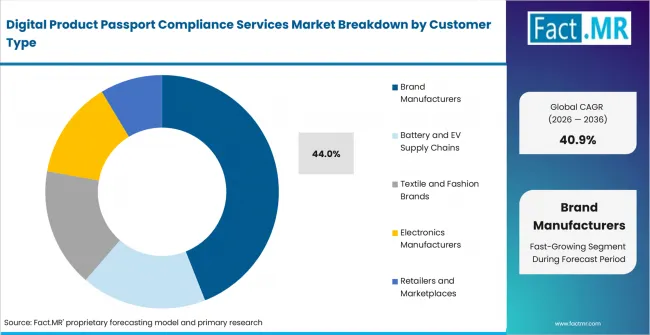
Digital Product Passport Compliance Services Market Analysis By Customer Type | Source: Fact.MR
Brand Manufacturers are likely to account for 44.0% share in 2026 because they carry market-access responsibility for regulated products. They need to coordinate product data from suppliers, factories and compliance teams. Avery Dennison describes atma.io as a connected product cloud that assigns unique digital IDs and tracks product events from source to consumer. [3] This fits brand needs for item-level data management.
Which delivery model dominates?
SaaS Passport Platforms lead because brands need scalable records.
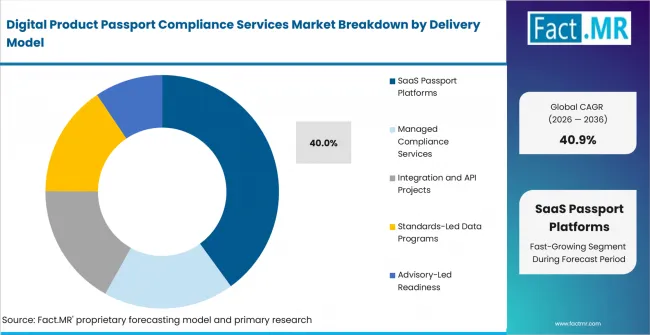
Digital Product Passport Compliance Services Market Analysis By Delivery Model | Source: Fact.MR
SaaS Passport Platforms lead because DPP compliance requires repeatable product records across large catalogs. The model is projected to hold 40.0% share in 2026 as brands move from pilots to portfolio-wide deployment. Platforms can manage identifiers, data fields, access permissions and updates. This model leads because one-off consulting cannot maintain passports across thousands of items and supplier changes.
Which end use dominates?
EU Market Access holds 37.0% share in 2026.
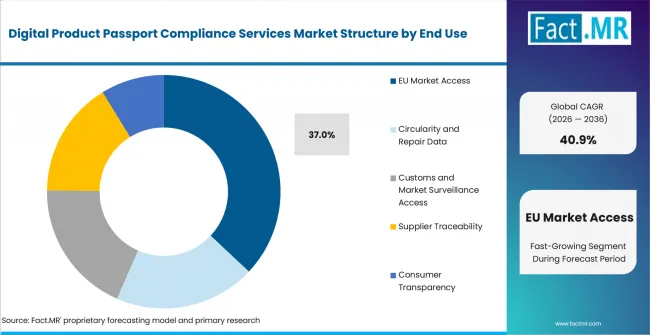
Digital Product Passport Compliance Services Market Analysis By End Use | Source: Fact.MR
EU Market Access leads because compliance decides whether regulated products can be placed on the EU market. The end use is expected to hold 37.0% share in 2026 as brands prepare for category-by-category rules. The European Commission’s 2025-2030 working plan prioritizes products such as textiles and materials for future ecodesign work. [4] Passport services help sellers reduce the risk of blocked listings or incomplete compliance evidence.
What is accelerating digital product passport compliance demand, and what is holding it back?
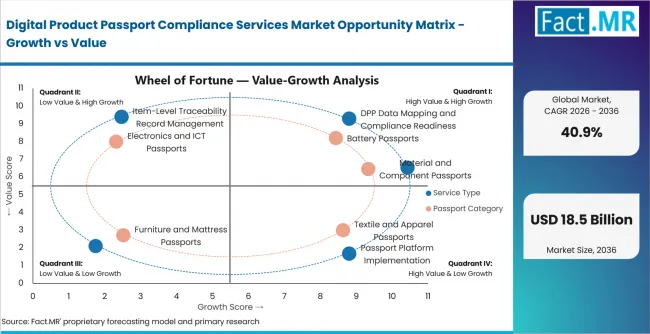
Digital Product Passport Compliance Services Market Opportunity Matrix Growth Vs Value | Source: Fact.MR
ESPR, battery passport deadlines and standards adoption drive demand; fragmented supplier data restrains adoption.
ESPR is the main driver. WBCSD’s 2025 ESPR readiness tool states that companies should evaluate the availability of key product information required under ESPR and prepare for forthcoming Digital Product Passport requirements= [5].
The main restraint is fragmented supplier data. Many brands do not have item-level material, component and repair information in one system. Supplier evidence can sit across spreadsheets, certificates and factory systems. Service providers must clean data flows and define ownership before passport platforms can work reliably.
Where do the biggest digital product passport compliance opportunities sit?
Battery passport readiness, textile traceability and item-level data infrastructure.
- Battery Passport Readiness: Providers can support battery makers before the 2027 deadline.
- Textile Traceability: Platforms can help apparel brands prepare product and material records.
- Item-Level Data Infrastructure: Service firms can connect identifiers, supplier evidence and passport records.
Which countries are scaling digital product passport compliance services fastest?
Germany 44.5%, France 43.2%, Italy 42.0%, Netherlands 41.1%, USA 39.8%.
Based on regional analysis, the digital product passport compliance services market is segmented into Western Europe, North America, East Asia, South Asia and Pacific, Latin America, and Middle East and Africa.
.webp "Top Country Growth Comparison Digital Product Passport Compliance Services Market Cagr (2026 2036)")
Top Country Growth Comparison Digital Product Passport Compliance Services Market Cagr (2026 2036) | Source: Fact.MR
| Country | CAGR |
|---|---|
| Germany | 44.5% |
| France | 43.2% |
| Italy | 42.0% |
| Netherlands | 41.1% |
| United States | 39.8% |
Source: Fact.MR analysis. Updated Jun 19, 2026
Source: Fact.MR analysis, based on proprietary forecasting model and primary research. Digital Product Passport Compliance Services Market Cagr Analysis By Country | Source: Fact.MR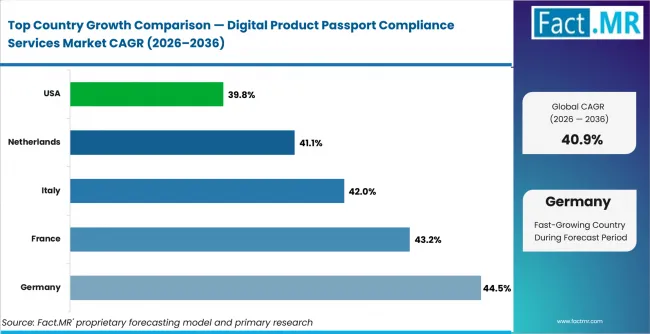
What is powering Germany’s lead?
Germany is projected to record 44.5% CAGR through 2036 as EU product compliance and manufacturing data needs expand. Battery and automotive supply chains need product records that can meet EU passport rules. German manufacturers also have complex supplier networks, which makes data mapping valuable. Battery passport readiness creates the first deadline-driven demand.
How is France scaling digital product passport compliance demand?
France is likely to post 43.2% CAGR from 2026 to 2036 because fashion and consumer goods brands need ESPR readiness. Apparel and luxury groups need traceability at item level before textile rules expand. Retailers need product information that supports circularity and consumer transparency. DPP services will support supplier onboarding and data quality checks. France will favor providers that can manage brand protection and sustainability disclosures together.
What underpins Italy’s growth?
Italy is expected to register 42.0% CAGR through 2036 as textile and furniture exporters prepare product data systems. Fashion, footwear and furniture supply chains often involve many small suppliers. That structure makes data collection and evidence verification harder. DPP compliance services can help brands standardize material records, repair data and supplier declarations. Italy will need practical services that work for mid-sized manufacturers.
What supports the Netherlands outlook?
The Netherlands is forecast to advance at 41.1% CAGR by 2036 as logistics, marketplaces and EU trade flows support passport infrastructure. Dutch ports, distributors and digital commerce networks handle large product flows into the EU. Importers and marketplaces will need passport data checks before products enter regulated channels.
How is the United States scaling digital product passport compliance demand?
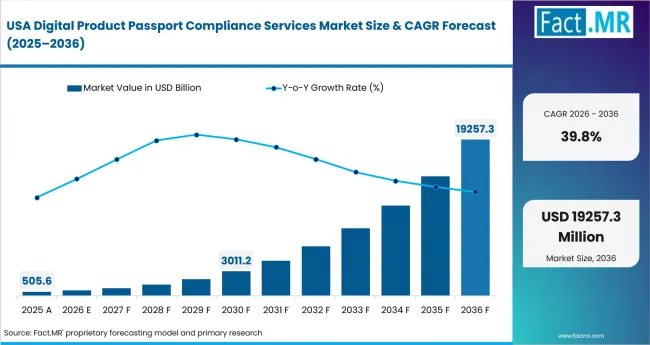
Digital Product Passport Compliance Services Market Country Value Analysis | Source: Fact.MR
The United States is set to record 39.8% CAGR over the forecast period as exporters selling into the EU build DPP compliance programs. U.S. battery, apparel, electronics and consumer goods firms need EU-ready product data even if production is outside Europe. Compliance teams will need support for supplier data mapping and passport platform implementation. The DPP requirement affects market access, which makes readiness a board-level issue for export-heavy brands.
Who leads the digital product passport compliance services landscape?
Circularise, Avery Dennison and Kezzler lead through traceability platforms, product IDs and compliance data infrastructure.
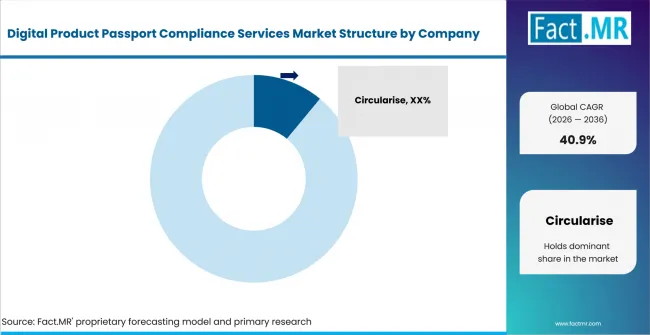
Digital Product Passport Compliance Services Market Analysis By Company | Source: Fact.MR
Digital product passport compliance services are used by brands and manufacturers that need product-level traceability records for EU compliance. Circularise provides supply chain traceability and digital product passport solutions. Avery Dennison’s atma.io supports connected product IDs and item-level event tracking. Kezzler provides product digitization and traceability services for regulated supply chains.
Spherity supports digital identity and credential-based product data exchange. EON supports digital IDs for fashion and connected products.Competition through 2036 will depend on interoperability and data accuracy.
Providers that combine product identity with compliance workflows will be better placed. Traceability firms can win early battery and textile programs. Standards-led ecosystems can support scale because passports need consistent identifiers and data carriers. Managed service providers can gain by helping brands maintain records after launch.
Which companies are the key players?
Circularise, Avery Dennison, Kezzler, Spherity, and EON.
- Circularise
- Avery Dennison (atma.io)
- Kezzler
- Spherity
- EON
Bibliography
- [1] European Parliament & Council of the European Union. (2024). Regulation (EU) 2024/1781 of the European Parliament and of the Council of 13 June 2024 establishing a framework for the setting of ecodesign requirements for sustainable products. Official Journal of the European Union, L, 2024/1781.
- [2] European Alternative Fuels Observatory. (2024, December 19). Solaris delivers the world’s first electric bus with a battery passport. European Commission.
- [3] Avery Dennison. (n.d.). atma.io connected product cloud.
- [4] European Commission. (2025, July 11). Plan to boost circular and efficient products on the European market. Green Forum.
- [5] World Business Council for Sustainable Development. (2025, April 22). Readiness Assessment Tool: Preparing for the Ecodesign for Sustainable Products Regulation (ESPR).
This Report Address
- Strategic intelligence on digital product passport compliance services across service type, passport category and customer type.
- Forecast mapping from USD 0.6 billion in 2026 to USD 18.5 billion by 2036.
- Segment analysis covering DPP Data Mapping and Compliance Readiness, Battery Passports, Brand Manufacturers, SaaS Passport Platforms and EU Market Access.
- Regional outlook covering Germany, France, Italy, Netherlands and the United States.
- Competitive analysis of Circularise, Avery Dennison, Kezzler, Spherity, EON.
- Service assessment covering passport platform implementation, supplier verification and compliance monitoring.
- Passport category assessment covering batteries, textiles, electronics, furniture and material records.
- Primary interviews, provider checks, official source review and EU product compliance validation support the forecast.
What does the digital product passport compliance services market cover?
Services that build and manage EU Digital Product Passports for regulated products.
The digital product passport compliance services market covers advisory and managed compliance services that help companies create product-level digital records. It includes product identifiers and passport platform management. The market differs from broad sustainability software because the focus is mandatory product-level compliance for market access.
What is included in the scope?
DPP data mapping and item-level traceability management.
The scope includes DPP readiness audits and data gap mapping. It covers passport platform deployment, item-level record creation and supplier data verification. It includes battery passport data support and electronics product data preparation. It also includes ongoing updates and compliance monitoring for products sold into the EU.
What is excluded from the scope?
General ESG reporting without product passport implementation.
The scope excludes general sustainability reporting unless product passport records are created. It excludes barcode or RFID hardware sales without compliance services. It also excludes lifecycle assessment services unless passport data preparation or DPP integration is included.
How was the analysis built?
100+ sources, 45+ company portfolios, 25+ countries, 20+ interviews.
- Primary Research:
- Primary research includes interviews with product compliance leaders and sustainability data managers. It includes input from DPP platform teams and supply chain traceability specialists.
- Desk Research:
- Desk research reviews ESPR and European Commission consultation sources. It covers official provider pages and standards guidance.
- Market-Sizing and Forecasting:
- Forecasting uses regulated brand counts and DPP service intensity. Passport platform adoption and supplier data complexity support the market assessment.
- Data Validation and Update Cycle:
- Forecasts are validated through provider checks and compliance-team feedback. EU delegated acts and category roadmap updates help confirm market direction.
Segmentation
What is the report’s scope and coverage?
USD 0.6 billion to USD 18.5 billion at 40.9% CAGR across key services and regions.
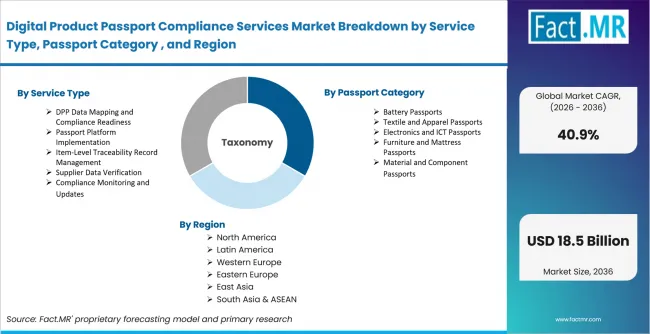
Digital Product Passport Compliance Services Market Breakdown By Service Type, Passport Category , And Region | Source: Fact.MR
| Attribute | Details |
|---|---|
| Quantitative Units | USD 0.6 billion in 2026 to USD 18.5 billion by 2036 at 40.9% CAGR |
| Market Definition | Services that build and manage EU Digital Product Passports for item-level traceability and compliance |
| Service Type | DPP Data Mapping and Compliance Readiness, Passport Platform Implementation, Item-Level Traceability Record Management, Supplier Data Verification, Compliance Monitoring and Updates |
| Passport Category | Battery Passports, Textile and Apparel Passports, Electronics and ICT Passports, Furniture and Mattress Passports, Material and Component Passports |
| Customer Type | Brand Manufacturers, Battery and EV Supply Chains, Textile and Fashion Brands, Electronics Manufacturers, Retailers and Marketplaces |
| Delivery Model | SaaS Passport Platforms, Managed Compliance Services, Integration and API Projects, Standards-Led Data Programs, Advisory-Led Readiness |
| End Use | EU Market Access, Circularity and Repair Data, Customs and Market Surveillance Access, Supplier Traceability, Consumer Transparency |
| Regions Covered | Western Europe, North America, East Asia, South Asia and Pacific, Latin America, Middle East and Africa |
| Countries Covered | Germany, France, Italy, Netherlands, United States |
| Key Companies Profiled | Circularise, Avery Dennison, Kezzler, Spherity, EON |
| Forecast Period | 2026 to 2036 |
| Approach | Hybrid top-down and bottom-up approach using regulated brand counts, category rollout timing, DPP project intensity, supplier-data complexity and provider validation |
Source: Fact.MR analysis. Updated Jun 19, 2026
How is the market segmented?
-
By Service Type:
- DPP Data Mapping and Compliance Readiness
- Passport Platform Implementation
- Item-Level Traceability Record Management
- Supplier Data Verification
- Compliance Monitoring and Updates
-
By Passport Category:
- Battery Passports
- Textile and Apparel Passports
- Electronics and ICT Passports
- Furniture and Mattress Passports
- Material and Component Passports
-
By Customer Type:
- Brand Manufacturers
- Battery and EV Supply Chains
- Textile and Fashion Brands
- Electronics Manufacturers
- Retailers and Marketplaces
-
By Delivery Model:
- SaaS Passport Platforms
- Managed Compliance Services
- Integration and API Projects
- Standards-Led Data Programs
- Advisory-Led Readiness
-
By End Use:
- EU Market Access
- Circularity and Repair Data
- Customs and Market Surveillance Access
- Supplier Traceability
- Consumer Transparency
-
By Region:
- North America
- United States
- Canada
- Europe
- Germany
- France
- Italy
- Netherlands
- United Kingdom
- Asia Pacific
- China
- Japan
- South Korea
- India
- Singapore
- Latin America
- Brazil
- Mexico
- Chile
- Middle East & Africa
- GCC Countries
- South Africa
- Israel
- North America
Frequently Asked Questions
What is the Digital Product Passport Compliance Services Market size in 2026?
What will the Digital Product Passport Compliance Services Market be worth by 2036?
What CAGR is projected for the Digital Product Passport Compliance Services Market?
Which service type leads the Digital Product Passport Compliance Services Market?
Which country expands faster in the Digital Product Passport Compliance Services Market?
How does France perform in the Digital Product Passport Compliance Services Market?
How does Italy perform in the Digital Product Passport Compliance Services Market?
How does the Netherlands perform in the Digital Product Passport Compliance Services Market?
How does the United States perform in the Digital Product Passport Compliance Services Market?
What is the primary driver in the Digital Product Passport Compliance Services Market?
What is the main restraint in the Digital Product Passport Compliance Services Market?
Why are battery passports important in this market?
Who worked on this report


Preview the report firsthand - request a free sample
Free SampleGet the brochure for pricing and purchase details
Download PDF