Bovine Gelatin Market Size, Share, Growth and Forecast (2026 - 2036)
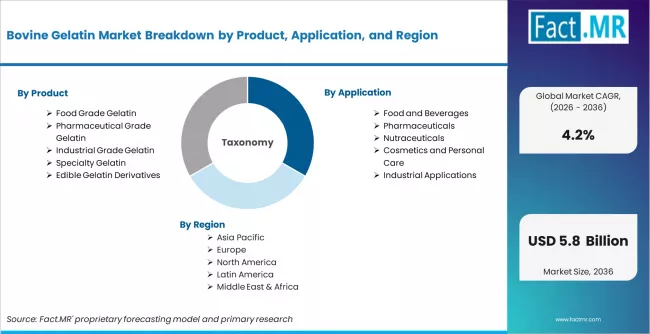
Bovine Gelatin Market is segmented by Product (Food Grade Gelatin, Pharmaceutical Grade Gelatin, Industrial Grade Gelatin, Specialty Gelatin, Edible Gelatin Derivatives), Application (Food and Beverages, Pharmaceuticals, Nutraceuticals, Cosmetics and Personal Care, Industrial Applications), End Use (Food Manufacturers, Pharmaceutical Companies, Nutraceutical Companies, Cosmetic Manufacturers, Industrial Manufacturers), and Region, with forecasts covering the period from 2026 to 2036.
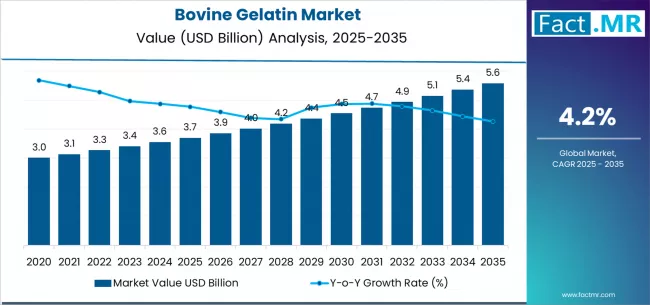
According to Fact.MR estimates, the global bovine gelatin market market was valued at USD 3.7 billion in 2025. The market is projected to reach USD 3.9 billion in 2026 and is expected to grow to USD 5.8 billion by 2036, expanding at a CAGR of 4.2%. Food Grade Gelatin is anticipated to account for 36.8% of the product segment in 2026, while Food and Beverages is expected to remain the leading application with around 41.5% share.
Bovine Gelatin Market Analysis and Forecast by Fact.MR
The bovine gelatin market, valued at USD 3.7 billion in 2025, is expanding at a 4.2% CAGR to reach USD 5.818 billion by 2036. Bovine gelatin is a protein derived from the hydrolysis of collagen in bovine hides, bones, tendons, and ligaments, delivering gelling, stabilising, emulsifying, and film-forming properties across food, pharmaceutical, nutraceutical, cosmetic, and industrial applications. Growth is shaped by pharmaceutical capsule production expansion, confectionery gelling agent demand, collagen supplement market growth, and food texturising ingredient requirements.
Summary of Bovine Gelatin Market
- Market Snapshot
- The bovine gelatin market is valued at USD 3.7 billion in 2025.
- Estimated market value for 2026 is USD 3.855 billion, projected to reach USD 5.818 billion by 2036.
- A CAGR of 4.2% is forecast for the 2026 to 2036 assessment period.
- Incremental opportunity of USD 1.963 billion between 2026 and 2036.
- Food-grade gelatin holds 36.8% of the product segment, with bovine hide at 52.6% of source demand.
- India and China are the fastest-growing markets for bovine gelatin consumption.
- Demand and Growth Drivers
- Global pharmaceutical hard and soft capsule production exceeds 500 billion units annually, with bovine gelatin serving as the primary capsule shell material due to its excellent film-forming properties, dissolution characteristics, and regulatory acceptance across all pharmaceutical markets.
- Confectionery industry demand for gelling agents in gummy sweets, marshmallows, and jelly products sustains food-grade gelatin consumption, with gummy supplement and gummy vitamin formats creating additional demand at the food-pharmaceutical intersection.
- Collagen peptide supplement market growth at 8 to 10% annually is driving demand for bovine gelatin hydrolysates marketed as beauty-from-within, joint health, and skin elasticity supplements.
- Industrial gelatin applications in photography, microencapsulation, and adhesive production maintain a stable demand base alongside food and pharmaceutical consumption.
- Product and Segment View
- Food-grade gelatin holds 36.8% of the product segment, reflecting the established position of gelatin in confectionery, dairy, and bakery applications.
- Food and beverages capture 41.5% of application demand, driven by gelling, stabilising, and texturising requirements in food manufacturing.
- Powder gelatin accounts for 44.2% of form demand, reflecting the versatility and ease of use of powdered gelatin in manufacturing processes.
- Key segmentation includes:
- Product: Food Grade Gelatin, Pharmaceutical Grade Gelatin, Industrial Grade Gelatin, Specialty Gelatin, Edible Gelatin Derivatives
- Application: Food and Beverages, Pharmaceuticals, Nutraceuticals, Cosmetics and Personal Care, Industrial Applications
- Source: Bovine Hide, Bovine Bones, Bovine Tendons and Ligaments
- Form: Powder Gelatin, Sheet Gelatin, Liquid Gelatin
- Bloom Strength: Medium Bloom, Low Bloom, High Bloom, Ultra High Bloom
- Geography and Competitive Outlook
- North America accounts for significant revenue, with the USA generating USD 1.38 billion in 2025.
- East Asia is expanding, with Japan contributing USD 0.196 billion and South Korea contributing USD 0.114 billion.
- Gelita holds approximately 12.0% of global market share through its position as the world's largest gelatin and collagen peptide manufacturer.
- Rousselot (Darling Ingredients), PB Leiner, and Nitta Gelatin compete on production scale, source diversification, and pharmaceutical-grade capabilities.
- Analyst Opinion
- The bovine gelatin market faces a dual dynamic: sustained demand from pharmaceutical capsule and confectionery applications, and competition from plant-based and marine alternatives in consumer-facing products. The commercial opportunity lies in two strategies: maintaining pharmaceutical-grade quality leadership where bovine gelatin's functional properties remain unmatched by alternatives, and developing collagen peptide value-added products that capture the growing beauty and health supplement market at premium price points.
Key Growth Drivers, Constraints, and Opportunities
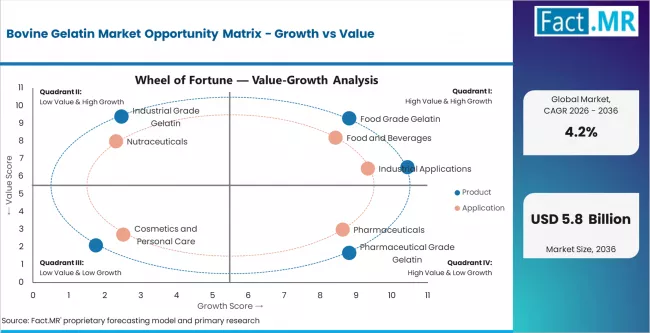
Key Factors Driving Growth
- Pharmaceutical capsule demand is the single largest application driver for bovine gelatin. Global soft gel capsule production alone exceeds 100 billion units annually, per Capsugel/Lonza industry references, with bovine gelatin providing the film-forming, dissolution, and oxygen barrier properties that capsule production requires. Bovine gelatin's regulatory acceptance (Ph. Eur., USP, JP pharmacopoeia compliance) across all major pharmaceutical markets provides a compliance advantage over alternative materials.
- Gummy supplement and gummy vitamin formats are the fastest-growing delivery system in the nutraceutical market, growing at 12 to 15% annually per CRN data. Bovine gelatin's gelling properties at specific bloom strengths produce the chewy texture that consumers expect in gummy products, and bovine gelatin gummies are preferred over porcine alternatives in markets with halal dietary requirements.
- Collagen peptide supplements derived from bovine gelatin hydrolysis are growing at 8 to 10% annually, driven by consumer demand for beauty-from-within products targeting skin elasticity, hair strength, and joint health. Bovine collagen peptides command retail prices of USD 30 to USD 80 per kilogram, delivering significant value-added processing margin above raw gelatin.
Key Market Constraints
- BSE (bovine spongiform encephalopathy) risk perception continues to affect bovine gelatin acceptance in certain markets. While scientific evidence confirms that gelatin production processes (acid/alkaline treatment, heat processing) inactivate BSE prions, consumer and regulatory sensitivity persists, particularly in Japan and certain European markets.
- Halal and kosher certification requirements create sourcing complexity. Bovine gelatin must be sourced from animals slaughtered according to halal or kosher requirements, and certification documentation must trace the gelatin from slaughterhouse to finished product. This certification process adds cost and limits supplier options.
- Competition from plant-based alternatives (agar, carrageenan, pectin, modified starch) and porcine gelatin constrains bovine gelatin market share in price-sensitive food applications where gelling functionality rather than specific gelatin properties is the primary requirement.
Key Opportunity Areas
- Pharmaceutical-grade bovine gelatin for specialised drug delivery systems (enteric-coated capsules, modified-release capsules, liquid-filled capsules) is a high-value growth niche. Specialised pharmaceutical gelatin commands prices of USD 15 to USD 40 per kilogram versus USD 4 to USD 8 for standard food-grade gelatin.
- Halal-certified bovine gelatin is growing at 10 to 12% annually as Muslim-majority markets expand pharmaceutical and food manufacturing. The global halal gelatin market is supply-constrained, as halal bovine gelatin production requires dedicated slaughterhouse sourcing and certified processing infrastructure.
- Bioactive collagen peptide development for targeted health applications (Type I for skin, Type II for joints, Type III for cardiovascular) is creating differentiated product positioning that commands premiums above generic collagen supplements.
Segment-wise Analysis of the Bovine Gelatin Market
- Food-grade gelatin holds 36.8% of the product segment, reflecting established food manufacturing demand.
- Food and beverages capture 41.5% of application demand, driven by confectionery and dairy gelling requirements.
- Medium bloom accounts for 38.7% of bloom strength demand, reflecting the broadest range of food and pharmaceutical applications.
Which product type dominates the Bovine Gelatin Market?
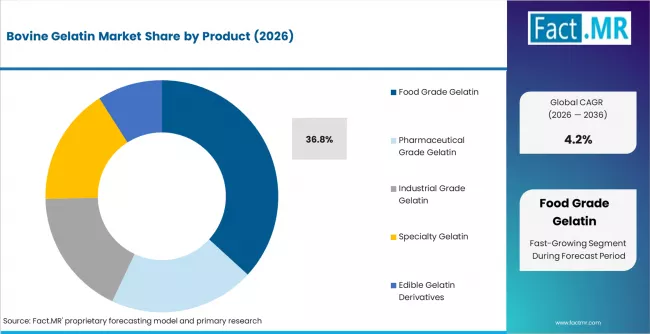
Food-grade gelatin controls 36.8% of the product segment. Food-grade bovine gelatin serves confectionery (gummy bears, marshmallows, jelly), dairy (yogurt, mousse, panna cotta), bakery (glazes, fillings), and beverage (clarification, stabilisation) applications. Food-grade gelatin specifications define bloom strength (100 to 300 bloom), mesh size, clarity, and microbiological limits.
Pharmaceutical-grade gelatin holds the second-largest share, serving hard capsule and soft gel capsule production with stringent pharmacopoeia compliance requirements. Specialty gelatin serves niche applications including microencapsulation, photographic film, and biomedical research.
Which application drives demand in the Bovine Gelatin Market?
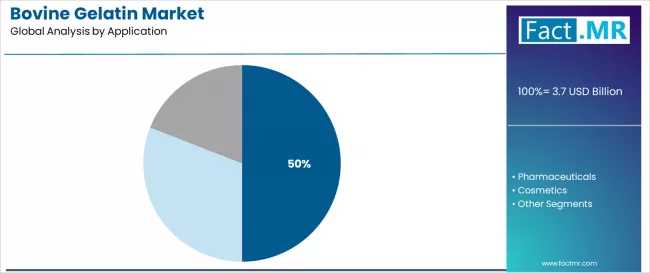
Food and beverages account for 41.5% of application demand. Confectionery is the largest food sub-application, with gummy sweets consuming over 30% of global food-grade gelatin production. Dairy applications (yogurt texturising, dessert gelling) and beverage applications (juice clarification, wine fining) contribute additional food-grade demand.
Pharmaceuticals hold the second-largest share, driven by capsule shell production. Nutraceuticals are the fastest-growing application, driven by collagen peptide supplements and gummy vitamin manufacturing.
Which source captures the largest share in the Bovine Gelatin Market?
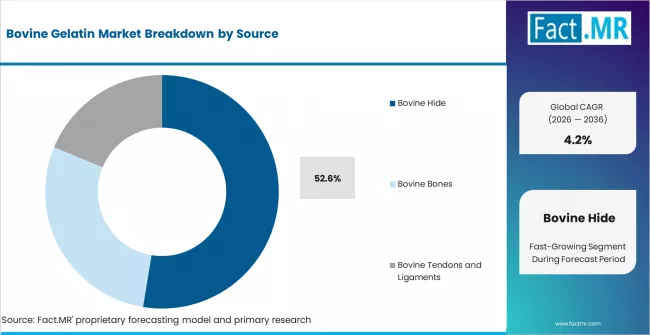
Bovine hide accounts for 52.6% of source demand. Type B gelatin (alkaline-processed) from bovine hides is the dominant product, delivering high bloom strength, excellent clarity, and consistent gelling properties. Bovine hides from South American, Indian, and Australian cattle are the primary raw material sources for the global gelatin industry.
Bovine bones hold the second-largest source share, producing Type A gelatin (acid-processed) with different functional characteristics. Bovine tendons and ligaments serve niche applications requiring specific collagen type profiles.
Which Product Trend is Shaping the Next Phase of Growth in the Bovine Gelatin Market?
The fastest-growing product trend in the bovine gelatin market is the development of type-specific collagen peptide products with targeted health benefit positioning. Traditional bovine gelatin is sold as a generic protein ingredient defined by bloom strength and grade. The emerging trend segments bovine collagen into Type I (skin, bones, tendons), Type II (cartilage, joints), and Type III (blood vessels, organs) peptide products, each marketed for specific health applications with supporting clinical evidence.
The commercial significance is that type-specific collagen peptides command retail prices 2 to 5 times above generic bovine gelatin. Type II collagen peptides for joint health (UC-II, Peptan) are marketed with published clinical trial data demonstrating cartilage protection and joint mobility benefits. Type I collagen peptides for skin health carry clinical data on skin elasticity and hydration improvement. Companies that invest in collagen type fractionation technology and clinical evidence programmes are capturing the premium supplement segment.
Regional Outlook Across Key Markets
.webp)
- North America is a major market, with the USA contributing USD 1.38 billion in 2025.
- East Asia is expanding, with Japan at USD 0.196 billion and South Korea at USD 0.114 billion.
- South Asia and Pacific is the fastest-growing region, driven by India's pharmaceutical and food manufacturing growth.
- Europe is a mature market with established pharmaceutical and confectionery gelatin demand.
CAGR Table
| Country | CAGR (%) |
|---|---|
| India | 6.0% |
| China | 5.2% |
| Mexico | 4.1% |
| USA | 3.8% |
| Germany | 3.7% |
| South Korea | 3.5% |
| Japan | 2.9% |
Source: Fact.MR analysis, based on proprietary forecasting model and primary research.
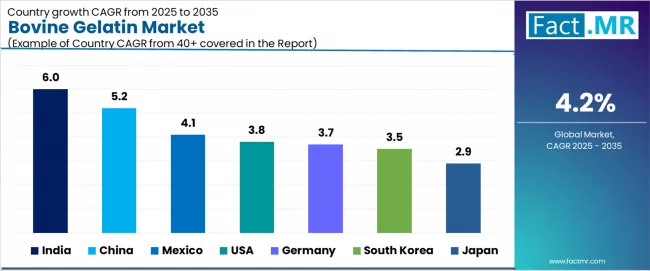
India: pharmaceutical manufacturing and halal gelatin demand drive growth
India leads country-level growth. India's pharmaceutical manufacturing sector, the world's largest by volume of generic drug production, is creating sustained demand for pharmaceutical-grade bovine gelatin capsule shells. India is also a major bovine hide source, with domestic gelatin production expanding alongside pharmaceutical sector growth.
- India's pharmaceutical capsule production exceeded 50 billion units in 2024, per Indian Drug Manufacturers Association data, with bovine gelatin as the primary capsule material.
China: confectionery growth and pharmaceutical demand drive adoption
China records the second-highest growth rate. Chinese gelatin demand is driven by confectionery industry expansion (gummy vitamins, jelly products), pharmaceutical capsule production growth, and the expanding collagen supplement market targeting Chinese consumers.
- China's gelatin consumption exceeded 80,000 tonnes in 2024, per China Gelatin Industry Association data.
Mexico: confectionery production and pharmaceutical manufacturing sustain demand
Mexico's growth reflects confectionery production for domestic and export markets and expanding pharmaceutical manufacturing. Mexican confectionery manufacturers use bovine gelatin in gummy and jelly product lines distributed throughout Latin America.
- Mexico's confectionery market grew 5% in 2024, per CANAINCA data, with gummy products as the fastest-growing confectionery sub-category.
USA: pharmaceutical capsule production and collagen supplement demand sustain the market
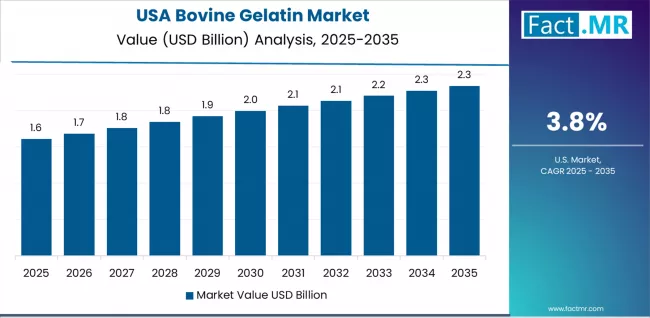
The USA generates USD 1.38 billion in 2025. US demand is driven by pharmaceutical capsule production, confectionery manufacturing, and the rapidly growing collagen supplement market. The US collagen supplement market exceeded USD 2 billion in 2024, with bovine collagen peptides as the leading source type.
- US collagen supplement sales grew 12% in 2024, per NBJ data, with bovine-sourced collagen maintaining the largest share of supplement collagen sales.
Germany: pharmaceutical quality standards and confectionery heritage define the market
Germany's growth reflects pharmaceutical-grade gelatin demand and the country's confectionery manufacturing heritage. Gelita (headquartered in Eberbach) and other German gelatin producers maintain pharmaceutical-grade production standards that serve the European pharmaceutical industry.
- Germany's gelatin production exceeded 30,000 tonnes in 2024, per VDG data, maintaining its position as Europe's largest gelatin producing country.
South Korea: K-beauty collagen demand and pharmaceutical growth drive adoption
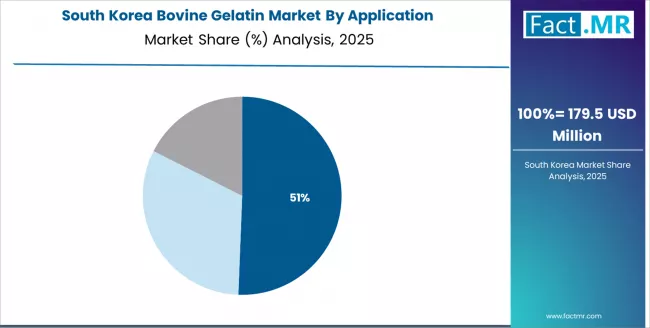
South Korea's growth is driven by the K-beauty industry's collagen supplement and cosmetic ingredient demand and pharmaceutical capsule production. Korean consumers are among the world's highest per-capita collagen supplement consumers.
- South Korea's collagen supplement market grew 10% in 2024, per KFDA data, with bovine collagen maintaining a significant share alongside marine collagen.
Japan: pharmaceutical precision and beauty supplement culture sustain demand
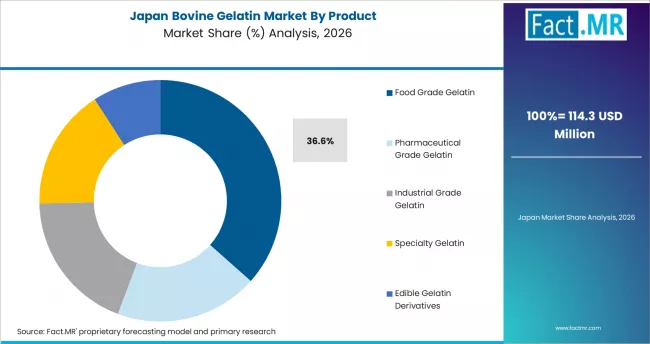
Japan contributes USD 0.196 billion in 2025. Japanese gelatin demand reflects the country's pharmaceutical manufacturing precision requirements and the established beauty supplement culture. Nitta Gelatin (headquartered in Osaka) is a major domestic and export gelatin producer.
- Japan's beauty supplement market exceeded JPY 250 billion in 2024, per JFMA data, with collagen as the leading active ingredient category.
Competitive Benchmarking and Company Positioning
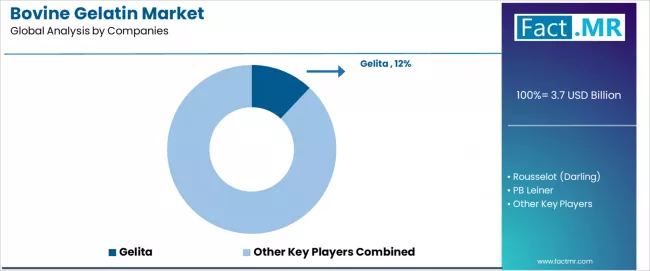
Bovine Gelatin Market Analysis By Company
- Gelita holds approximately 12.0% of global revenue through its position as the world's largest gelatin and collagen peptide manufacturer, with production facilities in Germany, Brazil, USA, Australia, and China.
- Rousselot (Darling Ingredients) and PB Leiner compete on production scale, multi-source gelatin production (bovine, porcine, fish), and pharmaceutical-grade capabilities.
- Nitta Gelatin and Weishardt serve specific regional markets with established quality reputations and customer relationships.
The competitive structure is moderately concentrated, with Gelita holding the largest share at 12.0%. Gelita's position is built on its global production network, pharmaceutical-grade quality certifications across multiple pharmacopoeias, and its Peptan collagen peptide brand that has achieved significant consumer and B2B market penetration.
Competition is evolving as collagen peptide supplements create a new revenue stream for gelatin manufacturers. Companies that can convert commodity gelatin production into value-added collagen peptide products capture 3 to 5 times the revenue per kilogram of raw material. Rousselot (Peptan), Gelita (Verisol, Fortigel), and Nitta (Wellnex) are building branded collagen peptide portfolios.
Key Companies in the Bovine Gelatin Market
The bovine gelatin competitive field includes Gelita, Rousselot (Darling Ingredients), PB Leiner, Nitta Gelatin, Weishardt, Sterling Biotech, Trobas Gelatine, Italgel, Ewald-Gelatine, Norland, Tessenderlo, Great Lakes Gelatin, Roxlor, Junca, and Kenney and Ross.
Recent Industry Developments
- Gelita: Verisol skin health collagen expansion (2025)
- Gelita expanded distribution of its Verisol bioactive collagen peptide product with new clinical data demonstrating skin elasticity and wrinkle reduction benefits in a 12-week randomised controlled trial.
- Rousselot: halal gelatin capacity expansion (2025)
- Rousselot expanded halal-certified bovine gelatin production capacity at its Brazilian facility, targeting growing demand from pharmaceutical and food manufacturers in halal-conscious markets.
- Nitta Gelatin: pharmaceutical capsule gelatin innovation (2026)
- Nitta Gelatin developed a new pharmaceutical capsule gelatin grade with improved moisture resistance and enhanced dissolution performance for modified-release capsule applications.
- PB Leiner: collagen peptide clinical programme (2025)
- PB Leiner published clinical trial results for its bovine collagen peptide product demonstrating joint health benefits in active adults, supporting nutraceutical positioning in the sports nutrition channel.
Leading Companies Shaping the Bovine Gelatin Market
-
Global Players
- Gelita
- Rousselot (Darling Ingredients)
- PB Leiner
- Nitta Gelatin
- Weishardt
-
Regional Players
- Sterling Biotech
- Trobas Gelatine
- Italgel
- Tessenderlo
-
Emerging / Start-up Players
- Ewald-Gelatine
- Norland
- Great Lakes Gelatin
- Roxlor
- Junca
Sources and Research References
- Company annual reports from Gelita, Darling Ingredients (Rousselot), and Nitta Gelatin.
- Capsugel/Lonza pharmaceutical capsule production data references.
- CRN dietary supplement market data.
- VDG (Verband Deutscher Gelatine-Hersteller) German gelatin production data.
- Indian Drug Manufacturers Association pharmaceutical production statistics.
- China Gelatin Industry Association consumption data.
All cited sources are first-party company filings, industry associations, or regulatory references. No syndicated market research reports were used.
Key Questions This Report Addresses
- What is the projected market value for bovine gelatin by 2036?
- Which product type holds the largest share?
- What CAGR is forecast from 2026 to 2036?
- How are collagen peptide supplements changing the gelatin value chain?
- Which countries are growing fastest?
- What is the competitive structure?
- How does BSE risk perception affect bovine gelatin acceptance?
- What role does halal certification play in bovine gelatin demand?
- How is pharmaceutical capsule demand driving gelatin growth?
Bovine Gelatin Market Definition
The bovine gelatin market encompasses the production and sale of gelatin derived from bovine collagen through acid or alkaline hydrolysis processes. Products include food-grade, pharmaceutical-grade, industrial-grade, and specialty gelatin in powder, sheet, and liquid forms at varying bloom strengths.
Bovine Gelatin Market Inclusions
- Food-grade bovine gelatin for confectionery, dairy, bakery, and beverage applications.
- Pharmaceutical-grade bovine gelatin for hard and soft capsule shell production.
- Bovine collagen peptides and hydrolysates for nutraceutical supplement applications.
- Industrial-grade bovine gelatin for photography, microencapsulation, and adhesive applications.
Bovine Gelatin Market Exclusions
- Porcine (pig) gelatin products.
- Fish and marine gelatin products.
- Plant-based gelatin alternatives (agar, carrageenan, pectin).
- Bovine collagen used in medical device and wound care applications regulated as medical products.
Bovine Gelatin Market Research Methodology
- Primary research with gelatin manufacturers, pharmaceutical capsule producers, confectionery manufacturers, and nutraceutical companies across 12 countries.
- Revenue modelling based on gelatin production volumes, hide and bone processing data, and manufacturer-reported sales.
- Pricing analysis using B2B gelatin trading data, pharmaceutical procurement records, and food ingredient price lists.
- Competitive share estimation through company annual reports, gelatin industry association data, and production capacity registries.
- Demand validation through pharmaceutical capsule production data, confectionery industry consumption statistics, and collagen supplement market analysis.
Scope of Analysis

| Parameter | Details |
|---|---|
| Report Currency | USD Billion |
| Market Value (2025) | USD 3.7 Billion |
| Forecast Value (2036) | USD 5.818 Billion |
| CAGR (2026 to 2036) | 4.2% |
| Product | Food Grade Gelatin, Pharmaceutical Grade Gelatin, Industrial Grade Gelatin, Specialty Gelatin, Edible Gelatin Derivatives |
| Application | Food and Beverages, Pharmaceuticals, Nutraceuticals, Cosmetics and Personal Care, Industrial Applications |
| Source | Bovine Hide, Bovine Bones, Bovine Tendons and Ligaments |
| Form | Powder Gelatin, Sheet Gelatin, Liquid Gelatin |
| Bloom Strength | Medium Bloom, Low Bloom, High Bloom, Ultra High Bloom |
| Regions | North America, Latin America, Europe, East Asia, South Asia and Pacific, Middle East and Africa |
| Countries | India, China, Mexico, USA, Germany, South Korea, Japan, and 40+ countries |
| Companies | Gelita, Rousselot, PB Leiner, Nitta Gelatin, Weishardt, Sterling Biotech, Trobas Gelatine, Italgel, Ewald-Gelatine, Norland, Tessenderlo, Great Lakes Gelatin, Roxlor, Junca, Kenney and Ross |
| Forecast Period | 2026 to 2036 |
| Approach | Top-down and bottom-up with primary and secondary research |
Market Segmentation Analysis
-
Bovine Gelatin Market Market Segmented by Product:
- Food Grade Gelatin
- Bloom Strength 150–200
- Bloom Strength 200–250
- Bloom Strength 250+
- Pharmaceutical Grade Gelatin
- Capsule Grade Gelatin
- Hard Shell Capsule Gelatin
- Softgel Gelatin
- Industrial Grade Gelatin
- Adhesives Grade
- Photographic Grade
- Specialty Gelatin
- Hydrolyzed Bovine Gelatin
- Functional Protein Gelatin
- Edible Gelatin Derivatives
- Gelatin Powder
- Gelatin Sheets
- Food Grade Gelatin
-
Bovine Gelatin Market Market Segmented by Application:
- Food and Beverages
- Confectionery Products
- Gummies and Candies
- Dairy Desserts
- Bakery Products
- Pharmaceuticals
- Hard Capsules
- Softgel Capsules
- Wound Care Products
- Nutraceuticals
- Dietary Supplements
- Functional Protein Products
- Cosmetics and Personal Care
- Skincare Products
- Hair Care Products
- Anti Aging Formulations
- Industrial Applications
- Photography Films
- Adhesives and Coatings
- Food and Beverages
-
Bovine Gelatin Market Market Segmented by End Use:
- Food Manufacturers
- Confectionery Producers
- Bakery Companies
- Pharmaceutical Companies
- Capsule Manufacturers
- Drug Formulators
- Nutraceutical Companies
- Supplement Brands
- Cosmetic Manufacturers
- Skincare Brands
- Industrial Manufacturers
- Chemical Processing Companies
- Adhesive Producers
- Food Manufacturers
-
Bovine Gelatin Market Market Segmented by Source:
- Bovine Hide
- Collagen Extraction from Skin
- Bovine Bones
- Collagen Rich Bone Material
- Bovine Tendons and Ligaments
- High Collagen Connective Tissue
- Bovine Hide
-
Bovine Gelatin Market Market Segmented by Form:
- Powder Gelatin
- Fine Powder
- Granulated Gelatin
- Sheet Gelatin
- Food Service Sheets
- Industrial Sheets
- Liquid Gelatin
- Hydrolyzed Liquid Form
- Concentrated Gel Solutions
- Powder Gelatin
-
Bovine Gelatin Market Market Segmented by Bloom Strength:
- Medium Bloom
- 120–200 Bloom
- Low Bloom
- 50–120 Bloom
- High Bloom
- 200–300 Bloom
- Ultra High Bloom
- 300+ Specialty Gelatin
- Medium Bloom
-
Bovine Gelatin Market Market by Region:
- North America
- USA
- Canada
- Mexico
- Latin America
- Brazil
- Chile
- Rest of Latin America
- Western Europe
- Germany
- UK
- Italy
- Spain
- France
- Nordic
- BENELUX
- Rest of Western Europe
- Eastern Europe
- Russia
- Poland
- Hungary
- Balkan & Baltic
- Rest of Eastern Europe
- East Asia
- China
- Japan
- South Korea
- South Asia and Pacific
- India
- ASEAN
- Australia & New Zealand
- Rest of South Asia and Pacific
- Middle East & Africa
- Kingdom of Saudi Arabia
- Other GCC Countries
- Turkiye
- South Africa
- Other African Union
- Rest of Middle East & Africa
- North America
- Frequently Asked Questions -
What is the current market size?
The market is valued at USD 3.7 billion in 2025.
What growth rate is expected?
A 4.2% CAGR from 2026 to 2036.
Which product type leads?
Food-grade gelatin holds 36.8% of the product segment.
Which application is largest?
Food and beverages capture 41.5% of application demand.
Which country is growing fastest?
India leads at 6.0% CAGR.
What is the incremental opportunity?
USD 1.963 billion between 2026 and 2036.
Which company holds the largest share?
Gelita holds approximately 12.0%.
Table of Content
- Executive Summary
- Global Market Outlook
- Demand to side Trends
- Supply to side Trends
- Technology Roadmap Analysis
- Analysis and Recommendations
- Market Overview
- Market Coverage / Taxonomy
- Market Definition / Scope / Limitations
- Research Methodology
- Chapter Orientation
- Analytical Lens and Working Hypotheses
- Market Structure, Signals, and Trend Drivers
- Benchmarking and Cross-market Comparability
- Market Sizing, Forecasting, and Opportunity Mapping
- Research Design and Evidence Framework
- Desk Research Programme (Secondary Evidence)
- Company Annual and Sustainability Reports
- Peer-reviewed Journals and Academic Literature
- Corporate Websites, Product Literature, and Technical Notes
- Earnings Decks and Investor Briefings
- Statutory Filings and Regulatory Disclosures
- Technical White Papers and Standards Notes
- Trade Journals, Industry Magazines, and Analyst Briefs
- Conference Proceedings, Webinars, and Seminar Materials
- Government Statistics Portals and Public Data Releases
- Press Releases and Reputable Media Coverage
- Specialist Newsletters and Curated Briefings
- Sector Databases and Reference Repositories
- Fact.MR Internal Proprietary Databases and Historical Market Datasets
- Subscription Datasets and Paid Sources
- Social Channels, Communities, and Digital Listening Inputs
- Additional Desk Sources
- Expert Input and Fieldwork (Primary Evidence)
- Primary Modes
- Qualitative Interviews and Expert Elicitation
- Quantitative Surveys and Structured Data Capture
- Blended Approach
- Why Primary Evidence is Used
- Field Techniques
- Interviews
- Surveys
- Focus Groups
- Observational and In-context Research
- Social and Community Interactions
- Stakeholder Universe Engaged
- C-suite Leaders
- Board Members
- Presidents and Vice Presidents
- R&D and Innovation Heads
- Technical Specialists
- Domain Subject-matter Experts
- Scientists
- Physicians and Other Healthcare Professionals
- Governance, Ethics, and Data Stewardship
- Research Ethics
- Data Integrity and Handling
- Primary Modes
- Tooling, Models, and Reference Databases
- Desk Research Programme (Secondary Evidence)
- Data Engineering and Model Build
- Data Acquisition and Ingestion
- Cleaning, Normalisation, and Verification
- Synthesis, Triangulation, and Analysis
- Quality Assurance and Audit Trail
- Market Background
- Market Dynamics
- Drivers
- Restraints
- Opportunity
- Trends
- Scenario Forecast
- Demand in Optimistic Scenario
- Demand in Likely Scenario
- Demand in Conservative Scenario
- Opportunity Map Analysis
- Product Life Cycle Analysis
- Supply Chain Analysis
- Investment Feasibility Matrix
- Value Chain Analysis
- PESTLE and Porter’s Analysis
- Regulatory Landscape
- Regional Parent Market Outlook
- Production and Consumption Statistics
- Import and Export Statistics
- Market Dynamics
- Global Market Analysis 2021 to 2025 and Forecast, 2026 to 2036
- Historical Market Size Value (USD Million) Analysis, 2021 to 2025
- Current and Future Market Size Value (USD Million) Projections, 2026 to 2036
- Y to o to Y Growth Trend Analysis
- Absolute $ Opportunity Analysis
- Global Market Pricing Analysis 2021 to 2025 and Forecast 2026 to 2036
- Global Market Analysis 2021 to 2025 and Forecast 2026 to 2036, By Product
- Introduction / Key Findings
- Historical Market Size Value (USD Million) Analysis By Product , 2021 to 2025
- Current and Future Market Size Value (USD Million) Analysis and Forecast By Product , 2026 to 2036
- Food Grade Gelatin
- Bloom Strength 150–200
- Bloom Strength 200–250
- Bloom Strength 250+
- Pharmaceutical Grade Gelatin
- Capsule Grade Gelatin
- Hard Shell Capsule Gelatin
- Softgel Gelatin
- Industrial Grade Gelatin
- Adhesives Grade
- Photographic Grade
- Specialty Gelatin
- Hydrolyzed Bovine Gelatin
- Functional Protein Gelatin
- Edible Gelatin Derivatives
- Gelatin Powder
- Gelatin Sheets
- Food Grade Gelatin
- Y to o to Y Growth Trend Analysis By Product , 2021 to 2025
- Absolute $ Opportunity Analysis By Product , 2026 to 2036
- Global Market Analysis 2021 to 2025 and Forecast 2026 to 2036, By Application
- Introduction / Key Findings
- Historical Market Size Value (USD Million) Analysis By Application, 2021 to 2025
- Current and Future Market Size Value (USD Million) Analysis and Forecast By Application, 2026 to 2036
- Food and Beverages
- Confectionery Products
- Gummies and Candies
- Dairy Desserts
- Bakery Products
- Pharmaceuticals
- Hard Capsules
- Softgel Capsules
- Wound Care Products
- Nutraceuticals
- Dietary Supplements
- Functional Protein Products
- Cosmetics and Personal Care
- Skincare Products
- Hair Care Products
- Anti Aging Formulations
- Industrial Applications
- Photography Films
- Adhesives and Coatings
- Food and Beverages
- Y to o to Y Growth Trend Analysis By Application, 2021 to 2025
- Absolute $ Opportunity Analysis By Application, 2026 to 2036
- Global Market Analysis 2021 to 2025 and Forecast 2026 to 2036, By End Use
- Introduction / Key Findings
- Historical Market Size Value (USD Million) Analysis By End Use, 2021 to 2025
- Current and Future Market Size Value (USD Million) Analysis and Forecast By End Use, 2026 to 2036
- Food Manufacturers
- Confectionery Producers
- Bakery Companies
- Pharmaceutical Companies
- Capsule Manufacturers
- Drug Formulators
- Nutraceutical Companies
- Supplement Brands
- Cosmetic Manufacturers
- Skincare Brands
- Industrial Manufacturers
- Chemical Processing Companies
- Adhesive Producers
- Food Manufacturers
- Y to o to Y Growth Trend Analysis By End Use, 2021 to 2025
- Absolute $ Opportunity Analysis By End Use, 2026 to 2036
- Global Market Analysis 2021 to 2025 and Forecast 2026 to 2036, By Source
- Introduction / Key Findings
- Historical Market Size Value (USD Million) Analysis By Source, 2021 to 2025
- Current and Future Market Size Value (USD Million) Analysis and Forecast By Source, 2026 to 2036
- Bovine Hide
- Collagen Extraction from Skin
- Bovine Bones
- Collagen Rich Bone Material
- Bovine Tendons and Ligaments
- High Collagen Connective Tissue
- Bovine Hide
- Y to o to Y Growth Trend Analysis By Source, 2021 to 2025
- Absolute $ Opportunity Analysis By Source, 2026 to 2036
- Global Market Analysis 2021 to 2025 and Forecast 2026 to 2036, By Form
- Introduction / Key Findings
- Historical Market Size Value (USD Million) Analysis By Form, 2021 to 2025
- Current and Future Market Size Value (USD Million) Analysis and Forecast By Form, 2026 to 2036
- Powder Gelatin
- Fine Powder
- Granulated Gelatin
- Sheet Gelatin
- Food Service Sheets
- Industrial Sheets
- Liquid Gelatin
- Hydrolyzed Liquid Form
- Concentrated Gel Solutions
- Powder Gelatin
- Y to o to Y Growth Trend Analysis By Form, 2021 to 2025
- Absolute $ Opportunity Analysis By Form, 2026 to 2036
- Global Market Analysis 2021 to 2025 and Forecast 2026 to 2036, By Bloom Strength
- Introduction / Key Findings
- Historical Market Size Value (USD Million) Analysis By Bloom Strength, 2021 to 2025
- Current and Future Market Size Value (USD Million) Analysis and Forecast By Bloom Strength, 2026 to 2036
- Medium Bloom
- 120–200 Bloom
- Low Bloom
- 50–120 Bloom
- High Bloom
- 200–300 Bloom
- Ultra High Bloom
- 300+ Specialty Gelatin
- Medium Bloom
- Y to o to Y Growth Trend Analysis By Bloom Strength, 2021 to 2025
- Absolute $ Opportunity Analysis By Bloom Strength, 2026 to 2036
- Global Market Analysis 2021 to 2025 and Forecast 2026 to 2036, By Region
- Introduction
- Historical Market Size Value (USD Million) Analysis By Region, 2021 to 2025
- Current Market Size Value (USD Million) Analysis and Forecast By Region, 2026 to 2036
- North America
- Latin America
- Western Europe
- Eastern Europe
- East Asia
- South Asia and Pacific
- Middle East & Africa
- Market Attractiveness Analysis By Region
- North America Market Analysis 2021 to 2025 and Forecast 2026 to 2036, By Country
- Historical Market Size Value (USD Million) Trend Analysis By Market Taxonomy, 2021 to 2025
- Market Size Value (USD Million) Forecast By Market Taxonomy, 2026 to 2036
- By Country
- USA
- Canada
- Mexico
- By Product
- By Application
- By End Use
- By Source
- By Form
- By Bloom Strength
- By Country
- Market Attractiveness Analysis
- By Country
- By Product
- By Application
- By End Use
- By Source
- By Form
- By Bloom Strength
- Key Takeaways
- Latin America Market Analysis 2021 to 2025 and Forecast 2026 to 2036, By Country
- Historical Market Size Value (USD Million) Trend Analysis By Market Taxonomy, 2021 to 2025
- Market Size Value (USD Million) Forecast By Market Taxonomy, 2026 to 2036
- By Country
- Brazil
- Chile
- Rest of Latin America
- By Product
- By Application
- By End Use
- By Source
- By Form
- By Bloom Strength
- By Country
- Market Attractiveness Analysis
- By Country
- By Product
- By Application
- By End Use
- By Source
- By Form
- By Bloom Strength
- Key Takeaways
- Western Europe Market Analysis 2021 to 2025 and Forecast 2026 to 2036, By Country
- Historical Market Size Value (USD Million) Trend Analysis By Market Taxonomy, 2021 to 2025
- Market Size Value (USD Million) Forecast By Market Taxonomy, 2026 to 2036
- By Country
- Germany
- UK
- Italy
- Spain
- France
- Nordic
- BENELUX
- Rest of Western Europe
- By Product
- By Application
- By End Use
- By Source
- By Form
- By Bloom Strength
- By Country
- Market Attractiveness Analysis
- By Country
- By Product
- By Application
- By End Use
- By Source
- By Form
- By Bloom Strength
- Key Takeaways
- Eastern Europe Market Analysis 2021 to 2025 and Forecast 2026 to 2036, By Country
- Historical Market Size Value (USD Million) Trend Analysis By Market Taxonomy, 2021 to 2025
- Market Size Value (USD Million) Forecast By Market Taxonomy, 2026 to 2036
- By Country
- Russia
- Poland
- Hungary
- Balkan & Baltic
- Rest of Eastern Europe
- By Product
- By Application
- By End Use
- By Source
- By Form
- By Bloom Strength
- By Country
- Market Attractiveness Analysis
- By Country
- By Product
- By Application
- By End Use
- By Source
- By Form
- By Bloom Strength
- Key Takeaways
- East Asia Market Analysis 2021 to 2025 and Forecast 2026 to 2036, By Country
- Historical Market Size Value (USD Million) Trend Analysis By Market Taxonomy, 2021 to 2025
- Market Size Value (USD Million) Forecast By Market Taxonomy, 2026 to 2036
- By Country
- China
- Japan
- South Korea
- By Product
- By Application
- By End Use
- By Source
- By Form
- By Bloom Strength
- By Country
- Market Attractiveness Analysis
- By Country
- By Product
- By Application
- By End Use
- By Source
- By Form
- By Bloom Strength
- Key Takeaways
- South Asia and Pacific Market Analysis 2021 to 2025 and Forecast 2026 to 2036, By Country
- Historical Market Size Value (USD Million) Trend Analysis By Market Taxonomy, 2021 to 2025
- Market Size Value (USD Million) Forecast By Market Taxonomy, 2026 to 2036
- By Country
- India
- ASEAN
- Australia & New Zealand
- Rest of South Asia and Pacific
- By Product
- By Application
- By End Use
- By Source
- By Form
- By Bloom Strength
- By Country
- Market Attractiveness Analysis
- By Country
- By Product
- By Application
- By End Use
- By Source
- By Form
- By Bloom Strength
- Key Takeaways
- Middle East & Africa Market Analysis 2021 to 2025 and Forecast 2026 to 2036, By Country
- Historical Market Size Value (USD Million) Trend Analysis By Market Taxonomy, 2021 to 2025
- Market Size Value (USD Million) Forecast By Market Taxonomy, 2026 to 2036
- By Country
- Kingdom of Saudi Arabia
- Other GCC Countries
- Turkiye
- South Africa
- Other African Union
- Rest of Middle East & Africa
- By Product
- By Application
- By End Use
- By Source
- By Form
- By Bloom Strength
- By Country
- Market Attractiveness Analysis
- By Country
- By Product
- By Application
- By End Use
- By Source
- By Form
- By Bloom Strength
- Key Takeaways
- Key Countries Market Analysis
- USA
- Pricing Analysis
- Market Share Analysis, 2025
- By Product
- By Application
- By End Use
- By Source
- By Form
- By Bloom Strength
- Canada
- Pricing Analysis
- Market Share Analysis, 2025
- By Product
- By Application
- By End Use
- By Source
- By Form
- By Bloom Strength
- Mexico
- Pricing Analysis
- Market Share Analysis, 2025
- By Product
- By Application
- By End Use
- By Source
- By Form
- By Bloom Strength
- Brazil
- Pricing Analysis
- Market Share Analysis, 2025
- By Product
- By Application
- By End Use
- By Source
- By Form
- By Bloom Strength
- Chile
- Pricing Analysis
- Market Share Analysis, 2025
- By Product
- By Application
- By End Use
- By Source
- By Form
- By Bloom Strength
- Germany
- Pricing Analysis
- Market Share Analysis, 2025
- By Product
- By Application
- By End Use
- By Source
- By Form
- By Bloom Strength
- UK
- Pricing Analysis
- Market Share Analysis, 2025
- By Product
- By Application
- By End Use
- By Source
- By Form
- By Bloom Strength
- Italy
- Pricing Analysis
- Market Share Analysis, 2025
- By Product
- By Application
- By End Use
- By Source
- By Form
- By Bloom Strength
- Spain
- Pricing Analysis
- Market Share Analysis, 2025
- By Product
- By Application
- By End Use
- By Source
- By Form
- By Bloom Strength
- France
- Pricing Analysis
- Market Share Analysis, 2025
- By Product
- By Application
- By End Use
- By Source
- By Form
- By Bloom Strength
- India
- Pricing Analysis
- Market Share Analysis, 2025
- By Product
- By Application
- By End Use
- By Source
- By Form
- By Bloom Strength
- ASEAN
- Pricing Analysis
- Market Share Analysis, 2025
- By Product
- By Application
- By End Use
- By Source
- By Form
- By Bloom Strength
- Australia & New Zealand
- Pricing Analysis
- Market Share Analysis, 2025
- By Product
- By Application
- By End Use
- By Source
- By Form
- By Bloom Strength
- China
- Pricing Analysis
- Market Share Analysis, 2025
- By Product
- By Application
- By End Use
- By Source
- By Form
- By Bloom Strength
- Japan
- Pricing Analysis
- Market Share Analysis, 2025
- By Product
- By Application
- By End Use
- By Source
- By Form
- By Bloom Strength
- South Korea
- Pricing Analysis
- Market Share Analysis, 2025
- By Product
- By Application
- By End Use
- By Source
- By Form
- By Bloom Strength
- Russia
- Pricing Analysis
- Market Share Analysis, 2025
- By Product
- By Application
- By End Use
- By Source
- By Form
- By Bloom Strength
- Poland
- Pricing Analysis
- Market Share Analysis, 2025
- By Product
- By Application
- By End Use
- By Source
- By Form
- By Bloom Strength
- Hungary
- Pricing Analysis
- Market Share Analysis, 2025
- By Product
- By Application
- By End Use
- By Source
- By Form
- By Bloom Strength
- Kingdom of Saudi Arabia
- Pricing Analysis
- Market Share Analysis, 2025
- By Product
- By Application
- By End Use
- By Source
- By Form
- By Bloom Strength
- Turkiye
- Pricing Analysis
- Market Share Analysis, 2025
- By Product
- By Application
- By End Use
- By Source
- By Form
- By Bloom Strength
- South Africa
- Pricing Analysis
- Market Share Analysis, 2025
- By Product
- By Application
- By End Use
- By Source
- By Form
- By Bloom Strength
- USA
- Market Structure Analysis
- Competition Dashboard
- Competition Benchmarking
- Market Share Analysis of Top Players
- By Regional
- By Product
- By Application
- By End Use
- By Source
- By Form
- By Bloom Strength
- Competition Analysis
- Competition Deep Dive
- Gelita
- Overview
- Product Portfolio
- Profitability by Market Segments (Product/Age /Sales Channel/Region)
- Sales Footprint
- Strategy Overview
- Marketing Strategy
- Product Strategy
- Channel Strategy
- Rousselot (Darling)
- PB Leiner
- Nitta Gelatin
- Weishardt
- Sterling Biotech
- Trobas Gelatine
- Italgel
- Ewald-Gelatine
- Norland
- Tessenderlo
- Great Lakes Gelatin
- Roxlor
- Junca
- Kenney & Ross
- Gelita
- Competition Deep Dive
- Assumptions & Acronyms Used
List Of Table
- Table 1: Global Market Value (USD Million) Forecast by Region, 2021 to 2036
- Table 2: Global Market Value (USD Million) Forecast by Product , 2021 to 2036
- Table 3: Global Market Value (USD Million) Forecast by Application, 2021 to 2036
- Table 4: Global Market Value (USD Million) Forecast by End Use, 2021 to 2036
- Table 5: Global Market Value (USD Million) Forecast by Source, 2021 to 2036
- Table 6: Global Market Value (USD Million) Forecast by Form, 2021 to 2036
- Table 7: Global Market Value (USD Million) Forecast by Bloom Strength, 2021 to 2036
- Table 8: North America Market Value (USD Million) Forecast by Country, 2021 to 2036
- Table 9: North America Market Value (USD Million) Forecast by Product , 2021 to 2036
- Table 10: North America Market Value (USD Million) Forecast by Application, 2021 to 2036
- Table 11: North America Market Value (USD Million) Forecast by End Use, 2021 to 2036
- Table 12: North America Market Value (USD Million) Forecast by Source, 2021 to 2036
- Table 13: North America Market Value (USD Million) Forecast by Form, 2021 to 2036
- Table 14: North America Market Value (USD Million) Forecast by Bloom Strength, 2021 to 2036
- Table 15: Latin America Market Value (USD Million) Forecast by Country, 2021 to 2036
- Table 16: Latin America Market Value (USD Million) Forecast by Product , 2021 to 2036
- Table 17: Latin America Market Value (USD Million) Forecast by Application, 2021 to 2036
- Table 18: Latin America Market Value (USD Million) Forecast by End Use, 2021 to 2036
- Table 19: Latin America Market Value (USD Million) Forecast by Source, 2021 to 2036
- Table 20: Latin America Market Value (USD Million) Forecast by Form, 2021 to 2036
- Table 21: Latin America Market Value (USD Million) Forecast by Bloom Strength, 2021 to 2036
- Table 22: Western Europe Market Value (USD Million) Forecast by Country, 2021 to 2036
- Table 23: Western Europe Market Value (USD Million) Forecast by Product , 2021 to 2036
- Table 24: Western Europe Market Value (USD Million) Forecast by Application, 2021 to 2036
- Table 25: Western Europe Market Value (USD Million) Forecast by End Use, 2021 to 2036
- Table 26: Western Europe Market Value (USD Million) Forecast by Source, 2021 to 2036
- Table 27: Western Europe Market Value (USD Million) Forecast by Form, 2021 to 2036
- Table 28: Western Europe Market Value (USD Million) Forecast by Bloom Strength, 2021 to 2036
- Table 29: Eastern Europe Market Value (USD Million) Forecast by Country, 2021 to 2036
- Table 30: Eastern Europe Market Value (USD Million) Forecast by Product , 2021 to 2036
- Table 31: Eastern Europe Market Value (USD Million) Forecast by Application, 2021 to 2036
- Table 32: Eastern Europe Market Value (USD Million) Forecast by End Use, 2021 to 2036
- Table 33: Eastern Europe Market Value (USD Million) Forecast by Source, 2021 to 2036
- Table 34: Eastern Europe Market Value (USD Million) Forecast by Form, 2021 to 2036
- Table 35: Eastern Europe Market Value (USD Million) Forecast by Bloom Strength, 2021 to 2036
- Table 36: East Asia Market Value (USD Million) Forecast by Country, 2021 to 2036
- Table 37: East Asia Market Value (USD Million) Forecast by Product , 2021 to 2036
- Table 38: East Asia Market Value (USD Million) Forecast by Application, 2021 to 2036
- Table 39: East Asia Market Value (USD Million) Forecast by End Use, 2021 to 2036
- Table 40: East Asia Market Value (USD Million) Forecast by Source, 2021 to 2036
- Table 41: East Asia Market Value (USD Million) Forecast by Form, 2021 to 2036
- Table 42: East Asia Market Value (USD Million) Forecast by Bloom Strength, 2021 to 2036
- Table 43: South Asia and Pacific Market Value (USD Million) Forecast by Country, 2021 to 2036
- Table 44: South Asia and Pacific Market Value (USD Million) Forecast by Product , 2021 to 2036
- Table 45: South Asia and Pacific Market Value (USD Million) Forecast by Application, 2021 to 2036
- Table 46: South Asia and Pacific Market Value (USD Million) Forecast by End Use, 2021 to 2036
- Table 47: South Asia and Pacific Market Value (USD Million) Forecast by Source, 2021 to 2036
- Table 48: South Asia and Pacific Market Value (USD Million) Forecast by Form, 2021 to 2036
- Table 49: South Asia and Pacific Market Value (USD Million) Forecast by Bloom Strength, 2021 to 2036
- Table 50: Middle East & Africa Market Value (USD Million) Forecast by Country, 2021 to 2036
- Table 51: Middle East & Africa Market Value (USD Million) Forecast by Product , 2021 to 2036
- Table 52: Middle East & Africa Market Value (USD Million) Forecast by Application, 2021 to 2036
- Table 53: Middle East & Africa Market Value (USD Million) Forecast by End Use, 2021 to 2036
- Table 54: Middle East & Africa Market Value (USD Million) Forecast by Source, 2021 to 2036
- Table 55: Middle East & Africa Market Value (USD Million) Forecast by Form, 2021 to 2036
- Table 56: Middle East & Africa Market Value (USD Million) Forecast by Bloom Strength, 2021 to 2036
List Of Figures
- Figure 1: Global Market Pricing Analysis
- Figure 2: Global Market Value (USD Million) Forecast 2021-2036
- Figure 3: Global Market Value Share and BPS Analysis by Product , 2026 and 2036
- Figure 4: Global Market Y-o-Y Growth Comparison by Product , 2026-2036
- Figure 5: Global Market Attractiveness Analysis by Product
- Figure 6: Global Market Value Share and BPS Analysis by Application, 2026 and 2036
- Figure 7: Global Market Y-o-Y Growth Comparison by Application, 2026-2036
- Figure 8: Global Market Attractiveness Analysis by Application
- Figure 9: Global Market Value Share and BPS Analysis by End Use, 2026 and 2036
- Figure 10: Global Market Y-o-Y Growth Comparison by End Use, 2026-2036
- Figure 11: Global Market Attractiveness Analysis by End Use
- Figure 12: Global Market Value Share and BPS Analysis by Source, 2026 and 2036
- Figure 13: Global Market Y-o-Y Growth Comparison by Source, 2026-2036
- Figure 14: Global Market Attractiveness Analysis by Source
- Figure 15: Global Market Value Share and BPS Analysis by Form, 2026 and 2036
- Figure 16: Global Market Y-o-Y Growth Comparison by Form, 2026-2036
- Figure 17: Global Market Attractiveness Analysis by Form
- Figure 18: Global Market Value Share and BPS Analysis by Bloom Strength, 2026 and 2036
- Figure 19: Global Market Y-o-Y Growth Comparison by Bloom Strength, 2026-2036
- Figure 20: Global Market Attractiveness Analysis by Bloom Strength
- Figure 21: Global Market Value (USD Million) Share and BPS Analysis by Region, 2026 and 2036
- Figure 22: Global Market Y-o-Y Growth Comparison by Region, 2026-2036
- Figure 23: Global Market Attractiveness Analysis by Region
- Figure 24: North America Market Incremental Dollar Opportunity, 2026-2036
- Figure 25: Latin America Market Incremental Dollar Opportunity, 2026-2036
- Figure 26: Western Europe Market Incremental Dollar Opportunity, 2026-2036
- Figure 27: Eastern Europe Market Incremental Dollar Opportunity, 2026-2036
- Figure 28: East Asia Market Incremental Dollar Opportunity, 2026-2036
- Figure 29: South Asia and Pacific Market Incremental Dollar Opportunity, 2026-2036
- Figure 30: Middle East & Africa Market Incremental Dollar Opportunity, 2026-2036
- Figure 31: North America Market Value Share and BPS Analysis by Country, 2026 and 2036
- Figure 32: North America Market Value Share and BPS Analysis by Product , 2026 and 2036
- Figure 33: North America Market Y-o-Y Growth Comparison by Product , 2026-2036
- Figure 34: North America Market Attractiveness Analysis by Product
- Figure 35: North America Market Value Share and BPS Analysis by Application, 2026 and 2036
- Figure 36: North America Market Y-o-Y Growth Comparison by Application, 2026-2036
- Figure 37: North America Market Attractiveness Analysis by Application
- Figure 38: North America Market Value Share and BPS Analysis by End Use, 2026 and 2036
- Figure 39: North America Market Y-o-Y Growth Comparison by End Use, 2026-2036
- Figure 40: North America Market Attractiveness Analysis by End Use
- Figure 41: North America Market Value Share and BPS Analysis by Source, 2026 and 2036
- Figure 42: North America Market Y-o-Y Growth Comparison by Source, 2026-2036
- Figure 43: North America Market Attractiveness Analysis by Source
- Figure 44: North America Market Value Share and BPS Analysis by Form, 2026 and 2036
- Figure 45: North America Market Y-o-Y Growth Comparison by Form, 2026-2036
- Figure 46: North America Market Attractiveness Analysis by Form
- Figure 47: North America Market Value Share and BPS Analysis by Bloom Strength, 2026 and 2036
- Figure 48: North America Market Y-o-Y Growth Comparison by Bloom Strength, 2026-2036
- Figure 49: North America Market Attractiveness Analysis by Bloom Strength
- Figure 50: Latin America Market Value Share and BPS Analysis by Country, 2026 and 2036
- Figure 51: Latin America Market Value Share and BPS Analysis by Product , 2026 and 2036
- Figure 52: Latin America Market Y-o-Y Growth Comparison by Product , 2026-2036
- Figure 53: Latin America Market Attractiveness Analysis by Product
- Figure 54: Latin America Market Value Share and BPS Analysis by Application, 2026 and 2036
- Figure 55: Latin America Market Y-o-Y Growth Comparison by Application, 2026-2036
- Figure 56: Latin America Market Attractiveness Analysis by Application
- Figure 57: Latin America Market Value Share and BPS Analysis by End Use, 2026 and 2036
- Figure 58: Latin America Market Y-o-Y Growth Comparison by End Use, 2026-2036
- Figure 59: Latin America Market Attractiveness Analysis by End Use
- Figure 60: Latin America Market Value Share and BPS Analysis by Source, 2026 and 2036
- Figure 61: Latin America Market Y-o-Y Growth Comparison by Source, 2026-2036
- Figure 62: Latin America Market Attractiveness Analysis by Source
- Figure 63: Latin America Market Value Share and BPS Analysis by Form, 2026 and 2036
- Figure 64: Latin America Market Y-o-Y Growth Comparison by Form, 2026-2036
- Figure 65: Latin America Market Attractiveness Analysis by Form
- Figure 66: Latin America Market Value Share and BPS Analysis by Bloom Strength, 2026 and 2036
- Figure 67: Latin America Market Y-o-Y Growth Comparison by Bloom Strength, 2026-2036
- Figure 68: Latin America Market Attractiveness Analysis by Bloom Strength
- Figure 69: Western Europe Market Value Share and BPS Analysis by Country, 2026 and 2036
- Figure 70: Western Europe Market Value Share and BPS Analysis by Product , 2026 and 2036
- Figure 71: Western Europe Market Y-o-Y Growth Comparison by Product , 2026-2036
- Figure 72: Western Europe Market Attractiveness Analysis by Product
- Figure 73: Western Europe Market Value Share and BPS Analysis by Application, 2026 and 2036
- Figure 74: Western Europe Market Y-o-Y Growth Comparison by Application, 2026-2036
- Figure 75: Western Europe Market Attractiveness Analysis by Application
- Figure 76: Western Europe Market Value Share and BPS Analysis by End Use, 2026 and 2036
- Figure 77: Western Europe Market Y-o-Y Growth Comparison by End Use, 2026-2036
- Figure 78: Western Europe Market Attractiveness Analysis by End Use
- Figure 79: Western Europe Market Value Share and BPS Analysis by Source, 2026 and 2036
- Figure 80: Western Europe Market Y-o-Y Growth Comparison by Source, 2026-2036
- Figure 81: Western Europe Market Attractiveness Analysis by Source
- Figure 82: Western Europe Market Value Share and BPS Analysis by Form, 2026 and 2036
- Figure 83: Western Europe Market Y-o-Y Growth Comparison by Form, 2026-2036
- Figure 84: Western Europe Market Attractiveness Analysis by Form
- Figure 85: Western Europe Market Value Share and BPS Analysis by Bloom Strength, 2026 and 2036
- Figure 86: Western Europe Market Y-o-Y Growth Comparison by Bloom Strength, 2026-2036
- Figure 87: Western Europe Market Attractiveness Analysis by Bloom Strength
- Figure 88: Eastern Europe Market Value Share and BPS Analysis by Country, 2026 and 2036
- Figure 89: Eastern Europe Market Value Share and BPS Analysis by Product , 2026 and 2036
- Figure 90: Eastern Europe Market Y-o-Y Growth Comparison by Product , 2026-2036
- Figure 91: Eastern Europe Market Attractiveness Analysis by Product
- Figure 92: Eastern Europe Market Value Share and BPS Analysis by Application, 2026 and 2036
- Figure 93: Eastern Europe Market Y-o-Y Growth Comparison by Application, 2026-2036
- Figure 94: Eastern Europe Market Attractiveness Analysis by Application
- Figure 95: Eastern Europe Market Value Share and BPS Analysis by End Use, 2026 and 2036
- Figure 96: Eastern Europe Market Y-o-Y Growth Comparison by End Use, 2026-2036
- Figure 97: Eastern Europe Market Attractiveness Analysis by End Use
- Figure 98: Eastern Europe Market Value Share and BPS Analysis by Source, 2026 and 2036
- Figure 99: Eastern Europe Market Y-o-Y Growth Comparison by Source, 2026-2036
- Figure 100: Eastern Europe Market Attractiveness Analysis by Source
- Figure 101: Eastern Europe Market Value Share and BPS Analysis by Form, 2026 and 2036
- Figure 102: Eastern Europe Market Y-o-Y Growth Comparison by Form, 2026-2036
- Figure 103: Eastern Europe Market Attractiveness Analysis by Form
- Figure 104: Eastern Europe Market Value Share and BPS Analysis by Bloom Strength, 2026 and 2036
- Figure 105: Eastern Europe Market Y-o-Y Growth Comparison by Bloom Strength, 2026-2036
- Figure 106: Eastern Europe Market Attractiveness Analysis by Bloom Strength
- Figure 107: East Asia Market Value Share and BPS Analysis by Country, 2026 and 2036
- Figure 108: East Asia Market Value Share and BPS Analysis by Product , 2026 and 2036
- Figure 109: East Asia Market Y-o-Y Growth Comparison by Product , 2026-2036
- Figure 110: East Asia Market Attractiveness Analysis by Product
- Figure 111: East Asia Market Value Share and BPS Analysis by Application, 2026 and 2036
- Figure 112: East Asia Market Y-o-Y Growth Comparison by Application, 2026-2036
- Figure 113: East Asia Market Attractiveness Analysis by Application
- Figure 114: East Asia Market Value Share and BPS Analysis by End Use, 2026 and 2036
- Figure 115: East Asia Market Y-o-Y Growth Comparison by End Use, 2026-2036
- Figure 116: East Asia Market Attractiveness Analysis by End Use
- Figure 117: East Asia Market Value Share and BPS Analysis by Source, 2026 and 2036
- Figure 118: East Asia Market Y-o-Y Growth Comparison by Source, 2026-2036
- Figure 119: East Asia Market Attractiveness Analysis by Source
- Figure 120: East Asia Market Value Share and BPS Analysis by Form, 2026 and 2036
- Figure 121: East Asia Market Y-o-Y Growth Comparison by Form, 2026-2036
- Figure 122: East Asia Market Attractiveness Analysis by Form
- Figure 123: East Asia Market Value Share and BPS Analysis by Bloom Strength, 2026 and 2036
- Figure 124: East Asia Market Y-o-Y Growth Comparison by Bloom Strength, 2026-2036
- Figure 125: East Asia Market Attractiveness Analysis by Bloom Strength
- Figure 126: South Asia and Pacific Market Value Share and BPS Analysis by Country, 2026 and 2036
- Figure 127: South Asia and Pacific Market Value Share and BPS Analysis by Product , 2026 and 2036
- Figure 128: South Asia and Pacific Market Y-o-Y Growth Comparison by Product , 2026-2036
- Figure 129: South Asia and Pacific Market Attractiveness Analysis by Product
- Figure 130: South Asia and Pacific Market Value Share and BPS Analysis by Application, 2026 and 2036
- Figure 131: South Asia and Pacific Market Y-o-Y Growth Comparison by Application, 2026-2036
- Figure 132: South Asia and Pacific Market Attractiveness Analysis by Application
- Figure 133: South Asia and Pacific Market Value Share and BPS Analysis by End Use, 2026 and 2036
- Figure 134: South Asia and Pacific Market Y-o-Y Growth Comparison by End Use, 2026-2036
- Figure 135: South Asia and Pacific Market Attractiveness Analysis by End Use
- Figure 136: South Asia and Pacific Market Value Share and BPS Analysis by Source, 2026 and 2036
- Figure 137: South Asia and Pacific Market Y-o-Y Growth Comparison by Source, 2026-2036
- Figure 138: South Asia and Pacific Market Attractiveness Analysis by Source
- Figure 139: South Asia and Pacific Market Value Share and BPS Analysis by Form, 2026 and 2036
- Figure 140: South Asia and Pacific Market Y-o-Y Growth Comparison by Form, 2026-2036
- Figure 141: South Asia and Pacific Market Attractiveness Analysis by Form
- Figure 142: South Asia and Pacific Market Value Share and BPS Analysis by Bloom Strength, 2026 and 2036
- Figure 143: South Asia and Pacific Market Y-o-Y Growth Comparison by Bloom Strength, 2026-2036
- Figure 144: South Asia and Pacific Market Attractiveness Analysis by Bloom Strength
- Figure 145: Middle East & Africa Market Value Share and BPS Analysis by Country, 2026 and 2036
- Figure 146: Middle East & Africa Market Value Share and BPS Analysis by Product , 2026 and 2036
- Figure 147: Middle East & Africa Market Y-o-Y Growth Comparison by Product , 2026-2036
- Figure 148: Middle East & Africa Market Attractiveness Analysis by Product
- Figure 149: Middle East & Africa Market Value Share and BPS Analysis by Application, 2026 and 2036
- Figure 150: Middle East & Africa Market Y-o-Y Growth Comparison by Application, 2026-2036
- Figure 151: Middle East & Africa Market Attractiveness Analysis by Application
- Figure 152: Middle East & Africa Market Value Share and BPS Analysis by End Use, 2026 and 2036
- Figure 153: Middle East & Africa Market Y-o-Y Growth Comparison by End Use, 2026-2036
- Figure 154: Middle East & Africa Market Attractiveness Analysis by End Use
- Figure 155: Middle East & Africa Market Value Share and BPS Analysis by Source, 2026 and 2036
- Figure 156: Middle East & Africa Market Y-o-Y Growth Comparison by Source, 2026-2036
- Figure 157: Middle East & Africa Market Attractiveness Analysis by Source
- Figure 158: Middle East & Africa Market Value Share and BPS Analysis by Form, 2026 and 2036
- Figure 159: Middle East & Africa Market Y-o-Y Growth Comparison by Form, 2026-2036
- Figure 160: Middle East & Africa Market Attractiveness Analysis by Form
- Figure 161: Middle East & Africa Market Value Share and BPS Analysis by Bloom Strength, 2026 and 2036
- Figure 162: Middle East & Africa Market Y-o-Y Growth Comparison by Bloom Strength, 2026-2036
- Figure 163: Middle East & Africa Market Attractiveness Analysis by Bloom Strength
- Figure 164: Global Market - Tier Structure Analysis
- Figure 165: Global Market - Company Share Analysis