- Market Value (2025): USD 7.08 Bn
- Estimated Value (2026): USD 7.32 Bn
- Forecast Value (2036): USD 10.2 Bn
- CAGR (2026-2036): 3.4%
What is the Brake Drum Market forecast to be worth by 2036?
USD 7.3 billion in 2026 to USD 10.2 billion by 2036, at a 3.4% CAGR.
- According to Fact.MR analysis, the brake drum market reached USD 7.08 billion in 2025.
- Sales are projected to rise from USD 7.32 billion in 2026 to USD 10.2 billion by 2036.
- The market is forecast to record a 3.4% CAGR from 2026 to 2036 as vehicle makers and repair networks continue to purchase application-specific drums.
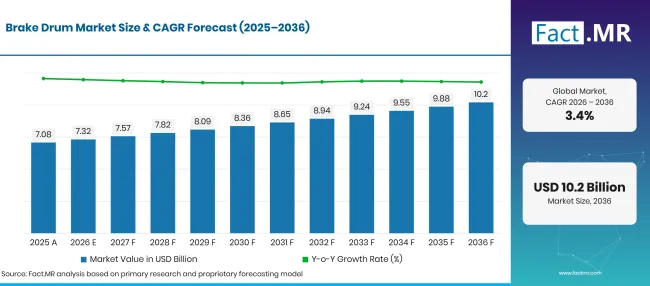
Brake Drum Market Forecast Global 1 | Source: Fact.MR
| Year | Basis | Market Value (USD billion) |
|---|---|---|
| 2025 | Actual | 7.08 |
| 2026 | Estimate | 7.32 |
| 2036 | Forecast | 10.2 |
| CAGR 2026 to 2036 | Forecast period | 3.4% |
Source: Fact.MR analysis. Updated Oct 22, 2026
What are the defining numbers behind Brake Drum Market growth?
USD 2.9 billion absoalute opportunity from 2026 to 2036, with cast iron drums and passenger cars forming the main sales base.
- Demand Drivers in the Market
- Fleet maintenance teams assess drum wall thickness and surface condition whenever brake shoes need attention. Replacement is tied to safe operation and vehicle service intervals, so accurate fit and workshop availability guide orders.
- Passenger-car manufacturers use rear drum layouts on vehicle platforms where space and cost are closely managed. A drum must meet the approved brake specification, including parking-brake operation and service performance.
- Commercial vehicle operators need replacement parts suitable for high loads and repeated stop-and-go use. Workshop downtime raises the cost of a delayed delivery, which gives dependable distribution practical value.
- repair workshops often prioritize accurate brake drum fitment and available replacement stock when choosing among comparable parts.
- Key Segments Analyzed
- By Product Type: Cast Iron Brake Drum is projected to hold 62.4% share in 2026 as it remains a familiar material for conventional drum designs.
- By Vehicle Type: Passenger Cars account for 54.8% share in 2026 given the scale of their vehicle and replacement-parts base.
- By Sales Channel: OEM represents 62.1% share in 2026 because brake hardware is matched to vehicle-platform approvals.
- By Application: Automotive holds 89.2% share in 2026 owing to drums used on road vehicle axles.
- Analyst Opinion at Fact.MR
- Shambhu Nath Jha, Principal Consultant at Fact.MR, states, “Casting accuracy and dependable brake part identification shape purchasing decisions. Vehicle makers need repeatable specifications for each axle program, while repairers focus on quick access to a correctly matched replacement.”
- Strategic Implications
- Foundries can focus on casting dimensions and machining quality so finished drums fit the intended axle assemblies.
- Vehicle manufacturers are expected to assess drum suitability against axle load and parking-brake requirements during vehicle design.
- Replacement-part distributors benefit from clear vehicle-to-part matching that helps workshops avoid incorrect drum orders.
- Fleet managers can use brake wear measurements to decide when a replacement is appropriate and plan workshop visits.
Japan is projected to record 4.3% CAGR, followed by Germany at 3.9% and Brazil at 3.5%. The United Kingdom is forecast at 2.9%, while the United States is estimated at 2.5%. The differences reflect distinct vehicle production bases, repair networks and axle-design choices.
How does the Brake Drum Market break down by segment?
Cast Iron Brake Drum 62.4%; Passenger Cars 54.8%; OEM 62.1%; Automotive 89.2% in 2026.
Which Product Type dominates?
Cast Iron Brake Drum holds 62.4% share in 2026.
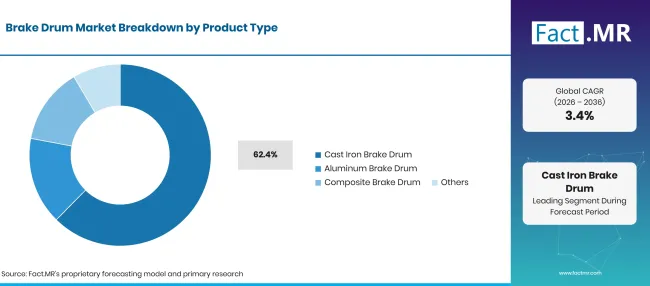
Brake Drum Market Breakdown Product Type | Source: Fact.MR
| Product Type | Share (2026) |
|---|---|
| Cast Iron Brake Drum (Leading segment) | 62.4% |
| Other segments combined | 37.6% |
| Total | 100.0% |
Source: Fact.MR analysis. Updated Oct 22, 2026
Cast iron is likely to remain common in traditional drum designs because foundries can control the required dimensions and braking surface. Accurate machining remains necessary for reliable contact with the brake shoes. Aluminum and composite designs serve more selective technical applications, where weight and material requirements justify a different production approach.
What leads the Vehicle Type segment?
Passenger Cars account for 54.8% share in 2026.
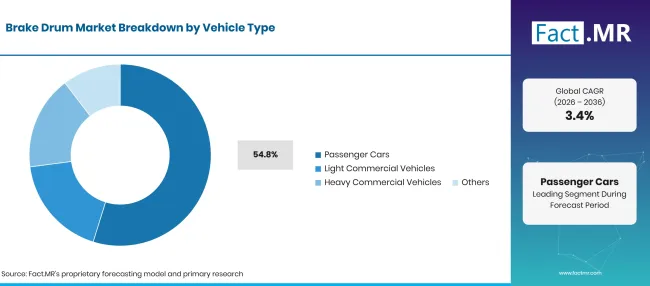
Brake Drum Market Breakdown Vehicle Type | Source: Fact.MR
| Vehicle Type | Share (2026) |
|---|---|
| Passenger Cars (Leading segment) | 54.8% |
| Other segments combined | 45.2% |
| Total | 100.0% |
Source: Fact.MR analysis. Updated Oct 22, 2026
Passenger car brake drum sales arise from original fitments and later replacement of worn components. Rear axle specifications determine which vehicles use drums. Light commercial vehicles require parts aligned with payload and service patterns, while heavy commercial vehicles often place greater emphasis on brake durability and scheduled maintenance.
How do Sales Channels shape purchases?
OEM leads with 62.1% share in 2026.
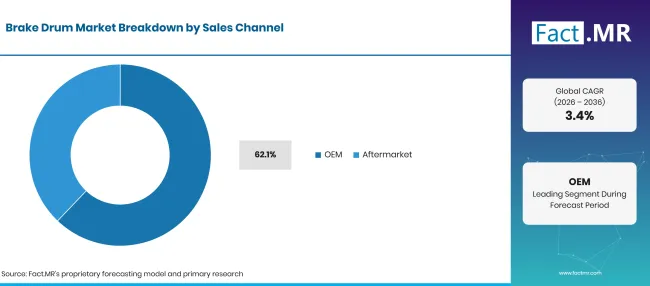
Brake Drum Market Breakdown Sales Channel | Source: Fact.MR
| Sales Channel | Share (2026) |
|---|---|
| OEM (Leading segment) | 62.1% |
| Other segments combined | 37.9% |
| Total | 100.0% |
Source: Fact.MR analysis. Updated Oct 22, 2026
Vehicle manufacturers approve drum specifications along with the rest of the axle brake assembly. Factory programs favor suppliers able to repeat the same casting dimensions across production batches. Aftermarket sales follow wear and repair schedules, so catalog accuracy and accessible workshop stock become more important.
Which Application accounts for the main share?
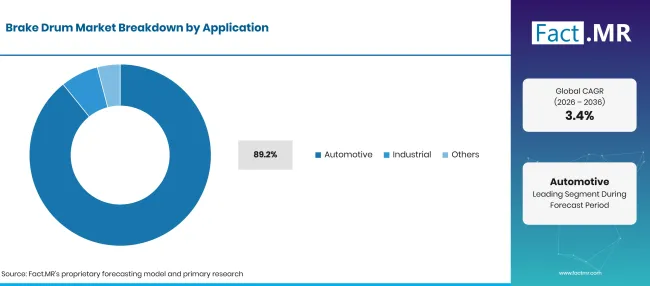
Brake Drum Market Breakdown Application | Source: Fact.MR
| Application | Share (2026) |
|---|---|
| Automotive (Leading segment) | 89.2% |
| Other segments combined | 10.8% |
| Total | 100.0% |
Source: Fact.MR analysis. Updated Oct 22, 2026
Automotive uses account for the main brake drum applications because fitted road-vehicle systems require model-specific parts. Industrial drum braking can serve separate equipment designs, where braking requirements are established by the machinery involved. Component selection depends on the load and operating conditions of each application.
What is accelerating Brake Drum Market adoption, and what is holding it back?
Replacement needs and established axle designs are expected to support brake drum sales. Competing brake discs and rotors affect new fitment decisions, while foundry input costs influence finished-part pricing.
Drivers Impact Analysis
| DRIVER | (~) % IMPACT ON CAGR | GEOGRAPHIC RELEVANCE | IMPACT TIMELINE |
|---|---|---|---|
| Brake service replacements | +1.0% | Global | Medium term (2–4 years) |
| Passenger-car rear axle fitment | +0.8% | Asia, Latin America | Medium term (2–4 years) |
| Commercial fleet maintenance | +0.7% | Global | Short term (<= 2 years) |
| Casting and machining reliability | +0.5% | Global | Medium term (2–4 years) |
| Workshop distribution reach | +0.4% | Global | Long term (>= 4 years) |
Source: Fact.MR analysis. Updated Oct 22, 2026
Opportunity Impact Analysis
| OPPORTUNITY | (~) % IMPACT ON CAGR | GEOGRAPHIC RELEVANCE | IMPACT TIMELINE |
|---|---|---|---|
| Fleet servicing programs | +0.8% | North America, Europe | Medium term (2–4 years) |
| Accurate parts catalogs | +0.6% | Global | Short term (<= 2 years) |
| Regional casting capacity | +0.5% | Latin America, Asia | Long term (>= 4 years) |
| Axle-specific product support | +0.4% | Global | Medium term (2–4 years) |
Source: Fact.MR analysis. Updated Oct 22, 2026
Restraints Impact Analysis
| RESTRAINT | (~) % IMPACT ON CAGR | GEOGRAPHIC RELEVANCE | IMPACT TIMELINE |
|---|---|---|---|
| Disc brake substitution | -0.8% | Global | Long term (>= 4 years) |
| Iron and energy input costs | -0.6% | Global | Short term (<= 2 years) |
| Machining and tolerance failures | -0.5% | Global | Medium term (2–4 years) |
| Uncertain vehicle output | -0.4% | Europe, Americas | Medium term (2–4 years) |
Source: Fact.MR analysis. Updated Oct 22, 2026
Which countries are scaling the Brake Drum Market through 2036?
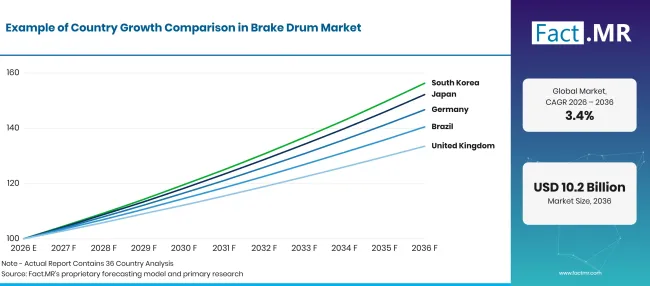
Brake Drum Market Growth Index | Source: Fact.MR
| Country | CAGR (2026–2036) |
|---|---|
| Japan | 4.3% |
| Germany | 3.9% |
| Brazil | 3.5% |
| United Kingdom | 2.9% |
| United States | 2.5% |
Source: Fact.MR analysis. Updated Oct 22, 2026
What supports brake drum purchases in Japan?
4.3% CAGR, linked to regional vehicle output and established maintenance practices.
Japanese vehicle makers assess brake drums against approved axle designs, and repair workshops need replacements that match the original dimensions. The Kyushu Bureau of the Ministry of Economy, Trade and Industry reported 1,241,660 four-wheel vehicles produced in Kyushu during 2025 [8]. This production activity supports the regional market for qualified brake parts, including drums on vehicles fitted with drum assemblies.
Why does Germany sustain brake drum sales?
3.9% CAGR, supported by a broad installed vehicle fleet.
Germany’s brake drum business combines vehicle production requirements with replacement work across a long-established car fleet. Destatis recorded 49.34 million passenger cars registered at the start of 2025 [1]. That fleet creates a broad service base, although replacement purchases depend on the braking systems fitted to individual vehicles. Germany’s Federal Statistical Office reported an 8.9% month-on-month decline in automotive industry production in December 2025, based on seasonally and calendar-adjusted figures [2]. Factory order schedules can therefore change more sharply than workshop requirements.
How is Brazil influencing brake drum production?
3.5% CAGR, shaped by local vehicle assembly and repair activity.
Brazilian brake drum suppliers serve domestic vehicle assembly and repair workshops that maintain cars and commercial fleets. The Brazilian Association of Automotive Vehicle Manufacturers (ANFAVEA) reported domestic motor vehicle production of approximately 2.64 million units in 2025 [3]. Approved axle components are purchased for eligible vehicle models, while service businesses focus on replacement availability and correct part numbers. The Brazilian Institute of Geography and Statistics reported an 8.7% month-on-month decline in motor vehicle and related manufacturing output in December 2025 [4].
What keeps UK brake drum orders moving?
2.9% CAGR, connected to vehicle repair and replacement cycles.
The United Kingdom’s brake drum market has a clear link to older vehicles and the workshop network serving them. The Department for Transport reported 42.3 million licensed vehicles at the end of 2025 in April 2026 [6]. Mechanics working on drum-equipped cars and commercial vehicles need accurately matched parts and dependable delivery. In September 2026, the department reported 682,000 first vehicle registrations during the second quarter of 2026 [7]. New registrations influence future service volumes, while brake designs determine the share suited to drums.
How is the US brake drum aftermarket developing?
2.5% CAGR, supported by a large and varied vehicle service network.
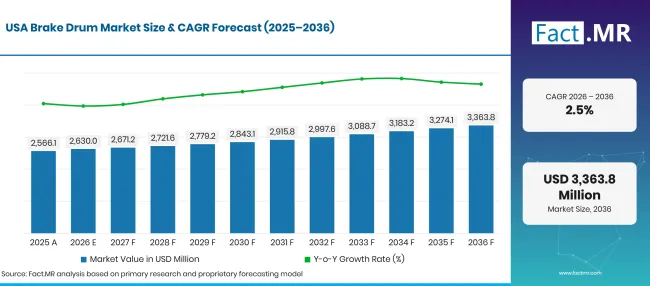
Brake Drum Market Forecast Usa | Source: Fact.MR
In the United States, brake drum sales are closely linked to freight vehicle maintenance and the wide network of independent repair workshops. The Federal Highway Administration recorded 297,525,836 registered motor vehicles across the United States in 2024 in its January 2026 Highway Statistics release [9]. Workshops serving drum-equipped vehicles compare axle specifications and the permitted wear limits before fitting replacements. The Department of Energy publishes 2025 light-duty vehicle registrations by state and fuel type [5], allowing parts businesses to assess the geographic spread of their vehicle customer base.
Who leads the Brake Drum Market?
ZF Friedrichshafen AG participates in commercial braking through systems and service channels. Brembo maintains broader automotive braking portfolios. Their product coverage differs, so a brake-system supplier is not automatically a direct drum manufacturer for every axle and vehicle type. Buyers need to confirm the exact approved product before comparing quotations.
AISIN is established braking system manufacturers. Knorr-Bremse operates in commercial vehicle braking, and Tenneco has aftermarket and friction-related activities. Meritor is now part of Cummins through its acquisition, so its name should be read as a product heritage within the current business. Competition rests on part compatibility and service coverage more than broad corporate size.
Which companies are the key providers?
Key companies include ZF Friedrichshafen AG; Brembo S.p.A.; Tenneco LLC; Cummins Inc. (Meritor); AISIN Corporation; and Knorr-Bremse AG.
- ZF Friedrichshafen AG
- Brembo S.p.A.
- Tenneco LLC
- Cummins Inc. (Meritor)
- AISIN Corporation
- Knorr-Bremse AG
Bibliography
- [1] Statistisches Bundesamt (Destatis). (2026, March 23). Bestand an Kraftfahrzeugen und Schienenfahrzeugen für die Jahre 2021 bis 2025 [Stock of motor vehicles and rail vehicles, 2021 to 2025].
- [2] Statistisches Bundesamt (Destatis). (2026, February 6). Production in December 2025: -1.9% on the previous month.
- [3] Associação Nacional dos Fabricantes de Veículos Automotores. (2026, January 15). Produção e venda de autoveículos crescem em 2025 e Anfavea projeta nova alta em 2026.
- [4] Instituto Brasileiro de Geografia e Estatística. (2026, February 3). Produção industrial recua 1,2% em dezembro.
- [5] U.S. Department of Energy. (n.d.). Vehicle registration counts by state. Alternative Fuels Data Center.
- [6] Department for Transport. (2026, April 29). Vehicle licensing statistics, United Kingdom: 2025.
- [7] Department for Transport. (2026, September 23). Vehicle licensing statistics: April to June 2026.
- [8] Kyushu Bureau of Economy, Trade and Industry. (2026, February 20). 四輪自動車・ICメモ(2025年) [Four-wheel automobiles and IC memo (2025)].
- [9] Federal Highway Administration. (2026, January). State motor-vehicle registrations, 2024 (Table MV-1). U.S. Department of Transportation.
This Report Answers
- Vehicle analysis explains the role of passenger cars and working fleets in factory and replacement sales.
- The country outlook compares Japan, Germany, Brazil, the United Kingdom and the United States.
- Competitive analysis distinguishes complete brake-system suppliers from replacement-parts brands.
- Sales-channel analysis examines why factory-fit programs and workshop orders follow different purchasing processes.
What does the Brake Drum Market cover?
The market covers cast iron, aluminum, composite and other brake drums installed in suitable braking assemblies. Finished drums are separate from pads and shoes, though automotive parts aftermarket businesses often distribute these products together.
What is included in the scope?
What is excluded from the scope?
Brake pads, brake shoes, calipers and hydraulic controllers are outside the product boundary when sold on their own. Disc rotors are separate components, even though both discs and drums provide a friction surface for vehicle braking. The report does not count complete vehicle sales as brake drum revenue.
How Was the Analysis Built?
The analysis draws on 120+ sources, 35+ company portfolios, 25+ countries, and more than 20 industry interviews.
- Primary Research: Primary research includes discussions with manufacturers, service providers, technology developers, distributors, end users, and subject-matter experts. These conversations examine purchasing priorities, product adoption, operational challenges, approval requirements, competitive positioning, and the factors that influence wider market acceptance.
- Desk Research: Desk research covers government statistics, regulatory publications, company filings, trade data, technical studies, industry associations, standards, public policy, and other authoritative sources. Every source used in the analysis is documented in the bibliography.
- Market Sizing and Forecasting: Market estimates combine historical performance, demand indicators, pricing and volume trends, segment shares, company participation, country-level growth, adoption patterns, investment activity, and barriers to market expansion.
- Data Validation and Update Cycle: Findings are validated by comparing primary interviews with public data, company activity, regulatory changes, trade patterns, and industry developments. Regular updates review new product launches, capacity changes, partnerships, approvals, and shifts in commercial adoption.
Segmentation
What is the report’s scope and coverage?
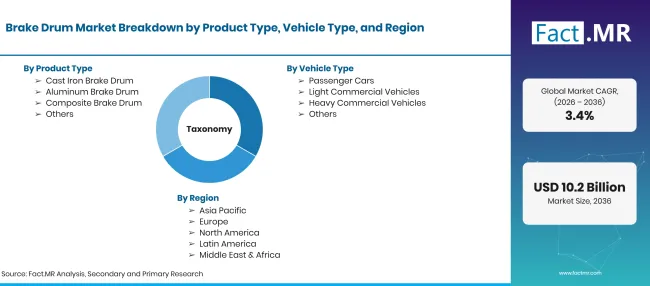
Brake Drum Market Taxonomy | Source: Fact.MR
| Attribute | Details |
|---|---|
| Quantitative Units | USD billion in 2026 to USD billion in 2036, at CAGR |
| Market Definition | Replacement and factory-fit brake drums used in wheel-end friction braking assemblies. |
| Product Type | Cast Iron Brake Drum; Aluminum Brake Drum; Composite Brake Drum; Others |
| Vehicle Type | Passenger Cars; Light Commercial Vehicles; Heavy Commercial Vehicles; Others |
| Sales Channel | OEM; Aftermarket |
| Application | Automotive; Industrial; Others |
| Regions Covered | North America; Latin America; Western Europe; Eastern Europe; East Asia; South Asia & Pacific; Middle East & Africa |
| Countries Covered | Germany; Brazil; United States; United Kingdom; Japan |
| Companies Profiled | ZF Friedrichshafen AG; Brembo S.p.A.; Tenneco LLC; Cummins Inc. (Meritor); AISIN Corporation; and Knorr-Bremse AG |
| Forecast Period | 2026 to 2036 |
| Approach | Vehicle fitment, replacement servicing, product material and supplier review |
Source: Fact.MR analysis. Updated Oct 22, 2026
How is the market segmented?
-
By Product Type
- Cast Iron Brake Drum
- Aluminum Brake Drum
- Composite Brake Drum
- Others
-
By Vehicle Type
- Passenger Cars
- Light Commercial Vehicles
- Heavy Commercial Vehicles
- Others
-
By Sales Channel
- OEM
- Aftermarket
-
By Application
- Automotive
- Industrial
- Others
-
By Region
- North America
- Latin America
- Western Europe
- Eastern Europe
- East Asia
- South Asia & Pacific
- Middle East & Africa
Frequently Asked Questions
How big is the brake drum market in 2026?
What is the CAGR from 2026 to 2036?
Which brake drum product type leads?
Which vehicle type accounts for the main share?
Who are the main companies in the brake drum market?
Who worked on this report


Preview the report firsthand - request a free sample
Free SampleGet the brochure for pricing and purchase details
Download PDF