- Market Value (2025): USD 38.7 Bn
- Estimated Value (2026): USD 40.7 Bn
- Forecast Value (2036): USD 67.8 Bn
- CAGR (2026-2036): 5.2%
What is the Brake Friction Parts Market forecast to be worth by 2036?
USD 40.7 billion in 2026 to USD 67.8 billion by 2036 at a 5.2% CAGR.
- Brake friction parts revenue reached USD 38.7 billion in 2025 on Fact.MR’s count, with replacement pads for passenger cars forming the base.
- By 2036, sales will move from USD 40.7 billion in 2026 to USD 67.8 billion as the global vehicle fleet grows older and heavier.
- A 5.2% CAGR will hold over 2026 to 2036, since every new vehicle adds years of pad and shoe replacement demand.
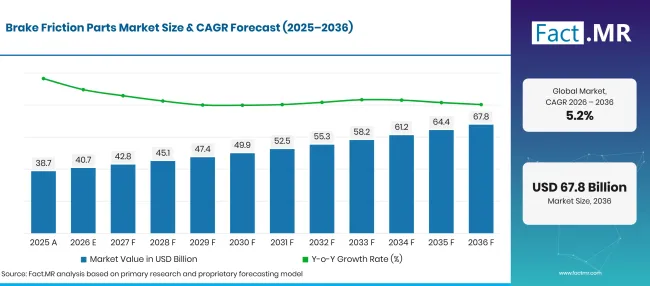
Factmr Brake Friction Parts Market Forecast Global | Source: Fact.MR
| Year | Basis | Market Value (USD billion) |
|---|---|---|
| 2025 | Actual | 38.7 |
| 2026 | Estimate | 40.7 |
| 2036 | Forecast | 67.8 |
| CAGR 2026 to 2036 | Forecast period | 5.2% |
Source: Fact.MR analysis. Updated Oct 17, 2026
What are the defining numbers behind Brake Friction Parts Market growth?
USD 27.1 billion in new value will build up from 2026 to 2036, led by replacement pads for cars.
- Demand Drivers in the Market
- Brake pad replacement demand grows with the car parc. Eurostat data show the EU car fleet passed 260 million in 2025, a 6.5% rise on 2020 [1]. Each of these cars needs new front pads every few years of normal driving.
- Brake particle limits are turning friction chemistry into a regulated feature. In June 2026, the European Commission adopted Delegated Regulation (EU) 2026/1214, which requires Euro 7 brake particle tests on cars and vans to follow UN Regulation No 179 [2]. Pad makers now design compounds against measured PM10 output as well as stopping power.
- Brake loads on SUVs and electric cars keep rising. Battery packs, larger SUVs and pickup trucks put more energy through pads and shoes at every stop. Friction suppliers answer with thicker backing plates and compounds that resist fade at higher temperatures.
- Truck brake lining demand follows freight traffic. Trucks and buses run long daily distances under heavy loads, and fleet operators reline drum brakes on fixed service intervals. That routine gives friction makers a predictable order book.
- Copper reduction rules have reset product ranges in North America. Suppliers reformulated pads to remove copper, and the new compounds often carry higher value per set than the grades they replaced.
- Key Segments Analyzed
- By Product Type: Disc Brake Pads will hold 47.3% share in 2026, as front disc brakes are standard on nearly all new cars and wear out faster than rear drums.
- By Material: Semi-Metallic will account for 36.7% share in 2026, given its heat tolerance on heavy SUVs, light trucks and commercial fleets.
- By Vehicle Type: Passenger Cars will capture 54.6% share in 2026 on the strength of a car parc that far outnumbers vans and trucks.
- By Sales Channel: Aftermarket will command 54.2% share in 2026, since a car goes through several pad sets during its life but leaves the factory with only one.
- Analyst Opinion at Fact.MR
- Shambhu Nath Jha, Principal Consultant at Fact.MR, states, “Friction parts earn their revenue after the vehicle is sold, so fleet age and annual mileage tell you more about this market than new car output. Euro 7 brings brake dust into type approval for the first time, and that will favor suppliers who can prove low-emission compounds on a test bench. Commercial vehicle linings will stay a quieter but reliable source of volume through 2036.”
- Strategic Implications
- Friction material producers should build particle emission testing into compound development now, given that Euro 7 type approval includes brake particle limits for new cars and vans.
- Aftermarket distributors should widen ceramic and low-metallic ranges for European and Japanese models, since owners of these cars ask for low dust and low noise.
- Vehicle makers should qualify pads for electric models with corrosion and noise in mind, because regenerative braking leaves friction surfaces idle for long periods.
- Fleet operators should track lining wear by route and load, given that drum brake relines on trucks and buses form a large share of maintenance spend.
Germany leads the five at 6.7% CAGR, where a dense car fleet and Autobahn driving wear pads quickly. Brazil follows at 6.1% on the strength of an old truck fleet and heavy road freight. A 5.5% pace in the United States rests on large SUVs and pickup trucks. The United Kingdom will grow at 4.9% as car traffic climbs and MOT tests catch worn brakes. At 4.4%, Japan completes the list with a fleet that has many small kei cars.
How does the Brake Friction Parts Market break down by segment?
Disc Brake Pads will lead Product Type at 47.3%; Semi-Metallic will top Material at 36.7%; Passenger Cars will head Vehicle Type at 54.6%; Aftermarket will hold first place in Sales Channel at 54.2%.
Which Product Type dominates?
Disc Brake Pads take 47.3% of 2026 sales.
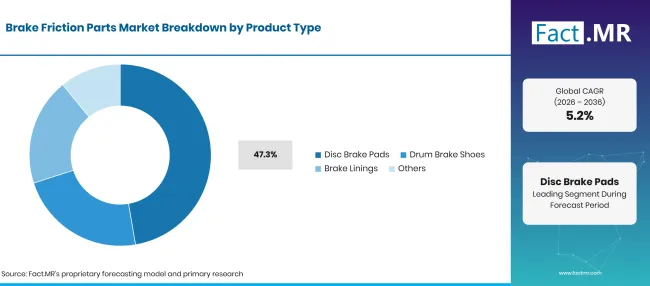
Factmr Brake Friction Parts Market Breakdown Product Type | Source: Fact.MR
| Product Type | Share (2026) |
|---|---|
| Disc Brake Pads (Leading segment) | 47.3% |
| Other segments combined | 52.7%* |
| Total | 100.0% |
Source: Fact.MR analysis. Updated Oct 17, 2026
Front brake pads carry most of the stopping load on a car, so they wear out first and come back for replacement most often. Workshops usually replace pads in axle sets, often together with brake discs and rotors once rotor thickness falls below its limit. Drum brake shoes remain common on the rear axle of small cars and on many trucks, trailers and buses. Brake linings are riveted or bonded to shoes in commercial fleets and are often sold in bulk to reline shops.
What leads the Material segment?
Semi-Metallic makes up 36.7% of 2026 sales.
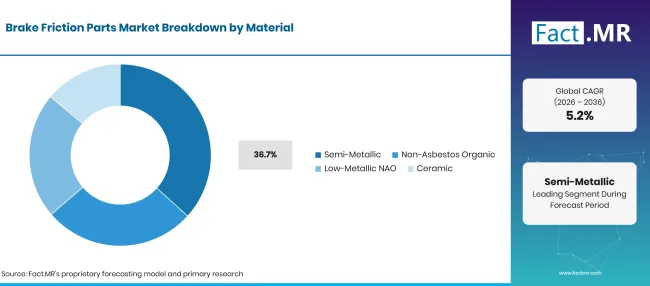
Factmr Brake Friction Parts Market Breakdown Material | Source: Fact.MR
| Material | Share (2026) |
|---|---|
| Semi-Metallic (Leading segment) | 36.7% |
| Other segments combined | 63.3%* |
| Total | 100.0% |
Source: Fact.MR analysis. Updated Oct 17, 2026
Pickup trucks, delivery vans and police cars generate heat that softer compounds struggle to absorb. Steel fiber in semi-metallic pads carries heat away from the rotor and keeps friction stable under repeated hard stops. Binders such as phenolic resins hold the fibers, fillers and abrasives together. Ceramic and non-asbestos organic pads gained ground as copper limits arrived. The U.S. Environmental Protection Agency states that signatories to its Copper-Free Brake Initiative agreed to cut copper in brake pads to 0.5% by weight by 2025 [3]. Organic formulas now rely on fibers such as para-aramid to keep strength without copper. Low-metallic NAO grades suit European cars that brake hard from high speed.
How does Vehicle Type shape demand?
Passenger Cars represent 54.6% of 2026 sales.
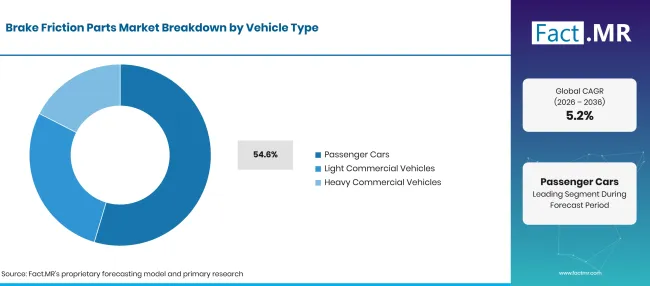
Factmr Brake Friction Parts Market Breakdown Vehicle Type | Source: Fact.MR
| Vehicle Type | Share (2026) |
|---|---|
| Passenger Cars (Leading segment) | 54.6% |
| Other segments combined | 45.4%* |
| Total | 100.0% |
Source: Fact.MR analysis. Updated Oct 17, 2026
Private car owners cover most of the miles driven on public roads and replace front pads at regular intervals. Model variety is wide, so suppliers carry thousands of pad shapes for each region. EV brake pads face a different wear profile, but they are still needed on every axle. The International Energy Agency said that close to 30% of cars sold worldwide in 2026 are set to be electric [4]. Regenerative braking reduces pad wear, yet pads on these heavier models must resist rust and stay quiet. Light and heavy commercial vehicles use more drum brakes and thicker linings per axle.
What supports Aftermarket within Sales Channel?
Aftermarket buyers account for 54.2% of 2026 sales.
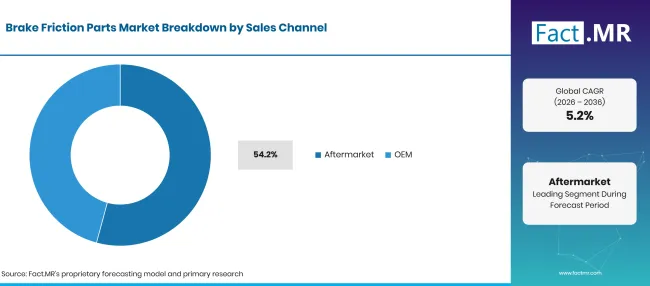
Factmr Brake Friction Parts Market Breakdown Sales Channel | Source: Fact.MR
| Sales Channel | Share (2026) |
|---|---|
| Aftermarket (Leading segment) | 54.2% |
| Other segments combined | 45.8%* |
| Total | 100.0% |
Source: Fact.MR analysis. Updated Oct 17, 2026
Independent workshops, dealer service centers and parts retailers buy friction parts each time a car or truck comes in for brake work. Roadworthiness checks keep this flow steady. In Great Britain, brake defects led to initial MOT failures in 6.10% of tests on cars, light vans and other class 3 and 4 vehicles in 2025 to 2026, or 15.18% of all failure defects [5]. OEM brake pads and shoes are fitted on the assembly line and also sold through dealer parts networks. Commercial fleets often buy linings through a heavy-duty aftermarket network that stocks truck and trailer parts.
What is accelerating Brake Friction Parts Market adoption, and what is holding it back?
Rising vehicle numbers, longer annual mileage and new brake particle rules will push friction part sales higher. Regenerative braking in electric cars, low-cost imports and swings in steel and resin prices will slow the pace.
Drivers Impact Analysis
| DRIVER | (~) % IMPACT ON CAGR | GEOGRAPHIC RELEVANCE | IMPACT TIMELINE |
|---|---|---|---|
| Replacement demand from a larger and older passenger car parc | +1.4% | Western Europe, North America, Latin America | Short term (<= 2 years) |
| Euro 7 brake particle limits and low-emission pad compounds | +1.2% | Western Europe, Eastern Europe | Medium term (2-4 years) |
| Heavier SUVs, pickups and battery electric models raising brake loads | +1.0% | North America, East Asia, Western Europe | Medium term (2-4 years) |
| Truck and bus relining cycles in road freight fleets | +0.8% | Latin America, South Asia & Pacific | Short term (<= 2 years) |
| Copper-free formulations replacing older pad grades | +0.5% | North America | Long term (>= 4 years) |
Source: Fact.MR analysis. Updated Oct 17, 2026
Opportunity Impact Analysis
| OPPORTUNITY | (~) % IMPACT ON CAGR | GEOGRAPHIC RELEVANCE | IMPACT TIMELINE |
|---|---|---|---|
| Coated discs sold with matched low-dust pad kits | +0.9% | Western Europe, North America | Medium term (2-4 years) |
| Low-noise, corrosion-resistant pads for electric vehicles | +0.7% | East Asia, Western Europe | Long term (>= 4 years) |
| Copper-free commercial vehicle disc pads | +0.5% | Western Europe, Latin America | Medium term (2-4 years) |
Source: Fact.MR analysis. Updated Oct 17, 2026
Restraints Impact Analysis
| RESTRAINT | (~) % IMPACT ON CAGR | GEOGRAPHIC RELEVANCE | IMPACT TIMELINE |
|---|---|---|---|
| Regenerative braking that lengthens pad replacement intervals | -0.7% | East Asia, Western Europe | Long term (>= 4 years) |
| Low-cost imported pads that compress aftermarket prices | -0.5% | Latin America, North America | Short term (<= 2 years) |
| Steel fiber, resin and graphite cost swings | -0.4% | Global | Short term (<= 2 years) |
Source: Fact.MR analysis. Updated Oct 17, 2026
Which countries are scaling the Brake Friction Parts Market through 2036?
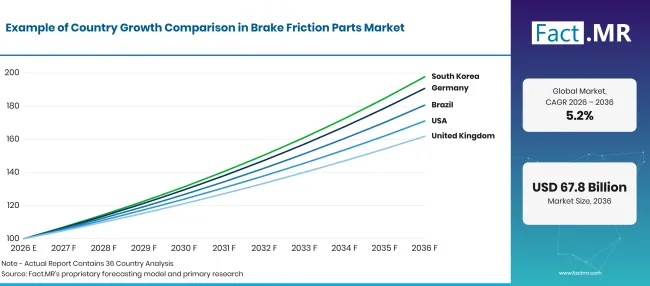
Factmr Brake Friction Parts Market Growth Index | Source: Fact.MR
| Country | CAGR (2026–2036) |
|---|---|
| Germany | 6.7% |
| Brazil | 6.1% |
| United States | 5.5% |
| United Kingdom | 4.9% |
| Japan | 4.4% |
Source: Fact.MR analysis. Updated Oct 17, 2026
What supports Germany’s adoption?
6.7% CAGR, driven by a dense car fleet and strict attention to brake dust.
Brake pad demand in Germany draws on one of Europe’s densest car fleets. Destatis reported 593 passenger cars per 1,000 inhabitants at the start of 2026, with about 49.5 million cars registered [6]. The Federal Environment Agency found that over 85% of road traffic PM10 now comes from tire, brake and road surface wear, up from just under 28% in 1995 [7]. That shift keeps low-dust pads high on the agenda for German buyers.
How is Brazil scaling demand?
6.1% CAGR, backed by an aging truck fleet and heavy reliance on road freight.
Brake lining sales in Brazil lean on trucks, the backbone of the country’s freight system. The national land transport agency ANTT counted 2,846,202 vehicles linked to registered road freight carriers through December 2025 [8]. Traction vehicles in that fleet averaged 16.8 years of age [8]. Older trucks with drum brakes need regular relining, and local producers supply both shoes and linings.
What supports United States adoption?
5.5% CAGR, on the back of heavy pickups and SUVs that load brakes harder.
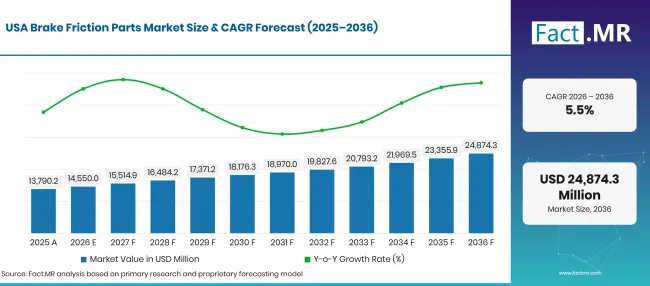
Factmr Brake Friction Parts Market Forecast Usa | Source: Fact.MR
Brake pads for pickups and SUVs set the tone for American demand. The EPA reported that truck SUVs accounted for half of all new vehicle production in model year 2024 [9]. The same report found that 66% of new vehicles were classed as trucks under federal definitions [9]. Ceramic pads are popular with daily drivers, while semi-metallic grades serve towing and work trucks.
How is the United Kingdom developing demand?
4.9% CAGR, helped by rising car traffic and annual MOT brake checks.
Car brake replacement in the United Kingdom rises with mileage. The Department for Transport reported that car traffic in Great Britain reached 262.4 billion vehicle miles in 2025, 2.5% higher than in 2024 [10]. In Great Britain, annual MOT tests for cars over three years old send worn pads and shoes back to workshops. Compact European models keep low-metallic and ceramic grades in demand.
How does Japan perform?
4.4% CAGR, reflecting a large but slow-growing fleet with many kei cars.
Japan’s brake pad market serves a fleet with many small cars. The transport ministry MLIT counted 83,158,429 vehicles at the end of July 2026 [11]. That total included 23,739,105 light kei passenger cars [11]. Japanese vehicle makers commonly fit NAO pads for low noise and low dust. Shaken inspections keep replacement steady even as annual mileage stays modest.
Who leads the Brake Friction Parts Market?
Brake friction suppliers come at the market from three directions.
System suppliers such as ZF Friedrichshafen, Robert Bosch and AUMOVIO sell pads to workshops under the TRW, Bosch and ATE brands. They also supply braking systems to vehicle makers. In September 2026, ZF presented TRW DTEC pads and discs that cut PM10 emissions by up to 80% against conventional pad and disc pairs in WLTP bench tests [12]. Bosch added disc brake pads for trucks, trailers and buses in August 2026 [13]. Friction specialists form the second group. Brembo launched its Greenance Plus Kit, a coated disc with matched pads aimed at Euro 7 brake emission rules, in September 2026 [14]. Tenneco extended its Ferodo Premier copper-free pads for commercial vehicles in February 2026 [15]. Akebono, Nisshinbo and ITT supply pads as original equipment to vehicle makers. Frasle Mobility anchors the third group from Brazil with pads and linings for cars and trucks. Proven low-emission compounds and broad part coverage will separate the leaders.
Which companies are the key providers?
Key companies include Brembo N.V.; Akebono Brake Industry Co., Ltd.; Robert Bosch GmbH; AUMOVIO SE; ZF Friedrichshafen AG; Nisshinbo Holdings Inc.; Tenneco Inc.; ITT Inc.; and Frasle Mobility.
- Brembo N.V.
- Akebono Brake Industry Co., Ltd.
- Robert Bosch GmbH
- AUMOVIO SE
- ZF Friedrichshafen AG
- Nisshinbo Holdings Inc.
- Tenneco Inc.
- ITT Inc.
- Frasle Mobility
Bibliography
- [1] Eurostat. (2026, July 31). Passenger cars in the EU.
- [2] European Commission. (2026, June 9). Commission Delegated Regulation (EU) 2026/1214 of 9 June 2026 amending Regulation (EU) 2024/1257 of the European Parliament and of the Council as regards conditions for testing compliance with brake particle emission limits.
- [3] U.S. Environmental Protection Agency. (2026, July 24). Copper-Free Brake Initiative.
- [4] International Energy Agency. (2026, May 20). Close to 30% of cars sold this year are set to be electric as countries and consumers respond to energy crisis.
- [5] Driver and Vehicle Standards Agency. (2026, September 10). MOT class 3 and 4 vehicles: initial failures by defect category.
- [6] Statistisches Bundesamt (Destatis). (2026, July 22). Pkw-Dichte 2026 erneut gestiegen [Car density rose again in 2026].
- [7] Umweltbundesamt. (2026, June 25). Emission von Feinstaub der Partikelgröße PM10 [Emission of PM10 particulate matter].
- [8] Agência Nacional de Transportes Terrestres (ANTT). (2026). Anuário TRC 2025 [Road freight transport yearbook 2025].
- [9] U.S. Environmental Protection Agency. (2026, February 19). Highlights of the Automotive Trends Report.
- [10] Department for Transport. (2026, May 20). Road traffic estimates in Great Britain: 2025.
- [11] Ministry of Land, Infrastructure, Transport and Tourism, Japan. (2026, August). 自動車保有車両数 [Number of motor vehicles owned].
- [12] ZF Friedrichshafen AG. (2026, September 8). ZF Introduces Braking Solutions Supporting Euro 7 Readiness in the Independent Aftermarket.
- [13] Robert Bosch GmbH. (2026, August 11). Safety and Availability in Everyday Transport: Bosch Expands Brake Program for Commercial Vehicles.
- [14] Brembo N.V. (2026, September 8). Brembo Broadens Its Beyond Range with Greenance Plus Kit.
[15] Tenneco Inc. (2026, February 12). DRiV Expands Ferodo Premier Copper-Free Brake Pads for Commercial Vehicles
This Report Answers
- Brake friction parts revenue is sized for 2026 and 2036 and split by product type, material, vehicle type and sales channel.
- Each segment section names its leader and the wear, heat or service pattern behind that position.
- Fleet age, traffic volumes and inspection rules are used to compare growth in the five profiled countries.
- Supplier profiles show which pad, shoe and lining makers sell to vehicle makers, workshops or both.
- Euro 7 brake particle tests and copper limits are traced to the friction materials they favor.
What does the Brake Friction Parts Market cover?
Pads for disc brakes, shoes for drum brakes and loose brake linings for road vehicles make up the Brake Friction Parts Market. These parts are counted in semi-metallic, non-asbestos organic, low-metallic NAO and ceramic grades.
Revenue is tracked for passenger cars, light commercial vehicles and heavy commercial vehicles. Sales to vehicle makers and to the replacement trade are measured at the value paid by the first buyer.
What is included in the scope?
Complete pad sets with backing plates, shims and wear sensors sold as one unit are valued as one set. Bonded and riveted shoes are included, and so are linings sold in rolls or blocks for relining.
Pads sold in kits with brake dust reduction shields or coated discs are counted only for the friction element. Parking brake shoes and pads for electric park brakes are also in scope.
What is excluded from the scope?
Discs, drums and brake calipers fall outside the friction parts boundary, as do brake fluid and hydraulic lines. Railway, aircraft and wind turbine brake pads are excluded.
Clutch facings and industrial friction products are not counted. Workshop fitting labor is also excluded.
How Was the Analysis Built?
The analysis draws on 120+ sources, 35+ company portfolios, 25+ countries, and more than 20 industry interviews.
- Primary Research: Primary research includes discussions with manufacturers, service providers, technology developers, distributors, end users, and subject-matter experts. These conversations examine purchasing priorities, product adoption, operational challenges, approval requirements, competitive positioning, and the factors that influence wider market acceptance.
- Desk Research: Desk research covers government statistics, regulatory publications, company filings, trade data, technical studies, industry associations, standards, public policy, and other authoritative sources. Every source used in the analysis is documented in the bibliography.
- Market Sizing and Forecasting: Market estimates combine historical performance, demand indicators, pricing and volume trends, segment shares, company participation, country-level growth, adoption patterns, investment activity, and barriers to market expansion.
- Data Validation and Update Cycle: Findings are validated by comparing primary interviews with public data, company activity, regulatory changes, trade patterns, and industry developments. Regular updates review new product launches, capacity changes, partnerships, approvals, and shifts in commercial adoption.
Segmentation
What is the report’s scope and coverage?
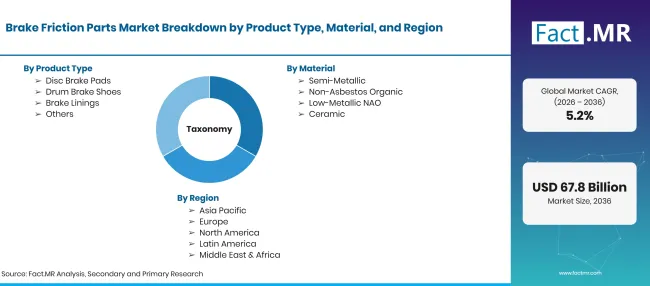
Factmr Brake Friction Parts Market Taxonomy | Source: Fact.MR
| Attribute | Details |
|---|---|
| Quantitative Units | USD billion in 2026 to USD billion by 2036 at CAGR |
| Market Definition | Friction components that slow or stop road vehicles by pressing against a disc or drum, including disc brake pads, drum brake shoes and brake linings. The scope covers parts sold to vehicle makers and to the replacement market. |
| Product Type | Disc Brake Pads; Drum Brake Shoes; Brake Linings; Others |
| Material | Semi-Metallic; Non-Asbestos Organic; Low-Metallic NAO; Ceramic |
| Vehicle Type | Passenger Cars; Light Commercial Vehicles; Heavy Commercial Vehicles |
| Sales Channel | Aftermarket; OEM |
| Regions Covered | North America; Latin America; Western Europe; Eastern Europe; East Asia; South Asia & Pacific; Middle East & Africa |
| Countries Covered | Germany; Brazil; United States; United Kingdom; Japan |
| Companies Profiled | Brembo N.V.; Akebono Brake Industry Co., Ltd.; Robert Bosch GmbH; AUMOVIO SE; ZF Friedrichshafen AG; Nisshinbo Holdings Inc.; Tenneco Inc.; ITT Inc.; Frasle Mobility |
| Forecast Period | 2026 to 2036 |
| Approach | Hybrid top-down and bottom-up approach using vehicle parc and annual mileage by country; pad and shoe replacement intervals; OEM fitment per vehicle; material mix by region; and supplier portfolio review. |
Source: Fact.MR analysis. Updated Oct 17, 2026
How is the market segmented?
-
By Product Type
- Disc Brake Pads
- Drum Brake Shoes
- Brake Linings
- Others
-
By Material
- Semi-Metallic
- Non-Asbestos Organic
- Low-Metallic NAO
- Ceramic
-
By Vehicle Type
- Passenger Cars
- Light Commercial Vehicles
- Heavy Commercial Vehicles
-
By Sales Channel
- Aftermarket
- OEM
-
By Region
- North America
- Latin America
- Western Europe
- Eastern Europe
- East Asia
- South Asia & Pacific
- Middle East & Africa
Frequently Asked Questions
How big is the brake friction parts market in 2026?
What is the CAGR of the brake friction parts market from 2026 to 2036?
Which product type leads the brake friction parts market?
Which material leads the brake friction parts market?
Which vehicle type leads the brake friction parts market?
Which sales channel leads the brake friction parts market?
Which country will grow the most in the brake friction parts market?
Who are the main companies in the brake friction parts market?
Who worked on this report


Preview the report firsthand - request a free sample
Free SampleGet the brochure for pricing and purchase details
Download PDF