- Market Value (2025): USD 873.4 Mn
- Estimated Value (2026): USD 906.6 Mn
- Forecast Value (2036): USD 1312.6 Mn
- CAGR (2026-2036): 3.8%
Brass Gate Valves Market Forecast and Outlook 2026 to 2036
The global brass gate valves market crossed a valuation of USD 873.4 million in 2025. The market is set to reach USD 906.6 million in 2026, with revenue projected to climb to USD 1,312.6 million by 2036. This outlook reflects a CAGR of 3.8% over the forecast period.
Brass gate valve purchasing is shaped by the point of installation and the service work planned around it. Maintenance teams usually begin by checking the existing pipe connection and working pressure. They then compare valve travel with the space available around the fitting. In larger facilities, stores teams also check whether the same model is held for routine replacement. Suppliers that provide clear drawings and consistent stock are better placed to serve these repeat orders. For new buildings, valve selection is linked to the installation schedule and the plumbing design.
Market Summary for the Brass Gate Valves Market
- Brass Gate Valves Market Value (2025): USD 873.4 million
- Brass Gate Valves Market Value (2026): USD 906.6 million
- Brass Gate Valves Market Forecast Value (2036): USD 1,312.6 million
- Brass Gate Valves Market Forecast CAGR (2026–2036): 3.8%
- Leading Product Type: Rising Stem (58.2%)
- Key Market Participants: Watts Water Technologies, KITZ Corporation, NIBCO Inc., Legend Valve & Fitting, Inc., Matco-Norca, Inc., Apollo Valves / Conbraco Industries, Jomar Valve, Milwaukee Valve Company, A.Y. McDonald Mfg. Co., B&K PRODUCTS / MUELLER STREAMLINE.
- Countries Covered: Germany, Brazil, USA, UK and Japan
Brass Gate Valves Market
| Metric | Value |
|---|---|
| Estimated Value in (2026) | USD 906.6 million |
| Forecast Value in (2036) | USD 1,312.6 million |
| Forecast CAGR (2026 to 2036) | 3.8% |
Source: Fact.MR analysis. Updated Nov 17, 2026
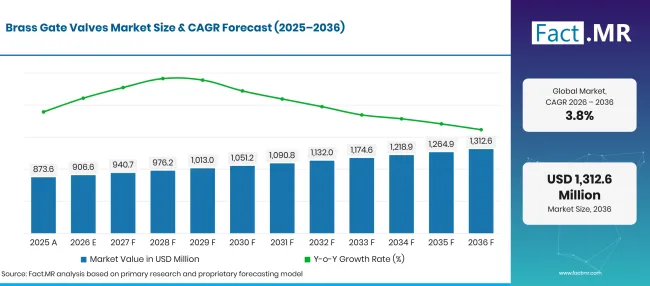
Brass Gate Valves Market Forecast Global | Source: Fact.MR
Category
| Category | Segments |
|---|---|
| Product Type | Rising Stem, Non-Rising Stem |
| Application | Industrial, Residential, Commercial |
| End-User | Water Supply Systems, Oil and Gas, Chemical Industry, Power Generation, Others |
| Distribution Channel | Offline, Online |
| Region | Germany, Brazil, USA, UK, Japan |
Source: Fact.MR analysis. Updated Nov 17, 2026
Segmental Analysis
How do rising-stem designs shape product-type revenue in the Brass Gate Valves Market?
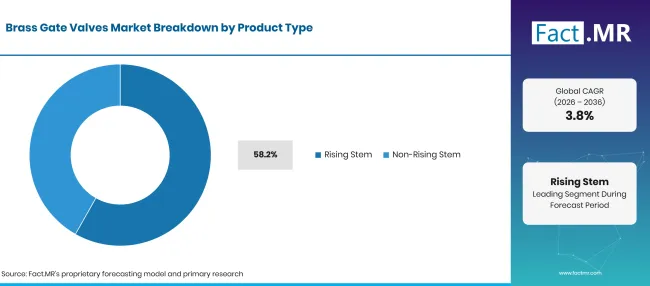
Brass Gate Valves Market Breakdown Product Type | Source: Fact.MR
Rising-stem designs are projected to account for 58.2% of share in 2026. Their visible stem movement helps maintenance teams check whether the valve is open or closed without relying only on handwheel position. This operating benefit is useful where technicians have room above the body and need a clear position check during planned isolation. Non-rising-stem alternatives suit tighter spaces where external stem travel creates an installation problem. The choice depends on the pipeline layout and maintenance procedures.
Why does industrial use account for the highest application revenue?
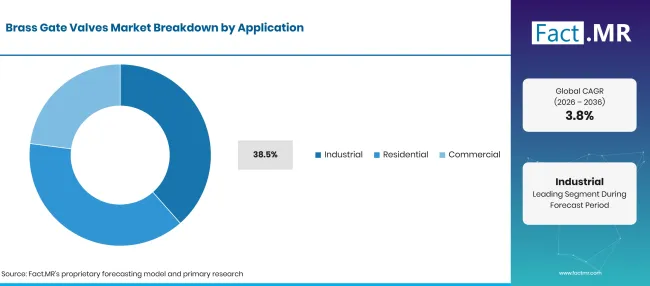
Brass Gate Valves Market Breakdown Application | Source: Fact.MR
Industrial applications are projected to account for 38.5% of brass gate valve revenue in 2026. Facility maintenance teams need shutoff points on utility lines that carry suitable fluids at acceptable pressures and temperatures. A replacement valve must match the existing pipe connection as well as the planned operating duty. Residential projects usually involve smaller quantities per installation but draw on a broad network of plumbing distributors. Commercial buildings can require frequent service access around equipment rooms and plumbing risers. Brass does not suit every industrial process, so specifications determine where this material is actually selected. Material specifications can favor forged steel valves where service pressure or fluid exposure requires a different body material.
What supports water supply systems within the end-user mix?
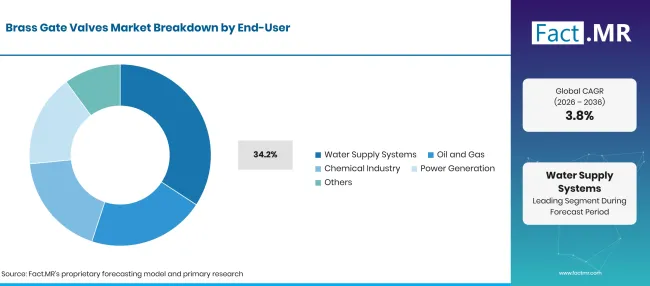
Brass Gate Valves Market Breakdown End User | Source: Fact.MR
Water supply systems are projected to represent 34.2% of end-user share in 2026. Maintenance crews need isolation points to limit service disruption when smaller branches or building connections are repaired. Drinking-water suitability and connection dimensions affect supplier selection. Large municipal mains often require other valve materials, so water-infrastructure investment should not be treated as direct evidence of brass use across every pipe size. In 2025, Brazil’s Ministry of Cities published the SINISA water-supply results covering 5,144 participating municipalities. The scale of network management helps explain continuing valve replacement opportunities at compatible connections. Water pipeline leak detection systems can help utilities identify repair priorities.
Why do offline channels account for most brass gate valve orders?
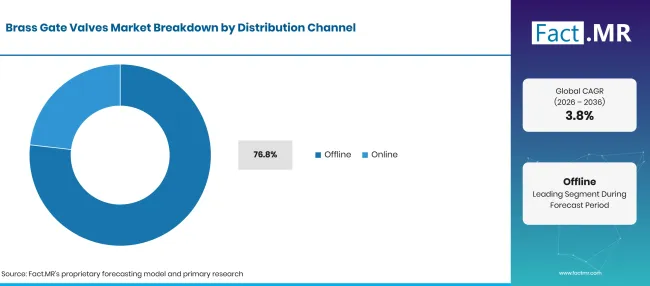
Brass Gate Valves Market Breakdown Distribution Channel | Source: Fact.MR
Offline channels are projected to capture 76.8% of brass gate valve sales in 2026. Plumbers and maintenance teams often need to compare connection threads and dimensions with the removed part before buying a replacement. Distributor stock also limits downtime when a repair cannot be postponed. Engineering buyers may request material and approval documents from the local branch before an order is placed. Online purchasing is useful for familiar stock codes and repeat replenishment. Its value increases when catalogue descriptions clearly identify the exact valve body and connection options, although urgent repairs continue to favor nearby inventory.
Brass Gate Valves Market-Drivers, Restraints & Trends
- Drivers: Renewal of water-service connections creates recurring purchase requirements for shutoff valves that match existing plumbing. Facilities need reliable isolation before contractors replace meters or service fittings. Ofwat’s 2024 final determinations provided for up to GBP 104 billion in water-sector expenditure allowances in England and Wales for 2025 to 2030, including contingent allowances. The program covers wider network work, including projects where compatible small-diameter valves may be specified.
- Restraints: Material limits restrict where brass can be installed. Fluid chemistry and service temperature determine whether an alloy grade is suitable. Project engineers may specify stainless steel or other materials for more demanding conditions. Pressure rating and local drinking-water requirements can also narrow the list of approved products. Poorly matched replacements increase installation risk and create costs that outweigh a low initial purchase price. Some incompatible duties use alternatives such as plastic ball valves where the fluid and operating duty favor a different valve design.
- Trend: Buyers increasingly separate the valve specification from the order channel. Technical approval can occur before the installer visits a distributor or submits a repeat purchase online. Catalogue accuracy affects ordering speed. Official Watts documentation describes its LFWGV range as lead-free brass gate valves with non-rising stems for general service applications. Such product information helps buyers identify the correct use case without treating every brass valve as identical. Installation programs may also involve low-carbon PVC water distribution systems when compatible pipe connections form part of larger upgrades.
Brass Gate Valves Market by Analysis by Country
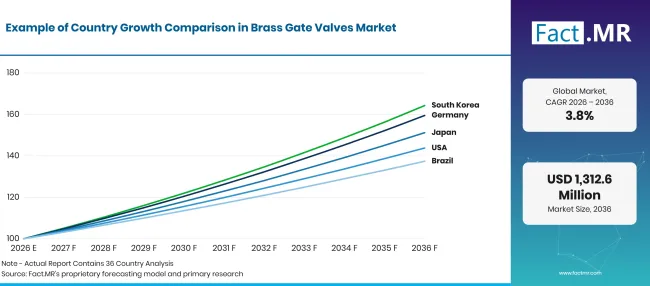
Brass Gate Valves Market Growth Index | Source: Fact.MR
| Country | CAGR (2026–2036) |
|---|---|
| Germany | 4.8% |
| Japan | 4.2% |
| USA | 3.7% |
| Brazil | 3.2% |
| UK | 2.8% |
Source: Fact.MR analysis. Updated Nov 17, 2026
How are German building projects affecting brass gate valve orders?
German plumbing contractors assess connection sizes and access requirements when replacing isolation valves in occupied buildings.
The brass gate valves market in Germany is projected to grow at a 4.8% CAGR from 2026 to 2036 as renovation work sustains demand for compatible fittings. In February 2026, the Federal Statistical Office reported that building permits covered 238,063 dwellings in Germany during 2025. Those authorizations suggest potential work for building-services installers once projects reach the fitting stage. Rising-stem models offer visible position checks in plant rooms with sufficient clearance. Distributors that maintain familiar threaded connections are positioned to serve scheduled repairs and smaller construction jobs. In May 2026, Destatis recorded 139,481 completed buildings or construction projects for 2025. That level of completed work shapes the near-term volume available to installation contractors.
What is influencing brass gate valve purchases in Brazil?
Brazil's water-service expansion provides a route to sales of shutoff fittings at building connections and suitable smaller distribution branches.
Brass gate valve sales in Brazil are forecast to rise at a 3.2% CAGR between 2026 and 2036. In December 2025, Brazil's Ministry of Cities released SINISA results showing that water-supply networks reached 84.1% of the population covered by the indicator. Service expansion and maintenance create an addressable base for valves specified at suitable connection points. In April 2026, the Brazilian Institute of Geography and Statistics reported that 86.1% of permanent homes had access to the general water network in 2025. Plumbing shops and regional wholesalers help installers match replacement threads with existing pipes. Industrial premises form another outlet where service fluid and working pressure suit brass. Regional transport distances influence which sizes dealers keep ready for urgent repairs.
Why is the USA an established market for brass valve replacement?
The USA has an extensive installed base of plumbing and water-service equipment that creates recurring maintenance purchases.
Sales of brass gate valves are projected to advance at a 3.7% CAGR through 2036. In November 2025, the US Environmental Protection Agency announced USD 6.5 billion in Water Infrastructure Finance and Innovation Act funding for water systems, alongside USD 550 million available to states. The funding covers a broad range of infrastructure work, including projects that involve smaller connected equipment. In November 2026, the U.S. Census Bureau reported that annualized public construction spending reached USD 546.8 billion in September 2026. Distributor branches serve contractors who need known valve sizes for repair work within limited service windows. Product approvals for drinking-water applications influence which brass alloys and fittings contractors select. Municipal and industrial projects may specify different material grades depending on the line. In September 2026, the Census Bureau's comparison showed that total construction spending was 2.7% below the level of September 2025.
How are water investment and building maintenance shaping UK sales?
The UK market is closely tied to water-utility upgrades and repairs within existing commercial buildings.
Sales of brass gate valves are anticipated to increase at a 2.8% CAGR through 2036, with product suitability affecting the share available to brass components. In March 2025, Ofwat outlined GBP 104 billion of expenditure in its 2025 to 2030 water-sector price review. The investment program creates possible work for suitable smaller connections alongside many other infrastructure products. In July 2026, the Office for National Statistics reported that new construction work on water infrastructure increased by 17.8% in 2025. Building maintenance contractors favor replacements that match earlier pipe dimensions and provide reliable shutoff. Offline distributors remain useful where crews must confirm threads before placing orders. In October 2026, the Office for National Statistics reported that construction new orders across Great Britain had risen 16.2% during 2025. Approval lists for water-company installations can narrow the material options used on specific lines. Costs of adapting older pipework influence the choice between valve models.
What supports small-bore valve demand in Japan?
Japan's established water and building-service networks sustain an continuing need to replace flow-isolation equipment.
Demand for brass gate valves is projected to rise at a 4.2% CAGR during 2026 to 2036. The Ministry of Land, Infrastructure, Transport and Tourism maintains national water-supply statistics covering the number and reach of service systems. In July 2026, Japan's Digital Agency updated the water-supply management dashboard using data collected from national ministries. Maintenance planners can use such operational records to prioritize work across regional service areas. Inside buildings, contractors compare available stem clearance before choosing rising-stem or non-rising-stem designs. Local hardware channels offer replacement sizes familiar to building managers and installers. Water-utility specifications shape the materials approved for different branches. Industrial operators likewise select brass only when the fluid and operating conditions match the manufacturer's specification.
Competitive Landscape for Brass Gate Valves Market
Competition in the brass gate valves market is shaped by manufacturers supplying plumbing isolation valves and industrial flow-control equipment. Watts Water Technologies and KITZ Corporation compete through valve portfolios suited to building services and fluid-control applications, while NIBCO Inc. and AVK Holding serve the wider water infrastructure sector. Emerson Electric, Matco-Norca, Inc., Flowserve and Velan operate across broader industrial valve categories. Buyers evaluate suppliers based on brass material specifications, pressure ratings, connection compatibility, drinking-water approvals and product availability.
Recent competitive activity reflects greater attention to water infrastructure upgrades, building maintenance and replacement requirements. Manufacturers are strengthening their position through product documentation, distributor relationships and availability of valves suited to existing pipe connections. Suppliers offering lead-free brass options, clear technical specifications and dependable regional inventories can address the purchasing needs of plumbing contractors and facility maintenance teams. Product compatibility, delivery reliability and access to approved replacement models will continue to influence supplier selection.
Recent Developments
- In October 2025, KITZ Corporation announced that its Indian subsidiary, Micro Pneumatics, signed an agreement to acquire Horizon Polymer Engineering, expanding its fluoropolymer-lined valve portfolio in India.
- In March 2026, Mueller Industries acquired Bison Metals Technologies, expanding its US copper tube manufacturing capacity and strengthening industrial production capabilities for piping systems and related applications.
Key Players in Brass Gate Valves Market
Key companies profiled include Watts Water Technologies; KITZ Corporation; NIBCO Inc.; Legend Valve & Fitting, Inc.; Matco-Norca, Inc.; Apollo Valves / Conbraco Industries; Jomar Valve; Milwaukee Valve Company; A.Y. McDonald Mfg. Co.; and B&K PRODUCTS / MUELLER STREAMLINE.
- Watts Water Technologies
- KITZ Corporation
- NIBCO Inc.
- Legend Valve & Fitting, Inc.
- Matco-Norca, Inc.
- Apollo Valves / Conbraco Industries
- Jomar Valve
- Milwaukee Valve Company
- A.Y. McDonald Mfg. Co.
- B&K PRODUCTS / MUELLER STREAMLINE
Bibliography
- Agência Gov. (2026, April 17). IBGE mostra melhora na qualidade das moradias: Energia elétrica e acabamento se expandem.
- Agência Nacional de Águas e Saneamento Básico. (2026, August 26). Água e desenvolvimento: O papel da ANA na universalização do saneamento.
- Digital Agency of Japan. (2026, July 3). Management status dashboard for water supply, etc.
- KITZ Corporation. (2025, October 21). Acquisition of 100% shares of Horizon Polymer Engineering Private Limited, India.
- Mueller Industries, Inc. (2026, March 30). Mueller Industries, Inc. announces acquisition of Bison Metals Technologies.
- Ministério das Cidades. (2025, December 23). Resultados SINISA 2025.
- Ministério das Cidades. (2026, January 14). Brasil tem ano de investimentos e avanços em saneamento básico
- Office for National Statistics. (2026, July 1). Infrastructure in the UK, investment and net stocks: July 2026.
- Office for National Statistics. (2026, October 23). Construction statistics, Great Britain: 2025.
- Ofwat. (2025, March 18). Ofwat refers five companies’ redetermination requests to the Competition and Markets Authority (CMA).
- Statistisches Bundesamt. (2026, February 18). Building permits in Germany.
- Statistisches Bundesamt. (2026, May 22). Construction work completed.
- Statistics Bureau of Japan. (2025).2025 [Statistics of Japan 2025].
- U.S. Census Bureau. (2026, November 2). Monthly construction spending, September 2026.
- U.S. Environmental Protection Agency. (2025, November 20). EPA announces $7 billion in newly available WIFIA funding and five new WIFIA loan approvals.
- U.S. Environmental Protection Agency. (2026, April 14). Fiscal year 2026 allotments for the Drinking Water State Revolving Fund.
- Watts Water Technologies. (2026). LFWGV: Lead free brass gate valves.
Segmentation
Scope of Report
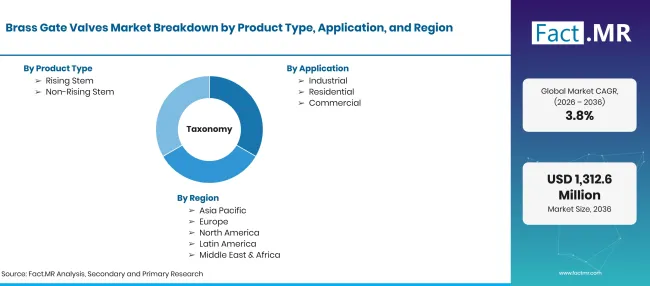
Brass Gate Valves Market Taxonomy | Source: Fact.MR
| Items | Values |
|---|---|
| Quantitative Units (2026) | USD 906.6 Million |
| Product Type | Rising Stem, Non-Rising Stem |
| Application | Industrial, Residential, Commercial |
| End-User | Water Supply Systems, Oil and Gas, Chemical Industry, Power Generation, Others |
| Distribution Channel | Offline, Online |
| Regions Covered | North America, Latin America, Europe, East Asia, South Asia and Pacific, Middle East & Africa |
| Countries Covered | Germany, Brazil, USA, UK, Japan |
| Key Companies Profiled | Watts Water Technologies, KITZ Corporation, NIBCO Inc., Legend Valve & Fitting, Inc., Matco-Norca, Inc., Apollo Valves / Conbraco Industries, Jomar Valve, Milwaukee Valve Company, A.Y. McDonald Mfg. Co., B&K PRODUCTS / MUELLER STREAMLINE |
| Additional Attributes | Revenue from brass-bodied gate valves within compatible fluid-isolation services; excludes other valve materials and separate installation costs. |
Source: Fact.MR analysis. Updated Nov 17, 2026
Brass Gate Valves Market by Segments
-
Product Type
- Rising Stem
- Non-Rising Stem
-
Application
- Industrial
- Residential
- Commercial
-
End-User
- Water Supply Systems
- Oil and Gas
- Chemical Industry
- Power Generation
- Others
-
Distribution Channel
- Offline
- Online
-
Region:
- North America
- USA
- Canada
- Mexico
- Europe
- Germany
- UK
- France
- Italy
- Spain
- Rest of Europe
- Asia Pacific
- Japan
- China
- India
- South Korea
- Rest of Asia Pacific
- Latin America
- Brazil
- Mexico
- Rest of Latin America
- Middle East & Africa
- GCC Countries
- South Africa
- Rest of Middle East & Africa
- North America
Frequently Asked Questions
How large is the Brass Gate Valves Market in 2026?
What is the Brass Gate Valves Market forecast for 2036?
What CAGR is projected for brass gate valves through 2036?
Which product type accounts for the largest share?
Which application leads demand?
Which end-user category leads the market?
Which sales channel leads the market?
Which country has the highest forecast CAGR?
Who worked on this report


Preview the report firsthand - request a free sample
Free SampleGet the brochure for pricing and purchase details
Download PDF