- Market Value (2025): USD 1.57 Bn
- Estimated Value (2026): USD 2.74 Bn
- Forecast Value (2036): USD 1.65 Bn
- CAGR (2026-2036): 5.2%
What is the Plastic Ball Valves Market forecast to be worth by 2036?
USD 1.7 billion in 2026 to USD 2.7 billion by 2036 at a 5.2% CAGR.
- The plastic ball valves market was valued at USD 1.57 billion in 2025, with true union PVC valves in water and chemical lines making up the bulk of unit shipments.
- By 2036 the market will reach USD 2.74 billion, from USD 1.65 billion in 2026, as utilities and process plants swap corroded metal valves for thermoplastic ones.
- Thermoplastic valve demand will advance at a 5.2% CAGR from 2026 to 2036, since every new dosing skid, filter train and pipe rack calls for several isolation points.
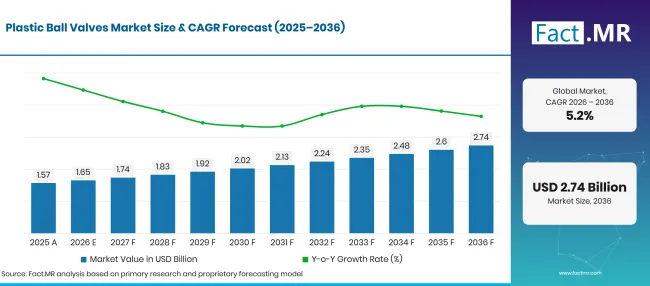
Plastic Ball Valves Market Forecast Global | Source: Fact.MR
| Year | Basis | Market Value (USD billion) |
|---|---|---|
| 2025 | Actual | 1.57 |
| 2026 | Estimate | 1.65 |
| 2036 | Forecast | 2.74 |
| CAGR 2026 to 2036 | Forecast period | 5.2% |
Source: Fact.MR analysis. Updated Oct 24, 2026
What are the defining numbers behind Plastic Ball Valves Market growth?
Fresh demand worth USD 1.0 billion will accumulate from 2026 to 2036, drawn chiefly from water treatment and chemical process lines.
- Demand Drivers in the Market
- Drinking water access gaps keep treatment capacity under construction worldwide. WHO and UNICEF reported that 2.1 billion people still lacked safely managed drinking water in 2024, including 106 million who drank untreated surface water [1]. Each new treatment works and booster station needs corrosion-free valves on chlorine, coagulant and sample lines.
- Lead pipe removal programs push utilities toward plastic service connections and fittings. The U.S. Environmental Protection Agency allotted USD 3 billion for lead service line replacement through the Drinking Water State Revolving Fund in fiscal 2025 [2]. Crews that replace a service line often fit a new curb stop or meter valve at the same time.
- Corrosive chemicals shorten the life of carbon steel and brass valves. Acids, caustic soda and hypochlorite attack metal seats within months, while PVC, CPVC and PVDF bodies resist them for years at a lower installed cost.
- Light weight cuts installation time on skids and pipe racks. A PVC ball valve weighs a fraction of a stainless steel one, so fitters can solvent-weld or thread it in place without lifting gear.
- Automation is moving into small-bore plastic lines. Plant operators now order thermoplastic ball valves with electric or pneumatic actuators and position feedback, which lets one control room run remote dosing points.
- Key Segments Analyzed
- By Material Type: PVC will hold 42.5% share in 2026, given that it costs the least of the common thermoplastics and handles cold water and dilute chemicals well.
- By Application: Water Treatment will account for 32.4% share in 2026 as municipal and industrial plants fit isolation valves on every filter, dosing and sampling line.
- By End-User: Industrial will command 54.2% share in 2026 through steady maintenance and expansion orders from chemical, power and process plants.
- By Distribution Channel: Offline will capture 72.3% share in 2026, since engineers buy through stocking distributors that hold sizes, seal options and spare parts on the shelf.
- Analyst Opinion at Fact.MR
- Shambhu Nath Jha, Principal Consultant at Fact.MR, states, “Plastic ball valves rarely win on price alone; they win because a corroded metal valve stops a plant. PVC will remain the volume material, but CPVC and PVDF will take a growing slice of value as hotter and more aggressive fluids move into plastic piping. Suppliers that pair valves with actuators and fast local stock will collect the repeat orders.”
- Strategic Implications
- Valve manufacturers should publish chemical resistance and pressure-temperature data for each body and seal material, because process engineers screen suppliers on that data before asking for a price.
- Distributors should stock true union valves in the common sizes with EPDM and FKM seals, as most plant buyers need a replacement the same day a valve fails.
- Water utilities should standardize thermoplastic valves for chemical feed and sampling lines in their design manuals, which shortens tender reviews.
- Actuator suppliers should offer pre-mounted packages for small plastic valves, given that plants want to automate dosing points without on-site assembly work.
With a 6.5% CAGR, Japan will move ahead of the other four, where aging sewer and water pipes require urgent renewal. Germany ranks second at 5.9%, backed by a large chemical industry that relies on corrosion-free valves. Brazil will expand at 5.5% as water and sewer connections widen and offshore oil output grows. In the United States, a 5.0% rate reflects lead service line replacement and water system upgrades. The United Kingdom completes the list at 3.8%, with pressure on water companies to cut sewage pollution.
How does the Plastic Ball Valves Market break down by segment?
PVC will lead Material Type at 42.5%; Water Treatment will top Application at 32.4%; Industrial will head End-User at 54.2%; Offline will hold first place in Distribution Channel at 72.3%.
Which Material Type dominates?
PVC takes 42.5% of 2026 sales.
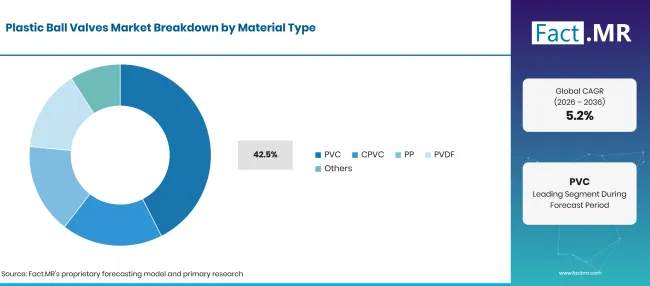
Plastic Ball Valves Market Breakdown Material Type | Source: Fact.MR
| Material Type | Share (2026) |
|---|---|
| PVC (Leading segment) | 42.5% |
| Other segments combined | 57.5%* |
| Total | 100.0% |
Source: Fact.MR analysis. Updated Oct 24, 2026
PVC ball valve buyers want a low-cost body that resists chlorinated water, dilute acids and salt solutions at moderate temperatures. The resin molds easily into compact and true union designs, and it solvent-welds to the same pipe already used across the plant. Its wide use in plastic valves of all types keeps tooling and resin costs down. CPVC serves hotter lines, since added chlorine lets it work at higher temperatures than PVC. Producers mold these valves from chlorinated polyvinyl chloride for hot process water and caustic service. PP handles solvents and alkalis, while PVDF resists strong oxidizers and ultrapure water in chip plants.
What leads the Application segment?
Water Treatment represents 32.4% of 2026 demand.
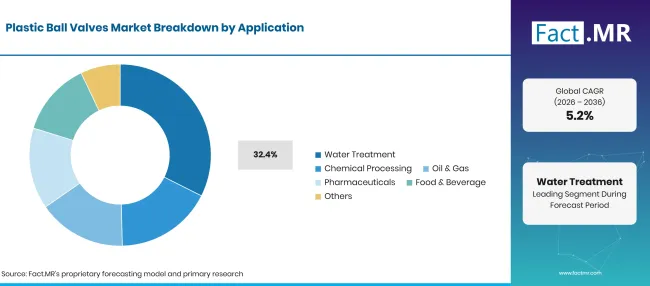
Plastic Ball Valves Market Breakdown Application | Source: Fact.MR
| Application | Share (2026) |
|---|---|
| Water Treatment (Leading segment) | 32.4% |
| Other segments combined | 67.6%* |
| Total | 100.0% |
Source: Fact.MR analysis. Updated Oct 24, 2026
Treatment works dose chlorine, ferric salts and polymers through small-bore lines that eat through metal valves. Operators isolate each pump, filter and analyzer with a ball valve, so one plant can hold hundreds of them. Larger mains in the same plant often use butterfly valves for flow isolation. Chemical processing forms the next demand block. Destatis reported that German businesses used 12.75 billion cubic meters of water in 2022, and the chemical industry alone accounted for 3.08 billion cubic meters [3]. Oil and gas operators use plastic valves on produced water and chemical injection lines, with the U.S. Energy Information Administration putting U.S. crude oil output at 13.7 million barrels per day in 2025 [4].
What supports Industrial within End-User?
Industrial buyers make up 54.2% of 2026 purchases.
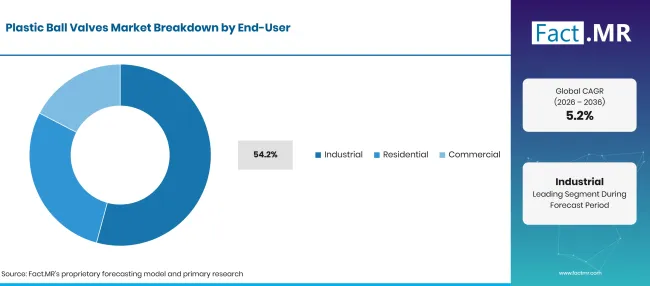
Plastic Ball Valves Market Breakdown End User | Source: Fact.MR
| End-User | Share (2026) |
|---|---|
| Industrial (Leading segment) | 54.2% |
| Other segments combined | 45.8%* |
| Total | 100.0% |
Source: Fact.MR analysis. Updated Oct 24, 2026
Chemical, power and metal finishing plants run acid, caustic and brine lines around the clock. Maintenance teams replace worn valves during each shutdown and add new ones when capacity grows. Many plants specify plastic bodies alongside metal industrial valves on the same pipe rack. Residential users buy small PVC ball valves for irrigation, pools and water softeners, mainly through hardware stores. Commercial buyers include hotels, hospitals and aquatic centers that need valves for pool filtration and building water treatment.
How does Distribution Channel shape demand?
Offline channels handle 72.3% of 2026 orders.
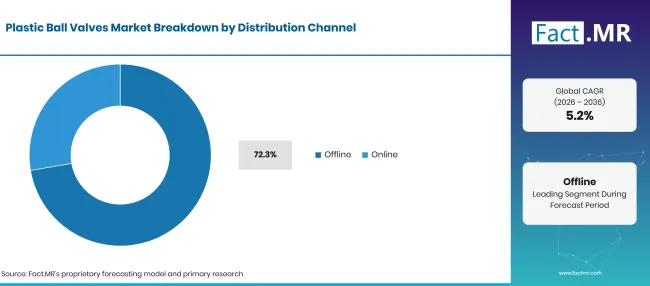
Plastic Ball Valves Market Breakdown Distribution Channel | Source: Fact.MR
| Distribution Channel | Share (2026) |
|---|---|
| Offline (Leading segment) | 72.3% |
| Other segments combined | 27.7%* |
| Total | 100.0% |
Source: Fact.MR analysis. Updated Oct 24, 2026
Plant engineers and contractors rely on local stocking distributors for technical advice and quick delivery. Distributors carry valves in many sizes, end connections and seal materials, and they can supply actuators and control valves on the same order. Online sales are growing among small contractors, pool owners and maintenance buyers who already know the part number. Manufacturer webshops and industrial marketplaces list stock levels and data sheets, which makes repeat orders faster.
What is accelerating Plastic Ball Valves Market adoption, and what is holding it back?
Adoption will grow through water treatment upgrades, corrosion-free chemical handling and the shift to automated dosing. Growth is held back by pressure and temperature limits of thermoplastics, resin price swings and competition from lined metal valves in severe service.
Drivers Impact Analysis
| DRIVER | (~) % IMPACT ON CAGR | GEOGRAPHIC RELEVANCE | IMPACT TIMELINE |
|---|---|---|---|
| New and upgraded drinking water and wastewater treatment plants | +1.3% | Global | Medium term (2-4 years) |
| Replacement of corroded metal valves in chemical service | +1.1% | North America, Western Europe, East Asia | Short term (<= 2 years) |
| Lead service line and water main renewal programs | +0.8% | North America, Western Europe | Medium term (2-4 years) |
| Automated chemical dosing with actuated plastic valves | +0.6% | East Asia, Western Europe | Medium term (2-4 years) |
| Pool, irrigation and building water systems | +0.4% | North America, Latin America | Short term (<= 2 years) |
Source: Fact.MR analysis. Updated Oct 24, 2026
Opportunity Impact Analysis
| OPPORTUNITY | (~) % IMPACT ON CAGR | GEOGRAPHIC RELEVANCE | IMPACT TIMELINE |
|---|---|---|---|
| PVDF and PP valves for semiconductor ultrapure water | +0.8% | East Asia, North America | Long term (>= 4 years) |
| Pre-assembled actuated valve packages for skids | +0.6% | Global | Medium term (2-4 years) |
| PE ball valves for gas and water distribution networks | +0.5% | Western Europe, Eastern Europe | Medium term (2-4 years) |
Source: Fact.MR analysis. Updated Oct 24, 2026
Restraints Impact Analysis
| RESTRAINT | (~) % IMPACT ON CAGR | GEOGRAPHIC RELEVANCE | IMPACT TIMELINE |
|---|---|---|---|
| Pressure and temperature limits of thermoplastic bodies | -0.6% | Global | Long term (>= 4 years) |
| PVC and fluoropolymer resin price swings | -0.4% | Global | Short term (<= 2 years) |
| Competition from PTFE-lined metal valves in severe service | -0.3% | North America, Western Europe | Medium term (2-4 years) |
Source: Fact.MR analysis. Updated Oct 24, 2026
Which countries are scaling the Plastic Ball Valves Market through 2036?
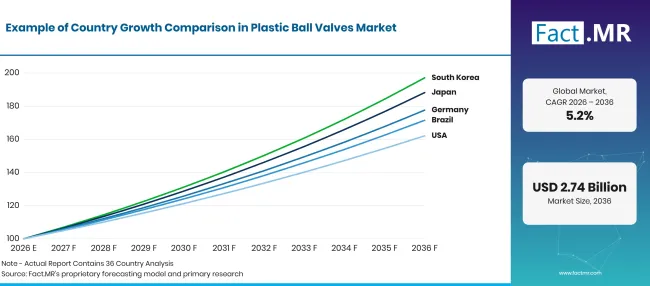
Plastic Ball Valves Market Growth Index | Source: Fact.MR
| Country | CAGR (2026 to 2036) |
|---|---|
| Japan | 6.5% |
| Germany | 5.9% |
| Brazil | 5.5% |
| United States | 5.0% |
| United Kingdom | 3.8% |
Source: Fact.MR analysis. Updated Oct 24, 2026
What supports Japan’s adoption?
6.5% CAGR, driven by urgent renewal of aging sewer and water pipes.
Plastic valve demand in Japan follows a national push to inspect and repair old sewer and water pipes. MLIT reported that its special survey of about 813 km of priority sewer pipes found about 72 km needing action within about one year [5]. Utilities rebuilding pump stations and treatment works fit PVC and PVDF valves on chemical lines. Japan’s chip plants add demand for high-purity PVDF valves.
How is Germany scaling demand?
5.9% CAGR, backed by a large chemical base and strict rules on water-hazardous substances.
Germany’s chemical parks handle acids, alkalis and solvents in thousands of plastic-lined and thermoplastic lines. Destatis reported 1,461 accidents involving water-hazardous substances in 2025, and 214 of the 477 handling accidents came from errors such as faulty operation or assembly [6]. Tight valves with clear position indication help plants reduce such incidents.
What supports Brazil’s growth?
5.5% CAGR, helped by wider water and sewer coverage and record oil output.
Brazilian sanitation contracts are extending networks to unserved homes. IBGE reported that 86.3% of households had a general network water supply in 2024, while 70.4% had sewage disposal through the network or a connected septic tank [7]. Offshore production adds chemical injection demand. ANP reported that Brazil’s oil output averaged a record 3.77 million barrels per day in 2025 [8].
How is the United States developing demand?
5.0% CAGR, reflecting lead pipe removal and drinking water system upgrades.
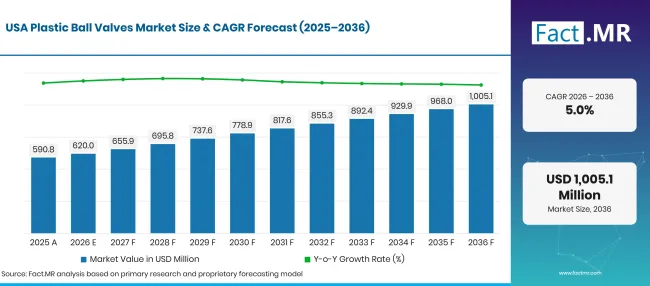
Plastic Ball Valves Market Forecast Usa | Source: Fact.MR
American water utilities are mapping and replacing old service lines under federal rules. EPA’s 2025 update to the 7th Drinking Water Infrastructure Needs Survey estimated about 4 million lead service lines nationwide, across about 48,000 eligible community water systems [9]. Treatment plants upgrading for new contaminant limits add chemical feed lines. Pool, irrigation and industrial users form a large replacement base.
How does the United Kingdom perform?
3.8% CAGR, as water companies invest to cut pollution from sewage assets.
The Environment Agency reported 75 serious pollution incidents from water and sewerage companies in England in 2024, up 60% from 47 in 2023 [10]. Total incidents from sewerage and water supply assets reached 2,801 [10]. Wastewater works upgrades will need valves for chemical phosphorus removal and sludge treatment. Industrial demand is steadier but slower than in the other four countries.
Who leads the Plastic Ball Valves Market?
Thermoplastic piping specialists set the pace in this market because they sell valves, pipe and fittings as one system.
GF Piping Systems offers its Ball Valve Type 546 Pro in PVC-U, PVC-C, ABS, PP-H and PVDF, and its June 2026 datasheet lists PTFE or PVDF seats with EPDM, FKM or FFKM seals [11]. Asahi/America builds industrial thermoplastic ball valves such as the Type-21 true union series. Spears Manufacturing and NIBCO, through its Chemtrol brand, serve North American PVC and CPVC buyers with true union and compact designs. AVK approaches the field from utility networks, with its CERTUS PE ball valve for gas service built from PE100 for electrofusion into PE pipe [12]. Cepex, a Fluidra brand, makes PVC-U and PVC-C valves with an anti-block system and hydraulic testing of each unit for pool and irrigation lines [13]. Breadth of materials, actuation options and distributor stock will decide which suppliers gain share.
Which companies are the key providers?
Key companies include GF Piping Systems; Asahi/America; Spears Manufacturing; NIBCO (Chemtrol); Cepex; and AVK.
- GF Piping Systems
- Asahi/America
- Spears Manufacturing
- NIBCO (Chemtrol)
- Cepex
- AVK
Bibliography
- [1] World Health Organization. (2025, August 26). 1 in 4 people globally still lack access to safe drinking water - WHO, UNICEF.
- [2] U.S. Environmental Protection Agency. (2025, November). Fiscal Year 2025 Lead Service Line Replacement Allotments for the Drinking Water State Revolving Fund Provisions of the Infrastructure Investment and Jobs Act.
- [3] Statistisches Bundesamt (Destatis). (2025, February 21). Deutsche Wirtschaft nutzt 12,75 Milliarden Kubikmeter Wasser im Jahr 2022 [German businesses use 12.75 billion cubic meters of water in 2022].
- [4] U.S. Energy Information Administration. (2026, October 6). Short-Term Energy Outlook.
- [5] Ministry of Land, Infrastructure, Transport and Tourism, Japan. (2025, September 17). 下水道管路の全国特別重点調査について優先実施箇所の調査結果を公表します [Results of the nationwide special priority survey of sewer pipes at priority sites].
- [6] Statistisches Bundesamt (Destatis). (2026, August 24). KORREKTUR: 5,9 Millionen Liter wassergefährdende Stoffe bei Unfällen im Jahr 2025 ausgetreten [CORRECTION: 5.9 million litres of water-hazardous substances released in accidents in 2025].
- [7] Instituto Brasileiro de Geografia e Estatística (IBGE). (2025, August 22). Coleta de lixo atende 93% dos domicílios, mas 4,7 milhões ainda queimam resíduos em 2024 [Waste collection serves 93% of households, but 4.7 million still burn waste in 2024].
- [8] Agência Nacional do Petróleo, Gás Natural e Biocombustíveis (ANP). (2026). Boletim da Produção de Petróleo e Gás Natural: Encarte de Consolidação da Produção 2025 [Oil and Natural Gas Production Bulletin: 2025 Production Summary].
- [9] U.S. Environmental Protection Agency. (2025, November). 2025 Update to the 7th Drinking Water Infrastructure Needs Survey and Assessment (DWINSA).
- [10] Environment Agency. (2025, October 23). Water and sewerage companies in England: environmental performance report for 2024.
- [11] GF Piping Systems. (2026, June). Ball Valve Type 546 Pro datasheet.
- [12] AVK. (2026). CERTUS PE Ball Valve, Gas MOP10.
- [13] Cepex. (2026). Cepex Home: Fluid Handling Experts.
This Report Answers
- What will plastic ball valves be worth in 2026 and 2036, and where will the new value come from?
- Why do buyers pick PVC, CPVC, PP or PVDF bodies for a given fluid and temperature?
- How do water treatment, chemical processing and oil and gas lines differ in valve needs?
- What pipe renewal and pollution rules shape demand in Japan, Germany, Brazil, the United States and the United Kingdom?
- Which thermoplastic valve makers compete for plant and utility orders, and what sets them apart?
What does the Plastic Ball Valves Market cover?
Thermoplastic ball valves of every common design fall within this market. That covers true union, compact, flanged and three-way valves, in sizes from small instrument lines to large process pipes.
Demand is tracked across water treatment, chemical processing, oil and gas, pharmaceuticals and food and beverage. Sales are measured through distributors, direct project supply and online stores.
What is included in the scope?
Manual valves with lever or T-handle operators are counted, along with valves sold with electric or pneumatic actuators fitted by the valve maker. PE ball valves for gas and water distribution are also covered.
Ball check valves and multiport ball valves made from thermoplastics count when sold under a ball valve product line. Valves sold within packaged dosing skids are included at their component value, apart from pressure relief valves mounted on the same skid.
What is excluded from the scope?
Metal ball valves with PTFE or PFA linings fall outside the revenue boundary, as do plastic butterfly, diaphragm and gate valves. Actuators sold separately for field retrofit are excluded.
Pipe, fittings and solvent cement sold with the valves are excluded. Used and refurbished valves are also left out.
How Was the Analysis Built?
The analysis draws on 120+ sources, 35+ company portfolios, 25+ countries, and more than 20 industry interviews.
- Primary Research: Primary research includes discussions with manufacturers, service providers, technology developers, distributors, end users, and subject-matter experts. These conversations examine purchasing priorities, product adoption, operational challenges, approval requirements, competitive positioning, and the factors that influence wider market acceptance.
- Desk Research: Desk research covers government statistics, regulatory publications, company filings, trade data, technical studies, industry associations, standards, public policy, and other authoritative sources. Every source used in the analysis is documented in the bibliography.
- Market Sizing and Forecasting: Market estimates combine historical performance, demand indicators, pricing and volume trends, segment shares, company participation, country-level growth, adoption patterns, investment activity, and barriers to market expansion.
- Data Validation and Update Cycle: Findings are validated by comparing primary interviews with public data, company activity, regulatory changes, trade patterns, and industry developments. Regular updates review new product launches, capacity changes, partnerships, approvals, and shifts in commercial adoption.
Segmentation
What is the report’s scope and coverage?
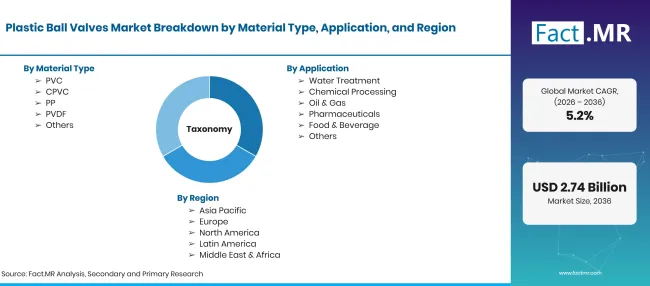
Plastic Ball Valves Market Taxonomy | Source: Fact.MR
| Attribute | Details |
|---|---|
| Quantitative Units | USD billion in 2026 to USD billion by 2036 at CAGR |
| Market Definition | Quarter-turn ball valves with thermoplastic bodies, including PVC, CPVC, PP, PVDF and other plastics, sold in manual and actuated form. Value is counted at the first sale by the valve maker. |
| Material Type | PVC; CPVC; PP; PVDF; Others |
| Application | Water Treatment; Chemical Processing; Oil & Gas; Pharmaceuticals; Food & Beverage; Others |
| End-User | Industrial; Residential; Commercial |
| Distribution Channel | Offline; Online |
| Regions Covered | North America; Latin America; Western Europe; Eastern Europe; East Asia; South Asia & Pacific; Middle East & Africa |
| Countries Covered | Japan; Germany; Brazil; United States; United Kingdom |
| Companies Profiled | GF Piping Systems; Asahi/America; Spears Manufacturing; NIBCO (Chemtrol); Cepex; AVK |
| Forecast Period | 2026 to 2036 |
| Approach | Hybrid top-down and bottom-up approach using water treatment and chemical plant capacity; thermoplastic pipe installations; valves per line and replacement cycles; resin prices by material; channel price points; and supplier portfolio review. |
Source: Fact.MR analysis. Updated Oct 24, 2026
How is the market segmented?
-
By Material Type
- PVC
- CPVC
- PP
- PVDF
- Others
-
By Application
- Water Treatment
- Chemical Processing
- Oil & Gas
- Pharmaceuticals
- Food & Beverage
- Others
-
By End-User
- Industrial
- Residential
- Commercial
-
By Distribution Channel
- Offline
- Online
-
By Region
- North America
- Latin America
- Western Europe
- Eastern Europe
- East Asia
- South Asia & Pacific
- Middle East & Africa
Frequently Asked Questions
How big is the plastic ball valves market in 2026?
What is the CAGR of the plastic ball valves market from 2026 to 2036?
Which material type leads the plastic ball valves market?
Which application leads the plastic ball valves market?
Which end-user leads the plastic ball valves market?
Which distribution channel leads the plastic ball valves market?
Which country will grow the most in the plastic ball valves market?
Who are the main companies in the plastic ball valves market?
Who worked on this report


Preview the report firsthand - request a free sample
Free SampleGet the brochure for pricing and purchase details
Download PDF