- Estimated Value(2026): 5.3 Bn
- Forecast Value (2036): 9.5 Bn
- CAGR (2026 - 2036): 6.0%
Brewer's Yeast Market Forecast and Outlook 2026 to 2036
In 2025, the brewer's yeast market surpassed a valuation of USD 5.1 billion. Based on Fact.MR analysis, demand for brewer's yeast is estimated to grow to USD 5.3 billion in 2026 and USD 9.5 billion by 2036. FACT.MR projects a CAGR of 6.0% during the forecast period.
The market is expected to generate USD 4.2 billion absolute dollar opportunity between 2026 and 2036. Growth is structurally anchored by the expanding global livestock sector, rising consumer appetite for immune-supporting nutritional supplements, and the pharmaceutical industry's growing reliance on yeast-derived beta-glucans and nucleotides. Constraint comes from logistics complexity in handling live liquid yeast at temperature and from feedstock availability tied to the seasonal and capacity-driven nature of the brewing industry.
Eric Ao, General Manager of Angel Yeast Europe said, "Guided by nature-inspired innovation, we seamlessly blend sustainability with cutting-edge technology, demonstrating our unwavering commitment to empowering industries worldwide to meet tomorrow's challenges head-on, all while prioritizing the health, welfare, and optimal nutrition of animals."
Country-level growth reflects livestock density, aquaculture expansion, and the maturity of human supplement markets. China leads at 8.0% CAGR, driven by massive aquaculture sector demand for yeast-based feeds under the government's Blue Granary programme and expanding domestic pet supplement consumption. India follows at 7.5% CAGR as poultry integrators upgrade from commodity feed additives to functional yeast inputs. The United States registers 5.7% CAGR underpinned by robust probiotic supplement demand and veterinary nutrition investment. Germany records 4.9% from pharmaceutical yeast derivative contracts and organic livestock premiums, while Brazil posts 4.3% from its dominant protein export sector, where yeast improves feed conversion ratios at scale.
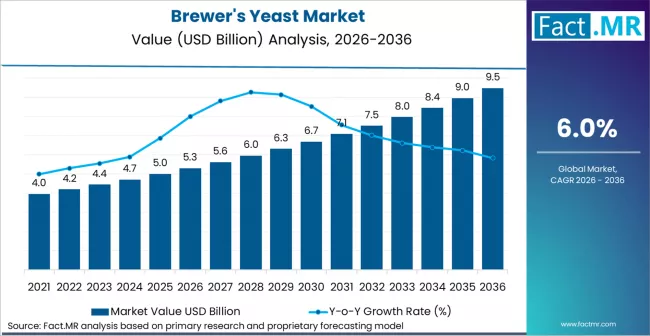
Brewers Yeast Market Market Value Analysis | Source: Fact.MR
| Metric | Value |
|---|---|
| Estimated Value in 2026 | USD 5.3 billion |
| Forecast Value in 2036 | USD 9.5 billion |
| Forecast CAGR (2026 to 2036) | 6.0% |
Source: Fact.MR analysis. Updated Feb 27, 2026
Market Definition
The brewer's yeast market covers Saccharomyces cerevisiae and closely related yeast strains recovered as by-products of beer brewing or grown intentionally for nutritional and pharmaceutical applications. These organisms are supplied in liquid slurry and dried powder formats to manufacturers of animal feed supplements, human dietary supplements, and pharmaceutical intermediates.
Market Inclusions
The report provides global and regional revenue forecasts from 2026 to 2036. It is segmented by form (liquid and dry), application (feed supplements, food supplements, pharmaceuticals, and others), and geography. Demand for primary-grown and secondary brewing-derived yeast is analysed alongside finished formulations. Country coverage includes China, India, Germany, Brazil, and the United States. Pricing dynamics, trade flow analysis, and capacity utilisation benchmarks are included.
Market Exclusions
The scope excludes baker's yeast and torula yeast unless used in direct functional substitution for brewer's yeast in feed or supplement applications. It omits finished fermented beverage products and downstream processed livestock or aquaculture products.
Research Methodology
- Primary Research: Interviews were conducted with feed nutritionists, procurement managers at livestock integrators, pharmaceutical API buyers, and specialty supplement brand managers across North America, Europe, and Asia Pacific. These discussions validated pricing benchmarks and adoption trends.
- Desk Research: Sources included FAO global livestock production statistics, WHO nutritional supplement market data, company annual reports and investor presentations.
- Market Sizing and Forecasting: A hybrid approach was used. Top-down estimates assessed addressable demand by livestock category, aquaculture segment, and human supplement user demographics by region. Bottom-up inputs included average selling prices by form, replacement cycle assumptions, and first-purchase growth rates from integrator and distributor interviews.
- Data Validation and Update Cycle: Outputs were cross-checked against company earnings disclosures, regulatory filings, and publicly available tender data from livestock procurement agencies. Forecasts are reviewed annually to reflect regulatory, commodity-price, and production-capacity-level shifts.
Summary
- Market Definition
- Brewer's yeast encompasses Saccharomyces cerevisiae and related strains produced through brewing or primary cultivation, supplied in liquid and dried forms as functional inputs delivering protein, B vitamins, beta-glucans, and nucleotides to livestock feed, human supplement, and pharmaceutical industries.
- Demand Drivers
- Global livestock antibiotic reduction programmes are creating structural demand for yeast-based immune modulators, as producers replace growth-promoting antibiotics with beta-glucan and mannan-oligosaccharide-rich yeast fractions to maintain animal performance while meeting regulatory requirements.
- Rising consumer awareness of immune health following the COVID-19 pandemic has accelerated adoption of beta-glucan-enriched food supplements, with mainstream pharmacy chains and e-commerce platforms.
- Rapid aquaculture sector expansion in Southeast Asia and China, driven by government-mandated shift from capture fisheries toward farmed protein, is generating concentrated demand for yeast-based feed inputs.
- Key Segments Analyzed
- By Form: Liquid brewer's yeast holds 38% of the market, valued for its higher bioactivity and direct integration into feed production lines for large-scale livestock and aquaculture.
- By Application: Feed supplements account for 47% of total market volume, anchored by compound feed manufacturers in Europe, North America, and Asia Pacific.
- By Geography: Asia Pacific commands the highest growth trajectory driven by expanding aquaculture and commercial poultry sectors in China, India, and Southeast Asia.
- Analyst Opinion at FACT.MR
- Shambhu Nath Jha, Principal Consultant at FACT.MR, opines, 'CXOs will find this report essential for mapping where brewer's yeast is moving beyond commodity feed ingredient status into defensible high-margin nutrition and pharmaceutical positions. The players who invest early in beta-glucan standardization and pharmaceutical-grade production certification will capture disproportionate value through 2036.'
- Strategic Implications
- Producers should expand beta-glucan extraction to move from bulk feed to high-margin pharma and premium supplements.
- Asia Pacific distributors should build cold-chain systems for liquid yeast serving aquaculture and poultry integrators.
- Supplement brands should invest in clinical validation and third-party certification to strengthen differentiation.
- Methodology
- Sizing combined yeast production data with livestock, supplement, and pharma demand modelling, validated through industry interviews.
- Adoption tracked via product launches from Angel Yeast, Lesaffre, Lallemand, Alltech, and Leiber.
- Forecasts used FAO livestock data, aquaculture growth rates, antibiotic policy timelines, and supplement e-commerce trends.
Segmental Analysis
Brewer's Yeast Market Analysis by Form
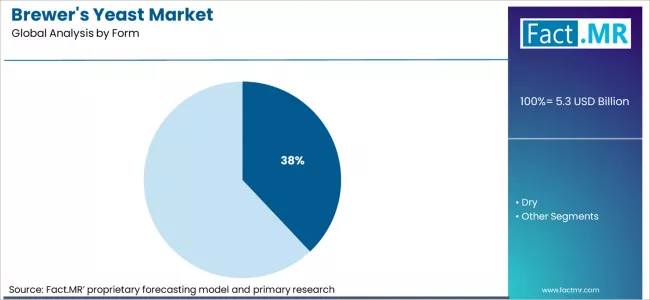
Brewers Yeast Market Analysis By Form | Source: Fact.MR
Based on FACT.MR analysis, liquid brewer’s yeast is projected to hold 38% share in 2026. Liquid formats are preferred by large feed mills and aquaculture operators. They preserve live cells and improve bioavailability of beta-glucans and nucleotides. They also integrate directly into wet mixing systems without rehydration losses seen in dry forms.
- Angel Yeast Feed Segment Expansion: In 2024, Angel Yeast expanded feed-grade capacity at its Yichang facility. The move supported rising poultry and aquaculture demand under China’s antibiotic reduction programme. The company reported 22% year-on-year feed yeast revenue growth in 2024. [2]
- Lesaffre Yeast Beta-Glucan Product Launch: In Q1 2025, Lesaffre introduced ActiPart, a premium beta-glucan yeast fraction for aquaculture. It targets shrimp and salmon producers facing bacterial challenges. This reflects the shift toward high-value yeast fractions. [3]
- Cold-Chain Logistics Investment: In 2024, DSV and Kuehne+Nagel expanded cold-chain infrastructure for biological inputs. Liquid yeast shipments at 2-8°C are increasing across Asia Pacific and Latin America. This supports wider liquid yeast adoption. [4]
Brewer's Yeast Market Analysis by Application
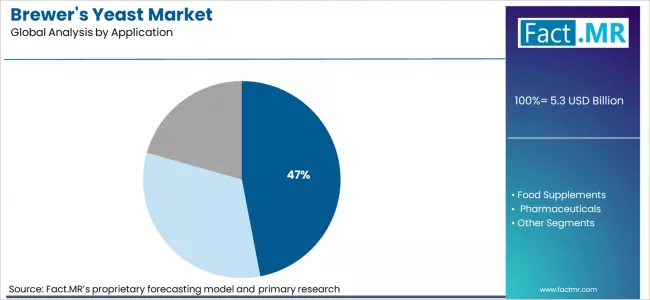
Brewers Yeast Market Analysis By Application | Source: Fact.MR
Feed supplements are projected to hold 47% share in 2026. Demand is driven by global livestock production. Yeast supports performance and antibiotic reduction compliance in the EU, U.S., and China.
- Alltech Antibiotic Alternatives Programme: In 2024, Alltech reported strong adoption of its ACE programme using Yea-Sacc yeast culture across 12 countries. Yeast culture was cited as its fastest-growing revenue category. [1]
- Lallemand Probiotics Pharmaceutical Entry: In September 2024, Lallemand’s LB-P yeast probiotic received EFSA QPS confirmation. This allows pharmaceutical-grade applications across EU markets. [5]
- Human Supplement Market Growth: The immune health supplement market reached USD 22.6 billion in 2024, growing at 7.1%. Yeast-derived beta-glucan ranked among the fastest-growing ingredients by new launches. [6]
Drivers, Restraints, and Opportunities
The brewer’s yeast market reached USD 5.1 billion in 2025. It is shifting from a commodity input to a functional nutrition ingredient. Livestock integrators rely on yeast as antibiotics are phased out. Meanwhile, human supplement demand has grown since COVID-19 boosted immune health awareness.
The market is splitting into two tiers. Commodity dried yeast faces price pressure from alternatives. In contrast, purified beta-glucan fractions and QPS-certified strains command 3-8 times higher prices. Standardized extraction and certification create structural pricing power.
- Antibiotic Reduction Mandates: EU Regulation (EU) 2019/6 and China’s 2020 antibiotic ban increased demand for yeast-based alternatives. WHO’s 2024 AMR update supports immunostimulant use. [7]
- Aquaculture Intensification in Asia Pacific: FAO projects aquaculture output to reach 111 million tonnes by 2030. Asia accounts for over 88% of production. Intensive farming drives yeast-based feed adoption. [8]
- Beta-Glucan Immune Health Opportunity: EFSA confirmed immune claims for beta-glucans in 2024. In the U.S., beta-glucan led immune supplement launches in 2024 with over 340 new SKUs.
Regional Analysis
The brewer's yeast market is analysed across Asia Pacific, Europe, North America, Latin America, and Middle East & Africa, covering more than 30 countries. The full report also offers market attractiveness analysis based on regional regulatory, demand, and supply dynamics.
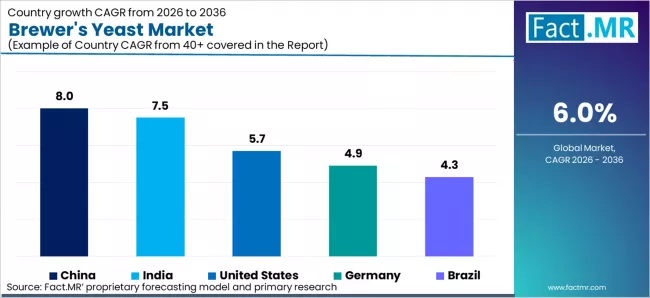
Brewers Yeast Market Cagr Analysis By Country | Source: Fact.MR
| Country | CAGR (2026-2036) |
|---|---|
| China | 8.0% |
| India | 7.5% |
| Germany | 4.9% |
| Brazil | 4.3% |
| United States | 5.7% |
Source: Fact.MR analysis. Updated Feb 27, 2026
Source: Fact.MR (FACT.MR) analysis, based on proprietary forecasting model and primary research
Asia Pacific Brewer's Yeast Market Analysis
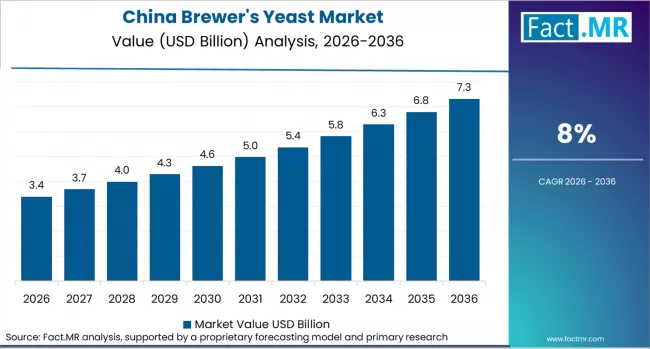
Brewers Yeast Market Country Value Analysis | Source: Fact.MR
Asia Pacific is the primary growth engine for the brewer's yeast market, driven by the world's largest aquaculture sector, rapid expansion of commercial poultry and swine production, and a growing middle-class consumer base adopting immune health supplements. Regional players including Angel Yeast hold commanding domestic positions.
- China: Demand for brewer's yeast in China is projected to rise at 8.0% CAGR through 2036. Growth is concentrated in aquaculture-intensive provinces including Guangdong, Fujian, and Shandong, where shrimp and fish farm operators have shifted from antibiotic-reliant intensive production toward yeast-supplemented feeds following the Ministry of Agriculture and Rural Affairs Announcement No. 194 enforcement. Angel Yeast reported in its H1 2024 results that its Yeast culture for aquaculture segment grew 28% year-on-year, supported by government-backed demonstration projects promoting yeast-based antibiotic alternatives.
- India: Demand for brewer's yeast in India is projected to rise at 7.5% CAGR through 2036. India's integrated poultry sector, which accounts for more than 4.3 million tonnes of broiler meat annually, is undergoing structural consolidation around large integrators who require consistent, certified yeast nutrition inputs.
FACT.MR's Asia Pacific analysis covers China, India, Japan, South Korea, Australia and New Zealand, ASEAN, and Rest of Asia Pacific. Readers can find regional trends, regulatory drivers, and market growth by segment and country within Asia Pacific.
Europe Brewer's Yeast Market Analysis
Europe functions as the global regulatory standard-setter for yeast nutrition, with the European Food Safety Authority EFSA providing the scientific framework for permitted health claims and pharmaceutical QPS designations that shape product development globally. German and French yeast producers including Leiber GmbH and Lesaffre anchor European supply with pharmaceutical-grade certified production that serves both domestic and export premium markets.
- Germany: Demand for brewer's yeast in Germany is projected to rise at 4.9% CAGR through 2036. Germany's pharmaceutical yeast segment benefits from its established API supply chain for beta-glucan, yeast extract, and nucleotide intermediates used by pharmaceutical manufacturers across the EU.
FACT.MR's European analysis covers Germany, France, the United Kingdom, Norway, Spain, the Netherlands, Nordics, and Rest of Europe. Readers can find regional regulatory updates, product approval timelines, and segment-level growth projections within Europe.
North America Brewer's Yeast Market Analysis
North America is defined by its mature but innovation-active brewer's yeast market. The United States combines one of the world's largest livestock sectors with the highest per-capita spending on human dietary supplements, creating dual demand dynamics that support both high-volume feed-grade supply and premium supplement-grade product development.
- United States: Demand for brewer's yeast in the United States is projected to rise at 5.7% CAGR through 2036. Alltech, headquartered in Nicholasville, Kentucky, reported in its 2024 Annual Outlook that antibiotic-free livestock production commitments from major US protein processors including Tyson Foods and Perdue Farms are driving sustained demand for its Yea-Sacc yeast culture product across broiler and swine feed programmes.
FACT.MR's North American analysis covers the United States, Canada, and Mexico. Readers can find regulatory compliance analysis, consumption trends by livestock category, and supplement market sizing within North America.
Latin America Brewer's Yeast Market Analysis
Latin America is driven by its role as the world's leading protein export region. Brazil, Argentina, and Mexico operate massive poultry and swine production systems that require cost-effective yeast-based feed inputs at scale.
- Brazil: Demand for brewer's yeast in Brazil is projected to rise at 4.3% CAGR through 2036. Brazil is the world's largest poultry exporter, with the Brazilian Animal Protein Association (ABPA) reporting 4.7 million tonnes of chicken exports in 2024. Export market requirements from the European Union and the Middle East, which mandate antibiotic-free and Salmonella-monitored production chains, are compelling major Brazilian integrators including BRF and JBS to adopt yeast-based immune modulators across their supply chains.
FACT.MR's Latin American analysis covers Brazil, Chile, Ecuador, and Rest of Latin America. Readers can find export-driven regulatory requirements, segment demand forecasts, and competitive landscape data within Latin America.
Competitive Aligners for Market Players
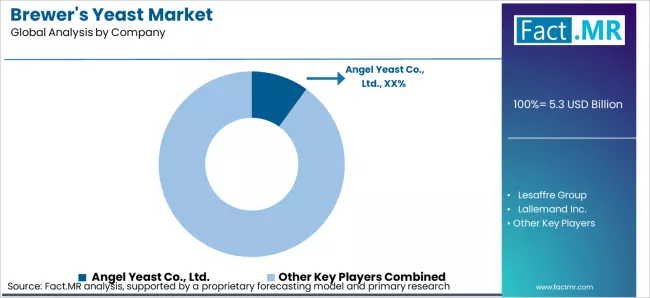
Brewers Yeast Market Analysis By Company | Source: Fact.MR
The global brewer’s yeast market is concentrated at the production level but fragmented in value-added segments. Angel Yeast and Lesaffre operate large multi-continent facilities, giving them scale advantages in feed and supplement-grade yeast. Lallemand holds a strong position in pharmaceutical and probiotic yeast through QPS and GRAS-certified strains. Alltech competes through integrated animal nutrition programmes, where yeast culture is bundled into broader feed solutions. Leiber and Asahi Group Foods focus on high-margin pharma and food-grade applications.
Competitive strength depends on fermentation scale, strain libraries, and regulatory certifications. Angel Yeast benefits from vertical integration, from brewing by-products to fractionated extracts. Lesaffre’s technical support network creates long-term formulation partnerships with feed manufacturers. Lallemand’s EFSA QPS approvals limit entry into EU pharmaceutical markets. Emerging players like Protein Distillery and Revyve target circular economy and precision fermentation niches.
Large feed buyers use dual sourcing to control costs, limiting pricing power in commodity dried yeast. However, certified beta-glucan and pharmaceutical-grade products face fewer substitutes. Supplement brands increasingly demand purity documentation, raising entry barriers for uncertified suppliers.
Recent Developments
- In February 2025, Angel Yeast Co., Ltd. announced a strategic partnership with a leading Southeast Asian aquaculture feed manufacturer to supply yeast-based functional feed additives across shrimp farming operations in Vietnam and Thailand, with contracted annual supply volumes representing a 30% increase over prior year feed-grade yeast revenues in the region.
- In October 2024, Revyve secured Series A funding of EUR 5.3 million from European agri-food investors to scale its spent brewer's yeast upcycling technology into structured protein and fibre ingredients for alternative protein food applications, positioning yeast-derived protein as a sustainable ingredient for the plant-based food sector and expanding the commercial end-use scope of brewing by-products.
Key Players
- Angel Yeast Co., Ltd.
- Lesaffre Group
- Lallemand Inc.
- Alltech Inc.
- Leiber GmbH
- Asahi Group Foods, Ltd.
- Biorigin
- ProteinDistillery
- Revyve
- Easy Bio
Bibliography
- [1] Alltech Inc. (2024). 2024 Annual Outlook: Antibiotic-Free Production and Yeast Nutrition Programmes.
- [2] Angel Yeast Co., Ltd. (August 2024). H1 2024 Interim Results Announcement. Shanghai Stock Exchange Disclosure Platform.
- [3] Lesaffre Group. (Q1 2025). ActiPart Beta-Glucan Aquaculture Product Launch Press Release.
- [4] Kuehne+Nagel International AG. (2024). Annual Report 2024: Cold Chain Logistics Expansion for Agricultural and Biological Inputs.
- [5] European Food Safety Authority. (September 2024). EFSA QPS List Update Lallemand LB-P Yeast Probiotic Strain Confirmation.
- [6] Council for Responsible Nutrition. (2024). CRN 2024 Consumer Survey on Dietary Supplements and Immune Health Ingredients.
- [7] World Health Organization. (2024). WHO Global Action Plan on Antimicrobial Resistance 2024 Progress Report.
- [8] Food and Agriculture Organization of the United Nations. (2024). The State of World Fisheries and Aquaculture 2024. Rome: FAO.
This Report Addresses
- Market intelligence to enable structured strategic decision-making across feed supplement, food supplement, pharmaceutical, and emerging precision fermentation segments of the global brewer's yeast market
- Market size estimation and 10-year revenue forecasts from 2026 to 2036, supported by validated production capacity benchmarks and primary demand-side interviews with livestock integrators, supplement brands, and pharmaceutical buyers
- Growth opportunity mapping across liquid and dry form segments with emphasis on the structural transition from commodity feed supply toward pharmaceutical-grade and premium supplement-grade beta-glucan and nucleotide products
- Segment and regional revenue forecasts covering feed supplements, food supplements, pharmaceuticals, and other applications across Asia Pacific, Europe, North America, Latin America, and Middle East & Africa
- Competition strategy assessment including capacity and certification benchmarking across major producers, vertical integration models, and new entrant positioning through circular economy and precision fermentation approaches
- Product development and regulatory compliance tracking, including antibiotic reduction mandate timelines, EFSA QPS designations, GRAS certifications, and halal qualification requirements by region
- Regulatory impact analysis covering EU antibiotic use prohibition, China AMR action plan enforcement, WHO Global Action Plan alignment, and human supplement claim substantiation requirements under applicable food law
- Market report delivery in PDF, Excel, PPT, and interactive dashboard formats for executive and operational use.
Segmentation
Scope of Report
| Items | Values |
|---|---|
| Quantitative Units | USD 5.3 billion (2026) to USD 9.5 billion (2036), at a CAGR of 6.0% |
| Market Definition | The brewer's yeast market encompasses Saccharomyces cerevisiae and related yeast strains produced as by-products of brewing, supplied in liquid and dry forms for feed supplement, food supplement, pharmaceutical, and other applications across global industrial and consumer channels. |
| Form Segmentation | Liquid, Dry |
| Application Segmentation | Feed Supplements, Food Supplements, Pharmaceuticals, Others |
| Application Coverage | Livestock and aquaculture feed supplementation, human nutritional supplements, probiotic and prebiotic formulations, pharmaceutical active ingredient supply, pet food fortification, and fermentation substrate applications |
| Regions Covered | Asia Pacific, Europe, North America, Latin America, Middle East & Africa |
| Countries Covered | China, Japan, South Korea, Australia and New Zealand, India, ASEAN, Rest of Asia Pacific, Germany, France, United Kingdom, Norway, Spain, Netherlands, Nordics, Rest of Europe, United States, Canada, Mexico, Brazil, Chile, Ecuador, Rest of Latin America, Kingdom of Saudi Arabia, United Arab Emirates, South Africa, Turkey, Rest of Middle East and Africa |
| Key Companies Profiled | Angel Yeast Co., Ltd., Lesaffre Group, Lallemand Inc., Alltech Inc., Leiber GmbH, Asahi Group Foods Ltd., Biorigin, ProteinDistillery, Revyve, Easy Bio |
| Forecast Period | 2026 to 2036 |
| Approach | Hybrid top-down and bottom-up model validated through primary interviews with brewery sustainability heads and feed nutritionists. |
Source: Fact.MR analysis. Updated Feb 27, 2026
Brewer's Yeast Market by Segment
-
By Form :
- Liquid
- Dry
-
By Application :
- Feed Supplements
- Food Supplements
- Pharmaceuticals
- Others
-
By Region :
- North America
- United States
- Canada
- Mexico
- Europe
- Germany
- France
- United Kingdom
- Norway
- Spain
- Netherlands
- Nordics
- Rest of Europe
- Asia Pacific
- China
- Japan
- South Korea
- India
- Australia and New Zealand
- ASEAN
- Rest of Asia Pacific
- Latin America
- Brazil
- Chile
- Ecuador
- Rest of Latin America
- Middle East and Africa
- Kingdom of Saudi Arabia
- United Arab Emirates
- South Africa
- Turkey
- Rest of Middle East and Africa
- North America
Frequently Asked Questions
How large is the brewer's yeast market in 2025?
What will the market size be in 2026?
What is the projected market size by 2036?
What is the expected CAGR for the forecast period 2026 to 2036?
Which form segment is poised to lead the brewer's yeast market?
Which application segment accounts for the largest share?
Which country is projected to grow the fastest?
What is the expected growth rate for India?
What is the forecast CAGR for Germany's brewer's yeast market?
How is the brewer's yeast market in the United States expected to grow?
Who worked on this report


Preview the report firsthand - request a free sample
Free SampleGet the brochure for pricing and purchase details
Download PDF