Cocoa-Free Chocolate Market Size, Share, Growth and Forecast (2026 - 2036)

The Cocoa-Free Chocolate Market is segmented by Product Type, Source Base, Sweetener Type, End User, Distribution Channel and Region. Forecast for 2026 to 2036.

Fact.MR is of the opinion that the cocoa-free chocolate market is entering a disruptive commercialization phase where rising cocoa supply instability, sustainability pressures, and advances in fermentation and plant-based ingredient technologies are accelerating the transition from niche alternative confectionery to scalable mainstream chocolate substitutes.

Cocoa-Free Chocolate Market Overview, Growth Outlook, and Forecast by Fact.MR

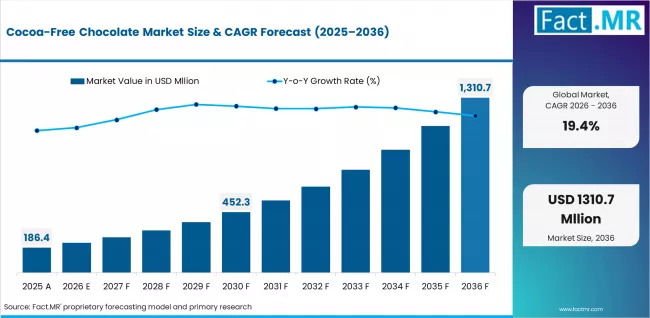
  • Global cocoa-free chocolate market revenue stood at USD 186.4 Mn in 2025 and is forecast to reach USD 1,310.7 Mn by 2036.
  • At a 19.4% CAGR from 2026 to 2036.
  • This market is set to expand ~ 5.9x in value, adding USD 1,088 Mn in absolute opportunity.
  • This represents a sustainability-driven transformation rather than conventional confectionery market expansion, driven by rising cocoa supply volatility, increasing climate-related concerns surrounding cocoa cultivation, accelerating consumer demand for ethical and plant-based chocolate alternatives, and rapid advancements in fermentation and cocoa-free ingredient technologies.
  • Growth momentum is expected to remain strong due to expanding retail penetration, increasing investment in alternative chocolate innovation, and growing adoption across bakery, snacks, and beverage applications, although factors such as premium product pricing, taste replication challenges, limited large-scale production capacity, and evolving regulatory labeling standards may moderate commercialization across certain consumer segments and regional markets.
Cocoa Free Chocolate Market  Value Analysis

Summary of the Cocoa-Free Chocolate Market

  • Market Snapshot
    • Global cocoa-free chocolate market revenue stood at USD 186.4 Mn in 2025 and is forecast to reach USD 1,310.7 Mn by 2036.
    • At a 19.4% CAGR from 2026 to 2036, this market is set to expand ~5.9x in value, adding USD 1,088 Mn in absolute opportunity.
    • Growth is being driven by increasing adoption of sustainable, cocoa-alternative confectionery products across retail, foodservice, and food manufacturing industries.
    • Rising concerns regarding cocoa supply volatility, climate impact on cocoa farming, and demand for sustainable food innovation are accelerating deployment of cocoa-free chocolate formulations.
    • Advancements in fermentation-based ingredients, plant-derived flavor systems, and sugar-reduction technologies are further supporting market expansion globally.
  • Demand and Growth Drivers
    • Increasing consumer demand for sustainable and climate-resilient chocolate alternatives is driving market growth.
    • Growing concerns over cocoa supply chain instability and rising cocoa prices are supporting adoption of cocoa-free formulations.
    • Expansion of plant-based and clean-label confectionery innovation across retail and foodservice sectors is accelerating product adoption.
    • Rising investments in food-tech, fermentation-derived ingredients, and alternative flavor technologies are enhancing commercialization potential.
    • Need for solutions that provide:
      • Sustainable chocolate alternatives
      • Reduced dependency on cocoa supply chains
      • Clean-label and plant-based ingredient profiles
      • Improved flavor innovation and sugar optimization
  • Product and Segment View
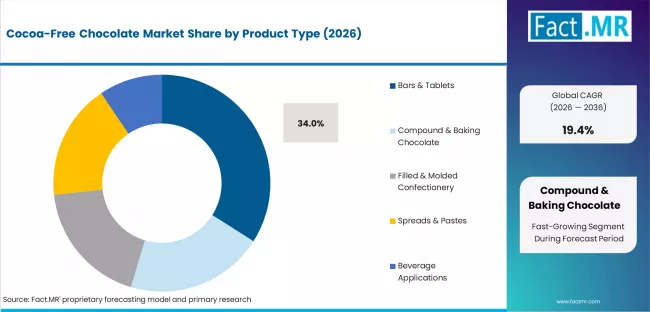
    • Bars & tablets hold 34% of product type share in 2025, emerging as the leading segment due to widespread consumer adoption and retail availability.
    • Compound & baking chocolate accounts for 24% share, while filled & molded confectionery represents 18%.
    • Beverage applications contribute 13% share, while spreads & pastes account for 11%.
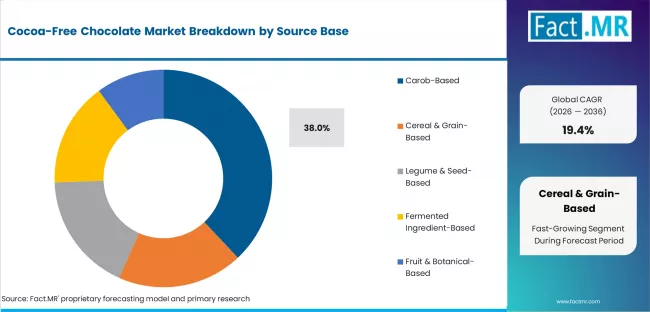
    • Carob-based formulations hold 38% share by source base in 2025, positioning them as the dominant segment driven by flavor similarity and established use in cocoa alternatives.
    • Cereal & grain-based sources represent 21% share, while legume & seed-based sources account for 19%.
    • Fermented ingredient-based systems contribute 14%, while fruit & botanical-based sources represent 8%.
    • Sugar-sweetened formulations hold 46% share by sweetener type, supported by mainstream confectionery demand and taste familiarity.
  • Geography and Competitive Outlook
    • Growth is supported across North America, Europe, and Asia Pacific driven by increasing demand for sustainable confectionery and alternative ingredient innovation.
    • Key growth markets and CAGR include: U.S. 16.8%, Germany 17.2%, Japan 17.6%, U.K. 18.1%, China 20.4%, India 22.8%, and South Korea 23.5%.
    • Market expansion is closely tied to:
      • Increasing deployment of cocoa-alternative ingredients
      • Expansion of plant-based and sustainable confectionery products
      • Rising investment in food-tech and fermentation-based chocolate alternatives
      • Key companies active in this market include Planet A Foods, Voyage Foods, Win-Win, Foreverland, and Nukoko.
  • Analyst Opinion
    • Shambhu Nath Jha, Principal Consultant at Fact.MR, says, “The Cocoa-Free Chocolate Market is no longer defined solely by niche cocoa substitutes and experimental confectionery formulations. Growth is increasingly driven by fermentation-enabled cocoa alternatives, plant-based ingredient innovation, sustainable sourcing priorities, and the shift toward climate-resilient chocolate production solutions that enhance taste replication, clean-label positioning, supply chain stability, and scalability across confectionery, bakery, beverage, foodservice, and functional snacking applications.

Cocoa-Free Chocolate Market— At a Glance

Attribute Details
Market Value 2025 USD 186.4 Mn
Market Value 2036 USD 1,310.7 Mn
Absolute Dollar Opportunity 2025–2036 USD 1,088 Mn
Total Growth 2025–2036 603.4%
CAGR 2026–2036 19.4%
Growth Multiple ~5.9x
Key Demand Theme Increasing adoption of sustainable and cocoa-alternative confectionery products
Leading Segment by Product Type (2025) Bars & Tablets
Segment Share (2025) 34%
Leading Segment by Source Base (2025) Carob-Based
Segment Share (2025) 38%
Leading Segment by Sweetener Type (2025) Sugar-Sweetened
Segment Share (2025) 46%
Leading Segment by End User (2025) Household Consumers
Segment Share (2025) 52%
Leading Segment by Distribution Channel (2025) Store-Based Retail
Segment Share (2025) 43%
Key Growth Regions North America, Europe, Asia Pacific
Country CAGRs U.S. 16.8%, Germany 17.2%, Japan 17.6%, U.K. 18.1%, China 20.4%, India 22.8%, South Korea 23.5%
Top Companies Planet A Foods, Voyage Foods, Win-Win, Foreverland, Nukoko
Segmentation by Product Type Bars & Tablets, Compound & Baking Chocolate, Filled & Molded Confectionery, Spreads & Pastes, Beverage Applications
Segmentation by Source Base Carob-Based, Cereal & Grain-Based, Legume & Seed-Based, Fermented Ingredient-Based, Fruit & Botanical-Based
Segmentation by Sweetener Type Sugar-Sweetened, Natural Alternative Sweeteners, Sugar Alcohol-Based, No Added Sugar
Segmentation by End User Household Consumers, Food Processing Industry, HoReCa Sector
Segmentation by Distribution Channel Store-Based Retail, Specialty Retail, Online Retail, Foodservice & Institutional
Segmentation by Region North America, Latin America, Europe, Asia Pacific, Middle East & Africa

Key Growth Drivers, Constraints, and Opportunities
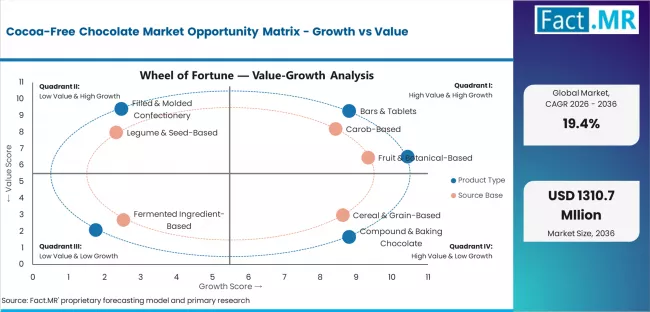
Cocoa Free Chocolate Market Opportunity Matrix Growth Vs Value

Key Factors Driving Growth

  • The demand for cocoa-free chocolate products is expected to rise globally as a result of the increasing popularity of sustainable confectionery products, plant-based snacks, ethical sourcing practices, and climate-conscious food consumption.
  • Demand for high-end cocoa-alternative formulations, fermentation-based flavor development technologies and clean-label ingredient systems capable of replacing the conventional chocolate flavor and texture is growing.
  • The growing number of cocoa-free chocolate adoption in the confectionery, bakery, desserts, beverages, and functional snacking categories will further drive the market growth across the globe.
Growth Driver Demand Impact Time Horizon Key Impact Area Fact.MR Insight
Rising cocoa price volatility and supply shortages High Short-Mid Term Alternative confectionery demand Cocoa supply instability is accelerating adoption of cocoa-free chocolate alternatives
Increasing consumer preference for sustainable and ethical food products High Short-Mid Term Sustainable confectionery Consumers are shifting toward environmentally responsible chocolate alternatives
Expansion of plant-based and clean-label food categories High Mid-Long Term Vegan and clean-label products Manufacturers are incorporating cocoa-free ingredients into broader plant-based portfolios
Advancements in fermentation and flavor replication technologies Medium-High Mid-Long Term Product innovation and taste enhancement Improved sensory replication is enhancing mainstream consumer acceptance
Growing investment in food-tech startups and alternative ingredient platforms Medium Short-Mid Term Commercialization and scalability Venture funding and strategic partnerships are accelerating market commercialization

Key Market Constraints

  • The cost of ingredients that are free of cocoa, precision fermentation technologies and specialty formulation systems will be expected to impede market growth, particularly in the global market.
  • Consumer adoption may be hindered by taste replication, texture consistency and raw material sourcing issues, as well as scalability of alternative raw materials.
  • New food labelling rules, differing definitions of chocolate across regions and lack of awareness in emerging markets can provide challenges to large-scale commercialization.

Key Opportunity Areas

  • Rising demand for confectionery, bakery, beverages, frozen desserts and functional snack applications will be expected to benefit manufacturers of cocoa-free ingredients and alternative chocolate solutions.
  • Manufacturers of cocoa-free ingredients and alternative chocolate solutions are expected to benefit from rising demand in confectionery, bakery, beverages, frozen desserts and functional snack applications.
  • Increased adoption of cocoa-free chocolate in vegan chocolate, low carbon foods, sustainable gift products, chocolate-based premium snacks and chocolate foodservice are expected to drive new growth opportunities.
  • Long-term market value is expected through increased investments in fermentation technologies, climate-resilient food innovation, scalable alternative ingredient production systems and clean-label formulations.

Segment-wise Analysis of the Cocoa-Free Chocolate Market

  • By the year 2026, Bars & Tablets account for a 34% market share of the product type segment due to rising consumer preference for convenient chocolate alternatives, increasing retail availability of plant-based confectionery products, growing demand for sustainable snacking formats, and expanding commercialization of cocoa-free chocolate bars across premium and mainstream categories.
  • Carob-Based ingredients represent a 38% market share of the source base segment by 2026, driven by their natural chocolate-like flavor profile, established use in confectionery formulations, cost-effectiveness compared to cocoa, and increasing adoption in clean-label and sustainable chocolate alternative products globally.

The segmentation of the Cocoa-Free Chocolate Market includes product type, source base, sweetener type, end user, distribution channel, and region.

Which Product Type Dominates the Cocoa-Free Chocolate Market?
Cocoa Free Chocolate Market Analysis By Product Type

Bars & Tablets have a market share of 34% due to higher consumer recognition, ready-to-consume format, increased retail availability, and growing consumption of sustainably produced chocolate products. The market is anticipated to witness consistent sales growth driven by the rise in popularity of plant-based chocolates, expansion in premium snacking, and higher penetration of cocoa-free bars through physical stores and online retail platforms. Some of the key drivers of growth include increasing consumer awareness concerning ethical chocolate production, rise in climate-based issues related to the cultivation of cocoa, increasing inclination towards clean-label snacks, and ongoing developments in flavor and texture technology.

Which Source Base Dominates the Cocoa-Free Chocolate Market?
Cocoa Free Chocolate Market Analysis By Source Base

Carob-Based Ingredients have a market share of 38% due to their naturally sweet taste profile, resemblance to chocolate flavor, historical usage in confectionery applications, and lower prices compared to cocoa-based ingredients. The market is expected to observe increasing demand for commercially available sustainable chocolate products and growing interest towards naturally sourced cocoa alternatives. Some of the important factors fueling growth in the market include increasing consumer preference for clean-label food ingredients, increasing usage of plant-based formulations, improving position within vegan confectioneries, and expansion of application areas in bakery, dessert, and snacking applications.

Which Sweetener Type Dominates the Cocoa-Free Chocolate Market?
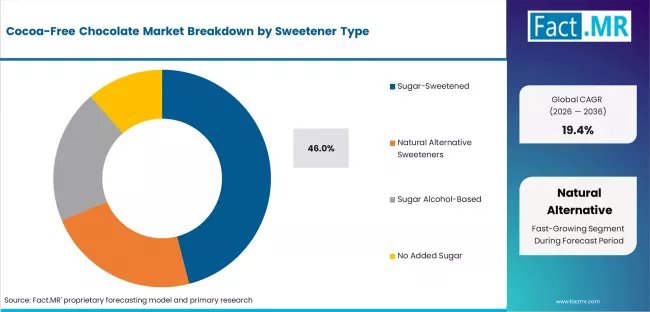
Cocoa Free Chocolate Market Analysis By Sweetener Type

Sugar-Sweetened Products have a market share of 46% owing to higher mainstream consumer appeal, enhanced familiarity with taste profile, extensive product availability, and persistent demands for indulgence confectionery products. Strong growth in the market is expected to be witnessed with manufacturers focusing on delivering products that are identical in terms of taste to regular chocolate products but can be made available in mass markets. Some of the important growth drivers include increasing demand for economically priced alternatives, growing retail availability of cocoa-free products, innovations in flavor systems, and consumer preferences for indulgent snacks.

Which End User Dominates the Cocoa-Free Chocolate Market?
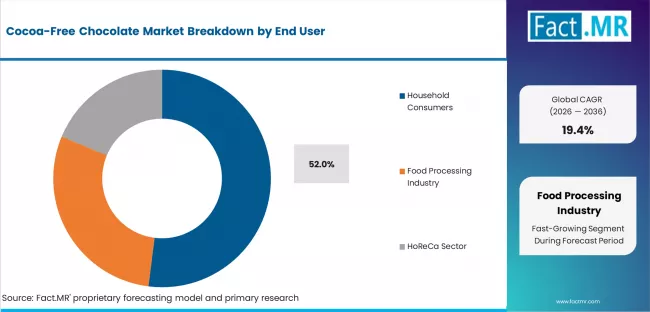
Cocoa Free Chocolate Market Analysis By End User

Household Consumers have a market share of 52% due to growing consumer interest towards sustainable food consumption, adoption of plant-based diets, and increasing interest in ethical confectioneries. Increasing penetration of cocoa-free snacks across supermarkets, specialty stores, and e-commerce platforms are expected to help drive the growth in sales. Some of the prominent drivers contributing to growth in the market include increasing consumer awareness regarding sustainability of cocoa production, rising preferences for clean-label products, premium gifting practices, and rising availability of innovative cocoa-free chocolate products.

Which Distribution Channel Dominates the Cocoa-Free Chocolate Market?
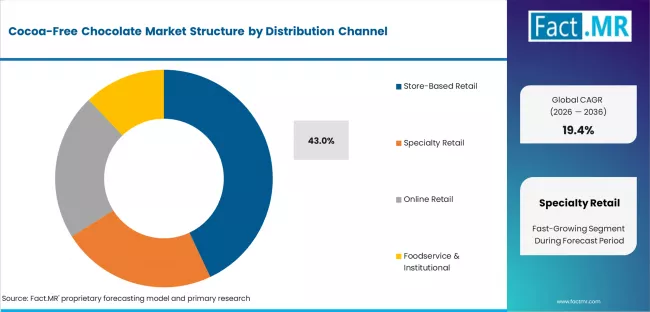
Cocoa Free Chocolate Market Analysis By Distribution Channel

Store-Based Retail holds a market share of 43% due to extensive penetration of supermarkets and hypermarkets, increasing availability of alternative confectionery products, and growing consumer interest in in-store discovery of new products. Growing investments towards premium chocolate sections and sustainable snack categories within organized retail formats are expected to lead to further growth in the market. Some of the important growth factors include increasing partnerships between retailers and manufacturers, higher incidences of impulse purchases of confectionery, greater availability of vegan and plant-based chocolate alternatives, and promotional activities from emerging cocoa-free brands.

Regional Outlook Across Key Markets

The market analysis covers key global regions, including South Asia and Pacific, Middle East & Africa, North America, Latin America, Western Europe, and Eastern Europe. It is segmented geographically, with specific market dynamics for each region. The full report provides a detailed market attractiveness analysis.

Top Country Growth Comparison Cocoa Free Chocolate Market Cagr (2026 2036)

CAGR Table

Country CAGR (%)
U.S. 16.8%
Germany 17.2%
Japan 17.6%
U.K. 18.1%
China 20.4%
India 22.8%
South Korea 23.5%

Source: Fact.MR (FMR) analysis, based on proprietary forecasting model and primary research.
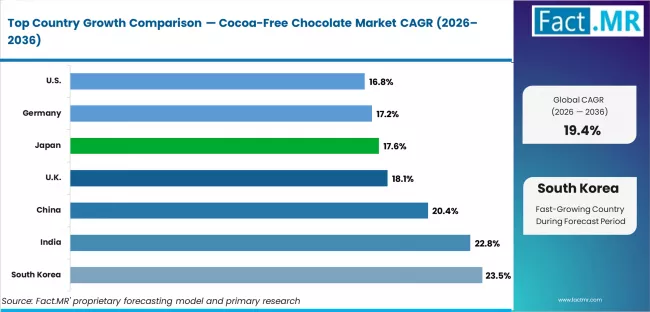
Cocoa Free Chocolate Market Cagr Analysis By Country

North America: The Commercialization and Venture Capital Hub

North America represents the commercialization center of the cocoa-free chocolate market, supported by strong food-tech investments, premium confectionery demand, and retailer openness to sustainable alternatives. The region benefits from active participation by companies such as Voyage Foods, Mars Incorporated, and Hershey Company, all of which are exploring climate-resilient ingredient solutions. Consumer demand for clean-label, allergen-free, and environmentally sustainable products continues to support rapid category expansion across retail and foodservice channels.

  • U.S.: Demand for cocoa-free chocolate in the U.S. is projected to rise at 16.8% CAGR through 2036. Growth in the U.S. is being driven by food-tech innovation funding, sustainable sourcing concerns, and premium retail expansion. In February 2025, Voyage Foods expanded manufacturing capabilities for cocoa-free spreads and confectionery alternatives to address rising demand from foodservice buyers [1]. In March 2025, the U.S. Food and Drug Administration updated guidance around food labeling transparency for alternative ingredient formulations, supporting adoption of novel cocoa substitutes [2].

Western Europe: The Global Sustainability and Innovation Laboratory
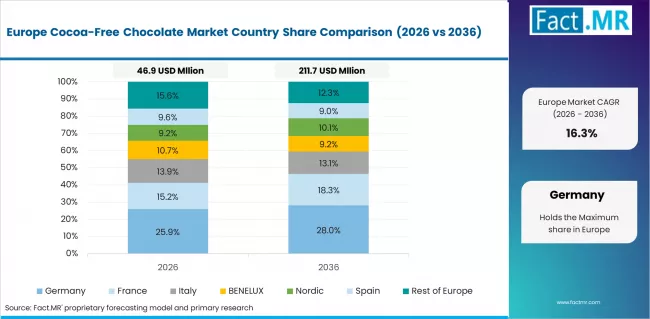
Cocoa Free Chocolate Market Europe Country Market Share Analysis, 2026 & 2036

Western Europe functions as the sustainability and alternative ingredient innovation center of the cocoa-free chocolate market. Strong environmental regulations, consumer preference for ethical sourcing, and premium confectionery culture continue to support regional leadership. Key participants include Planet A Foods, Lindt & Sprüngli, and Barry Callebaut. The region is witnessing increasing partnerships between ingredient technology firms and established confectionery manufacturers focused on climate-resilient chocolate alternatives.

  • Germany: Demand for cocoa-free chocolate in Germany is projected to rise at 17.2% CAGR through 2036. Germany’s growth is supported by strong food-tech innovation ecosystems and sustainability-focused consumer purchasing behavior. In January 2025, Planet A Foods expanded production capacity for its ChoViva cocoa-free ingredient platform to support European confectionery manufacturers [3]. In April 2025, the German Federal Ministry of Food and Agriculture strengthened climate-oriented food innovation initiatives supporting alternative ingredient commercialization [4].

East Asia: The High-Growth Functional Confectionery Market
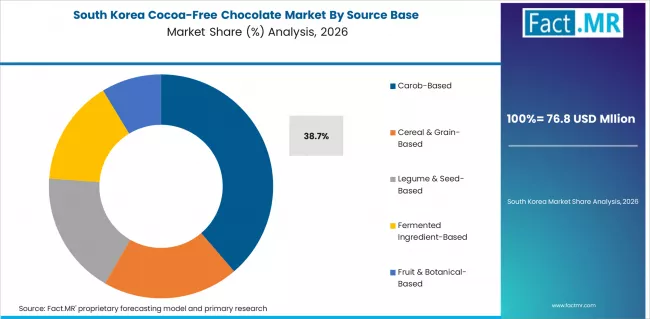
Cocoa Free Chocolate Market South Korea Market Share Analysis By Source Base

East Asia represents one of the fastest-growing regional markets due to advanced food manufacturing infrastructure, premium gifting culture, and rapid adoption of functional confectionery products. Major participants include Fazer, Nestlé, and Barry Callebaut. Strong consumer interest in sustainability, premiumization, and novel flavors continues to create favorable conditions for cocoa-free product innovation and market penetration.

  • China: Demand for cocoa-free chocolate in China is projected to rise at 20.4% CAGR through 2036. China is witnessing rapid growth due to rising premium confectionery consumption and large-scale investment in food innovation technologies. In February 2025, Barry Callebaut expanded regional innovation activities in Asia focused on sustainable chocolate formulations [5]. In April 2025, the State Administration for Market Regulation advanced food labeling and traceability initiatives supporting sustainable ingredient transparency [6].
  • South Korea: Demand for cocoa-free chocolate in South Korea is projected to rise at 23.5% CAGR through 2036. South Korea is emerging as a high-growth market due to strong consumer responsiveness to premium food innovation and sustainability-driven consumption trends. In January 2025, Lotte Wellfood expanded sustainable snack product development initiatives targeting younger consumers [7].

South Asia & Pacific: The Emerging Consumption and Manufacturing Base

South Asia & Pacific is developing into a major future growth region due to expanding middle-class consumption, rising urbanization, and increasing exposure to premium international confectionery brands. Companies such as Mondelez International and Nestlé continue expanding sustainable and premium confectionery portfolios across the region. Growing digital retail ecosystems and evolving consumer preferences for healthier indulgence products are creating strong long-term opportunities for cocoa-free chocolate manufacturers.

  • India: Demand for cocoa-free chocolate in India is projected to rise at 22.8% CAGR through 2036. India’s market is expanding rapidly due to increasing premium chocolate consumption and growing awareness regarding sustainable food products. In March 2025, Mondelez India expanded premium chocolate distribution networks across Tier-1 and Tier-2 cities. In June 2025, the Food Safety and Standards Authority of India reinforced clean-label and food transparency initiatives relevant to alternative ingredient products [8].

Fact.MR’s analysis of the global cocoa-free chocolate market delivers region-wise and country-wise assessment across North America, Western Europe, East Asia, South Asia & Pacific, Eastern Europe, Latin America, and the Middle East & Africa. Readers can access detailed insights on market growth outlook, sustainability trends, alternative ingredient innovation, competitive benchmarking, pricing dynamics, distribution channel expansion, and evolving consumer demand patterns shaping the future of cocoa-free confectionery worldwide.

Competitive Benchmarking and Company Positioning
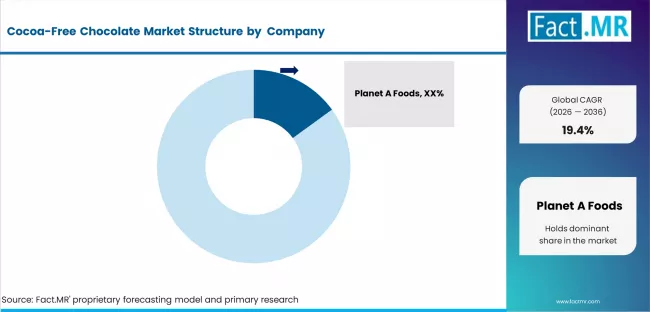
Cocoa Free Chocolate Market Analysis By Company

Leading Companies Shaping the Cocoa-Free Chocolate Market

The cocoa-free chocolate market is moderately fragmented, with innovators like Planet A Foods, Voyage Foods and WNWN Food Labs, and global confectionery companies like Nestlé, Mars Incorporated and Barry Callebaut dominating it. These are mostly the top players who account for almost 45% to 55% of the market share, competing with each other mainly based on taste replication, sustainability and the ability to produce products on a scale. Integrated sourcing, global distribution and R&D capabilities are advantageous for large manufacturers, while proprietary formulations and sustainability branding are key for startups. Buyers minimize dependency on suppliers by adopting multi-sourcing models, with the exception of companies that can supply a consistent quality, have a commercial scale and can provide sustainable ingredient platforms.

Key Players of the Cocoa-Free Chocolate Market

  • Planet A Foods
  • Voyage Foods
  • WNWN Food Labs
  • Foreverland food
  • Fazer
  • Barry Callebaut. 
  • Cargill, Incorporated
  • Nestlé
  • Lindt & Sprüngli
  • Mars Incorporated
  • Nukoko Ltd 

Recent Industry Developments

  • Planet A Foods expands international commercialization of ChoViva cocoa-free chocolate (September 2025): Planet A Foods expanded ChoViva distribution into Japan through a partnership with AEON under the TOPVALU private-label brand, marking the company’s first commercial expansion outside Europe and strengthening its global cocoa-free confectionery footprint. (Planet A Foods Press Release) [9]
  • Cargill and Voyage Foods launch NextCoa cocoa-free confectionery platform in North America (May 2026): Cargill, Incorporated partnered with Voyage Foods to commercialize the NextCoa cocoa-free confectionery platform across North America, helping manufacturers address cocoa price volatility and sustainable sourcing challenges. (Cargill News Release) [10]
  • Barry Callebaut and Planet A Foods establish strategic cocoa-free partnership (November 2025): Barry Callebaut entered a strategic partnership with Planet A Foods to scale ChoViva cocoa-free chocolate alternatives globally. The collaboration focuses on sustainable ingredient innovation, expanded European commercialization, and resilient non-cocoa chocolate supply chains. (Barry Callebaut News Release) [11]

Sources and Research References

  • [1] Voyage Foods, “Voyage Foods Expands Cocoa-Free Production Capacity for Commercial Food Applications,” February 2025
  • [2] U.S. Food and Drug Administration, “Food Labeling Guidance for Alternative Ingredient Transparency,” March 2025
  • [3] Planet A Foods, “Planet A Foods Expands ChoViva Production Capacity in Europe,” January 2025
  • [4] German Federal Ministry of Food and Agriculture, “Climate-Oriented Food Innovation Support Initiatives,” April 2025
  • [5] Barry Callebaut, “Barry Callebaut Expands Sustainable Chocolate Innovation Activities in Asia,” February 2025
  • [6] State Administration for Market Regulation of China, “Food Labeling and Traceability Regulatory Updates,” April 2025
  • [7] Lotte Wellfood, “Lotte Wellfood Expands Sustainable Snack Product Development Initiatives,” January 2025
  • [8] Food Safety and Standards Authority of India, “Clean Label and Food Transparency Regulatory Initiatives,” June 2025
  • [9] Planet A Foods, “ChoViva in Asia,” September 2025
  • [10] Cargill, Incorporated, “Cargill and Voyage Foods Bring NextCoa Cocoa-Free Confectionery Alternatives to North America,” May 2026
  • [11] Barry Callebaut, “Barry Callebaut and Planet A Foods Announcement,” November 2025

Cocoa-Free Chocolate Market Definition

Cocoa-free chocolate is defined as chocolate-type food confectioneries which have been manufactured without using any cocoa solids and cocoa powder in the formula composition. Other materials used in the development of this type of chocolate include ingredients like carob, cereals, legumes, sunflower seeds, fermented grains, or herbal extracts in order to achieve desired taste, texture, aroma, and functionality of chocolate. This category of products applies to all confectionery products intended for use in various markets like confectionery, bakery, beverages, desserts, and healthy snacks.

Cocoa-Free Chocolate Market Inclusions

The research encompasses the assessment of the market size and forecast, price trends, and supply and demand dynamics related to cocoa-free chocolate products worldwide, at a regional level and in different segments. Segmentation covered in the report will comprise product types, sources, sweeteners, end-users, distribution channels, and regions. Moreover, trends of innovation, sustainability, competitive benchmarking, trade flow assessment, and adoption rate across applications will be evaluated.

Cocoa-Free Chocolate Market Exclusions

In the current scope, cocoa-free chocolate does not encompass traditional chocolate products that involve conventional cocoa liquor, cocoa butter, or cocoa powder as core ingredients in their composition. In addition, the research does not include the market segment dedicated to the cultivation of cocoa crops, raw cocoa beans trading, and processing of conventional chocolate. Finally, other confectionery products without cocoa-free indication and artificial flavors produced for sale separately do not belong to the research scope.

Cocoa-Free Chocolate Market Research Methodology

  • Primary Research
    • Primary research entailed the use of interviews from cocoa-free chocolate producers, ingredient suppliers, food technology startups, confectionery processors, distribution firms, retail channel partners, and industry consultants. Additional insights were acquired from product development managers, sustainability specialists, and executives engaged in alternative chocolate innovations and commercialization strategies.
  • Desk Research
    • Secondary research involved the review of annual reports, corporate presentations, product launch press releases, sustainability information, industry journals, food industry databases, government trade data, import/export figures, and regulatory journals concerning confectionery, alternative ingredient products, and plant-based food products.
  • Market-Sizing and Forecasting
    • Market sizing was performed by applying a composite forecast method that incorporates bottom-up company financial analysis alongside top-down confectionery and alternative chocolate industry adoption demand forecast. Adoption rates, price analysis, innovation pipeline evaluation, and regional consumption trends for alternative chocolate in end-use markets were used to forecast future market opportunities.
  • Data Validation and Update Cycle
    • Market sizing was cross-referenced using triangulation through primary interviews, financial analysis, supply chain analysis, and regional trade information. Market forecasts assumptions and market dynamics are constantly evaluated and updated as necessary based on changes in product adoption and market trends such as new product launches, industry investments, regulation, and consumer buying habits.

Scope of Analysis
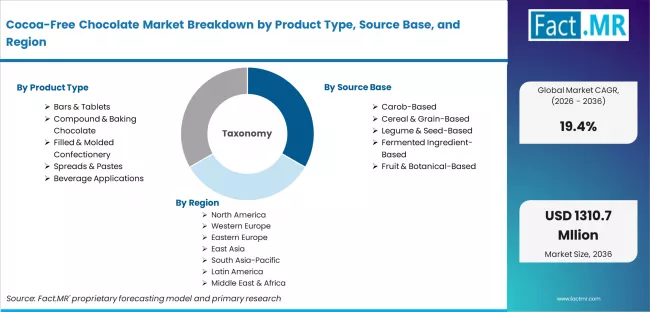
Cocoa Free Chocolate Market Breakdown By Product Type, Source Base, And Region

Parameter Details
Quantitative Units USD 186.4 million in 2025 to USD 1,310.7 million in 2036, at a CAGR of 19.4%
Market Definition The cocoa-free chocolate market comprises confectionery products formulated without cocoa beans using alternative ingredients such as carob, grains, legumes, and fermented materials to replicate conventional chocolate taste, texture, and functionality sustainably.
Regions Covered North America, Latin America, Europe, East Asia, South Asia and Pacific, MiddleEastand Africa
Countries Covered USA, Canada, UK, Germany, China, India, 30 plus countries
Key Companies Planet A Foods, Voyage Foods, WNWN Food Labs, Foreverland food, Fazer, Barry Callebaut., Cargill, Incorporated, Nestlé, Lindt & Sprüngli, Mars Incorporated, Nukoko Ltd
Forecast Period 2026 to 2036
Approach Hybrid demand-side and top-downmethodologybuilt on country-level application demand, product benchmarking, pricing analysis, shipment validation, and primary interviews across manufacturers, distributors, retailers, and end users

Analysis by Product Type, by Source Base, by Sweetener Type, by End User, by Distribution Channel and by Region

  • Cocoa-Free Chocolate Market by Product Type

    • Bars & Tablets
      • Dark-Style
      • Milk-Style
      • White-Style
    • Compound & Baking Chocolate
      • Chips
      • Baking Blocks
      • Coatings
    • Filled & Molded Confectionery
      • Pralines
      • Truffles
      • Filled Bites
    • Spreads & Pastes
      • Sweet Spreads
      • Dessert Fillings
    • Beverage Applications
      • Hot Chocolate Mixes
      • Ready-to-Drink Beverages
  • Cocoa-Free Chocolate Market by Source Base

    • Carob-Based
      • Pure Carob
      • Carob Blends
    • Cereal & Grain-Based
      • Oat-Based
      • Barley-Based
    • Legume & Seed-Based
      • Fava Bean-Based
      • Sunflower Seed-Based
    • Fermented Ingredient-Based
      • Fermented Grains
      • Fermented Pulses
    • Fruit & Botanical-Based
      • Grape Seed-Based
      • Date-Based
  • Cocoa-Free Chocolate Market by Sweetener Type

    • Sugar-Sweetened
      • Cane Sugar
      • Beet Sugar
    • Natural Alternative Sweeteners
      • Stevia
      • Monk Fruit
    • Sugar Alcohol-Based
      • Erythritol
      • Maltitol
    • No Added Sugar
      • Unsweetened
      • Naturally Sweetened
  • Cocoa-Free Chocolate Market by End User

    • Household Consumers
      • Everyday Consumption
      • Gifting
    • Food Processing Industry
      • Bakery
      • Dairy & Frozen Desserts
    • HoReCa Sector
      • Restaurants
      • Artisan Chocolatiers
  • Cocoa-Free Chocolate Market by Distribution Channel

    • Store-Based Retail
      • Supermarkets & Hypermarkets
      • Convenience Stores
    • Specialty Retail
      • Health Food Stores
      • Gourmet Stores
    • Online Retail
      • Brand Websites
      • E-commerce Marketplaces
    • Foodservice & Institutional
      • Cafés & Bakeries
      • Hotels & Restaurants
  • Cocoa-Free Chocolate Market by Region

    • North America
      • USA
      • Canada
      • Mexico
    • Latin America
      • Brazil
      • Chile
      • Rest of LATAM
    • East Asia
      • China
      • Japan
      • South Korea
    • Western Europe
      • Germany
      • Italy
      • France
      • U.K.
      • Spain
      • BENELUX
      • Nordic
      • Rest of W. Europe
    • Eastern Europe
      • Russia
      • Hungary
      • Poland
      • Balkan & Baltics
      • Rest of E. Europe
    • South Asia & Pacific
      • India
      • ASEAN
      • ANZ
      • Rest of SAP
    • Middle East and Africa
      • Kingdom of Saudi Arabia
      • United Arab Emirates
      • South Africa
      • Rest of Middle East and Africa

- Frequently Asked Questions -

How large is the demand for Cocoa-Free Chocolate in the global market in 2026?

Demand for Cocoa-Free Chocolate in the global market is estimated to be valued at USD 222.6 million in 2026.

What will be the market size of Cocoa-Free Chocolate in the global market by 2036?

The market size for Cocoa-Free Chocolate is projected to reach USD 1,310.7.7 million by 2036.

What is the expected demand growth for Cocoa-Free Chocolate in the global market between 2026 and 2036?

Demand for Cocoa-Free Chocolate in the global market is expected to grow at a CAGR of 19.4% between 2026 and 2036, driven by rising sustainability concerns, cocoa supply volatility, and demand for alternative chocolate ingredients.

Which product type is expected to dominate the market?

Bars & Tablets are expected to dominate the market, accounting for 34% of the market share in 2026, supported by growing consumer preference for convenient and sustainable confectionery products.

Which region is expected to show the highest growth rate for Cocoa-Free Chocolate?

South Korea is projected to show the highest regional CAGR at 23.5%, supported by rapid adoption of innovative food products and increasing demand for sustainable confectionery alternatives.

How significant is the growth outlook for India in this market?

India is expected to grow at a CAGR of 22.8%, reflecting rising consumption of premium confectionery products and growing awareness of sustainable food choices.

What is the growth outlook for China in this report?

China is anticipated to grow at a CAGR of 20.4%, supported by expansion of plant-based food products and increasing innovation in alternative ingredients.

Which company is identified as a leading player in the Cocoa-Free Chocolate market?

Planet A Foods is recognized as a leading player in this market, developing cocoa-free chocolate alternatives using sustainable ingredient technologies.

Table of Content

  1. Cocoa-Free Chocolate Market – Executive Summary
  2. Market Overview
    • Market Definition & Introduction
    • Market Taxonomy & Research Scope
  3. Global Cocoa-Free Chocolate Market Demand Analysis 2021-2025 and Forecast, 2026–2036
    • Historical Market Volume (MT) Analysis, 2021-2025
    • Current and Future Market Volume (MT) Projections, 2026–2036
    • Y-o-Y Growth Trend Analysis
  4. Global Cocoa-Free Chocolate Market - Pricing Analysis
    • Product Category and Country-Level Pricing Analysis
    • Region Average Pricing Analysis Benchmark
    • Price Trends and Forecasts
      • Historical price trends
      • Future price forecasts
    • Factors Influencing Pricing
    • Competitive Pricing Strategies
    • Cocoa Price Volatility and Supply Shortages
    • Pricing Competitiveness versus Conventional Chocolate
  5. Global Cocoa-Free Chocolate Market Demand (in Value or Size in US$ Mn) Analysis 2021-2025 and Forecast, 2026–2036
    • Historical Market Value (US$ Mn) Analysis, 2021-2025
    • Current and Future Market Value (US$ Mn) Projections, 2026–2036
      • Y-o-Y Growth Trend Analysis
      • Absolute $ Opportunity Analysis
  6. Market Background and Foundational Data Points
    • Consumer Shift Toward Sustainable Confectionery Products
    • Adoption of Plant-Based and Vegan Diets
    • Investment in Cocoa-Free Food Technology and Fermentation Startups
    • Expansion of Alternative Chocolate Product Launches
    • Retail Penetration Across Supermarkets and E-commerce Channels
    • Consumer Awareness Regarding Deforestation and Ethical Sourcing
    • Availability and Cost of Alternative Raw Materials (Carob, Oats, Fava Beans, Sunflower Seeds)
    • R&D Advancements in Flavor Replication and Texture Enhancement
    • Growth in Functional and Clean-Label Food Consumption
    • Foodservice and Bakery Industry Adoption of Cocoa Alternatives
    • Trade Scenario, 2025
      • Imports and Export Analysis
        • By Region
        • By Country
    • Start-up Ecosystem Analysis, 2021-2025
    • Cocoa-Free Chocolate Market Opportunity Assessment
      • Total Available Market (US$ Mn)
      • Serviceable Addressable Market (US$ Mn)
      • Serviceable Obtainable Market (US$ Mn)
    • Porter’s Five Forces and PESTEL Analysis
    • Investment Feasibility Analysis
    • Macro-Economic Factors & Forecast Factors - Relevance & Impact
    • Industry Value and Supply Chain Analysis
      • List of Key Channel Partners
      • Profit Margin & Operating Margin at Each Node of Supply Chain.
      • Notes on Value Added at Each Node in the Value Chain
      • Factors Influencing Value Chain
    • Market Dynamics
      • Drivers
      • Restraints
      • Opportunity Analysis
    • Key Regulations & Certifications
  7. Cocoa-Free Chocolate Market Analysis 2021-2025 and Forecast 2026–2036, By Product Type
    • Introduction / Key Findings
    • Historical Market Size (US$ Mn) & Volume (MT) Trend Analysis By Product Type, 2021-2025
    • Current and Future Market Size (US$ Mn) & Volume (MT) Analysis and Forecast By Product Type, 2026-2036
      • Bars & Tablets
        • Dark-Style
        • Milk-Style
        • White-Style
      • Compound & Baking Chocolate
        • Chips
        • Baking Blocks
        • Coatings
      • Filled & Molded Confectionery
        • Pralines
        • Truffles
        • Filled Bites
      • Spreads & Pastes
        • Sweet Spreads
        • Dessert Fillings
      • Beverage Applications
        • Hot Chocolate Mixes
        • Ready-to-Drink Beverages
    • Market Attractiveness Analysis By Product Type
  8. Cocoa-Free Chocolate Market Analysis 2021-2025 and Forecast 2026–2036, By Source Base
    • Introduction / Key Findings
    • Historical Market Size (US$ Mn) & Volume (MT) Trend Analysis By Source Base, 2021-2025
    • Current and Future Market Size (US$ Mn) & Volume (MT) Analysis and Forecast By Source Base, 2026-2036
      • Carob-Based
        • Pure Carob
        • Carob Blends
      • Cereal & Grain-Based
        • Oat-Based
        • Barley-Based
      • Legume & Seed-Based
        • Fava Bean-Based
        • Sunflower Seed-Based
      • Fermented Ingredient-Based
        • Fermented Grains
        • Fermented Pulses
      • Fruit & Botanical-Based
        • Grape Seed-Based
        • Date-Based
    • Market Attractiveness Analysis By Source Base
  9. Cocoa-Free Chocolate Market Analysis 2021-2025 and Forecast 2026–2036, By Sweetener Type
    • Introduction / Key Findings
    • Historical Market Size (US$ Mn) & Volume (MT) Trend Analysis By Sweetener Type, 2021-2025
    • Current and Future Market Size (US$ Mn) & Volume (MT) Analysis and Forecast By Sweetener Type, 2026-2036
      • Sugar-Sweetened
        • Cane Sugar
        • Beet Sugar
      • Natural Alternative Sweeteners
        • Stevia
        • Monk Fruit
      • Sugar Alcohol-Based
        • Erythritol
        • Maltitol
      • No Added Sugar
        • Unsweetened
        • Naturally Sweetened
    • Market Attractiveness Analysis By Sweetener Type
  10. Cocoa-Free Chocolate Market Analysis 2021-2025 and Forecast 2026–2036, By End User
    • Introduction / Key Findings
    • Historical Market Size (US$ Mn) & Volume (MT) Trend Analysis By End User, 2021-2025
    • Current and Future Market Size (US$ Mn) & Volume (MT) Analysis and Forecast By End User, 2026-2036
      • Household Consumers
        • Everyday Consumption
        • Gifting
      • Food Processing Industry
        • Bakery
        • Dairy & Frozen Desserts
      • HoReCa Sector
        • Restaurants
        • Artisan Chocolatiers
    • Market Attractiveness Analysis By End User
  11. Cocoa-Free Chocolate Market Analysis 2021-2025 and Forecast 2026–2036, By Distribution Channel
    • Introduction / Key Findings
    • Historical Market Size (US$ Mn) & Volume (MT) Trend Analysis By Distribution Channel, 2021-2025
    • Current and Future Market Size (US$ Mn) & Volume (MT) Analysis and Forecast By Distribution Channel, 2026-2036
      • Store-Based Retail
        • Supermarkets & Hypermarkets
        • Convenience Stores
      • Specialty Retail
        • Health Food Stores
        • Gourmet Stores
      • Online Retail
        • Brand Websites
        • E-commerce Marketplaces
      • Foodservice & Institutional
        • Cafés & Bakeries
        • Hotels & Restaurants
    • Market Attractiveness Analysis By Distribution Channel
  12. Global Cocoa-Free Chocolate Market Analysis and Forecast, by Region
    • Introduction / Key Findings
    • Historical Market Size (US$ Mn) & Volume (MT) Trend Analysis by Region, 2021-2025
    • Current and Future Market Size (US$ Mn) & Volume (MT) Analysis and Forecast by Region, 2026-2036
      • North America
      • Latin America
      • Western Europe
      • Eastern Europe
      • East Asia
      • South Asia & Pacific
      • Middle East & Africa
    • Market Attractiveness Analysis by Region
  13. North America Cocoa-Free Chocolate Market Analysis and Forecast
    • Introduction / Key Findings
    • Pricing Analysis
    • Historical Market Size (US$ Mn) & Volume (MT) Trend Analysis by Market Taxonomy, 2021-2025
    • Current and Future Market Size (US$ Mn) and Volume (MT) Analysis & Forecast by Market Taxonomy, 2026-2036
    • By Country
      • United States
      • Canada
      • Mexico
    • By Taxonomy
    • Market Attractiveness Analysis By Country & Taxonomy
    • Market Trends
    • Key Market Participants – Intensity Mapping
    • Drivers and Restraints - Impact Analysis
  14. Latin America Cocoa-Free Chocolate Market Analysis and Forecast
    • Introduction / Key Findings
    • Pricing Analysis
    • Historical Market Size (US$ Mn) & Volume (MT) Trend Analysis by Market Taxonomy, 2021-2025
    • Current and Future Market Size (US$ Mn) and Volume (MT) Analysis & Forecast by Market Taxonomy, 2026-2036
    • By Country
      • Brazil
      • Chile
      • Rest of LATAM
    • By Taxonomy
    • Market Attractiveness Analysis By Country & Taxonomy
    • Market Trends
    • Key Market Participants – Intensity Mapping
    • Drivers and Restraints - Impact Analysis
  15. Western Europe Cocoa-Free Chocolate Market Analysis and Forecast
    • Introduction / Key Findings
    • Pricing Analysis
    • Historical Market Size (US$ Mn) & Volume (MT) Trend Analysis by Market Taxonomy, 2021-2025
    • Current and Future Market Size (US$ Mn) and Volume (MT) Analysis & Forecast by Market Taxonomy, 2026-2036
    • By Country
      • Germany
      • Italy
      • France
      • United Kingdom
      • Spain
      • BENELUX
      • Nordics
      • Rest of Western Europe
    • By Taxonomy
    • Market Attractiveness Analysis By Country & Taxonomy
    • Market Trends
    • Key Market Participants – Intensity Mapping
    • Drivers and Restraints - Impact Analysis
  16. Eastern Europe Cocoa-Free Chocolate Market Analysis and Forecast
    • Introduction / Key Findings
    • Pricing Analysis
    • Historical Market Size (US$ Mn) & Volume (MT) Trend Analysis by Market Taxonomy, 2021-2025
    • Current and Future Market Size (US$ Mn) and Volume (MT) Analysis & Forecast by Market Taxonomy, 2026-2036
    • By Country
      • Russia
      • Hungary
      • Poland
      • Balkan & Baltics
      • Rest of Eastern Europe
    • By Taxonomy
    • Market Attractiveness Analysis By Country & Taxonomy
    • Market Trends
    • Key Market Participants – Intensity Mapping
    • Drivers and Restraints - Impact Analysis
  17. East Asia Cocoa-Free Chocolate Market Analysis and Forecast
    • Introduction / Key Findings
    • Pricing Analysis
    • Historical Market Size (US$ Mn) & Volume (MT) Trend Analysis by Market Taxonomy, 2021-2025
    • Current and Future Market Size (US$ Mn) and Volume (MT) Analysis & Forecast by Market Taxonomy, 2026-2036
    • By Country
      • China
      • Japan
      • South Korea
    • By Taxonomy
    • Market Attractiveness Analysis By Country & Taxonomy
    • Market Trends
    • Key Market Participants – Intensity Mapping
    • Drivers and Restraints - Impact Analysis
  18. South Asia & Pacific Cocoa-Free Chocolate Market Analysis and Forecast
    • Introduction / Key Findings
    • Pricing Analysis
    • Historical Market Size (US$ Mn) & Volume (MT) Trend Analysis by Market Taxonomy, 2021-2025
    • Current and Future Market Size (US$ Mn) and Volume (MT) Analysis & Forecast by Market Taxonomy, 2026-2036
    • By Country
      • India
      • ASEAN
      • Australia & New Zealand
      • Rest of South Asia & Pacific
    • By Taxonomy
    • Market Attractiveness Analysis By Country & Taxonomy
    • Market Trends
    • Key Market Participants – Intensity Mapping
    • Drivers and Restraints - Impact Analysi
  19. Middle East & Africa Cocoa-Free Chocolate Market Analysis and Forecast
    • Introduction / Key Findings
    • Pricing Analysis
    • Historical Market Size (US$ Mn) & Volume (MT) Trend Analysis by Market Taxonomy, 2021-2025
    • Current and Future Market Size (US$ Mn) and Volume (MT) Analysis & Forecast by Market Taxonomy, 2026-2036
    • By Country
      • Kingdom of Saudi Arabia
      • Other GCC Countries
      • Turkiye
      • South Africa
      • Other African Union
    • By Taxonomy
    • Market Attractiveness Analysis By Country & Taxonomy
    • Market Trends
    • Key Market Participants – Intensity Mapping
    • Drivers and Restraints - Impact Analysis
  20. Country-level Cocoa-Free Chocolate Market Analysis and Forecast
    • Introduction
    • Market Value Proportion Analysis, By Key Countries
    • Global Vs. Country Growth Comparison
      • United States Cocoa-Free Chocolate Market Analysis
        • Market Size (US$ Mn) & Volume (MT) Analysis by Market Taxonomy, 2021–2036
        • By Product Type
        • By Source Base
        • By Sweetener Type
        • By End User
        • By Distribution Channel
        • Canada Cocoa-Free Chocolate Market Analysis
        • Mexico Cocoa-Free Chocolate Market Analysis
        • Brazil Cocoa-Free Chocolate Market Analysis
        • Chile Cocoa-Free Chocolate Market Analysis
        • Germany Cocoa-Free Chocolate Market Analysis
        • France Cocoa-Free Chocolate Market Analysis
        • Italy Cocoa-Free Chocolate Market Analysis
        • Spain Cocoa-Free Chocolate Market Analysis
        • United Kingdom Cocoa-Free Chocolate Market Analysis
        • BENELUX Cocoa-Free Chocolate Market Analysis
        • Nordics Cocoa-Free Chocolate Market Analysis
        • Poland Cocoa-Free Chocolate Market Analysis
        • Russia Cocoa-Free Chocolate Market Analysis
        • Hungary Cocoa-Free Chocolate Market Analysis
        • Balkan & Baltics Cocoa-Free Chocolate Market Analysis
        • China Cocoa-Free Chocolate Market Analysis
        • Japan Cocoa-Free Chocolate Market Analysis
        • South Korea Cocoa-Free Chocolate Market Analysis
        • India Cocoa-Free Chocolate Market Analysis
        • ASEAN Cocoa-Free Chocolate Market Analysis
        • ANZ Cocoa-Free Chocolate Market Analysis
        • KSA Cocoa-Free Chocolate Market Analysis
        • Other GCC Countries Cocoa-Free Chocolate Market Analysis
        • South Africa Cocoa-Free Chocolate Market Analysis
        • Turkiye Cocoa-Free Chocolate Market Analysis
    • Cocoa-Free Chocolate Market Structure Analysis
      • Market Analysis by Tier of Companies
      • Market Concentration
      • Market Share Analysis of Top Players
      • Market Space for New Brands and Dollar Opportunity
      • Market Presence Analysis
        • Regional Footprint of Players
        • Product Footprint by Players
    • Mobile Optical Pluggable Competition Analysis
      • Competition Dashboard
      • Pricing Analysis by Competition
      • Competition Benchmarking
      • Competition Deep Dive
        • Planet A Foods
          • Overview
          • Product Portfolio
          • Sales Footprint
          • Key Developments
          • SWOT Analysis
          • Strategy Overview
          • Key Financials
        • Voyage Foods
        • WNWN Food Labs
        • Foreverland food
        • Fazer
        • Barry Callebaut. 
        • Cargill, Incorporated
        • Nestlé
        • Lindt & Sprüngli
        • Mars Incorporated
        • Nukoko Ltd 
    • Primary insights
    • Assumptions & Acronyms Used
    • Research Methodology & Data Sources

List Of Table

  • Table 1: Global Market Value (USD Mn) Forecast by Region, 2021 to 2036
  • Table 2: Global Market Volume (MT) Forecast by Region, 2021 to 2036
  • Table 3: Global Market Value (USD Mn) Forecast by Product Type, 2021 to 2036
  • Table 4: Global Market Volume (MT) Forecast by Product Type, 2021 to 2036
  • Table 5: Global Market Value (USD Mn) Forecast by Source Base, 2021 to 2036
  • Table 6: Global Market Volume (MT) Forecast by Source Base, 2021 to 2036
  • Table 7: Global Market Value (USD Mn) Forecast by Sweetener Type, 2021 to 2036
  • Table 8: Global Market Volume (MT) Forecast by Sweetener Type, 2021 to 2036
  • Table 9: Global Market Value (USD Mn) Forecast by End User, 2021 to 2036
  • Table 10: Global Market Volume (MT) Forecast by End User, 2021 to 2036
  • Table 11: Global Market Value (USD Mn) Forecast by Distribution Channel, 2021 to 2036
  • Table 12: Global Market Volume (MT) Forecast by Distribution Channel, 2021 to 2036
  • Table 13: North America Market Value (USD Mn) Forecast by Country, 2021 to 2036
  • Table 14: North America Market Volume (MT) Forecast by Country, 2021 to 2036
  • Table 15: North America Market Value (USD Mn) Forecast by Product Type, 2021 to 2036
  • Table 16: North America Market Volume (MT) Forecast by Product Type, 2021 to 2036
  • Table 17: North America Market Value (USD Mn) Forecast by Source Base, 2021 to 2036
  • Table 18: North America Market Volume (MT) Forecast by Source Base, 2021 to 2036
  • Table 19: North America Market Value (USD Mn) Forecast by Sweetener Type, 2021 to 2036
  • Table 20: North America Market Volume (MT) Forecast by Sweetener Type, 2021 to 2036
  • Table 21: North America Market Value (USD Mn) Forecast by End User, 2021 to 2036
  • Table 22: North America Market Volume (MT) Forecast by End User, 2021 to 2036
  • Table 23: North America Market Value (USD Mn) Forecast by Distribution Channel, 2021 to 2036
  • Table 24: North America Market Volume (MT) Forecast by Distribution Channel, 2021 to 2036
  • Table 25: Latin America Market Value (USD Mn) Forecast by Country, 2021 to 2036
  • Table 26: Latin America Market Volume (MT) Forecast by Country, 2021 to 2036
  • Table 27: Latin America Market Value (USD Mn) Forecast by Product Type, 2021 to 2036
  • Table 28: Latin America Market Volume (MT) Forecast by Product Type, 2021 to 2036
  • Table 29: Latin America Market Value (USD Mn) Forecast by Source Base, 2021 to 2036
  • Table 30: Latin America Market Volume (MT) Forecast by Source Base, 2021 to 2036
  • Table 31: Latin America Market Value (USD Mn) Forecast by Sweetener Type, 2021 to 2036
  • Table 32: Latin America Market Volume (MT) Forecast by Sweetener Type, 2021 to 2036
  • Table 33: Latin America Market Value (USD Mn) Forecast by End User, 2021 to 2036
  • Table 34: Latin America Market Volume (MT) Forecast by End User, 2021 to 2036
  • Table 35: Latin America Market Value (USD Mn) Forecast by Distribution Channel, 2021 to 2036
  • Table 36: Latin America Market Volume (MT) Forecast by Distribution Channel, 2021 to 2036
  • Table 37: Western Europe Market Value (USD Mn) Forecast by Country, 2021 to 2036
  • Table 38: Western Europe Market Volume (MT) Forecast by Country, 2021 to 2036
  • Table 39: Western Europe Market Value (USD Mn) Forecast by Product Type, 2021 to 2036
  • Table 40: Western Europe Market Volume (MT) Forecast by Product Type, 2021 to 2036
  • Table 41: Western Europe Market Value (USD Mn) Forecast by Source Base, 2021 to 2036
  • Table 42: Western Europe Market Volume (MT) Forecast by Source Base, 2021 to 2036
  • Table 43: Western Europe Market Value (USD Mn) Forecast by Sweetener Type, 2021 to 2036
  • Table 44: Western Europe Market Volume (MT) Forecast by Sweetener Type, 2021 to 2036
  • Table 45: Western Europe Market Value (USD Mn) Forecast by End User, 2021 to 2036
  • Table 46: Western Europe Market Volume (MT) Forecast by End User, 2021 to 2036
  • Table 47: Western Europe Market Value (USD Mn) Forecast by Distribution Channel, 2021 to 2036
  • Table 48: Western Europe Market Volume (MT) Forecast by Distribution Channel, 2021 to 2036
  • Table 49: Eastern Europe Market Value (USD Mn) Forecast by Country, 2021 to 2036
  • Table 50: Eastern Europe Market Volume (MT) Forecast by Country, 2021 to 2036
  • Table 51: Eastern Europe Market Value (USD Mn) Forecast by Product Type, 2021 to 2036
  • Table 52: Eastern Europe Market Volume (MT) Forecast by Product Type, 2021 to 2036
  • Table 53: Eastern Europe Market Value (USD Mn) Forecast by Source Base, 2021 to 2036
  • Table 54: Eastern Europe Market Volume (MT) Forecast by Source Base, 2021 to 2036
  • Table 55: Eastern Europe Market Value (USD Mn) Forecast by Sweetener Type, 2021 to 2036
  • Table 56: Eastern Europe Market Volume (MT) Forecast by Sweetener Type, 2021 to 2036
  • Table 57: Eastern Europe Market Value (USD Mn) Forecast by End User, 2021 to 2036
  • Table 58: Eastern Europe Market Volume (MT) Forecast by End User, 2021 to 2036
  • Table 59: Eastern Europe Market Value (USD Mn) Forecast by Distribution Channel, 2021 to 2036
  • Table 60: Eastern Europe Market Volume (MT) Forecast by Distribution Channel, 2021 to 2036
  • Table 61: East Asia Market Value (USD Mn) Forecast by Country, 2021 to 2036
  • Table 62: East Asia Market Volume (MT) Forecast by Country, 2021 to 2036
  • Table 63: East Asia Market Value (USD Mn) Forecast by Product Type, 2021 to 2036
  • Table 64: East Asia Market Volume (MT) Forecast by Product Type, 2021 to 2036
  • Table 65: East Asia Market Value (USD Mn) Forecast by Source Base, 2021 to 2036
  • Table 66: East Asia Market Volume (MT) Forecast by Source Base, 2021 to 2036
  • Table 67: East Asia Market Value (USD Mn) Forecast by Sweetener Type, 2021 to 2036
  • Table 68: East Asia Market Volume (MT) Forecast by Sweetener Type, 2021 to 2036
  • Table 69: East Asia Market Value (USD Mn) Forecast by End User, 2021 to 2036
  • Table 70: East Asia Market Volume (MT) Forecast by End User, 2021 to 2036
  • Table 71: East Asia Market Value (USD Mn) Forecast by Distribution Channel, 2021 to 2036
  • Table 72: East Asia Market Volume (MT) Forecast by Distribution Channel, 2021 to 2036
  • Table 73: South Asia and Pacific Market Value (USD Mn) Forecast by Country, 2021 to 2036
  • Table 74: South Asia and Pacific Market Volume (MT) Forecast by Country, 2021 to 2036
  • Table 75: South Asia and Pacific Market Value (USD Mn) Forecast by Product Type, 2021 to 2036
  • Table 76: South Asia and Pacific Market Volume (MT) Forecast by Product Type, 2021 to 2036
  • Table 77: South Asia and Pacific Market Value (USD Mn) Forecast by Source Base, 2021 to 2036
  • Table 78: South Asia and Pacific Market Volume (MT) Forecast by Source Base, 2021 to 2036
  • Table 79: South Asia and Pacific Market Value (USD Mn) Forecast by Sweetener Type, 2021 to 2036
  • Table 80: South Asia and Pacific Market Volume (MT) Forecast by Sweetener Type, 2021 to 2036
  • Table 81: South Asia and Pacific Market Value (USD Mn) Forecast by End User, 2021 to 2036
  • Table 82: South Asia and Pacific Market Volume (MT) Forecast by End User, 2021 to 2036
  • Table 83: South Asia and Pacific Market Value (USD Mn) Forecast by Distribution Channel, 2021 to 2036
  • Table 84: South Asia and Pacific Market Volume (MT) Forecast by Distribution Channel, 2021 to 2036
  • Table 85: Middle East & Africa Market Value (USD Mn) Forecast by Country, 2021 to 2036
  • Table 86: Middle East & Africa Market Volume (MT) Forecast by Country, 2021 to 2036
  • Table 87: Middle East & Africa Market Value (USD Mn) Forecast by Product Type, 2021 to 2036
  • Table 88: Middle East & Africa Market Volume (MT) Forecast by Product Type, 2021 to 2036
  • Table 89: Middle East & Africa Market Value (USD Mn) Forecast by Source Base, 2021 to 2036
  • Table 90: Middle East & Africa Market Volume (MT) Forecast by Source Base, 2021 to 2036
  • Table 91: Middle East & Africa Market Value (USD Mn) Forecast by Sweetener Type, 2021 to 2036
  • Table 92: Middle East & Africa Market Volume (MT) Forecast by Sweetener Type, 2021 to 2036
  • Table 93: Middle East & Africa Market Value (USD Mn) Forecast by End User, 2021 to 2036
  • Table 94: Middle East & Africa Market Volume (MT) Forecast by End User, 2021 to 2036
  • Table 95: Middle East & Africa Market Value (USD Mn) Forecast by Distribution Channel, 2021 to 2036
  • Table 96: Middle East & Africa Market Volume (MT) Forecast by Distribution Channel, 2021 to 2036

List Of Figures

  • Figure 1: Global Market Volume (MT) Forecast 2021 to 2036
  • Figure 2: Global Market Pricing Analysis
  • Figure 3: Global Market Value (USD Mn) Forecast 2021 to 2036
  • Figure 4: Global Market Value Share and BPS Analysis by Product Type, 2026 and 2036
  • Figure 5: Global Market Y-o-Y Growth Comparison by Product Type, 2026 to 2036
  • Figure 6: Global Market Attractiveness Analysis by Product Type
  • Figure 7: Global Market Value Share and BPS Analysis by Source Base, 2026 and 2036
  • Figure 8: Global Market Y-o-Y Growth Comparison by Source Base, 2026 to 2036
  • Figure 9: Global Market Attractiveness Analysis by Source Base
  • Figure 10: Global Market Value Share and BPS Analysis by Sweetener Type, 2026 and 2036
  • Figure 11: Global Market Y-o-Y Growth Comparison by Sweetener Type, 2026 to 2036
  • Figure 12: Global Market Attractiveness Analysis by Sweetener Type
  • Figure 13: Global Market Value Share and BPS Analysis by End User, 2026 and 2036
  • Figure 14: Global Market Y-o-Y Growth Comparison by End User, 2026 to 2036
  • Figure 15: Global Market Attractiveness Analysis by End User
  • Figure 16: Global Market Value Share and BPS Analysis by Distribution Channel, 2026 and 2036
  • Figure 17: Global Market Y-o-Y Growth Comparison by Distribution Channel, 2026 to 2036
  • Figure 18: Global Market Attractiveness Analysis by Distribution Channel
  • Figure 19: Global Market Value (USD Mn) Share and BPS Analysis by Region, 2026 and 2036
  • Figure 20: Global Market Y-o-Y Growth Comparison by Region, 2026 to 2036
  • Figure 21: Global Market Attractiveness Analysis by Region
  • Figure 22: North America Market Incremental $ Opportunity, 2026 to 2036
  • Figure 23: Latin America Market Incremental $ Opportunity, 2026 to 2036
  • Figure 24: Western Europe Market Incremental $ Opportunity, 2026 to 2036
  • Figure 25: Eastern Europe Market Incremental $ Opportunity, 2026 to 2036
  • Figure 26: East Asia Market Incremental $ Opportunity, 2026 to 2036
  • Figure 27: South Asia and Pacific Market Incremental $ Opportunity, 2026 to 2036
  • Figure 28: Middle East & Africa Market Incremental $ Opportunity, 2026 to 2036
  • Figure 29: North America Market Value Share and BPS Analysis by Country, 2026 and 2036
  • Figure 30: North America Market Value Share and BPS Analysis by Product Type, 2026 and 2036
  • Figure 31: North America Market Y-o-Y Growth Comparison by Product Type, 2026 to 2036
  • Figure 32: North America Market Attractiveness Analysis by Product Type
  • Figure 33: North America Market Value Share and BPS Analysis by Source Base, 2026 and 2036
  • Figure 34: North America Market Y-o-Y Growth Comparison by Source Base, 2026 to 2036
  • Figure 35: North America Market Attractiveness Analysis by Source Base
  • Figure 36: North America Market Value Share and BPS Analysis by Sweetener Type, 2026 and 2036
  • Figure 37: North America Market Y-o-Y Growth Comparison by Sweetener Type, 2026 to 2036
  • Figure 38: North America Market Attractiveness Analysis by Sweetener Type
  • Figure 39: North America Market Value Share and BPS Analysis by End User, 2026 and 2036
  • Figure 40: North America Market Y-o-Y Growth Comparison by End User, 2026 to 2036
  • Figure 41: North America Market Attractiveness Analysis by End User
  • Figure 42: North America Market Value Share and BPS Analysis by Distribution Channel, 2026 and 2036
  • Figure 43: North America Market Y-o-Y Growth Comparison by Distribution Channel, 2026 to 2036
  • Figure 44: North America Market Attractiveness Analysis by Distribution Channel
  • Figure 45: Latin America Market Value Share and BPS Analysis by Country, 2026 and 2036
  • Figure 46: Latin America Market Value Share and BPS Analysis by Product Type, 2026 and 2036
  • Figure 47: Latin America Market Y-o-Y Growth Comparison by Product Type, 2026 to 2036
  • Figure 48: Latin America Market Attractiveness Analysis by Product Type
  • Figure 49: Latin America Market Value Share and BPS Analysis by Source Base, 2026 and 2036
  • Figure 50: Latin America Market Y-o-Y Growth Comparison by Source Base, 2026 to 2036
  • Figure 51: Latin America Market Attractiveness Analysis by Source Base
  • Figure 52: Latin America Market Value Share and BPS Analysis by Sweetener Type, 2026 and 2036
  • Figure 53: Latin America Market Y-o-Y Growth Comparison by Sweetener Type, 2026 to 2036
  • Figure 54: Latin America Market Attractiveness Analysis by Sweetener Type
  • Figure 55: Latin America Market Value Share and BPS Analysis by End User, 2026 and 2036
  • Figure 56: Latin America Market Y-o-Y Growth Comparison by End User, 2026 to 2036
  • Figure 57: Latin America Market Attractiveness Analysis by End User
  • Figure 58: Latin America Market Value Share and BPS Analysis by Distribution Channel, 2026 and 2036
  • Figure 59: Latin America Market Y-o-Y Growth Comparison by Distribution Channel, 2026 to 2036
  • Figure 60: Latin America Market Attractiveness Analysis by Distribution Channel
  • Figure 61: Western Europe Market Value Share and BPS Analysis by Country, 2026 and 2036
  • Figure 62: Western Europe Market Value Share and BPS Analysis by Product Type, 2026 and 2036
  • Figure 63: Western Europe Market Y-o-Y Growth Comparison by Product Type, 2026 to 2036
  • Figure 64: Western Europe Market Attractiveness Analysis by Product Type
  • Figure 65: Western Europe Market Value Share and BPS Analysis by Source Base, 2026 and 2036
  • Figure 66: Western Europe Market Y-o-Y Growth Comparison by Source Base, 2026 to 2036
  • Figure 67: Western Europe Market Attractiveness Analysis by Source Base
  • Figure 68: Western Europe Market Value Share and BPS Analysis by Sweetener Type, 2026 and 2036
  • Figure 69: Western Europe Market Y-o-Y Growth Comparison by Sweetener Type, 2026 to 2036
  • Figure 70: Western Europe Market Attractiveness Analysis by Sweetener Type
  • Figure 71: Western Europe Market Value Share and BPS Analysis by End User, 2026 and 2036
  • Figure 72: Western Europe Market Y-o-Y Growth Comparison by End User, 2026 to 2036
  • Figure 73: Western Europe Market Attractiveness Analysis by End User
  • Figure 74: Western Europe Market Value Share and BPS Analysis by Distribution Channel, 2026 and 2036
  • Figure 75: Western Europe Market Y-o-Y Growth Comparison by Distribution Channel, 2026 to 2036
  • Figure 76: Western Europe Market Attractiveness Analysis by Distribution Channel
  • Figure 77: Eastern Europe Market Value Share and BPS Analysis by Country, 2026 and 2036
  • Figure 78: Eastern Europe Market Value Share and BPS Analysis by Product Type, 2026 and 2036
  • Figure 79: Eastern Europe Market Y-o-Y Growth Comparison by Product Type, 2026 to 2036
  • Figure 80: Eastern Europe Market Attractiveness Analysis by Product Type
  • Figure 81: Eastern Europe Market Value Share and BPS Analysis by Source Base, 2026 and 2036
  • Figure 82: Eastern Europe Market Y-o-Y Growth Comparison by Source Base, 2026 to 2036
  • Figure 83: Eastern Europe Market Attractiveness Analysis by Source Base
  • Figure 84: Eastern Europe Market Value Share and BPS Analysis by Sweetener Type, 2026 and 2036
  • Figure 85: Eastern Europe Market Y-o-Y Growth Comparison by Sweetener Type, 2026 to 2036
  • Figure 86: Eastern Europe Market Attractiveness Analysis by Sweetener Type
  • Figure 87: Eastern Europe Market Value Share and BPS Analysis by End User, 2026 and 2036
  • Figure 88: Eastern Europe Market Y-o-Y Growth Comparison by End User, 2026 to 2036
  • Figure 89: Eastern Europe Market Attractiveness Analysis by End User
  • Figure 90: Eastern Europe Market Value Share and BPS Analysis by Distribution Channel, 2026 and 2036
  • Figure 91: Eastern Europe Market Y-o-Y Growth Comparison by Distribution Channel, 2026 to 2036
  • Figure 92: Eastern Europe Market Attractiveness Analysis by Distribution Channel
  • Figure 93: East Asia Market Value Share and BPS Analysis by Country, 2026 and 2036
  • Figure 94: East Asia Market Value Share and BPS Analysis by Product Type, 2026 and 2036
  • Figure 95: East Asia Market Y-o-Y Growth Comparison by Product Type, 2026 to 2036
  • Figure 96: East Asia Market Attractiveness Analysis by Product Type
  • Figure 97: East Asia Market Value Share and BPS Analysis by Source Base, 2026 and 2036
  • Figure 98: East Asia Market Y-o-Y Growth Comparison by Source Base, 2026 to 2036
  • Figure 99: East Asia Market Attractiveness Analysis by Source Base
  • Figure 100: East Asia Market Value Share and BPS Analysis by Sweetener Type, 2026 and 2036
  • Figure 101: East Asia Market Y-o-Y Growth Comparison by Sweetener Type, 2026 to 2036
  • Figure 102: East Asia Market Attractiveness Analysis by Sweetener Type
  • Figure 103: East Asia Market Value Share and BPS Analysis by End User, 2026 and 2036
  • Figure 104: East Asia Market Y-o-Y Growth Comparison by End User, 2026 to 2036
  • Figure 105: East Asia Market Attractiveness Analysis by End User
  • Figure 106: East Asia Market Value Share and BPS Analysis by Distribution Channel, 2026 and 2036
  • Figure 107: East Asia Market Y-o-Y Growth Comparison by Distribution Channel, 2026 to 2036
  • Figure 108: East Asia Market Attractiveness Analysis by Distribution Channel
  • Figure 109: South Asia and Pacific Market Value Share and BPS Analysis by Country, 2026 and 2036
  • Figure 110: South Asia and Pacific Market Value Share and BPS Analysis by Product Type, 2026 and 2036
  • Figure 111: South Asia and Pacific Market Y-o-Y Growth Comparison by Product Type, 2026 to 2036
  • Figure 112: South Asia and Pacific Market Attractiveness Analysis by Product Type
  • Figure 113: South Asia and Pacific Market Value Share and BPS Analysis by Source Base, 2026 and 2036
  • Figure 114: South Asia and Pacific Market Y-o-Y Growth Comparison by Source Base, 2026 to 2036
  • Figure 115: South Asia and Pacific Market Attractiveness Analysis by Source Base
  • Figure 116: South Asia and Pacific Market Value Share and BPS Analysis by Sweetener Type, 2026 and 2036
  • Figure 117: South Asia and Pacific Market Y-o-Y Growth Comparison by Sweetener Type, 2026 to 2036
  • Figure 118: South Asia and Pacific Market Attractiveness Analysis by Sweetener Type
  • Figure 119: South Asia and Pacific Market Value Share and BPS Analysis by End User, 2026 and 2036
  • Figure 120: South Asia and Pacific Market Y-o-Y Growth Comparison by End User, 2026 to 2036
  • Figure 121: South Asia and Pacific Market Attractiveness Analysis by End User
  • Figure 122: South Asia and Pacific Market Value Share and BPS Analysis by Distribution Channel, 2026 and 2036
  • Figure 123: South Asia and Pacific Market Y-o-Y Growth Comparison by Distribution Channel, 2026 to 2036
  • Figure 124: South Asia and Pacific Market Attractiveness Analysis by Distribution Channel
  • Figure 125: Middle East & Africa Market Value Share and BPS Analysis by Country, 2026 and 2036
  • Figure 126: Middle East & Africa Market Value Share and BPS Analysis by Product Type, 2026 and 2036
  • Figure 127: Middle East & Africa Market Y-o-Y Growth Comparison by Product Type, 2026 to 2036
  • Figure 128: Middle East & Africa Market Attractiveness Analysis by Product Type
  • Figure 129: Middle East & Africa Market Value Share and BPS Analysis by Source Base, 2026 and 2036
  • Figure 130: Middle East & Africa Market Y-o-Y Growth Comparison by Source Base, 2026 to 2036
  • Figure 131: Middle East & Africa Market Attractiveness Analysis by Source Base
  • Figure 132: Middle East & Africa Market Value Share and BPS Analysis by Sweetener Type, 2026 and 2036
  • Figure 133: Middle East & Africa Market Y-o-Y Growth Comparison by Sweetener Type, 2026 to 2036
  • Figure 134: Middle East & Africa Market Attractiveness Analysis by Sweetener Type
  • Figure 135: Middle East & Africa Market Value Share and BPS Analysis by End User, 2026 and 2036
  • Figure 136: Middle East & Africa Market Y-o-Y Growth Comparison by End User, 2026 to 2036
  • Figure 137: Middle East & Africa Market Attractiveness Analysis by End User
  • Figure 138: Middle East & Africa Market Value Share and BPS Analysis by Distribution Channel, 2026 and 2036
  • Figure 139: Middle East & Africa Market Y-o-Y Growth Comparison by Distribution Channel, 2026 to 2036
  • Figure 140: Middle East & Africa Market Attractiveness Analysis by Distribution Channel
  • Figure 141: Global Market – Tier Structure Analysis
  • Figure 142: Global Market – Company Share Analysis

Cocoa-Free Chocolate Market