- Market Value (2025): USD 6.9 Bn
- Estimated Value (2026): USD 7.6 Bn
- Forecast Value (2036): USD 20.8 Bn
- CAGR (2026-2036): 10.6%
What is the Brewer’s Yeast Market forecast to be worth by 2036?
USD 7.6 billion in 2026 to USD 20.8 billion by 2036 at 10.6% CAGR.
- The brewer’s yeast market reached USD 6.9 billion in 2025 as processors widened use of yeast-derived ingredients.
- Demand is projected to increase from USD 7.6 billion in 2026 to USD 20.8 billion by 2036.
- The market is forecast to record 10.6% CAGR from 2026 to 2036 as bakery, brewing, nutrition and feed users need stable yeast inputs.
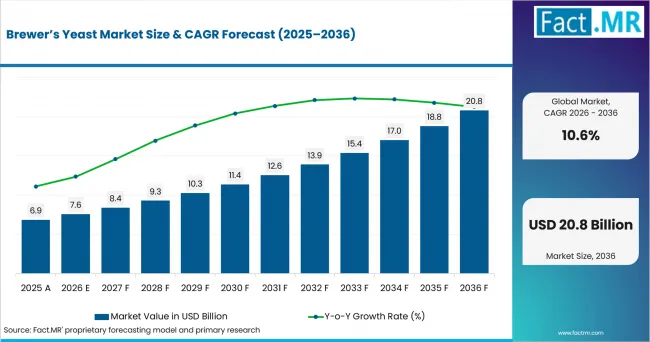
Brewer’s Yeast Market Value Analysis | Source: Fact.MR
What are the defining numbers behind Brewer’s Yeast Market growth?
USD 13.2 billion absolute opportunity by 2036, led by Active Brewer’s Yeast, Food & Beverage Applications and Fermentation Technology.
- Demand Drivers in the Market
- Bakery manufacturers need yeast with reliable leavening strength so production lines avoid batch rejection and recipe drift. In May 2026, USDA NASS reported U.S. wheat flour production of 418.6 million hundredweight in 2025, supporting bakery demand for reliable yeast performance.
- Brewers require strain consistency because flavor, attenuation and fermentation time shape batch release decisions.
- Nutraceutical brands use inactive and fortified yeast to support protein and B-vitamin positioning.
- Key Segments Analyzed
- By Product: Active Brewer’s Yeast is expected to hold 43.70% share in 2026 due to bakery and beverage use.
- By Application: Food & Beverage Applications are projected to account for 68.40% share in 2026 owing to bread and brewing use.
- By End Use: Food Processing Companies are anticipated to capture 36.50% share in 2026 because users need repeatable lots.
- By Technology: Fermentation Technology is estimated to represent 74.80% share in 2026 as propagation remains central to quality.
- By Formulation: Powder Formulations are forecast to hold 59.20% share in 2026 since dry formats cut storage pressure.
- By Distribution Channel: Direct Industrial Sales are expected to account for 45.10% share in 2026 as accounts need technical support.
- Analyst Opinion at Fact.MR
- Shambhu Nath Jha, Principal Consultant at Fact.MR, states, “Brewer’s yeast purchasing now depends on documented performance. Suppliers are expected to gain preference when strain selection and drying stability carry support. Consistent lots define the commercial case.”
- Strategic Implications
- Ingredient producers should prove yeast stability before negotiating multi-year supply contracts.
- Food processors should qualify alternate yeast formats where shelf-life or moisture control creates production risk.
- Brewers should match strain selection to target flavor and attenuation before expanding recipe portfolios.
- Investors should separate broad yeast capacity from specialist exposure to brewer’s yeast and extracts.
Lesaffre invested in beer yeast production and packaging facilities at its Ghent plant in August 2025. The Algist Bruggeman site supports Fermentis by Lesaffre customers. The project fits buyer focus on strain performance and packaging integrity.
Germany is projected to post 12.2% CAGR through 2036. Brazil follows at 11.1% CAGR, shaped by beer registrations and feed output. The USA, UK and Japan record 10.1%, 9.0% and 8.0% CAGR.
How does the Brewer’s Yeast Market break down by segment?
Active Brewer’s Yeast leads Product at 43.70%; Food & Beverage Applications lead Application at 68.40%.
Which product dominates?
Active Brewer’s Yeast is projected to account for 43.70% share in 2026.
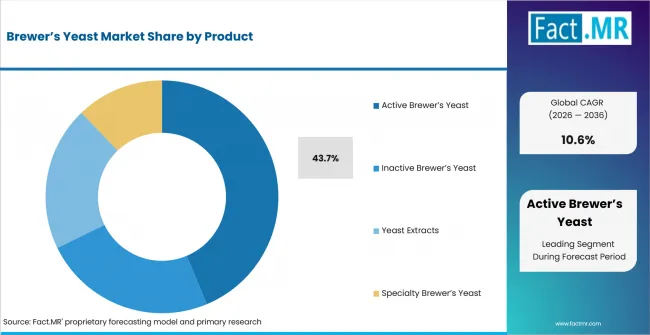
Brewer’s Yeast Market Analysis By Product | Source: Fact.MR
Active Brewer’s Yeast is expected to lead Product since it carries the main fermentation role in bread and beer. Fresh yeast supports short bakery inventory cycles. Dry active yeast adds shelf-life value for wider distribution. Enriched formats extend demand into nutrition and feed. USDA NASS also reported that 907.2 million bushels of wheat were ground for flour in the United States in 2025, showing the size of the bakery base that depends on active yeast.
What leads the Application segment?
Food & Beverage Applications are expected to hold 68.40% share in 2026.
Food & Beverage Applications are projected to lead Application owing to bakery, brewing and processed food use. Beverage users depend on strain choice before flavor targets are fixed. Supplements, feed and biotechnology add demand where yeast supplies protein or biomass functions. USDA NASS placed U.S. whole wheat flour production at 17.3 million hundredweight in 2025, adding a measurable whole-grain bakery use case for yeast suppliers.
How does End Use shape demand?
Food Processing Companies are anticipated to lead with 36.50% share in 2026.
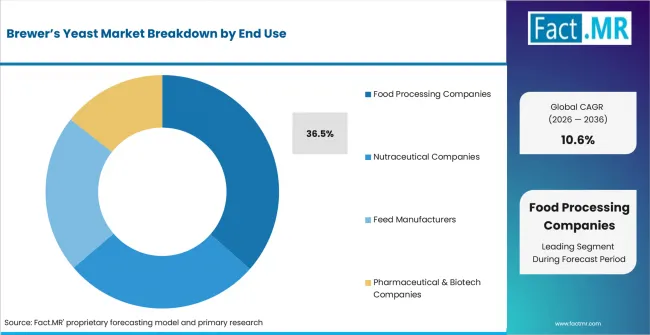
Brewer’s Yeast Market Analysis By End Use | Source: Fact.MR
Food Processing Companies are anticipated to lead End Use as industrial accounts buy stable formats and repeatable lots. Bakeries need predictable proofing. Nutraceutical and feed users value fortified yeast with documented strain identity.
What supports Fermentation Technology?
Fermentation Technology is estimated to represent 74.80% share in 2026.
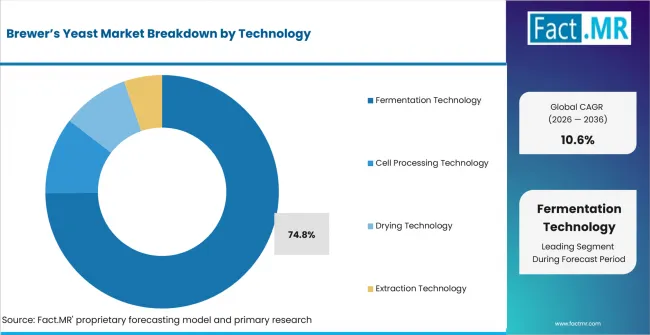
Brewer’s Yeast Market Analysis By Technology | Source: Fact.MR
Fermentation Technology is estimated to lead Technology as yeast performance starts with controlled propagation. Batch systems fit specialty lots. Continuous systems support stable output. Separation and drying protect usable quality after growth.
Which formulation holds the main share?
Powder Formulations are forecast to hold 59.20% share in 2026.
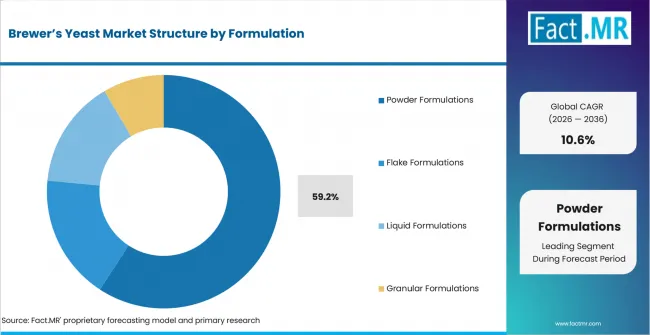
Brewer’s Yeast Market Analysis By Formulation | Source: Fact.MR
Powder Formulations are forecast to lead Formulation due to easier storage and dosing. Fine powders help blending in premixes. Agglomerated powders improve dispersion in industrial batches. Flake and granular forms serve defined flavor or processing needs.
How do sales channels shape purchasing?
Direct Industrial Sales are expected to account for 45.10% share in 2026.
Direct Industrial Sales are expected to lead Distribution Channel as large accounts need technical service. Manufacturer contracts improve continuity. Distributors and digital channels serve smaller users.
What is accelerating Brewer’s Yeast Market adoption, and what is holding it back?
Food and beverage fermentation drives it; brewery volume softness restrains it.
Drivers Impact Analysis
| DRIVER | (~) % IMPACT ON CAGR | GEOGRAPHIC RELEVANCE | IMPACT TIMELINE |
|---|---|---|---|
| Food and beverage fermentation | +2.4% | Germany, Brazil, USA, UK, Japan | Short term (<= 2 years) |
| Powder and dry handling economics | +2.0% | Global food processing sites | Short term (<= 2 years) |
| Nutritional and fortified yeast use | +1.8% | USA, UK, Japan | Medium term (2-4 years) |
| Feed and animal nutrition formulations | +1.5% | Brazil, USA, East Asia | Medium term (2-4 years) |
| Industrial contracts with application support | +1.1% | Europe and North America | Long term (>= 4 years) |
Source: Fact.MR analysis. Updated Aug 11, 2026
- Food and beverage fermentation: Yeast performance protects flavor, rise and batch release in bread, beer and processed foods.
- Powder and dry handling economics: Dry formats reduce spoilage risk and simplify dosing across factories and wider distribution routes.
- Nutritional and fortified yeast use: Inactive, enriched and specialty yeast support protein and vitamin claims in nutrition products.
- Feed and animal nutrition formulations: Livestock and aquafeed producers use yeast derivatives when palatability and gut-health evidence fit formulation cost.
- Industrial contracts with application support: Large users prefer suppliers that combine strain selection, blending help and batch release support.
Opportunity Impact Analysis
| OPPORTUNITY | (~) % IMPACT ON CAGR | GEOGRAPHIC RELEVANCE | IMPACT TIMELINE |
|---|---|---|---|
| Yeast extract flavor systems | +1.0% | Europe, Japan, USA | Medium term (2-4 years) |
| Spray-dried powder consistency | +0.9% | Global | Medium term (2-4 years) |
| B2B digital ordering | +0.7% | USA, UK, Brazil | Long term (>= 4 years) |
| Fortified flake nutrition blends | +0.6% | UK, Japan, USA | Long term (>= 4 years) |
Source: Fact.MR analysis. Updated Aug 11, 2026
- Yeast extract flavor systems: Yeast extracts create opportunity where savory foods and beverages need umami and mouthfeel support.
- Spray-dried powder consistency: Spray drying supports particle control, logistics risk and dosing in premixes and nutrition products.
- B2B digital ordering: Digital channels help smaller processors compare technical sheets and place trial orders with less friction.
- Fortified flake nutrition blends: Enriched flakes support plant-forward nutrition products where taste and micronutrient positioning both count.
Restraints Impact Analysis
| RESTRAINT | (~) % IMPACT ON CAGR | GEOGRAPHIC RELEVANCE | IMPACT TIMELINE |
|---|---|---|---|
| Brewery volume softness | -1.2% | Germany, USA, Japan | Short term (<= 2 years) |
| Energy and drying cost exposure | -1.0% | Yeast production sites | Short term (<= 2 years) |
| Microbial documentation burden | -0.8% | EU, Japan, USA | Medium term (2-4 years) |
| Shelf-life and moisture control | -0.6% | Tropical logistics and retail channels | Medium term (2-4 years) |
Source: Fact.MR analysis. Updated Aug 11, 2026
- Brewery volume softness: Lower beer output reduces active yeast volumes tied only to brewing, especially in mature markets. Statistics Canada reported beer sales by volume declined 3.8% to 1,876 million liters in fiscal 2024/2025, giving another mature-market signal for brewing-linked yeast demand.
- Energy and drying cost exposure: Controlled fermentation and drying make yeast formats sensitive to utility costs.
- Shelf-life and moisture control: Yeast activity declines when storage or packaging conditions fail to control moisture.
Which countries are scaling Brewer’s Yeast Market fastest?
- The country comparison spans 4.2 percentage points, with Germany leading the listed markets at 12.2% CAGR through 2036.
- Germany remains 1.1 percentage points above Brazil through brewing depth, bakery quality requirements and strong microbial documentation.
- Brazil remains 1.0 percentage point above the USA as beer registrations, feed production and industrial food processing support yeast demand.
- The USA remains 1.1 percentage points above the UK through food spending, craft brewery activity and technical strain support.
- The UK remains 1.0 percentage point above Japan as food manufacturing scale, bakery supply planning and trade flows support industrial purchasing.
- Japan closes the displayed range at 8.0% CAGR, supported by food manufacturing quality, standards-led bakery use and specification-focused purchasing.
Similar growth rates can produce different supplier opportunities because brewing activity, bakery scale, feed demand, documentation requirements and distribution conditions vary by country. Full report coverage includes North America, Latin America, Europe, East Asia, South Asia and Pacific, and Middle East and Africa.
| Country | CAGR (2026-2036) |
|---|---|
| Germany | 12.2% |
| Brazil | 11.1% |
| USA | 10.1% |
| UK | 9.0% |
| Japan | 8.0% |
Source: Fact.MR analysis. Updated Aug 11, 2026
What supports Germany adoption?
12.2% CAGR through 2036, driven by brewing depth, bakery quality and EU microbial documentation.
ISO 23983:2025 provides a clearer benchmark for fresh and dry bakery yeast, while breweries continue to depend on stable strains for flavor, attenuation and fermentation control. Growth may be constrained by the 6.0% decline in beer sales in 2025, energy-intensive drying costs and slower specialty strain trials among smaller breweries.
How is Brazil scaling brewer’s yeast demand?
11.1% CAGR through 2036, driven by formal beer registration, feed output and industrial food processing.
Industrial buyers also value technical service, packaging reliability and direct supply agreements. Mandatory production declarations, beer demand volatility and moisture-related shelf-life risks may restrain expansion across warm and humid distribution channels.
What shapes the USA outlook?
10.1% CAGR through 2036, driven by food spending, craft breweries and technical strain support.
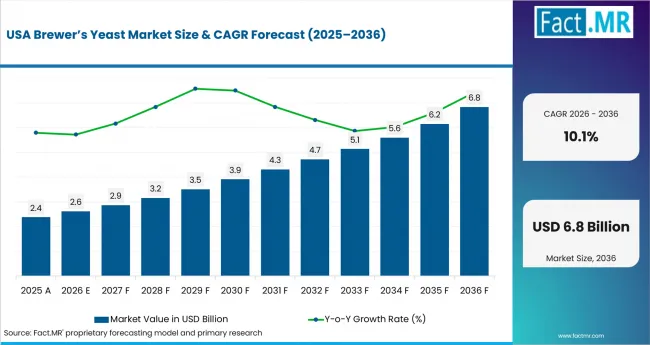
Brewer’s Yeast Market Country Value Analysis | Source: Fact.MR
The USA’s growth is supported by a large food-processing economy, with food spending reaching USD 2.51 trillion in 2025, and an established craft brewing base of 9,578 breweries. Contract bakeries require dependable yeast activity, particle size and delivery timing, while nutritional and fortified yeast formats broaden demand beyond brewing.
What underpins the UK’s growth?
9.0% CAGR through 2036, driven by food manufacturing, trade flows and bakery supply planning.
Bakery and processed food producers require dry yeast formats that remain stable across longer supply routes, and import-led sourcing increases the value of dependable documentation and regional distribution. Freight exposure, lead-time pressure and tighter input budgets among smaller bakeries may limit premium yeast adoption.
How does Japan perform?
8.0% CAGR through 2036, driven by food manufacturing quality, liquor exports and standards-led bakery use.
Japan’s growth reflects strict quality requirements across bakery, processed food and beverage production. Manufacturers value stable activity, lot consistency and strain support that protects aroma and batch quality.
Who leads the Brewer’s Yeast Market?
Lesaffre and Lallemand lead direct brewer’s yeast coverage, while AB Mauri and Angel Yeast strengthen bakery, nutrition and feed applications.
Lesaffre has direct relevance through brewer’s yeast and fermented beverages. Lallemand supports brewing, nutritional yeast and yeast extracts. AB Mauri adds industrial bakery scale and reported a 9% carbon-intensity reduction at its Casteggio yeast plant in 2025. In April 2025, Lallemand Brewing introduced LalBrew Aurora Northern IPA Yeast through its Limited Release Series, adding a Saccharomyces cerevisiae strain selected for cool fermentation and fruity expression. AB Mauri's 2025 Bandirma case study reported improved evaporator technology at its yeast plant that contributes more than 1,300 tCO2e in annual emissions reductions.
Angel Yeast, Alltech and Laffort widen the field through animal nutrition, wine fermentation and yeast-derived ingredients. Inland Island, Omega Yeast and Oriental Yeast add regional coverage.
Which companies are the key providers?
Lesaffre and Lallemand Inc. are key providers. Angel Yeast Co. Ltd and AB Mauri Ltd. are profiled. Inland Island completes the set.
- Lesaffre
- Inland Island Yeast Laboratories
- Lallemand Inc.
- Angel Yeast Co. Ltd
- AB Mauri Ltd
Bibliography
- Department for Environment, Food & Rural Affairs. (2026, July 29). Chapter 14: The food chain. In Agriculture in the United Kingdom 2025.
- EFSA Panel on Biological Hazards (BIOHAZ). (2026, January 22). Update of the list of qualified presumption of safety (QPS) recommended microbiological agents intentionally added to food or feed as notified to EFSA 23: Suitability of taxonomic units notified to EFSA until September 2025.
- Statistisches Bundesamt (Destatis). (2026, February 2). Beer sales down in 2025.
- Statistisches Bundesamt (Destatis). (2026, February 23). 1,415 breweries in Germany in 2025.
- HM Revenue & Customs. (2025, July 17). HMRC annual report and accounts: 2024 to 2025.
- International Organization for Standardization. (2025, September). ISO 23983:2025: Food products—Characteristics of fresh and dry baker’s yeast.
- Lesaffre. (2025, August 26). Lesaffre invests in a new state-of-the-art yeast production for fermented beverages and packaging facilities on its production plant in Ghent, Belgium.
- Office for National Statistics. (2026, July 24). UK manufacturers’ sales by product: 2025.
This Report Addresses
- The report covers brewer’s yeast applications across bakery, beverage, nutrition and feed use cases.
- Segment analysis covers yeast ingredient demand and Active Brewer’s Yeast as the Product share leader in 2026.
- Nutrition coverage evaluates nutritional yeast products alongside enriched, fortified and inactive brewer’s yeast formats.
- Flavor and process analysis covers yeast extract systems used by processed food and beverage formulation teams.
- Animal nutrition review includes feed yeast additives where livestock and aquafeed producers require documented microbial ingredients.
What does the Brewer’s Yeast Market cover?
The Brewer’s Yeast Market covers active, inactive, powder, extract, specialty, organic and enriched yeast used in food, beverage, nutrition and feed.
The market is adjacent to fermented ingredient use and baking ingredient procurement for bread, snacks, beverages and processed foods.
What is included in the scope?
The scope includes active brewer’s yeast and inactive brewer’s yeast. Yeast extracts and specialty brewer’s yeast are covered across food, beverage, supplements, feed and biotechnology uses.
Adjacent scope references include functional bakery inputs and bakery premix formulations where yeast performance affects formulas.
What is excluded from the scope?
The scope excludes household baker’s yeast without brewer’s yeast positioning. Brewing equipment, malt, hops, non-yeast enzymes and general fermentation services remain outside the market boundary.
How Was the Analysis Built?
The analysis draws on 120+ sources, 35+ company portfolios, 25+ countries and more than 20 industry interviews.
- Primary Research: Interviews cover yeast producers, processors, brewers and feed formulators. Distributor and nutrition brand discussions examine format choice, strain performance and switching barriers.
- Desk Research: Research covers official statistics, regulators, standards, company newsrooms, investor materials and association data.
- Market Sizing and Forecasting: Estimates combine historical values, segment shares and country growth rates. Company participation, formats and channels are checked against market evidence.
- Data Validation and Update Cycle: Findings are checked against official data, company activity and ingredient purchasing behavior.
Segmentation
What is the report’s scope and coverage?
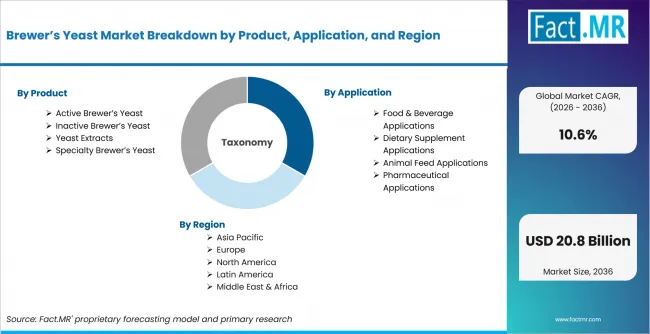
Brewer’s Yeast Market Breakdown By Product, Application, And Region | Source: Fact.MR
| Attribute | Details |
|---|---|
| Quantitative Units | USD billion |
| Market Definition | Commercial brewer’s yeast and yeast-derived ingredients used in bakery, brewing, food processing, nutrition, feed and technical fermentation where strain quality, activity, drying stability and documentation shape purchasing |
| Product | Active Brewer’s Yeast, Inactive Brewer’s Yeast, Yeast Extracts, Specialty Brewer’s Yeast |
| Application | Food & Beverage Applications, Dietary Supplement Applications, Animal Feed Applications, Pharmaceutical Applications |
| End Use | Food Processing Companies, Nutraceutical Companies, Feed Manufacturers, Pharmaceutical & Biotech Companies |
| Technology | Fermentation Technology, Cell Processing Technology, Drying Technology, Extraction Technology |
| Formulation | Powder Formulations, Flake Formulations, Liquid Formulations, Granular Formulations |
| Distribution Channel | Direct Industrial Sales, Specialty Ingredient Distributors, Online Commercial Channels, Retail Distribution |
| Regions Covered | North America; Latin America; Europe; East Asia; South Asia and Pacific; Middle East and Africa |
| Countries Covered | Germany; Brazil; USA; UK; Japan |
| Key Companies Profiled | Lesaffre; Inland Island Yeast Laboratories; Lallemand Inc.; Angel Yeast Co. Ltd; AB Mauri Ltd |
| Forecast Period | 2026 to 2036 |
| Approach | Hybrid top-down and bottom-up approach using food processing demand, brewery activity, bakery needs, feed use, yeast formats, channels, official country indicators and verified company portfolios |
Source: Fact.MR analysis. Updated Aug 11, 2026
How is the market segmented?
-
By Product:
- Active Brewer’s Yeast
- Inactive Brewer’s Yeast
- Yeast Extracts
- Specialty Brewer’s Yeast
-
By Application:
- Food & Beverage Applications
- Dietary Supplement Applications
- Animal Feed Applications
- Pharmaceutical Applications
-
By End Use:
- Food Processing Companies
- Nutraceutical Companies
- Feed Manufacturers
- Pharmaceutical & Biotech Companies
-
By Technology:
- Fermentation Technology
- Cell Processing Technology
- Drying Technology
- Extraction Technology
-
By Formulation:
- Powder Formulations
- Flake Formulations
- Liquid Formulations
- Granular Formulations
-
By Distribution Channel:
- Direct Industrial Sales
- Specialty Ingredient Distributors
- Online Commercial Channels
- Retail Distribution
-
By Region:
- North America
- Latin America
- Europe
- East Asia
- South Asia and Oceania
- Middle East and Africa
Frequently Asked Questions
How big is the brewer’s yeast market in 2026?
What is the CAGR of the brewer’s yeast market from 2026 to 2036?
Which product leads the brewer’s yeast market?
Which application leads the brewer’s yeast market?
Who are the leading companies in the brewer’s yeast market?
Who worked on this report


Preview the report firsthand - request a free sample
Free SampleGet the brochure for pricing and purchase details
Download PDF