- Market Value (2025): USD 224.3 Mn
- Estimated Value (2026): USD 262.0 Mn
- Forecast Value (2036): USD 1240.0 Mn
- CAGR (2026-2036): 16.8%
What is the Buried Power Rail Tools Market forecast to be worth by 2036?
USD 262.0 million in 2026 to USD 1,240.0 million by 2036, at a 16.8% CAGR.
- The Buried Power Rail Tools Market crossed a valuation of USD 224.3 million in 2025, supported by demand from Foundries serving Deep trench etch workflows that require etching, lining, filling and planarizing narrow power rails beneath the transistor without contaminating or disturbing FEOL devices.
- Demand is projected to increase from USD 262.0 million in 2026 to USD 1,240.0 million by 2036.
- The market is forecast to record a 16.8% CAGR from 2026 to 2036 as what a bpr is (imec definition), demonstrated integration and quantified benefit remain central purchase reasons.
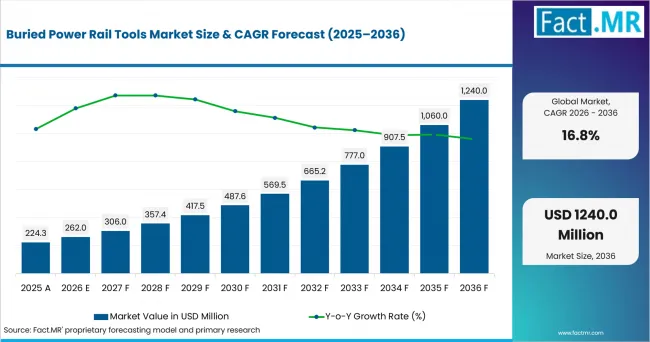
Buried Power Rail Tools Market Value Analysis | Source: Fact.MR
What are the defining numbers behind Buried Power Rail Tools Market growth?
USD 978.0 million absolute opportunity is expected by 2036.
- Demand Drivers in the Market
- What a BPR is (imec definition): Demand for buried-power-rail equipment tracks a specific architectural shift: a BPR is a metal line construct buried below the transistors, partially within the silicon substrate and partially within the shallow trench isolation oxide, taking over the VDD/VSS role from BEOL rails - moving rails from BEOL to FEOL reduces Mint tracks, shrinks standard-cell height, and lets perpendicular-to-cell rails be widened to cut IR drop, per imec's definition. [2]
- Demonstrated integration: Demand accelerated after imec's world-first demonstration at VLSI 2022, which showed BPRs connecting scaled FinFETs to both wafer sides, with roughly 320 nm-deep nano-TSVs landing on BPRs at 200 nm pitch without consuming any standard-cell area, and FinFET performance unimpacted by the backside processing needed to get there. [1]
- Quantified benefit: The commercial case is now quantified: BSPDN paired with BPR is projected to cut energy consumption by up to 8% and IC area by up to 24% at 3 nm-class technology, per an EPJ review of imec and industry data, with rail burial alone accounting for 15-20% of standard-cell area reduction. [3]
- Tool-defining material choice: Equipment requirements diverge sharply based on fill-metal choice: tungsten offers lower contamination risk and meets a 50 ohm/micrometer target resistance, while barrierless ruthenium offers lower via resistance, per Cadence IEDM notes - a choice that directly determines whether a fab needs CVD tungsten nucleation/fill tooling or ruthenium CVD/ALD barrierless fill tooling, plus matching CMP integration. [4]
- Key Segments Analyzed
- By Process Step: Deep trench etch is projected to hold 31.0% share in 2026, supported by a clear process advantage: Deep trench etch defines the rail location, width and sidewall condition before any liner or metal is deposited. An error at this step cannot be corrected by fill and directly limits resistance, isolation and overlay to the transistor.
- By Fill Metal: Ruthenium is projected to hold 42.9% share in 2026, supported by a clear process advantage: Ruthenium can reduce liner volume and maintain useful conductivity in very narrow features, supporting more complete fill at scaled rail dimensions. Its deposition options also fit the drive toward conformal, void-free metal.
- By Rail Geometry: <30 nm width is projected to hold 42.0% share in 2026, supported by a clear process advantage: Widths below 30 nanometers represent the scaling regime in which buried rails free valuable frontside routing area and place the greatest demand on etch, liner and metal fill. Small defects or recess variations become a large fraction of the conductor.
- By Integration Scheme: Rail-before-FEOL is projected to hold 43.8% share in 2026, supported by a clear process advantage: Rail-before-FEOL integration places the power conductor beneath the device stack from the beginning and enables the most direct connection to later backside vias. It also requires exceptionally strict contamination and thermal-budget control.
- By End User: Foundries are projected to hold 29.3% share in 2026, supported by a clear process advantage: Foundries must turn buried power rails into a repeatable node option across customer designs, which requires matched etch, deposition, CMP and metrology capacity. Their commercial risk is a platform-wide defect mechanism rather than a single product excursion.
- Analyst Opinion at Fact.MR
- Shambhu Nath Jha, Sr. Consultant at Fact.MR, states, 'Buyers should evaluate the complete process sequence around etching, lining, filling and planarizing narrow power rails beneath the transistor without contaminating or disturbing FEOL devices. Technical review should focus on repeatability, integration, defect control and production throughput rather than a single headline specification. Suppliers that connect tool performance to measurable yield and qualification results are likely to build trust faster.'
- Strategic Implications
- Tool choices must be made around the complete rail integration scheme, including tungsten-versus-ruthenium fill and connection to backside vias.
- Equipment suppliers should document how their systems address the challenge of etching, lining, filling and planarizing narrow power rails beneath the transistor without contaminating or disturbing FEOL devices across production-representative wafers, panels, dies or packages.
- Procurement teams should assess trench profile control, liner and fill compatibility, contamination control, CMP integration, metrology correlation and qualification support for buried-power-rail process flows.
Taiwan is projected to record a 18.4% CAGR as leading foundry production, advanced packaging and a dense OSAT and substrate supply chain supports relevant capital spending; USA is projected to record a 18.6% CAGR as leading-edge logic, high-performance computing, federally supported semiconductor R&D and a large domestic equipment base supports relevant capital spending; South Korea is projected to record a 17.7% CAGR as high-volume memory, HBM and vertically integrated semiconductor manufacturing supports relevant capital spending; Israel is projected to record a 16.2% CAGR as advanced logic manufacturing and process-control R&D supports relevant capital spending; Japan is projected to record a 17.4% CAGR as semiconductor equipment, materials, inspection and memory-process expertise supports relevant capital spending; while Ireland is projected to record a 15.8% CAGR as European logic manufacturing and process-development investment supports relevant capital spending through 2036.
How does the Buried Power Rail Tools Market break down by segment?
Deep trench etch leads Process Step with a 31.0% share, while Ruthenium accounts for 42.9% of Fill Metal in 2026.
Why does Deep trench etch lead Process Step?
Deep trench etch is projected to account for 31.0% share in 2026.
Deep trench etch defines the rail location, width and sidewall condition before any liner or metal is deposited. An error at this step cannot be corrected by fill and directly limits resistance, isolation and overlay to the transistor. Metal fill is essential, but it inherits the geometry and damage condition created by the trench etch. TEL's published module requirements for adjacent FEOL structures - highly selective etches, conformal films, defect-free epi - illustrate the selectivity/conformality bar BPR trench etch and fill must clear; BPR adds deep, narrow trenches in STI/Si with aspect ratios beyond contact-etch norms. [5] Buyers therefore tend to treat deep trench etch as the practical choice when qualification must balance process capability, repeatability and production economics.
Why does Ruthenium lead Fill Metal?
Ruthenium is projected to account for 42.9% share in 2026.
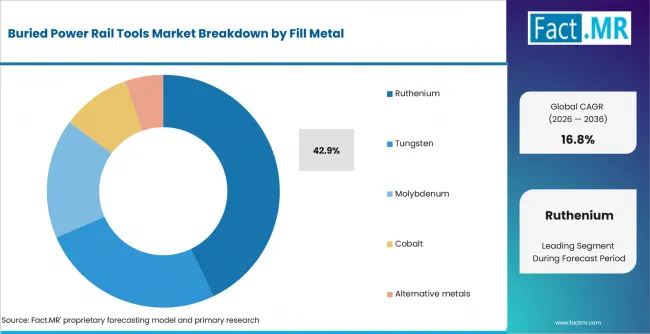
Buried Power Rail Tools Market Analysis By Fill Metal | Source: Fact.MR
Ruthenium can reduce liner volume and maintain useful conductivity in very narrow features, supporting more complete fill at scaled rail dimensions. Its deposition options also fit the drive toward conformal, void-free metal. Tungsten has a mature contact and fill infrastructure, but barrier and size effects consume more of the cross-section as rails shrink. BPR metal candidates: tungsten - lower contamination risk, meets 50 Ω/µm target resistance; ruthenium - barrierless, lower via resistance (Cadence IEDM notes). This choice drives deposition-tool requirements (CVD W nucleation/fill vs Ru CVD/ALD barrierless fill) and CMP integration. [4] Buyers therefore tend to treat ruthenium as the practical choice when qualification must balance process capability, repeatability and production economics.
Why does <30 nm width lead Rail Geometry?
<30 nm width is projected to account for 42.0% share in 2026.
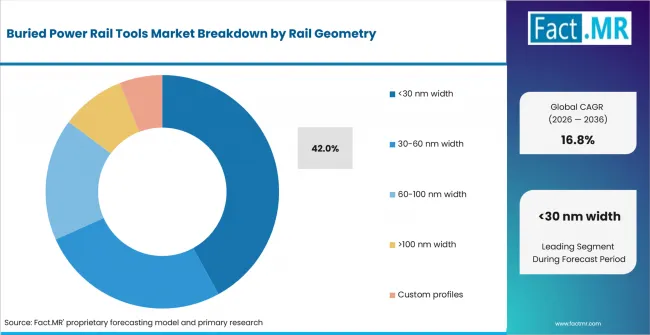
Buried Power Rail Tools Market Analysis By Rail Geometry | Source: Fact.MR
Widths below 30 nanometers represent the scaling regime in which buried rails free valuable frontside routing area and place the greatest demand on etch, liner and metal fill. Small defects or recess variations become a large fraction of the conductor. The 30-60 nanometer class is easier to fill and inspect but provides less density benefit for leading logic. BSPDN+BPR projected to reduce energy consumption up to 8% and IC area up to 24% at 3 nm-class technology (EPJ review of imec/industry data); standard-cell area reduction of 15-20% from rail burial alone. [3] Buyers therefore tend to treat <30 nm width as the practical choice when qualification must balance process capability, repeatability and production economics.
Why does Rail-before-FEOL lead Integration Scheme?
Rail-before-FEOL is projected to account for 43.8% share in 2026.
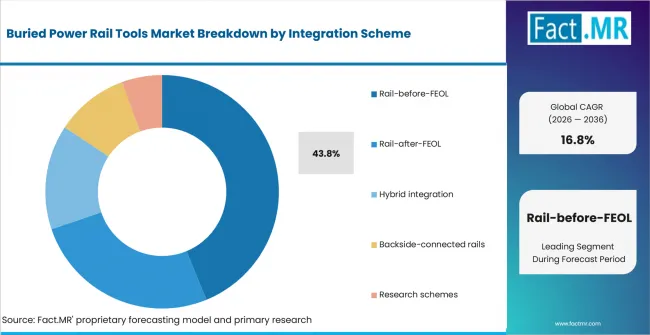
Buried Power Rail Tools Market Analysis By Integration Scheme | Source: Fact.MR
Rail-before-FEOL integration places the power conductor beneath the device stack from the beginning and enables the most direct connection to later backside vias. It also requires exceptionally strict contamination and thermal-budget control. Rail-after-FEOL can reduce early contamination exposure, but routing and access become more constrained after the transistor structure is complete. Imec's VBPR scheme makes the BPR double as backside metal 1, collapsing a BEOL level - tool flow simplification (EPJ; Cadence). Buyers therefore tend to treat rail-before-FEOL as the practical choice when qualification must balance process capability, repeatability and production economics.
Why do Foundries lead End User?
Foundries are projected to account for 29.3% share in 2026.
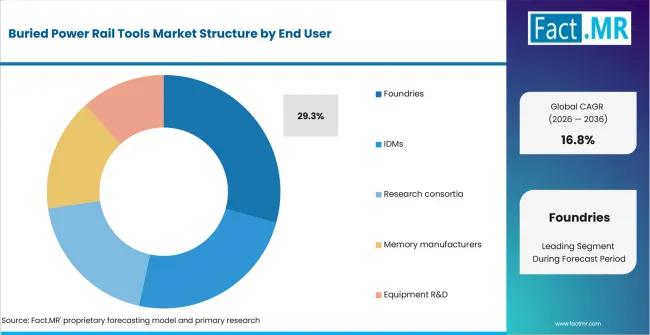
Buried Power Rail Tools Market Analysis By End User | Source: Fact.MR
Foundries must turn buried power rails into a repeatable node option across customer designs, which requires matched etch, deposition, CMP and metrology capacity. Their commercial risk is a platform-wide defect mechanism rather than a single product excursion. IDMs can tailor the rail to one architecture, while foundries need a wider design and process window. A metal line construct buried below the transistors - partially within the Si substrate, partially within the shallow trench isolation oxide, taking the role of VDD/VSS rails; moving rails from BEOL to FEOL reduces Mint tracks, shrinking standard-cell height; perpendicular-to-cell rails can be widened to cut IR drop. [2] Buyers therefore tend to treat foundries as the practical choice when qualification must balance process capability, repeatability and production economics.
What is accelerating Buried Power Rail Tools Market adoption, and what is holding it back?
The strongest accelerator is what a BPR is (imec definition), while the main restraint is that FEOL contamination limits and extreme feature dimensions make material changes and defect excursions unusually costly.
Drivers Impact Analysis
| DRIVER | (~) % IMPACT ON CAGR | GEOGRAPHIC RELEVANCE | IMPACT TIMELINE |
|---|---|---|---|
| What a BPR is (imec definition) | +4.7% | Global leading-edge fabs | Medium term (2-4 years) |
| Demonstrated integration | +3.9% | Global leading-edge fabs | Medium term (2-4 years) |
| Quantified benefit | +3.2% | Global leading-edge fabs | Medium term (2-4 years) |
| Tool-defining material choice | +2.5% | Global leading-edge fabs | Medium term (2-4 years) |
Source: Fact.MR analysis. Updated Jul 23, 2026
- What a BPR is (imec definition): A metal line construct buried below the transistors - partially within the Si substrate, partially within the shallow trench isolation oxide, taking the role of VDD/VSS rails; moving rails from BEOL to FEOL reduces Mint tracks, shrinking standard-cell height; perpendicular-to-cell rails can be widened to cut IR drop. [2]
- Demonstrated integration: Imec's world-first (VLSI 2022): BPRs connecting scaled FinFETs to both wafer sides; nTSVs (~320 nm deep) landing on BPRs at 200 nm pitch without consuming any area of the standard cell; FinFET performance unimpacted by backside processing (carrier bonding, thinning, nTSV processing). [1]
- Quantified benefit: BSPDN+BPR projected to reduce energy consumption up to 8% and IC area up to 24% at 3 nm-class technology (EPJ review of imec/industry data); standard-cell area reduction of 15-20% from rail burial alone. [3]
- Tool-defining material choice: BPR metal candidates: tungsten - lower contamination risk, meets 50 Ω/µm target resistance; ruthenium - barrierless, lower via resistance (Cadence IEDM notes). This choice drives deposition-tool requirements (CVD W nucleation/fill vs Ru CVD/ALD barrierless fill) and CMP integration. [4]
Opportunity Impact Analysis
| OPPORTUNITY | (~) % IMPACT ON CAGR | GEOGRAPHIC RELEVANCE | IMPACT TIMELINE |
|---|---|---|---|
| W to Ru transition | +2.9% | Global leading-edge fabs | Medium term (2-4 years) |
| Rail-as-backside-metal | +2.2% | Global leading-edge fabs | Medium term (2-4 years) |
| GAA+BPR co-optimization | +1.7% | Global leading-edge fabs | Medium term (2-4 years) |
Source: Fact.MR analysis. Updated Jul 23, 2026
- W to Ru transition: Barrierless Ru rails eliminate liner thickness in narrow trenches - the key resistance lever as rail pitch shrinks; Ru CVD/ALD tool demand follows.
- Rail-as-backside-metal: Imec's VBPR scheme makes the BPR double as backside metal 1, collapsing a BEOL level - tool flow simplification (EPJ; Cadence).
- GAA+BPR co-optimization: Nanosheet channels sit directly above rails; inner-spacer and channel-release steps must not compromise rail integrity - integrated module development (epi/etch/dep co-optimization per TEL/imec).
Restraints Impact Analysis
| RESTRAINT | (~) % IMPACT ON CAGR | GEOGRAPHIC RELEVANCE | IMPACT TIMELINE |
|---|---|---|---|
| Primary qualification constraint | -2.5% | Global leading-edge fabs | Medium term (2-4 years) |
| Contamination and defect risk | -2.0% | Global leading-edge fabs | Medium term (2-4 years) |
| Cross-module integration risk | -1.5% | Global leading-edge fabs | Medium term (2-4 years) |
Source: Fact.MR analysis. Updated Jul 23, 2026
- Primary qualification constraint: FEOL contamination limits and extreme feature dimensions make material changes and defect excursions unusually costly. [4]
- Contamination and defect risk: BPR metal candidates: tungsten - lower contamination risk, meets 50 Ω/µm target resistance; ruthenium - barrierless, lower via resistance (Cadence IEDM notes). [4]
- Cross-module integration risk: The process must be qualified across adjacent modules because a local improvement can still fail the full flow when etching, lining, filling and planarizing narrow power rails beneath the transistor without contaminating or disturbing FEOL devices. [4]
Which countries are scaling Buried Power Rail Tools Market fastest?
§For Buried Power Rail Tools Market, South Korea's 17.7% CAGR reflects high-volume memory, HBM and vertically integrated semiconductor manufacturing.
- Countries differ less by the headline CAGR than by the type of semiconductor work creating demand for the Buried Power Rail Tools Market.
- USA demand is tied to backside-power development, logic-node investment and domestic equipment capability, whereas Taiwan demand is shaped by foundry-led BPR integration, OSAT coordination and process qualification.
- South Korea's BPR opportunity is linked to memory and advanced-node integration, while Japan contributes etch, deposition, materials and metrology capability for process development.
- Israel is relevant for advanced-logic process development and control research, while Ireland contributes through European logic manufacturing and production-ramp activity.
- BPR-tool demand differs by node roadmaps, backside-power integration choices, foundry capacity, local tool support and qualification timing, even where modeled country growth rates are close.
Country analysis places the six profiled markets within North America, Latin America, Europe, East Asia, South Asia & Oceania, and the Middle East & Africa.
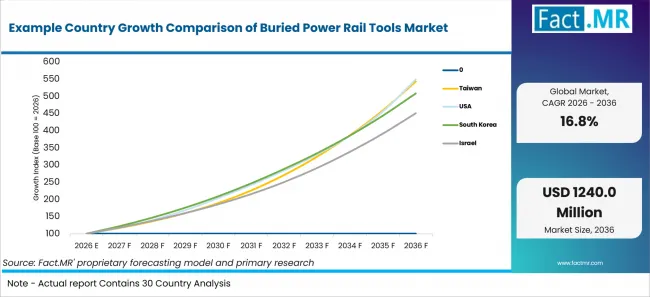
Example Country Growth Comparison Of Buried Power Rail Tools Market | Source: Fact.MR
| COUNTRY | CAGR, 2026 to 2036 |
|---|---|
| USA | 18.6% |
| Taiwan | 18.4% |
| South Korea | 17.7% |
| Japan | 17.4% |
| Israel | 16.2% |
| Ireland | 15.8% |
Source: Fact.MR analysis. Updated Jul 23, 2026
What is driving USA's growth through 2036?
18.6% CAGR, supported by leading-edge logic, high-performance computing, federally supported semiconductor R&D and a large domestic equipment base.
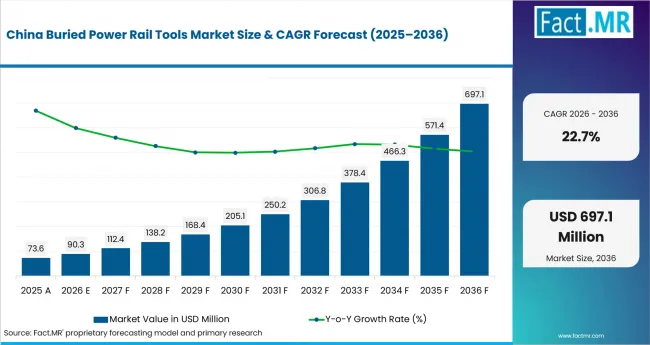
Buried Power Rail Tools Market Country Value Analysis | Source: Fact.MR
Intel’s PowerVia architecture creates direct demand for backside power delivery, while Applied Materials and Lam Research provide relevant etch, deposition and planarization capabilities. These U.S. programs make BPR tooling relevant where fabs need a qualified sequence for trench formation, liner deposition, metal fill, planarization and FEOL contamination control.
What is driving Taiwan's growth through 2036?
18.4% CAGR, supported by leading foundry production, advanced packaging and a dense OSAT and substrate supply chain.
TSMC’s Super Power Rail approach and Samsung’s 2 nm manufacturing roadmap create direct demand for buried power rail process tools. Taiwan's roadmap creates an equipment case around repeatable rail patterning, conformal fill and process integration within foundry production lines.
What is driving South Korea's growth through 2036?
17.7% CAGR, supported by high-volume memory, HBM and vertically integrated semiconductor manufacturing.
South Korea’s 17.7% CAGR is also supported by advanced semiconductor research, domestic equipment development and strong links between chipmakers, universities and process-technology institutes. For the GAA Epitaxy Systems Market, this ecosystem creates demand for precise Si/SiGe multilayer growth, abrupt interfaces and low-defect source-drain structures. Continued investment in leading-edge logic, process equipment and materials qualification strengthens the country’s ability to move GAA epitaxy from development lines into stable high-volume production.
What is driving Japan's growth through 2036?
17.4% CAGR, supported by semiconductor equipment, materials, inspection and memory-process expertise.
TEL (etch/dep modules); Hitachi (metrology). Japan's etch, deposition and metrology base supports BPR process development, with emphasis on rail-profile control, metal continuity and contamination-safe integration.
What is driving Israel's growth through 2036?
16.2% CAGR, supported by advanced logic manufacturing and process-control R&D.
Israel combines advanced logic manufacturing and process-control R&D, demand across the six profiled countries. A metal line construct buried below the transistors - partially within the Si substrate, partially within the shallow trench isolation oxide, taking the role of VDD/VSS rails; moving rails from BEOL to FEOL reduces Mint tracks, shrinking standard-cell height; perpendicular-to-cell rails can be widened to cut IR drop. [2] The commercial link is the need to solve the problem of etching, lining, filling and planarizing narrow power rails beneath the transistor without contaminating or disturbing FEOL devices as capacity and process complexity increase.
What is driving Ireland's growth through 2036?
15.8% CAGR, supported by European logic manufacturing and process-development investment.
Ireland combines European logic manufacturing and process-development investment, demand across the six profiled countries. Imec's world-first (VLSI 2022): BPRs connecting scaled FinFETs to both wafer sides; nTSVs (~320 nm deep) landing on BPRs at 200 nm pitch without consuming any area of the standard cell; FinFET performance unimpacted by backside processing (carrier bonding, thinning, nTSV processing). [1] The commercial link is the need to solve the problem of etching, lining, filling and planarizing narrow power rails beneath the transistor without contaminating or disturbing FEOL devices as capacity and process complexity increase.
Who leads the Buried Power Rail Tools Market?
Applied Materials and Lam Research lead the competitive landscape, followed by Tokyo Electron and ASM International as the next tier of challengers.
Applied Materials participates through deposition, etch, materials engineering and integrated process modules. Trench etch + fill + CMP modules for BPR flows. Lam Research participates through etch, deposition, clean and advanced memory process integration, with relevance determined by its ability to address the challenge of etching, lining, filling and planarizing narrow power rails beneath the transistor without contaminating or disturbing FEOL devices. Tokyo Electron participates through etch, clean, deposition and wafer-bonding process equipment. Trench etch + fill + CMP modules for BPR flows. ASM International participates through epitaxy and atomic-layer process equipment. Barrierless Ru fill development.
Ebara holds a more specialized role through vacuum, CMP and semiconductor process equipment, particularly where custom integration and service coverage affect qualification. Hitachi High-Tech holds a more specialized role through CD-SEM and semiconductor inspection, particularly where custom integration and service coverage affect qualification.
Competition is expected to center on repeatable process performance, integration with adjacent modules, installed-base service and documented capability to address the challenge of etching, lining, filling and planarizing narrow power rails beneath the transistor without contaminating or disturbing FEOL devices. Buyers are likely to compare accuracy, defect prevention, throughput, recipe stability and the completeness of the delivered process cell.
Which companies are the key providers?
Key companies include Applied Materials; Lam Research; Tokyo Electron; ASM International; Ebara; Hitachi High-Tech.
- Applied Materials
- Lam Research
- Tokyo Electron
- ASM International
- Ebara
- Hitachi High-Tech
Bibliography
- Imec. (2022, June 14). Imec demonstrates backside power delivery with buried power rails for back- and frontside routing.
- Imec. (2020, June 15). Imec demonstrates excellent performance of Si FinFET CMOS devices with integrated tungsten buried power rails.
- Cadence Design Systems, Inc. (2023, June 28). Cadence delivers certified, innovative backside implementation flow to support Samsung Foundry SF2 technology.
This Report Addresses
- The report provides strategic intelligence on Buried Power Rail Tools Market across Process Step and Fill Metal choices that shape purchasing decisions.
- Segment analysis covers Deep trench etch as the share leader within the 2026 market structure.
- Regional outlook evaluates Taiwan and USA alongside South Korea and Israel, while Japan and Ireland complete the growth comparison.
- Competitive analysis profiles Applied Materials and Lam Research alongside Tokyo Electron and ASM International, followed by additional active providers.
- Use-case assessment covers the categories and applications that shape demand in the Buried Power Rail Tools Market across the forecast period.
What does the Buried Power Rail Tools Market cover?
The market covers equipment and process systems configured to address the challenge of etching, lining, filling and planarizing narrow power rails beneath the transistor without contaminating or disturbing FEOL devices.
Buried power rail (BPR) tools are the FEOL equipment set that fabricates power rails buried beneath the transistors - deep trench etch into silicon/STI, conformal barrier/liner deposition, metal fill (W or Ru), CMP, and rail-contact (VBPR) patterning. BPR replaces the standard-cell VDD/VSS rails previously implemented in BEOL M0/M1, and pairs with backside power delivery to form full BSPDN.
Commercial value includes BPR trench-etch, liner and metal-fill, CMP, metrology, wafer handling, process-control software and integration services. Finished semiconductor devices, package value and unrelated parent-market equipment are excluded.
What is included in the scope?
The scope includes systems used by foundries and the other end-user groups listed in the segmentation.
The market is segmented by Process Step, including Deep trench etch, Metal fill deposition, Barrier/liner deposition, CMP planarization, Anneal/recess; Fill Metal, including Ruthenium, Tungsten, Molybdenum, Cobalt, Alternative metals; Rail Geometry, including <30 nm width, 30-60 nm width, 60-100 nm width, >100 nm width, Custom profiles; Integration Scheme, including Rail-before-FEOL, Rail-after-FEOL, Hybrid integration, Backside-connected rails, Research schemes; End User, including Foundries, IDMs, Research consortia, Memory manufacturers, Equipment R&D.
Wafer handling, cleaning, metrology, process-control and application-support modules are included when delivered as part of a buried-power-rail tool chain.
What is excluded from the scope?
The scope excludes unrelated semiconductor equipment, standalone materials and components sold independently of the configured system.
It also excludes facility construction, cleanroom infrastructure, the value of processed wafers or packages, and adjacent process steps that are not part of the defined equipment category.
How Was the Analysis Built?
Fact.MR is of the opinion that this assessment combines structured market analysis with a review of public information and industry evidence relevant to the market.
- Market Assessment: The analysis considers demand patterns, supply conditions, segment mix, country activity, company participation, and adoption trends.
- Evidence Review: Public company disclosures, government and regulatory publications, trade information, technical literature, and industry records inform the assessment.
- Validation and Updates: Findings are cross-checked against available market indicators and reviewed when material market developments emerge.
Segmentation
What is the report's scope and coverage?
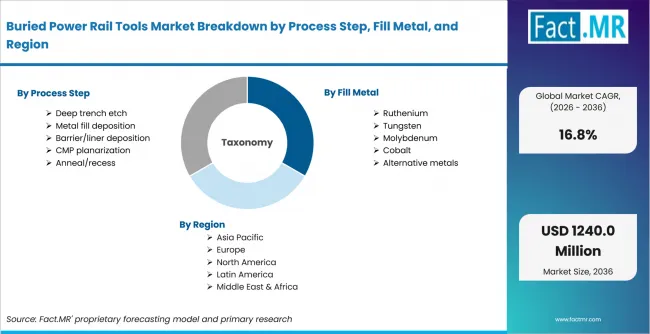
Buried Power Rail Tools Market Breakdown By Process Step, Fill Metal, And Region | Source: Fact.MR
| Attribute | Details |
|---|---|
| Quantitative Units | USD 262.0 million in 2026 to USD 1,240.0 million by 2036 at a 16.8% CAGR |
| Market Definition | Buried power rail (BPR) tools are the FEOL equipment set that fabricates power rails buried beneath the transistors - deep trench etch into silicon/STI, conformal barrier/liner deposition, metal fill (W or Ru), CMP, and rail-contact (VBPR) patterning. BPR replaces the standard-cell VDD/VSS rails previously implemented in BEOL M0/M1, and pairs with backside power delivery to form full BSPDN. |
| Process Step | Deep trench etch; Metal fill deposition; Barrier/liner deposition; CMP planarization; Anneal/recess |
| Fill Metal | Ruthenium; Tungsten; Molybdenum; Cobalt; Alternative metals |
| Rail Geometry | <30 nm width; 30-60 nm width; 60-100 nm width; >100 nm width; Custom profiles |
| Integration Scheme | Rail-before-FEOL; Rail-after-FEOL; Hybrid integration; Backside-connected rails; Research schemes |
| End User | Foundries; IDMs; Research consortia; Memory manufacturers; Equipment R&D |
| Regions Covered | North America; Latin America; Europe; East Asia; South Asia & Oceania; Middle East & Africa |
| Countries Covered | Taiwan; USA; South Korea; Israel; Japan; Ireland |
| Key Companies Profiled | Applied Materials; Lam Research; Tokyo Electron; ASM International; Ebara; Hitachi High-Tech |
| Forecast Period | 2026 to 2036 |
| Approach | Hybrid top-down and bottom-up approach using demand indicators across Process Step; Fill Metal; Rail Geometry; Integration Scheme; End User; country-level growth; company participation and adoption trends |
Source: Fact.MR analysis. Updated Jul 23, 2026
How is the market segmented?
-
By Process Step:
- Deep trench etch
- Metal fill deposition
- Barrier/liner deposition
- CMP planarization
- Anneal/recess
-
By Fill Metal:
- Ruthenium
- Tungsten
- Molybdenum
- Cobalt
- Alternative metals
-
By Rail Geometry:
- <30 nm width
- 30-60 nm width
- 60-100 nm width
- >100 nm width
- Custom profiles
-
By Integration Scheme:
- Rail-before-FEOL
- Rail-after-FEOL
- Hybrid integration
- Backside-connected rails
- Research schemes
-
By End User:
- Foundries
- IDMs
- Research consortia
- Memory manufacturers
- Equipment R&D
-
By Region:
- North America
- Latin America
- Europe
- South Asia & Oceania
- Middle East & Africa
Frequently Asked Questions
Which Process Step leads the Buried Power Rail Tools Market?
Which Fill Metal leads the Buried Power Rail Tools Market?
Which Rail Geometry leads the Buried Power Rail Tools Market?
Which Integration Scheme leads the Buried Power Rail Tools Market?
Which End User leads the Buried Power Rail Tools Market?
What CAGR is projected for USA in the Buried Power Rail Tools Market?
What CAGR is projected for Taiwan in the Buried Power Rail Tools Market?
What CAGR is projected for South Korea in the Buried Power Rail Tools Market?
What CAGR is projected for Japan in the Buried Power Rail Tools Market?
What CAGR is projected for Israel in the Buried Power Rail Tools Market?
What CAGR is projected for Ireland in the Buried Power Rail Tools Market?
What is the primary driver of the Buried Power Rail Tools Market?
What is the main restraint in the Buried Power Rail Tools Market?
Who worked on this report


Preview the report firsthand - request a free sample
Free SampleGet the brochure for pricing and purchase details
Download PDF