- Base Value(2025): 920.0 Mn
- Estimated Value(2026): 955.9 Mn
- Forecast Value (2036): 1401.4 Mn
- CAGR (2026 - 2036): 3.9%
Cable Separator Market Analysis and Forecast by Fact.MR
- The global cable separator market is estimated at USD 955.88 million in 2026 and is forecast to expand at a CAGR of 3.9% to reach USD 1401.389 million by 2036.
- Cable separators are devices used to maintain spacing between parallel power cables in transmission and distribution installations, preventing overheating from proximity-induced electromagnetic interference.
- Metal-based separators in aluminum alloy and stainless steel dominate, with medium-voltage applications serving as the largest demand segment.
- Growth is supported by urban power distribution upgrades, underground cabling expansion replacing overhead lines, and renewable energy grid interconnection requiring cable management in convertor stations.
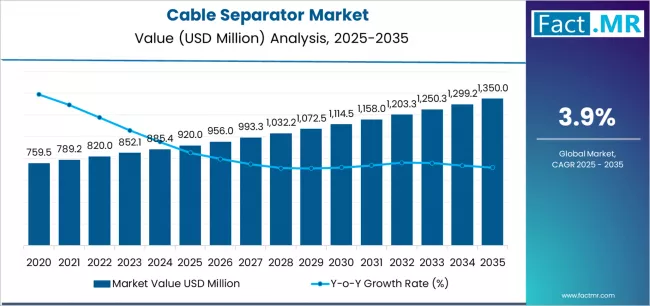
Cable Separator Market Market Value Analysis | Source: Fact.MR
Summary of Cable Separator Market
- Market Snapshot
- In 2025, the global Cable Separator Market was valued at approximately USD 920.0 million.
- The market is estimated to reach USD 955.88 million in 2026 and is projected to attain USD 1401.389 million by 2036.
- The cable separator market is likely to expand at a CAGR of 3.9% during the forecast period.
- The market is anticipated to create an absolute dollar opportunity of USD 445.509 million between 2026 and 2036.
- Utilities accounts for 42.5% of the end use segment share in 2026.
- India (4.6%) and China (4.1%) are the key growth markets during the forecast period.
- Demand and Growth Drivers
- Expanding power grid infrastructure in emerging markets is creating structured procurement demand for cable separator market across new installations.
- Regulatory compliance mandates are establishing non-discretionary procurement requirements that transform cable separator market from optional to mandatory equipment in regulated facilities.
- Technology advancement from metal to composite materials is creating upgrade cycles at existing installations.
- Growing safety and quality standards across utility operations are increasing procurement budgets.
- Underground cabling expansion replacing overhead lines is broadening the addressable market.
- Product and Segment View
- Mechanical Cable Separators accounts for 37.8% of the product segment in 2026.
- Metal Based represents 41.3% of the material segment.
- Medium voltage holds the largest share of voltage segment.
- Key segmentation includes:
- Product: Mechanical Cable Separators, Spacer Type Cable Separators, Clamp Based Cable Separators, Hydraulic Cable Separators
- Material: Metal Based, Aluminum Alloy Separators, Stainless Steel Separators, Copper Alloy Components
- Voltage Rating: Medium Voltage, 1 kV to 33 kV Applications, Commercial Infrastructure Use, Low Voltage
- Application: Power Distribution, Industrial Distribution Networks, Urban Grid Systems, Power Transmission
- These systems enable:
- Primary functional capability for the market's core use case
- Compliance-enabling capability for regulated applications
- Technology-differentiated capability for premium specifications
- Geography and Competitive Outlook
- North America holds significant value, with the U.S. at USD 332.264 million in 2026.
- Asia Pacific leads by growth, with India (4.6%) and China (4.1%) supported by expanding infrastructure and manufacturing capacity.
- Europe shows growth led by Germany ({'name': 'Germany', 'cagr': 3.3}).
- Key companies include Prysmian Group, Nexans S.A., NKT A/S, Leoni AG.
- Analyst Opinion
- Shambhu Nath Jha, Principal Consultant at Fact.MR, says 'The cable separator market is a specification-driven component segment where procurement is tied directly to cable installation project volumes. Grid modernization, underground cabling, and renewable interconnection are creating sustained demand. Manufacturers with broad voltage coverage, material certification, and fast delivery capability aligned to project timelines are capturing specification wins from utility procurement and EPC contractor channels.'
Key Growth Drivers, Constraints, and Opportunities
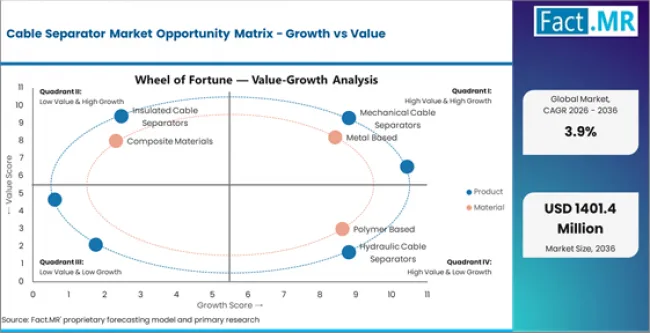
Cable Separator Market Opportunity Matrix Growth Vs Value | Source: Fact.MR
Key Factors Driving Growth
- Grid modernization and underground cabling projects create structured procurement demand.
- Renewable energy interconnection requiring cable management creates compliance-driven adoption.
- Urban power distribution density increases cable separation requirements drives technology investment.
Key Market Constraints
- High capital cost creates procurement barriers for smaller operators.
- Long qualification and approval cycles extend time-to-revenue for new products.
- Commodity pricing pressure from low-cost manufacturers limits margin capture in standard product segments.
Key Opportunity Areas
- Technology upgrade from standard to premium specifications creates higher-value procurement.
- Emerging market infrastructure expansion creates greenfield installation demand.
- IoT connectivity and predictive maintenance create recurring service revenue.
Segment-wise Analysis of the Cable Separator Market
- Mechanical Cable Separators holds 37.8% of the product segment.
- Utilities accounts for 42.5% of the end use segment.
- Metal-based separators lead their respective segments.
The cable separator market is segmented by product, material, voltage rating, application, and region.
Which Product Segment Dominates the Cable Separator Market?
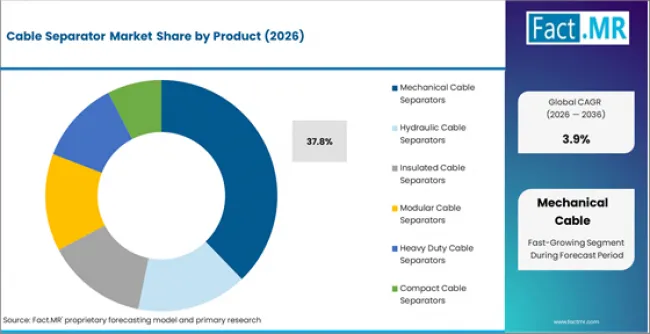
Cable Separator Market Analysis By Product | Source: Fact.MR
Mechanical Cable Separators accounts for 37.8% in 2026, reflecting established demand from the primary application base.
Alternative configurations serve specialized application niches and are growing as technology advancement creates new specification opportunities.
Which End Use Segment Dominates the Cable Separator Market?
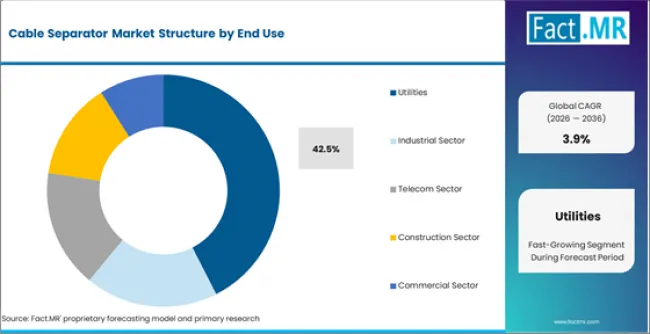
Cable Separator Market Analysis By End Use | Source: Fact.MR
Utilities leads with 42.5% share in 2026, with procurement concentrated in the primary buyer category.
Secondary end-use categories represent growing demand as applications expand beyond traditional core procurement channels.
Which Product Trend is Shaping the Next Phase of Growth in the Cable Separator Market?
Non-metallic composite cable separators are gaining specification interest for applications where electromagnetic neutrality, corrosion resistance, and lighter weight offer installation advantages over traditional metal separators. Fiber-reinforced polymer and ceramic-based separators are being evaluated for offshore and chemically aggressive environments where metal separator corrosion creates maintenance risk.
This material shift is in early stages but represents a structural opportunity for manufacturers developing composite alternatives that meet utility approval standards. The qualification process for new separator materials in medium and high-voltage applications is lengthy, giving early-mover manufacturers a specification advantage once utility approvals are obtained.
Regional Outlook Across Key Markets
.webp "Top Country Growth Comparison Cable Separator Market Cagr (2026 2036)")
Top Country Growth Comparison Cable Separator Market Cagr (2026 2036) | Source: Fact.MR
- India leads at 4.6%, supported by expanding infrastructure and regulatory compliance investment.
- China (4.1%) reflects growing industrial capacity and infrastructure modernization.
- The U.S. (3.5%) shows growth from grid modernization.
CAGR Table
| Country | CAGR (%) |
|---|---|
| India | 4.6% |
| China | 4.1% |
| USA | 3.5% |
| South Korea | 3.4% |
| Germany | 3.3% |
| France | 3.1% |
| Japan | 3.0% |
Source: Fact.MR analysis. Updated Jun 1, 2026
Source: Fact MR (FMR) analysis, based on proprietary forecasting model and primary research.
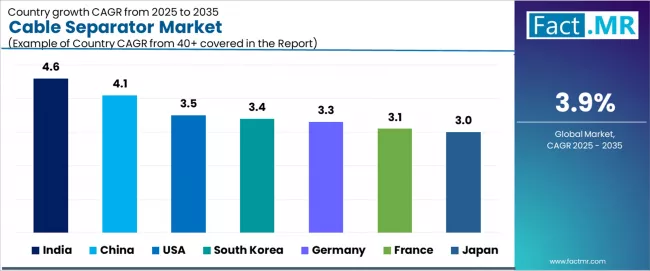
Cable Separator Market Cagr Analysis By Country | Source: Fact.MR
Cable Separator Market Demand Trends in India
PLI manufacturing expansion and grid infrastructure drives demand at 4.6% CAGR.
- Primary growth driver creating structured procurement.
- Secondary factor supporting market expansion.
China Cable Separator Market Growth Assessment
Expanding capacity and regulatory compliance shape demand at 4.1% CAGR.
- Manufacturing and infrastructure investment creates procurement demand.
- Quality and safety standards drive technology adoption.
Market Outlook for Cable Separator in the United States
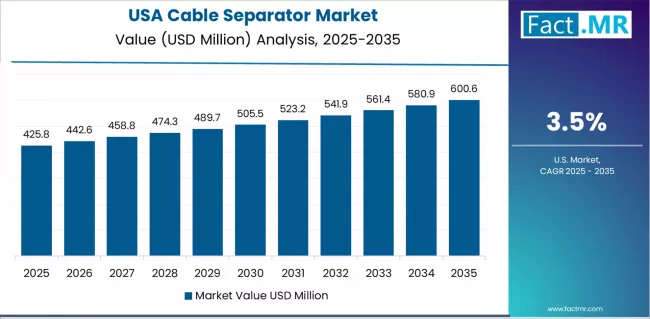
Cable Separator Market Country Value Analysis | Source: Fact.MR
Grid modernization and underground cabling drive demand at 3.5% CAGR.
- Regulatory compliance creates non-discretionary procurement demand.
- Technology upgrade cycles generate premium product specification.
Germany Cable Separator Demand Analysis
EU regulatory alignment and industrial modernization shape demand at 3.3% CAGR.
- EU regulatory standards establish minimum specification requirements.
- Industrie 4.0 integration drives smart and connected product adoption.
South Korea Cable Separator Opportunity
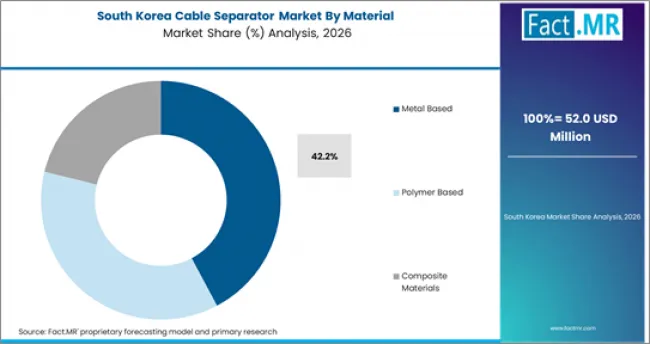
Cable Separator Market South Korea Market Share Analysis By Material | Source: Fact.MR
Industrial concentration and quality standards support demand at 3.4% CAGR.
- High-technology industry concentration generates specialized procurement.
- Quality and certification requirements favor established manufacturers.
Competitive Benchmarking and Company Positioning
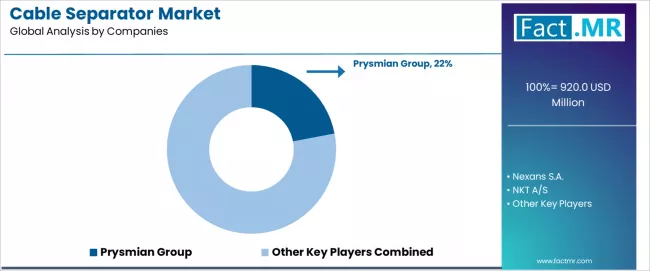
Cable Separator Market Analysis By Company | Source: Fact.MR
Cable Separator Market Analysis By Company
- Prysmian Group holds the leading position with approximately 22.0% share through comprehensive product portfolios and global distribution.
- Nexans S.A. and NKT A/S compete through specialized capabilities and regional market depth.
- Technology differentiation and regulatory certification are primary competitive factors.
The competitive landscape is moderately concentrated. Prysmian Group leads through vertically integrated capability.
Nexans S.A., NKT A/S, Leoni AG serve specific segments and regional markets.
Strategic priorities include technology advancement, geographic expansion, and service capability development.
Key Companies in the Cable Separator Market
- Prysmian Group, Nexans S.A., NKT A/S, Leoni AG are among the leading players in the cable separator market globally, supported by strong brand visibility, broad service portfolios, and growing positions in managed energy solutions.
- Sumitomo Electric Industries, Ltd., LS Cable & System Ltd., Southwire Company, LLC, Fujikura Ltd. hold established positions across specific service segments, end-use categories, and regional markets, supported by specialized capabilities and established commercial relationships.
- Hengtong Group Co., Ltd., Belden Inc., Encore Wire Corporation, Taihan Electric Wire Co., Ltd. continue to compete through focused offerings, technology partnerships, and regional service networks.
Recent Industry Developments
- Prysmian Group, Product Enhancement, Portfolio Expansion (2025)
- Prysmian Group continued enhancement of its cable separator portfolio, strengthening its competitive position in the primary application segment.
- Nexans S.A., Market Expansion, Technology Development (2025)
- Nexans S.A. expanded its market presence through technology development and regional distribution strengthening.
- NKT A/S, Technology Integration, Advanced Systems (2025)
- NKT A/S advanced its product portfolio with improved performance and compliance capability.
Leading Companies Shaping the Cable Separator Market
- Prysmian Group
- Nexans S.A.
- NKT A/S
- Leoni AG
- Sumitomo Electric Industries, Ltd.
- LS Cable & System Ltd.
- Southwire Company, LLC
- Fujikura Ltd.
- Hengtong Group Co., Ltd.
- Belden Inc.
Sources and Research References
- Prysmian Group. Product portfolio and market developments.
- Nexans S.A.. Technology and market expansion.
- NKT A/S. Product and competitive developments.
- Industry regulatory bodies. Standards and compliance data.
- Primary interviews across manufacturers, distributors, and end users.
- This bibliography is provided for reader reference and is not exhaustive.
Key Questions This Report Addresses
- What is the current and future size of the Cable Separator Market?
- How fast is the Cable Separator Market expected to grow between 2026 and 2036?
- Which product type leads by 2026?
- Which end-use accounts for the highest demand?
- What drives demand for cable separator?
- How is technology advancement influencing the market?
- Why is India the fastest-growing market?
- Which countries show fastest growth?
- Who are key companies in the Cable Separator Market?
- How does Fact.MR validate the forecast?
Cable Separator Market Definition
The cable separator market covers cable separator products and systems for industrial and commercial applications.
Cable Separator Market Inclusions
- The scope covers global and regional forecasts for 2026 to 2036.
- It includes regional analysis based on industry-specific demand factors.
- The report includes pricing across product categories.
- It covers technology trends and competitive landscape.
Cable Separator Market Exclusions
- The scope excludes consumer-grade and non-industrial products.
- It excludes components sold separately without system integration.
- The report excludes custom one-off products for research applications.
Cable Separator Market Research Methodology
- The methodology combines secondary research, primary interviews, and forecast modelling.
- It draws on 90+ secondary sources and benchmarks 35+ company portfolios.
- Market sizing covers 30+ countries.
- Key inputs include industry activity data and regulatory compliance tracking.
- The model cross-checks with manufacturer shipments.
- Primary validation includes 20+ interviews.
- Final estimates go through reconciliation and sensitivity testing.
Segmentation
Scope of Analysis
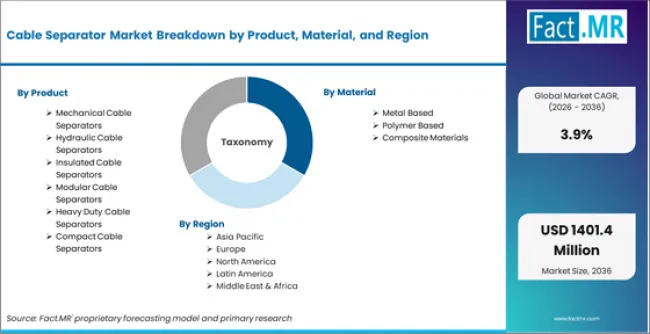
Cable Separator Market Breakdown By Product, Material, And Region | Source: Fact.MR
| Parameter | Details |
|---|---|
| Quantitative Units | USD 955.88 million to USD 1401.389 million, at a CAGR of 3.9% |
| Market Definition | The cable separator market covers cable separator products and systems. |
| Regions Covered | North America, Latin America, Europe, East Asia, South Asia and Pacific, Middle East and Africa |
| Countries Covered | India, China, USA, South Korea, Germany, France, Japan, 30 plus countries |
| Key Companies | Prysmian Group, Nexans S.A., NKT A/S, Leoni AG, Sumitomo Electric Industries, Ltd., LS Cable & System Ltd., Southwire Company, LLC, Fujikura Ltd., Hengtong Group Co., Ltd., Belden Inc. |
| Forecast Period | 2026 to 2036 |
| Approach | Hybrid demand-side methodology built on industry-specific procurement data, regulatory compliance tracking, and primary interviews across manufacturers, distributors, and end users |
Source: Fact.MR analysis. Updated Jun 1, 2026
Cable Separator Market Segmentation
-
Cable Separator Market Segmented by Product:
- Mechanical Cable Separators
- Spacer Type Cable Separators
- Clamp Based Cable Separators
- Hydraulic Cable Separators
- Manual Hydraulic Separators
- Power Assisted Hydraulic Separators
- Insulated Cable Separators
- High Voltage Insulated Separators
- Electrically Resistant Separators
- Modular Cable Separators
- Adjustable Modular Systems
- Preassembled Modular Units
- Heavy Duty Cable Separators
- Industrial Grade Separators
- Power Grid Application Separators
- Compact Cable Separators
- Space Saving Separator Units
- Miniature Cable Management Separators
- Mechanical Cable Separators
-
Cable Separator Market Segmented by Material:
- Metal Based
- Aluminum Alloy Separators
- Stainless Steel Separators
- Copper Alloy Components
- Polymer Based
- PVC Cable Separators
- High Density Polyethylene Separators
- Fiberglass Reinforced Polymer Separators
- Composite Materials
- Insulated Composite Separators
- Heat Resistant Composite Units
- Metal Based
-
Cable Separator Market Segmented by Voltage Rating:
- Medium Voltage
- 1 kV to 33 kV Applications
- Commercial Infrastructure Use
- Low Voltage
- Up to 1 kV Applications
- Mobile and Residential Use
- High Voltage
- Above 33 kV Applications
- Power Transmission Systems
- Extra High Voltage
- Ultra High Voltage Grid Systems
- Interstate Transmission Networks
- Medium Voltage
-
Cable Separator Market Segmented by Application:
- Power Distribution
- Industrial Distribution Networks
- Urban Grid Systems
- Power Transmission
- Overhead Transmission Lines
- Underground Cable Systems
- Industrial Applications
- Oil and Gas Infrastructure
- Manufacturing Plants
- Construction
- Commercial Building Wiring
- Infrastructure Projects
- Telecommunication
- Fiber Optic Cable Management
- Data Center Cable Routing
- Power Distribution
-
Cable Separator Market Segmented by End Use:
- Utilities
- Electricity Boards
- Power Grid Operators
- Industrial Sector
- Heavy Manufacturing
- Process Industries
- Telecom Sector
- Network Service Providers
- Data Centers
- Construction Sector
- Commercial Sector
- Utilities
-
Cable Separator Market by Region:
- North America
- USA
- Canada
- Mexico
- Latin America
- Brazil
- Chile
- Rest of Latin America
- Western Europe
- Germany
- UK
- Italy
- Spain
- France
- Nordic
- BENELUX
- Rest of Western Europe
- Eastern Europe
- Russia
- Poland
- Hungary
- Balkan & Baltic
- Rest of Eastern Europe
- East Asia
- China
- Japan
- South Korea
- South Asia and Pacific
- India
- ASEAN
- Australia & New Zealand
- Rest of South Asia and Pacific
- Middle East & Africa
- Kingdom of Saudi Arabia
- Other GCC Countries
- Turkiye
- South Africa
- Other African Union
- Rest of Middle East & Africa
- North America
Frequently Asked Questions
How big is the cable separator market in 2026?
What will be the size of cable separator market in 2036?
How much will be the cable separator market growth between 2026 and 2036?
What are the key product types in the cable separator market?
Which material segment is expected to contribute significant share in the cable separator market in 2026?
Who worked on this report


Preview the report firsthand - request a free sample
Free SampleGet the brochure for pricing and purchase details
Download PDF