- Base Value(2025): 1.7 Bn
- Forecast Value (2035): 2.9 Bn
- CAGR (2035): 5.4%
Heating Cable Market Outlook 2025 to 2035
The global heating cable market is projected to increase from USD 1.7 billion in 2025 to USD 2.9 billion by 2035, with a CAGR of 5.4% during the forecast period. Growth is driven by rising emphasis on frost protection, pipe freeze prevention, and underfloor heating systems in colder regions. Rapid urbanization, infrastructure development, and the adoption of smart technologies are further boosting demand for self-regulating and constant wattage heating cables.
2025-to-2035.webp "Us Heating Cable Market Value(usd Billion)2025 To 2035")
Us Heating Cable Market Value(usd Billion)2025 To 2035 | Source: Fact.MR
What are the Drivers of Heating Cable Market?
The growth of the heating cable market is driven by increasing demand for energy-efficient heating solutions across residential, commercial, and industrial sectors. Rapid urbanization and industrialization have led to heightened requirements for freeze protection, roof and gutter de-icing, and underfloor heating systems, particularly in regions experiencing harsh winters.
The expansion of oil and gas pipelines, coupled with the need to maintain process temperatures in industries such as chemicals, food processing, and pharmaceuticals, further accelerates the adoption of heating cables. Rising emphasis on minimizing energy consumption and reducing carbon emissions has encouraged the integration of self-regulating and advanced electric heating technologies.
Government initiatives promoting sustainable building practices and stricter safety regulations around pipeline integrity also support market growth. Technological advancements, such as the development of smart heating cables with IoT-enabled monitoring systems, are enhancing operational efficiency and attracting investments from key players.
Additionally, growing awareness of comfort heating applications, such as snow melting in driveways and energy-efficient floor heating, is fueling residential adoption. The rising construction of commercial complexes, airports, and public infrastructure in colder regions amplifies demand, while the trend toward renewable energy systems and the electrification of heating processes provide new growth avenues. Together, these factors create a robust environment for the heating cable market, with strong potential for innovation and expansion in both developed and emerging economies.
| Metric | Value |
|---|---|
| Industry Size (2025E) | USD 1.7 billion |
| Industry Size (2035F) | USD 2.9 billion |
| CAGR (2025-2035) | 5.4% |
Source: Fact.MR analysis. Updated Aug 25, 2025
What are the Regional Trends of Heating Cable Market?
The heating cable market exhibits distinct regional trends driven by climate, industrialization, and infrastructure development. In North America and Europe, demand is primarily fueled by harsh winters and the need for freeze protection in residential, commercial, and industrial applications.
These regions see extensive use of self-regulating and constant wattage heating cables for pipe freeze protection, roof and gutter de-icing, and underfloor heating systems. Europe also emphasizes energy-efficient solutions due to strict environmental regulations, leading to technological advancements and adoption of eco-friendly materials. In Asia-Pacific, rapid urbanization, rising construction activities, and increasing industrialization are key growth drivers.
Countries like China, Japan, and South Korea are witnessing high demand for heating cables in process industries such as chemicals, oil & gas, and food processing, alongside growing use in smart buildings. The Middle East & Africa, despite their generally warm climate, show growing demand for heating cables in oil & gas pipelines, petrochemical plants, and cold storage facilities, particularly in areas prone to occasional low temperatures. Latin America is experiencing moderate growth, led by countries like Brazil and Argentina, where infrastructure development and industrial applications are supporting market expansion.
Across all regions, there is a rising focus on renewable energy integration and digitalization of heating systems for enhanced energy efficiency and monitoring. These regional dynamics collectively shape the global heating cable market, with developed economies focusing on upgrades and sustainability while emerging markets drive growth through new installations and industrial expansion.
What are the Challenges and Restraining Factors of Heating Cable Market?
The heating cable market faces several challenges and restraining factors that impact its growth and widespread adoption. One of the primary challenges is the high initial cost of installation, which often discourages potential users, especially in developing regions where budget constraints are significant.
The complexity of installation and the need for skilled labor further add to the operational costs, making it less attractive for small-scale applications. Additionally, fluctuations in raw material prices, particularly for metals like copper and stainless steel used in cable manufacturing, affect the overall production costs and profit margins for manufacturers.
The market is also restrained by the lack of awareness about advanced heating cable systems in certain regions, limiting demand in residential and commercial sectors. Concerns over energy efficiency and environmental impact are rising as heating cables consume substantial electricity, prompting end-users to seek alternative solutions. Moreover, stringent regulations and safety standards in some countries create barriers for new market entrants, increasing compliance costs for existing players.
Country-Wise Outlook
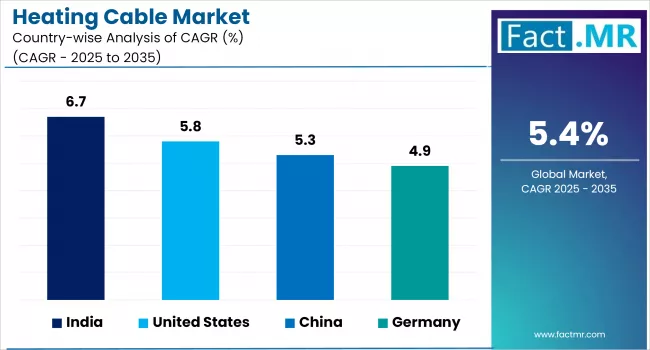
Heating Cable Market By Country | Source: Fact.MR
| Countries | CAGR (2025-2035) |
|---|---|
| United States | 5.8% |
| Germany | 4.9% |
| India | 6.7% |
Source: Fact.MR analysis. Updated Aug 25, 2025
U.S.: Dominance Driven by Industrial and Residential Applications
2025-to-2035.webp "Us Heating Cable Market Country Value(usd Billion)2025 To 2035")
Us Heating Cable Market Country Value(usd Billion)2025 To 2035 | Source: Fact.MR
The U.S. heating cable market is driven by strong demand across industrial, commercial, and residential sectors. The country’s colder regions, especially in the northern states, experience prolonged winters, leading to significant use of heating cables for pipe freeze protection, roof de-icing, and floor heating systems. Industrial sectors, including oil & gas, petrochemicals, and power generation, continue to adopt heating cables for process temperature maintenance and frost protection in pipelines and storage tanks.
This demand is further supported by the growing trend of smart homes and energy-efficient buildings where electric floor heating systems are being increasingly installed. Federal initiatives aimed at improving energy efficiency and reducing carbon emissions have resulted in incentives for adopting electric heating solutions, including advanced self-regulating and constant wattage cables. However, challenges such as high installation costs and growing competition from alternative heating technologies like hydronic systems could restrain market growth slightly.
Germany: Energy Transition and Sustainability Goals Fuel Market Growth
The Germany heating cable market is propelled by its commitment to energy transition (Energiewende) and sustainability objectives. With stringent EU regulations mandating energy-efficient building technologies, heating cables have found increased adoption for underfloor heating and frost protection in residential and commercial infrastructure.
Germany’s focus on renewable energy integration supports the use of electric heating systems, as these can be powered by renewable electricity sources like wind and solar. The automotive and industrial sectors, key pillars of the German economy, also drive demand for heating cables for process heating, freeze protection, and ensuring the safe operation of sensitive equipment during extreme winters. The country’s advanced infrastructure, coupled with consumer preference for comfort heating, has led to widespread installation of self-regulating and mineral-insulated heating cables in both new constructions and retrofits.
India: Rising Urbanization and Infrastructure Development Boost Demand
IndiaThe heating cable market is fueled by rapid urbanization, infrastructure expansion, and industrial growth. While India traditionally experiences warmer climates, the northern regions face harsh winters where heating cables are increasingly utilized for floor heating, pipe freeze protection, and frost prevention in critical infrastructure.
The growing demand for modern residential complexes and smart buildings in urban areas is leading to the adoption of electric underfloor heating systems, catering to the rising middle-class preference for luxury and comfort. Additionally, industrial applications in sectors like oil & gas, chemicals, and power are driving the use of heating cables for process temperature maintenance and frost protection in pipelines and tanks, particularly in colder states like Himachal Pradesh, Uttarakhand, and Jammu & Kashmir. Government initiatives such as "Smart Cities Mission" and infrastructure investments further support market expansion by encouraging advanced building technologies, including energy-efficient heating systems.
Category-wise Analysis
Self-regulating to Exhibit Leading by Product Type
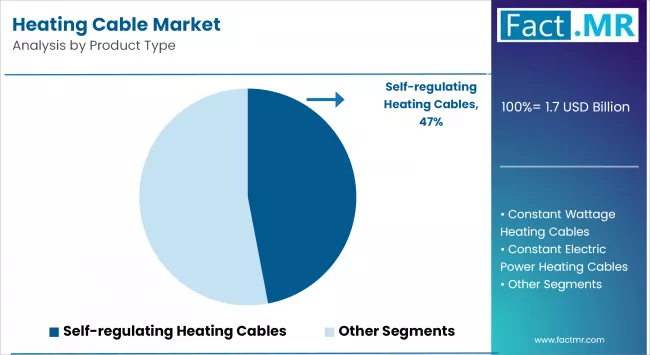
Heating Cable Market By Product Type | Source: Fact.MR
Self-regulating heating cables hold the largest market share in the heating cable market, due to their energy efficiency and safety. These cables automatically adjust output based on ambient temperature, reducing the risk of overheating and energy waste. Their flexibility makes them ideal for applications like freeze protection and pipe tracing in residential, commercial, and industrial setups. Their durability and low maintenance requirements further boost adoption. Industries favor them for temperature-sensitive environments, resulting in steady and high revenue generation globally.
Constant wattage heating cables are the fastest-growing segment, as these cables are gaining traction for their reliable heat output across the entire length of the cable. With increasing use in applications such as underfloor heating and snow melting systems, these cables appeal to cost-conscious consumers seeking consistent heating. Their simpler construction and competitive pricing drive adoption, especially in residential projects. As infrastructure modernization accelerates, the demand for these efficient solutions is surging, making them the fastest-growing product type in the market.
151 to 200°F to Exhibit Leading by Maximum Temperature
Heating cables with a maximum temperature range of 151 to 200 °F dominate the hetaing cable market, due to their optimal suitability for most residential and commercial applications. This range is ideal for freeze protection, underfloor heating, and temperature maintenance. The balance between efficiency and safety has made this temperature range the most commercially viable. It supports various sectors from food processing to building automation, contributing significantly to the overall revenue in the electric heating cables market.
The above 200 °F segment is the fastest-growing segment, due to rising demand in specialized industrial and commercial applications. High-temperature environments such as oil refineries, chemical plants, and heavy-duty HVAC systems require robust solutions that can withstand extreme conditions. As industrial infrastructure scales up and energy efficiency becomes a priority, more users are shifting to advanced heating cables with higher heat tolerance. This segment’s growing importance in demanding environments drives its rapid growth.
50 to 100 to Exhibit Leading by Maximum Wattage
The 50 to 100 watt category dominates the heating cable market, as it provides a good balance of power consumption vs. heat for residential, commercial, and light industrial heating applications. These cables are widely used for floor heating, roof and gutter de-icing, and freeze protection for small pipes, while maintaining adequate power for efficiency and reliable heating. As sustainability and operating costs rise across every sector, the 50 to 100 watt category remains the optimum option to provide effective thermal management without straining energy load and safety.
The above 150 watt segment is the fastest-growing, driven by increasing demand in high-performance industrial applications and snow melting systems. High-wattage heating cables are necessary for high-temperature processes, oil and gas pipelines, and essential chemical infrastructure where consistent and considerable heat flow is needed. As industrial operations and critical infrastructure in harsh environments develop globally at rapid rates, high-capacity heating cables will be increasingly needed. Technological improvements in heat control are making these high-wattage solutions more efficient and attractive to buyers.
Bulk (B2B) to Exhibit leading by Packaging Format
Bulk (B2B) packaging dominates the heating cable segment, primarily due to consistent demand in the industrial and commercial sectors. For maximum impact in infrastructure, energy facilities, and manufacturing plants, considerable quantities of heating cables are bundled together for extensive installation and implementation. Packing heating cables into B2B packaging dramatically reduces per-unit costs while significantly streamlining logistics and inventory management for large-scale purchasers. Engineering procurement and construction (EPC) contractors, as well as utilities, prefer bulk shipments in one consistent package type in order to make custom installations while ensuring billing, distribution, control, and procurement program compliance.
The B2C packaging segment is the fastest-growing, largely driven by a smart home trend and growing demand from consumers for DIY heating solutions and products. Small, easy to install, retail ready, heating cable kits are being sold for residential floor heating, pipe freeze protection, and roof de-icing. E-commerce and home improvement retailers give increased access to the individual buyer. As energy efficient homes and retrofitting projects emerge into the common vernacular, the B2C segment will continue to grow due to product innovations and consumer education around energy management within the home.
Copper to Exhibit Leading by Conductor Material
Copper is the dominant conductor material, due to its excellent electrical conductivity, durability, and reliability. Copper-based heating cables provide fast heat transfer and are ideal for consistent performance in both residential and industrial applications. Despite being costlier than alternatives, copper's superior efficiency and longevity ensure a higher return on investment. Its prevalence in standard and premium-grade heating cables across global markets makes it the top contributor to overall market revenue.
Aluminum wires are the fastest-growing segment, due to their lower cost and lighter weight compared to copper. While slightly less conductive, advances in insulation and design have improved their reliability, making them viable for budget-conscious residential and light commercial applications. Their affordability is attracting increasing demand in emerging markets and large-scale installations. As manufacturers continue to innovate in material efficiency, aluminum-based heating cables are witnessing the fastest growth rate.
Freeze Protection to Exhibit Leading by Application
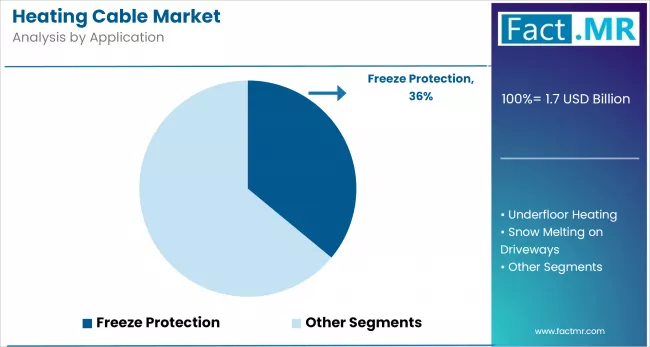
Heating Cable Market By Application | Source: Fact.MR
Freeze protection applications account for the largest market share in the heating cable market, due to their critical role in preventing pipe bursts and damage during freezing weather. These cables are extensively used in residential homes, commercial buildings, and municipal water systems to ensure uninterrupted operation and avoid costly repairs. Their high utility across diverse regions experiencing harsh winters and the relatively low installation cost ensure consistent demand, making freeze protection the top revenue-generating application.
Underfloor heating is the fastest-growing segment, driven by rising demand for energy-efficient, space-saving, and comfort-enhancing heating solutions. It is increasingly adopted in modern homes, luxury hotels, and commercial offices. As architectural trends shift towards minimalism and smart homes, electric underfloor heating gains appeal for both new constructions and retrofits. Government incentives for energy-efficient housing are also encouraging installation, propelling this segment's rapid growth.
Residential to Exhibit Leading by End-Use
The residential sector holds the largest revenue share in the heating cable market, owing to widespread adoption of heating cables for pipe freeze protection, underfloor heating, and roof de-icing. Increasing awareness of winterproofing homes, rising disposable incomes, and the appeal of energy-efficient heating systems are fueling demand. Homeowners value the safety, convenience, and long-term cost benefits of electric heating cables, especially in colder regions, making the residential segment the market's biggest contributor.
The commercial segment is the fastest- growing segment, due to expanding use in office complexes, shopping centers, hospitals, and hospitality establishments. Applications include snow melting on driveways, temperature maintenance in pipelines, and underfloor heating in public spaces. Stringent energy codes and sustainability goals are encouraging businesses to adopt efficient heating systems. Additionally, government incentives and green building certifications are further propelling commercial adoption of advanced heating cable technologies.
Competitive Analysis
The heating cable market is becoming increasingly competitive, with key players focusing on innovation, offering self-regulating and constant wattage cables to meet diverse applications such as pipe freeze protection, roof and gutter de-icing, and underfloor heating.
The market is characterized by the presence of both global giants and regional players, creating intense competition on pricing, technology, and distribution networks. Companies are investing in R&D to develop advanced materials and smart heating cables integrated with IoT for remote monitoring and control, aligning with the growing trend of smart homes and buildings. Strategic partnerships, mergers, and acquisitions are common as firms seek to expand their geographic reach and strengthen product portfolios.
Key players in the market include Leader Wuhu Jiahong New Material Co. Ltd, SST Group, Thermopads, Fine Korea Co. Ltd, nVent Raychem, Emerson, Anbang, Anhui Huayang, Eltherm, Chromalox, Isopad, Thanglong Electric, BriskHeat, and other players.
Recent Development
- In June 2023, nVent Electric plc a global leader in electrical connection and protection solutions, launched its newest self-regulating heating cable, the nVent RAYCHEM XTVR. Building on the proven benefits of the nVent RAYCHEM XTV heating cable, the XTVR heating cables deliver reliable and efficient performance in higher temperatures and come with more power variants.
- In September 2024, SST GmbH rebranded as Sigmian GmbH. The rebranding initiative is a part of a broader corporate strategy focused on diversification and innovation.
Segmentation
Segmentation of Heating Cable Market
-
By Product Type :
- Constant Electric Power Heating Cables
- Constant Wattage Heating Cables
- Self-regulating Heating Cables
-
By Maximum Temperature (F) :
- Below 100
- 100 to 150
- 151 to 200
- Above 200
-
By Maximum Wattage :
- Below 50
- 50 to 100
- 101 to 150
- Above 150
-
By Packaging Format :
- Bulk (B2B) Packaging
- B2C Packaging
-
By Conductor Material :
- Copper
- Aluminum
-
By Application :
- Freeze Protection
- Temperature Maintenance
- Snow Melting on Driveways
- Gulley & Roof Snow/Ice Protection
- Underfloor Heating
-
By End-Use :
- Residential
- Commercial
-
By Region :
- North America
- Latin America
- Western Europe
- Eastern Europe
- East Asia
- South Asia & Pacific
- Middle East & Africa
Frequently Asked Questions
What is the Global Heating Cable Market size in 2025?
Who are the Major Players Operating in the Heating Cable Market?
What is the Estimated Valuation of the Heating Cable Market by 2035?
What Value CAGR Did the Heating Cable Market Exhibit over the Last five Years?
Who worked on this report


Preview the report firsthand - request a free sample
Free SampleGet the brochure for pricing and purchase details
Download PDF