- Base Value(2025): 20.6 Bn
- Estimated Value(2026): 23.1 Bn
- Forecast Value (2036): 78.5 Bn
- CAGR (2026 - 2036): 13%
Capability Center As A Service Market Forecast and Outlook By Fact.MR
In 2025, the capability center as a service market was valued at USD 20.6 billion. Based on Fact MR analysis, demand for capability center as a service solutions is estimated to grow to USD 23.1 billion in 2026 and USD 78.5 billion by 2036. FMR projects a CAGR of 13% during the forecast period.
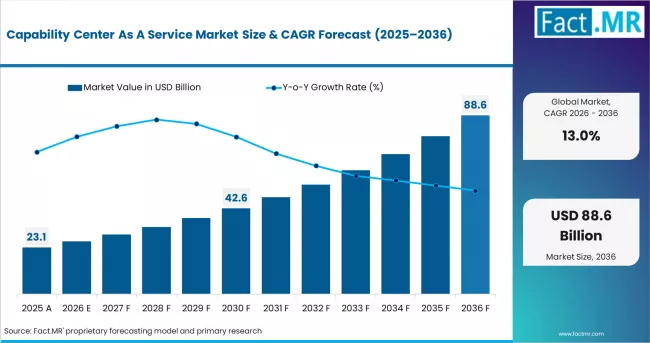
Capability Center As A Service Market Market Value Analysis | Source: Fact.MR
Capability Center As A Service Market
| Metric | Details |
|---|---|
| Industry Size (2026E) | USD 23.1 billion |
| Industry Value (2036F) | USD 78.5 billion |
| CAGR (2026 to 2036) | 13% |
Source: Fact.MR analysis. Updated Apr 20, 2026
Summary of Capability Center As A Service Market
- Market Definition
- The market includes outsourced capability center delivery platforms providing enterprise functions such as IT operations, analytics, engineering support, cybersecurity services, and business process management through scalable managed service models enabling distributed global operations.
- Demand Drivers
- Increasing enterprise adoption of asset-light operating models supporting scalable shared service delivery across global business units.
- Rising demand for specialized digital skills supporting IT operations, analytics workflows, and engineering service execution.
- Expansion of managed service delivery frameworks enabling predictable cost structure across enterprise operational functions.
- Increasing requirement for scalable workforce infrastructure supporting rapid expansion of digital transformation programs.
- Growing adoption of hybrid delivery environments integrating offshore capability centers with onshore operational governance structures.
- Rising need for centralized process standardization supporting consistent execution of enterprise workflows across distributed service environments.
- Key Segments Analyzed
- Deployment Model: Managed services lead with 46% share supported by structured operational outsourcing frameworks.
- Service Type: IT services hold 34% share due to demand for infrastructure management and application support.
- End Use Industry: IT and telecom sector demonstrates strong demand due to continuous digital platform development requirements.
- Service Function: Capability centers support analytics processing, engineering design workflows, and cybersecurity operations.
- Geography: Asia Pacific maintains strong demand concentration supported by availability of skilled workforce infrastructure.
- Analyst Opinion at Fact MR
- Shambhu Nath Jha, Principal Consultant, Fact MR, opines, 'In this updated edition of the Capability Center As A Service Market report, enterprises increasingly adopt managed capability delivery frameworks enabling scalable digital operations and optimized resource utilization through 2036.'
- Strategic Implications or Executive Takeaways
- Strengthen managed service capability supporting scalable enterprise function delivery across distributed operational environments.
- Invest in specialized technical workforce supporting IT operations, analytics modeling, and engineering workflow execution.
- Improve integration capability supporting compatibility with enterprise cloud infrastructure and digital transformation programs.
- Expand hybrid delivery capability supporting coordination between offshore capability centers and onshore governance teams.
- Focus on process standardization supporting predictable performance metrics across outsourced enterprise service functions.
- Enhance cybersecurity capability supporting data governance compliance across cross-border service delivery environments.
- Methodology
- Primary interviews conducted with enterprise service providers, outsourcing consultants, and digital transformation specialists.
- Benchmarked against enterprise demand indicators influencing outsourcing adoption across IT and analytics service functions.
- Evaluated capability center deployment models supporting hybrid and managed delivery frameworks.
- Hybrid modeling applied combining top down enterprise outsourcing demand evaluation with bottom up capability center utilization benchmarking.
- Validation conducted using provider level service capacity indicators across global delivery networks.
- Peer review applied using Fact MR analytical frameworks linking digital transformation initiatives with capability center adoption trends.
An increase of USD 55.4 billion indicates transformational expansion driven by enterprise demand for scalable shared services across IT, analytics, and engineering functions. Growth is supported by operating cost optimization and access to specialized talent, while constraints persist from data governance requirements, vendor lock-in risk, and integration complexity with existing enterprise systems.
India leads with a projected CAGR of 14.2%, supported by expansion of outsourced capability hubs across IT services, analytics, and engineering support functions. China follows with a CAGR of 13.9%, driven by increasing establishment of specialized capability centers supporting global business operations. The United Kingdom records a CAGR of 13.6%, reflecting steady adoption of shared service and managed capability delivery models across enterprise organizations. Germany shows a CAGR of 13.4%, supported by consistent implementation of remote operational support centers across industrial and technology sectors. The United States records the slowest growth at 13.0%, reflecting a relatively mature service outsourcing ecosystem tied to replacement demand within established enterprise service delivery frameworks.
Segmental Analysis
Capability Center As A Service Market Analysis by Deployment Model
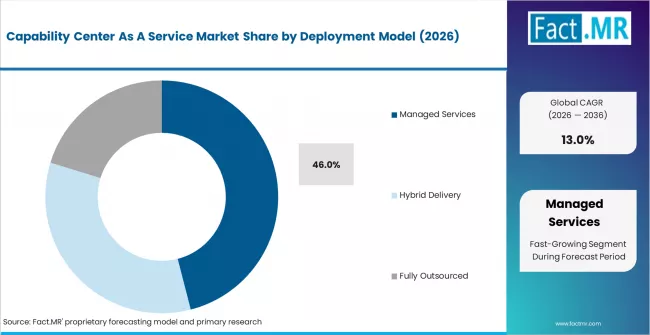
Capability Center As A Service Market Analysis By Deployment Model | Source: Fact.MR
- Market Overview: Based on Fact MR assessment, managed services are projected to account for 46% share of the capability center as a service market in 2026. Managed delivery frameworks enable external service providers to operate capability centers supporting business process execution, technology management, and analytics functions through structured service level agreements. Service providers assume responsibility for infrastructure management, workforce coordination, and operational governance enabling client organizations to focus on core strategic functions. Deployment preference is influenced by requirement for predictable cost structure and standardized performance metrics across distributed service delivery environments requiring continuous operational support.
- Demand Drivers:
- Operational Efficiency Requirements: Managed service structures support external handling of technology and process workflows requiring defined performance benchmarks.
- Cost Predictability Parameters: Contract based delivery frameworks enable structured expenditure planning across outsourced capability center operations.
- Service Continuity Needs: Managed delivery environments support ongoing maintenance and process optimization across enterprise support functions.
Capability Center As A Service Market Analysis by Service Type
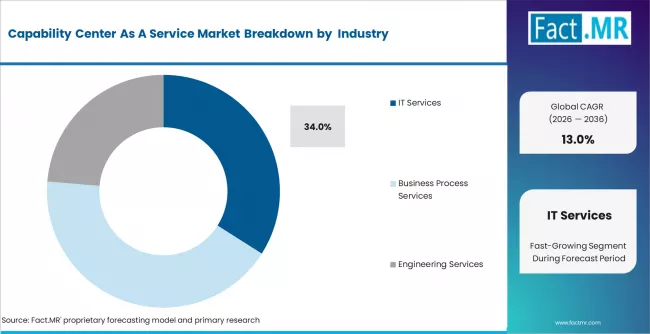
Capability Center As A Service Market Analysis By Service Type | Source: Fact.MR
- Market Overview: IT services are estimated to hold 34% share of the capability center as a service market in 2026, supported by requirement for software development, infrastructure management, cybersecurity operations, and application support across enterprise digital environments. Capability centers deliver structured IT service functions including system monitoring, cloud environment management, and data processing operations requiring defined technical skill sets and process governance frameworks. Service integration supports alignment of IT operations with enterprise technology requirements requiring consistent performance across distributed service delivery infrastructure.
- Demand Drivers:
- Technology Management Requirements: Capability centers support execution of IT operations including application maintenance and infrastructure monitoring across enterprise environments.
- Skill Availability Parameters: Service providers deliver access to technical expertise supporting implementation of software and infrastructure solutions.
- Process Standardization Needs: IT service delivery frameworks support consistent execution of technology workflows across structured operational environments.
Key Dynamics
Capability Center As A Service Market Drivers, Restraints, and Opportunities
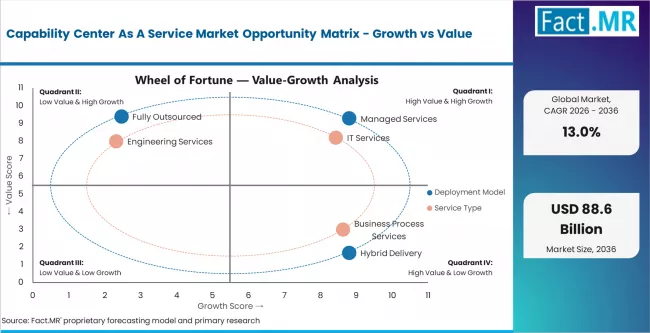
Capability Center As A Service Market Opportunity Matrix Growth Vs Value | Source: Fact.MR
Fact MR analysis indicates historical demand for capability centers originates from shared services and offshore delivery models where multinational firms centralized IT, finance, analytics, and engineering functions to optimize operating cost structures. The current market size reflects a structural transition from captive Global Capability Centers toward subscription-based Capability Center as a Service models that allow enterprises to access skilled talent, infrastructure, and digital delivery frameworks without establishing wholly owned subsidiaries. Structural reality indicates a growth-phase market because enterprises increasingly prioritize asset-light expansion strategies that support rapid scaling of digital operations, analytics capability, and product development functions across distributed global teams.
The present structural shift reflects declining reliance on traditional offshore captives requiring large upfront setup investment, while managed capability center platforms provide faster deployment through standardized technology stacks and pre-integrated operating models. Service pricing per function may exceed legacy outsourcing cost benchmarks, yet reduced transition complexity, faster time-to-productivity, and access to specialized digital skills improve enterprise-level value realization. Demand expansion is strongest among firms pursuing cloud-native transformation programs requiring flexible operating models aligned with evolving workforce structures.
- Asset-Light Expansion: Capability center as a service converts fixed infrastructure investment into subscription-based operating expenditure aligned with scalable global delivery models.
- Data Governance Requirements: GDPR and cross-border data transfer regulations encourage standardized operating environments capable of maintaining compliance across distributed service delivery locations.
- India Talent Hub: India maintains structural demand concentration due to large skilled workforce availability supporting IT, analytics, engineering, and finance capability center operations.
Regional Analysis
The capability center as a service market is assessed across North America, Europe, and Asia Pacific, segmented by country-level demand in managed global capability centers, offshore business services, engineering support operations, analytics delivery platforms, and digital transformation execution services. Regional demand reflects expansion of outsourced capability hubs and increasing adoption of flexible service delivery structures. The full report offers market attractiveness analysis.
.webp "Top Country Growth Comparison Capability Center As A Service Market Cagr (2026 2036)")
Top Country Growth Comparison Capability Center As A Service Market Cagr (2026 2036) | Source: Fact.MR
CAGR Table of Capability Center As A Service Market
| Country | CAGR (2026–2036) |
|---|---|
| India | 14.2% |
| China | 13.9% |
| United Kingdom | 13.6% |
| Germany | 13.4% |
| United States | 13.0% |
Source: Fact.MR analysis. Updated Apr 20, 2026
Source: Fact MR analysis, based on proprietary forecasting model and primary research
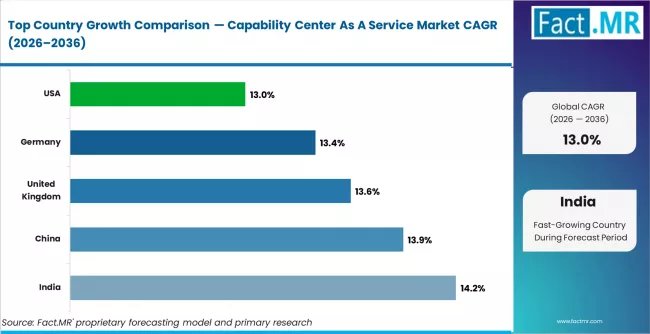
Capability Center As A Service Market Cagr Analysis By Country | Source: Fact.MR
Asia Pacific
Asia Pacific functions as the global capability center delivery hub, supported by expansion of offshore service operations and strong availability of skilled digital workforce. Accenture plc strengthens managed capability center services portfolio. Tata Consultancy Services Limited expands engineering and analytics delivery infrastructure. Infosys Limited supports scalable digital service execution capability.
- India: India is projected to record 14.2% CAGR in capability center as a service adoption through 2036. Digital India programme expansion update (Ministry of Electronics and Information Technology, February 2024) supports outsourcing of analytics and engineering functions. Tata Consultancy Services Limited expanded global capability center delivery capacity (June 2023).
- China: China is expected to expand at 13.9% CAGR in capability center as a service demand through 2036. Service Outsourcing Industry development guideline update (Ministry of Commerce, January 2024) supports offshore digital service expansion. Accenture plc expanded regional capability center operations (May 2023).
Europe
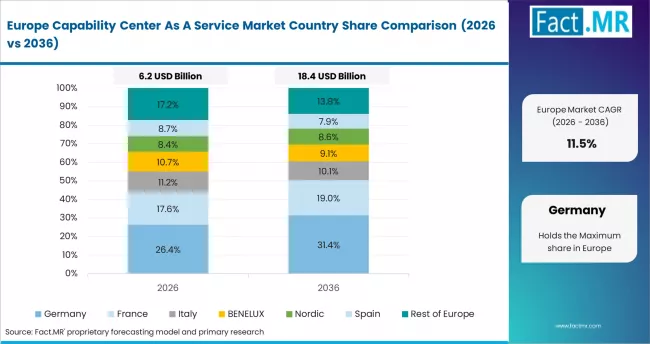
Capability Center As A Service Market Europe Country Market Share Analysis, 2026 & 2036 | Source: Fact.MR
Europe operates as the specialized engineering services coordination center, supported by structured digital transformation initiatives and increasing adoption of hybrid service delivery models. Capgemini SE strengthens managed capability center integration capability. Atos SE expands analytics and engineering service infrastructure. Cognizant Technology Solutions Corporation supports distributed delivery models.
- United Kingdom: Deployment of capability center as a service in United Kingdom is expected to expand at 13.6% CAGR through 2036. UK Digital Strategy implementation update (Department for Science, Innovation and Technology, March 2024) supports managed service delivery adoption. Capgemini SE expanded engineering services delivery capability (July 2023).
- Germany: Germany is anticipated to observe 13.4% CAGR in capability center as a service demand through 2036. Industry 4.0 digitalization programme update (BMWK, October 2023) supports outsourcing of engineering analytics capabilities. Atos SE expanded enterprise transformation service capacity (April 2023).
North America
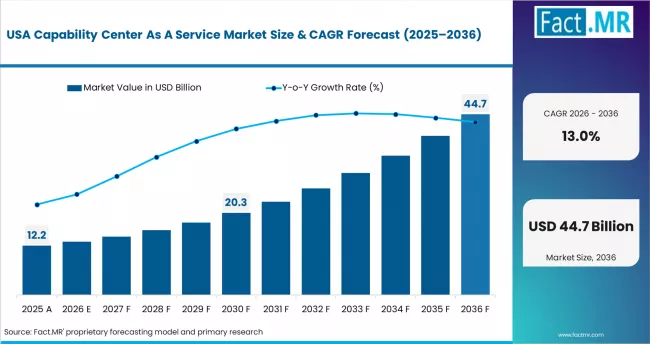
Capability Center As A Service Market Country Value Analysis | Source: Fact.MR
North America represents the enterprise digital transformation outsourcing environment, supported by demand for scalable delivery infrastructure and integration of analytics-driven business operations. IBM Corporation strengthens managed services delivery capability. Cognizant Technology Solutions Corporation expands global engineering service networks. Accenture plc supports enterprise capability outsourcing platforms.
- United States: The United States is forecast to witness 13.0% CAGR in capability center as a service adoption through 2036. Federal cloud and digital modernization initiative update (NIST, April 2024) supports scalable service delivery infrastructure demand. IBM Corporation expanded hybrid capability center service offerings (August 2023).
Fact MR's analysis of capability center as a service market in global regions consists of country-wise assessment that includes India, China, United Kingdom, Germany, and United States. Readers can find outsourced capability delivery trends, digital transformation service developments, enterprise analytics adoption signals, and competitive positioning across key markets.
Competitive Landscape
Competitive Structure and Buyer Dynamics in the Capability Center As A Service Market
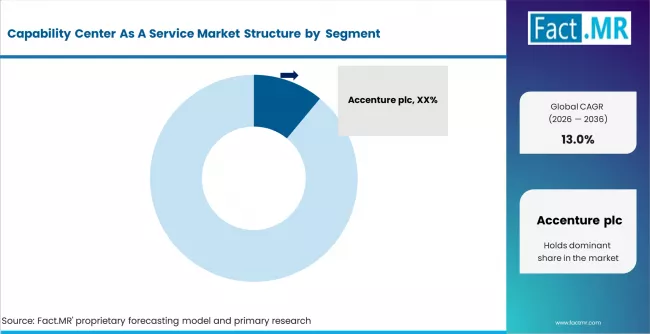
Capability Center As A Service Market Analysis By Company | Source: Fact.MR
The competitive structure of the Capability Center As A Service Market is moderately concentrated, with global IT services firms controlling a significant share of outsourced capability center operations. Companies such as Accenture plc, Tata Consultancy Services Ltd., Infosys Ltd., Wipro Ltd., Cognizant Technology Solutions Corporation, Capgemini SE, HCLTech Ltd., Genpact Ltd., and Tech Mahindra Ltd. maintain strong positions through established global delivery networks and expertise in managed service models. Additional participants including ANSR Inc. contribute through specialized global capability center setup and operational management services. Competition is primarily influenced by service scalability, talent availability, operational efficiency, and ability to integrate capability centers with enterprise technology and business processes.
Several companies maintain structural advantages through large global workforce networks and established relationships with multinational enterprises seeking offshore and nearshore service delivery models. Firms such as Accenture plc, Tata Consultancy Services Ltd., and Infosys Ltd. benefit from extensive experience in managing distributed delivery centers and long term enterprise outsourcing contracts. Capgemini SE and Cognizant Technology Solutions Corporation maintain advantages through consulting integration and digital transformation expertise. Enterprises often evaluate multiple service providers to reduce dependence on a single outsourcing partner and maintain operational flexibility. Procurement decisions assess vendors based on delivery reliability, cost efficiency, and long term scalability, moderating supplier pricing leverage across capability center service engagements.
Key Players of the Capability Center As A Service Market
- Accenture plc
- Tata Consultancy Services Ltd.
- Infosys Ltd.
- Wipro Ltd.
- Cognizant Technology Solutions Corporation
- Capgemini SE
- HCLTech Ltd.
- Genpact Ltd.
- Tech Mahindra Ltd.
- ANSR Inc.
Bibliographies
- [1] Eurostat. (2023, December 7). 45 percent of EU enterprises bought cloud services in 2023. European Commission.
- [2] Micromunch. (2025). Global capability centers reshaping Indias tech sector a new business paradigm. Micromunch.
- [3] Rootstack. (2025, September 7). Most commonly outsourced IT service analysis. Rootstack.
- [4] Statista. (2025, March 26). Global enterprises cloud provider adoption rates 2023 to 2025. Statista.
- [5] Torry Harris Business Solutions. (n.d.). GCC enterprises accelerate deep tech adoption research report. Torry Harris Business Solutions.
This Report Addresses
- Market size forecasts for 2026 to 2036 based on enterprise adoption of outsourced shared service delivery models supporting IT, analytics, engineering, and business operations.
- Opportunity mapping across IT services, business process services, engineering services, analytics services, and cybersecurity service delivery capabilities.
- Segment and regional forecasts covering managed services, hybrid delivery, and fully outsourced capability center deployment models across enterprise operating environments.
- Competition benchmarking based on scalability of delivery infrastructure, availability of specialized digital talent, service integration capability, and alignment with enterprise transformation initiatives.
- Regulatory and governance assessment covering cross-border data management compliance, information security frameworks, and operational control structures influencing outsourced capability center adoption.
- Report delivery in PDF, Excel, PPT, and dashboard formats supporting enterprise strategy teams, outsourcing providers, and digital transformation program managers.
- Operational risk evaluation covering vendor lock-in exposure, service integration complexity, workforce availability variability, and dependency on global delivery infrastructure supporting distributed enterprise functions.
Capability Center As A Service Market Definition
The Radio Frequency Duplexer Market includes passive electronic components that enable simultaneous transmission and reception of radio signals using a shared antenna by isolating transmitter and receiver paths, ensuring signal integrity and preventing interference in wireless communication systems such as mobile networks, satellite communication, radar, and broadcasting equipment. (Wikipedia)
Capability Center As A Service Market Inclusions
The report includes global and regional market size estimates, forecast analysis, and segmentation by duplexer type, frequency band, technology architecture, application area, end use industry, pricing structure, and integration across wireless communication and RF signal management systems. (RF Wireless World)
Capability Center As A Service Market Exclusions
The scope excludes diplexers designed only for frequency band separation, standalone RF filters without duplexing functionality, finished communication devices where duplexer components cannot be isolated, and non RF signal routing components not used in transmit receive isolation. (Cadence PCB)
Capability Center As A Service Market Research Methodology
- Primary Research:Interviews were conducted with RF component manufacturers, telecom equipment providers, semiconductor companies, and wireless communication system integrators.
- Desk Research:Public sources included RF engineering publications, company technical datasheets, patent literature, telecommunications standards documentation, and research studies on signal routing technologies.
- Market-Sizing and Forecasting:A hybrid model combining top-down wireless infrastructure demand evaluation and bottom-up analysis of RF duplexer adoption across communication hardware platforms was applied.
- Data Validation and Update Cycle:Outputs were validated through cross comparison of supplier data, expert consultation, and periodic monitoring of wireless communication technology deployment trends.
Segmentation
Report Scope
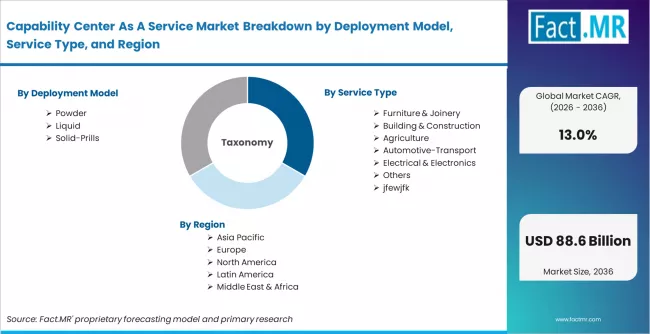
Capability Center As A Service Market Breakdown By Deployment Model, Service Type, And Region | Source: Fact.MR
| Metric | Value |
|---|---|
| Quantitative Units | USD 23.1 billion (2026) to USD 78.5 billion (2036), at a CAGR of 13% |
| Market Definition | The capability center as a service market includes outsourced operational and functional delivery centers that provide specialized digital, engineering, analytics, and process management capabilities through scalable service models supporting enterprise transformation initiatives. |
| Service Type Segmentation | IT services, Business process services, Engineering services, Analytics services, Cybersecurity services |
| Deployment Model Segmentation | Managed services, Hybrid delivery, Fully outsourced |
| End Use Industry Segmentation | IT and telecom, BFSI, Healthcare, Manufacturing, Retail and e-commerce |
| Regions Covered | North America, Latin America, Europe, East Asia, South Asia, Oceania, Middle East and Africa |
| Countries Covered | United States, Canada, United Kingdom, Germany, France, Netherlands, Ireland, India, Philippines, China, Singapore, Australia, United Arab Emirates, Saudi Arabia, Brazil, Mexico, South Africa, and 40+ countries |
| Key Companies Profiled | Accenture plc, Tata Consultancy Services Ltd., Infosys Ltd., Wipro Ltd., Cognizant Technology Solutions Corporation, Capgemini SE, HCLTech Ltd., Genpact Ltd., Tech Mahindra Ltd., ANSR Inc. |
| Forecast Period | 2026 to 2036 |
| Approach | Hybrid top-down and bottom-up market estimation based on enterprise outsourcing demand benchmarking, digital transformation service adoption rates, global capability center expansion trends, offshore and hybrid delivery adoption analysis, and validation through primary interviews with service providers, enterprise clients, and consulting firms. |
Source: Fact.MR analysis. Updated Apr 20, 2026
Capability Center As A Service Market Key Segments
-
Service Type:
- IT Services
- Business Process Services
- Engineering Services
- Analytics Services
- Cybersecurity Services
-
Deployment Model:
- Managed Services
- Hybrid Delivery
- Fully Outsourced
-
End Use Industry:
- IT and Telecom
- BFSI
- Healthcare
- Manufacturing
- Retail and E Commerce
-
Region:
- North America
- USA
- Canada
- Mexico
- Europe
- Germany
- UK
- France
- Italy
- Spain
- Nordic Countries
- BENELUX
- Rest of Europe
- Asia Pacific
- China
- Japan
- South Korea
- India
- Australia
- Rest of Asia Pacific
- Latin America
- Brazil
- Argentina
- Rest of Latin America
- Middle East and Africa
- Kingdom of Saudi Arabia
- United Arab Emirates
- South Africa
- Rest of Middle East and Africa
- Other Regions
- Oceania
- Central Asia
- Other Markets
- North America
Frequently Asked Questions
How large is the demand for Capability Center As A Service in the global market in 2026?
What will be the market size of Capability Center As A Service in the global market by 2036?
What is the expected demand growth for Capability Center As A Service in the global market between 2026 and 2036?
Which company is identified as a leading provider in the Capability Center As A Service market?
Which deployment model is projected to dominate capability center as a service adoption by 2026?
Why are managed services widely used in capability center as a service operating models?
What is driving demand for capability center as a service platforms in India?
What is the growth outlook for the Capability Center As A Service market in India?
Why is China an important market for capability center service delivery models?
What is the growth outlook for the Capability Center As A Service market in China?
How is demand for capability center services evolving in the United Kingdom enterprise sector?
What is the growth outlook for the Capability Center As A Service market in the United Kingdom?
What is the growth outlook for the Capability Center As A Service market in Germany?
How is the United States positioned in the Capability Center As A Service market?
What is the growth outlook for the Capability Center As A Service market in the United States?
What is capability center as a service and what is it mainly used for?
What does the Capability Center As A Service market include in this report?
What applications are included in the scope of the Capability Center As A Service market?
What is excluded from the scope of the Capability Center As A Service market report?
What does market forecast mean in the Capability Center As A Service market report?
How is the Capability Center As A Service market forecast developed in this report?
What does primary validation indicate in the Capability Center As A Service market analysis?
Who worked on this report


Preview the report firsthand - request a free sample
Free SampleGet the brochure for pricing and purchase details
Download PDF